* Corresponding author: (E-mail) [email protected]
Disappearing Forest Tree Species Diversity in Tropical Moist Deciduous Forest and Its Implications: A Case Study in the
Madhupur Tract of Central Bangladesh
Mohammed Mahabubur Rahman1,3*. Md. Motiur Rahman2, and Mahbubul Alam3
1Graduate School of Integrated Arts and Science, Faculty of Agriculture, Kochi University,
2Slivacom Ltd. Edmonton, Alberta, Canada
3Graduate School of Agricultural Science, Ehime University, Matsuyama, 790-8566, Japan.
ABSTRACT : A study was conducted for indentifying the floral biodiversity of woody species by calculating four diversity indices using data collected from 4 stands of different age groups and disturbance regimes in two areas of Madhupur tract. Results showed that highest species diversity in the old growth secondary coppice forest (>60 years) under moderate anthropogenic disturbances of Madhupur National Park area (delete (D=0.74, Hʼ=3.36) followed by old growth secondary forest stands (>40 years) under moderate disturbances at Bhawal National Park area (D=0.65, Hʼ=2.81). Plant species diversity of the young enrichment plantations (<20 years and <15 years) under high anthropogenic disturbances in both the areas are much low (D=0.54 and Hʼ=2.16 and D=0.52 and Hʼ=1.92 respectively), which indicate high anthropogenic disturbances coupled with introduction of invasive exotics that are rival for endemic species are detrimental for conservation of biological diversity of tropical moist deciduous forests of Madhupur tract in Bangladesh.
Keywords : Floral biodiversity, Anthropogenic disturbances, Diversity indices, Madhupur Tract, Bangladesh.
INTRODUCTION
Bangladesh is a South Asian country with very low percentage of forests. The total area of forest of Bangladesh is 1.3 million hectares that amounts 10.2 % of the countryʼs land area (FAO, 2003). One of the peculiarities of forest resources distribution of Bangladesh is that the resources are very eccentrically distributed. More than 90 percent of the government forests are concentrated within 12 districts in the east and southeastern region of the country. Vast central and northwestern parts have only patches of forests covering 0.12 million ha, that represents only 4.65% of country’s forested area (GOB, 1992; Rahman et. al., 2010).
These forests are classified as tropical moist deciduous forests (Champion et. al., 1965). Sal (Shorea robusta) is the dominant species. Other than the sal, the other common trees are palash (Butea monosperma), haldu (Adina cordifolia), shidah jarul (Lagerstroemia parviflora), bazna (Zanthoxylum
rhetsa), hargoja (Dillenia pentagyna), koroi (Albizia spp.), menda (Litsea monopetala), kushum(Schleichera olosa), udhal (Sterculia villosa), bahera (Terminalia belerica) , kurchi (Holarrhena antidysenterica), haritaki (Terminalia chebula), pitraj (Aphanamixis polystachya), sheora (Streblus asper), dephajam (Cleistocalyx operculatus) sonalu (Cassia fistula), assar (Grewia microcos), amlaki (Phyllanthus emblica), adagash (Croton oblongifolius), etc. (Banglapedia, 2010). Until the beginning of the 20th century, tropical moist deciduous forests existed as a continuous belt from Comilla to Darjeeling of India. At present, most of the forest area is under occupation and the present remaining stands of sal are of poor stocking and quality, consisting of degraded coppice and plantations. The mass destruction of sal forests occurred in early 70s during and immediately after the liberation war of Bangladesh in 1971, as freedom fighters widely used these forests as shelter and absence of law and order immediately after the liberation war.
The main cause of depletion of this forest was due to the land clearance for agriculture and forestland encroachment.
Encroachment and illicit removal of timber and firewood from the forests are the major forest conservation problems in the area. The sal forests are under constant human pressure from all sides as there was no boundary of the forest. The areas under encroachments estimated about 0.036 million ha and the number of encroachers are about 100,000 (Rahman et. al., 2010). The chief reasons of encr- oachments are: legal lacunae due to past tenurial history of the lands, and intricate nature of the boundary of the forest land and cultivable lands, and failure to complete the forest settlement operations initiated in the 1950ʼs.
The main reason of illicit removal of timber are: wide gap between the demand and supply of wood and its consequent high; limited year round employment in rural areas resulting in compelling dependence on collection of wood from the forests for subsistence (Chowdhury, 1994).
The present notified area of sal forests is largely honeyc- ombed with rice fields. These forests are now distributed in Dhaka, Tangail, Mymensingh, Dinajpur and Comilla (Rahman et. al., 2010). Owing to huge population pressure, wrong management approach and hostile activities of both the indigenous and greed encroachers’ diversity of Madhupur tract is decreasing continuously. Due to degradation of the natural forest, most of the wildlife in the sal forest has also rapidly vanished. Two centuries ago elephants, rhino- ceros have been reported in these forests but became extinct in the late nineteenth century. Tigers and leopards were numerous, but tigers dwindled in the early twentieth century and extinct fifty years ago. Leopards, bears, deer, and many other animals, which were abundant in the sal forest areas, have now totally disappeared. Bands of monkeys are rarely seen these days. Although common in the past, pheasants, peacocks, pythons, and a variety of birds have no place now in the afforested rubber and fuel-wood plantations. The Leopard-Cat, Fishing-Cat, Jungle Cat and small Indian Civet are still to be found (UNEP, 2001; Banglapedia, 2010). In Bangladesh Capped Langur (Trachypithecus pileatus) was found most frequently in the Madhupur forest tract (Khan, 1981). But due to habitat
loss and degradation induced by human, IUCN enlisted Capped langur (Trachypithecus pileatus) as endangered species in its red list of 2008 (IUCN, 2008). Convention on the International Trade in Endangered Species of Wild Flora and Fauna (CITES) listed capped langur under appendix I, which means the species is threatened with extinction for Bangladesh (UNEP-WCMC, 2004). Tree species like Vatica lanceaefolia, and Hopea odorata are also listed as critically endangered and vulnerable species respectively in 2008 IUCN Red List of Threaded Species (IUCN, 2008). Hence it is desirable that measures should be taken to preserve the biodiversity of Madhupur tract.
The two areas where part of the original tropical moist deciduous forest remains are the Madhupur National Park in the north and the Bhawal National Park in the south.
These parks were expected to protect the natural ecosystems of the area (Banglapedia, 2010). The real importance for conservation of deciduous forest lies in the fact that they are the most used and threatened ecosystem (Janzen, 1986; Rahman et. al., 2010). The conservation of plant diversity for present and future use is very essential (Pimm et. al., 1995; Murali et. al., 1996). There have been many studies that deal with diversity and different aspects vegetation analysis of tropical deciduous forests from various regions of India and Nepal (Gupta and Shukla, 1991; Singh et. al., 1995; Murali et. al., 1996;
Sukumar et. al., 1998; Pandey, 1999; Uma, 2001; Pandey and Shukla, 2003; Saha, 2003; Webb and Sah, 2003).
Though there is concern in all quarters regarding the loss of biodiversity of deciduous sal forests of central Bangladesh but there is no evidence of systematic studies of biodiversity in sal forests of the area. As biological diversity is a key issue of nature conservation (Wilson, 1999), and species diversity is one of the important components of biological diversity (Ito, 1997). In this study efforts have made to assess species diversity of different forest stands representing the major two age groups under different level of anthropogenic and other biotic disturbances. We compared four diversity indices that are usually used in biodiversity studies based on data collected from four different forest stands of different age
Fig. 1. Map showing the tropical moist deciduous forest of Madhupur tract of central Bangladesh (Source: Banglapedia, 2010).
groups and disturbance regimes in the Madhupur tract to elucidate the status of species diversity in the area. Results were compared with findings from other studies from India and other parts of the world to make a comparative assessment of diversity. Finally, based our findings, we recommended possible ways to enhance conservation measures to improve the diversity of sal forests of the area.
METHODOLOGY Study area
This study was conducted in the tropical moist deciduous forest of Madhupur Tract of central Bangladesh (23° 30ʼ N, 24° 50ʼ N to 90° 0ʼ E 90° 50ʼ E) (Fig. 1). Geologically it is a terrace from one to ten meters above the adjacent floodplains. Study sites include stands from two best remaining patches forests, namely Bhawal National Park (24° 01’N, 90° 20’E) in the southern part and Madhupur National Park (24° 45ʼN, 90° 05’E) in the northern part.
Bhawal National Park covers an area of 5,022 ha and Madhupur National Park covers an area of 8,436 ha. The
soils of the tract have developed largely on Madhupur clays; which are nutrient poor and somewhat acidic. They are red or brown in color. The climate of the Tract varies slightly from north to south; the northern part reaches much cooler in winter. Average temperatures vary from 28°C to 32°C in summer, falling to 20°C in winter, with extreme lows of 10°C. Rainfall ranges between 1,000 mm and 1,500 mm annually. Two tribal clans, the Koch and the Mande (Garo), who are dependent on these forests, live in the Madhupur tract. The Koch is among the earliest people of Bangladesh, while the Mande have their main center of dispersal in the Garo hills in India. The Bengali-speaking people, who used to live along the fringes of the extensive forests, have entered in large numbers and cleared most of the forests. The Bengali- speaking people, who used to live along the fringes of the extensive forests, have entered in large numbers and cleared most of the forests. Bengalis has developed stable agro-horticultural systems in the west. Due to anthropogenic disturbances, the landscape and ecosystems of most of the Tract has changed drastically in last thirty years that triggered the loss of invaluable biodiversity in area.
Four stands with varying sizes (ranging from 3 to 5 ha) were selected in two protected areas of tropical moist deciduous forests of Madhupur tract. Two stand, stand-1 old growth secondary coppice forest of >40 years age of 4 ha area and stand-2 young forest stand of enrichment plantation of <20 years age of 3 ha area were located in Bhawal National Park (BNP). Other two stands were located in Madhupur National Park (MNP). Stand 3 of 5 ha area is of old growth secondary coppice forests of >40 years old and stand 4 is a young forest stand under enric- hment plantation with an area of 4 ha. Age of the stands were approximated by checking forest department records, consulting long time senior residents of the area, judging the girth size of the trees, growth features like branching pattern based on branch scars (Shukla and Ramakrishnan, 1986) as well as considering the physiognomy of the stands such as existence of large woody liana for old growth stands. A simple disturbance index (DI) was developed as the ratio of the number of cut as well as severed individuals expressed as percent of total number of individuals of all perennial plants occurring within a sample area of 100 m2 (Pandey and Shukla, 1999). The level of anthropogenetic and other biotic disturbances were intermediate in both the old growth secondary forests stands (DI 32 for MNP and 36 for BNP stands) and high in both the young enrichment forest stands (DI 65 for MNP, 60 for BNP stands). As rectangular plots tend to sample more species than square plots of the same area (Condit et. al., 1996), each stand was divided into rectan- gular plots of 20 m × 10 m size and 10 plots were randomly selected from each stand. All freestanding woody species in the plots were identified and dbh of all plants ≥ 5 cm were measured. Species identification was done with the help of teachers and students of Department of Botany of Dhaka Imperial College, Dhaka.
Four non-parametric diversity indices that are often used in studies on species diversity (Krebs, 1989) were computed and compared with results from other similar studies. The four indices are:
1. Inverse of Simpson’s Index (Simpson, 1949)=1/λ (1)
2. D=1-λ Simpson diversity index (Lande, 1996) (2)
3. Shannon-Wiener index (MacArthur, 1955; Odum, 1971)
Hʼ=-Σ[ni/N*log2 (ni/N)] (3)
4. Equitability index recommended by Pielou (1969) Jʼ=Hʼ
/Hʼmax (4)
Where: λ=Σ pi2, pi is the proportion of the number of ith species (ni) to total number of individuals (N), i.e., pi
=ni/N, and Hʼmax=log2S, S=total number of species found in all the samples.
Although Simpson’s original equation for λ is expressed by equation λ=Σ pi2, we followed example of Ito (1997) to calculate an unbiased estimator (Morisita 1967; Pielou, 1969) of λ, which is expressed by the equation
λ=[ni*(ni-1)/N*(N-1)] (5)
Based on statistical re-examination of the indices, Lande (1996) concluded that D is the best index for comparative studies. His simulation showed that values of D were not affected by the sample size (N) and the confidence intervals became reasonably small with 50 to 100 individuals in a sample. However, we also calculated Hʼ and Jʼ for making comparison of our results with results from other similar studies from India and other parts of the world. Though Jʼ expresses only one aspect of species diversity, the equi- tability of numbers of each species comprising the comm- unity, it is convenient for comparing communities having different number of species (Ito, 1997).
RESULTS AND DISCUSSIONS
Table 1 shows that altogether 46 species under 24 families were found in the different forest stands of Madhupur tract.
Old growth secondary forest stand in Madhupur National Park has the greatest species richness (34) under 20 families and maximum number of individuals (211) followed by old growth secondary forest stand of Bhawal National Park with 29 species under 20 families with 190 individuals.
Table 1. Species, family, life form, and number individuals per species, number species and families found in the different forests stands of the Madhupur tract.
Family Species Life form
Total number of individuals
MNP1 BNP2 BNP <20 MNP <15
>60yrs >40yrs yrs yrs
Anacardiaceae Spondias pinnata Small tree 0 2 0 0
Anacardiaceae Swintonia floribunda Tall tree 2 1 0 0
Anacardiaceae Lannea coromandelica Medium tree 2 0 0 0
Anacardiaceae Semicarpus anacardium Medium tree 0 2 0 0
Annonaceae Meliusa velutina Medium tree 2 0 2 2
Apocynaceae Holarrhena antidysentrica Medium tree 2 1 1 0
Apocynaceae Wrightia tomentosa Small tree 3 0 0 0
Apocynaceae Alstonia scholaris Medium tree 2 0 0 0
Bombacaceae Bombax ceiba Tall tree 3 3 0 0
Burseraceae Garuga pinnata Small tree 2 2 2 0
Combretaceae Terminalia belerica Medium tree 3 3 2 1
Dilleniaceae Dellenia pentagyna Medium tree 6 5 2 2
Dipterocarpaceae Shorea robusta Tall tree 106 101 81 71
Dipterocarpaceae Hopea odorata Tall tree 1 1 0 0
Dipterocarpaceae Vatica lanceofolia Medium tree 1 0 0 0
Euphorbiaceae Phyllanthus emblica Medium tree 4 3 1 0
Euphorbiaceae Croton oblongifolius Small tree 0 1 1 0
Euphorbiaceae Mallotus philippinensis Small tree 1 0 0 0
Lauraceae Litsea polyantha Medium tree 2 0 0 0
Lecythidaceae Carea arborea Tall tree 5 0 2 0
Leguminosae Xylia dolabiformis Medium tree 0 0 4 2
Leguminosae Entada phaseolodes Woody climber 8 7 0 0
Liguminosae Albizia procera Tall tree 13 11 4 3
Liguminosae Albizia chinensis Tall tree 5 0 0 0
Liguminosae Butea monosperma Medium tree 2 2 0 0
Liguminosae Albizia lebbeck Tall tree 2 0 0 0
Liguminosae Cassia fistula Medium tree 3 3 1 0
Liguminosae Acacia auricoliformis Medium tree 0 0 0 8
Liguminosae Acacia mangium Medium tree 0 0 0 4
Lythraceae Lagerstroemia parviflora Medium tree 4 4 0 0
Meliaceae Aphanamixis polystachya Tall tree 0 2 0 0
Meliaceae Switeina mahogany Tall tree 0 0 7 3
Moraceae Artocarpus chaplasha Tall tree 5 5 2 1
Moraceae Ficus hispida Medium tree 2 2 0 0
Myrtaceae Syzygium grande Medium tree 3 2 2 3
Myrtaceae Cleistocalyx operculatus Small tree 2 1 2 0
Rhamnaceae Zyzyphus jujuba Small tree 2 1 2 0
Rubiaceae Hymenodictyon excelsum Small tree 2 0 0 0
Rubiaceae Adina cordifolia Medium tree 5 2 0 2
Sapindaceae Scleichera oleosa Tree 4 5 0 0
Sterculiaceae Sterculia colorata Medium tree 0 1 0 0
Thymalaceae Aqularia agallucha Tall tree 0 1 0 0
Tiliaceae Microcos paniculata Medium tree 0 2 0 0
Urticaceae Streblus asper Small tree 1 0 0 0
Verbanaceae Gmelina arborea Tall tree 0 1 2 1
Verbanaceae Vitex glabrata Small tree 1 0 0 0
Total number of individuals 211 190 120 103
Total number of species 34 29 18 13
Total number of families 20 20 13 10
Source: Analysis of field data 2004. Keys: 1Madhupur National Park, 2Bhawal National Park
Table 2. Comparison of diversity indices in different Stands
Stands Area (m2) Species # Total N lλ 1/λ D Hʼ Jʼ=Hʼ/Hʼmax
MNP, >60 years 2000 34 211 0.26 3.84 0.74 3.36 0.66
BNP, >40 Years 2000 29 190 0.35 2.86 0.65 2.81 0.58
BNP, <20 Years 2000 18 120 0.46 2.17 0.54 2.16 0.52
MNP, <15 years 2000 13 103 0.48 2.07 0.52 1.92 0.52
Source: Analysis of field data, keys: MNP= Madhupur National Park, BNP=Bhawal National Park.
Table 3. Species, family, life form, total individuals climber in different forest stands for individual ≥ 1 cm dbh.
Species Family Life form Number of individuals
BNP>40yrs MNP>60 yrs BNP<20 yrs MNP<15 yrs
Calamus latifolius Araceae Climber 0 18 0 6
Dioscorea esculenta Dioscoreaceae Climber 18 0 24 28
Mucuna prurens Leguminosae Climber 22 28 25 27
Glinus lotoides Molluginaceae Climber 12 10 21 24
Vitis quadrangularis Vitaceae Climber 15 13 15 20
Entada phaseolodes Leguminosae Climber 14 18 2 3
Dioscorea pentaphylla Dioscoreaceae Climber 2 0 15 18
Thumbergia grandifolia Acanthaceae Climber 0 0 15 12
Bauhinia vahlii Leguminosae Climber 14 12 5 12
Smilex aspera Smilaceae Climber 18 16 12 15
Bauhinia anguina Leguminosae Climber 14 15 5 7
Spatholobus roxburghii Leguminosae Climber 12 14 18 16
Hemidesmus indicus Asclepidaceae Climber 8 9 12 15
Asparagus acerosus Liliaceae Climber 0 0 11 9
Vitis repens Vitaceae Climber 0 6 16 18
Vitis glabrata Vitaceae Climber 14 8 12 16
Scindapus officinalis Araceae Climber 2 0 0 0
Total number of individuals 165 167 208 246
Total number of species 13 12 15 15
Total number of families 8 8 8 8
Source: Analysis of field data. aWe did not discern between liana and climbers, all individuals that have a climbing habit are treated as climber.
Both the enrichment plantation of younger age have much lesser number families, species and individuals in comparison to old growth secondary forest stands but the least number of these parameters were found in young enrichment plantation of Madhupur National Park being represented by 13 species under 10 families with 103 individuals.
Liguminosae is the species richest family with 9 species followed by Anacardiaceae with 4 species while each of Dipterocarpaceae, Euphorbiaceae, Miliaceae and Apocynaceae represent 3 species Table 2 shows the number of species,
number of individuals and four species diversity indices for different forest stands in Madhupur tract for trees ≥ 5 cm dbh. Values of Inverse of Simpson’s index (1/λ)and Simpson’s diversity index described by Lendle (D), which are measures of dominance, show that moderate dominance for all stands but it decreases with the increase of stand age and decrease of disturbance index. Values for Shannon- Wiener index (Hʼ) that takes account of species richness and the abundance of constituent species show that highest species diversity in the old growth stand of MNP with
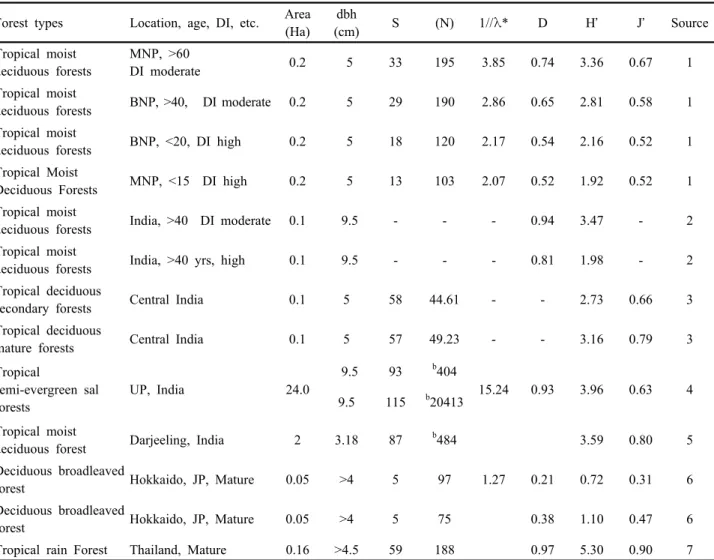
Table 4. Comparison of different diversity indices from different studies from the indo-subcontinent and other parts of the world.a
Forest types Location, age, DI, etc. Area (Ha)
dbh
(cm) S (N) 1//λ* D Hʼ Jʼ Source
Tropical moist deciduous forests
MNP, >60
DI moderate 0.2 5 33 195 3.85 0.74 3.36 0.67 1
Tropical moist
deciduous forests BNP, >40, DI moderate 0.2 5 29 190 2.86 0.65 2.81 0.58 1 Tropical moist
deciduous forests BNP, <20, DI high 0.2 5 18 120 2.17 0.54 2.16 0.52 1
Tropical Moist
Deciduous Forests MNP, <15 DI high 0.2 5 13 103 2.07 0.52 1.92 0.52 1
Tropical moist
deciduous forests India, >40 DI moderate 0.1 9.5 - - - 0.94 3.47 - 2
Tropical moist
deciduous forests India, >40 yrs, high 0.1 9.5 - - - 0.81 1.98 - 2
Tropical deciduous
secondary forests Central India 0.1 5 58 44.61 - - 2.73 0.66 3
Tropical deciduous
mature forests Central India 0.1 5 57 49.23 - - 3.16 0.79 3
Tropical
semi-evergreen sal forests
UP, India 24.0
9.5 93 b404
15.24 0.93 3.96 0.63 4
9.5 115 b20413 Tropical moist
deciduous forest Darjeeling, India 2 3.18 87 b484 3.59 0.80 5
Deciduous broadleaved
forest Hokkaido, JP, Mature 0.05 >4 5 97 1.27 0.21 0.72 0.31 6
Deciduous broadleaved
forest Hokkaido, JP, Mature 0.05 >4 5 75 0.38 1.10 0.47 6
Tropical rain Forest Thailand, Mature 0.16 >4.5 59 188 0.97 5.30 0.90 7
Sources: 1 Present study, 2 Pandey and Shukla, 1999; 3 Saha, 2003; 4 Pandey and Shukla, 2003; 5 Uma, 2001; 6 Tatewaki and Igarashi, 1971; 7 Ogawa et. al., 1965.
aAs sample sizes, dbh and formula used vary and in some cases values for different indices are derived from the information provided in the original studies, consequently there are limitations of these values for absolute comparison.
bvalues are per hectare basis.
least disturbance followed by old growth stand of BNP while least in the youngest stands with highest disturbance in MNP. Species diversity decrease with the increase of disturbance index and decrease of stand age. Relatively low values of Pielou’s index (Jʼ), which is a measure of species evenness, indicate that species in all the stands are moderately evenly distributed though old stand at MNP with modest disturbance is most evenly distributed amongst them.
Table 3 shows the species, family, life form, total indi- viduals; Shannon-Weiner index (Hʼ) of climber and liana
in different forest stands for individual ≥ 1 cm dbh. All together 17 species under 9 families were found to occur in all the stands. Liguminosae is the most species rich family with 4 species followed by Vitaceae with 3 species.
Number of individuals is highest in the most disturbed young stand of MNP while more or less same in the moderately disturbed old growth stands of BNP and MNP. It was realized that the number of individuals of climber increase with the increase of disturbances and decrease of stand age.
Table 4 shows that old growth tropical moist deciduous
forest stand of >60 years old with intermediate disturbances in the Madhupur tract has the greatest species diversity (Hʼ=3.36), which is fairly comparable with old growth tropical moist deciduous forests of Gorakpur, India, under moderate anthropogenetic disturbances regimes with species diversity Hʼ=3.47 (Pandey and Shukla, 1999) and mature tropical deciduous forests in central India with Hʼ=3.16 (Saha, 2003) but lower than tropical moist deciduous forest of Darjeeling, India Hʼ=3.59 (Uma, 2001). On the other hand, relatively low value of Simpson diversity index D=0.74, shows relatively higher concentration of species dominance in old growth stand in Madhupur tract than in Gorakpur (D=0.94) which is further confirmed with relatively low value Pielou’s evenness index (J=0.67ʼ) for Madhupur tract while that of Darjeeling, India J= 0.80. In general old growth tropical deciduous sal forests have higher species diversity, low species dominance and more species evenness than deciduous broad leaved forests with Hʼ=0.72 and 1.10, D=0.21 and 0.38 and J=0.31 and 0.47, in Hokkaido, Japan (Tatewaki and Igarashi, 1971) but lower species diversity, higher concentration of dominance and lower species evenness in relation to tropical rain forest as expressed by values of respective indices Hʼ
=5.30, D=0.97 and J=0.90, in Thailand (Ogawa et. al., 1965).
However, both species diversity and species evenness decrease and species dominance increase with the increase of disturbance regime and decrease of stand age in Madhupur tract and elsewhere in India.
In Madhupur tract species diversity greatly decreased in the young stands under high disturbances both in Mad- hupur and Bhawal National Park areas, though situation is worst in Madhupur area with the introduction of exotic species like Acacia auriculiformis and Acacia mangium and so on. The young stand (S4) with high disturbances, where exotic species were introduced apparently due to their fast growing capacity and resistibility against anthro- pogenetic and other biotic disturbances, has shown that many of the endemic species like Phyllanthus emblica, Ficus hispida, Wrightia tomentosa, which are important for conservation of threatened wildlife of the area have already disappeared and other important species like Albizia
procera, Terminalia belerica and Dellenia pentagyna have reduced in number while exotic species like Acacia auriculiformis, Acacia mangium, that are not at all suitable for conservation of biological diversity, specially faunal diversity are increasing in number. This phenomenon is a matter of concern to conserve the biological diversity of Madhupur tract, as some of the exotics are invasive in nature. For instance, Islam et. al., (2003) reported that Acacia auriculiformis and Acacia mangium have proven to be rivals to endemic flora that replace indigenous forest species as well as other native wild flora. These trees do not support wildlife because they do not produce edible fruit or nectar for them (Ameen, 1999). From the results of the study another phenomenon is evident that both species richness and number of individuals of climber and liana increase with the increase of disturbances and decrease of stand age. Thus in the young stands where disturbance is high, enough light and spaces are available and tree stems are relatively slender are increasingly invaded by different species of climber and liana, thus reducing the productivity of the stands. This finding is consistent with other studies that report lianas are often associated with disturbed areas and high light intensities (Hegarty and Clifford, 1991; Richards 1996). From introductory chapter, it is evident Madhupur sal forests were very rich in wildlife, many of which have already been extinct due to unwise destruction of habitat and loss species diversity.
At present these forests are the only habitat for endangered wildlife like Capped langur (Trachypithecus pileatus).
Wilson (1999) stressed the importance of species diversity of communities to avoid extinction of endangered species.
Feeding behavior of Capped langur showed that they feed on leaves, fruit and other parts of different endemic plant species. The most important sources of leaves came from Wrightia tomentosa, Bauhinia variegata, and Adina cordifolia.
Fruit is consumed most during the rainy season (May- September) where it can comprise almost 50% of the diet.
Examples of fruit consumed include Ficus sp., Spondias mangifera, and Terminalia balerica, with Garruga pinnata and Miliusa vetulina being the two most important fruit species consumed during the rainy season. Flowers were
consumed during the flowering peaks of May and October, just before and after the monsoon season. Capped langurs prefer fruit to leaves when both are available (Stanford, 1991). Results of our study indicate that virtually sal forest is becoming unsuitable as a habitat for Capped langur as only old growth stands in Madhupur area, though in limited extent, has species diversity where they can find food and remaining stands are not suitable as the species diversity is being reduced and species composition has been changing progressively. Furthermore, results of the study have shown tree species like Vatica lanceaefolia, Hopea odorata, which are enlisted as critically endangered and vulnerable species respectively in 2002 by IUCN (IUCN, 2002) have already disappeared from young stands and only a few individuals are still found in old growth forests.
CONCLUSION
The results of this study provide evidences that endang- ered and vulnerable species of the tropical moist deciduous forests of Madhupur tract are on the verge of extinction are confined in the old growth stands that are under mod- erate anthropogenetic disturbance regimes and pose threat of complete extinction unless wise conservation measures are put in place immediately. The very relevant questions that would arise are: what measures should be taken, where to be taken and how those measures could be implemented. The current study addresses the first two questions. The tropical moist deciduous forests of Madhupur tract have the species diversity that is fairly comparable with other such forests in India and elsewhere in the world. Results of this study suggest that the old growth stands should be preserved from any further damage to thwart the risk of extinction of many valuable species.
Enrichment plantations or any other such silvicultural operations should exclude exotic invasive species. Protection of the sal coppice supplemented with endemic species that are natural to the sal forests of the area should be encouraged and reintroduced to reclaim the natural ecosystem in the degraded sites. Studies on similar sites justify the argument for forest protection. For example, studies from
West Bengal showed that forest protection costs are only 5% of the cost of plantation establishment. Finally, anthr- opogenetic disturbances should be kept to a tolerable moderate level in all forest stands.
ACKNOWLEDGEMENT
We are grateful to Dr. Jiro Tsukamoto, Education and Research Center for Subtropical Field Science, Kochi University, Japan, for his insightful comments and suggestions on preparation of the manuscript. We wish to thank the two anonymous reviewers for their prudent comments and recommendations that have significantly contributed to improving the manuscript.
LITERATURE CITED
Ameen, M. 1999. Development of guiding principles for the prevention of impact of alien species. Paper presented at a preparatory workshop for the 4th meeting of SBSTTA to CBD, organized by IUCN Bangladesh, Dhaka 25 May, 1999.
Banglapedia. 2010. National encyclopedia of Bangladesh, sal forest, Banglapedia. Available online at http://banglapedia.search.com.bd/
HT/S_0035.htm, last accessed Apr. 10, 2010.
Champion, H. G., Seth, S. K. and Khattak, G. M. 1965. Forest Types of Pakistan, Pakistan Forestry Institute, Peshawar, Pakistan.
Chowdhury, R. A. 1994. History and importance of sal forests and current management status. In: Agroforestry for the degraded sal forest, Proceedings of national workshop held at Bangladesh Agricultural Research Council, BARC and Forest Department with the financial assistance of APAN, Dhaka.
GOB. 1992. Forestry Master Plan (Participatory Forestry), p-45, Ministry of Environment and Forests, Peoples Republic of Bangladesh, Dhaka.
Gupta, O. P. and Shukla, R. P. 1991. The composition and dynamics of associated plant communities of sal plantations. Trop. Ecol.
32:296-309.
FAO. 2003. State of World’s Forests 2003. FAO, Rome, Italy.
Hegarty, E. E. and Clifford, H. T. 1991. Climbing angiosperms in the Australian flora. In Werren, G., Kershaw, P. (eds.) The rainforest legacy. Australian Government Publishing Service, Canberra, Australia, pp. 105-120.
Islam, M. M., Ruhul A. S. M. A. and Sarker, S. K. 2003. Alien Plants Species in Bangladesh. In: Pallewatta, N., Reaser, J. K., andGutierrz, A. T. (eds.). Invasive Alien Species in Southeast Asia: National Reports and Directory of Resources. Global Invasive Species Proramme, Cape Town, South Africa.
Ito, Y. 1997. Diversity of Forest Tree Species in Yanbaru, the northern part of Okinawa Island. Plant Ecol. 133:125-133.
IUCN. 2008. Red List of Endangered Species. Available online at http://www.redlist.org, last accessed Apr. 29, 2010.
IUCN. 2002. Red List of Endangered Species. Available online at http://www.redlist.org, last accessed May, 20, 2010.
Janzen, D. H. 1986. In: Biodiversity, Wilson, E. O. (eds.). National Academy Press, Washington, pp. 130-137.
Khan, M. A. R. 1981. The non-human primates of Bangladesh.
Tiger Paper. 8:12-15.
Krebs, C. J. 1989. Ecological Methodology, Harper and Row, New York, USA.
Lande, R. 1996. Statistics and portioning of species diversity, and similarity among multiple communities. Oikos. 76:5-13.
MacArthur, R. H. 1955. Fluctuations of animal populations and a measure of community stability. Ecology. 36:533-536.
Murali, K. S., Uma, S., Ganeshaiah, K. N. and Bawa, K. S. 1996.
Extraction of non-timber forest products in the forests of Biligiri Rangan Hills, India.2. Impact of NTFP extraction on regeneration, population structure, and species composition. Econ. Bot. 50:
252-269.
Morisita, M. 1967. Seasonal distribution of butterflies near Kyoto city. In Morisita, M. and Kira, T. (eds.). Nature: Ecological studies.
Chuokoronsha, Tokyo (in Japanese), pp. 95-132.
Odum, E. P. 1971. Fundamentals of Ecology, Toppan Printing Company Ltd. Tokyo, Japan.
Ogawa, H., Yoda, K., Kira, T., Ogino, K., Ratanawonse, D. and Apasutaya, C. 1965. Comparative ecological study on three main types of forest vegetaion in Thailand. Nat Life Southeast Asia.
4:13-48.
Pandey, P. K. 1999. Comparative vegetation analysis and sal (Shorea robusta) regeneration in relation to their disturbance magnitude in some sal forests. Trop. Ecol. 40:51-61.
Pandey, S. K. and Shukla, R. P. 1999. Plant diversity and community patterns along the disturbance gradient in plantation forests of sal (Shorea robusta Gaertn.). Curr. Sci. 77:814-818.
Pandey, S. K. and Shukla, R. P. 2003. Plant diversity in managed sal (Shorea robusta Gaertn.) forests of Gorakhpur, India. Bio.
Conser. 12:2295-2319.
Pielou, E. C. 1969. An Introduction to Mathematical Ecology.
Wiley Interscience, New York, USA.
Pimm, S. L., Russell, G. J., Gittleman, J. L. and Brooks, T. M.
1995. The future of biodiversity. Science. 269:347-35.
Rahman, M. M., Motiur, M. R., Guogang, Z. and Islam, K. S.
2010. A review of the present threats to tropical moist deciduous sal (Shorea robusta) forest ecosystem of central Bangladesh.
Trop. Conser. Sci. 3(1):59-69.
Richards, P. W. 1996. The tropical rain forest: an ecological study (2nd edition). Cambridge University Press, Cambridge.UK.
Saha, S. 2003. Patterns in woody species diversity, richness and partitioning of diversity in forest communities of tropical deciduous forest biomes. Ecogoraphy. 26:80-86.
Singh. A., Reddy, V. S. and Singh, J. S. 1995. Analysis of woody vegetation of Corbett National Park, India. Vegetatio. 120:69-79.
Simpson, E. M. 1949. Measurement of diversity. Nature. 163:688.
Shukla, R. P. and Ramakrishnan, P. S. 1986. Architecture and growth strategies of tropical trees in relation to successional status. J. Ecol. 74:33-46.
Stanford, C. B. 1991. The diet of the capped langur (Presbytis pileata) in a moist deciduous forest in Bangladesh. International J. Primatol. 12:199-216.
Sukumar, R., Suresh, H.S., Dattaraja, H. S. and Joshi, N.V. 1998.
Dynamics of tropical deciduous forest: Population changes (1988 through 1993) in a 50-ha plot at Mudumalai, Southern India. In:
Dallmeier, F. and Comiskey, J. A. (eds.). Forest Biodiversity Research, Monitoring and Modeling: Conceptual Background and Old World Case Studies. The Parthenon Publishing Group, Camforth, UK, pp. 529-540.
Tatewaki, M. and Igarashi, T. 1971. Forest vegetations in Teshio- Nakagawa area of Hokkaido University Forests. Research Reports of University Forests, Hokkaido University, 28:1-192.
Uma, S. 2001. A case of high tree diversity in a sal (Shorea robusta) dominated lowland forest of Eastern Himalaya: floristic composition, regeneration and conservation. Curr. Sci. 81:776-786.
UNEP. 2001. State of the Environment Report - Bangladesh.
UNEP-WCMC. 2004. UNEP-WCMC Species Database: CITES-Listed Species.
Webb, E. L. and Sah, R. N. 2003. Structure and diversity in the natural and managed sal (Shorea robusta Gaertn.f.) forest in the Terai of Nepal. For. Ecol. Manage. 176:337-353.
Wilson, E. O. 1999. The diversity of life, Harvard University Press, USA.
(Received June 29, 2010; Accepted September 18, 2010)