Yonsei Med J http://www.eymj.org Volume 52 Number 4 July 2011 558
Review Article
DOI 10.3349/ymj.2011.52.4.558pISSN: 0513-5796, eISSN: 1976-2437 Yonsei Med J 52(4):558-561, 2011
Current Status of the Korean Venous Thromboembolism Registry
Doyeun Oh on behalf of Venous Thromboembolism Working Party of Korean Society of Hematology/Korean Society of Thrombosis and Hemostasis
Department of Internal Medicine, School of Medicine, CHA University, Seongnam, Korea.
Received: August 18, 2010 Revised: October 26, 2010 Accepted: October 28, 2010 Corresponding author: Dr. Doyeun Oh, Department of Internal Medicine, College of Medicine, CHA University, 351 Yatap-dong, Bundang-gu, Seongnam 463-712, Korea.
Tel: 82-31-780-5217, Fax: 82-31-780-5208 E-mail: [email protected]
This article was presented in part at the 2010 Joint Meeting of Korean Hematology Societies, Seoul, Korea, 28 May 2010.
∙ The author has no financial conflicts of interest.
© Copyright:
Yonsei University College of Medicine 2011 This is an Open Access article distributed under the terms of the Creative Commons Attribution Non- Commercial License (http://creativecommons.org/
licenses/by-nc/3.0) which permits unrestricted non- commercial use, distribution, and reproduction in any medium, provided the original work is properly cited.
The Korean venous thromboembolism (VTE) registry, which was initiated by the Working Parties of Korean Society on Thrombosis and Hemostasis, and the Kore- an Society of Hematology, is a web-based multicenter registry (http://kdvt.chamc.
co.kr) for recruiting consecutive VTE patients. The aim of the registry is to pro- spectively collect data on the epidemiology and clinical outcomes of VTE from a large, unselected cohort of patients, and to provide data on the true incidence and management of VTE in the real-world. By the end of 2007, the starting year of the registry, 840 patients were registered. By the end of 2008, 1,121 were registered, with 1,289 by the end of 2009, and 1,463 by April 2010 from 11 hospitals. The first report on the epidemiologic characteristics of 596 consecutive VTE patients was released in October 2007.
Key Words: Venous thromboembolism, registry, Korean
VTE IN KOREA
Venous thromboembolism (VTE) is the third most common cardiovascular dis- ease after myocardial infarction and stroke.1 More than 600,000 cases of VTE oc- cur annually in the United States of America, and 50,000 deaths due to pulmonary embolism.2 The annual mortality from VTE surpasses the sum of the mortalities from breast cancer, prostate cancer, AIDS and traffic accidents in Europe.3 The in- cidence of VTE in Koreans has been generally found to be lower than Caucasian, but it appears to be rapidly increasing, possibly because of the widespread adop- tion of a westernized life style4 and increased awareness of VTE among physicians and the community. Therefore, it is to raise awareness of this health issue to reduce mortality from VTE.
VTE REGISTRY IN KOREA AND ITS CURRENT ACTIVITIES
In order to promote the study on the epidemiology, clinical and basic research of VTE in Koreans, the Korean Society of Hematology (KSH) and Korean Society
Korean VTE Registry
Yonsei Med J http://www.eymj.org Volume 52 Number 4 July 2011 559
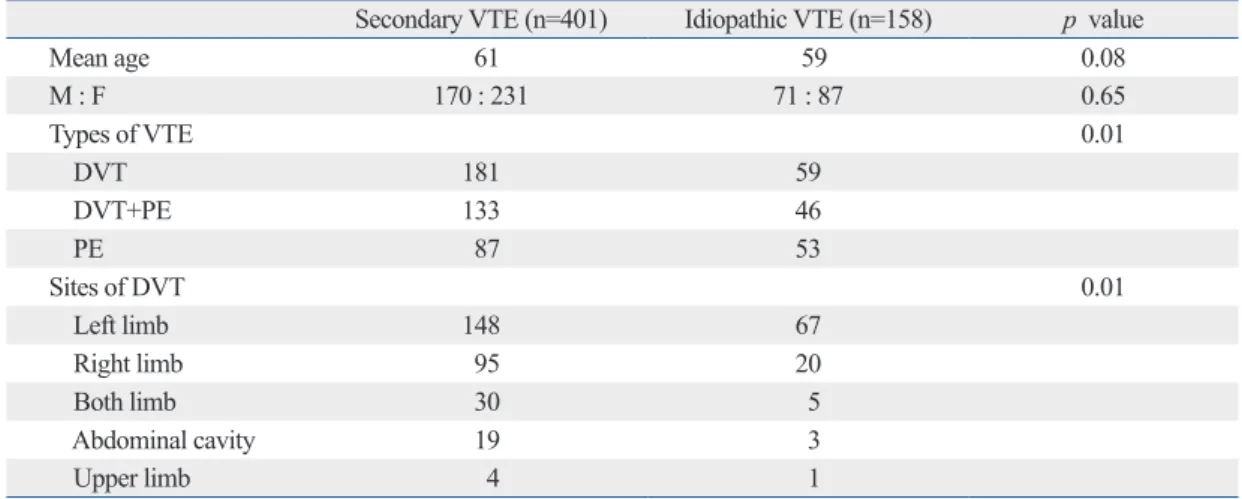
(p=0.014) (Table 1). Using the registry, clinical epidemio- logic research on metabolic syndrome4 and cancer patients5 were carried out. The activation of the registration has en- abled participating clinicians to manage their VTE patients according to the international standard of care on VTE, and resulted in qualitative improvement in diagnosis and treat- ment of VTE. These include rapid and accurate diagnosis by early use of compression ultrasonography (CUS) and pulmonary CT angiogram, home treatment using low mo- lecular weight heparin (LMWH), careful use of thrombolysis or IVC filter insertion, use of dosing nomogram for VKA-, and adoption of the updated ACCP guidelines, among other things. The registry also enables stratification of risk groups on diagnostic timing. Increased detection of VTE patients by the activation of the registry made it possible to carry out large clinical trials. Since March 2008, international clinical trials such as RECOVER-II (NCT00680186), RES- ONATE (NCT00329238), MAGELLAN (NCT00571649), and HOKUSAI (NCT00680186) have been carried out in Korea and the number is increasing. Clinical studies using therapeutic or preventive devices or diagnostic reagents will also be applicable soon.
ACTIVITIES OF VTE REGISTRY IN WESTERN COUNTRIES
Many registries and databases several of which enroll VTE patients exclusively, such as Worchester DVT Study,2 Roch- estrer Epidemiology Project,6 Brigham and Women’s hospi- tal DVT Registry,7 California Patient Discharge Data,8 Mal- mo DVT Study,9 Nord-Trondelag VTE Study,1 Study of Men Born in 1913,10 Swedish Inpatient Registry,11 Bretagne on Thrombosis and Hemostasis (KSTH) organized the work-
ing party on VTE in October 2005 and 2006, respectively.
Because the core members of both working parties are basi- cally similar, the working party was termed “The KSH/
KSTH-Deep Vein Thrombosis Working Party (KSH/KSTH- DVTWP)”. Since the registry includes pulmonary embolism (PE) in addition to DVT, its name was changed to “The KSH/KSTH VTE Working Party (KSH/KSTH-VTEWP)”
in 2009. It is a web-based, multicenter registry (http://kdvt.
chamc.co.kr) recruiting consecutive VTE patients from 11 teaching hospitals.4 Patient enrollment began since January 1, 2007, and the registry is the largest registry on VTE in Korea.
The aim of the registry is to prospectively collect data on the epidemiology and clinical outcomes of VTE from a large un- selected cohort of patients and to provide the data on the true incidence and management of VTE in the real-world.
By the end of the first year, 840 patients with VTE were registered from nine initial university hospitals. A total of 1,121 were registered by the end of 2008, 1,289 by the end of 2009, and 1,463 by April 2010 from 11 hospitals. The first report on the epidemiologic characteristics of 596 consecu- tive VTE patients was released in October 2007. The pro- portions of patient over 50 years old was 76% among the 596 VTE patients. VTE developed more frequently in we- men than men. Major risk factors for VTE were old age, cancer, immobilization, surgery, severe medical disease, stroke, and trauma. In 28% (158/596) of the patients, VTE was idiopathic. Cancer was associated with VTE in 24%
(134/596) and cancer was detected after diagnosis of VTE in 4% (24/596). Cancer-associated DVT frequently oc- curred was developed in an atypical location more frequently than DVT without cancer (p=0.0465). PE was more fre- quently associated with idiopathic VTE than secondary VTE
Table 1. Characteristics of Korean Patients with Idiopathic Venous Thromboembolism
Secondary VTE (n=401) Idiopathic VTE (n=158) p value
Mean age 61 59 0.08
M : F 170 : 231 71 : 87 0.65
Types of VTE 0.01
DVT 181 59
DVT+PE 133 46
PE 87 53
Sites of DVT 0.01
Left limb 148 67
Right limb 95 20
Both limb 30 5
Abdominal cavity 19 3
Upper limb 4 1
VTE, venous thromboembolism; DVT, deep vein thrombosis; PE, pulmonary embolism.
Doyeun Oh
Yonsei Med J http://www.eymj.org Volume 52 Number 4 July 2011 560
ed studies will be necessary for vitalizing our registry. Be- cause the ultimate goal of VTE study is the improvement in the quality of management, we hope that our registry will be applicable in the development of new drugs and diag- nostic reagents or devices.
REFERENCES
1. Naess IA, Christiansen SC, Romundstad P, Cannegieter SC, Rosendaal FR, Hammerstrøm J. Incidence and mortality of ve- nous thrombosis: a population-based study. J Thromb Haemost 2007;5:692-9.
2. Anderson FA Jr, Wheeler HB, Goldberg RJ, Hosmer DW, Pat- wardhan NA, Jovanovic B, et al. A population-based perspective of the hospital incidence and case-fatality rates of deep vein thrombosis and pulmonary embolism. The Worcester DVT Study.
Arch Intern Med 1991;151:933-8.
3. Cohen AT, Agnelli G, Anderson FA, Arcelus JI, Bergqvist D, Bre- cht JG, et al. Venous thromboembolism (VTE) in Europe. The number of VTE events and associated morbidity and mortality.
Thromb Haemost 2007;98:756-64.
4. Jang MJ, Choi WI, Bang SM, Lee T, Kim YK, Ageno W, et al.
Metabolic syndrome is associated with venous thromboembolism in the Korean population. Arterioscler Thromb Vasc Biol 2009;29:
311-5.
5. Lee KW, Bang SM, Kim S, Lee HJ, Shin DY, Koh Y, et al. The incidence, risk factors and prognostic implications of venous thromboembolism in patients with gastric cancer. J Thromb Hae- most 2010;8:540-7.
6. Heit JA, Silverstein MD, Mohr DN, Petterson TM, OʼFallon WM, Melton LJ 3rd. Predictors of survival after deep vein thrombosis and pulmonary embolism: a population-based, cohort study. Arch Intern Med 1999;159:445-53.
7. Piccioli A, Prandoni P, Goldhaber SZ. Epidemiologic characteris- tics, management, and outcome of deep venous thrombosis in a tertiary-care hospital: the Brigham and Womenʼs Hospital DVT registry. Am Heart J 1996;132:1010-4.
8. White RH, Zhou H, Romano PS. Incidence of idiopathic deep ve- nous thrombosis and secondary thromboembolism among ethnic groups in California. Ann Intern Med 1998;128:737-40.
9. Nordström M, Lindblad B, Bergqvist D, Kjellström T. A prospec- tive study of the incidence of deep-vein thrombosis within a de- fined urban population. J Intern Med 1992;232:155-60.
10. Hansson PO, Welin L, Tibblin G, Eriksson H. Deep vein thrombo- sis and pulmonary embolism in the general population. ‘The Study of Men Born in 1913’. Arch Intern Med 1997;157:1665-70.
11. Baron JA, Gridley G, Weiderpass E, Nyrén O, Linet M. Venous thromboembolism and cancer. Lancet 1998;351:1077-80.
12. Oger E. Incidence of venous thromboembolism: a community- based study in Western France. EPI-GETBP Study Group. Groupe d'Etude de la Thrombose de Bretagne Occidentale. Thromb Hae- most 2000;83:657-60.
13. Ferrari E, Baudouy M, Cerboni P, Tibi T, Guigner A, Leonetti J, et al. Clinical epidemiology of venous thromboembolic disease. Re- sults of a French Multicentre Registry. Eur Heart J 1997;18:685-91.
14. Cushman M, Tsai AW, White RH, Heckbert SR, Rosamond WD, Enright P, et al. Deep vein thrombosis and pulmonary embolism
VTE Study,12 French Multicenter VTE Registry,13 CHS/
ARIC Study,14 Danish National Patient Registry,15 VERI- TY,16,17 MASTER,18 and Registro Informatizado de la En- fermedad Thromboembolica (RIETE),19,20 have been used to study different aspects of VTE. The most active and larg- est registry is the RIETE in which 24,000 VTE patients from 186 hospitals in 13 countries have been registered since March 2001. The success of this registry gives insight for the future of our registry.
PUBMED search on RIETE reveals that 55 clinical stud- ies have been published since 2004, 3 years after initiation of the registry. Since the activation of the RIETE in March 2001, 6,160 patients had been registered by the end of 2003.
The first series of publications was published in the New England Journal of Medicine on recurrent VTE,20,21 differ- ent outcomes in acutely ill medical versus surgical patients with VTE,21 and management pattern of VTE in the regis- try.22 The incidences of fatal PE, fatal bleeding, and major bleeding were significantly higher in acutely ill medical pa- tients compared to surgical patients, suggesting that throm- boprophylaxis is necessary in acutely ill medical patients.
In 2005, patients with VTE and recent major bleeding prior to VTE diagnosis were studied and found to have poorer clinical outcomes compared with those who had not experi- enced recent major bleeding.23 Study of the influence of overweight,24 and early ambulation in the treatment of VTE demonstrated no influence of extreme overweight and bed rest in patients presenting with acute VTE.25
In 2006, markers of poor prognosis in acute VTE patients were investigated. Bilateral DVT, renal insufficiency, body weight <70 kg, recent immobility, chronic heart failure, and cancer were associated with an increased risk for adverse events.26 In VTE patients aged 80 years or older, there is more concern about fatal PE than about bleeding.27 The re- lationship between cancer and VTE was extensively stud- ied,28-33 and abnormal renal function, metastatic disease, re- cent major bleeding and recent immobility for 4 days or more have been shown to be associated with an increased risk for both fatal PE and fatal bleeding. VTE in atypical lo- cation such as upper extremity,32,34 VTE in renal insufficien- cy,35 and VTE in pregnancy, postpartum, or with contracep- tive use36,37 were also investigated.
FUTURE PERSPECTIVES
Maintenance of good quality, secure data and future-orient-
Korean VTE Registry
Yonsei Med J http://www.eymj.org Volume 52 Number 4 July 2011 561 Vasc Surg 2006;44:789-93.
27. López-Jiménez L, Montero M, González-Fajardo JA, Arcelus JI, Suárez C, Lobo JL, et al. Venous thromboembolism in very elder- ly patients: findings from a prospective registry (RIETE). Haema- tologica 2006;91:1046-51.
28. Monreal M, Falgá C, Valdés M, Suárez C, Gabriel F, Tolosa C, et al. Fatal pulmonary embolism and fatal bleeding in cancer patients with venous thromboembolism: findings from the RIETE registry.
J Thromb Haemost 2006;4:1950-6.
29. Trujillo-Santos J, Prandoni P, Rivron-Guillot K, Román P, Sán- chez R, Tiberio G, et al. Clinical outcome in patients with venous thromboembolism and hidden cancer: findings from the RIETE Registry. J Thromb Haemost 2008;6:251-5.
30. Trujillo-Santos J, Nieto JA, Tiberio G, Piccioli A, Di Micco P, Prandoni P, et al. Predicting recurrences or major bleeding in can- cer patients with venous thromboembolism. Findings from the RIETE Registry. Thromb Haemost 2008;100:435-9.
31. Trujillo-Santos J, Ruiz-Gamietea A, Luque JM, Samperiz AL, Garcia-Bragado F, Todoli JA, et al. Predicting recurrences or ma- jor bleeding in women with cancer and venous thromboembolism.
Findings from the RIETE Registry. Thromb Res 2009;123 Suppl 2:S10-5.
32. Monreal M, Munoz FJ, Rosa V, Romero C, Roman P, Di Micco P, et al. Upper extremity DVT in oncological patients: analysis of risk factors. Data from the RIETE registry. Exp Oncol 2006;28:
245-7.
33. Nieto JA, Solano R, Ruiz-Ribó MD, Ruiz-Gimenez N, Prandoni P, Kearon C, et al. Fatal bleeding in patients receiving anticoagulant therapy for venous thromboembolism: findings from the RIETE registry. J Thromb Haemost 2010;8:1216-22.
34. Muñoz FJ, Mismetti P, Poggio R, Valle R, Barrón M, Guil M, et al. Clinical outcome of patients with upper-extremity deep vein thrombosis: results from the RIETE Registry. Chest 2008;133:
143-8.
35. Falgá C, Capdevila JA, Soler S, Rabuñal R, Sánchez Muñoz-Tor- rero JF, Gallego P, et al. Clinical outcome of patients with venous thromboembolism and renal insufficiency. Findings from the RIE- TE registry. Thromb Haemost 2007;98:771-6.
36. Blanco-Molina A, Trujillo-Santos J, Criado J, Lopez L, Lecum- berri R, Gutierrez R, et al. Venous thromboembolism during preg- nancy or postpartum: findings from the RIETE Registry. Thromb Haemost 2007;97:186-90.
37. Blanco-Molina A, Rota LL, Di Micco P, Brenner B, Trujillo-San- tos J, Ruiz-Gamietea A, et al. Venous thromboembolism during pregnancy, postpartum or during contraceptive use. Thromb Hae- most 2010;103:306-11.
in two cohorts: the longitudinal investigation of thromboembolism etiology. Am J Med 2004;117:19-25.
15. Severinsen MT, Kristensen SR, Overvad K, Dethlefsen C, Tjøn- neland A, Johnsen SP. Venous thromboembolism discharge diag- noses in the Danish National Patient Registry should be used with caution. J Clin Epidemiol 2010;63:223-8.
16. Paneesha S, McManus A, Arya R, Scriven N, Farren T, Nokes T, et al. Frequency, demographics and risk (according to tumour type or site) of cancer-associated thrombosis among patients seen at outpatient DVT clinics. Thromb Haemost 2010;103:338-43.
17. Paneesha S, Cheyne E, French K, Bacchu S, Borg A, Rose P. High D-dimer levels at presentation in patients with venous thrombo- embolism is a marker of adverse clinical outcomes. Br J Haematol 2006;135:85-90.
18. Agnelli G, Verso M, Ageno W, Imberti D, Moia M, Palareti G, et al. The MASTER registry on venous thromboembolism: descrip- tion of the study cohort. Thromb Res 2008;121:605-10.
19. Monreal M, Trujillo-Santos J. Lessons from VTE registries: the RIETE experience. Best Pract Res Clin Haematol 2009;22:25-33.
20. Nieto JA, Monreal M; RIETE Investigators. Recurrent venous thromboembolism in men and women. N Engl J Med 2004;351:
2015-8; author reply 2015-8.
21. Monreal M, Kakkar AK, Caprini JA, Barba R, Uresandi F, Valle R, et al. The outcome after treatment of venous thromboembolism is different in surgical and acutely ill medical patients. Findings from the RIETE registry. J Thromb Haemost 2004;2:1892-8.
22. Monreal M, Suárez C, Fajardo JA, Barba R, Uresandi F, Valle R, et al. Management of patients with acute venous thromboembo- lism: findings from the RIETE registry. Pathophysiol Haemost Thromb 2003;33:330-4.
23. Nieto JA, De Tuesta AD, Marchena PJ, Tiberio G, Todoli JA, Sam- periz AL, et al. Clinical outcome of patients with venous thrombo- embolism and recent major bleeding: findings from a prospective registry (RIETE). J Thromb Haemost 2005;3:703-9.
24. Barba R, Marco J, Martín-Alvarez H, Rondon P, Fernández-Capi- tan C, Garcia-Bragado F, et al. The influence of extreme body weight on clinical outcome of patients with venous thromboem- bolism: findings from a prospective registry (RIETE). J Thromb Haemost 2005;3:856-62.
25. Trujillo-Santos J, Perea-Milla E, Jiménez-Puente A, Sánchez- Cantalejo E, del Toro J, Grau E, et al. Bed rest or ambulation in the initial treatment of patients with acute deep vein thrombosis or pulmonary embolism: findings from the RIETE registry. Chest 2005;127:1631-6.
26. Trujillo-Santos J, Herrera S, Page MA, Soto MJ, Raventós A, Sánchez R, et al. Predicting adverse outcome in outpatients with acute deep vein thrombosis. findings from the RIETE Registry. J