• 검색 결과가 없습니다.

INTRODUCTION MATERIALSANDMETHODS IntraoperativeAdjustmentinStrabismusSurgeryunderTopicalAnesthesia

N/A
N/A
Protected

Academic year: 2022

Share "INTRODUCTION MATERIALSANDMETHODS IntraoperativeAdjustmentinStrabismusSurgeryunderTopicalAnesthesia"

Copied!
5
0
0

로드 중.... (전체 텍스트 보기)

전체 글

(1)

Vol. 47, No. 5, pp. 667 - 671, 2006

We evaluated the one-stage intraoperative adjustment strabismus surgery with adjustable suture under topical anesthesia. Medical records of the patients who had intra- operative adjustment surgery under topical anesthesia for horizontal or vertical strabismus in our hospital from March 1997 to March 2003 with follow-up of 6 months were analyzed retrospectively. Of the 71 patients, 48 patients had exotropia, 16 had esotropia, and 7 had hyper- or hypotropia.

The overall success rates were 85.9% at 1 week, 83% at 1 month, 78.9% at 3 months, and 76.1% at 6 months after surgery. The procedure was not stopped in any patients, and no serious intra-operative or postoperative complications were noted. Intraoperative adjustment strabismus surgery under topical anesthesia is a simple, well-tolerated and effective procedure.

Key Words: Intraoperative adjustment, topical anesthesia

INTRODUCTION

There has been considerable interest in suture adjustment strabismus surgery since it was first described by Jampolsky in 1979.

1

It decreases the incidence of reoperation, and increases the accuracy of strabismus correction especially in unpredictable cases.

2-4

Generally, adjustable sur- gery with a two-stage procedure is performed under general or retrobulbar anesthesia; adjust-

ments can be made after the anesthetic effect has faded out.

3

This entails an extra visit or a pro- longed stay in hospital for the second phase of adjustment.

4

One-stage intraoperative adjustment under topical anesthesia has the advantages over a two-stage proedure. There are no complications of general or retrobulbar anesthesia, and less chance of infection, accurate extraocular muscle tests and rapid rehabilitations are possible.

We performed one-stage intraoperative adjust- ment strabismus surgery under topical anesthesia and analyzed the results.

MATERIALS AND METHODS

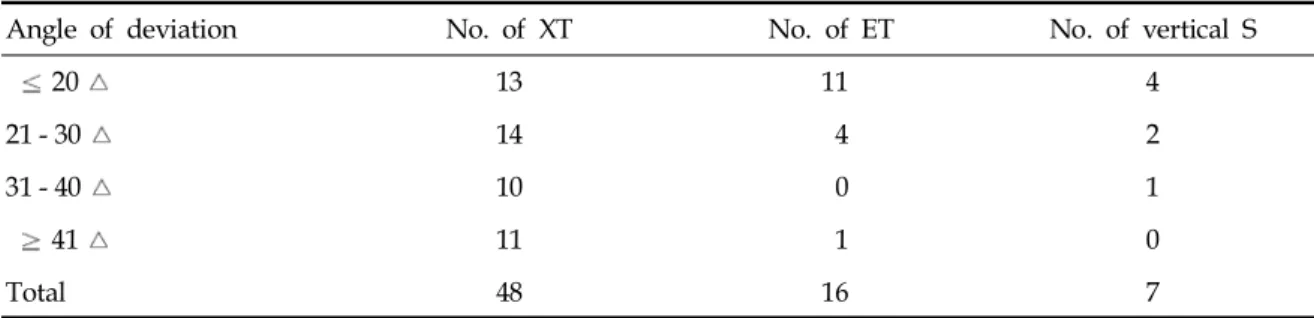
The medical records of the patients, who had undergone intraoperative adjustment surgery under topical anesthesia for horizontal or vertical strabismus in our hospital from March 1997 to March 2003 with follow-up of 6 months, were re- viewed retrospectively. This study was approved by the ethics committee of Yonsei University Medical Center, Seoul, Korea. Seventy-one patients (29 men and 42 women) underwent an intra- operative adjustment of strabismus surgery under topical anesthesia. The mean age of the patients was 31.4 ± 13.6 years. Forty eight patients had exotropia, 16 had esotropia, and 7 had hyper- or hypotropia (Table 1).

All the procedures were performed by one of authors. Premedication was not given and the local anesthetic consisted of 0.5% proparacaine (Alcaine , Alcon-Couvreur, Puurs, Belgium) eye drops that were administered prior to surgery.

Intraoperative Adjustment in Strabismus Surgery under Topical Anesthesia

Yoon-Hee Chang,

1

Ik Hee Ryu,

2

Sueng-Han Han,

2

Seung-Jae Lee,

2

and Jong-Bok Lee

2

1

Department of Ophthalmology, Ajou University School of Medicine, Suwon, Korea;

2
The Institute of Vision Research, Department of Ophthalmology, Yonsei Medical Center, Yonsei University College of Medicine, Seoul, Korea.

Received November 29, 2005 Accepted May 17, 2006

Presented in part at the 29th Meeting of the European Strabismological Association, Izmir, Turkey, June, 2004.

Reprint address: requests to Dr. Sueng-Han Han, Department of Ophthalmology, Yongdong Severance Hospital, Yonsei Univer- sity College of Medicine, 146-92 Dokok-dong, Kangnam-gu, Seoul 135-720, Korea. Tel: 82-2-2019-3442, Fax: 82-2-3463-1049, E-mail:

[email protected]

(2)

Table 2. Summary of Surgical Procedure

Procedure No. of muscles

Lateral rectus recession 83

Medial rectus recession 21

Superior rectus recession 7 Inferior rectus recession 3 Additional drops were instilled during the

incision of conjunctiva and Tenon's capsule, or if the patient complained of discomfort during sur- gery. The patients were continuously monitored using electrocardiography and pulse oxymetry.

The surgical technique used in all patients consisted of a unilateral or bilateral rectus muscle recession with a fornix-based limbal incision. The muscle was isolated and secured using a double- ended 6/0 Vicryl suture technique and an adjustable suture was tied with a double throw and half bowknot at a point on the sclera according to the estimated amount of recession. If the procedure was performed on two muscles, the first muscle was recessed according to a preopera- tive estimation using a conventional technique, and an adjustable suture on the second muscle was performed as described above.

A brief period of time was allowed to elapse in order to allow the patient to adjust to the ambient light binocularly, and cover and alternating cover tests with prism were performed by the surgeon.

All strabismus measurements were taken in the primary position with the patient fixating at a 20/200 Snellen “E”, approximately 5 m away. For patients who required the use of glasses, a pair of disposable contact lenses or their glasses, after being gas sterilized, was used during adjustment.

The muscle position was adjusted until there was no deviation or diplopia in the primary position.

In patients with exotropia, surgical success was defined as an angle deviation within 10 of ex- otropia/phoria, or within 8 of esotropia/phoria without diplopia and asthenopia. In patients with esotropia, surgical success was defined as an angle deviation within 10 of either a heterotropia or phoria. In patients with vertical strabismus, sur-

gical success was defined as an angle deviation within 6 of either a heterotropia or phoria without diplopia. The angle deviation was measured at 1 week, 1 month, 3 months, and 6 months postoperatively.

RESULTS

During the study, we recessed 83 lateral rectus muscles, 21 medial rectus muscles, 7 superior rectus muscles, and 3 inferior rectus muscles (Table 2). Of the muscles operated, we had adjusted 41 lateral rectus muscles, 13 medial rectus muscles, and 3 SR muscles.

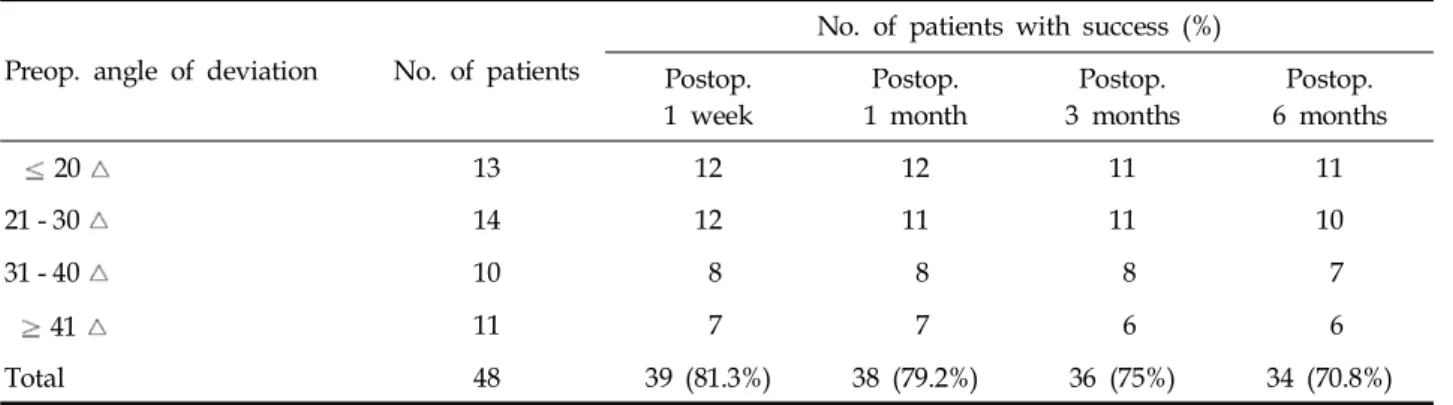
In the patients with exotropia, 39 out of 48 patients (81.3%) achieved successful results at 1 week after surgery. Thirty four out of 48 patients (70.8%) obtained successful results at 6 months.

Table 3 summarizes the postoperative results in exotropia. In the patients with esotropia, fifteen out of 16 patients (93.8%) achieved successful results at 1 week after surgery. Fourteen of 16 patients (87.5%) achieved a successful outcome at 6 months after surgery. Table 4 summarizes the postoperative results in esotropia. Overall, 48 out Table 1. Preoperative Strabismus Types and Angle of Deviation

Angle of deviation No. of XT No. of ET No. of vertical S

20 13 11 4

21 - 30 14 4 2

31 - 40 10 0 1

41 11 1 0

Total 48 16 7

, prism diopter; No, number; XT, extropia; ET, esotropia; S, strabismus.

Δ

(3)

of 64 patients (75%) with horizontal strabismus achieved successful results at 6 months after surgery. In the patients with vertical strabismus, all of the seven patients (100%) achieved suc- cessful results at 1 week and at 1 month after surgery. Six out of 7 patients with a follow-up at 6 months (85.7%) achieved successful results after surgery. Table 5 summarizes the postoperative results in vertical strabismus. The overall success rate for both horizontal and vertical strabismus surgery at 6 months reached up to 76.1%. No

operation was stopped in any of the patients, and no serious intraoperative or postoperative compli- cations were noted. All patients who achieved unsuccessful results had undercorrection.

In all the procedures, the patients recorded no pain when an incision was made through the conjunctiva or Tenon’s capsule. The most patients complained of discomfort when we hooked the muscle to isolate it and ended by muscle dis- insertion. There was no pain on muscle reattach- ment or suture adjustment. Intraoperative cardiac Table 3. Success Rates in Exotropia

Preop. angle of deviation No. of patients

No. of patients with success (%) Postop.

1 week

Postop.

1 month

Postop.

3 months

Postop.

6 months

20 13 12 12 11 11

21 - 30 14 12 11 11 10

31 - 40 10 8 8 8 7

41 11 7 7 6 6

Total 48 39 (81.3%) 38 (79.2%) 36 (75%) 34 (70.8%)

, prism diopter; No., number; Preop., preoperative; Postop., postoperative.

Table 4. Success Rate in Esotropia

Preop. angle of deviation No. of patients

No. of patients with success (%) Postop.

1 week

Postop.

1 month

Postop.

3 months

Postop.

6 months

20 11 11 10 10 10

21 5 4 4 4 4

Total 16 15 (93.8%) 14 (87.5%) 14 (87.5%) 14 (87.5%)

, prism diopter; No., number; Preop., preoperative; Postop., postoperative.

Table 5. Success Rate in Vertical Strabismus

Preop. angle of deviation No. of patients

No. of patients with success (%) Postop.

1 week

Postop.

1 month

Postop.

3 months

Postop.

6 months

20 4 4 4 3 3

21 3 3 3 3 3

Total 7 7 (100%) 7 (100%) 6 (85.7%) 6 (85.7%)

, prism diopter; No., number; Preop., preoperative; Postop., postoperative.

(4)

monitoring did not record positive oculocardiac reflex in any of our patients.

DISCUSSION

The advantage of adjustable surgery, such as decreased frequency of additional surgery and increased accuracy of strabismus correction, has caused a steady increase in its use.

2,5

The post- operative adjustment of the rectus muscle is well described and widely used, while an intra- operative adjustment under local anesthesia is less commonly practiced.

6

Intraoperative one-stage adjustment has been limited to selected patients because it is a time-consuming procedure, which requires a skilled and experienced surgeon, as well as a cooperative patient.

7

However, in a two-stage adjustment procedure, there is usually time lapse between the end of surgery and com- mencing adjustment usually performed some hours later. Some surgeons have performed ad- justable surgery using retrobulbar anesthesia rather than general anesthesia, but the patient and surgeon must wait until the anesthetic effect has faded out, which prolongs the hospital stay.

2

Moreover, complications related to retrobulbar anesthesia such as retrobulbar hemorrhage, eye- ball perforation, or optic nerve damage can be encountered.

8

The disadvantage associated with retrobulbar anesthesia also makes the use of adjustable surgery under topical anesthesia more attractive.

This study showed that one-stage adjustable suture surgery under topical anesthesia was well tolerated with satisfactory results. The overall success rates of adjustable surgery in this study were 85.9% at 1 week, 83% at 1 month, 78.9% at 3 months, and 76.1% at 6 months after surgery.

These results are comparable to previous studies on two-stage adjustment under general or retrobulbar anesthesia.

9,10

Wygnanski-Jaffe et al.

10

reported the surgical success rate of 80% in patients with horizontal strabismus using two- stage adjustment. Our result in vertical strabismus is also comparable to a previous study by Rauz and Govan.

6

They performed one stage vertical rectus muscle recession using adjustable sutures under local anesthesia (topical anesthesia supple-

mented with a subconjunctival injection of local anesthetic over the muscle insertions) on eight patients with vertical diplopia, and six patients became asymptomatic after surgery.

In this study, the success rate appeared to decrease slightly as the follow-up period was extended. This can be explained as postoperative drift, which was reported by Weston et al.

2

that this phenomenon can occur within 8 weeks after surgery. This phenomenon was also noted in our study as the survival curve. Postoperative drift occurred more significantly in patients with exotropia compared with other patients, and that was the reason why the surgical success rate of exotropia at 6 months was lower than other types of strabismus. Therefore, the postoperative drift should not be neglected, and be observed more precisely especially for the patients with exotropia. For a more precise alignment, a slight over-correction can be one of the answers to the postoperative drift. However, because most of our patients were adolescents or adults, we tried to adjust not to have unbearable diplopia.

In this study, the use of topical anesthesia can avoid the complications associated with general or retrobulbar anesthesia. In addition, no intra- operative or postoperative complications were encountered during topical anesthesia such as oculocardiac reflex, nausea, or vomiting, which make the use of topical anesthesia more favorable and convenient. Some patients complained of pain during the procedure. This was relieved by the additional instillation of topical anesthesia, and the patients were well tolerated the pain during and after surgery.

In conclusion, intraoperative adjustment stra- bismus surgery is a simple, tolerable and effective procedure, and is recommended for all coopera- tive patients, especially when postoperative results would otherwise be unpredictable.

REFERENCES

1. Jampolsky A. Current techniques of adjustable stra- bismus surgery. Am J Ophthalmol 1979;88:406-18.

2. Weston B, Enzenauer RW, Kraft SP, Gayowksy GR.

Stability of the postoperative alignment in adjustable-

suture strabismus surgery. J Pediatr Ophthalmol Stra-

bismus 1991;28:206-11.

(5)

3. Wright KW. Color Atlas of Ophthalmic Surgery:

Strabismus. Philadelphia: JB Lippincott Co; 1991. p.87- 124.

4. Isenberg SJ, Apt L, Yamada S. Overnight admission of outpatient strabismus patients. Ophthalmic Surg 1990;

21:540-3.

5. Wisnicki HJ, Repka MX, Guyton GL. Reoperation rate in adjustable strabismus surgery. J Pediatr Ophthalmol Strabismus 1988;25:112-4.

6. Rauz S, Govan JA. One stage vertical rectus muscle recession using adjustable sutures under local anes- thesia. Br J Ophthalmol 1996;80:713-8.

7. Klyve P, Nicolaissen B Jr. Topical anesthesia and adjustable sutures in strabismus surgery. Acta Ophthal- mologica 1992;70:637-40.

8. Krupin T, Waltman SR. Complications in ophthlamic surgery. Philadelphia: JB Lippincott Co; 1984.

9. Rosenbaum AL, Metz HS, Carlson M, Jampolsky AJ.

Adjustable recuts muscle recession surgery: a follow up study. Arch Ophthalmol 1977;95:817-20.

10. Wygnanski-Jaffe T, Wysanbeek Y, Bessler E, Spierer A.

Strabismus surgery using the adjustable suture tech-

nique. J Pediatr Ophthalmol Strabismus 1999;36:184-8.

수치

Table 2. Summary of Surgical Procedure
Table 4. Success Rate in Esotropia

참조

관련 문서

The experimental data were adopted for this analysis on the base of cold storage technology of modified atmosphere package(MAP) for seven months from March

Second, for the relationship between hospital capability and service orientation, the hospital capability had the positive significant impact on the service orientation in the

A series of experiments was conducted from March 16 to July 12 in 2004 in Jeju Island to investigate the effects of sowing date, sowing rate, sand

This showed that the surgical outcome was successfulin 269 patients (98.89%),butthe revision surgery due to surgicalrelapse was performed in three patients.Of 152 patients

) Ŗ᜾໦⋎ᮡ 「Directive //EC of the European Parliament and of the Council of  March  on the reten- tion of data generated or processed in connection

그가 그 린 풍경화는 우리 주위에 실재하는 대상을 이성적으로 재현했다기보다는 이를 통해 우리의 감성을 비추고자 했죠.. 그것이 비록 광활한 대 자연 속에서

Methods: We conducted a retrospective analysis of clinical records of obese children who visited to Chosun university hospital between January 2013 and February 2014 due to

The sample for this research are current patients in hospitals or alternative medical centre and were diagnosed to be not in need for special equipments