INTRODUCTION
Neurally mediated syncope (NMS) is the most common type of syncope, characterized by abnormal autonomic response with excessive vagal tone and sympathetic withdrawal.1,2 How- ever, the pathophysiological mechanisms of NMS remain un- certain.2,3 The head-up tilt test (HUT) is often used to confirm NMS in patients with a suspicious history of NMS. The HUT
induces a large gravitational shift of blood away from the chest to the distensible venous capacitance system below the dia- phragm. The circulatory adjustments to orthostatic stress lead to an increase in cardiac contractility, heart rate (HR), and vas- cular tone in order to maintain arterial blood pressure in an upright posture. These adjustments are mediated by the neural pathways of the autonomic nervous system. Arterial and car- diopulmonary reflex changes are also involved in these adjust- ments.2 However, previous studies did not find any clear evi- dence of alterations in the arterial baroreflex control of HR in subjects with tilt-induced NMS.4-7 Several studies have report- ed a reduction8,9 or increase in baroreflex activity,10,11 and one study reported that reduced baroreflex sensitivity (BRS) dur- ing HUT is an independent value in predicting the recurrence of syncope.12
There are several treatment options of NMS, and tilt training is one of them.1 As results have differed regarding the efficacy of tilt training in preventing recurrence of syncope, tilt training
Role of Baroreflex Sensitivity in Predicting Tilt Training Response in Patients with Neurally Mediated Syncope
Kwang Jin Chun, Hye Ran Yim, Jungwae Park, Seung-Jung Park, Kyoung-Min Park, Young Keun On, and June Soo Kim
Division of Cardiology, Department of Medicine, Heart Vascular Stroke Institute, Samsung Medical Center, Sungkyunkwan University School of Medicine, Seoul, Korea.
Purpose: An association between baroreflex sensitivity (BRS) and the response to tilt training has not been reported in patients with neurally mediated syncope (NMS). This study sought to investigate the role of BRS in predicting the response to tilt training in patients with NMS.
Materials and Methods: We analyzed 57 patients who underwent tilt training at our hospital. A responder to tilt training was de- fined as a patient with three consecutive negative responses to the head-up tilt test (HUT) during tilt training.
Results: After tilt training, 52 patients (91.2%) achieved three consecutive negative responses to the HUT. In the supine position before upright posture during the first session of tilt training for responders and non-responders, the mean BRS was 18.17±10.09 ms/mm Hg and 7.99±5.84 ms/mm Hg (p=0.008), respectively, and the frequency of BRS ≥8.945 ms/mm Hg was 45 (86.5%) and 1 (20.0%; p=0.004), respectively. Age, male gender, frequency of syncopal events before HUT, type of NMS, phase of positive HUT, to- tal number of tilt training sessions, and mean time of tilt training did not differ between the study groups. In the multivariate analy- sis, BRS <8.945 ms/mm Hg in the supine position (odds ratio 23.10; 95% CI 1.20–443.59; p=0.037) was significantly and indepen- dently associated with non-response to tilt training.
Conclusion: The BRS value in the supine position could be a predictor for determining the response to tilt training in patients with NMS who are being considered for inpatient tilt training.
Key Words: Baroreflex sensitivity, tilt training, neurally mediated syncope
pISSN: 0513-5796 · eISSN: 1976-2437
Received: March 5, 2015 Revised: June 29, 2015 Accepted: August 10, 2015
Corresponding author: Dr. June Soo Kim, Division of Cardiology, Department of Medicine, Heart Vascular Stroke Institute, Samsung Medical Center, Sungkyunkwan University School of Medicine, 81 Irwon-ro, Gangnam-gu, Seoul 06351, Korea.
Tel: 82-2-3410-3414, Fax: 82-2-3410-3849, E-mail: [email protected]
•The authors have no financial conflicts of interest.
© Copyright: Yonsei University College of Medicine 2016
This is an Open Access article distributed under the terms of the Creative Com- mons Attribution Non-Commercial License (http://creativecommons.org/licenses/
by-nc/3.0) which permits unrestricted non-commercial use, distribution, and repro- duction in any medium, provided the original work is properly cited.
Yonsei Med J 2016 Mar;57(2):313-320 http://dx.doi.org/10.3349/ymj.2016.57.2.313
is listed as a class IIb recommendation in current guidelines.1 Moreover, there have been limitations when performing tilt training at hospitals due to hospital admission and medical costs. Therefore, identifying predictors for tilt training response could be useful in terms of clinical management.
This study aimed to assess the role of BRS in predicting tilt training response in patients with NMS.
MATERIALS AND METHODS
Study population
We reviewed our tilt training database, and 111 consecutive patients with recurrent NMS who performed tilt training be- tween March 2006 and March 2014 were identified. The diag- nosis of NMS was established based on suggestive clinical history, positive HUT results, and absence of any other cause of syncope. Patients with two consecutive positive responses to HUT (a positive response to the initial diagnostic HUT and a positive response to the first session of tilt training) were en- rolled in our study in order to avoid over-diagnosis. We exclud- ed those who had structural heart disease and any other cause of syncope. Among a total of 111 patients, 41 patients with a negative response to the first session of tilt training and 13 pa- tients whose BRS data were lost were excluded. Therefore, 57 patients were ultimately analyzed (Fig. 1). This study received institutional review board approval, and informed consent was waived for this retrospective study.
Diagnostic head-up tilt test
The HUT was performed on patients who had fasted for at least 4 hours. We used the tilt test protocol, which was reported pre- viously.13 After a 10-min resting period in the supine position, the patients were tilted to an angle of 70° for 30 minutes or un- til symptoms appeared. If a negative response was observed, the intravenous isoproterenol provocation test, which uses in- cremental doses in order to increase average HR, was per- formed. Patients were kept in the same 70° upright posture as in the first phase, and isoproterenol was intravenously admin- istered at an initial rate of 1 µg/min. The infusion rate was in-
creased by 1 µg/min every 3 minutes to a maximum of 5 µg/
min. A positive HUT response was defined when syncope or presyncope developed in association with hypotension [sys- tolic blood pressure (SBP) <80 mm Hg], bradycardia [sinus ar- rest (>3 seconds), <45 beats/min in the first phase, or <60 beats/min in the second phase], or both. HR and blood pressure measurements immediately before or during syncope were used to define a positive response to HUT. Faintness without significant hypotension or bradycardia was considered as a negative response to HUT. The tilting table was rapidly low- ered to the horizontal position when a positive response ap- peared or the study endpoint was reached. The syncope was classified on the basis of the previous study:14 type 1 (mixed), type 2 (cardioinhibitory), or type 3 (vasodepressive).
Tilt training
Tilt training was performed during hospital admission. Tilt tests were repeated daily, two sessions per day. Tilt training re- sponders were defined as patients with three consecutive nega- tive responses to HUT during tilt training.
Data acquisition
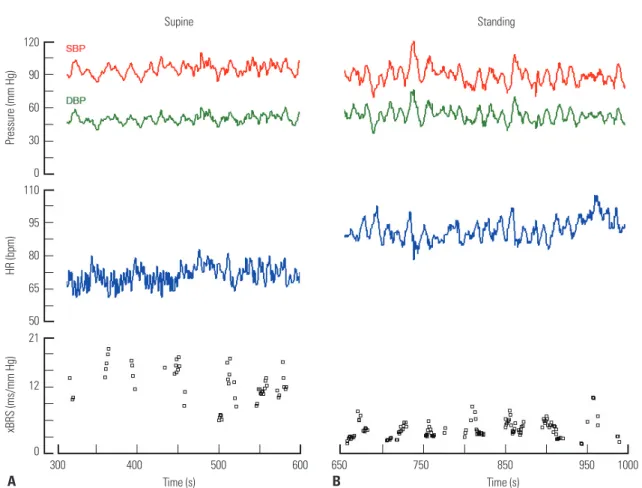
Data recording was initiated at the start of each HUT. During a sequential HUT, beat-to-beat arterial blood pressure was con- tinuously measured non-invasively with a servo-controlled photoplethysmograph (Finometer® PRO; Finapres Medical Systems B.V, Amsterdam, the Netherlands), placed on the mid- phalanx of the right middle finger (Fig. 2).15 Continuous elec- trocardiogram data were also obtained during the HUT.
Arterial baroreflex sensitivity
Calculation of cardiac BRS was based on the cross-correlation baroreflex sensitivity (xBRS) method (Fig. 3). The SBP and in- terbeat interval (IBI) time series were spline interpolated and resampled at 1 Hz. In 10-s windows, correlation and regression slopes between SBP and IBI were computed. Delays of 0- to 5-s increments in IBI were computed, and the delay with the highest positive coefficient of correlation was selected; this optimal delay (tau) was stored. The slope between SBP and IBI was recorded as an estimate of xBRS if the correlation was sig- nificant at p<0.01. When these conditions were not met, there was no result for this time segment.16,17
Hemodynamic parameters
Mean arterial blood pressure (MBP) was the true integral of the arterial pressure wave over 1 beat divided by the corre- sponding beat interval. HR was computed as the inverse of the IBI and expressed in beats per minute. Beat-to-beat changes in stroke volume were estimated by modelling flow from fin- ger arterial pressure (Modelflow, Finapres Medical System B.V., Amsterdam, the Netherlands).
Session 1+
+
Fig. 1. Enrollment of patients in the study and response to tilt training. A plus sign indicates a positive response to the tilt test.
Diagnostic tilt test
Study population (n=57) Tilt training at hospital
(n=111)
Responder (n=52)
Non-responder (n=5)
54 were excluded
41 session 1 negative response 13 data loss
Statistical analysis
Hemodynamic data were averaged at fixed 5 min frames with- in subsequent HUT: 1) 5-min in the supine position before head-up tilt; 2) 5 min after 70° upright tilting of the head-up tilt table; and 3) 5 min before the occurrence of syncope or the end of HUT.
Continuous variables are expressed as mean±standard de- viation or median and interquartile range. Categorical variables are expressed as frequency and percentage. To evaluate differ- ence between the study groups, we used Student’s unpaired t- test for normally distributed data and the Mann-Whitney U test for skewed data. Categorical variables were analyzed with the chi-square test or Fisher’s exact tests using SPSS software (SPSS for Windows, version 20.0, IBM Corp., Armonk, NY, USA). A p value of <0.05 was considered to be significant.
RESULTS
Baseline characteristics of the study population
We ultimately analyzed 57 patients (26 males, mean age of 33.9±13.5 years) with NMS and with two consecutive positive responses to HUT (a positive response to the initial diagnostic HUT and a positive response to the first session of tilt training)(Table 1). The vasodepressive type was the most common, and positive responses appeared more frequently in the second phase. Among all patients, 52 obtained three consecutive neg- ative responses to HUT (responders), and five did not reach the target (non-responders). For patients with a response to tilt training, changes in the response to HUT are shown in Fig. 4.
Among the non-responder group, three patients obtained two consecutive negative responses to the tilt test, one patient ob- tained a negative response twice (non-consecutively), and one patient was unable to obtain a negative response during a to- tal of six sessions of tilt training. Baseline clinical characteris- tics between responders and non-responders are shown in Ta- ble 2. The mean age was numerically younger in the responder group (32.9±13.3 years vs. 44.4±13.2 years; p=0.071). The type of syncope, phase of positive HUT response, mean duration of HUT, and total number of tilt training sessions did not differ between the two groups.
Comparison of BRS and hemodynamic parameters
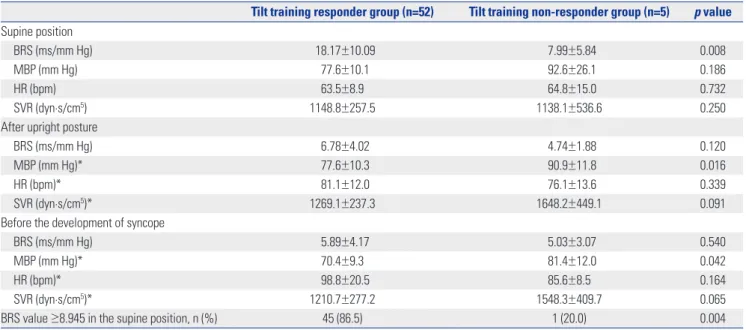
Table 3 shows the BRS and hemodynamic parameters during the first session of tilt training. Univariate analysis showed that BRS in the supine position was significantly higher in the responder group (18.17±10.09 ms/mm Hg vs. 7.99±5.84 ms/mm Hg; p=0.008). The receiver operating characteristic analy- 120
90 60 30
0 110 95 80 65
50 21
12
0
Pressure (mm Hg)HR (bpm)xBRS (ms/mm Hg)
300 400 500 600 650 750 850 950 1000 Time (s)
Supine Standing
Time (s)
Fig. 2. BRS and hemodynamic parameters during head-up tilt test. Recordings during 5 min in the supine position immediately before upright posture (A) and during 5 min in a standing position immediately after an upright posture (B) are shown. SBP, systolic blood pressure; DBP, diastolic blood pressure;
HR, heart rate; xBRS, cross-correlation baroreflex sensitivity.
A B
sis of BRS as a predictor of the non-responder group revealed an area under the curve of 0.846. For non-responders, a BRS cut-off value of 8.945 ms/mm Hg resulted in a sensitivity and specificity of 86.5% and 80.0%, respectively. The proportion of patients with a mean BRS of ≥8.945 ms/mm Hg in the supine
position was 86.5% among responders and 20.0% among non- responders (p=0.004). However, BRS values after upright pos- ture and before syncope development did not differ between the two groups. As for hemodynamic parameters, MBP values after upright posture (77.6±10.3 mm Hg vs. 90.0±11.8 mm Hg;
p=0.016) and before syncope (70.4±9.3 mm Hg vs. 81.4±12.0 mm Hg; p=0.042) were significantly lower in the responder group. HR and systemic vascular resistance did not differ be- tween the two groups in all phases of tilt training.
Changes of BRS and hemodynamic parameters between first and last session of tilt training
Changes of BRS and hemodynamic parameters were defined as the values of the last session minus the values of the first session during hospital tilt training. Changes in BRS value were not significantly different between the two groups (Table 4).
Changes in hemodynamic parameters also did not differ sig- nificantly, with the exception of HR after upright posture.
Factors in predicting tilt training non-responders
Univariate analysis showed that the variables associated with tilt training non-responders were a lower BRS value (especially<8.945 ms/mm Hg in the supine position), a higher MBP after upright posture, and a higher MBP before syncope. Table 5 Fig. 3. Methods used to compute cross-correlation BRS. (A and B) Beat to beat SBP and IBI data were fitted with cubic spline functions and resampled at 1-s intervals. (C) In 10-s windows, the correlation and regression slopes between SBP and IBI were computed. Delays of 0- to 5-s increments in IBI were computed, and the delay with the highest positive coefficient of correlation was selected; this optimal delay (Tau) was stored. (D) The slope be- tween SBP and IBI was recorded as an xBRS estimate if the correlations was significant at p=0.01. SBP, systolic blood pressure; IBI, interbeat interval;
xBRS, cross-correlation baroreflex sensitivity.
115 110 105 100 95 90
950 900 850 800 750 700
950 900 850 800 750 700 Time (s)
Time (s) IBI
SBP
τ=0 τ=5
Time (s)
SBP
335 340 345 350 355 360 365
335 340 345 350 355 360 365
335 340 345 350 355 360 365
90 95 100 105 110 115 τ=1 r=0.897 r2=0.805 p<0.001 BRS=11.684
SBP IBIIBI
A
C
B
D
Table 1. Baseline Clinical Characteristics of the Study Patients Patients (n=57)
Age (yrs) 33.9±13.5
Male gender 26 (45.6)
Height (cm) 167.9±9.2
Weight (kg) 63.1±11.1
BMI (kg/m2) 22.4±3.4
Frequency of syncope before diagnosis 5.2±5.5 Type of NMS
Mixed 14 (24.6)
Cardioinhibitory 3 (5.3)
Vasodepressive 40 (70.1)
Phase of positive diagnostic HUT
Passive 22 (38.6)
Isoproterenol 35 (61.4)
Duration of initial diagnostic HUT (min) 30.1±12.4 BMI, body mass index; NMS, neurally mediated syncope; HUT, head-up tilt test.
Data are presented as mean±SD or number (%).
shows the results of the binary logistic regression analysis. MBP after upright posture and before syncope did not remain asso- ciated with non-responders in the first and second models that included BRS and clinical factors. In the third model, a BRS val- ue of <8.945 ms/mm Hg in the supine position remained sig- nificantly associated with non-responders after correcting for
female gender.
DISCUSSION
The main finding of our study was that the tilt training non-re-
120
65
10
120
65
10 130
80
30
130
80
30 30
15 0
30 15 0
Pressure (mm Hg) Pressure (mm Hg)
HR (bpm) HR (bpm)
xBRS (ms/mm Hg) xBRS (ms/mm Hg)
450 600 7501100 1200 1300 450 600 7502400 2500 2600
Time (s) Time (s)
Supine Standing Syncope (+) Supine Standing Syncope (-)
Fig. 4. Changes in responses to the tilt test before and after tilt training. This graph describes the BRS and hemodynamic parameters during the head-up tilt test in one patient (tilt training no. 134). A (first session of tilt training): Heart rate and systolic blood pressure decreased in the passive phase, and the patient lost consciousness transiently (mixed type). B (fifth session of tilt training): The patient felt mild chest discomfort; however, heat rate and blood pressure did not decrease in the passive and isoproterenol phases. HR, heart rate; xBRS, cross-correlation baroreflex sensitivity.
A B
Table 2. Baseline Clinical Characteristics of the Study Groups
Tilt training responder group (n=52) Tilt training non-responder group (n=5) p value
Age (yrs) 32.9±13.3 44.4±13.2 0.071
Male gender 25 (48.1) 1 (20.0) 0.362
Height (cm) 168.6±8.9 160.7±10.0 0.067
Weight (kg) 63.4±10.9 60.6±14.2 0.604
BMI (kg/m2) 22.3±3.4 23.2±3.0 0.466
Frequency of syncope before diagnosis 5.2±5.7 5.0±3.0 0.439
Type of NMS 0.323
Mixed 13 (25.0) 1 (20.0)
Cardioinhibitory 2 (3.8) 1 (20.0)
Vasodepressive 37 (71.2) 3 (60.0)
Phase of positive diagnostic HUT 0.364
Passive 19 (36.5) 3 (60.0)
Isoproterenol 33 (63.5) 2 (40.0)
Duration of initial diagnostic HUT (min) 30.3±12.7 28.6±9.9 0.597
Total number of tilt training session 5.5 (4.0–6.8) 6.0 (5.0–8.0) 0.265
Total time of tilt training (min) 214.0 (175.8–263.5) 237.0 (144.5–301.5) 0.854
Mean time of tilt training (min) 39.7±6.0 34.5±5.6 0.071
BMI, body mass index; NMS, neurally mediated syncope; HUT, head-up tilt test.
Data are presented as mean±SD, number (%), or median value (interquartile range).
sponder group had a lower BRS value in the supine position than the responder group. A BRS value of less than 8.945 ms/
mm Hg in the supine position was an independent factor in predicting non-responders of hospital tilt training among pa- tients with NMS.
The role of arterial baroreflex function in the pathophysiology of NMS remains unclear.2-12 Iacoviello, et al.9 reported that pa- tients with nitrate-induced NMS showed significantly lower BRS values than patients without syncope, and depressed BRS during HUT was reported to be an independent predictor of
NMS recurrences.12 However, the study did not evaluate the ef- ficacy of tilt training according the BRS value, and to our knowl- edge, no studies have performed such an evaluation. The role of tilt training in preventing recurrent syncope is also contro- versial.14,18-21 Several studies performed tilt training at hospi- tals, while other studies performed tilt training at home or both at home and in hospitals. Although no studies compared the efficacy of tilt training according to the location where tilt training was performed, it is reasonable to suggest that tilt training using a tilt table at a hospital is more effective than Table 3. BRS and Hemodynamic Parameters during the First Session of Tilt Training
Tilt training responder group (n=52) Tilt training non-responder group (n=5) p value Supine position
BRS (ms/mm Hg) 18.17±10.09 7.99±5.84 0.008
MBP (mm Hg) 77.6±10.1 92.6±26.1 0.186
HR (bpm) 63.5±8.9 64.8±15.0 0.732
SVR (dyn·s/cm5) 1148.8±257.5 1138.1±536.6 0.250
After upright posture
BRS (ms/mm Hg) 6.78±4.02 4.74±1.88 0.120
MBP (mm Hg)* 77.6±10.3 90.9±11.8 0.016
HR (bpm)* 81.1±12.0 76.1±13.6 0.339
SVR (dyn·s/cm5)* 1269.1±237.3 1648.2±449.1 0.091
Before the development of syncope
BRS (ms/mm Hg) 5.89±4.17 5.03±3.07 0.540
MBP (mm Hg)* 70.4±9.3 81.4±12.0 0.042
HR (bpm)* 98.8±20.5 85.6±8.5 0.164
SVR (dyn·s/cm5)* 1210.7±277.2 1548.3±409.7 0.065
BRS value ≥8.945 in the supine position, n (%) 45 (86.5) 1 (20.0) 0.004
BRS, baroreflex sensitivity; MBP, mean blood pressure; HR, heart rate; SVR, systemic vascular resistance.
Data are presented as mean±SD or number (%).
*There was a missing value in one patient in the tilt training responder group.
Table 4. Changes in BRS and Hemodynamic Parameters between the First and Last Session of Tilt Training
Tilt training responder group (n=52) Tilt training non-responder group (n=5) p value Supine position
BRS (ms/mm Hg)* 1.11±11.93 2.79±4.55 0.489
MBP (mm Hg) -0.6±10.1 0.8±11.7 0.767
HR (bpm) 0.2±9.6 1.2±4.2 0.967
SVR (dyn·s/cm5) -29.3±363.7 -34.9±605.4 0.880
After upright posture
BRS (ms/mm Hg)† 0.71±3.56 0.76±1.94 0.772
MBP (mm Hg)‡ -0.5±8.5 -4.2±8.4 0.357
HR (bpm)‡ -1.6±8.1 3.5±2.5 0.006
SVR (dyn·s/cm5)‡ -47.7±299.3 -303.1±588.4 0.390
Before the development of syncope
BRS (ms/mm Hg)§ -2.37±4.35 -1.25±3.21 0.656
MBP (mm Hg)‡ 7.9±13.7 -0.7±6.7 0.171
HR (bpm)‡ 16.8±20.4 14.1±18.5 0.776
SVR (dyn·s/cm5)‡ -88.3±396.7 -171.3±580.3 0.670
BRS, baroreflex sensitivity; MBP, mean blood pressure; HR, heart rate; SVR, systemic vascular resistance.
Data are presented as mean±SD.
*There was a missing value in one patient in the tilt training non-responder group, †There was a missing value in three patients in the tilt training responder group,
‡There was a missing value in one patient in the tilt training responder group, §There was a missing value in six patients in the tilt training responder group.
self-training at home. Our study estimated the response of tilt training performed at hospitals.
Several studies defined responders to hospital tilt training as patients who obtained two consecutive negative responses to tilt training.20,21 However, we defined successful tilt training as three consecutive negative responses to ensure that the tilt training was more effective. In our study, 52 (91.2%) of 57 pa- tients obtained three consecutive negative responses. Among the five patients in the non-responder group, three obtained two consecutive negative responses, and one obtained nega- tive responses twice, though non-consecutively. However, one patient did not obtain a negative response at all during a total of six sessions of tilt training. This indicates that the response to tilt training might differ among patients. The mean BRS val- ue of patients with all positive responses during tilt training was 2.809 ms/mm Hg, and this was the lowest value among our study patients. This implies that a lower BRS value is indica- tive of a higher possibility of a patient being a non-responder to hospital tilt training. Among the non-responder group, there was only one patient whose BRS value was higher than the cut- off value used when predicting non-responders, and the BRS value of this patient was 17.581 ms/mm Hg. The patient per- formed five sessions of tilt training, the lowest number of train- ing sessions among the five patients of the non-responder group (two patients performed six sessions, and the other two patients performed eight sessions).
There are several therapeutic options for patients with NMS, including physical counter-pressure maneuvers, tilt training, pharmacological therapy, and cardiac pacing.1 When deter- mining the treatment strategy, we should consider the cost-ef- fectiveness of treatment. Hospital-based tilt training requires a hospital stay and increased medical costs. Therefore, if there are any useful parameters that can be used to predict the re- sponse to tilt training before admission, only good candidates
could be selected for hospital tilt training. To the best of our knowledge, our study is the first to suggest that BRS may be used in predicting tilt training responses in patients with NMS. Based on our findings, a BRS value of less than 8.945 ms/
mm Hg in the supine position may be useful in predicting non- responders to tilt training among patients with NMS.
Study limitation
Our study had several limitations. First, this was a retrospec- tive study. Second, a relatively small number of patients were enrolled in our study. Third, the follow-up data were insuffi- cient. We conducted a telephone interview that allowed the study patients to evaluate the recurrence of syncope following hospital tilt training, and 45 (86.5%) of the 52 patients in the responder group and two (40%) of the five patients in the non- responder group were evaluated. The mean follow-up dura- tion was 46 months. In the responder group, 15 patients (33.3%) experienced a syncopal episode during follow-up, and one of the two evaluated patients in the non-responder group suf- fered a syncopal episode. Due to the many patients lost to fol- low-up in the non-responder group and the lack of informa- tion regarding home orthostatic self-training after discharge, we were unable to estimate the difference in the recurrence of syncope according to the response to hospital tilt training.
Conclusion
In conclusion, the BRS value in the supine position could be a predictor for determining the response to tilt training in pa- tients with NMS who are being considered for inpatient tilt training.
REFERENCES
1. Task Force for the Diagnosis and Management of Syncope; Euro- Table 5. Multivariate Analysis of Tilt Training Non-Response
Hazard ratio (95% CI) p value
Model 1
BRS <8.945 in the supine position during the first session of tilt training 23.10 (1.20– 443.59) 0.037
MBP after upright posture 1.07 (0.96–1.18) 0.227
Frequency of syncope before initial diagnostic HUT 1.12 (0.87–1.43) 0.377
Total number of tilt training sessions 1.04 (0.50–2.17) 0.907
Model 2
BRS <8.945 in the supine position during the first session of tilt training 29.62 (1.64–534.14) 0.022
MBP before syncope 1.07 (0.94–1.22) 0.312
Frequency of syncope before initial diagnostic HUT 1.08 (0.85–1.38) 0.544
Total number of tilt training sessions 0.95 (0.42–2.15) 0.895
Model 3
BRS <8.945 in the supine position during the first session of tilt training 46.55 (1.66–1308.64) 0.024
Female gender 0.59 (0.03–12.86) 0.739
Frequency of syncope before initial diagnostic HUT 1.11 (0.88–1.40) 0.388
Total number of tilt training sessions 1.13 (0.54–2.39) 0.742
BRS, baroreflex sensitivity; MBP, mean blood pressure; HUT, head-up tilt test.
pean Society of Cardiology (ESC); European Heart Rhythm Asso- ciation (EHRA); Heart Failure Association (HFA); Heart Rhythm Society (HRS), Moya A, et al. Guidelines for the diagnosis and management of syncope (version 2009). Eur Heart J 2009;30:
2631-71.
2. Mosqueda-Garcia R, Furlan R, Tank J, Fernandez-Violante R. The elusive pathophysiology of neurally mediated syncope. Circula- tion 2000;102:2898-906.
3. Béchir M, Binggeli C, Corti R, Chenevard R, Spieker L, Ruschitzka F, et al. Dysfunctional baroreflex regulation of sympathetic nerve activity in patients with vasovagal syncope. Circulation 2003;107:
1620-5.
4. Freitas J, Pereira S, Lago P, Costa O, Carvalho MJ, Falcão de Freitas A. Impaired arterial baroreceptor sensitivity before tilt-induced syncope. Europace 1999;1:258-65.
5. Morillo CA, Eckberg DL, Ellenbogen KA, Beightol LA, Hoag JB, Tahvanainen KU, et al. Vagal and sympathetic mechanisms in pa- tients with orthostatic vasovagal syncope. Circulation 1997;96:
2509-13.
6. Thomson HL, Wright K, Frenneaux M. Baroreflex sensitivity in pa- tients with vasovagal syncope. Circulation 1997;95:395-400.
7. Jardine DL, Ikram H, Frampton CM, Frethey R, Bennett SI, Crozier IG. Autonomic control of vasovagal syncope. Am J Physiol 1998;
274(6 Pt 2):H2110-5.
8. Samniah N, Sakaguchi S, Ermis C, Lurie KG, Benditt DG. Transient modification of baroreceptor response during tilt-induced vasova- gal syncope. Europace 2004;6:48-54.
9. Iacoviello M, Guida P, Forleo C, Sorrentino S, D’Alonzo L, Favale S.
Impaired arterial baroreflex function before nitrate-induced vaso- vagal syncope during head-up tilt test. Europace 2008;10:1170-5.
10. el-Sayed H, Hainsworth R. Relationship between plasma volume, carotid baroreceptor sensitivity and orthostatic tolerance. Clin Sci (Lond) 1995;88:463-70.
11. Pitzalis M, Parati G, Massari F, Guida P, Di Rienzo M, Rizzon B, et al.
Enhanced reflex response to baroreceptor deactivation in subjects
with tilt-induced syncope. J Am Coll Cardiol 2003;41:1167-73.
12. Iacoviello M, Forleo C, Guida P, Sorrentino S, D’Andria V, Rodio M, et al. Independent role of reduced arterial baroreflex sensitivity during head-up tilt testing in predicting vasovagal syncope recur- rence. Europace 2010;12:1149-55.
13. Jeong JO, Kim JS, Kim JK, Kwak MH, Oh JH, Lee SY, et al. Head-up tilt test in subjects with no history of syncope or presyncope. Ko- rean Circulation J 2000;30:841-6.
14. On YK, Park J, Huh J, Kim JS. Is home orthostatic self-training ef- fective in preventing neurally mediated syncope? Pacing Clin Elec- trophysiol 2007;30:638-43.
15. Imholz BP, Wieling W, van Montfrans GA, Wesseling KH. Fifteen years experience with finger arterial pressure monitoring: assess- ment of the technology. Cardiovasc Res 1998;38:605-16.
16. Gisolf J, Immink RV, van Lieshout JJ, Stok WJ, Karemaker JM. Or- thostatic blood pressure control before and after spaceflight, de- termined by time-domain baroreflex method. J Appl Physiol (1985) 2005;98:1682-90.
17. Westerhof BE, Gisolf J, Stok WJ, Wesseling KH, Karemaker JM.
Time-domain cross-correlation baroreflex sensitivity: performance on the EUROBAVAR data set. J Hypertens 2004;22:1371-80.
18. Duygu H, Zoghi M, Turk U, Akyuz S, Ozerkan F, Akilli A, et al. The role of tilt training in preventing recurrent syncope in patients with vasovagal syncope: a prospective and randomized study. Pacing Clin Electrophysiol 2008;31:592-6.
19. Gajek J, Zys´ko D, Mazurek W. Efficacy of tilt training in patients with vasovagal syncope. Kardiol Pol 2006;64:602-8.
20. Ector H, Willems R, Heidbüchel H, Reybrouck T. Repeated tilt testing in patients with tilt-positive neurally mediated syncope. Eu- ropace 2005;7:628-33.
21. Verheyden B, Ector H, Aubert AE, Reybrouck T. Tilt training in- creases the vasoconstrictor reserve in patients with neurally me- diated syncope evoked by head-up tilt testing. Eur Heart J 2008;
29:1523-30.