Author contributions: H.D.J. and J.H.J. performed the physio logical and biochemical experiments.
This is an Open Access article distributed under the terms of the Creative Commons Attribution Non-Commercial License, which permits unrestricted non-commercial use, distribution, and reproduction in any medium, provided the original work is properly cited.
Copyright © Korean J Physiol Pharmacol, pISSN 1226-4512, eISSN 2093-3827
INTRODUCTION
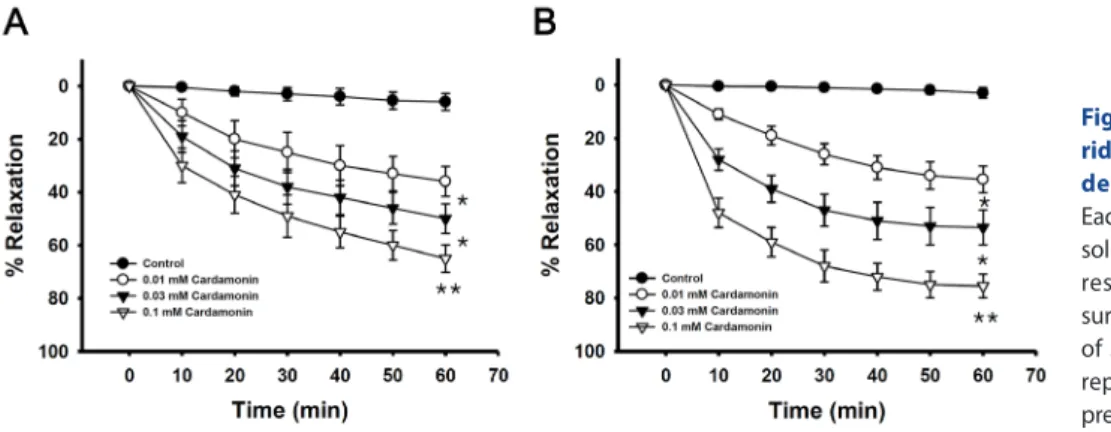
Cardamonin ((E)-1-(2,4-dihydroxy-6-methoxyphenyl)-3- phenylprop-2-en-1-one, Fig. 1 ) is the main flavonoid derived from the seed of Alpinia katsumadai (Zingiberaceae), which is a commonly used traditional medicinal plant in China and Korea. Previous studies have demonstrated that cardamonin inhibits the proliferation of various cancer cells [1] and inhibits the proliferation of vascular smooth muscle cells and the production of pro-inflammatory mediators [2]. We investigated the mechanisms underlying the relaxing effect of cardamonin on vascular smooth muscle contractility with the ultimate goal of developing a better antihypertensive agent. Denuded aortic rings from male Sprague-Dawley rats were used and isometric contractions were recorded using a computerized data acquisition system. These data were combined with molecular experiments.
It is generally accepted that initiation of smooth muscle contractility is predominantly controlled by a Ca
2+-dependent
increase in the phosphorylation of the 20 kDa myosin light chain (MLC
20) [3]. However, the degree of MLC
20phosphorylation or contraction does not always parallel the intracellular Ca
2+concentration. The extent of MLC
20phosphorylation or force of contraction induced by agonist stimulation is usually higher than that caused by an increase in the Ca
2+concentration, which is
Original Article
Cardamonin inhibits agonist-induced vascular contractility via Rho-kinase and mEK inhibition
Hyun Dong Je
1and Ji Hoon Jeong
2,3,*
1Department of Pharmacology, College of Pharmacy, Catholic University of Daegu, Gyeongsan 38430, 2College of Medicine, 3Research Institute for Translational System Biomics, Chung-Ang University, Seoul 06974, Korea
ARTICLE INFO
Received August 22, 2015 Revised September 24, 2015 Accepted October 21, 2015
*Correspondence