http://e-nrp.org
Acculturation and changes in dietary behavior and anthropometric measures among Chinese international students in South Korea
Jounghee Lee
1, Ran-Ran Gao
2and Jung-Hee Kim
2§1Department of Nutrition Education, Graduate School of Education, Kyonggi University, Gyeonggi 443-760, Korea
2Department of Food and Nutrition, Seoul Women's University, 621 Hwarangro, Nowon-gu, Seoul 139-774, Korea
BACKGROUND/OBJECTIVES: International students face dissimilar food environments, which could lead to changes in dietary behaviors and anthropometric characteristics between before and after migration. We sought to examine the risk factors, including dietary behaviors, acculturation, and demographic characteristics, related to overweight subjects residing in South Korea.
SUBJECTS/METHODS: We conducted a cross-sectional study, collecting data from 142 Chinese international students (63 males, 79 females) in 2013.
RESULTS: The mean age of the subjects was 25.4 years, and almost half of them immigrated to South Korea to earn a master’s degree or doctoral degree (n = 70, 49.3%). Chinese international students showed an increase in skipping meals and eating speed, but a decrease in the frequency of fruit and vegetable consumption in South Korea compared to when they lived in China. We found a statistically significant increase in weight (69.4 → 73.9 kg) and BMI (22.4 → 23.8 kg/m
2) for male subjects (P < 0.001) but no change for female subjects. We also found that overweight subjects were more likely to be highly acculturated and male compared with normal-weight subjects.
CONCLUSION: Among Chinese international students living in South Korea, male and more highly acculturated subjects are more vulnerable to weight gain. This study provides useful information to design tailored nutrition intervention programs for Chinese international students.
Nutrition Research and Practice 2015;9(3):304-312; doi:10.4162/nrp.2015.9.3.304; pISSN 1976-1457 eISSN 2005-6168
Keywords: Chinese, international students, acculturation, diet, migration
INTRODUCTION
*Chinese international students face high levels of stress in language, finances, personal relationships, and academic performance as well as a different cuisine and culture in South Korea [1-3]. Migration may play an important role in nutritional and health status because migrants may be exposed to dissimilar environmental influences and culture shock [4-7].
Adopting new dietary behaviors is challenging when people migrate to a new country [8]. Zhu [9] indicated that Chinese international students decreased their consumption of fruits and vegetables while increasing their consumption of instant noodles and fast food and skipping breakfast more frequently.
Moreover, they drank tea less but drank coffee more often in South Korea. It is critical to identify the nutritional problems for Chinese international students to develop an evidence- based nutrition intervention program.
The number of Chinese students in South Korea has increased sharply over the past two decades. Chinese students began studying abroad in Korea just after the conclusion of the contract on Korea-Chinese Cultural Exchange in 1994. According
to the National Statistical Office 2013, Chinese students compose 65.1% of all international students in South Korea [10]. Chinese students numbered approximately 300 in early 1993, but this number increased to 53,251 in 2013. International students generally stay in South Korea for more than 2 years. This is a critical time for these international students to develop healthy eating habits for chronic disease prevention.
Acculturation can have positive or negative impacts on dietary practices. One recent study found that a higher level of acculturation was associated with a high intake of more vegetables and less meat among Mongolians living in South Korea [11]. The author also noted that the level of acculturation was positively correlated with the consumption of sodium.
Another previous study indicated that acculturation improved the variety and adequacy of the diet but facilitated lower dietary moderation in Chinese women living in the United States [12].
International students were exposed to different food environ- ments compared to migrant workers and international married immigrant women. Because the majority of the subjects in previous studies were migrant workers, we need to conduct research that uses international students as study subjects.
This work was supported by a special research grant from Seoul Women’s University (2015).
§Corresponding Author: Jung Hee Kim, Tel. 82-2-970-5646, Fax. 82-2-976-4049, Email. [email protected] Received: January 17, 2015, Revised: May 20, 2015, Accepted: May 22, 2015
This is an Open Access article distributed under the terms of the Creative Commons Attribution Non-Commercial License (http://creativecommons.org/licenses/by-nc/3.0/) which permits unrestricted non-commercial use, distribution, and reproduction in any medium, provided the original work is properly cited.
Understanding acculturation, diet behaviors, and nutritional status is crucial for designing a nutrition intervention program for this understudied population.
In addition to acculturation, there are many factors associated with changes in dietary behavior among immigrants. Rosenmoller
et al. [13] found that Chinese immigrants stayed in Canada fora longer period of time, consumed significantly larger meals, ate out more often and consumed convenience foods more frequently. Pan et al. [14] investigated the eating patterns of Asian international students before and after migration to the United States. This study reported that there was a significant increase in the intake of fruits, fats, sweets and skipping breakfast among Asian students; however, they also significantly reduced their intake of meat and vegetables after migration to the United States. Most foreign students reside in a dormitory while at university, and because the school provides 2-3 meals per day, school meals are responsible for the bulk of students’
nutritional status. Chinese students experience many problems adjusting to Korean food, which is unfamiliar to them at first because the dormitory restaurants do not offer Chinese food.
Therefore, according to research by Jung and Jeon (2011), 45.5% of Chinese students stated that they did not use the school restaurants because of an unfavorable taste, and 11.4%
of subjects did not use the restaurants because there were not enough types of foods [15]. Thus, some students said that they had to live alone to freely cook and eat Chinese food. Taking into consideration the characteristics and different living conditions of international students, we implemented research focusing on the dietary behaviors of international students.
Previous studies on Chinese international students have mostly focused on changes in dietary behaviors [16], surveys on the preference for Korean food and satisfaction with the school food service [17-19], acculturation and stress among Chinese students in Korea [5], and the relationship between acculturative stress and the preference for traditional Korean food [20]. Research that examines the risk factors for overweight and obese Chinese international students, however, including general characteristics, diet and health behaviors and accultura- tion, is limited.
The specific aim of this study is to explore how gender and the acculturation level change the dietary practices or anthropometric characteristics before and after migration among Chinese international students in South Korea. First, we evaluated the difference between Chinese students’ weight and the prevalence of obesity before and after studying abroad.
Second, we examined the differences in dietary behaviors and dietary intake patterns among Chinese students. Third, we analyzed the risk factors including dietary factors, demographic characteristics, acculturation, and lifestyle factors, associated with overweight and obese Chinese international students in South Korea.
SUBJECTS AND METHODS
SurveyWe conducted a cross-sectional study targeting Chinese international students in two universities from August through October 2013. We set the inclusion criteria for study subjects
as individuals who were born in China and had stayed in South Korea as international students. The participants who met the inclusion criteria filled out a self-administered questionnaire.
The survey questionnaire was written in Chinese. The pilot test was completed by five Chinese international students. We revised the questionnaire based on the results of the pilot test.
Demographic characteristics
We collected the demographic characteristics of the study subjects, including age, gender, length of residence in South Korea, marital status, education level, residential type and purpose for visiting South Korea. Age was classified into two groups: < 25 years and ≥ 25 years. The length of residence in South Korea was categorized into two groups: < 2 years and
≥ 2 years. The marital status of subjects was grouped into two categories: single and married. Educational level was classified into four groups: graduated from high school, two-year college, attending a university and graduated from university or above.
Residential type was categorized in three groups: rented room, dormitory or other. The purpose for visiting South Korea was grouped into four categories: studying Korean, international exchange student program, earning a bachelor's degree and earning a master's or a doctoral degree.
Anthropometric measures and lifestyle factors
We collected the self-reported height and weight of subjects in China prior to migration as well as the current height and weight of subjects in South Korea after migration. We calculated subjects’ body mass index (BMI), dividing the weight in kilograms by the height in meters squared (kg/m
2). Subjects’ BMI was classified into four groups using the WHO regional office for the western Pacific-Asian criteria: underweight (BMI < 18.5), normal weight (18.5-22.9), overweight (23.0-24.9), obese (BMI
≥ 25.0) [21]. We also included sleeping time (≤ 12:00 midnight or > 12:00 midnight) as a lifestyle factor.
Dietary behavior
The frequency of eating breakfast was classified into three groups: always, often and seldom/never. Eating speed was categorized into three groups: slow (≥ 30 min), normal (15-29 min) and fast (< 15 min). The number of meals per day was grouped in three categories: ≤ two times, three times and four times. The frequency of meal regularity and uniformity of meal size were classified in four groups: always, often, sometimes and seldom/never.
Food consumption pattern
The frequency of eating vegetables was grouped in four categories: ≤ 1 time/day, 2 times/day, 3 times/day and ≥ 4 times/day. The frequency of eating fruits was classified in four groups: almost never, 1 time/day, 2 times/day and ≥ 3 times/day.
The frequency of eating bread or instant noodles (instead of rice) was categorized in four groups: < 1 time/week, 1-2 times/week, 3-4 times/week, ≥ 5 times/week. The frequency of fast food consumption was classified in four groups: 1-2 times/
month, 3-4 times/month, 2 times/week and ≥ 3 times/week.
The frequency of late-night snack consumption was grouped
in three categories: ≤ 2 times/month, 3-4 times/month and ≥ 2
Variables
Male
(n = 63) Female
(n = 79) Total (n = 142) n (%) or mean ± SD Age (yrs)
< 25 20 (31.7) 29 (36.7) 49 (34.5)
≥ 25 43 (68.3) 50 (63.3) 93 (65.5)
Average 25.5 ± 2.9 25.4 ± 2.5 25.4 ± 2.7
Length of residence in South Korea (months)
< 24 29 (46.0) 24 (30.4) 53 (37.3)
≥ 24 34 (54.0) 55 (69.6) 89 (62.7)
Average 36.9 ± 28.0 34.4 ± 22.4 35.5 ± 24.9
Marital status
Single 60 (95.2) 75 (94.9) 135 (95.1)
Married 3 (4.8) 4 (5.1) 7 (4.9)
Education level
Graduated from high school 5 (7.9) 8 (10.1) 13 (9.2) Graduated from two-year college 1 (1.6) 8 (10.1) 9 (6.3) Attending university 9 (14.3) 19 (24.1) 28 (19.7) Graduated from university or above 48 (76.2) 44 (55.7) 92 (64.8) Residential type
Rented room 18 (28.6) 45 (57.0) 63 (44.4)
Dormitory 43 (68.3) 28 (35.4) 71 (50.0)
Other 2 (3.2) 6 (7.6) 8 (5.6)
Purpose for visiting South Korea
Studying Korean 10 (15.9) 17 (21.5) 27 (19.0)
International exchange student program 6 (9.5) 2 (2.5) 8 (5.6) Earning a bachelor's degree 10 (15.9) 23 (29.1) 33 (23.2) Earning a master's or a doctoral degree 35 (55.6) 35 (44.3) 70 (49.3)
Other 2 (3.2) 2 (2.5) 4 (2.8)
Table 1. Demographic characteristics of Chinese international students by gender
Variables
Male (n = 63) Female (n = 79) Total (n = 142)
In China In South Korea
t-value In China In South Korea
t-value In China In South Korea t-value
Mean ± SD Mean ± SD Mean ± SD
Body weight (kg) 69.4 ± 13.7 73.9 ± 15.1 -5.1*** 52.6 ± 6.9 53.2 ± 6.3 -1.0 60.1 ± 13.4 62.4 ± 15.1 -4.5***
Height (cm) 175.6 ± 6.5 174.3 ± 14.9 0.8 161.4 ± 5.4 161.5 ± 5.5 -2.6* 167.7 ± 9.2 167.2 ± 12.4 0.7
BMI (kg/m2) 22.4 ± 3.9 23.8 ± 4.4 -4.8*** 20.2 ± 2.6 20.4 ± 2.2 0.2 21.2 ± 3.4 21.9 ± 3.7 -4.0***
*P< 0.05, ***P< 0.001 significantly different by paired t-tests
Table 2. Changes in the anthropometric indices of Chinese international students students
times per week.
Acculturation
The acculturation index includes nine categories: 1) Korean speaking ability, 2) satisfaction with the language program at the university, 3) contacts with Koreans, 4) participation in meetings with Koreans, 5) participation in social activities for students, 6) understanding Korean drama and movies, 7) understanding Korean newspapers, 8) understanding lectures at university, 9) and participation in a club or study meetings [5,22]. We used a five-point Likert scale with the following point values for each question: 1 point, not at all satisfied; 2 points, not satisfied; 3 points, partially satisfied; 4 points, satisfied; and 5 points, highly satisfied.
Only those Chinese international students who agreed to participate in the study were included as study subjects. We attained institutional review board approval (IRB-2013A-5) before conducting this study at Seoul Women’s University.
Statistical analysis
The data set was analyzed using SPSS 21.0 (SPSS Inc., Chicago, IL). We compared the demographic characteristics and accultu- ration status of subjects between males and females. Paired t-tests were employed to investigate changes in anthropometric measurements of subjects before and after immigrating to South Korea. We also investigated the BMI categories of subjects before and after migration to South Korea using the Chi-square test. Additionally, we examined any changes in the dietary behaviors and food consumption patterns before and after immigrating to South Korea. We also used a logistic regression for predicting overweight subjects. We investigated the adjusted odds ratio (OR) and 95% confidence intervals (CI) in a logistic regression model. We employed two-sided P-values
< 0.05 to test this hypothesis.
RESULTS
Demographic characteristics
This study included 142 subjects, 63 male Chinese international students (44.4%) and 79 female Chinese international students (55.6%) (Table 1). The mean age of subjects was 25.4 years, and their mean length of residence in South Korea was 35.5 months.
Most of them were not married (135 subjects, 95.1%). The education level was mostly above graduating from university (64.8%), and male students (76.2%) had a higher education level than female students (55.7%). There was a significant difference in residential type by gender. The most common residential type for female students was ‘rented room’ (45 subjects, 57.0%),
while the most common type for male students was ‘dormitory’
(43 subjects, 68.3%). Almost half of the students came to Korea to study for a master’s degree or doctoral degree (70 subjects, 49.3%).
Anthropometric characteristics
The mean height of all subjects before immigrating to South
Korea was 167.7 cm, and their current mean height was 167.2
cm (Table 2). However, the mean weight of subjects before
coming to Korea was 60.1 kg, and the current mean weight
of subjects was 62.4 kg. We found that there was a statistically
significant change in BMI after coming to Korea compared to
subjects’ previous BMI (21.9 vs. 21.2). Accounting for gender,
we investigated a statistically significant change in weight and
BMI for male Chinese students, but not for female Chinese
international students. We found a significant increase in body
Male (n = 63) Female (n = 79)
In China In South Korea X2-value In China In South Korea X2-value
Underweight (BMI < 18.5) 5 (7.9) 3 (4.8)
4.954NS
20 (25.3) 14 (17.7)
4.307NS
BMI 17.3 ± 1.8 17.7 ± 0.6 17.6 ± 0.7 17.4 ± 0.5
Normal weight (BMI 18.5-22.9) 36 (57.1) 27 (42.9) 51 (64.6) 59 (74.7)
BMI 20.7 ± 1.2 20.8 ± 1.3 20.4 ± 1.4 20.6 ± 1.1
Overweight (BMI 23.0-24.9) 11 (17.5) 12 (19) 2 (2.5) 4 (5.1)
24.0 ± 1.1 23.6 ± 0.8
BMI 23.8 ± 0.6 23.8 ± 0.6
Obese (BMI ≥ 25.0) 11 (17.5) 21 (33.3) 6 (7.6) 2 (2.5)
BMI 29.1 ± 3.6 28.6 ± 4.0 26.6 ± 1.1 27.8 ± 1.8
n (%) or mean ± SD BMI; Body mass index NS; Not statistically significant
Table 3. Body mass index of Chinese international students by gender
Variables Male (n = 63) Female (n = 79) Total (n = 142)
In China In Korea X2-value In China In Korea X2-value In China In Korea X2-value Frequency of eating breakfast
Always 23 (36.5) 14 (22.2)
4.507NS
38 (48.1) 19 (24.1)
14.014**
61 (43.0) 33 (23.2)
17.209***
Often 18 (28.6) 16 (25.4) 27 (34.2) 27 (34.2) 45 (31.7) 43 (30.3)
Seldom/Never 22 (34.9) 33 (52.4) 14 (17.7) 33 (41.8) 36 (25.4) 66 (46.5)
Eating speed
Slow (> 30 min) 5 (7.9) 3 (4.8)
1.125NS
7 (8.9) 6 (7.6)
1.963NS
12 (8.5) 9 (6.3)
2.773NS
Normal (15-29 min) 35 (55.6) 32 (50.8) 53 (67.1) 46 (58.2) 88 (62.0) 78 (54.9)
Fast (< 15 min) 23 (36.5) 28 (44.4) 19 (24.1) 27 (34.2) 42 (29.6) 55 (38.7)
Number of meals/day
≤ 2 times 16 (25.4) 20 (31.7)
14.175**
44 (55.7) 25 (31.6)
21.148***
20 (14.1) 60 (42.3)
31.222***
3 times 39 (61.9) 33 (52.4) 31 (39.2) 38 (48.1) 114 (80.3) 70 (49.3)
4 times 8 (12.7) 4 (6.3) 4 (5.1) 8 (10.1) 8 (5.6) 12 (8.5)
Frequency of meal regularity
Always 20 (31.7) 11 (17.5)
3.713NS
25 (31.6) 11 (13.9)
20.025***
45 (31.7) 22 (15.5)
19.726***
Often 33 (52.4) 39 (61.9) 38 (48.1) 27 (34.2) 71 (50.0) 66 (46.5)
Sometimes 4 (6.3) 4 (6.3) 8 (10.1) 12 (15.2) 12 (8.5) 16 (11.3)
Seldom/Never 6 (9.5) 9 (14.3) 8 (10.1) 29 (36.7) 14 (9.9) 38 (26.8)
Uniformity of meal size
Always 14 (22.2) 6 (9.5)
4.960NS
16 (20.3) 10 (12.7)
25.919***
30 (21.1) 16 (11.3)
21.456***
Often 30 (47.6) 37 (58.7) 44 (55.7) 21 (26.6) 74 (52.1) 58 (40.8)
Sometimes 18 (28.6) 17 (27.0) 17 (21.5) 30 (38.0) 35 (24.6) 47 (33.1)
Seldom/Never 1 (1.6) 3 (4.8) 2 (2.5) 18 (22.8) 3 (2.1) 21 (14.8)
**P< 0.01, ***P< 0.001 significantly different by chi-square tests NS; Not statistically significant
Table 4. Changes in the dietary behaviors of Chinese international students
weight (69.4 kg to 73.9 kg) and BMI (22.4 to 23.8) after the students immigrated to South Korea (P < 0.001); however, we did not observe any significant change in weight and BMI for female Chinese international students.
When we examined the nutritional status of subjects by gender, the proportion of male obese subjects increased between China and South Korea (17.5% vs. 33.3%) (Table 3).
Conversely, the proportion of female obese subjects decreased from 7.6% in China to 2.5% in South Korea. The proportion of normal weight subjects decreased after immigrating to South Korea in male students (57.1% to 42.9%), while the proportion of normal weight subjects increased in female students (64.6%
to 74.7%).
Dietary behavior
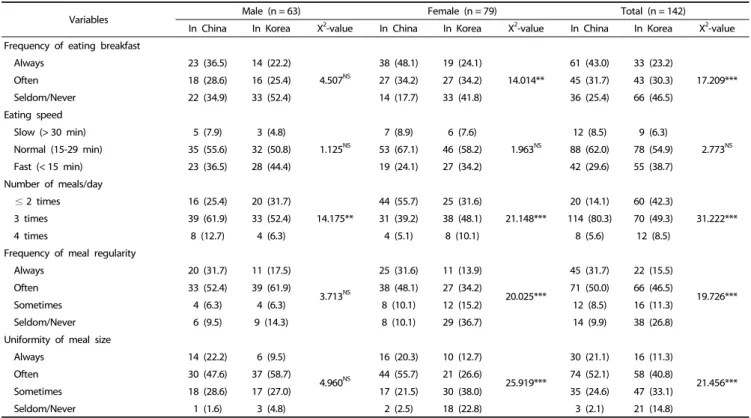
For the frequency of eating breakfast, the proportion of subjects who answered ‘always eat breakfast’ decreased from 43.0% in China to 23.2% in South Korea, while subjects who responded ‘seldom or never eat breakfast’ significantly increased from 25.4% to 46.5% (Table 4). For the number of meals per day, 80.3% of subjects responded that ‘they had 3 meals a day’
in China, while only 49.3% of subjects said that ‘they had 3 meals a day’ in South Korea. Additionally, respondents who had
≤ 2 meals a day significantly increased from 14.1% in China
to 42.3% in South Korea. For the frequency of meal regularity,
31.7% of the respondents answered that ‘they always had a
regular meal time’ in China, while the proportion decreased to
Variables Male (n = 63) Female (n = 79) Total (n = 142)
Before After X2-value Before After X2-value Before After X2-value
Frequency of eating vegetables per day
≤ 1 time 10 (15.9) 20 (31.7)
12.793**
13 (16.5) 46 (58.2)
32.309***
23 (16.2) 66 (46.5)
37.933***
2 times 11 (17.5) 21 (33.3) 23 (29.1) 14 (17.7) 34 (23.9) 35 (24.6)
3 times 33 (52.4) 18 (28.6) 30 (38.0) 17 (21.5) 63 (44.4) 35 (24.6)
≥ 4 times 9 (14.3) 4 (6.3) 13 (16.5) 2 (2.5) 22 (15.5) 6 (4.2)
Frequency of eating fruits per day
Almost never eat 13 (20.6) 35 (55.6)
25.342***
8 (10.1) 16 (20.3)
38.000***
21 (14.8) 51 (35.9)
56.076***
1 time 19 (30.2) 21 (33.3) 19 (24.1) 43 (54.4) 38 (26.8) 64 (45.1)
2 times 13 (20.6) 3 (4.8) 27 (34.2) 20 (25.3) 40 (28.2) 23 (16.2)
≥ 3 times 18 (28.6) 4 (6.3) 25 (31.6) 0 (0.0) 43 (30.3) 4 (2.8)
Frequency of eating bread or instant noodles (instead of rice) per week
< 1 time 28 (44.4) 16 (25.4)
7.156NS
40 (50.6) 26 (32.9)
22.013***
68 (47.9) 42 (29.6)
25.563***
1-2 times 22 (34.9) 22 (34.9) 26 (32.9) 14 (17.7) 48 (33.8) 36 (25.4)
3-4 times 9 (14.3) 16 (25.4) 12 (15.2) 26 (32.9) 21 (14.8) 42 (29.6)
≥ 5 times 4 (6.3) 9 (14.3) 1 (1.3) 13 (16.5) 5 (3.5) 22 (15.5)
Frequency of fast food consumption
1-2 times/month 32 (50.8) 16 (25.4)
9.535*
46 (58.2) 35 (44.3)
9.068*
78 (54.9) 51 (35.9)
14.407**
3-4 times/month 22 (34.9) 32 (50.8) 28 (35.4) 27 (34.2) 50 (35.2) 59 (41.5)
2 times/week 6 (9.5) 7 (11.1) 5 (6.3) 13 (16.5) 11 (7.7) 20 (14.1)
≥ 3 times/week 3 (4.8) 8 (12.7) 0 (0.0) 4 (5.1) 3 (2.1) 12 (8.5)
Frequency of late-night snack consumption
≤ 2 times/month 43 (68.3) 15 (23.8)
25.988***
52 (65.8) 28 (35.4)
15.573***
95 (66.9) 43 (30.3)
39.998***
3-4 times/month 12 (19.0) 22 (34.9) 15 (19.0) 22 (27.8) 27 (19.0) 44 (31.0)
≥ 2 times/week 8 (12.7) 26 (41.3) 12 (15.2) 29 (36.7) 20 (14.1) 55 (38.7)
*P< 0.05, **P< 0.01, ***P< 0.001 significantly different by chi-square tests NS; Not statistically significant
Table 5. Changes in the food consumption patterns of Chinese international students
Variables Male (n = 63) Female (n = 79) t-value Total (n = 142)
Korean speaking 2.9 ± 1.0 3.1 ± 0.8 -1.091NS 3.0 ± 0.9
Satisfaction with language program at university 3.3 ± 0.6 3.4 ± 0.9 -1.360NS 3.4 ± 0.8
Contacts with Koreans 3.3 ± 0.9 3.0 ± 0.9 2.115* 3.1 ± 0.9
Participation in meetings with Koreans 3.0 ± 1.1 2.3 ± 1.1 3.539** 2.7 ± 1.2
Participation in social activities for students 2.5 ± 1.1 2.3 ± 1.0 1.043NS 2.4 ± 1.1
Understanding Korean drama and movies 3.1 ± 0.9 3.1 ± 1.0 0.080NS 3.1 ± 1.0
Understanding Korean newspapers 3.0 ± 1.0 2.9 ± 0.9 0.757NS 2.9 ± 1.0
Understanding lectures at university 3.0 ± 0.9 3.0 ± 0.9 -0.062NS 3.0 ± 0.9
Participation in a club or study meetings 2.2 ± 1.1 2.1 ± 1.1 0.918NS 2.1 ± 1.1
Mean acculturation score 2.9 ± 0.6 2.8 ± 0.6 1.171NS 2.9 ± 0.6
Mean ± SD
*P< 0.05, **P< 0.01 significantly different by independent t-tests NS; Not statistically significant
Table 6. Acculturation status of Chinese international students
15.5% in South Korea. Furthermore, the proportion of respondents who seldom or never had regular meal times substantially increased from 9.9% in China to 26.8% in South Korea. The proportion of subjects who ‘always had a regular sized meal’
was 21.1% before coming to South Korea and decreased to 11.3%.
Dietary pattern
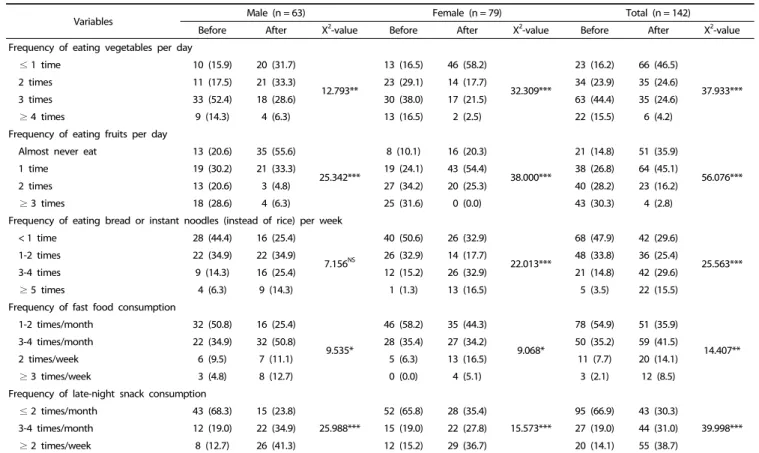
For the frequency of eating vegetables daily, the proportion of subjects who had vegetables three times per day declined from 44.4% in China to 24.6% in South Korea (Table 5). However,
there was a statistically significant increase from 16.2% to 46.5%
in the percentage of subjects that had vegetables ≤ 1 time per
day. Regarding the frequency of eating fruits daily, 30.3% of
respondents had fruits ≥ 3 times per day in China, but only
2.8% of them had fruits ≥ 3 times per day in South Korea. For
the weekly frequency of eating bread or instant noodles instead
of rice, almost half of the subjects consumed bread or instant
noodles ≤ 1 time per week in China, but the proportion of them
decreased from 47.9% in China to 29.6% in South Korea. We
also observed a statistically significant change in the frequency
of fast food consumption. The proportion of subjects who
Variables Low acculturation (n = 78) High acculturation (n = 64) X2-value Frequency of eating vegetables per day
≤ 1 time 33 (42.3) 33 (51.6)
1.66NS
2 times 20 (25.6) 15 (23.4)
3 times 22 (28.2) 13 (20.3)
≥ 4 times 3 (3.8) 3 (4.7)
Frequency of eating fruits per day
Almost never eat 29 (37.2) 22 (34.4)
2.80NS
1 time 33 (42.3) 31 (48.4)
2 times 15 (19.2) 8 (12.5)
≥ 3 times 1 (1.3) 3 (4.7)
Frequency of eating bread or instant noodles (instead of rice) per week
< 1 time 31 (39.7) 11 (17.2)
9.50*
1-2 times 16 (20.5) 20 (31.3)
3-4 times 22 (28.8) 20 (31.3)
≥ 5 times 9 (11.5) 13 (20.3)
Frequency of fast food consumption
1-2 times/month 29 (37.2) 22 (34.4)
0.34NS
3-4 times/month 32 (41.0) 27 (42.2)
2 times/week 10 (12.8) 10 (12.8)
≥ 3 times/week 9 (9.0) 7 (9.0)
Frequency of late-night snack consumption
≤ 2 times/month 23 (29.5) 20 (31.3)
3.32NS
3-4 times/month 20 (25.6) 24 (37.5)
≥ 2 times/week 35 (44.9) 20 (31.3)
*P< 0.05 significantly different by chi-square tests NS; Not statistically significant
Table 7. Changes in the food consumption patterns of Chinese international students
Fig. 1. Proportion of eating out frequency by participation in meeting with Koreans
consumed fast food 2 times per week increased from 7.7%
before immigrating to 14.1% after immigrating to South Korea.
In addition, 2.1% of subjects who consumed fast food ≥ 3 times per week in China increased to 8.5% in South Korea. Similarly, for the frequency of late-night snack consumption, the proportion of respondents consumed late-night snacks ≥ 2 times per week increased from 14.1% in China to 38.0% in South Korea.
Acculturation
The mean acculturation score of all subjects was 2.9, which shows a reasonably bicultural acculturation (Table 6). Male Chinese international students had a higher mean acculturation score than female students (2.9 vs. 2.8), but the difference was not significant. More specifically, for contacts with Koreans, male students had a higher mean score than female students (3.3 vs. 3.0). Additionally, for participation in meetings with Koreans, the mean score was higher in males than in females (3.0 vs.
2.3). The groups did not show any significant difference in the other components: Korean speaking ability, satisfaction with language programs at the university, participation in social activities for students, understanding Korean dramas and movies, understanding Korean newspapers, understanding lectures at the university, and participation in a club or study meetings.
For the frequency of eating out, the proportion of subjects who responded ‘≥ 2 times/week’ significantly increased from 43.8%
for the subjects who seldom or never participated in meeting with Koreans to 59.4% for the subjects who always or often
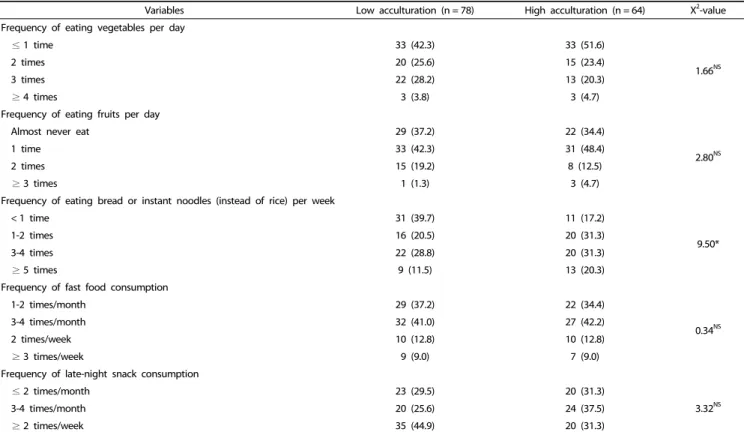
participated (P < 0.05) (Fig. 1). We also found highly acculturated group consumed more frequently bread and instant noodles compared with less acculturated group (P < 0.05) (Table 7).
Predictors of overweight and obese Chinese students compared to normal weight subjects
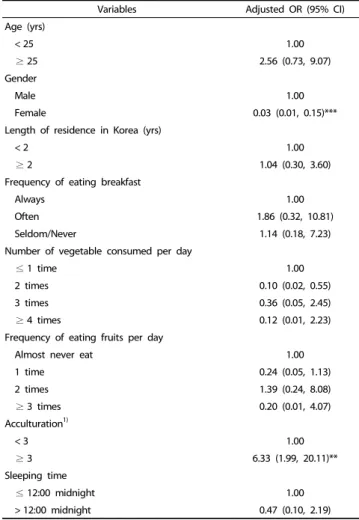
We observed that overweight and obese subjects were more
likely to be male and be of a higher acculturation group
Variables Adjusted OR (95% CI) Age (yrs)
< 25 1.00
≥ 25 2.56 (0.73, 9.07)
Gender
Male 1.00
Female 0.03 (0.01, 0.15)***
Length of residence in Korea (yrs)
< 2 1.00
≥ 2 1.04 (0.30, 3.60)
Frequency of eating breakfast
Always 1.00
Often 1.86 (0.32, 10.81)
Seldom/Never 1.14 (0.18, 7.23)
Number of vegetable consumed per day
≤ 1 time 1.00
2 times 0.10 (0.02, 0.55)
3 times 0.36 (0.05, 2.45)
≥ 4 times 0.12 (0.01, 2.23)
Frequency of eating fruits per day
Almost never eat 1.00
1 time 0.24 (0.05, 1.13)
2 times 1.39 (0.24, 8.08)
≥ 3 times 0.20 (0.01, 4.07)
Acculturation1)
< 3 1.00
≥ 3 6.33 (1.99, 20.11)**
Sleeping time
≤ 12:00 midnight 1.00
> 12:00 midnight 0.47 (0.10, 2.19)
1)Mean acculturation score
**P< 0.01, ***P< 0.001 significantly different according to the logistic regression model
Table 8. Predictors of overweight and obese Chinese students (n = 39) compared to normal-weight subjects (n = 86)
compared with normal weight subjects (Table 8). There was no significant association between overweight subjects and other explanatory factors, such as age, length of residence in South Korea, eating breakfast, consumption of vegetables and fruits and sleeping time.
DISCUSSION
We conducted this study to examine changes in the dietary behavior, anthropometric characteristics and food consumption patterns of Chinese international students before and after immigrating to South Korea. The total number of study subjects was 142 Chinese international students, including 63 male students and 79 female students. To summarize the results of this study, we found that Chinese international students practiced unhealthier dietary behaviors when they lived in South Korea compared to when they lived in China. We found that there was a decrease in the frequency of eating breakfast, meal time regularity and the uniformity of meal size after Chinese international students immigrated to South Korea. In addition, we observed that there was an increase in study subjects’ eating
speed and their tendency to skip meals while they lived in South Korea compared to when they lived in China. Weight and BMI for male Chinese students significantly increased in South Korea compared to those in China, but there was no significant difference in female subjects. Different food environments between China and Korea would result in a change in dietary behaviors before and after studying abroad for Chinese interna- tional students.
In this research, after the study subjects immigrated to South Korea, there was a significant increase in the frequency of the consumption of fast food, processed foods, and late-night snacks. The number of convenience stores in South Korea has increased remarkably from 12,000 in 2009 to 23,000 stores in 2013, a 90% increase [23]. Convenience stores sell diverse types of ready-to-eat meals and instant food, such as instant noodles, dried seaweed rolls, fish cake soup, fried chicken and hamburgers.
Instant food is appealing to university students due to its easy access, taste and relatively low cost, although overconsumption of instant food can result in weight gain, leading to obesity [24]. When Xu et al. [25] examined the exposure to fast-food restaurants and weight changes, they found that the number of Western fast-food restaurants was positively associated with increases in the waist-to-hip and waist-to-height ratio of the rural Chinese population. Additionally, late-night meal delivery services are readily available in the area around universities and are also popular among university students in South Korea.
Late-night snacking increases calorie consumption and contains low quantities of micronutrients, such as vitamins and minerals [26]. This finding implies that a nutrition intervention is urgently needed to reduce the prevalence of overweight and obese male Chinese international students in South Korea. Given the suggestive associations between changes in the dietary behaviors, food environments and weight changes in male Chinese international students, health professionals would be well advised to monitor the growth of convenience stores, fast-food restau- rants and late night food delivery services and examine their implications in future studies.
Chinese international students showed an increase in skipping meals, eating speed, and eating at irregular times and a decrease in the frequency of fruit and vegetable consumption after migration to South Korea. Unhealthy eating habits and unhealthy dietary patterns were more common among Chinese students after migration than before migration. This unfavo- rable diet change could result from living away from their parents' homes [27]. Without establishing healthy eating habits when they lived with their parents, migration to a new environ- ment could worsen students’ eating habits due to a lack of knowledge, cooking skills, and self-efficacy. Another explanation for these dietary changes may be the limited budget of international students and fruits and vegetables that are more expensive in the host country than in their home country [28].
Taking the independent lifestyle of international students into consideration, nutrition interventions may be critical to guide students in making their own healthy eating decisions for long-term nutrition.
Contrary to our expectations, there was no significant
association between migration and weight in female Chinese
international students. One possible explanation is that female
students have adopted diet behavior changes influenced by mass-media and peer-pressure rather than the food environment.
Lim [8] reported that Chinese female international students felt that Korean female university students paid too much attention to their physical appearance. Previous research shows that even if most female college students were categorized as under- weight or normal weight, 93% of subjects wanted to be underweight [29]. The gap between the real and ideal BMI negatively affects the self-esteem of the female college students [30]. The findings of this study also show that the prevalence of being overweight and obese significantly increased for male Chinese students after migrating to South Korea, but not for female Chinese students. When each variable of the accultura- tion index was closely examined, we found that the mean score of ‘contact with Koreans’ and ‘participation in meeting with Koreans’ was significantly higher for Chinese male students than for Chinese female students. Social relationships with more Koreans could give Chinese male students more opportunities to eat out. When eating out, restaurants usually provide energy- dense foods and large portion sizes [31]. Without control over their overconsumption of high calorie foods, this could result in weight gain and obesity.
The limitations of this research include the absence of information on individual ethnicity. Asano et al. [32] reported that Han Chinese female married immigrants did not show any statistically significant difference in food intake, dietary habits and dietary acculturation compared with the Korean-Chinese subjects after immigration to South Korea. The ethnicity of Chinese international students may differently affect dietary habits, acculturation and anthropometric parameters due to dissimilar food availability and accessibility. We could not investigate any changes in dietary practice and anthropometric characteristics by ethnicity, however, because of the absence of individual ethnicity information. Accordingly, we need to conduct a further study to examine the impact of acculturation on diet and anthropometric measures among ethnic groups.
This will provide useful information to design a nutrition intervention program.
A previous study indicated that Chinese students would be more satisfied with diverse menus and cooking methods for international students and better nutritional value in meals served by schools [18,31]. Guo et al. [33] suggested that nutrition education focused on individual energy needs and food exchange units to improve knowledge of nutrition, dietary attitude and intake in South Korea would be effective for Chinese college students. Taking into account the rapid increase of Chinese international students as one of the most nutri- tionally vulnerable groups, it is urgent to take action to intervene in their nutritional problems. First, for those who use a school cafeteria, menus could be offered with the dishes written in English or in their own language, with the nutritional value of the dishes displayed; additionally, a special event, such as a 'Chinese day', could be organized to serve Chinese cuisine.
Second, for those who live in a dormitory, it would be very useful to provide a kitchen equipped with gas, cooking utensils, and a refrigerator. This would increase the opportunity for international students to cook healthier meals in a dormitory.
Third, it would be advantageous to offer nutrition education
to Chinese international students. Nutrition education would include information on how to make healthier choices when eating out, how to read the nutritional labels of processed foods, and so on. It is important to support Chinese interna- tional students in keeping healthful dietary habits from their own country and to encourage them to adopt dietary behaviors that are nutritionally sound in a new food environment.
REFERENCES
1. Park MS. Analysis on life-adaptation situation of Chinese students in Korea: focused on Daegu city and Gyeongsang provinces [master's thesis]. Daegu: Keimyung University; 2010.
2. Cho H, Jon KT. Factors associated with living satisfaction of studying in Korean universities. J Ins Soc Sci 2009;20:193-223.
3. Ha JH. A qualitative study on Chinese students' adaptation to Korean college life. Korean J Couns Psychother 2008;20:473-96.
4. Hamboyan H, Bryan AK. International students. Culture shock can affect the health of students from abroad. Can Fam Physician 1995;41:1713-6.
5. Kim HK, Son YJ, Lee MR, Lim KC, Chang HK, Han SJ, Yang NY, Yoo MR, Ko EJ. Predictors of acculturative stress among Chinese students in Korea. J Korean Acad Adult Nurs 2010;22:143-52.
6. Kim MK, Kim KS. A study of Chinese students' acculturative stress, depression influencing on drinking problem and social maladapation- moderating effect of ego resilience. Asian J Child Welf Dev 2014;
12:23-41.
7. Yoo MR, Choi SY, Kim YM, Han SJ, Yang NY, Kim HK, Chang HK, Lee MR, Son YJ. Acculturative stress, resilience, and depression among Chinese students in Korea. J Korean Acad Soc Nurs Educ 2013;19:320-9.
8. Lim C. Acculturative stresses and adjustment elements of Chinese students' studying in Korea. J Korean Living Sci Assoc 2009;18:
93-112.
9. Zhu JF. Lifestyle changes and acculturative stress of Chinese international students living in Korea [master's thesis]. Seoul:
Chungang University; 2012.
10. Statistics Korea. International student statistics in South Korea [Internet]. Daejeon: Statistics Korea; 2014 [cited 2015 March 30].
Available from: http://kosis.kr/.
11. Tserendejid Z, Hwang J, Lee J, Park H. The consumption of more vegetables and less meat is associated with higher levels of acculturation among Mongolians in South Korea. Nutr Res 2013;33:1019-25.
12. Liu A, Berhane Z, Tseng M. Improved dietary variety and adequacy but lower dietary moderation with acculturation in Chinese women in the United States. J Am Diet Assoc 2010;110:457-62.
13. Rosenmöller DL, Gasevic D, Seidell J, Lear SA. Determinants of changes in dietary patterns among Chinese immigrants: a cross- sectional analysis. Int J Behav Nutr Phys Act 2011;8:42.
14. Pan YL, Dixon Z, Himburg S, Huffman F. Asian students change their eating patterns after living in the United States. J Am Diet Assoc 1999;99:54-7.
15. Jung HY, Jeon ER. Preference for Korean food and satisfaction of dormitory foodservice by Chinese students studying at Mokpo National University. J Korean Soc Food Sci Nutr 2011;40:283-9.
16. Li G. The change of dietary environment and snacking habits of Chinese students in South Korea [master's thesis]. Sungnam:
Gachon University; 2013.
17. Song JS, Moon SJ. Survey of Chinese university or college students' preference for and satisfaction with Korean food in Daegu and Gyeongbuk. Korean J Food Cult 2011;26:113-9.
18. Ryu SH, Cho YH, Han YR. Adaptation for Korean foods and satisfaction for foodservice by different residence periods of Chinese and Japanese university students in Daejeon. J East Asian Soc Diet Life 2014;24:143-55.
19. Ha KH. Survey of Korean food acknowledgement and preference by Chinese students in Daejeon. Korean J Food Nutr 2010;23:186-95.
20. Her ES, Park HJ. Interrelations among acculturative stress and, recognitions, preferences and eating frequency of Korean traditional food by Chinese students in Korea. Korean J Food Nutr 2013;26:
216-25.
21. World Health Organization. Definition of terms. In: Western Pacific Country Health Information Profiles: 2011 Revision. Manila: World Health Organization Western Pacific Region; 2011. p.541-42.
22. Lu WF. Acculturation and changes in dietary habits of Chinese students living in Korea [master's thesis]. Seoul: Myongji University;
2012.
23. Kim BR. Rapid growth of convenience stores. Hankyung Bus 2014;
983:44-45.
24. Akpalu W, Zhang X. WP/2014/139 Fast-Food Consumption and Child Body Mass Index in China: Application of an Endogenous Switching Regression Model. Helsinki: UNU-WIDER; 2014.
25. Xu H, Short SE, Liu T. Dynamic relations between fast-food restaurant and body weight status: a longitudinal and multilevel
analysis of Chinese adults. J Epidemiol Community Health 2013;67:
271-9.
26. Hong SH, Yeon JY, Bae YJ. Relationship among night eating and nutrient intakes status in university students. J East Asian Soc Diet Life 2013;23:297-310.
27. Gaowei, Kim S, Chang N, Kim KN. Dietary behavior and nutritional status among Chinese female college students residing in Korea.
Korean J Nutr 2013;46:177-85.
28. Perez-Cueto F, Verbeke W, Lachat C, Remaut-De Winter AM.
Changes in dietary habits following temporal migration. The case of international students in Belgium. Appetite 2009;52:83-8.
29. Yook KY, Yun JW, Kim KH, Suh SY, Park JH. The relationship between body-image discrepancy and psychological well-being in female college students. Korean J Woman Psychol 2009;14:665-82.
30. Kim EJ. Self-esteem according to differences between real and ideal body mass index in female college students. J East West Nurs Res 2008;14:54-9.
31. Bezerra IN, Curioni C, Sichieri R. Association between eating out of home and body weight. Nutr Rev 2012;70:65-79.
32. Asano K, Yoon J, Ryu SH. Chinese female marriage immigrants' dietary life after immigration to Korea: comparison between Han- Chinese and Korean-Chinese. Korean J Community Nutr 2014;19:
317-27.
33. Guo JL, Kim SK, Kim JW, Kim MH, Kim SN, Kim SB. Effects of nutrition education for Chinese college students in Korea: focused on personalized daily energy requirement and food exchange units.
Korean J Community Nutr 2013;18:565-76.