321
Open Access
Interleukin-6 (-636 C/G) Gene Polymorphism in Korean Children With Kawasaki Disease
Hye Mi Ahn, MD
1, In Sook Park, MD
2, Soo-Jong Hong, MD
2, and Young Mi Hong, MD
11
Department of Pediatrics, School of Medicine, Ewha Womans University, Seoul,
2
Department of Pediatrics, College of Medicine, University of Ulsan, Seoul, Korea
ABSTRACT
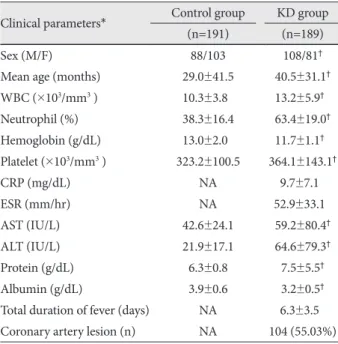
Background and Objectives: Kawasaki disease (KD) is a multi-systemic vasculitis with coronary artery involvement. Se- rum interleukin (IL)-6 levels during acute phase showed a significant correlation with the duration of fever in patients with KD who were not treated with intravenous immunoglobulin (IVIG), suggesting that the regulation of IL-6 expression in KD patients may differ from that in normal children. However, there are controversies surrounding the association between IL-6 (-636 C/G) gene polymorphism and development of KD. Subjects and Methods: One hundred and nine children with KD and 191 children with congenital heart disease were included in this study. Echocardiography was performed to examine cardiac involvement in patients with KD. Genotyping of the IL-6 (-636 C/G) gene polymorphism was performed using the single-base extension method, and serum IL-6 concentrations were estimated using the sandwich enzyme immu- noassay method. Results: Neutrophil, platelet count, liver function test, total protein and albumin concentrations were sig- nificantly different in the KD group and the serum IL-6 concentration was significantly higher in the KD group than the con- trol group. There was no difference between the patients with coronary arterial dilatation (CAD) and those without CAD in the IL-6 (-636 C/G) polymorphism. The serum albumin concentration was significantly lower in patients with KD who had the -636 C/G or GG genotype compared with the control group. The serum IL-6 concentration was significantly higher in pa- tients with KD who had the -636 C/G or GG genotype. Conclusion: There was no association between the IL-6 (-636 C/G) gene polymorphism and development of coronary arterial lesions in KD. Further multicenter studies are required to establish the relationship between the IL-6 (-636 C/G) gene polymorphism and development of KD. (Korean Circ J 2011;41:321-326) KEY WORDS: Mucocutaneous lymph node syndrome; Interleukins; Polymorphism, genetic.
Received: August 1, 2010
Revision Received: September 14, 2010 Accepted: October 24, 2010
Correspondence: Young Mi Hong, MD, Department of Pediatrics, School of Medicine, Ewha Womans University, 911-1, Mok-dong, Yangcheon- gu, Seoul 158-710, Korea
Tel: 82-2-2650-2841, Fax: 82-2-2653-3718 E-mail: [email protected]
• The authors have no financial conflicts of interest.
cc