• 검색 결과가 없습니다.

Impact of Multivessel Coronary Disease With Chronic Total Occlusion on One-Year Mortality in Patients With Acute Myocardial Infarction

N/A
N/A
Protected

Academic year: 2022

Share "Impact of Multivessel Coronary Disease With Chronic Total Occlusion on One-Year Mortality in Patients With Acute Myocardial Infarction"

Copied!
5
0
0

로드 중.... (전체 텍스트 보기)

전체 글

(1)

Korean Circulation Journal

Introduction

The incidence of multivessel disease (MVD) in patients with acute myocardial infarction (AMI) is reported to be 40-50%. The morbid- ity and mortality are higher in patients with MVD versus single ves- sel disease (SVD).

1-6)

Chronic total occlusion (CTO) is commonly fo-

Print ISSN 1738-5520 • On-line ISSN 1738-5555

Impact of Multivessel Coronary Disease With Chronic Total Occlusion on One-Year Mortality in Patients With Acute Myocardial Infarction

Ju Hwan Lee, MD 1,2 , Hun Sik Park, MD 1 , Hyeon Min Ryu, MD 2 , Hyunsang Lee, MD 2 , Myung Hwan Bae, MD 1 , Jang Hoon Lee, MD 1 , Dong Heon Yang, MD 1 , Yongkeun Cho, MD 1 , Shung Chull Chae, MD 1 , and Jae-Eun Jun, MD 1

1

Department of Internal Medicine, Kyungpook National University School of Medicine, Daegu,

2
Department of Internal Medicine, Gumi CHA Hospital, Gumi, Korea

Background and Objectives: The impact of multivessel coronary disease (MVD) with chronic total occlusion (CTO) on one-year mortality in patients with acute myocardial infarction (AMI) is not clearly known. We investigated the impact of MVD with concurrent CTO lesion on one-year mortality in patients with AMI.

Subjects and Methods: We studied 1008 consecutive patients who underwent coronary angiography between November 2005 and De- cember 2008 with a diagnosis of AMI.

Results: Among 1008 patients, 432 patients (43%) had MVD, and 88 patients (8.7%) had CTO lesion. The one-year overall mortality was higher in patients with MVD than in patients with single vessel disease (SVD) (10.2% vs. 5.9%, p=0.012). However, the one-year overall mor- tality was not significantly higher in patients with CTO lesion than in patients without that lesion (12.5% vs. 7.3%, p=0.080). In multivariate analysis, independent predictors of one-year overall mortality were age older than 65 years {hazard ratio (HR) 2.41, 95% confidence inter- val (CI): 1.43 to 4.08}, Killip class ≥III (HR 3.59, 95% CI: 2.24 to 5.77), ST-elevation myocardial infarction (HR 2.45, 95% CI: 1.49 to 4.05) and MVD (HR 1.76, 95% CI: 1.07 to 2.89).

Conclusion: Patients with MVD showed higher one-year mortality than patients with SVD. However, the presence of CTO was not an inde- pendent predictor of one-year mortality in this study that included patients with successfully revascularized CTO lesion. (Korean Circ J 2012;42:95-99)

KEY WORDS: Coronary occlusion; Myocardial infarction; Chronic disease; Prognosis.

Received: April 25, 2011 Revision Received: June 20, 2011 Accepted: September 23, 2011

Correspondence: Hun Sik Park, MD, Department of Internal Medicine, Kyungpook National University School of Medicine, 130 Dongdeok-ro, Jung- gu, Daegu 700-721, Korea

Tel: 82-53-420-5529, Fax: 82-53-426-2046 E-mail: [email protected]

• The authors have no financial conflicts of interest.

This is an Open Access article distributed under the terms of the Creative Commons Attribution Non-Commercial License (http://creativecommons.

org/licenses/by-nc/3.0) which permits unrestricted non-commercial use, distribution, and reproduction in any medium, provided the original work is properly cited.

und on diagnostic angiography in patients with coronary artery dise- ase.

7)8)

Recent studies have shown that the effects of MVD on long term mortality are due to the presence of CTO in a noninfarct-re- lated artery.

9)10)

These findings suggest that CTO lesion in a non-in- farct related artery was a modifiable risk factor for mortality after AMI. However, successfully opened CTO lesions were not included in these studies. Therefore, we investigated the impact of MVD with CTO lesion on 12-month mortality in patients with AMI, including successfully opened lesions.

Subjects and Methods

Patients

Between November 2005 and December 2008, 1094 patients with

a diagnosis of AMI underwent coronary angiogram at Kyungpook

National University Hospital in Daegu, Korea. Of these patients, 21

patients who had undergone coronary bypass surgery within 30

days after index hospitalization were excluded from the study. Also

(2)

excluded were 65 patients who did not provide 12-month clinical fol- low-up data. Therefore, data on 1008 patients were retrospectively analyzed in this study.

Definition

Acute myocardial infarction was defined by the World Health Or- ganization criteria incorporating clincial features, elevated bioche- mistry markers and electrocardiographic findings.

11)

ST-segment elevation myocardial infarction (STEMI) was defined as a new ST ele- vation in ≥2 contiguous leads, measuring >0.2 mV in leads V

1

to V

3

, or 0.1 mV in all other leads. Killip class was defined at admission.

Left ventricular ejection fraction (LVEF) was measured by 2-dimen- sional echocardiogram. MVD was defined as visually assessed ≥70%

diameter stenosis of at least one of the non-infarct-related arteries.

CTO was defined as total occlusion of an estimated duration of >3 months. Identical angiographic criteria with regard to vessel size (≥2.5 mm) and coronary artery lesion were used to qualify for the presence of MVD and/or a CTO. The duration of the occlusion was estimated from clinical events such as myocardial infarction and sudden onset or worsening of the symptoms or was proven by pre- vious angiography. In patients without a history of angina and with a definite identification of the culprit vessel, associated total oc- clusion of a non-culprit vessel was considered a chronic occlusion if there was angiographic evidence of filling of the vessel through col- laterals. If the duration of the occlusion was uncertain and the in- vestigators had no clear reason to estimate the CTO <3 months, the patient was included.

Treatment

Primary percutaneous coronary intervention (PCI), thrombolysis, or conservative treatment was used as the initial treatment strate- gy for patients with STEMI at the discretion of the attending doctor.

For patients with non-STEMI (NSTEMI), the initial treatment strate- gy was early invasive PCI or conservative treatment according to the American College of Cardiology and the American Heart Asso- ciation guidelines for the management of patients with acute cor- onary syndrome. Prescription of evidence-based medications was encouraged whenever clinically indicated.

Primary outcomes

The primary outcome for the present analysis was all-cause 12- month mortality. During the follow-up period, follow-up data were obtained by reviewing medical records and by telephone interview with patients.

Statistical analysis

Data are expressed as mean±SD for continuous variables and

percentages for categorical variables. All comparisons between baseline variables were assessed with the Student’s t-test for con- tinuous variables and the Pearson’s Chi-square test for categorical variables. Cumulative survival curves were constructed according to the Kaplan-Meier method, and significance of differences be- tween the curves were calculated by log-rank test. Cox proportion- al-hazards model was used to determine independent predictors of all-cause death. Univariate predictors of 12-month mortality were included in the multivariate cox proportional analysis. Age (≥65 years) was dichotomised for the multivariate analysis. For all analy- ses, a two-sided p<0.05 was considered statistically significant. St- atistical analysis was performed using Statistical Package for the Social Sciences (SPSS) version 12.0 (SPSS Inc., Chicago, IL, USA).

Results

The mean age was 63±11 years, and 698 patients (69%) were men.

Among all patients, 432 patients (43%) had MVD. The baseline ch- aracteristics of the patients are listed in Table 1. Patients with MVD were older than patients with SVD (64.7±10.6 years vs. 61.5±11.8 years, p<0.001). A history of hypertension or diabetes was more com- mon in patients with MVD than in those with SVD (54.0% vs. 37.5%, p<0.001; 36.4% vs. 22.9%, p<0.001). Previous myocardial infarction (MI) was also more frequent in patients with MVD (9.3% vs. 3.8%, p<0.001). However, the prevalence of smoking was lower in patients with MVD than in those with SVD (60.9% vs. 68.0%, p=0.022). STEMI was more prevalent in patients with SVD (60.5% vs. 41.0%, p<0.001).

The LVEF was lower (50.8±11.0% vs. 53.2±9.8%, p=0.001) and Killip class III or IV was more common in patients with MVD than in those with SVD (20.6% vs.12.2%, p=0.001). The left anterior descending Table 1. Characteristics of 1008 patients with and without multivessel cor- onary disease

Variable Coronary arteries narrowed 1 (n=576) >1 (n=432) p

Age (years) 61.5±11.8 64.7±10.6 <0.001

Men (%) 401 (70) 297 (68.8) 0.675

Hypertension (%) 215 (37.5) 230 (54.0) <0.001

Smoker (%) 383 (68.0) 248 (60.9) 0.022

Diabetes mellitus (%) 131 (22.9) 155 (36.4) <0.001

Hyperlipidemia (%) 169 (32.5) 114 (30.1) 0.440

Previous MI (%) 22 (3.8) 40 (9.3) <0.001

Ejection fraction 53.2±9.8 50.8±11.0 0.001

Killip class ≥III (%) 66 (12.2) 82 (20.6) 0.001

STEMI (%) 347 (60.5) 177 (41.0) <0.001

MI related to LAD (%) 272 (47.8) 147 (35.5) <0.001

MI: myocardial infarction, STEMI: ST-segment elevation MI, LAD: left ante-

rior descending artery

(3)

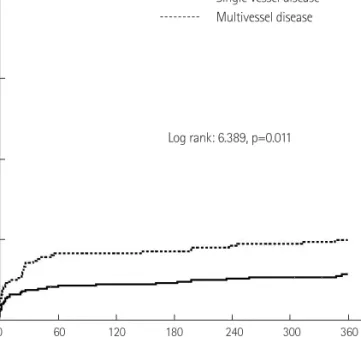
artery was the most frequent infarct-related lesion in SVD (47.8%), compared to the right coronary artery in MVD (35.6%). There was no significant difference in gender or the prevalence of hyperlipidemia between the two groups. Twelve-month clinical follow-up outcomes are listed in Table 2. During the 12-month follow-up, 78 patients died (7.7%). The overall mortality in patients with MVD was higher than that in patients with SVD (10.2% vs. 5.9%, p=0.012). The car- diac mortality was also higher in patients with MVD (9.5% vs. 4.7%, p=0.003). Kaplan-Meier survival estimates for 12-month mortality in patients with MVD and SVD are shown in Fig. 1.

Among the 1008 patients, 88 (8.7%) patients had CTO lesion. CTO PCI was attempted in 60 (68%) patients. Successful opening was obtained in 66% of the attempted cases. Clinical characteristics are presented in Table 3. Patients with CTO lesion were older than patients without CTO lesion (65.7±10.2 years vs. 62.6±11.5 years, p=0.015). A history of diabetes (41.9% vs. 27.4%, p=0.005) or previ- ous MI (21.6% vs. 4.7%, p<0.001) was more common in patients with CTO lesion than in those without that lesion. The frequency of STEMI was lower in patients with CTO lesion (29.5% vs. 54.2%, p<0.001).

The LVEF was also lower in patients with CTO lesion (49.1±10.3% vs.

52.5±10.3%, p=0.006). Killip class III or IV was also more common

in patients with CTO lesion (27.4% vs. 14.6%, p=0.002). There was no significant difference in gender or the prevalence of hyperten- sion, smoking and hyperlipidemia between the two groups. The frequency of left anterior descending artery as the infarct-related artery was also similar between the two groups.

Twelve-month overall mortality was not significantly higher in patients with CTO lesion than in patients without that lesion (12.5%

vs. 7.3%, p=0.080). However, cardiac mortality was higher in pa- tients with CTO lesion (12.5% vs. 6.2%, p=0.024). Kaplan-Meier sur- vival estimates for 12- month mortality in patients with or without CTO are shown in Fig. 2.

To examine the independent prognostic value of CTO, multivari- ate analysis was performed (Table 4). Independent predictors of one-year overall mortality were: age older than 65 years {hazard ra- tio (HR) 2.41, 95% confidence interval (CI): 1.43 to 4.08}, Killip class

≥III (HR 3.59, 95% CI: 2.24 to 5.77), STEMI (HR 2.45, 95% CI: 1.49 to 4.05) and MVD (HR 1.76, 95% CI: 1.07 to 2.89). Independent pre- dictors of one-year cardiac death were age older than 65 years (HR 2.50, 95% CI: 1.42 to 4.39), Killip class ≥III (HR 3.55, 95% CI: 2.14 to 5.90), STEMI (HR 3.16, 95% CI: 1.81 to 5.53) and MVD (HR 2.11, 95% CI: 1.23 to 3.61) (Table 4). The presence of CTO was not a signifi- Table 2. Twelve-month clinical outcome

MVD

p

CTO

p

CTO PCI No p

(n=576)

Yes (n=432)

No (n=920)

Yes (n=88)

Group A (n=40)

Group B (n=48)

Overall mortality (%) 34 (5.9) 44 (10.2) 0.012 67 (7.3) 11 (12.5) 0.080 0 11 (22.9) 0.001

Cardiac mortality (%) 27 (4.7) 41 (9.5) 0.003 57 (6.2) 11 (12.5) 0.024 0 11 (22.9) 0.001

MVD: multivessel disease, CTO: chronic total occlusion, PCI: percutaneous coronary intervention, Group A: CTO PCI success, Group B: CTO PCI failure (n=12)/

non-attempt (n=36)

Fig. 1. Twelve-month the overall mortality.

40

30

20

10

0

Follow up (days)

M or ta lit y (% )

0 60 120 180 240 300 360 Log rank: 6.389, p=0.011

Table 3. Characteristics of 1008 patients with and without a chronic total occlusion

Variable Chronic total occlusion

No (n=920) Yes (n=88) p

Age (years) 62.6±11.5 65.7±10.2 0.015

Men (%) 635 (69.2) 63 (71.6) 0.648

Hypertension (%) 399 (43.6) 46 (54.1) 0.062

Smoker (%) 579 (65.3) 52 (62.7) 0.631

Diabetes mellitus (%) 250 (27.4) 36 (41.9) 0.005

Hyperlipidemia (%) 265 (32.3) 18 (22.8) 0.081

Previous MI (%) 43 (4.7) 19 (21.6) <0.001

Ejection fraction 52.5±10.3 49.1±10.3 0.006

Killip class ≥III (%) 125 (14.6) 23 (27.4) 0.002

STEMI (%) 498 (54.2) 26 (29.5) <0.001

MI related to LAD (%) 384 (42.7) 35 (41.7) 0.853 MI: myocardial infarction, STEMI: ST-segment elevation MI, LAD: left ante- rior descending artery

Single vessel disease

Multivessel disease

(4)

cant predictor of one-year mortality or cardiac death.

Discussion

The purpose of this study was to determine the impact of MVD with CTO on one-year mortality in patients with AMI. Results of the

present study are in line with those of a previous study demon- strating that patients with MVD had a higher one-year mortality than SVD patients. There were several differences in the baseline ch- aracteristics between patients with and without MVD. Patients with MVD were older and had a more frequent history of diabetes, hyper- tension or previous MI, and a lower LVEF than SVD patients. There- fore, the mortality difference could be explained by a higher preval- ence of associated risk factors in patients with MVD.

In this study, CTO lesion was present in 8% of all study patients and in 20% of patients with MVD. CTO PCI was attempted in 60 (68%) patients. Successful opening was obtained in 66% of the at- tempted cases. Patients with CTO lesion were older, more often dia- betic, and had more unfavorable Killip class compared with patients without that lesion. Of note, STEMI was more frequent in patients without CTO lesion. Among the 88 patients with CTO lesion, there were 11 deaths, all of which were of cardiac origin. We found that the presence of CTO was not a significant predictor of one-year ov- erall mortality and cardiac mortality of AMI patients. These findings are in contrast to the results of van der Schaaf et al.

9)

They insisted that the presence of a CTO, but not the mere presence of MVD, was an independent predictor of one-year mortality. Moreover, they also evaluated the effects of a concurrent CTO on long-term mortality and left ventricular function.

12)

They found that the presence of CTO lesion, but not MVD alone, was associated with long-term mortality Table 4. Predictors of 12-month mortality

Predictor Univariate analysis Multivariate analysis

HR 95% CI p HR 95% CI p

All cause death

Age >65 3.42 2.08-5.65 <0.001 2.41 1.43-4.08 0.001

Male 0.496 0.32-0.77 0.002 0.68 0.42-1.07 0.096

Diabetes mellitus 1.324 0.83-2.11 0.238 1.05 0.65-1.71 0.835

Previous MI 1.037 0.42-2.57 0.938 1.35 0.53-3.44 0.526

Killip class ≥III 5.119 3.27-8.01 <0.000 3.59 2.24-5.77 <0.001

STEMI 2.154 1.33-3.48 0.002 2.45 1.49-4.05 <0.001

MVD 1.766 1.13-2.76 0.013 1.76 1.07-2.89 0.026

Presence of CTO 1.786 0.94-3.38 0.075 1.20 0.59-2.42 0.618

Cardiac death

Age >65 3.487 2.04-5.98 <0.000 2.50 1.42-4.39 0.001

Male 0.540 0.34-0.87 0.012 0.74 0.45-1.22 0.234

Diabetes mellitus 1.362 0.83-2.24 0.223 1.07 0.63-1.79 0.810

Previous MI 0.945 0.34-2.59 0.912 1.53 0.54-4.32 0.424

Killip class ≥III 5.261 3.26-8.50 <0.000 3.55 2.14-5.90 <0.001

STEMI 2.653 1.55-4.55 <0.000 3.16 1.81-5.53 <0.001

MVD 2.068 1.27-3.36 0.003 2.11 1.23-3.61 0.007

Presence of CTO 2.092 1.10-3.99 0.025 1.36 0.66-2.77 0.403

MI: myocardial infarction, MVD: multivessel disease, STEMI: ST-segment elevation MI, CTO: Chronic total occlusion, HR: hazard ratio, CI: confidence interval Fig. 2. Twelve-month mortality according to presence of chronic total oc-

clusion.

40

30

20

10

0

Follow up (days)

M or ta lit y (% )

0 60 120 180 240 300 360 Log rank: 3.28, p=0.070

Single vessel disease

Multivessel disease

(5)

even when early deaths were excluded from the analysis, and the presence of CTO lesion was associated with reduced LVEF and fur- ther deterioration of LVEF. Although the reason for these differenc- es is not clear, the impact of successful revascularization of CTO might have affected the results. In our study, although the number of CTO was small, successful revascularization of CTO was obtained in more than 40% of patients with CTO lesion. It is also known that delayed opening of CTO has beneficial effects on long-term mor- tality.

13-17)

The difference in the study populations may be another explanation for the discrepancies in these results. We included not only STEMI, but also NSTEMI.

To the best of our knowledge, the present study is the first study to evaluate the impact of concurrent CTO that was revascularized on 12-month mortality in patients with AMI. A previous study re- porting the impact of concurrent CTO on mortality in patients with AMI did not include the CTO lesions that were successfully revas- cularized.

Limitations

Our study had several limitations.

First, the number of patients, especially of patients with CTO, was small. Therefore, the statistical power to detect differences in mor- tality between patients with or without CTO lesion was limited. Sec- ond, this study was a retrospective study, not a randomized con- trolled study. We could not investigate the benefit of opening the concurrent CTO lesion. Selection bias might have occurred in decid- ing to attempt CTO revascularization. Third, there was a possibility of the inclusion of patients who had the occlusion for less than 3 months.

Conclusion

Patients with MVD have a higher one-year mortality than patients with SVD, which can be explained by a greater prevalence of asso- ciated risk factors in patients with MVD. However, the presence of a CTO was not an independent predictor of one-year mortality in AMI patients after including successfully revascularized CTO lesions. A larger patient population in a randomized controlled trial is needed to assess the possible benefit of successful revascularization of con- current CTO lesion.

References

1. O’ Keefe JH Jr, Rutherford BD, McConahay DR, et al. Early and late re- sults of coronary angioplasty without antecedent thrombolytic thera- py for acute myocardial infarction. Am J Cardiol 1989;64:1221-30.

2. Moreno R, García E, Soriano J, et al. Early coronary angioplasty for acu- te myocardial infarction: predictors of poor outcome in a non-selected population. J Invasive Cardiol 2001;13:202-10.

3. van der Schaaf RJ, Timmer YR, Ottervanger JP, et al. Long-term impact

of multivessel disease on cause-specific mortality after ST elevation myocardial infarction treated with reperfusion therapy. Heart 2006;

92:1760-3.

4. De Boer MJ, Suryapranata H, Hoorntje JC, et al. Limitation of infarct size and preservation of left ventricular function after primary coro- nary angioplasty compared with intravenous streptokinase in acute myocardial infarction. Circulation 1994;90:753-61.

5. Shihara M, Tsutsui H, Tsuchihashi M, Tada H, Kono S, Takeshita A; Ja- panese Coronary Invention Study (JCIS) Group. In-hospital and one- year outcomes for patients undergoing percutaneous coronary inter- vention for acute myocardial infarction. Am J Cardiol 2002;90:932-6.

6. Parodi G, Memisha G, Valenti R, et al. Five year outcome after primary coronary intervention for acute ST elevation myocardial infarction:

results from a single centre experience. Heart 2005;91:1541-4.

7. Waldecker B, Wass W, Haberbosch W, Voss R, Heizmann H, Tillmanns H. Long-term follow-up after direct percutaneous transluminal coro- nary angioplasty for acute myocardial infarction. J Am Coll Cardiol 1998;

32:1320-5.

8. Christofferson RD, Lehmann KG, Martin GV, Every N, Caldwell JH, Ka- padia SR. Effects of chronic total coronary occlusion on treatment st- rategy. Am J Cardiol 2005;95:1088-91.

9. van der Schaaf RJ, Vis MM, Sjauw KD, et al. Impact of multivessel coronary disease on long-term mortality in patients with ST-elevation myocardial infarction is due to the presence of a chronic total occlu- sion. Am J Cardiol 2006;98:1165-9.

10. Claessen BE, Hoebers LP, van der Schaaf RJ, et al. Prevalence and im- pact of a chronic total occlusion in a non-infarct-related artery on long- term mortality in diabetic patients with ST elevation myocardial in- farction. Heart 2010;96:1968-72.

11. French JK, White HD. Clinical implications of the new definition of myocardial infarction. Heart 2004;90:99-106.

12. Claessen BE, van der Schaaf RJ, Verouden NJ, et al. Evaluation of the effect of a concurrent chronic total occlusion on long-term mortality and left ventricular function in patients after primary percutaneous coronary intervention. JACC Cardiovsc Interv 2009;2:1128-34.

13. Schömig A, Mehilli J, Antoniucci D, et al. Mechanical reperfusion in patients with acute myocardial infarction presenting more than 12 hours from symptom onset: a randomized controlled trial. JAMA 2005;

293:2865-72.

14. Piscione F, Galasso G, De Luca G, et al. Late reopening of an occluded infarct related artery improves left ventricular function and long term clinical outcome. Heart 2005;91:646-51.

15. Suero JA, Marso SP, Jones PG, et al. Procedural outcomes and long- term survival among patients undergoing percutaneous coronary in- tervention of a chronic total occlusion in native coronary arteries: a 20-year experience. J Am Coll Cardiol 2001;38:409-14.

16. Hoye A, van Domburg RT, Sonnenschein K, Serruys PW. Percutaneous coronary intervention for chronic total occlusions: the Thoraxcenter experience 1992-2002. Eur Heart J 2005;26:2630-6.

17. Joyal D, Afilalo J, Rinfret S. Effectiveness of recanalization of chronic

total occlusions: a systematic review and meta-analysis. Am Heart J

2010;160:179-87.

수치

Table 3. Characteristics of 1008 patients with and without a chronic total  occlusion

참조

관련 문서

Prevention of coronary and stroke events with atorvastatin in hypertensive patients who have average or lower-than-average cholesterol concentrations, in

Analysing this research material, The present study were examined that extravasated blood and cancer had interrelationship by comparing cancer patients

Therefore, cTnT is a recommended biomarker for use in the detection of myocardial infarction (MI) and in acute coronary syndromes.[8] Indeed, several authors

(Background) Gallbladder wall thickening(GWT) and gallbladder contraction are often observed in patients with acute hepatitis.. The incidence of acute hepatitis A

 Although van der Waals equation is still less accurate at high

The associations of hepatic steatosis and fibrosis using fatty liver index and BARD score with cardiovascular outcomes and mortality in patients with new‑onset type 2

Incident major cardiovascular events (coronary artery disease, ischemic stroke, hemorrhagic stroke and cardiovascular mortality) were set as primary end points.

Our study showed comparable success rates between Ahmed valve implantation with MMC and trabeculectomy with MMC in patients with uveitic glaucoma throughout the