https://doi.org/10.5468/ogs.2018.61.1.56 pISSN 2287-8572 · eISSN 2287-8580
Introduction
Intravenous magnesium sulfate (MgSO4) is widely used in perinatal medicine to treat preterm labor [1,2]. The ability of MgSO4 to inhibit uterine contractility both in vivo and in vitro has been appreciated for over 40 years. Most recently, administration of MgSO4 to women at risk of preterm delivery has been shown to decrease the probability of cerebral palsy [3,4].It is well-known that magnesium (Mg) can be toxic to pregnant women. In general, the therapeutic range of total magnesium (T-Mg) is considered to be 4–8 mg/dL [5,6]. Patel- lar reflex disappears if the serum level reaches 8 mEq/L (4.0 mmol/L) due to the noncompetitive antagonism of calcium
Total and ionized serum magnesium and calcium levels during magnesium sulfate administration for preterm labor
Won Hee Kim, Yoon Ha Kim, Yuna An, Jong Ho Moon, Eun Ji Noh, Jong Woon Kim
Department of Obstetrics and Gynecology, Chonnam National University Medical School, Gwangju, Korea.
Objective
This study aimed to estimate the association between total and ionized magnesium, and the changes in serum magnesium and calcium levels in patients with preterm labor during magnesium sulfate (MgSO4) administration.
Methods
The study population included 64 women who were candidates for intravenous MgSO4 treatment for preterm labor.
Serial blood samples were taken and measured total magnesium (T-Mg), ionized magnesium (I-Mg), total calcium (T- Ca), and ionized calcium (I-Ca) levels every one-week interval (1st, 2nd, 3rd).
Results
There was no significant difference in T-Mg and I-Mg levels during MgSO4 administration (P>0.05). There was no significant difference in T-Ca and I-Ca levels during MgSO4 administration (P>0.05). Compared before and after administration of MgSO4, T-Mg and I-Mg levels and T-Ca levels were changed allow statistically significant (P<0.05).
But, there was no significant difference in the I-Ca serum levels before and after MgSO4 administration (P=0.495). The I-Mg levels for patients with adverse effect were higher than other group but did not reach statistical significance (P>0.05). There was significant correlation between levels of I-Mg and T-Mg (I-Mg=0.395×T-Mg+0.144, P<0.01).
Conclusion
There were no significant differences in serum Mg and Ca levels during MgSO4 administration for preterm labor.
Compared to the before and after administration of MgSO4, only I-Ca levels were not substantially changed. There are significant correlations between I-Mg and T-Mg levels during administration of MgSO4 and I-Mg level seemed to have more correlation with adverse effect than T-Mg.
Keywords: Magnesium sulfate; Magnesium; Calcium; Obstetric labor, premature
Articles published in Obstet Gynecol Sci are open-access, distributed under the terms of the Creative Commons Attribution Non-Commercial License (http://creativecommons.
org/licenses/by-nc/3.0/) which permits unrestricted non-commercial use, distribution, and reproduction in any medium, provided the original work is properly cited.
Copyright © 2018 Korean Society of Obstetrics and Gynecology
Received: 2016.11.18. Revised: 2017.07.05. Accepted: 2017.07.25.
Corresponding author: Yoon Ha Kim
Department of Obstetrics and Gynecology, Chonnam National University Medical School, 42 Jebong-ro, Dong-gu, Gwangju 61469, Korea
E-mail: [email protected]
https://orcid.org/0000-0003-0058-9161
(Ca) ions by Mg at the neuromuscular junction [7].Also, respi- ratory depression is possible when Mg levels reach 12 mEq/
L [3,4].Furthermore, Mg is transported through the placenta via an active transport mechanism [8,9], and its administra- tion to the mother may lead to fetal hypermagnesemia and deleterious neonatal consequences [10]. Early case reports suggested that Mg ions given to the mother might induce neuromuscular blockade in neonates and manifest as respira- tory depression, hypotonia, and hyporeflexia [10,11]. Thus, close monitoring of serum Mg levels is essential.
The therapeutic range for T-Mg, however, it is still being de- bated. The reason is that ionized magnesium (I-Mg), like ion- ized calcium (I-Ca), possesses physiological activity in vivo. Mg exists in various form [12]. Of the T-Mg in the body, 67% is found in bone and hard tissue; 31% is found inside cells; and approximately 2% is found in serum. Intracellular T-Mg vastly exceeds extracellular or serum T-Mg levels. In contract, intra- and extracellular I-Mg appear to be comparable [13]. Also, I-Mg passes through the cell membrane relatively quickly, sug- gesting that the 2 I-Mg reservoirs are in dynamic equilibrium.
These observations suggest that extracellular measurement of I-Mg in whole blood, plasma, or serum reflects dynamic intracellular-extracellular Mg homeostasis. In either instance, cardiac and vascular smooth muscle are exposed to the I-Mg concentration present in the blood plasma, and this would be the most likely value to predict a physiological response [14,15].
To investigate the stability of long-term use of MgSO4, we tried to estimate the changes in the association between I- and T-Mg levels, and the changes in T-Mg, I-Mg, total calcium (T-Ca), and I-Ca levels in patients with preterm labor during MgSO4 administration.
Materials and methods
The study population included 64 women who were candi- dates for intravenous MgSO4 treatment for preterm labor at the Maternal Care Center of Chonnam University Hospital from August 2014 to May 2015. The preterm labor was defined as of regular uterine contractions accompanied by a change in cervical dilation, effacement, or both, or initial presentation with regular contractions and cervical dilation of at least 2 cm [16]. Exclusion criteria were contraindications to tocolysis, such as advanced labor, fetal demise, severe pre-
eclampsia, lethal fetal anomaly, overt or suspected chorioam- nionitis and severe hemorrhage. During the study, first line tocolytic treatment consisted of intravenous MgSO4. The sec- ond line included ritodrine, and the third line treatment was atosiban. Patients with preterm labor between 24.0 and 33.6 weeks of pregnancy received glucocorticoids for fetal pulmo- nary maturation.
MgSO4 was administered at a loading dose of 2 g for 1 hour followed by a maintenance dose of 0.8–3.0 g/hr, which was titrated as the uterine contraction changed. The maxi- mum dose was 3 g/hr. If 3 g/hr MgSO4 did not decrease uter- ine contractions, other tocolytic agents were used instead.
Uterine contractions were regularly monitored with electronic fetal monitoring and chest X-ray was performed to monitor pulmonary edema once a week. The patients were moni- tored routinely by evaluation of patellar reflexes, respiratory rate and urinary output measurement daily. Furthermore, we investigated the occurrence of facial flushing, headache, nystagmus, nausea, dizziness, dry mouth and lethargy during administration of MgSO4. If absence of contraction (2 or less per 10 minutes) or presence of side effect, MgSO4 was either tapered or discontinued.
Maternal serum T-Mg, I-Mg, T-Ca, and I-Ca levels were mea- sured immediately before MgSO4 therapy, and at 8, 15, and 22 days after beginning the loading dose until administration was discontinued. The blood was obtained by direct puncture to a vein. I-Mg and Ca were analyzed directly from whole blood with an ion-selective electrode (NOVA 8 Analyzer;
NOVA Biomedical Corp., Waltham, MA, USA) at the time of the blood draw. The T-Mg and T-Ca levels were measured us- ing a Hitachi 7700 automatic analyzer (Hitachi, Tokyo, Japan).
Results were expressed as mean±standard deviation. The
Table 1. Clinical characteristics of patients with preterm labor administrated with magnesium sulfate (n=64)
Variable Value
Maternal age (yr) 29.7±3.2
Gestational age (wk) 28.0±3.6
Administration duration (day) 17.1±11.3
1–7 25
8–14 15
15–21 9
>28 15
Total dose (g) 787.7±619.8
Values are expressed as mean±standard deviation or number.
associations between I-Mg and T-Mg, and I-Ca and T-Ca were calculated using Pearson’s correlation coefficient test. A P<0.05 was considered significant.
Results
A total of 64 patients with preterm labor were studied. Table 1 shows the clinical characteristics. The average maternal age was 29.7±3.2 years. The mean gestational week at the ini- tiation of MgSO4 administration in patients with preterm labor was 28.0±3.6 weeks. The administration duration was 17.1±11.3 days. The total dose of MgSO4 administration was 787.7±619.8 g.
Table 2 shows the results according to MgSO4 administra- tion duration. To investigate the stability of long-term use of MgSO4, the data could be divided into 3 groups — within 7
days (G1), within 14 days (G2), and more than 15 days (G3) of MgSO4 administration duration. The dose of MgSO4 dur- ing the last 7 days was 350.91, 301.54, and 332.51 g, for G1, G2, and G3, respectively. There were no significant dif- ferences in the total dose of MgSO4 administered among the 3 groups (P=0.634). The average T-Mg and I-Mg levels were 3.46±0.86 (G1) vs. 3.15±0.91 (G2) vs. 3.51±1.08 (G3) mg/
dL and 1.74±0.42 (G1) vs. 1.70±0.62 (G2) vs. 1.87±0.56 (G3) mEq/L, respectively. The average T-Ca and I-Ca levels were 7.80±0.48 (G1) vs. 7.82±0.61 (G2) vs. 7.82±0.58 (G3) mg/
dL and 2.11±0.16 (G1) vs. 2.10±0.15 (G2) vs. 2.12±0.18 (G3) mEq/L, respectively. There were no significant differences between T-Mg and I-Mg (P=0.540 and P=0.611, respectively) and T-Ca and I-Ca (P=0.993 and P=0.892, respectively) ac- cording to MgSO4 administration duration.
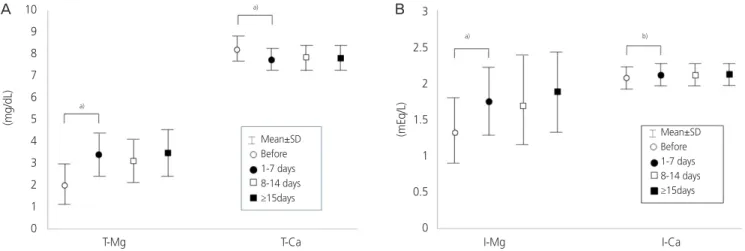
Fig. 1A shows the results of T-Mg and T-Ca levels between before and after MgSO4 administration. The average baseline Table 2. Changes in T-Mg and I-Mg and T-Ca and I-Ca blood plasma levels in patients with preterm labor (n=64) administered magne- sium sulfate according to administration duration
Variable Administration duration (day)
F P-valuea)
1–7 (n=25) 8–14 (n=15) ≥15 (n=24)
Dose (g) 350.91±193.16 301.54±160.11 332.51±139.35 0.459 0.634
T-Mg (mg/dL) 3.46±0.86 3.15±0.91 3.51±1.08 0.623 0.540
I-Mg (mEq/L) 1.74±0.42 1.70±0.62 1.87±0.56 0.497 0.611
T-Ca (mg/dL) 7.80±0.48 7.82±0.61 7.82±0.58 −0.007 0.993
I-Ca (mEq/L) 2.11±0.16 2.10±0.15 2.12±0.18 0.115 0.892
Values are expressed as mean±standard deviation.
T-Mg, total magnesium; I-Mg, ionized magnesium; T-Ca, total calcium; I-Ca, ionized calcium.
a)P-value <0.05 was considered statistically significant.
Fig. 1. Comparison of total magnesium (T-Mg) and total calcium (T-Ca) levels (A) and ionized magnesium (I-Mg) and ionized calcium (I-Ca) levels (B) in patients with preterm labor between before and after magnesium sulfate administration. Superscript marks considered statistically significant: a)P<0.05 or b)P>0.05.
(mg/dL) (mEq/L)
T-Mg I-Mg
Mean±SD Before 1-7 days 8-14 days
≥15days
Mean±SD Before 1-7 days 8-14 days
≥15days
a)
a)
a) b)
10 9 8 7 6 5 4 3 2 1 0
3 2.5 2 1.5 1 0.5
0
T-Ca I-Ca
A B
(preload) T-Mg and T-Ca level for all patients was 2.09±0.85 and 8.25±0.55 mg/dL. Both T-Mg and T-Ca levels increased after infusion, reaching a statistically significant increase com- pared to the baseline (T-Mg: P<0.05; T-Ca: P<0.05). In Fig.
1B, the average baseline I-Mg and I-Ca level was 1.34±0.52 and 2.07±0.15 mEq/L. There was a significant difference in the I-Mg serum levels before and after MgSO4 administration (P<0.05). However, there was no significant difference in I-Ca levels before and after MgSO4 administration (P=0.495).
Table 3 shows the results of comparing each level (T-Mg and I-Mg, T-Ca and I-Ca), depending on the presence or absence of adverse effects. There were no serious complications, such as pulmonary edema or respiratory depression, among the
patients included in the study. The patients were classified into those who experienced adverse side effects and those who did not experience adverse side effects. Side effects were febrile sense (n=12), headache (n=6), nausea (n=5), dry mouth (n=5), and loss of the patella reflex (n=1). The I-Mg level tended to be higher in the group with side effects than without side effects. However, it was not statistically signifi- cant. Furthermore, the levels of T-Mg, and T-Ca and I-Ca did not show any significant differences.
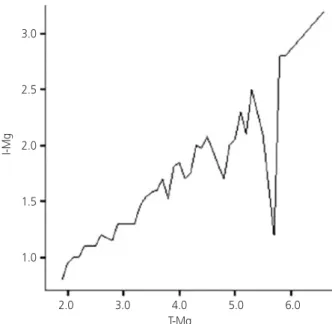
In total, the 64 patients were monitored 165 times. As a result, there was a statistically significant positive correlation between the levels of T-Mg and I-Mg in patients with preterm labor during MgSO4 administration (Fig. 2). Regression analy- sis obtained the following equation:
I-Mg=0.395×T-Mg+0.144; F=302.621; P<0.01
Discussion
According to previous studies, T-Mg has been determined in patients with preterm labor to monitor MgSO4 administra- tion [1,2]. This measurement includes all 3 fractions of Mg, i.e., the protein-bound fraction, and 2 ultrafiltratable frac- tions consisting of complex-bound and free I-Mg. However, only the free ionized fraction is biologically active [12,17,18].
Saha et al. [19] compared the use of I-Mg vs. T-Mg in a group of patients with chronic renal disease and found 14 of 69 cases with low T-Mg but normal I-Mg were false-positive for hypomagnesaemia. The authors concluded that T-Mg might overestimate the incidence of hypomagnesemia, and the I-Mg measurement may be beneficial when studying patients with expected hypomagnesemia. Although the study was not Table 3. Comparison of T-Mg and I-Mg levels and T-Ca and I-Ca levels in accordance with presence or absence of adverse effects in pa- tients with preterm labor administered magnesium sulfate
Variable Group
t P-valuea)
No AE (n=24) AE (n=19)
T-Mg 3.30±0.94 3.38±1.02 1.006 0.545
I-Mg 1.31±0.37 1.54±0.54 1.664 0.090
T-Ca 7.94±0.54 7.81±0.57 −0.766 0.651
I-Ca 2.12±0.15 2.14±0.15 0.366 0.795
Values are expressed as mean±standard deviation.
T-Mg, total magnesium; I-Mg, ionized magnesium; T-Ca, total calcium; I-Ca, ionized calcium; AE, adverse effect.
a)P-value <0.05 was considered statistically significant.
Fig. 2. Correlation between ionized and total magnesium (T-Mg) during administration of MgSO4 in patients with preterm labor (n=64). Regression analysis obtained the following equation: Ion- ized magnesium (I-Mg)=0.395×T-Mg+0.144; F=302.621; P<0.01.
I-Mg
T-Mg
2.0 3.0 4.0 5.0 6.0 3.0
2.5
2.0
1.5
1.0
targeted at patient with preterm labor, the results support the theory that I-Mg is biologically active. In our data, there was no statistical significance between T- and I-Mg, according to the presence or absence of adverse side effects. However, measurement of I-Mg levels is essential to examine the asso- ciation between adverse side effects and MgSO4 injection in patients with preterm labor.
In our study, the concentrations of T-Mg and I-Mg were not different between the groups according to the duration of MgSO4 use. Taber et al. [20] studied the pharmacokinet- ics of I-Mg vs. T-Mg in patients with preterm labor and pre- eclampsia. In their study, both I-Mg and T-Mg concentrations increased rapidly after standard boluses of MgSO4, with steady-state levels reached within 30 minutes. Interstitial and systemic concentrations of free (i.e., unbound) Mg must be delicately maintained by the combined processes of buffering (binding of ions to proteins and other molecules) and muffling (the transport of ions to storage or extracellular spaces) [21].
It can be inferred that T-Ca and I-Ca maintain equilibrium in a similar way. This supports our argument for the stability of long-term use of MgSO4.
Regarding the association between I-Mg and T-Mg levels during MgSO4 administration, some authors [22,23] reported a correlation, while others [20] negated such an association.
Taber et al. [20] found a lack of correlation between T-Mg and I-Mg levels in both physiologic and hypermagnesmic (phar- macologic) ranges during MgSO4 administration. The authors suggested that this may be due to variance in total protein concentration or to protein binding or may indicate the pres- ence of buffering systems that control I-Mg within a narrower range than T-Mg. Conversely, Handwerker et al. [22] reported a high correlation between I-Mg and T-Mg for preeclampsia.
Also, Yoshida et al. [23] demonstrated a significant correlation between the I-Mg and T-Mg levels during MgSO4 administra- tion for both preterm labor and preeclampsia, supporting the results of our study. These authors speculated that the correlation existed because the mechanism of homeostasis for I-Mg and other forms of Mg might be similar. Therefore, when I-Mg measurement is not possible, our study indicates that it is possible to convert T-Mg to I-Mg level.
In our study, there was no significant difference in I-Ca level before and after administration of MgSO4 in patients with preterm labor. Salamon et al. [24] estimated the ef- fect of MgSO4 concentration on serum I-Mg and I-Ca. They demonstrated that the addition of MgSO4 in vitro causes an
exponential increase in serum I-Mg and no significant change in serum I-Ca. Although the in vitro results cannot be entirely extrapolated to the clinical settings, we could have expected a displacement of Ca from its protein- and salt-bound forms, as Mg and Ca are known to compete for these molecules [1].It is conceivable that MgSO4 administration rarely causes hypo- calcemia. However, administration of MgSO4 effects serum Ca through a different pathway — suppressing parathyroid hor- mone secretion by acting directly on the parathyroid gland, competing with Ca for reabsorption in the loop of Henle and lessening the peripheral actions of parathyroid hormone — that leads to hypocalcemia [25]. Several cases of hypocalce- mia [26,27] occurring after the MgSO4 administration have been reported. Hence, the T-Ca and I-Ca levels of women receiving MgSO4 therapy should be routinely monitored for hypocalcemia.
This study has limitations. First, our result provides insuf- ficient evidence for the safety of MgSO4 administration.
No significant side effects during administration of MgSO4 were observed in our study. This result is probably because the number of participants (n=64) was small and long-term follow-up was not done. Many studies avoid long-term use of MgSO4 in patients because it can induce hypermagnesemia and hypocalcemia [26-29]. Another limitation of our study was the lack of assessment of serum Mg and Ca concentra- tions and any adverse effects of babies born from mothers treated with MgSO4. Thus, further large-scale research is re- quired to establish the safety of MgSO4 administration. Third, we did not consider any underlying disease in the patients.
Indeed, if there are fewer albumin binding sites available for Ca or Mg due to hypoproteinemia, the addition of a small amount of Ca or Mg will have a large effect on the binding of the other ion. Also, serum creatine and body weight signifi- cantly affect maternal serum Mg levels.
In conclusion, when MgSO4 was used, Mg and Ca con- centrations became equilibrium when certain levels were reached. Furthermore, there was no significant difference be- tween I-Ca levels before and after administration of MgSO4.
Significant correlations exist between I-Mg and T-Mg levels during administration of MgSO4 for preterm labor. Further- more, the I-Mg level seemed to be more highly correlated with adverse side effects than T-Mg.
Conflict of interest
No potential conflict of interest relevant to this article was reported.
References
1. Elliott JP. Magnesium sulfate as a tocolytic agent. Am J Obstet Gynecol 1983;147:277-84.
2. Sibai BM. Magnesium sulfate is the ideal anticonvul- sant in preeclampsia-eclampsia. Am J Obstet Gynecol 1990;162:1141-5.
3. Rouse DJ, Hirtz DG, Thom E, Varner MW, Spong CY, Mercer BM, et al. A randomized, controlled trial of mag- nesium sulfate for the prevention of cerebral palsy. N Engl J Med 2008;359:895-905.
4. American College of Obstetricians and Gynecologists Committee on Obstetric PracticeSociety for Maternal-Fe- tal Medicine. Committee Opinion No. 455: magnesium sulfate before anticipated preterm birth for neuroprotec- tion. Obstet Gynecol 2010;115:669-71.
5. ACOG technical bulletin. Preterm labor. Number 206-- June 1995 (replaces no. 133, October 1989). Int J Gyn- aecol Obstet 1995;50:303-13.
6. ACOG technical bulletin. Hypertension in pregnancy.
Number 219--January 1996 (replaces no. 91, February 1986). Committee on Technical Bulletins of the Ameri- can College of Obstetricians and Gynecologists. Int J Gynaecol Obstet 1996;53:175-83.
7. Pearson HA, Wray D. Non-competitive antagonism of calcium by magnesium ions at the K(+)-depolarised mouse neuromuscular junction. Eur J Pharmacol 1993;236:323-6.
8. Miller RK, Berndt WO. Evidence for Mg 2+ -depen- dent, Na + + K + -activated ATPase and Ca 2+ -ATPase in the human term placenta. Proc Soc Exp Biol Med 1973;143:118-22.
9. Mimouni F, Mughal Z, Hammond G. Placental calcium transport during acute maternal hypermagnesemia in the rat. Am J Obstet Gynecol 1993;168:984-7.
10. Rasch DK, Huber PA, Richardson CJ, L’Hommedieu CS, Nelson TE, Reddi R. Neurobehavioral effects of neonatal hypermagnesemia. J Pediatr 1982;100:272-6.
11. Lipsitz PJ, English IC. Hypermagnesemia in the newborn
infant. Pediatrics 1967;40:856-62.
12. Altura BT, Shirey TL, Young CC, Dell’Orfano K, Hiti J, Welsh R, et al. Characterization of a new ion selec- tive electrode for ionized magnesium in whole blood, plasma, serum, and aqueous samples. Scand J Clin Lab Invest Suppl 1994;217:21-36.
13. Shirey TL. Ionized magnesium: a new assay. Clin Chem News 1993;19:13-5.
14. Aglio LS, Stanford GG, Maddi R, Boyd JL 3rd, Nussbaum S, Chernow B. Hypomagnesemia is common following cardiac surgery. J Cardiothorac Vasc Anesth 1991;5:201-8.
15. Mimouni FB. The ion-selective magnesium electrode: a new tool for clinicians and investigators. J Am Coll Nutr 1996;15:4-5.
16. American College of Obstetricians and Gynecologists’
Committee on Practice Bulletins—Obstetrics. Practice bulletin no. 171: management of preterm labor. Obstet Gynecol 2016;128:e155-64.
17. Altura BT, Altura BM. Measurement of ionized mag- nesium in whole blood, plasma and serum with a new ion-selective electrode in healthy and diseased human subjects. Magnes Trace Elem 1991-1992;10:90-8.
18. Ising H, Bertschat F, Günther T, Jeremias E, Jeremias A.
Measurement of free magnesium in blood, serum and plasma with an ion-sensitive electrode. Eur J Clin Chem Clin Biochem 1995;33:365-71.
19. Saha H, Harmoinen A, Nisula M, Pasternack A. Serum ionized versus total magnesium in patients with chronic renal disease. Nephron 1998;80:149-52.
20. Taber EB, Tan L, Chao CR, Beall MH, Ross MG. Pharma- cokinetics of ionized versus total magnesium in subjects with preterm labor and preeclampsia. Am J Obstet Gy- necol 2002;186:1017-21.
21. Thomas RC, Coles JA, Deitmer JW. Homeostatic muf- fling. Nature 1991;350:564.
22. Handwerker SM, Altura BT, Chi DS, Altura BM. Serum ionized magnesium levels during intravenous MGSO4 therapy of preeclamptic women. Acta Obstet Gynecol Scand 1995;74:517-9.
23. Yoshida M, Matsuda Y, Akizawa Y, Ono E, Ohta H.
Serum ionized magnesium during magnesium sulfate administration for preterm labor and preeclampsia. Eur J Obstet Gynecol Reprod Biol 2006;128:125-8.
24. Salamon M, Mimouni FB, Dollberg S, Mandel D. Effect of magnesium sulfate concentration on serum ionized
magnesium in vitro. Am J Perinatol 2010;27:525-8.
25. Cholst IN, Steinberg SF, Tropper PJ, Fox HE, Segre GV, Bilezikian JP. The influence of hypermagnesemia on se- rum calcium and parathyroid hormone levels in human subjects. N Engl J Med 1984;310:1221-5.
26. Nassar AH, Salti I, Makarem NN, Usta IM. Marked hy- pocalcemia after tocolytic magnesium sulphate therapy.
Am J Perinatol 2007;24:481-2.
27. Koontz SL, Friedman SA, Schwartz ML. Symptom- atic hypocalcemia after tocolytic therapy with mag-
nesium sulfate and nifedipine. Am J Obstet Gynecol 2004;190:1773-6.
28. Cao Z, Bideau R, Valdes R Jr, Elin RJ. Acute hyperma- gnesemia and respiratory arrest following infusion of MgSO4 for tocolysis. Clin Chim Acta 1999;285:191-3.
29. Mayan H, Hourvitz A, Schiff E, Farfel Z. Symptomatic hypocalcaemia in hypermagnesaemia-induced hypo- parathyroidism, during magnesium tocolytic therapy- -possible involvement of the calcium-sensing receptor.
Nephrol Dial Transplant 1999;14:1764-6.