www.earticle.net
쌀 함유 산양발효유의 유산균에 의한 GABA생산
우광태 · 김완섭* 한경대학교 동물생명환경과학과
Production of γ-Aminobutyric Acid (GABA) by Lactic Acid Bacteria in Goat Fermented Milk Added with Rice
Kwang-Tae Woo and Woan-Sub Kim*
Department of Animal Life and Environmental Science, Hankyong National University
ABSTRACT1)
γ-Aminobutyric acid (GABA) is present in many vegetables and fruits, but not in dairy products. GABA is known to be beneficial for preventing neurological disorders and hypertension. The objective of this study was to measure the physicochemical changes, number of lactic acid bacteria, and GABA content in fermented goat milk containing rice (1%). The levels of pH and titratable acidity (TA) in each test samples were found to be pH 4.4∼4.5 and 0.74∼0.8%, respectively. The number of viable lactic acid bacteria between test samples ranged from 8.63 to 8.95 Log CFU/ml. Therefore, pH, TA, and number of viable cells in each test sample had no difference. Furthermore, the Lactobacillus delbrueckii subsp. bulgaricus SP5 (Lb. bulgaricus SP5) showed the highest GABA production in goat milk containing rice. Its maximum GABA yield was 3.4 mg/100 mL. The results suggest that GABA contents of fermented goat milk containing rice can be enriched using Lb.
bulgaricus SP5.
(Key Words: γ-Aminobutyric acid (GABA), Goat milk, Yoghurt, Milk)
Ⅰ. 서론
GABA(Gamma-Amino Butyric Acid)는 포유동물의 뇌 또는 척수에 존재하는 신경전달 물질로서 비단백질구성 아 미노산의 일종으로 자연계에 널리 분포하고 있다. Schales 등(1946)은 GABA를 생성하는 효소인 glutamic acid decarboxylase(GAD)를 고등식물체로부터 분리하였다. 그 리고 Stanton(1963)은 동물의 순환계에서 GABA의 작용모 드에 대해서 연구하였다. 그 후 여러 곡물, 야채 및 녹차 잎 을 비롯한 식물체와 미생물 등 생물학적 방법에 의해서 글 루탐산으로부터 GABA를 생성하는 연구(Hayakaya 등, 1997)
가 이루어져 왔다. Ueno(2000)는 glutamate와 GABA의 농 도는 GAD에 의해서 조절된다고 보고하였다.
GABA는 통증완화, 혈압 강하, 이뇨작용, 신경안정효과, 항산화작용 등의 생리활성 기능이 있다(Kook과 Cho, 2013). 그러나 과일, 쌀, 콩 등의 자연계에 존재하는 GABA 는 생리활성을 나타나기에는 함량이 매우 낮다. 또한 GABA는 뇌 속의 해마에 많이 함유되어 있으나 나이가 들 수록 현저히 감소된다고 알려져 있는데, 치매환자를 비롯 한 정신적 공황상태나 불안상태에 있는 환자들의 뇌하수체 액을 조사해보면 GABA의 함량이 현저히 감소하여 이에 GABA가 함유된 음식을 섭취함으로써, 이러한 제반 증상
* Corresponding author: Woan-Sub Kim, Dept. of Animal Life and Environmental Science, Hankyong National University, Anseong 456-749, Korea. Tel: +82-31-670-5122, E-mail: [email protected]
This is an Open Access journal distributed under the teams of the Creative Commons Attribution Non-Commercial License (http://creativecommons.org/licenses(by-nc/3.0) which permits unrestricted non-commercial use, and reproduction in any medium, provided the original work is properly cited.
[Provider:earticle] Download by IP 118.70.52.165 at Monday, December 20, 2021 7:58 PM
www.earticle.net
이나 노망, 건망증, 우울증 등을 예방하고 개선하여야만 한 다. 따라서 GABA의 함량을 높이기 위해서 다양한 연구가 시도되고 있다. GABA의 함량을 높이는 방법은 천연물 내 에 존재하는 탈탄산 효소의 반응을 촉진시켜 글루탐산으 로부터 생성 되도록 하는 방법이 있다. 즉, 미배아를 물에 담가 탈탄산효소의 작용을 통한 GABA증가 방법(Saikusa 등, 1994), 현미의 발아를 통한 GABA증가 방법(Miwako 등, 1999), 녹차의 혐기조건에 의한 GABA증가 방법(Sawai 등, 2001) 등이 알려져 있다.
GABA물질은 주로 곡물이나 식물뿐만 아니라, 유산균 을 이용한 GABA 생성 연구도 함께 진행되어 왔다. 국내외 에서 유산균을 이용한 GABA의 생산 균주는 Lactobacillus (Lb) brevis IFO 12005(Ueno 등, 1997), Lb. paracasei NFRI 7415(Komastsuzaki 등, 2005), Lb. OPY-1, Lb. buchneri, 그 리고 Lb. acidophilus RMK567(Park과 Oh, 2005, 2006; Lim 등, 2009),Lb. sakei B2-16(Kook 등, 2010) 등의 연구가 보고 되어 있다.
발효유는 생리활성 펩타이드 이외에 유산균의 생장에 의해 생성된 유산, 분비단백질, 그리고 균체 등이 영양학적 으로 매우 높은 가치를 가지고 있다(Kim 등, 2013). 한편 산양유는 모유와 같이 기능성성분을 많이 함유하고 있고, α-casein 보다 β-casein을 주로 함유하며, 알레르기 반응이 없어 아토피 어린이들이 음용하기에 용이하다(Haenlein, 2004). 따라서 유산균을 이용한 산양유의 GABA생성 연구 는 기능성 식품의 개발에 있어서 매우 흥미롭고 기대되는 분야이다.
본 연구는 생리활성물질의 하나인 GABA와 GABA생성 미생물에 주목하고 GABA를 생산하는 유산균의 검색을 수 행하였다. 즉, 산양발효유 내에 GABA 물질의 생성을 돕기 위해서 제조단계에 쌀가루를 첨가하여 시판되는 단독 또 는 복합유산균들을 접종하였다. 그리고 발효결과 생성된 GABA의 량을 측정하여 우수 GABA생성 균주를 상업적으 로 이용하고자 하였다.
Ⅱ. 재료 및 방법
1. 재료 및 균주
복합 균주인 ABT-5(Lactobacillus acidophilus, Streptococcus thermophilus, Bifidobacteria), YC-380(Lb. delbrueckii subsp.
bulgaricus, S. thermophilus), ABY-3(S. thermophilus, Lb.
acidophilus, Bifidobacterium lactis, Lb. delbrueckii subsp.
bulgaricus), YF-L903(S. thermophilus, Lb. delbrueckii subsp.
bulgaricus)은 Chri Hansen's(Denmark)사로부터 구입하여 시험에 이용하였다. 그리고 ABT-B(Lb. acidophilus, B. longum, S. thermophilus), ABCT-1(Lb. acidophilus, B. longum, Lb.
casei, S. thermophilus)은 삼익유가공으로부터 공급 받아 시 험에 이용하였다. 한편, Lb. delbrueckii subsp. bulgaricus SP5(Lb. bulgaricus SP5)와 YAB-450(Lb. acidophilus, B. lactis, S. thermophilus, Lb. delbrueckii subsp. bulgaricus)은 Sacco (Italy)사로부터 구입하여 시험에 이용하였다.
2. 발효유의 제조
산양원유 1000 mL와 쌀가루 1%(유량 대비)를 혼합한 후, 90℃에서 30분간 살균하였다. 그리고 난 후, 냉각수를 이용하여 배양에 적합한 온도(37∼38℃)까지 냉각하였고, Lb. bulgaricus SP5 단독균주와 상업 복합균주를 각각 1%
접종하여 37℃에서 18시간 호기 배양하였다. 쌀가루의 첨 가는 유산균이 GABA를 생성하는데 도움을 주기 위하여 첨가하였다.
3. pH측정
쌀 함유 산양유에 각각의 균주를 이용하여 발효 제조된 쌀 함유 산양발효유의 pH변화는 pH meter(Fisher Scientific, USA)를 이용하여 측정하였다.
4. 산도측정
발효시료 10 mL에 동량의 증류수를 혼합하였다. 1%
phenolphthalein용액 3∼5방울 가한 후, pH값이 8.3이 될 때까지 0.1 N NaOH를 가하여 소모된 양을 다음 계산식을 통하여 계산하였다.
산도(%) = [a×f×0.009/10×검사시료의 비중]×100
a: 0.1 N NaOH의 소비량(mL) f: 0.1 N NaOH의 역가
0.009: 유산계수(0.1 N-NaOH 1 ml) 5. 유산균수 측정
쌀 함유 산양유에 각각의 유산균을 접종하여 제조된 최
[Provider:earticle] Download by IP 118.70.52.165 at Monday, December 20, 2021 7:58 PM
www.earticle.net
종 산양발효유의 유산균수를 측정하였다. 즉, 각각의 시료 를 1 mL 취하여 9 mL의 멸균 peptone(0.1%)수에 넣고 균 질 하였다. 균질 된 시료용액 1 mL를 십진 희석 후 MRS agar에 도말 한 후 colony가 형성될 때까지 37℃의 항온기 에서 호기 배양하였다.
6. GABA 의 정량분석
각각의 발효유 100 mL를 원심분리(8,000 rpm, 20 min) 한 후, 상층액은 0.45 μm cellulose acetate membrane filter(Advantec, MFS. Inc., Japan)로 여과 하였다. 그리고 난 후, 상층액 중의 GABA 정량은 Moret 등(2005)의 방법 을 변형하여 high-performance liquid chromatography (HPLC)법으로 측정하였다. 즉 준비된 시료를 o-phthaldialdehyde (OPA, Sigma Chemical Industries, Ltd., Saint Louis, MO, USA)를 이용하여 유도체화 과정을 거친 후 0.22 μm cellulose acetate membrane filter(Advantec, MFS. Inc., Japan)로 여과 시켜 HPLC를 이용하여 분석을 진행하였다.
컬럼(Column)은 Mightysil C18(4.6 mm×250 mm)을 이용 하였고, 샘플의 주입량은 20 μL로 하였다. 이동상은 phosphate buffer(pH 7.0), acetonitrile, 그리고 deionized water의 혼합액을 농도 구배(gradient)하였다. 이동상의 유 속은 1 mL/min로 고정하였고, 254 nm의 UV detector로 GABA를 검출하였다.
7. 통계분석
분석된 결과에 대한 통계처리는 Statistical Analysis System(SAS, 2002)를 이용하여 평균과 표준편차를 나타내 었다. 각 시험구간의 유의성 검증을 위하여 ANOVA로 분 석하였으며, 사후 검증으로 Duncan의 다중검정을 통하여 유의성 검정(p<0.05)을 실시하였다
Ⅲ. 결과 및 고찰
각각의 단독 또는 복합 유산균을 접종한 쌀 함유 산양발 효유의 최종 이화학적 변화를 비교 조사하였다(Fig. 1과 2).
최종 발효산물로부터 시험구별 pH는 Fig. 1 에 나타내었 다. 시험구 사이의 최종 pH는 4.4∼4.5의 범위를 나타내었 다. 특히 단일 균주인 Lb. bulgaricus SP5와 복합 균주들 사 이의 최종 pH는 유의성을 나타나지 않았다. 따라서 단일
Fig. 1. The value of pH after incubation at 37℃ for 18hr in goat milk added with 1% rice. LB-SP5 (Lb. bulgaricus SP-5), ABCT-1 (Lb. acidophilus, B. longum, Lb. casei, S.
thermophilus), ABT-B (Lb. acidophilus, B. longum, S.
thermophilus), ABT-5 (Lb. acidophilus, S. thermophilus, Bifidobacteria), ABY-3 (S. thermophilus,Lb. acidophilus,B.
lactis,Lb. bulgaricus), YAB-450 (Lb. acidophilus,B. lactis,S.
thermophilus, Lb. bulgaricus), YC-380 (Lb. bulgaricus, S.
thermophilus), YF-L903 (S. thermophilus, Lb. bulgaricus)
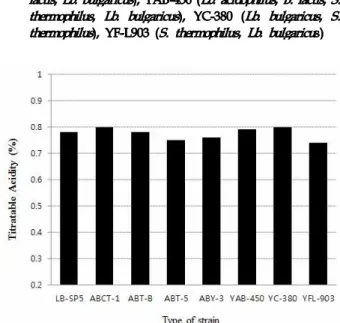
Fig. 2. The value of titratable acidity after incubation at 37℃
for 18hr in goat milk added with 1% rice. LB-SP5 (Lb.
bulgaricusSP-5), ABCT-1 (Lb. acidophilus, B. longum, Lb.
casei, S. thermophilus), ABT-B (Lb. acidophilus, B. longum, S. thermophilus), ABT-5 (Lb. acidophilus, S. thermophilus, Bifidobacteria), ABY-3 (S. thermophilus, Lb. acidophilus, B. lactis, Lb. bulgaricus), YAB-450 (Lb. acidophilus, B.
lactis, S. thermophilus, Lb. bulgaricus), YC-380 (Lb.
bulgaricus, S. thermophilus), YF-L903(S. thermophilus, Lb.
bulgaricus).
균주로서도 충분히 발효유를 제조가능 한 것으로 사료된 다. 발효유는 pH와 더불어 적정산도도 최종산물에 중요한 요소를 차지하는데, 각각의 시험구 사이의 최종발효유로부 터 측정된 적정산도는 Fig. 2에 나타내었다. 각 시험구의
[Provider:earticle] Download by IP 118.70.52.165 at Monday, December 20, 2021 7:58 PM
www.earticle.net
적정산도의 측정치 범위는 0.74∼0.8%를 보여주었다. 그리 고 pH와 동일하게 단일 균주인 Lb. bulgaricus SP5와 복합 균주들 사이에 최종 적정산도의 유의적 차이는 나타나지 않았다.
각각의 최종 산양발효유로부터 생존 유산균 수는 Fig. 3 에 나타내었다. 시험구별 생균수의 측정결과 8.63∼8.95 (Log CFU/ml)범위를 나타내어 시험구 간의 유산균 수는 현저한 차이 없이 측정되었다. 특히 단일균주인 Lb.
bulgaricus SP5의 생균수는 다른 복합 균주와 대등한 결과 를 보여주었다.
Fig. 3. Number of viable cell after incubation at 37℃ for 18 hr in goat milk added with 1% rice. LB-SP5 (Lb.
bulgaricusSP-5), ABCT-1 (Lb. acidophilus, B. longum, Lb.
casei,S. thermophilus), ABT-B (Lb. acidophilus, B. longum, S. thermophilus), ABT-5 (Lb. acidophilus, S. thermophilus, Bifidobacteria), ABY-3 (S. thermophilus, Lb. acidophilus, B. lactis, Lb. bulgaricus), YAB-450 (Lb. acidophilus, B.
lactis, S. thermophilus, Lb. bulgaricus), YC-380 (Lb.
bulgaricus, S. thermophilus), YF-L903 (S. thermophilus, Lb.
bulgaricus).
단일균주인 Lb. bulgaricus SP5와 복합균주인 ABT-5, YC-380, YF-L903, ABT-B, ABY-3, YAB 450, ABCT-1와의 최종 산양발효유로부터 얻어진 GABA생성량의 측정 결과 는 Fig. 4에 나타내었다. 쌀 함유 산양발효유에서 생성된 GABA는 단일 균주인 Lb. bulgaricus SP5가 가장 많은 양의 GABA물질을 생성하였고(3.4 mg/100 mL), 그 다음은 복 합 균주인 YC-380이었다(2.74 mg/100 mL). 그 외 미량으 로 ABCT-1(0.97 mg/100 mL), YAB 450(0.92 mg/100 mL), ABT-5(0.91 mg/100 mL), ABY-3(0.71 mg/100 mL), YFL-903(0.31 mg/100 mL)의 순으로 GABA를 생성하였다 (Fig. 4). 그러나 ABT-B의 복합 균주는 다른 복합 균주와 달리 전혀 GABA물질이 검출되지 않았다(Fig. 4).
Fig. 4. γ-Aminobutyric acid content produced after incubation at 37℃ for 18 hr in the goat milk added with 1% rice.
LB-SP5 (Lb. bulgaricusSP-5), ABCT-1 (Lb. acidophilus, B.
longum, Lb. casei,S. thermophilus), ABT-B (Lb. acidophilus, B. longum, S. thermophilus), ABT-5 (Lb. acidophilus, S.
thermophilus, Bifidobacteria), ABY-3 (S. thermophilus, Lb.
acidophilus, B. lactis, Lb. bulgaricus), YAB-450 (Lb.
acidophilus, B. lactis, S. thermophilus, Lb. bulgaricus), YC-380 (Lb. bulgaricus, S. thermophilus), YF-L903 (S.
thermophilus, Lb. bulgaricus).
GABA를 함유하고 있는 식품은 여러 종류가 있지만 함 량을 높이는 방법은 많은 연구 노력이 필요하다. Saikusa 등(1994)은 현미에 내재되어 있는 글루타민산탈탄산효소 (glutamate decarboxylase)가 가수조건하에서 미립 중의 글루타민산(gultamic acid)을 대량으로 빠르게 GABA로 전 환시킨다는 것을 발견하였고, 이 사실을 응용하여 GABA 를 고농도로 축적시킨 탈지 쌀 배아 식품의 개발에 성공하 였다. Tsushida와 Murai(1987)는 녹차를 혐기적 조건하에 처리하는 방법에 의해서 GABA의 함량을 증가시키는 방법 을 보고하였다. 그리고 Kamatsuzaki 등(2005)은 Lb.
paracasei NFRI 7415 에 대해서 배지의 pH를 5로 조정하고 pyridoxal phosphate(PLP)를 첨가하면 GABA의 생산량이 증가하였다고 보고하였다. 그러나 Ueno 등(2007)은 Lb. sp.
L13균주에 있어서 배지 내에 PLP를 첨가하지 않고 발효단 계에 단지 pH를 5로 조정하는 것만으로도 GABA의 생산 량을 높였다고 보고하였다. 또한 Choi 등(2006)은 Lb.
brevis GABA 057로부터 배지 내 MSG를 첨가하는 것으로 부터 GABA의 생산량을 증가시켰다고 보고하였다. 그리고 Kook 등(2010)은 김치로부터 분리한 Lb. sakei B2-16을 이 용하여 대량의 GABA를 생산하였다고 보고하였다. 본 연 구에서 Lb. bulgaricus SP5 얻어진 GABA함량은 실험에 이 용된 다른 상업균주보다는 많은 양을 생산하였지만, 현미, 녹차, 그리고 Lb. paracasei NFRI 7415 에 비하면 매우 낮은
[Provider:earticle] Download by IP 118.70.52.165 at Monday, December 20, 2021 7:58 PM
www.earticle.net
수준이다. 따라서 Lb. bulgaricus SP5로부터 GABA 함량을 높일 수 있는 방법 등은 보다 더 많은 연구가 필요하다.
낙농식품인 발효유제품 개발과 관련하여 GABA의 함량 을 증가시키는 연구도 시도 되고 있으나, 아직 미흡한 수 준이다. 치즈가 숙성되는 동안 유산균으로부터 GABA의 생성을 유도하는 연구가 Nomura 등(1998)으로부터 시도 되었다. Park과 Oh(2005)는 김치로부터 분리한 GABA생성 균인 Lb. brevis OPY-1과 상업 균주인 Lb. acidophilus와 Lb.
plantarum을 현미와 분유를 함유한 발효기질에 접종하여 요구르트를 제조한 결과 많은 량의 GABA가 생성되었다고 보고하였다.
본 실험에서 쌀을 함유한 것은 유산균의 GABA생성 도 움과 산양원유에 부족할 수 있는 영양소를 공급하기 위한 것으로 접종 유산균이 보다 많은 량의 GABA를 생성하기 위해서는 쌀의 조건 즉, 첨가량 및 형태(백미 또는 현미) 등을 보다 더 고려해야 할 것으로 사료된다. 그리고 발효 유 제조 시, GABA를 많이 생산하는 유산 균주와 쌀 추출 물을 혼합하여 제조한다면, 항불안, 항스트레스 및 혈압강 하 효과를 가지는 기능성을 기대할 수 있다.
Ⅳ. 요약
GABA물질은 각종 채소와 과일에 널리 분포되어 있는 것으로 알려져 있으나, 유제품에는 알려져 있지 않다.
GABA는 신경질환과 고혈압을 예방하는 효과가 있는 것으 로 알려져 있다. 본 연구는 단독 또는 복합 유산균을 접종 한 쌀 함유(1%) 산양발효유의 최종 이화학적 변화와 유산 균 수를 측정하였고, 최종산물로부터 GABA의 함량을 측 정하였다. 그 결과 각 시험구 사이의 최종 pH는 4.4∼4.5의 범위를 나타내었고, 적정산도의 측정치 범위는 0.74∼0.8%
를 보여주었다. 그리고 시험구별 생균수의 측정결과, 시험 구 사이의 유산균 수는 8.63∼8.95 Log CFU/ml를 나타내 었다. 따라서 각 시험구간의 pH, TA, 그리고 유산균수의 차이는 나타나지 않았다. 더욱이 최종 산양발효유로부터 얻어진 GABA생성량의 측정 결과, 단일 균주인 Lb.
bulgaricus SP5가 다른 복합균주에 비해서 가장 많은 함량 을 나타내었다. Lb. bulgaricus SP5가 생산한 GABA의 최대 함량은 3.4 mg/100 mL이었다. 본 실험결과,Lb. bulgaricus SP5는 쌀 함유 산양발효유에 있어서 GABA함량을 충분히 증가시킬 것으로 사료된다.
Ⅴ. REFERENCES
1. Choi, S. I., Lee, J. W., Park, S. M., Lee, M. Y., Ji, G.
E., Park, M. S. and Heo, T. R. 2006. Improvement of γ-aminobutyric acid (GABA) production using cell entrapment of Lactobacillus brevis GABA 057. J.
Microbial. Biotechnol. 16:562-568.
2. Haenlein, GFW. 2004. Goat milk in human nutrition.
Small Ruminant Res. 51:155-163.
3. Hayakaya, K., Ueno, Y., Kawamura, S., Taniguchi, R.
and Oda, K. 1997. Production of ɣ-aminobutyric acid by lactic acid bacteria. Sebutsu Kogaku. 75:239-244.
4. Kim, J. K., Lee, J. S., Jeong, Y. T. and Bae, I. H. 2013.
Development of yoghurt with sanmeoru (Vitis amurensis Ruprecht) wine as an additive. Korean J.
Dairy Sci. Technol. 30:23-30.
5. Kook, M. C. and Cho, S. C. 2013. Production of GABA (gamma amino butyric acid) by lactic acid bacteria. Korean J. Food Sci. An. 33:377-389.
6. Komatsuzaki, N., Shima, J., Kawamoto, S., Momose, H. and Kimura, T. 2005. Production of γ -aminobutyric acid (GABA) by Lactobacillus paracasei isolated from traditional fermented foods. Food Microbiol. 22:497-504.
7. Kook, M. C., Seo, M. J., Cheigh, C. I., Pyun, Y. R., Cho, S. C. and Park, H. 2010. Enhanced production of γ-aminobutyric acid using rice bran extracts by Lactobacillus sakei B2-16. J. Microbiol. Biotechnol.
20:763-766.
8 . Lim, S. D., Kim, K. S. and Do, J. R. 2009.
Physiological characteristics and GABA production ofLactobacillus acidophilus RMK567 isolated from raw milk. Korean J. Food Sci. Ani. Resour. 29:15-23.
9. Miwako, K., Miyuki, S., Akira, Y. and Koji, Y. 1999.
Accumulation of GABA in brown rice by high pressure treatment. J. Japanese Soc. Food Sci.
Technol. 46:329-333.
10. Moret, S., Populin, T., Conte, L. S. and Cosens, G.
2005. HPLC determination of free nitrogenous compounds of Centaurea solstitialis (Asteraceae), the cause of equine nigropallidal encephalomalacia.
Toxicon. 46:651-657.
[Provider:earticle] Download by IP 118.70.52.165 at Monday, December 20, 2021 7:58 PM
www.earticle.net
11. Nomura, M., Kimoto, H., Someya, Y., Furugawa, S.
and Suzuki, I. 1998. Production of γ-aminobutyric acid by cheese starter during cheese ripening. J.
Dairy Sci. 81:1486-1491.
12. Park, K. B. and Oh, S. H. 2005. Production and characterization of GABA rice yogurt. Food Sci.
Biotech. 14:518-522.
13. Park, K. B. and Oh, S. H. 2006. Isolation and characterization of Lactobacillus buchneri strains with high γ-aminobutyric acid producing capacity from naturally aged cheese. Food Sci. Biotechnol. 15:86-90.
14. Saikusa, T., Horino, T. and Mori, Y. 1994.
Accumulation of γ-aminobutyric acid (GABA) in the germ during water soaking. Biosci. Biotech. Biochem.
58:2291-2292.
15. SAS. 2002. The SAS system release 9.1, SAS Institute INC., Cary, NC, USA.
16. Sawai, Y., Yamaguchi, Y., Miyama, D. and Yoshitomi, H. 2001. Cycling treatment of anaerobic and aerobic incubation increase the content of γ-aminobutyric acid in tea shoots. Amino Acids. 20:331-334.
17. Schales, O., Mims, V. and Schales, S. S. 1946 Glutamic acid decarboxylase of higher plants. Arch.
Biochem. 10:455-465.
18. Shelp, B. J., Bown, A. W. and McLean, M. D. 1999.
Metabolism and functions of gamma-aminobutyric acid. Trends Plant Sci. 4:446-452.
19. Tsushida, T. and Murai, T. 1987. Conversion of glutamic acid to γ-aminobutyric acid in tea reaves under anaerobic conditions. Agric. Biol. Chem.
51:2856-2871.
20. Ueno, H. 2000. Enzymatic and structural aspects on glutamate decarboxylase. J. Mol. Catal. B. Enzym.
10:67-69.
21. Ueno, Y., Hayakawa, K., Takahashi, S. and Oda, K.
1997. Purification and characterization of glutamate decarboxylase from Lactobacillus brevis IFO 12005.
Biosci. Biotech. Biochem. 61:1168-1171.
22. Ueno, Y., Hiraga, K., Mori, Y. and Oda, K. 2007.
Isolation and utilization of a lactic acid bacterium, producing a high level of γ–aminobutyric acid (GABA). Seibutsu-kogaku. 85:109-114.
(Received 01 October 2014, Revised 13 Novermber 2014, Accepted 14 Novermber 2014)
[Provider:earticle] Download by IP 118.70.52.165 at Monday, December 20, 2021 7:58 PM