a)성균관대학교 정보통신공학부
School of Information and Communication Engineering. Sungkyunkwan University
‡교신저자 : 전병우([email protected])
※This research was supported by Basic Science Research Program through the National Research Foundation of Korea (NRF) funded by the Ministry of Education, Science and Technology (No. 20100008030).
․접수일(2011년3월15일),수정일(2011년5월6일),게재확정일(2011년5월6일)
분산비디오부호화에서 동적비디오에 적합한 프레임별 모드 결정
Xiem HoangVana), 박 종 빈a), 심 혁 재a), 전 병 우a)‡
A Frame-based Coding Mode Decision for Temporally Active Video Sequence in Distributed Video Coding
Xiem HoangVana), Jongbin Parka), Hiuk Jae Shima), and Byeungwoo Jeona)‡
요 약
분산비디오부호화를 위한 인트라 모드 결정은 빠른 움직임 특성을 갖는 영상에서 분산비디오부호화 성능을 향상시킬 수 있는 중요한 도구이다. 그러나 기존의 인트라 모드 결정 방법은 사전에 정의한 매개변수나 특정 임계값에 크게 의존함으로 인해 영상 의 통계적 특성이 갑자기 바뀌는 상황에 효과적인 대처가 어려웠다. 본 논문에서는 이러한 문제를 해결하는 분산비디오부호화를 위한 인트라모드와 Wyner-Ziv 모드간의 적응적 결정 방법을 제안한다. 제안 방법은 분산비디오부호화에서 시간과 공간상관도를 고려하여 각각의 확률을 계산 후 엔트로피를 계산하고 이를 비교함으로써 영상의 특성에 적응적으로 인트라와 Wyner-Ziv 모드를 결정한다. 따라서 현실적인 응용에 적합하도록 사전에 정의한 매개변수나 임계값을 사용하지 않아도 되는 장점이 있다. 실험 결과 비트율 왜곡 측면에서 모드 결정 방법을 사용하지 않는 기존의 Wyner-Ziv 분산비디오부호화 방식에 비해 PSNR에서 최대 2dB 까지 성능을 개선한다. 또한, 제안방법은 사용자로부터 어떠한 경계치 또는 모델파라메타 값을 요구하지 않으므로 실제적인 응용 에 적합하다.
Abstract
Intra mode decision is a useful coding tool in Distributed Video Coding (DVC) for improving DVC coding efficiency for video sequences having fast motion. A major limitation associated with the existing intra mode decision methods, however, is that its efficiency highly depends on user-specified thresholds or modeling parameters. This paper proposes an entropy-based method to address this problem. The probabilities of intra and Wyner–Ziv (WZ) modes are determined firstly by examining correlation of pixels in spatial and temporal directions. Based on these probabilities, entropy of the intra and the WZ modes are computed. A comparison based on the entropy values decides a coding mode between intra coding and WZ coding without relying on any user-specified thresholds or modeling parameters. Experimental results show its superior rate-distortion performance of improvements of PSNR up to 2 dB against a conventional Wyner–Ziv coding without intra mode decision. Furthermore, since the proposed method does not require any thresholds or modeling parameters from users, it is very attractive for real life applications.
Keyword : Distributed video coding, Wyner-Ziv coding, Intra coding mode decision, Entropy based method 일반논문-11-16-3-12
Ⅰ. Introduction
Those popular conventional video coding standards such as MPEG-1/2/4 and H.26x which exploit complex motion estimation at encoder cannot meet the emerging need for low power consumption and low computational complexity by encoder. Therefore, in many new applications where re- duction of encoder complexity is utmost important such as in wireless PC cameras, mobile camera phones, sensor net- works, or surveillances, a new video coding paradigm with low complex video encoding would be extremely valuable.
Distributed video coding (DVC) [1] is one of the solutions for such low complexity encoding problems [2].
Transform-domain Wyner-Ziv (TDWZ) video coding is one of the representative DVC schemes [3]. By many re- cent researches, its coding efficiency has been significantly improved [4-9]. However, for active video sequences in which the correlation of pixels in spatial direction is higher than that in temporal direction, a video coding technique that exploits more spatial correlation shows better results than that utilizing temporal correlation. This can be ex- plained by considering a comparison between H.264/AVC intra coding and Wyner-Ziv video coding in Foreman, Hall monitor, Coastguard, and Soccer sequences as in [20].
To address this problem, several intra coding mode deci- sion algorithms have been introduced in the DVC liter- atures in which an encoder selects the most critical frames (or blocks) to be intra coded [10-14]. The intra coding is chosen in the regions having low correlation between side information (Y) and corresponding WZ source since dis- tributed coding is supposed to be inefficient there. In [10], an intra frame coding decision method is proposed by com- puting the amount of the estimated noise. The intra block mode decision proposed in [11,12] exploiting the temporal correlation and the spatial smoothness of a block shows im- provements up to 1 dB in RD performance when compared to a DVC codec without the intra coding mode decision.
In [13], by defining a rate-estimation modeling based on the concepts of entropy and parametric Laplacian sources, an iterative method for deciding on a block-basis either in- tra or WZ coding mode is proposed. Also, by providing encoding rate estimation models for intra and WZ coding modes, a low complexity intra mode selection is presented in [14]. However, with these previous intra mode decision approaches, the WZ source length varies with the number of selected intra blocks thus causing an interleaver to ran- domly generate each WZ frame (it has the same length of the source), thus increasing the encoder complexity.
Moreover, these approaches highly depend on either coding parameters [13-14] or thresholds [10-12]. That makes them quite unattractive for real life video applications. To over- come these drawbacks, this paper proposes a novel method to select intra mode for WZ frames based on entropy calculations. Entropy is determined under the probability of intra and WZ block coding modes in the WZ frame. For the purpose of verifying the effectiveness of the proposed method, this paper mentions the coding mode decision only at a frame level, however, lower level decision such as slice or macroblock level will be presented in future works.
The rest of this paper is organized as follows: Section 2 describes the TDWZ video coding scheme with intra frame mode decision. In Section 3, the proposed method is introduced and experimental results are presented in Section 4. Finally, in Section 5, conclusion is drawn with suggestion on future works.
Ⅱ. TDWZ Video Coding with Intra Mode Decision Structure
In conventional transform domain Wyner-Ziv (TDWZ) coding structure [3], the input sequence is separated into two parts: key (K) and Wyner-Ziv (W) frames. The key frames are typically compressed using conventional video
DCT Uniform Quantization
LDPC Encoder
LDPC Decoder
H.264/AVC Intra Encoder
H.264/AVC Intra Decoder
Side information Generation
DCT CNM
Reconstruction IDCT Buffer
Wyner-Ziv Mode
W
K
Wˆ
Kˆ Y
Key frames
WZ frames
WZ bitstreams
Feedback channel
Decoded WZ frames
Decoded Key frames Mode
Decision
Mode Decision Intra
Encoding
Intra Decoding Intra
Mode Intra
Mode
Wyner-Ziv Mode Encoder
Mode information
Intra bitstreams
Decoder
그림 1. 제안한 인트라 프레임 모드 결정방법에 따른 변환영역 Wyner-Ziv 부호화 구조 Fig. 1. Transform domain Wyner-Ziv coding structure with intra frame mode decision
coding such as H.264/AVC intra coding, and the WZ frames are coded using the WZ coding.
In our TDWZ video coding scheme (Figure 1), mode de- cision is made before a WZ frame encoding to decide whether the frame should be WZ coded or H.264/AVC in- tra coded. The frame mode decision can be either placed at the encoder or at the decoder. In our scheme, the mode decision is placed at the encoder and mode information is transmitted toward the decoder. Since the frame level is chosen to verify the proposed method, the extra bits to in- dicate the mode for WZ frame is only one bit. Therefore, its effect on the final bitrate of reconstructed frames is insignificant.
In this scheme, together with key frames, WZ frames available at the encoder are also exploited to decide the coding mode. At the decoder, after receiving mode in- formation from the encoder, WZ coding mode or intra cod- ing mode will be set up. If WZ coding mode is chosen, the side information generation process [15] creates side in- formation frames (Y) and together with the error in- formation between side information and WZ frames esti-
mated from the channel noise modeling (CNM), WZ de- coder will process this side information to reconstruct the WZ frames (); otherwise, the intra decoding block will process intra bitstreams which is sent from the encoder if intra coding mode is chosen.
III. Proposed Intra Mode Decision Method
The WZ video coding utilizes correlation between pixels extended in temporal direction at the decoder to reduce the complexity at the encoder while H.264/AVC intra coding utilizes the correlation between pixels only in spatial direc- tion to efficiently exploit spatial redundancy. Therefore, the correlation of pixels in spatial direction and temporal direc- tions is directly proportional to the probability for a block being intra coded or WZ coded, respectively.
In Information theory, entropy is a measure of in- formation or uncertainty of a random variable [16]. If is a discrete random variable, is the set of possible
distinct values that can take, and is the probability function of , the entropy can be defined as fol- lows:
∈
log (1)
The entropy plays an important role in a lot of applica- tions in diverse technical areas [17, 18]. In [17], for exam- ple, based on local contrast probability, the spatial local contrast entropy is computed to remove spatial outlier. In the same context, if we know the probabilities of intra and WZ modes, we can determine the entropies of intra mode and WZ mode for each WZ frames. Following, a coding mode with the smallest entropy value can be selected as the best mode.
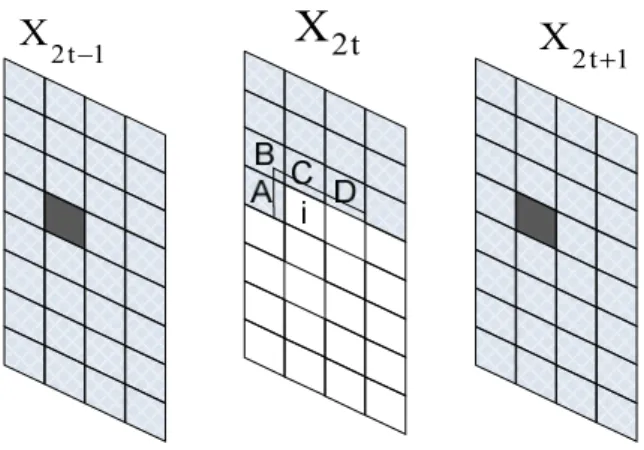
To determine the degree of correlation in temporal and spatial directions for the block, we define two meas- ures, one for temporal correlation by using the sum of ab- solute difference between pixels in collocated blocks of two neighboring key frames (2), and the other for spatial correlation (Figure. 2) by computing the sum of absolute difference between pixels of current block and median values of pixels of neighboring blocks (A, B, and C) in WZ frame () (3).
(2)
(3) Where : pixel index (row, column) inside a block()
The reason for these definition is that in H.264/AVC in- tra coding, pixels in a current block are predicted based on pixels in decoded neighboring blocks (A, B, C, and D) [19]. Therefore, the difference between pixels in the current block and pixels in decoded neighboring blocks plays a major role in verifying the pixel correlation in spatial
X2t 1
- X2t 1
2t +
X
그림 2. 시간 및 공간 상관도 측정 방법
Fig. 2. Temporal and spatial correlation measurement
direction. The median function is chosen since its superi- ority in outlier removal. While in WZ video coding, tempo- ral correlation is exploited at decoder to create side information. It significantly depends on the correlation be- tween pixels in the two closest-key frames, and
. Therefore, the difference between pixels in the two closest-key frames represents the correlation in temporal direction exactly.
Since the degree of correlation in spatial and temporal directions is directly proportional to the probability of a block being intra and WZ modes, respectively, let's define the probability of intra mode and WZ mode
as (4) and (5). The entropy for intra mode () and WZ mode () in whole WZ frame are calculated in (6) and (7).
(4)
(5)
log (6)
Sequence Foreman Coastguard Soccer
1 40 38 44
2 39 37 43
3 38 37 41
4 34 34 36
5 34 33 36
6 32 31 34
7 29 30 31
8 25 26 25
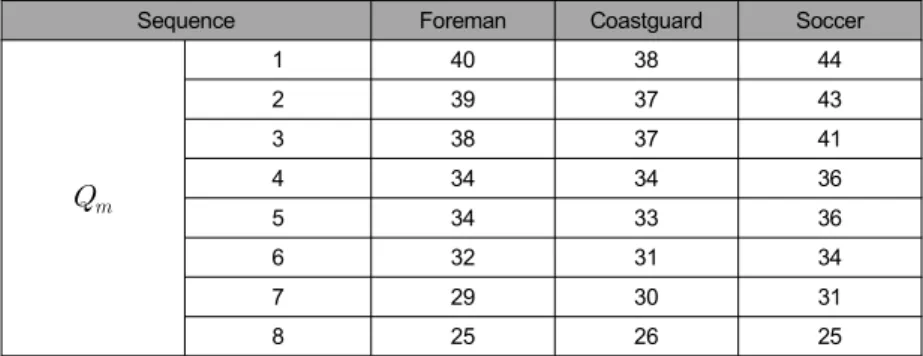
표 1. Key 프레임에 대한 양자화 파라미터
Table 1. Quantization parameter setting for key frame
Quantization matrix for Wyner - Ziv frame
log (7)where : Number of blocks in a frame
A comparison between the entropy of intra mode and WZ mode for each of WZ frames decides the desirable coding mode between intra and WZ modes as below:
( ) { }
{ }
( ) ( ) Choose intra mode
Choose Wyner-Ziv coding
£
if H I H W then else
By comparing and themselves, a user does not need to supply any threshold values, which makes it attractive for many practical applications.
IV. Experimental Results and Discussions
Our simulation is performed based on a GOP size of 2.
The test conditions are the same as for the DISCOVER video codec [20]. The Coastguard, Foreman and Soccer se- quences are used to test since they represent wide content variety. Spatial and temporal resolutions are QCIF and 15Hz, respectively. Quantization matrix and quantization parameters are shown in Table 1.
Three issues are investigated in the next Sub-section:
firstly, we examine the mode decision accuracy of the pro- posed method, secondly, we compare its RD performance with H.264/AVC intra coding under the main profile against the DISCOVER codec [20]. Finally, we analyse both encoding and decoding complexity with and without the proposed method.
1. Accuracy of the Proposed Method
Firstly, we verify the probability of intra and Wyner-Ziv mode for each WZ frame based on (8) and (9) below:
(8)
(9)
where : Number of blocks in a frame
The result in Fig. 3 shows that: in the fast motion se- quences such as in Soccer sequence, the probability of intra mode is almost higher than that of WZ mode. Conversely, in slow motion sequences such as Coastguard sequence, the probability of intra mode is mostly lower than that of WZ mode. It can be easily explained based on the correlation
0 10 20 30 40 50 60 70 0.0
0.1 0.2 0.3 0.4 0.5 0.6 0.7 0.8 0.9 1.0
Frame number
Probability (intra mode)
Foreman, QCIF, WZ Frames only
0 10 20 30 40 50 60 70
0.0 0.1 0.2 0.3 0.4 0.5 0.6 0.7 0.8 0.9 1.0
Frame number
Probability (intra mode)
Coastguard, QCIF, WZ Frames only
0 10 20 30 40 50 60 70
0.0 0.1 0.2 0.3 0.4 0.5 0.6 0.7 0.8 0.9 1.0
Frame number
Probability (intra mode)
Soccer, QCIF, WZ Frames only
그림 3. 인트라 프레임 모드의 발생 확률 Fig. 3. The probability of intra frame mode
0 10 20 30 40 50 60 70 80
25 26 27 28 29 30 31 32
Frame Number
PSNR [dB]
H.264/AVC intra SKKU w/o intra mode SKKU with intra mode
그림 4. 인트라 모드 결정에 따른 PSNR (Foreman 영상)
Fig. 4. PSNR of Foreman sequence with and without intra mode decision
0 10 20 30 40 50 60 70 80
2 3 4 5 6 7 8 9
Frame Number
Rate [kbits]
H.264/AVC intra SKKU w/o intra mode SKKU with intra mode
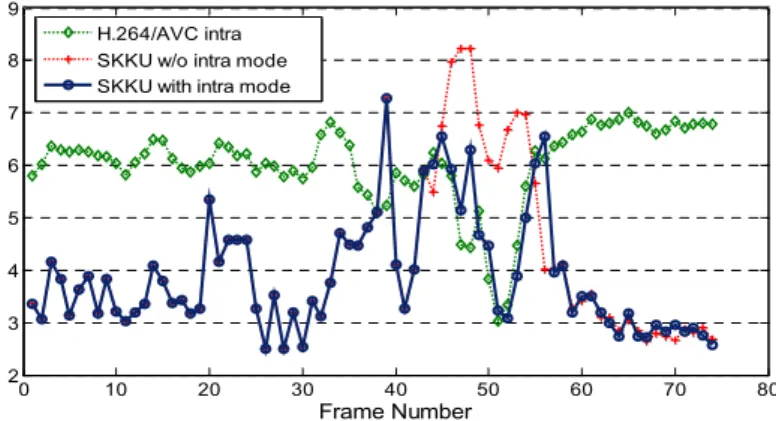
그림 5. 인트라 모드 결정에 따른 비트율 (Foreman 영상)
Fig. 5. Bitrate of Foreman sequence with and without intra mode decision between pixels in the spatial and temporal directions.
Moreover, in order to evaluate how accurate the pro- posed intra mode decision technique is, a comparison of
our DVC codec (called SKKU DVC) with and without in- tra mode decision vs. H.264/AVC intra in terms of PSNR and rate separately are made as in Fig. 4 and Fig. 5. It can
0 100 200 300 400 500 26
28 30 32 34 36 38 40 42
Bitrate [kbps]
PSNR [dB]
Foreman, QCIF @15Hz
H.264/AVC Intra DISCOVER SKKU w/o intra mode SKKU with intra mode
0 100 200 300 400 500
26 28 30 32 34 36 38
Bitrate [kbps]
PSNR [dB]
Coastguard, QCIF @15Hz
H.264/AVC Intra DISCOVER SKKU w/o intra mode SKKU with intra mode
0 100 200 300 400 500 600
26 28 30 32 34 36 38 40 42
Bitrate [kbps]
PSNR [dB]
Soccer, QCIF @15Hz
H.264/AVC Intra DISCOVER SKKU w/o intra mode SKKU with intra mode
그림 6. 제안 방법의 율 왜곡 성능 (QCIF, 15Hz, GOP 크기=2)
Fig. 6. RD performance for QCIF video seuqneces at 15Hz and for GOP size of 2 be remarked that the proposed method is accurate since it
almost always selects the best one between the intra mode and the Wyner-Ziv mode for total frames in Foreman sequence.
2. Rate - Distortion Performance
The rate-distortion (RD) performance of our DVC codec (SKKU) with and without intra mode decision is compared
Encoding Time [s] Decoding Time [s]
Qm SKKU w/o intra mode
SKKU with intra
mode [%] SKKU w/o intra mode
SKKU with intra
mode [%]
1 4.55 5.85 28.6% 813.65 600.66 -26.2%
2 4.61 6.00 30.2% 1312.97 740.65 -43.6%
3 4.74 6.12 29.1% 1692.54 865.79 -48.8%
4 5.09 6.49 27.5% 2701.15 1330.81 -50.7%
5 4.86 6.35 30.6% 3204.03 1566.59 -51.1%
6 5.27 6.76 28.3% 4114.24 2175.67 -47.1%
7 5.38 7.15 32.9% 4195.13 2632.00 -37.3%
8 5.91 7.59 28.4% 5679.59 4404.97 -22.4%
Average 5.05 6.54 29.5% 2964.16 1789.64 -39.6%
표 2. 부/복호화 과정의 복잡도 비교 (Foreman 영상, QCIF, 15Hz)
Table 2. Encoding / Decoding Complexity comparison (Foreman, QCIF, 15Hz) to those of DISCOVER codec [20] and H.264/AVC intra
with main profile (JM 17.2)[21].
As can be concluded from Fig. 6, the proposed DVC co- dec (SKKU) with intra frame mode decision outperforms the DVC scheme without the intra frame mode decision for all sequences and at all RD points. As expected, the video sequence having higher motion has the higher coding gain which the proposed additional intra coding mode decision provides. The coding gains up to 2 dB are achieved by the proposed method when it is compared with the DVC codec without the intra frame mode decision, notably for the Soccer sequence.
Moreover, as the conclusion in [22], by exploiting the adaptive GOP size technique, coding performance can im- prove up to 0.8 dB for the pixel domain codec and up to 0.4 dB for the transform domain - approach when com- pared to the rigid GOP size approach. Therefore, DVC with the proposed method shows the higher coding effi- ciency than the previous schemes, even for DVC with adaptive GOP size approach[22].
3. Encoding / Decoding Complexity
In computational complexity point of view, when we im-
plement DVC with the proposed intra mode decision, en- coder complexity may be increased due to extra computa- tions such as temporal and spatial correlation measure- ments. However, since there are only two matrices to be calculated, they only have a slight effect on the final encod- ing complexity. The time difference between our DVC co- dec with and without the proposed intra mode decision is calculated as below:
(10)
(11) where
In Table 2, a comparison of processing time between our DVC codec with and without the proposed intra mode deci- sion is summarized. When applying intra mode decision in- to DVC structure, significant amount of complexity has been reduced at decoder side ( 39.6 %) while the encoder still retains the property of low complexity. Therefore, the proposed method is desirable for applications which have constraint in decoding resource.
V. Conclusions and Future Works
Intra mode decision is an efficient tool for improving RD performance of DVC. However, its effectiveness has been much influenced by user-specified thresholds and/or model parameters in previous works. In this paper, we have pro- posed a novel method for choosing a better mode between intra mode and WZ mode using the entropy calculations.
It makes the mode decision operable without any user-specified input for threshold or model parameters.
Experimental results show the superiority of the proposed method compared to conventional DVC with improvement up to 2 dB. It is especially efficient in high motion se- quence such as in Soccer sequence. Furthermore, since no thresholds or modelling parameters need to be pre-defined by user, the proposed method is attractive in practical applications. Our future works will continue applying the proposed method to lower levels such as slice or macro- block levels to exploit its advantages in slow motion se- quences such as in Coastguard or Hall Monitor.
References
[1] B. Girod, A. Aaron, S. Rane, and D. Rebollo-Monedero,
“Distributed Video Coding," Proceedings of IEEE,vol.93, no.1, pp.71–83, Jan. 2005.
[2] F. Pereira, L. Torres, C. Guillemot, T. Ebrahimi, R. Leonardi, S.
Klomp, “Distributed Video Coding: Selecting the most promising application scenarios,” Signal Processing: Image Communication, vol. 23, pp.339–352, Jun. 2008.
[3] A. Aaron, S. Rane, E. Setton, and B. Girod, “Transform Domain Wyner-Ziv Codec for Video,” inProc.SPIE Visual Communication:
Image Processing, pp.520–528, Jan. 2004.
[4] 고봉혁, 심혁재, 전병우, "복호 신뢰도에 기반하여 점진적으로 보조정 보를 향상시키는 변환영역 Wyner-Ziv 부호화 방법", 방송공학회 논문 지, 제13권, 제6호, pp.892~904, 2008년 11월.
[5] C. Brites and F. Pereira, "Correlation noise modeling for efficient pixel and transform domain Wyner-Ziv video coding," IEEE Transactions on circuits and systems for video technology, Vol. 18, pp.1177 - 1190, Sep. 2008.
[6] 고봉혁, 심혁재, 전병우, "공간적 유사성과 심볼단위 오류정정 채널 코 드를 이용한 경량화 비디오 부호화 방법", 방송공학회 논문지, 제13권,
제2호, pp.188~199, 2008년 3월.
[7] 김병희, 고봉혁, 전병우, "주파수 적응 채널 잡음 모델링에 기반한 변환 영역 Wyner-Ziv 부호화 방법 ", 방송공학회 논문지, 제14권, 제2호, pp.144-153, 2009년 3월.
[8] J. L. Martinez, W. A. R. J. Weerakkody, W. A. C. Fernando, G.
Fernadez-Escribano, H. Kalva, and A. Garrido, "Distributed video coding using turbo trellis coded modulation," The Visual Computer, Vol. 25, No. 1, pp. 69 - 82, Jan. 2009.
[9] M. B. Badem, W. A. C. Fernando, and A. M. Kondoz, "Transform domian distributed video coding with spatial correlations,"
Multimedia Tools and Applications, pp. 369 - 379, Jul. 2010.
[10] T. Do, H. J. Shim, and B. Jeon, “Intra Frame Decision Based on the Correlation Noise Statistics for Wyner-Ziv Video Coding,”
ITC-CSCC, pp.103–106, Jul.2009.
[11] A. Trapanese, M. Tagliasacchi, S. Tubaro, J. Ascenso, C. Brites, and F. Pereire, “Embedding a Block-based Intra Mode in Frame-based Pixel Domain Wyner-Ziv Video Coding,” International Workshopon Very Low Bitrate Video Coding, Sep.2005.
[12] M. Tagliasacchi, A. Trapanese, S. Tubaro, J Ascenso, C. Brites and F. Pereira, “ Intra Mode Decision based on Spatio-Temporal Cues in Pixel Domain Wyner-Ziv Video Coding,” IEEE ICASSP, vol.2, pp.57–60, Toulouse, France, May, 2006.
[13] L. Liu, D. –K. He, A. Jagmohan, L. Lu, and E. J. Delp, “A Low-complexity Iterative Mode Selection Algorithm for Wyner-Ziv Video Compression,” IEEE International Conference on Image Processing (ICIP), pp.1136–1139, Oct. 2008.
[14] J. Ascenso and F. Pereira, “Low complexity Intra Mode Selection for Efficient Distributed Video Coding,” Proceedings of the International Conference on Multimedia and Expo (ICME), pp.101 –104, Jul. 2009.
[15] B. Ko, H. J. Shim, and B. Jeon, “Wyner-Ziv Video Coding with Side Matching For Improved Side Information,” LNCS, vol.4872, pp.816-825, Dec. 2007.
[16] C. E. Shannon, “A Mathematical Theory of Communication,” The Bell System Technical Journal, vol.27, pp.379-423, Jul.1948.
[17] X. Liu, C. Lu, and F. Chen, "An entropy-based method for assess- ing the number of spatial outliers," International Conference on Information Reuse and Integration, pp. 244 - 249, Aug. 2008.
[18] Y. Sang, D. Wang, and J. Wu, "Entropy-based method for choosing the decomposition level in wavelet threshold de-noising," Entropy 2010, Vol. 12, Issue 6, pp. 1499 - 1513, Jun. 2010.
[19] T. Wiegand, G. J. Sullivan, G. Bjontegaard, and A. Luthra,
“Overview of the H.264/AVC Video Coding Standard,” IEEE Transaction on Circuits and Systems for Video Technology, Vol.13, No.7, Jul.2003.
[20] DISCOVER – Distributed coding for Video Services: http://www.
img.lx.it.pt/~discover/home.html.
[21] H.264/AVC Software Coordination: http://iphome.hhi.de/suehr- ing/tml/.
[22] J. Ascenso, C. Brites, and F. Pereira, "Content Adaptive Wyner-Ziv Video Coding Driven by Motion Activity," IEEE International Conference on Image Processing, Atlanta, USA, Oct. 2006.
저 자 소 개
Xiem HoangVan
- 2009년 : Hanoi University of Science and Technology (Vietnam)
- 2009년 ~ 현재 : Master candidate at Digital Media Lab, Sungkyunkwan University (Korea) - 주관심분야 : Distributed Video Coding, H.264/AVC, Scalable Video Coding
박 종 빈
- 2004년 : 성균관대학교 정보통신공학부 졸업(학사) - 2006년 : 성균관대학교 전자전기공학과 졸업(석사)
- 2006년 ~ 현재 : 성균관대학교 전자전기컴퓨터공학과 박사과정 - 주관심분야 : 분산비디오부호화, 다시점비디오부호화, 영상인식, 신호처리
심 혁 재
- 2000년 : 성균관대학교 전자공학과 졸업 (학사) - 2002년 : 성균관대학교 정보통신공학부 졸업 (석사) - 2002년 ∼ 현재 : 성균관대학교 정보통신공학부 박사과정 - 주관심분야 : 멀티미디어 영상압축, 신호처리
전 병 우
- 1985년 : 서울대학교 전자공학과 졸업(학사) - 1987년 : 서울대학교 전자공학과 졸업(석사)
- 1992년 : Purdue Univ, School of Elec. 졸업(공학박사) - 1993년 ~ 1997년 : 삼성전자 신호처리연구소 선임/수석연구원 - 1997년 ~ 현재 : 성균관대학교 정보통신공학부 교수 - 주관심분야 : 멀티미디어 영상압축, 영상인식, 신호처리