• 검색 결과가 없습니다.

Effect of Carbonization Temperature on Hygric Performance of Carbonized Fiberboards

N/A
N/A
Protected

Academic year: 2021

Share "Effect of Carbonization Temperature on Hygric Performance of Carbonized Fiberboards"

Copied!
9
0
0

로드 중.... (전체 텍스트 보기)

전체 글

(1)

Effect of Carbonization Temperature on Hygric Performance of Carbonized Fiberboards 1

Min Lee

2

⋅Sang-Bum Park

2,†

⋅Sang-Min Lee

2

ABSTRACT

Increases of public attention on healthy environment lead to the regulation of indoor air quality such as Clean Healthy House Construction Standard. This standard covers emission of total volatile organic compounds (TVOCs) (e.g., formaldehyde, benzene, and toluene), ventilation, and use of environmentally-friendly products or functional products. Moisture absorption and desorption abilities are a recommended functionality for improving indoor air quality. In this study, moisture absorption and desorption capacities of carbonized board from wood-based panels and other materials were determined by using UNT-HEAT-01 according to ISO 24358:2008. Pine had higher moisture ab- sorption and desorption capacities (49.0 g/m

2

and 35.3 g/m

2

, respectively) than hinoki cypress, cement board, gypsum board, oriented strand board, and medium density fiberboard (MDF). The moisture absorption and desorption capacities differed considerably according to the wood species. After carbonization process at 400℃, the absorption and de- sorption ability of MDF increased to 38% and 60%, respectively. However, moisture absorption and desorption capaci- ties decreased with increasing carbonization temperature, but they were still higher than original MDF.) Therefore, it is suggested that carbonization below 600℃ can improve moisture absorption/desorption capacities.

Keywords : carbonization, medium density fiberboard, moisture absorption, moisture desorption

1

Date Received February 18, 2014, Date Accepted May 14, 2014

2

Department of Forest Products, Korea Forest Research Institute, Seoul 130-712, Korea

Corresponding author : Sang-Bum Park (e-mail: [email protected])

1. INTRODUCTION

The indoor air quality is one of key parameters for pursuing healthy life because people spend most of their life in indoor area. Thus, they have more chance to be exposed to hazardous substances from indoor products (WHO 2010). In this context, indoor air quality has been raised a critical issue for man- kind, and attracted a public attention because of its riskiness for human (Yang et al. 2007; Li 2011).

As results of concern, green building movement

has started in many countries around the world. Green buildings are defined as facilities designed, built, op- erated, and renovated throughout ecological principles for promoting occupant health and sufficient supports, and resource efficiency including minimizing the im- pacts of the built environment on the natural envi- ronment (Kibert 2003; Woloszyn and Rode 2008).

USA started to promote Leadership in Energy and

Environmental Design (LEED) program which is

supporting to bring energy and water efficient, healthy,

environmentally-friendly cost saving building, homes

(2)

and communities. Moreover, Korea adopted and en- forced the Green Building Certification Criteria (GBCC) in 2002. However, Spengler and Chen (2000) pointed that guidelines for green buildings are superficial and insufficient for specifying materials and designing ventilation systems to ensure a healthful indoor environment by design. Yoon and Lim (2011) reported GBCC is not defined as well as the guide- lines of other countries, and it is not closely connected and interacted with GBCC and local government.

The indoor air quality is determined by many dif- ferent factors such as levels of relative humidity, fine dust, and harmful chemicals. In the influences of indoor humidity on the performance of building, components of building materials and building occu- pants are multifaceted and highly interrelated (Roels and Janssen 2006; Abadie and Mendonca 2009). In this study, we focused on moisture absorption and desorption properties of construction materials in in- door scale. The controlling of indoor relative humid- ity (RH) is an important factor on respiratory com- fort, skin humidity, and perceived indoor air quality (WHO 2010). According to Lechner (2000), lower RH may cause complaints of dry noses, mouths, eyes, and skin and respiratory illnesses. The several European States started to regulate low values of transmittance for the building envelope due to in- crease the demand for controlling energetic con- sumptions and gas emissions (Cerolini 2009). Therefore, thick layers of insulating material in wall and roofs were introduced to solve high energy consumption, but these brought other problems such as air perme- ability and increase of indoor RH levels in occupied buildings (Cerolini 2009).

Charcoal from wood has been widely used for wa- ter purification, humidity controller and deodorant in the houses from old times because it is well known that high humidity control performance and absorp- tion of smell without any scientific evidence.

Therefore, investigation and utilization of charcoal has been fulfilled and done by many research (Park et al. 2012; Kong and Kim 1996, 2000, 2002; Kim et al. 2006; Lee and Kim 2010, Mun et al. 2002).

Moreover, charcoal has been used in manufacture of wood-based composite panels or cement and other inorganic materials by mixing (Park et al. 2012).

Kercher and Nagle (2002) developed carbonized medium-density fiberboard for electrical applications.

Additionally, the carbonized boards have abilities of toxic components adsorption, fireproof, sound-ab- sorption, and electromagnetic shield (Kwon et al.

2012). The fire performance of carbonized boards was investigated and then concluded that it had sat- isfied class III flame retardancy according to the Building Standard Law (Park et al. 2013). The car- bonized boards, therefore, can be used for indoor construction material because it absorbs form- aldehyde, benzene, and toxic VOCs.

However, the moisture buffering performance of carbonized boards has not been investigated yet.

Therefore, the objective of this study was to inves- tigate the performance of moisture buffering capacity of carbonized boards manufactured from wood-based composite panel at different temperatures.

2. MATERIALS and METHODS 2.1. Materials

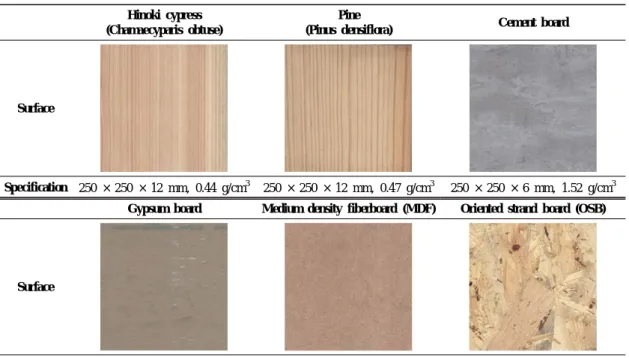
Medium density fiberboard (12 mm-thick, Sunchang Corp., South Korea), oriented strand board (11 mm- thick, Ainsworth Engineered, Vancouver, Canada), cement board (6 mm-thick, PRIMAflex™, Hume Cemboard Industries, Malaysia), gypsum board (9.5 mm-thick, Lafarge, Boral Corp., USA), were used in this study and all boards were commercially avail- able in market and purchased for this study (Fig. 1).

Around 50 years old pine (Pinus densiflora) was cut

(3)

Hinoki cypress (Chamaecyparis obtuse)

Pine

(Pinus densiflora) Cement board

Surface

Specification 250 × 250 × 12 mm, 0.44 g/cm

3

250 × 250 × 12 mm, 0.47 g/cm

3

250 × 250 × 6 mm, 1.52 g/cm

3

Gypsum board Medium density fiberboard (MDF) Oriented strand board (OSB)

Surface

Specification 250 × 250 × 12 mm, 0.61 g/cm

3

250 × 250 × 12 mm, 0.70 g/cm

3

250 × 250 × 6 mm, 0.55 g/cm

3

Fig. 1. Test specimens.

Fig. 2. Manufacture of carbonized boards (Kwon et al. 2013).

from Kwang-neung experiment forest site (Pocheon-si, South Korea) and hinoki cypress (Chamaecyparis obtuse, around 50-60 years old) was kindly provided from Namhae-gun (South Korea). Wood species were

cut into 12 mm thickness. Medium density fiberboard (MDF) was cut into 260 mm × 130 mm, and other samples were cut into 250 mm × 250 mm.

2.2. Carbonization MDF Panels

Cut MDF was wrapped with aluminum foil.

Carbonization of boards was conducted stacking be-

tween two graphite sheets (10 mm-thick) in order to

prevent distortion and crack by a vacuum furnace

under nitrogen gas flow (200 mℓ/min) (Fig. 2). The

temperature in the vacuum furnace was raised by

50℃ per hr, and when its temperature reached at

each 400, 600, 800, 1000℃, temperature maintained

continuously for 2 hours. After carbonization, car-

bonized products were cooled down under ambient

condition.

(4)

Fig. 3. Schematic and picture of test chamber and inside.

2.3. Moisture Buffering Capacity

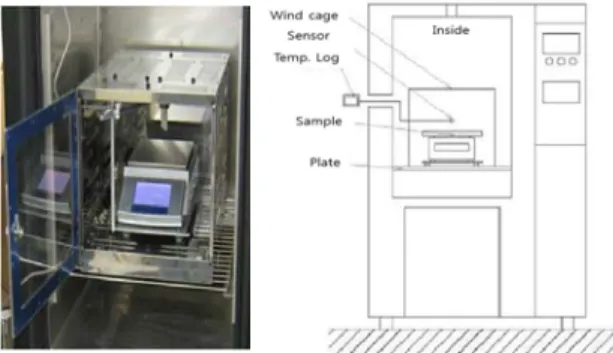
The moisture absorption and desorption capacities of different indoor building materials and carbonized boards made at different carbonizing temperatures were conducted in sealed chamber (UNT-UEAT-01, Unitech, South Korea) according to ISO 24353:2008, KS F 2611: 2009 and JIS A 1470-1: 2008. The test chamber contained an electronic balance, thermostat, temperature sensor, humidity sensor, air flow sensor, and humidifier (Fig. 3). The data from sensors were collected by computer at every 1 minute for 24 hrs.

Each sample was cut into 250 mm × 250 mm and thickness was varied by sample types. Prepared sam- ple was covered by aluminum foil except one side of surface for testing moisture absorption and de- sorption capacities. Test specimen was cured under temperature at 23 ± 0.5℃ and 50 ± 1% relative hu- midity (RH) until weight change of test specimen maintained under 0.01 g for 24 hr, and then mois- ture absorption and desorption test was conducted.

The test conditions were middle humidity level as follows: preconditioning of a specimen at 50% RH;

moisture absorption process at 75% RH for 12 hrs;

moisture desorption process at 50% RH for 12 hrs.

The moisture absorption and desorption capacities were calculated according to ISO 24353:2008 and

equations were following by Eq. 1 and Eq. 2.

Moisture absorption and desorption rates were calcu- lated using equation as shown in Eq. 3.



  

 

Eq. 1



: Change of moisture capacity at time of com- pletion of absorption process

: Mass of specimen at time of completion of moisture absorption process

: Mass of specimen after preconditioning

 : Surface area of absorption



  

 

Eq. 2



: Moisture desorption capacity at time of com- pletion of desorption process

: Mass of specimen at time of completion of moisture absorption process

: Mass of specimen at time of completion of moisture desorption process

 : Surface area of absorption

 



 

  

Eq. 3

: Absorption/desorption rate at time n

: Mass of specimen at time of n;: Mass of specimen at time of n-1,

 : Elapsed time

3. RESULTS and DISCUSSION 3.1. MDF Carbonization

Fig. 4 shows original MDF and carbonized MDF at 400, 600, 800, and 1000℃. After carbonization process, MDF shrunk in all direction including thickness. In general, carbonized MDF at 400℃

shrunk around 13% in width, 14% in length, and

33% in thickness. With increasing carbonization tem-

(5)

(g/m

2

) Hinoki cypress Pine OSB Cement board Gypsum board

Moisture absorption capacity 16.7 49.0 25.2 13.6 5.0

Moisture desorption capacity 19.6 35.3 23.8 12.6 5.3

  Original

MDF

c-MDF 400

c-MDF 600

c-MDF 800

c-MDF 1000

Moisture absorption capacity 26.5 42.7 43.0 29.5 31.2

Moisture desorption capacity 16.6 42.2 42.4 30.1 29.6

Table 1. Moisture absorption capacity and desorption capacity of indoor building materials and carbonized board

Fig. 4. Pictures of MDFs after carbonization at dif- ferent temperatures.

perature, shrinkage increased to 23% in width, 23%

in length, and 42% in thickness in the case of the carbonized MDF(c-MDF) at 1000℃. Also, weight of MDF reduced 67% and 73% on c-MDF at 400℃

and 1000℃, respectively, compared to original MDF.

Carbonization temperature above 800℃, the per- centage of shrinkage was not significantly different from each other. The percentage of shrinking was similar to previous research (Kwon et al. 2013; Park et al. 2009). During the carbonization, resin and oth- er components in MDF were removed and vaporized.

The shrinkage might occur from these reasons.

3.2. Performance of Moisture Absorption and Desorption

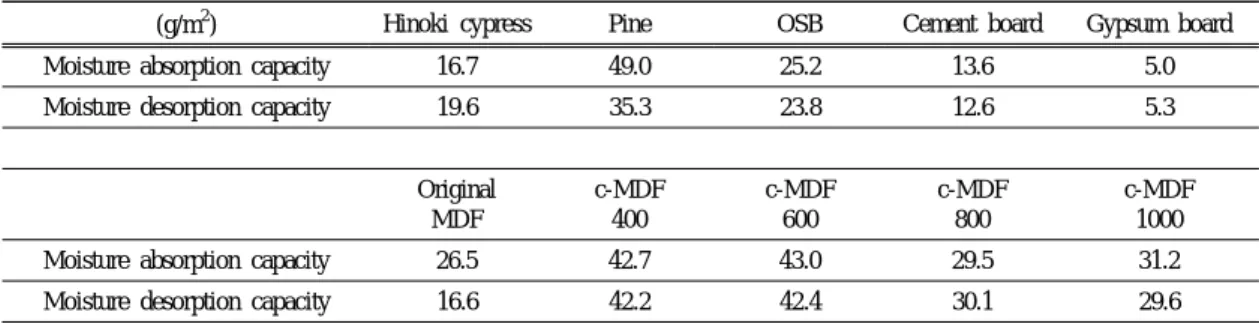
Table 1 summarized the moisture absorption ca- pacity and desorption capacity of indoor building

materials and carbonized MDF prepared at 400, 600, 800, and 1000℃. Wood or wood-based board and c-MDFs had higher moisture absorption and de- sorption ability than other materials, while gypsum board had the lowest performance than wood and wood-based boards. Gypsum board had 5.0 and 5.3 g/m

2

of moisture absorption and desorption capaci- ties, respectively. These performances were lower than cement board with 13.6 and 12.6 g/m

2

of mois- ture absorption and desorption capacities, respectively.

It was expected that cement board would have the lowest moisture buffering capacity, but it was not.

Component of cement board may have more mois- ture absorption and desorption abilities than that of gypsum board. Typically, cement board consists of lime, silica, alumina, and iron oxide, so silica and iron oxide may help to adsorb or desorb moisture. In addition, not only chemical reaction of materials in- fluences absorption and desorption, but also physical reaction between materials and moisture can influ- ence that.

In case of hinoki cypress and pine, pine had ap-

proximately 3 and 1.8 times higher moisture absorp-

tion and desorption capacities than that of hinoki cy-

press (Table 1). It means that the performance of

moisture absorption and desorption capacities has

differ from between wood species. Hinoki cypress

has been widely used for indoor building material

because it emits phytoncides. Effects of phytoncides

(6)

(g/m

2

⋅ h) Hinoki cypress Pine OSB Cement board Gypsum board

Moisture absorption rate 8.98 14.94 5.89 4.71 4.04

Moisture desorption rate 7.98 12.95 4.51 4.38 3.70

  Original

MDF

c-MDF 400

c-MDF 600

c-MDF 800

c-MDF 1000

Moisture absorption rate 6.06 17.93 17.48 16.38 15.84

Moisture desorption rate 4.71 15.21 14.75 14.20 13.80

Table 2. Moisture absorption and desorption rates of indoor building materials and carbonized board for 1 hour

Fig. 6. Absorption and desorption capacities of original MDF and carbonized MDF at different temperatures.

Fig. 5. Absorption and desorption capacities of wood and indoor construction materials.

have been studied by many researchers and con- cluded that it reduces stress and tiredness (Shin et al. 2010; Nam and Uhm 2008). However, hinoki cy- press had low moisture absorption and desorption ca- pacities (below 20 g/m

2

). Using hinoki cypress in building or house may help to improve indoor air quality with its phytoncides, but it will not help to control humidity in building or house. In our experi- ment, we tested only two wood species, so more wood species should be tested and basic character- istics should be collected for better understanding of wood as an indoor material.

Original OSB and MDF had also low moisture ab- sorption and desorption capacities (below 26 g/m

2

) which was lower than that of pine, but higher than that of hinoki cypress (Table 1). Between OSB and

MDF, no significant difference was observed and it is considered that so type of wood-based panel did not affect moisture buffering capacity.

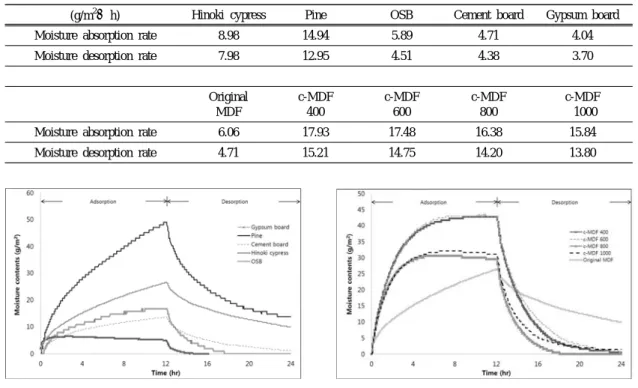
Fig. 5 shows the pattern of absorption and de- sorption capacities of wood and indoor construction materials. Wood and wood-based panel had similar absorption and desorption pattern even through its amount of capacity were different, while cement board and gypsum board had different pattern com- pare of that.

In comparison of moisture absorption and de- sorption rates, c-MDFs had higher rates of moisture absorption and desorption than other materials (Table 2). It means that c-MDF adsorbs or desorbs moisture faster than cement board, gypsum board, and wood.

After carbonization process at 400℃ and 600℃,

(7)

moisture absorption and desorption capacities of MDF increased in 38% and 60% of moisture absorp- tion and desorption capacities, respectively. Among the c-MDFs, the c-MDF at 400℃ and 600℃ had higher performance of moisture absorption and de- sorption capacities than those at 800℃ and 1000℃

(Fig. 6). Moreover, on carbonized MDF, moisture capacity reached faster at maximum level than origi- nal MDF.

Moisture buffering in porous surfaces was found to have a large influence on the humidity dis- tribution in the dwelling. Due to the storage capacity of the building envelope and furniture, moisture was absorbed by porous surfaces before reaching the oth- er rooms. (Van Belleghem et al. 2011; Kim et al.

2010).

Specific surface area increased by removing lignin and presence of lignin in wood reduce moisture ab- sorbing ability (Yang et al. 1995). According to Lee and Kim (2011), higher specific surface area had higher moisture absorption capacity. In general, black (soft) charcoal which made at lower temper- ature (below 600℃) has 0.1-13.7 m

2

/g of specific surface area, and white (hard) charcoal which made at higher temperature (above 800℃) has 53.2-372.6 m

2

/g of specific surface area (Lee and Kim 2010).

Blankehorn et al. (1978) and Pulido-Novicio et al.

(2001) reported that specific surface area was af- fected by carbonization temperature, and specific sur- face area increases as temperature increases.

However, in our experiment, carbonized MDF at higher temperature (above 800℃) had lower mois- ture absorption capacity than carbonized MDF at lower temperature (below 600℃). Therefore, specific surface area may not significantly affect on moisture absorption capacity. Pore size or pore size dis- tribution and pore shape should not only be eval- uated in order to understand the mechanism of mois- ture absorption ability, and also hydrophilic proper-

ties of carbonized board will help to understand the effects of carbonization temperature.

4. CONCLUSION

Environmental pollution has been a threat to mankind. Activated carbon or black charcoal has been studied and proved for absorbing toxic materi- als because of its excellent absorbing ability.

Therefore, indoor materials with activated carbon or black charcoal by mixing and reforming are developed. The carbonized board from wood based panels can be used rather than mixing activated car- bon or black charcoal with board because of work- ability and environmental issue. Based on our ex- periment, c-MDF at 400℃ and 600℃ had higher performance of moisture absorption and desorption capacities. Carbonization helps to improve the mois- ture absorption capacity of wood material, but mois- ture absorption capacity was affected by carbon- ization temperature. High specific surface area, which is one of key factors of moisture absorption capacity, had high ability of that, and high specific surface area could be yielded by high carbonization temperature. However, moisture absorption and de- sorption capacities decreased as carbonization tem- perature increased in this experiment. The moisture absorption capacity may depend on specific surface area, pore size or pore size distribution, pore shape, and hydrophilicity of material. In view of absorption performance, economic feasibility, and effectiveness, carbonized MDF may be used as humidity controller in indoor condition.

REFERENCES

Abadie, M.O., Mendonça, K.C. 2009. Moisture per-

formance of building materials: From material

characterization to building simulation using the

(8)

Moisture Buffer Value concept. Building and Environment 44(2): 388∼401.

Blankehorn, P.R., Barnes, D.P., Kline, D.E., Murphey, W.K. 1978. Porosity and pore size distribution of black cherry carbonized in an insert atmosphere.

Wood Science 11(1): 23∼29.

Cerolini, S., D’Orazio, M., Di Perna, C., Stazi, A.

2009. Moisture buffering capacity of highly ab- sorbing materials. Energy and Buildings 41(2):

164∼168.

Chu, Y.S., Kwon, C.W., Song, H., Lee, J.K. 2008.

Hygroscopic Characteristic of Hydrothermal Reacted Panels Using Porous Materials. Journal of the Korean Ceramic Society 45(12): 832∼838.

ISO 24353. 2008. Hygrothermal performance of building materials and products -- Determination of moisture absorption/desorption properties in response to humidity variation.

JIS A 1470-1. 2008. Determination of water vapour absorption / desorption properties for building materials -- Part 1: Response to humidity variation.

Japan: Japanese Industrial Standard.

Kwon, J.H., Park, S.B., Ayrilmis, N., Kim, N.H., Kwon, S.M. 2012. Electromagnetic interference shielding effectiveness, electrical resistivity and mechanical performance of carbonized medium density fiberboard. Journal of Composite Materials 47(16): 1951∼1958.

KS F 2611. 2009. Hygrothermal performance of building materials and products -Determination of moisture absorption/desorption properties in response to humidity variation.

Kercher, A.K., Nagle, D.C. 2002. Evaluation of car- bonized medium-density fiberboard for electrical applications. Carbon 40: 1321∼1330.

Kibert, C.J. 2003. Green buildings: an overview of progress. Journal of Land Use & Environmental Law 19: 491.

Kim, H.J., Kim, S.S., Lee, Y.G., Song, K.D. 2010.

The Hygric Performances of Moisture Adsorbing/

Desorbing Building Materials. Aerosol and Air Quality Research 10: 625∼634.

Kong, S.W., Kim, B.R. 2002. Absorption Characteristics of Charcoals of Major Korean Wood Species and Wood-based Materials. Mokchae Konghak 30(4): 33∼40.

Kong, S.W., Kim, B.R. 2000. Development of Carbonization Technology and Application of Unutilized Wood Wastes (II). Mokchae Konghak 28(2): 57∼65.

Kong, S.W., Kim, B.R. 1996. Development of Carbonization Technology and Application of Unutilized Wood Wastes (I). Mokchae Konghak 27(2): 70∼77.

Kim, J.T., Kim, S.H., Kim, H.J. 2006. Characteristics of Physical and Absorption of Korean Traditional Charcoal. Korean Journal of Sanitation 21(4):

77∼86.

Li, Y. 2011. An Experimental and Numerical Study of the Influence of Room Factors and Hygros- copic Material of Wood Paneling on the Indoor Environment. Ph.D. Thesis, Concordia University, USA.

Lee, D.Y., Kim, B.R. 2010. Analysis of Functional Characteristics of the Commercial Wood Charcoal in Korea. Mokchae Konghak 38(6): 480∼489.

Lee, D.Y., Kim, B.R. 2010. Absorption Characteristics of Commercial Wood Charcoal in Korea (I).

Mokchae Konghak 38(1): 27∼35.

Lee, D.Y., Kim, B.R. 2011. Absorption Characteristics of Charcoal from Major Korean Wood Species and Wood-based Materials (II). J. Korean W ood Sci. & Tech. 39(4): 281∼290.

Lechner, N. 2000. Heating, cooling, lighting, design methods for architects. John Wiley & Sons, Inc.

Mun, S.P., Hwang, U.D., Park, S.B., Kwon, S.D.

2002. Characterization of Pine Bark Charcoal

Prepared from Small and Large-Scale Carbonization

(9)

Kilns. Journal of Korea Forest Energy 21(2):

1∼9.

Nam, E.S., Uhm, D.C. 2008. Effects of Phytoncides Inhalation on Serum Cortisol Level and Life Stress of College Students. Korean Society of Adult Nursing 20(5): 697∼706.

Park, S.B., Lee, M., Son, D.W., Lee, S.M., Kim, J.I.

2013. Fire performance of carbonized medium density fiberboard manufactured at different temperatures. Journal of Wood Science 60(1):

74∼79.

Park, S.B., Lee, S.M., Park, J.Y., Lee, S.H. 2009.

Manufacture of Crack-free Carbonized Board from Fiberboard. Mokchae Konghak 37(4):

293∼299.

Park, H.M., Heo, H.S., Sung, E.J., Nam, J.H., Lim, J.S. 2012. Physical Properties of Hybrid Boards Composed of Green Tea, Charcoals and Wood Fiber. Journal of Korean Wood Science &

Technology 40(6): 406∼417.

Pulido-Novicio, L., Hata, T., Kurimoto, Y., Doi, S., Ishihara, S., Imamura, Y. 2001. Absorption ca- pacities and related characteristics of wood char- coals carbonized using a one-step or two-step process. Journal of Wood Science 47: 48∼57.

Roels, S., Janssen, H. 2006. A comparison of the Nordtest and Japanese test methods for the mois- ture buffering performance of building materials.

Journal of Building Physics 30(2): 137∼161.

Shin, W.S., Kim, S.K., Yeon, P.S., Lee, J.H. 2010.

Effects of Phytoncides on Psychophysical Responses.

Korean Institute of Forest Recreation 14(2):

85∼91.

Spengler, J.D., Chen, Q. 2000. Indoor air quality factors in designing a healthy building. Annual Review of Energy and the Environment 25:

567∼600.

Van Belleghem, M., Steeman, M., Willockx, A., Janssens, A., De Paepe, M. 2011. Benchmark experiments for moisture transfer modelling in air and porous materials. Building and Environment 46(4) 884‐898. doi: 10.1016/j.buildenv.2010.10.018.

World Health Organization. 2010. WHO guidelines for indoor air quality: selected pollutants. Geneva, Switzerland: WHO.

Woloszyn, M., Rode, C. 2008. Tools for perform- ance simulation of heat, air and moisture con- ditions of whole buildings. In Building Simulation 1(1): 5∼24.

Yang, X., Vera, S., Rao, J., Ge, H., Fazio, P. 2007.

Full-scale experimental investigation of moisture buffering effect and indoor moisture distribution.

In Proceedings of Thermal Performance of the Exterior Envelopes of Whole Buildings.

Yang, J.K., Kim, H.J., Lee, W.H. 1995. Changes of Specific Surface Area of the Steam Exploded Wood. Mokchae Konghak 23(1): 54∼60.

Yoon, J.E., Lim, Y.H. 2011. Study on Correlation of

Green Building Certification System and

Guidelines - Focused on LEED and Sustainable

Building Guidelines in the US -. Architectural

Institute of Korea 27(11): 155∼164.

수치

Fig. 1. Test specimens.
Fig. 3. Schematic and picture of test chamber and  inside.
Table 1. Moisture absorption capacity and desorption capacity of indoor building materials and carbonized board
Fig. 5. Absorption and desorption capacities of wood and indoor construction materials.

참조

관련 문서

15) 세광음악출판사

Piattelli M, Scarano A, Paolantonio M, lezzi G, Petrone G, Piattelli A : Bone response to machines and resorbable blast material titanium implants: An experimental stydy

F F Fi i ig g g.. 56℃ 이었으나 열싸이클링 수가 증가함에 따라 M s 및 M f 온도는 각각 2-3℃ 저하하는 것을 알 수 있었으며 heatfl ow 는 약간 감소하는 경향을 나타냈다.그러나 M

Eventually bthe control board doesn't send the IOCTST signal in order to test the IO board anymore.. Checking the IO board by the control board is performed by the

1) Transition boundary between Newtonian and non‐Newtonian flow behavior 2) Iso‐viscosity contours representing stress and temperature effect on viscosity 3)

for a future of work that does not yet exist, careers that have not yet been invented, an economy that prizes things not yet created, and that puts STEAM into the

A homogeneous disk of mass m and radius r is mounted on the vertical shaft AB as shown Determine the directions of the angular momentum of the disc about the mass

To this end, the actual situation of using board games of special teachers, the level of use, satisfaction with board games, the perceptions of special