Effects of the Physicochemical Properties of Lignocellulosic Artificial Soil Containing Bacillus subtilis on the Growth of
Lespedeza cyrtobotrya 1KORAPP
Ji-Su Kim
2⋅Ji young Jung
2⋅Si Young Ha
2⋅Jae-Kyung Yang
2,†ABSTRACT
1)In this study, we prepared lignocellulosic artificial soil that contains Bacillus subtilis (peat moss/perlite/ steam-exploded oak wood/microbial culture = 3:1:3:3, w/w/w/w) for use in the restoration of damaged soil areas. The prepared lignocellulosic artificial soil was mixed with soil at ratios of 0%, 25%, 50%, 75%, and 100%. These mixed soils were then applied to fields, and the resultant physicochemical properties and their effects on the plant growth of Lespedeza cyrtobotrya were observed. The mixture of the prepared artificial soils (mixed at ratios of 25%–100%) with soil had a bulk densities of <0.04 g/cm3, porosities of >85%, pH values between 4.3 and 4.7, electrical conductivities of <0.5 dS/m, C/N ratios between 15.0 and 26.5, organic matter content between 23.6% and 43.2%, and bacterial densities between 157 × 106 and 624 × 106 CFU/g. In addition, the prepared artificial soils mixed with soil at ratios of 25%–50%
exhibited higher plant growth rates for L. cyrtobotrya compared with the control. Overall, we identified positive correlations between the plant growth of L. cyrtobotrya and soil bulk density, porosity, water-holding capacity, C/N ratio, organic matter, and bacterial densities.
Keywords: lignocellulosic, artificial soil, Bacillus subtilis, physicochemical properties, plant growth, Lespedeza
cyrtobotrya
1. INTRODUCTION
Afforestation on damaged soil by natural restoration is a long process that can possibly produce conditions unfavorable for plant growth (Pritchett and Fischer, 1987). Artificial soil is commonly used to promote plant growth by improving the physicochemical properties of soil (Cao et al., 2014; Kerek, 2003). South Korean researchers have been evaluating methods of preparing
artificial soil using organic wood materials such as Miscanthus sinensis var. purpurascens, waste wood chips, and pulp slurry (Kwon et al., 2014); waste wood chips and slurry (Kim and Kim, 2010); pre-treated wood chips and peat moss (Kim et al., 2016); incinerated paper mill sludge (Choi and Park, 2016); waste wood chips (Koh et al., 2010); raw straw mats, peat moss, and fermented wood chips (Jeong et al., 2010);
high-temperature- or high-pressure-treated wood chips
1Date Received May 2, 2019, Date Accepted July 2, 2019
2Division of Environmental Forest Science, Major of Environmental Materials Science, Institute of Agriculture & Life Science, Gyeongsang National University, Jinju 52828, Republic of Korea
†Corresponding author: Jae-Kyung Yang (e-mail: [email protected], ORCID: 0000-0003-0423-6398)
https://doi.org/10.5658/WOOD.2019.47.4.393 Original Article
(Moon et al., 2018; Kim et al., 2016); wood mill (Jo et al., 2017); and pine sawdust (Jung et al., 2017).
Artificial soil that contains wood material not only enhances soil structure, air permeability, and water- holding and cation exchange capacities (Cogger, 2005) but also promotes plant growth by supplying oxygen, moisture, and nutrients to the plant root systems (Bandaranayake et al., 2003). However, given that arti- ficial soil is usually mixed with peat moss or perlite, the plant root system lacks the microorganisms necessary for effective promotion of plant growth. Ju et al. (2013) have reported that the microbes present in organic artificial soil protect plant roots and promote their growth. Other studies have claimed that these microbes are essential for nutrient absorption (Lange et al., 1993) and that they promote plant growth through direct and indirect interactions with plants (Juanda, 2005; Ahmad et al., 2008; Sayyed et al., 2009). Additionally, microbial activity can improve soil fertility by promoting soil aggregate formation (Oades, 1993; Tisdall, 1994; Six et al., 2007). These observations confirm that microbes significantly improve the physicochemical properties of artificial soil, thereby promoting plant growth. Despite the importance of developing new artificial soils that contain both microbes and wood materials, very few studies on the subject have been published in the literature (Jeon and Woo, 2005; Ma et al., 2011).
In this study, we prepared a wood-based artificial soil that was mixed with a control soil at varying ratios. We then planted seeds of Lespedeza cyrtobotrya in small outdoor pots. We evaluated the use of artificial soil in afforestation and identified the properties of the soil that affect the growth of L. cyrtobotrya by analyzing the physicochemical properties of the artificial soil and examining the stem and root growth of the plant.
2. MATERIALS and METHODS
2.1. Testing materials
Commercially available peat moss (pH 3.5–4.5, Sunshine, Canada), perlite (S company, Seoul, Korea), and carboxyl methyl cellulose (CMC, K company, Daejeon, Korea) were used in these experiments.
Unseasoned Quercus mongolica chips were processed at a pressure of 25 kgf/cm
2in a high-temperature/
pressure processing machine (Y company, Daegu, Korea) for 5 min. Ethanol (10%) was extracted from the wood chips at 60 °C for 3 h (1:20 w/v) and subjected to decompression filtration. The resulting solids were used in the next steps of the experiment.
2.2. Preparation of microbial formulation and artificial soil
Bacillus subtilis, the bacterial test strain used in this study, was acquired from H company (Jinju-si, Gyeongsangnam-do, Korea). The microbes were cultured in liquid broth at 30 °C and 100 rpm for 4 days. Subsequently, 30 mL of the culture was added to 30 mL of 2% CMC and incubated in 100 g of sterilized perlite at 30 °C for 8 days. The microbes were dried at 35 °C for 48 h and formulated with a freeze dryer to be used as a raw material for the artificial soil.
Artificial soil was prepared by mixing peat moss, perlite, pre-processed Quercus mongolica chips, and the microbial formulation in a ratio of 3:1:3:3 (w/w/w/w).
2.3. Plot design using small outdoor pots
Before the experimental plots were established, the control soil (wetland soil from Cheongseongsan, Yangsan-si, Gyeongsangnam-do), 25% mixed soil (75%
natural soil + 25% artificial soil, w/w), 50% mixed soil (50% natural soil + 50% artificial soil, w/w), 75%
mixed soil (25% natural soil + 75% artificial soil, w/w),
and 100% artificial soil were prepared (based on dry weights). The plots were set up by randomly placing the soils in cube-shaped pots (7.5 × 7.5 × 7.5 cm
3) on a sloped surface at a latitude of 35.14N and longitude of 128.09E. The pots were watered once every 3 days to prevent the soils from drying. Subsequently, 50 seeds of the woody plant L. cyrtobotrya were planted in the plots to analyze plant growth. The physicochemical properties and microbial densities of the control, mixed, and artificial soils were also assessed.
2.4. Analysis of physicochemical properties
The control, mixed, and artificial soils were dried at 60 °C for 24 h before analysis of the physicochemical properties. To measure bulk density, a 100-cm
3core was filled with the sample, and pressure was applied for 3 min using a 500-g weight. Next, the top of the core was vertically cut from the container surface, and the sample was weighed to determine the bulk density (CEN, 1999a, 1999b; Byun et al., 2012). Porosity was calculated by applying the specific gravity (2.65) to the bulk density measurement (Inbar et al., 1993). To measure the water-holding capacity, a 100-cm
3core was filled with the sample and pressured as described above. The sample was saturated with water, which was allowed to drain under gravity over 24 h. The final weight of the dry sample was then measured to determine the water-holding capacity (Yi et al., 2012).
The sample was mixed with distilled water (1:5, w/w) and then placed in a shaking incubator for 30 min, after which the pH was measured using a pH meter (HI-8417, HANNA Instrument, USA). The electrical conductivity (EC) of the suspended filtrate was measured using an EC meter (Orion 3-Star, Plus, Thermo Fisher Scientific, USA). The content of organic matter was measured by completely carbonizing the sample in a muffle furnace (NIAST, 2000) at 550 °C.
The carbon-to-nitrogen (C/N) mass ratio was calculated
using an elemental analyzer (Flash 2000 Series, Thermo Fisher Scientific Inc., USA).
2.5. Analysis of plant growth characteristics
The 50 L. cyrtobotrya seedlings were allowed to germinate for 3 months; subsequently, 5 seedlings were randomly selected for plant growth analysis. The stem heights and root lengths of the seedlings were measured with a pair of calipers (Digital calipers, Blue bird, China) (Lee et al., 2013).
2.6. Analysis of microbial density
A total of 10-g (dry weight) samples of control, mixed, and artificial soil was collected before establishment of the plots, and equivalent 10 g of samples were collected taken after 3 months. The soils were mixed with 90 mL of sterilized 0.85% NaCl solution and then placed in a shaking incubator (Vision Co., Bucheon, Korea) at 200 rpm for 30 min. The suspension was serially diluted, smeared, and cultured on R2A agar (NA, Difco, Detroit, MI) badge containing cycloheximide (0.05 g/L). The plates were incubated at 28 °C for 2 days, and the number of colonies was counted. For each sample, the microbial number (CFU/ml) was calculated by averaging the counts from three Petri dishes (Oh et al., 2014).
2.7. Statistical analysis
All statistical analyses were performed using IBM SPSS statistics v25 (IBM Corp., Armonk, NY, USA).
The Duncan’s multiple range test (p < 0.05) was
conducted to determine significance levels between the
means of the experimental plots. Pearson’s correlation
coefficient analysis was used to investigate the
correlation between the physicochemical properties of
artificial soil and root/stem growth.
3. RESULTS and DISCUSSION
3.1. Physical properties
Comparisons of the physical properties (e.g., bulk density, porosity, and water-holding capacity) of different soils are important because these parameters affect plant growth significantly (Boodley, 1998). Table 1 summarizes the bulk densities, porosities, and water- holding capacities of the control, mixed, and artificial soils.
The bulk densities of the 25% and 50% mixed soils were 0.24 and 0.16g/cm
3, respectively. These mea- surements were significantly lower than that of the control soil (0.51 g/cm
3). The observed gradual decrease in bulk density was associated with an increase in the percentage of artificial soil. The level of organic matter in soil is thought to be negatively correlated to bulk density (Ju et al., 2015). The decrease in bulk density due to the presence of artificial soil has the advantage of improving water-holding capacity and air permeability (Nelson, 2003). Porosity has been shown to affect the drainage and water-holding capacity of soils and the growth of plant roots (Schoenholtz et al., 2000; Liebig and Doran, 1999). Plants are reported to grow well in soils with a porosity of ≥85% (De Boodt and Verdonck, 1972; Gruda and Schnitzler, 2004). Although the control soil had an inadequate porosity of 80.7%, this porosity increased to 90.8%–95.5% by increasing
the mixing ratio of the artificial soil. Although an increase in porosity can be beneficial for plant growth, it may also lead to an increase in permeability because moisture migrates through the pores, thereby subjecting plants to significant dehydration-induced damage (Shin, 2002). Therefore, natural and artificial soils must be mixed according to the soil conditions at the planting site, rather than solely using artificial soil with a high porosity. The water-holding capacity of a soil is the amount of water that it can store and is known to affect the distribution of water into the plant, a process that is essential for growth (Yang et al., 2013). The water-holding capacities of the control, 25% mixed, 50% mixed, 75% mixed, and artificial soils were found to be 59.9%, 66.1%, 76.5%, 79.8%, and 83.3%, respectively. These findings demonstrate the positive correlation between water-holding capacity and the mixing ratio of the artificial soil. The water-holding capacity of the soils in all the experimental plots (except the control) was > 60%, which is considered adequate (Yeager et al., 1997). Basso et al. (2013) and Lawes et al. (2009) have reported that high water-holding capacity is beneficial for long-term plant growth and soil loss prevention. These benefits can be achieved by the on-site application of artificial soil as prepared in this study. In addition, increases in the bulk density, porosity and water-holding capacity of the soils were achieved by increasing the ratio of the artificial soil, relative to the control soil.
Media1) Bulk density (g/cm3) Porosity (%) Water holding capacity (%)
Soil 0.51±0.01a2) 80.70±0.20e 59.90±1.30e
25% mixed soil 0.24±0.02b 90.80±0.10d 66.10±0.40d
50% mixed soil 0.16±0.02c 94.10±0.30c 76.50±0.50c
75% mixed soil 0.13±0.03c 95.00±0.50b 79.80±1.50b
Artificial soil 0.08±0,00d 97.00±0.70a 83.30±0.10a
1)Soil: 100% soil, control; 25% mixed soil: 75% soil and 25% artificial soil, (w/w); 50% mixed soil: 50% soil and 50%
artificial soil, (w/w); 75% mixed soil: 25% soil and 75% artificial soil, (w/w); Artificial soil: 100% artificial soil.
2)Different letters within same column indicate the significant difference at p < 0.05 by Duncan’s multiple range test
Table 1. Physical properties on mixing ratio of artificial soil with soil.
3.2. Chemical properties
The chemical properties of soils are important determinants of plant growth and appropriate environ- ment (Gabriels et al., 1986). Accordingly, a comparative analysis of the soil components should be conducted with reference to ratios of control to artificial soil. Table 2 summarized the pH, EC, C/N ratio, and organic matter content of the control, mixed, and artificial soils.
The pH of the control, 25% mixed, 50% mixed, and 75% mixed soils were 4.8, 4.7, and 4.6, respectively.
These values are lower than the optimal pH range for plant growth, i.e., 5.3–6.5 (Abad et al., 1992).
Significant differences in pH were not observed between the soils containing different percentages of artificial soil. The artificial soil was found to have the lowest pH at 4.3. Yamazaki (1982) have reported that plant roots are easily damaged at a pH of <four. These observations highlight the need to adjust the pH of soils according to local conditions to optimize plant growth. The EC of the control, mixed, and artificial soils were measured between 0.061 and 0.101 ds/m.
ECs of ≤0.5 ds/m are generally considered adequate for plant growth (Abad et al., 2002). High ECs can result in salt accumulation and poor conditions for root growth (Aliasgharzadeh et al., 2001). As such, we suggest that the low EC of the artificial soil prevents salt-induced growth inhibition. A high C/N ratio promotes microbial absorption of nitrogen in the
root-zone around the plant, thereby hindering early growth (Choi et al., 2011). For this reason, nitrogen fertilizers should be added if the C/N ratio of the artificial soil is ≥ 50 (Lee and Sang, 1991). Sou et al. (2011) have reported a C/N ratio of 17.4 in a habitat containing L. cyrtobotrya. In the present study, the 25% mixed, 50% mixed, and 75% mixed soils showed C/N ratios ranging from 15.0 to 19.8, thus suggesting that varying amounts of artificial soil are unlikely to inhibit early growth. The control soil showed the lowest organic matter content (23.6%); however, as the mixing ratio of the artificial soil increased, the organic matter significantly increased from 27.6% to 43.2% possibly because of the addition of pre-processed oak and peat moss, which are rich in organic materials, to the artificial soil. High levels of organic matter provide large amounts of nutrients to the plant and improve the cation exchange capacity necessary for small nutrient exchanges (Wood et al., 2018).
3.3. Microbial density
Table 3 presents the microbial densities before and after the on-site application of the control, mixed, and artificial soils in small outdoor pots.
Prior to the on-site application, the control soil had the lowest microbial density of 3.5 × 10
7CFU/g. This microbial density increased from 1.57 × 10
8to 6.24
× 10
8CFU/g as the ratio of the artificial soil increased.
Media1) pH EC (ds/m) C/N ratio
Soil 4.8±0.15a2) 0.061±0.001c 11.0±0.1e
25% mixed soil 4.7±0.20a 0.065±0.002c 15.0±0.2d
50% mixed soil 4.7±0.12a 0.066±0.004c 17.7±0.2c
75% mixed soil 4.6±0.13a 0.076±0.003b 19.8±0.1b
Artificial soil 4.3±0.10b 0.101±0.003a 26.5±0.3a
1)Soil: 100% soil, control; 25% mixed soil: 75% soil and 25% artificial soil, (w/w); 50% mixed soil: 50% soil and 50%
artificial soil, (w/w); 75% mixed soil: 25% soil and 75% artificial soil, (w/w); Artificial soil: 100% artificial soil
2)Different letters within same column indicate the significant difference at p < 0.05 by Duncan’s multiple range test
Table 2. Chemical properties on mixing ratio of artificial soil with soil
Media1)
Bacteria (× 106, CFU/g) Field application
Before After
Soil 35±5.3e2) 30±7.1e
25% mixed soil 157±10.4d 253±29.1d
50% mixed soil 334±15.1c 437±10.2c
75% mixed soil 440±20.3b 532±32.1b
Artificial soil 624±41.2a 854±21.2a
1)Soil: 100% soil, control; 25% mixed soil: 75% soil and 25% artificial soil, (w/w); 50% mixed soil: 50% soil and 50% artificial soil, (w/w); 75% mixed soil: 25% soil and 75% artificial soil, (w/w); Artificial soil: 100% artificial soil
2)Different letters within same column indicate the significant difference at p < 0.05 by Duncan’s multiple range test
Table 3. Change of bacteria density in mixing ratio of artificial soil with soil on field application
After 3 months, the microbial density of the control soil had decreased by 13.4%. Conversely, the microbial numbers of the 25%, 50%, and 75% mixed soils and the artificial soil had increased by 61.1%, 30.8, 21, and 36.9%, respectively. These increases can be explained by the ability of microbes to use organic carbon and nitrogen sources as macronutrients for plant growth. Moreover, the artificial soil prepared in this study contained peat moss and wood materials comprising organic matter that is beneficial for microbial growth (Barber and Lynch, 1997; Lynch, 1982; Krieg and Holt, 1984). An increase in microbial density is known to positively affect plant growth (Nautiyal et al., 2013).
3.4. Plant growth characteristics
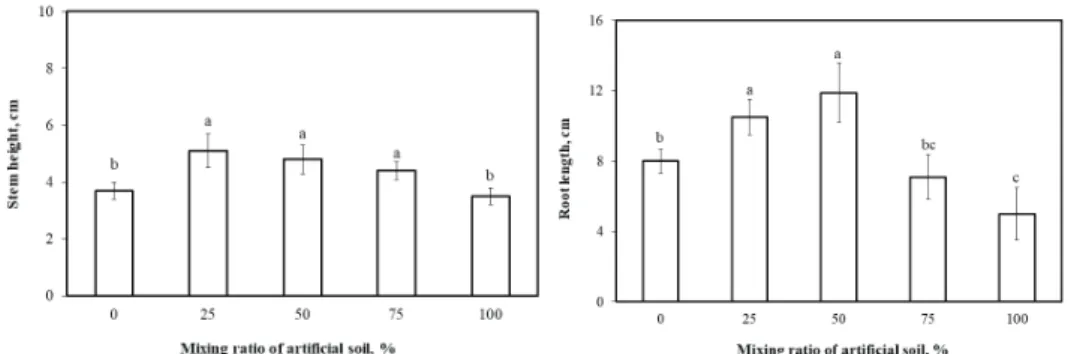
Fig. 1 illustrates stem heights and root lengths of L. cyrtobotrya planted in small outdoor pots containing the control, mixed, and artificial soils.
The longest stem was 5.1 cm in the 25% mixed soil.
Stem lengths in the 50% and 75% mixed soils and the artificial soil were 4.8, 4.4, and 3.5 cm, respectively.
Stem growth decreased in the 50% (or above) mixed soil. The longest root length was 11.9 cm in the 50%
mixed soil, followed by 10.5, 8, 7, and 5 cm in the 25% mixed, control, 75% mixed, and artificial soils, respectively, although artificial soil is thought to improve plant growth by improving water and air permeability (Warkentin, 1984; Kang et al., 2004);
Fig. 1. Effect of mixing ratio of artificial soil with soil on growth of Lespedeza cyrtobotrya.
however, this association was not observed between stem and root lengths and the ratio of artificial soil in the potting mix. This suggests that the appropriate mixing ratio of artificial soil must be determined for the target plant.
3.5. Correlation between the physicochemical properties of artificial soil and the growth of L.
cyrtobotrya
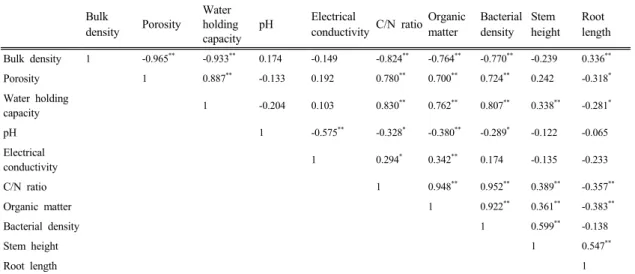
Table 4 shows a correlation analysis of the effects of the physicochemical properties of soils on the stem and root growth of L. cyrtobotrya.
A positive correlation between the physicochemical properties of the soils and stem/root growth was observed in terms of microbial density, C/N ratio, organic matter content, and water-holding capacity (p
< 0.01). Microbial density and stem growth showed the most significant positive correlation with a correlation coefficient of 0.599. Our finding that porosity correlates with stem growth is in agreement with the report of Jo et al. (2017). The root growth
of L. cyrtobotrya was found to positively correlate with bulk density (p < 0.01) but negatively correlate with porosity, water-holding capacity, C/N ratio, and organic matter content.
4. CONCLUSION
The bulk density of the mixture of artificial and control soils was < 0.4 g/cm
3, porosity was > 85%, and water-holding capacity was > 60%. Regarding its chemical properties, the soil showed an EC of <0.5 ds/m, a C/N ratio of <50, and a high concentration of organic matter. Based on the data for bulk density, porosity, and water-holding capacity, the soil showed appropriate physicochemical properties required for optimal plant growth. However, the pH of the artificial soil prepared in this study was slightly acidic, thus making it necessary to adjust its pH according to the site conditions. The root and stem growth rates of L.
cyrtobotrya were higher in the 25% and 50% mixed soils than in the control soil. Microbial density had the greatest impact on stem growth, whereas the organic
Bulkdensity Porosity
Water holding capacity
pH Electrical
conductivity C/N ratio Organic matter
Bacterial density
Stem height
Root length Bulk density 1 -0.965** -0.933** 0.174 -0.149 -0.824** -0.764** -0.770** -0.239 0.336**
Porosity 1 0.887** -0.133 0.192 0.780** 0.700** 0.724** 0.242 -0.318*
Water holding
capacity 1 -0.204 0.103 0.830
** 0.762** 0.807** 0.338** -0.281*
pH 1 -0.575** -0.328* -0.380** -0.289* -0.122 -0.065
Electrical
conductivity 1 0.294
* 0.342** 0.174 -0.135 -0.233
C/N ratio 1 0.948** 0.952** 0.389** -0.357**
Organic matter 1 0.922** 0.361** -0.383**
Bacterial density 1 0.599** -0.138
Stem height 1 0.547**
Root length 1
1) Correlation coefficient (r) was determined by Pearson correlation analysis to evaluate the relationship between parameters. Results were evaluated with 95% and 99% confidence intervals: *, significant at p < 0.05 and **, significant at p < 0.01 level