형태분석과 피부색모델을 다층 퍼셉트론으로 사용한 운전자 얼굴추출 기법
이 종 수*
Driver face localization using morphological analysis and multi-layer preceptron as a skin-color model
Jong-Soo Lee*
ABSTRACT
In the area of computer vision, face recognition is being intensively researched. It is generally known that before a face is recognized it must be localized. Skin-color information is an important feature to segment skin-color regions. To extract skin-color regions the skin-color model based on multi-layer perceptron has been proposed. Extracted regions are analyzed to emphasize ellipsoidal regions. The results from this study show good accuracy for our vehicle driver face detection system.
키워드 Face detection, Multi-layer perceptron, Color model
* 교신저자 : 울산대학교 IT융합 전공 교수
접수일자:2013년 10 월 10 일, 수정일자 : 2013년 11 월 09 일, 심사완료일자:2013년 12 월 02 일
I. Introduction
The problem of face detection is met in many applications such as security systems, vehicle driver vigilance tracking, emotions recognition etc. Many approaches have been developed.
Some of them are based on texture information and facial features [1],[2],[3], while others use skin color information [4],[5].
This paper focuses on identifying a method- ology for driver’s face localization. A major problem of driver’s face localization is in sensing the inattention. of a driver. Generally, many road accidents are a consequence of inattention. A
profiled face can be analyzed to recognize loss of attention. In the security system applications, the car engine will only start once the onboard computer has recognized its owner’s face.
There are some difficulties in driver’s face detection should be considered. The first is re- lated to a wide range of light conditions de- pending on the time of day. Weather also affects lighting conditions. Additional there are other light sources at night such as interior lights, street lamps and outdoor advertising signs. In the case of an oncoming vehicle, the face will be illuminated too much. The current system is able to detect faces with different skin-color.
lems they encountered. Section III considers a skin-color model based on a multi-layer perceptron. It shows advantages and the sim- plicity of our suggested model. Section IV sets a hypothesis for facial shapes. Principal component analysis allows us to exclude components which don’t have facial proportions. Experimental re- sults in different light conditions and back- grounds are shown in Section V.
Ⅱ. Overview of proposed method and related work
The proposed algorithm can be divided into three stages. First stage is color-skin filtering, which excludes regions with non-skin color.
Second stage uses geometrical properties of face to omit skin-color regions which do not contain face components. One of the contributions of this paper is the simple and easy customizable skin-color model which is achieved by using a neural network. Skin color filters make it possi- ble to exclude regions which do not contain skin colors. Skin color filters are usually fast, but the main problem with skin filters consists in choosing appropriate color space with defining skin color domain. Many studies has been done utilizing different color spaces and models such as HIS, YCbCr among others.
In this paper multi-layer perceptron (MLP) is applied to approximate skin-color domain in col- or space. The color model based on MLP does not require transforming RGB space into any other color spaces. Furthermore it is not neces- sary to choose boundaries for skin-color domain manually [6][7]. Showing examples of skin and non-skin pixels the model is learning automati- cally to correctly distinguish skin-color and non
skin color tones. In most of the cases these re- gions are not connected with the face region and therefore they can be eliminated through morphological analysis
The block schema (fig. 1) shows full process of face detection.
Ⅲ. Skin-color model
There are many color spaces has been sug- gest, which provide easy way to separate skin-color domain. Most of these methods apply heuristic approaches to customize boundaries of skin-color domain. However following heuristic methods doesn’t provide general or provide par- ticular way to adapt skin-color for new skin-color sample. We suggest unified method to build skin-color model. To do so a skin-color model based on MLP obtained through the training. Strictly speaking we use two layer perceptron with sigmoid activation function in hidden layer neurons and liner activation func- tion for output neuron (Fig. 2). The number of input neurons corresponds to the number of col- or component i.e. 3 for red, green, blue. The number of neurons in the hidden layer is not
Fig. 3. Preparation of training samples restricted and can be customized according to
complexity of training set. Using trial and error method we set number of hidden neurons equal to 25.
Fig. 2. Two layer perceptron for skin-color space approximation
Training set has to contain two types of subsets. First subset is for positive, i.e.
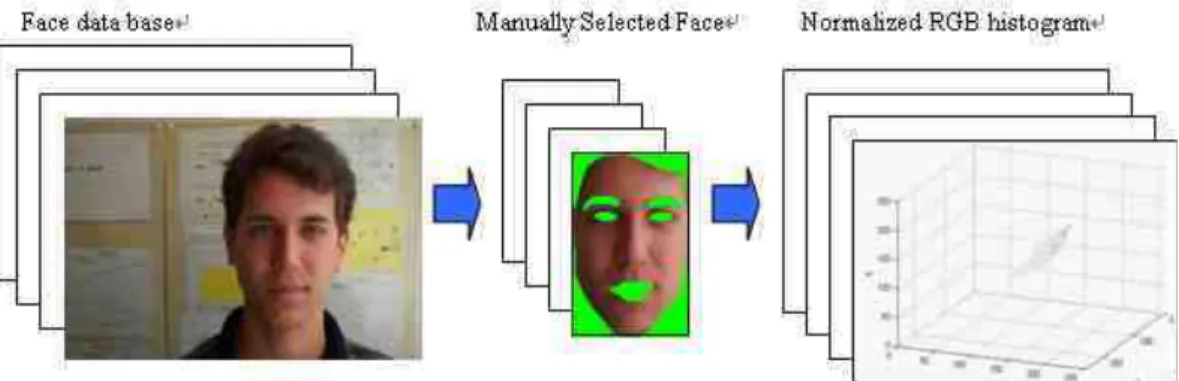
skin-color sample and second for negative non-skin color samples. To obtain skin color samples the frontal face dataset, collected by Markus Weber at California Institute of Technology was utilized. It contains 450 images with 27 unique people under with different light- ing/expressions/backgrounds. All these images have been processed manually i.e. facial regions were cut out by hand. Because each of pixels has three color components red, green and blue
each of processed faces transformed into RGB color space and thus spatial information is lost (Fig. 3).
Second subset contains negative samples which don’t belong to skin-color. Obviously there are plenty of colors which do not belong to skin-color domain. When skin-color domain in RGB space has been formed, negative train- ing samples were obtained by uniformly posi- tioning color vectors in RGB space avoiding skin-colordomain (Fig. 4).
Fig. 4. Cumulative histogram with ne
Ⅳ Morphological and shape analysis
Suitable face candidates were extracted by using skin color filtering, i.e. by using MLP skin color approximation and checking the member- ship of color vectors to skin-color domain. To identify whether the reaming components are faces or not, the prior knowledge of geometrical
Fig. 5. Flow chart of morphological and shape analysis.
An opening operation is required to combine isolated regions with an objective to reduce the
number of regions. After connected components are extracted, each of the target components is to be analyzed separately.
A size check is done to throw out compo- nents with a small area. The cut off value de- pends on the number of layers in the Gaussian pyramid. To decrease processing time each im- age (video frame)decomposed into Gaussian pyramid. First color filtering applied for low res- olution layer then the segmentation result grad- ually transformed to higher resolution layers.
The higher the layer (low resolution) the lower is the threshold value. The area of a face re- duces to 4 times from lower to higher level. It is expected that the size of a face should not be lower than a size of (45x60)/2=2700, where 45x60 is the smallest size of a face that can be detected. The product is divided by two to ac- count for possible noise and holes inside the plate. To exclude components that do not have a rectangular shape, rectangularity checkis used.
where Scomp is area of component and
Scover is a reaofrectangle which covers the component.
For the best case, R has a value equal to 0.9. The remaining components were analyzed in order to exclude components which are too nar- row or long. This analysis is done effectively by calculating the ratio of deviation along the prin- cipal axes. Usually the proportion of a face is close to 0.75.
4. Experimental results and conclusion
In our experiments we attached a web cam- era across from driver’s face. While the driver was driving the car, our system analyzed the input video stream. Visual analysis showed good localization abilities during the day time however algorithm should be improved for night time. A particular example of day time face detection is shown in the figure 6. Another set of experi- ments was done in order to simulate toll road system. Thus the photo camera with better res- olution (4 Mega pixels) was located in about 5 meters from the driver.
It is common at toll road systems to take pictures of toll vehicles in order either to recog- nize vehicle license plate or to match driver face with police database. Our experiment showed good face localization in 16 cases of total 20 snapshots. This is equal to 80% localization rate for people with different skin color (Asian, Caucasian, Africans)
5. Conclusion
To improve face localization, we propose to combine multilayer-perceptron as a skin-color model and morphological analysis for non-face component. detection. The use of multi-layer perceptron with 25 hidden neurons showed good skin-color domain approximation which allowed us to create a skin-color filter. The combination of a skin-color filter with the morphological analysis leads to a face localization system with an 80% localization rate. As a further research we are planning to improve localization rate by adding texture features detection.
References
1. D'Orazio, T., Leo, M., Cicirelli, G., Distante, A.: An algorithm for real time eye detection in face images. Inter. Conf. on Pattern Recognition. Volume 3 (2004) 278–281.
2. Hyungkeun, Jee, Kyunghee, Lee, Sungbum, Pan: Eye and face detection using SVM Conference on Intelligent Sensors, Sensor Networks and Information, (2004) 577–580.
3. Nguyen, D., Halupka, D., Aarabi, P., Sheikholeslami, A.: Real-time face detection and lip feature extraction using field-pro- grammable gate arrays. IEEE Transactions on Systems, Man and Cybernetics,PartB, Volume 36, Issue 4 (2006), 902–912.
4. Naseem, I.,Deriche, M.; Robust human face detection incomplex color images. IEEE International Conference on Image Processing. Volume 2 (2005), 338-41.
5. Butler, D., Sridharan, S., Chandran, V.:
Chromatic colour spaces for skin detection using GMMs. Inter. Conf. on Acoustics ,Speech, and Signal Processing. Volume 4 (2002) 3620-IV-3623.
6. Chen, C., Chiang, S.-P., Detection of human faces in colour images. IEE Proceedings on Vision, Image and Signal Processing.
Volume 144(1997) 384–388.
7. Phil Chen, Dr. Christos Grecos, A Fast Skin Region Detector, ESC DIVISION RESEARCH 2005
8. Orlando J. Hernandez and Mitchell S.
Kleiman, Face Recognition Using Multispectral Random Field Texture Models, Color Content, and Biometric Features. Proceedings of the 34th Applied Imagery and Pattern Recognition Workshop 2005.
1973. 서울대학교 공학사 1981. Virginia Polytechnic
Institute & State Univ. 공학석사 1985. Virginia Polytechnic
Institute & State Univ. 공학박사 1985∼ 1990.
한국전자통신연구소 영상통신연구실장 1991∼ 1993.
생산기술연구원 개발 부장
2013년 현재
울산대학교 공과대학 IT 융합 전공 교수
<관심분야> 영상처리, 멀티미디어