Copyright ⓒ 2011, The Microbiological Society of Korea
Leucine Zipper Motif를 이용한 닭의 재조합 이량체 Single-chain Fv (ScFv) 항체의 개발
박동운1·김언동1·김성헌1·한재용2·김진규1*
1창원대학교 자연과학대학 미생물학과,
2서울대학교 농업생명과학대학 농생명공학부 WCU 바이오모듈레이션 전공
The Development of Dimerized Chicken Recombinant Single-chain Fv (ScFv) Antibody Using Leucine Zipper Motif
Dong Woon Park
1, Eon Dong Kim
1, Sung Heon Kim
1, Jae Yong Han
2, and Jin-Kyoo Kim
1*1Department of Microbiology, College of Natural Sciences, Changwon National University, Changwon 641-773, Republic of Korea
2WCU Biomodulation Major, Department of Agricultural Biotechnology, and Research Institute for Agriculture and Life Sciences, Seoul National University, Seoul 151-921, Republic of Korea
(Received September 27, 2011 / Accepted November 25, 2011)
Leucine zipper motif consists of multiple periodic leucine residues, which forms amphipathic alpha helix. The hydrophobic nature of leucine zipper motif can dimerize proteins which contain this motif. Leucine zipper motif addition at C-terminus of single-chain Fv (ScFv) antibody induces its dimerization. Since the dimeric ScFv antibody contains two antigen binding sites (bivalency) like Y-shaped complete antibody, it could increase avidity. As a result, it could show higher antigen binding activity than monomeric ScFv antibodies. Based on this concept, monomeric chicken 8C3 ScFv antibody previously developed from chicken hybridoma was dimerized by the addition of leucine zipper motif at C-terminus of ScFv antibody. The dimeric 8C3 ScFv antibody specifically reacted with Eimerian sporozoite which causes Avian Coccidiosis. As expected, dimeric 8C3 ScFv antibody showed 3-folds higher antigen binding activity than monomer due to increased avidity. In addition, protien yields of dimer expression were 2-folds higher than monomer.
Keywords: avidity, dimer, leucine zipper motif, single-chain Fv antibody
항체 공학은 주로 재조합된 항체 단편의 생산을 목적으로 하며 주로 Fab, Fc, Fv, ScFv (single chain Fv) 항체 등을 생 산한다(20). 이중 ScFv 항체는 직접적으로 항원과 결합하는 부위인 VH와 VL의 유전자를 linker peptide로 연결하여 만든 재조합 항체이다(2, 7). 재조합 ScFv 항체 제조 기술은 초기에 는 주로 생쥐 ScFv 항체생산을 목적으로 하였으나, 최근에는 닭의 재조합 ScFv 항체를 생산하는 데에도 성공적으로 적용 되고 있다(21, 23).
재조합 ScFv 항체의 항원 결합력을 높이기 위해서는 항원 과 항체 사이의 친화력 즉 affinity를 높여 주는 방법도 있으 나, 이는 항원결합력이 높은 VH와 VL 유전자를 찾아내어 새 로운 ScFv 항체를 제조하는 것으로 많은 시간과 비용을 요구 하므로 이에 대한 대안으로 항원 친화력 즉 affinity는 변하지
* For correspondence. E-mail: [email protected]; Tel.: +82-55- 213-3485; Fax: +82-55-213-3480
않고 항원과 항체간의 탐욕성 즉 avidity를 증가 시키는 방법 을 고려해 볼 수 있다. Avidity를 증가시키는 방법으로 항체의 이량체화(dimerization)를 통해 항체와 항원간의 결합력을 높 여 줄 수 있는데, 그 방법으로는 ScFv 항체의 C-terminus에 항체의 Fc 부분을 도입함에 의한 이량체화(18)와 항체의 hinge (경첩) 부분만을 도입하여 miniantibody형태로 이량체화 하는 방법(11, 13, 18), 또는 Fc나 hinge 부분에서 이황화결합을 만 들어주어 이량체 형성의 결정적인 역할을 하는 cysteine 잔기 를 포함시켜 인위적으로 만든 아주 짧은 peptides를 도입함(4, 6, 15, 24)으로 이량체화를 유도하는 방법 등이 있으며 이는 모두 공유결합인 이황화결합을 이용한다는 공통점을 가진다.
한편 비공유 결합을 이용한 avidity 증가 방법으로 leucine zipper motif를 도입하는 방법이 보고되었다(5, 9, 12). Leucine zipper motif는 yeast의 transcriptional activator인 GCN4로부 터 유래된 sequence로써 leucine 잔기가 주기적으로 나열되어
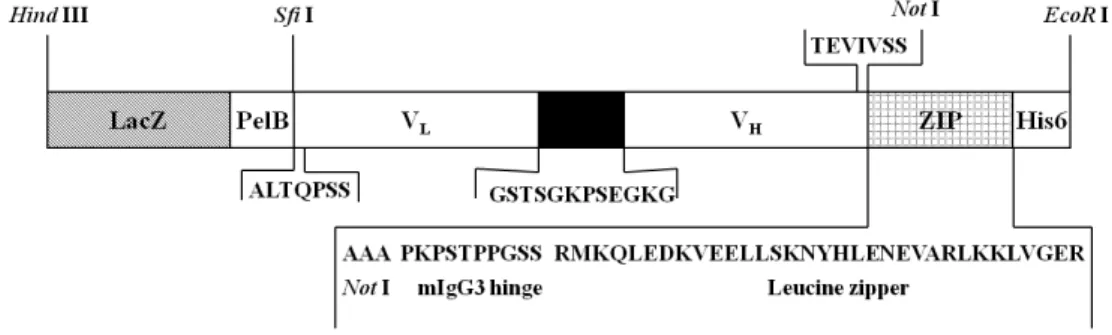
Fig. 1. Construction of dimeric 8C3 ScFv by addition of leucine zipper motif. The 8C3 dimeric ScFv is constructed from
monomeric ScFv expression vector derived from pUC119 containing a 5′-PelB leader sequence and 3′-hexahistidine tag by insertion of leucine zipper motif at C-terminus of ScFv.지는 polypeptide 조각이며, 7개의 peptide간격으로 주기적으 로 나열되어진 이 leucine 잔기가 alpha helix를 형성하도록 하며 주변의 동일한 alpha helix간에 비공유결합인 소수성 결 합에 의한 이량체 형성을 가능하게 한다(5, 9, 12).
이전 연구에서는 조류에서 Coccidiosis를 일으키는 Eimeria 속(genus)에 속하는 Protozoa의 sporozoite가 숙주 세포에 침 투하는 과정에 관여하는 Conoid에 특이적으로 결합하는 단일 클론항체를 분비하는 8C3 hybridoma로 부터 variable heavy chain (VH)과 variable light chain (VL) 유전자를 RT-PCR에 의해 클로닝하여 12개의 아미노산으로 이루어진 soluble linker (GSTSGKPSEGKG)에 의해 연결된 재조합 ScFv 항체 를 제조하여 항원 결합력을 확인하였다(10, 16). 본 실험에서 는 이미 만들어진 단량체 형태의 8C3 ScFv 항체에 amphipathic alpha helix가 융합 되도록 ScFv 항체의 C-terminus에 leucine zipper motif를 도입하여, 이량체 형태의 재조합 8C3 ScFv 항 체 발현을 E. coli를 숙주로 하여 시도하였다. 정제된 이량체 형태의 재조합 8C3 ScFv 항체는 size exclusion chromato- graphy에 의해 이량체임을 확인하였고 ELISA 분석을 이용하 여 단량체 8C3 ScFv 항체에 비해 avidity 증가로 인하여 항원 결합력이 3배 정도 증가됨을 확인 할 수 있었다. 또한 Western- blot 분석과 immunocytochemistry 등을 통해서도 이량체 8C3 ScFv 항체의 항원결합력을 재확인 할 수 있었다.
재료 및 방법
Leucine zipper motif를 이용한 이량체 형태의 발현 벡터 구축
Leucine zipper motif 유전자는 oligonucleotide를 이용한 유전자 합성방법으로 자체 제작하였으며 이를 이전 실험에서 구축했던 단량체 형태의 8C3 ScFv 항체 발현벡터에 NotI 제 한효소를 이용해 클로닝하였다(Fig. 1) (8, 16).
8C3 Fv 항체의 3차 구조 모델링
항체 3차구조 모델링을 위한 web site인 WAM (http://anti body.bath.ac.kr/)을 이용하여 8C3 Fv 항체(VH and VL complex) 의 3차 구조 모델링을 시도하였다. 즉 8C3 Fv 항체의 아미노
산 배열을 입력하면 그와 가장 유사한 아미노산 배열을 가지 면서 이미 3차 구조가 알려진 항체를 RCSB PDB (http://www.
rcsb.org/pdb/)에서 찾아내어 이를 주형으로 하여 8C3 Fv 항 체의 항원결합부위인 complementarity determining region (CDR)의 loop와 항체의 안정화 역할을 담당하는 framework (FR)의 β-sheet의 3차 구조를 결정하였다. 예측된 3차 구조는 PyMol (Delano Scientific, USA) 프로그램을 이용하여 형상 화하여 분석하였다.
이량체 형태의 8C3 ScFv 항체 발현 및 정제
ScFv 항체 유전자를 포함한 발현 벡터를 E. coli BMH71-18 에 형질전환 하였다(8). 형질전환 된 E. coli BMH71-18을 2XTY 액체배지에 100 μg/ml의 농도가 되도록 ampicillin (Sigma- Aldrich, USA)과 1% (w/v) glucose를 첨가하여 30°C에서 180 rpm으로 밤새 진탕배양하였고, 2,500×g로 원심분리하여 액체 배지를 제거 후 2×TY 액체배지로 모아진 E. coli를 재현 탁하여 다시 원심분리하였다. 재현탁 되어진 배양액에 100 μg/ml 의 ampicillin을 다시 넣어주고 0.25 mM IPTG를 처리하여 25°C, 200 rpm에서 5.5 h 동안 배양하였다. 배양이 끝난 세포 배양액을 원심분리하여 상등액을 제거하고, 수거된 세포에 차 가운 TES buffer (0.5 M Sucrose, 0.1 mM EDTA and 200 mM Tris-Cl, pH 7.5)를 첨가하여 4°C에서 1 h 동안 배양하 였다. 다시 위와 같은 방법으로 원심분리하여 수거된 상등액 은 PBS를 이용해 밤새 투석하였다. 밤새 투석 된 단백질 샘플 용액을 Ni-NTA agarose에 결합시키고, Ni-NTA agarose 부피의 20배에 해당하는 TN buffer (0.1 M Tris-Cl, 0.5 M NaCl, pH 7.5 and pH 8.0)를 이용하여 세척하였다. 세척이 끝난 Ni-NTA agarose에 250 mM immidazole을 처리하여 재조합 단백질을 용출해 냈다.
또한 TES buffer 처리 후 수거된 세포덩어리를 초음파 파 쇄를 위한 buffer (0.1 M Tris-Cl, 0.5 M NaCl, pH 7.5)에 재 현탁 한 후 초음파 파쇄하여 원심분리 후 상등액을 수거하여 위와 같은 방법으로 정제하였다.
정제된 단백질들을 2×SDS-PAGE buffer와 섞어 준 후 100°C에서 5 min 끓여 15% SDS-PAGE gel에 전기영동하고, 이를 0.25% Coomassie Brilliant Blue R-25 용액을 이용하여
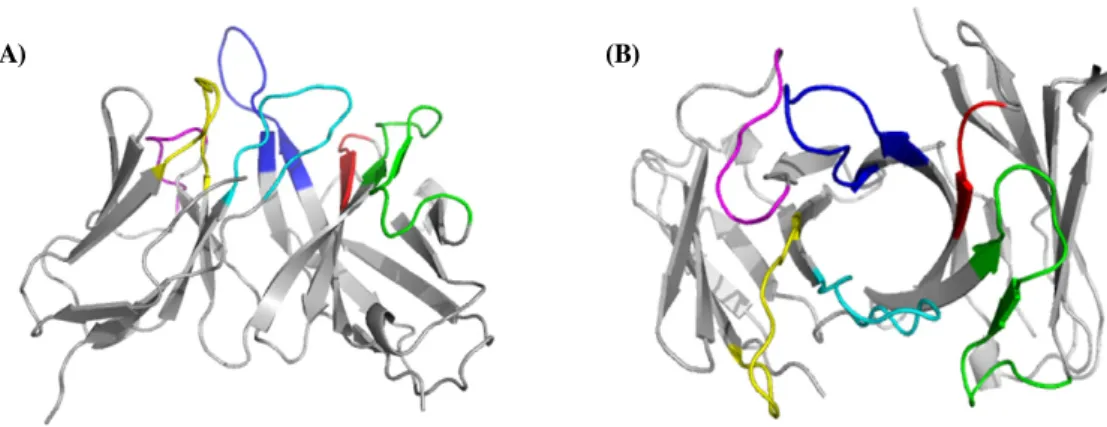
Fig. 2. 3D modeling of chicken 8C3 Fv. (A) Side view. (B) Top view. Coloered region represent each CDR (HCDR 1: red,
HCDR2: green, HCDR3: blue, LCDR 1: yellow, LCDR 2: magenta and LCDR 3: Cyan)(A) (B)
염색하였다. 정제된 ScFv 항체 단백질은 Bradford protein assay (Thermo scientific, USA)를 이용해 정량하고 실험에 이용하였다.
Size exclusion chromatography
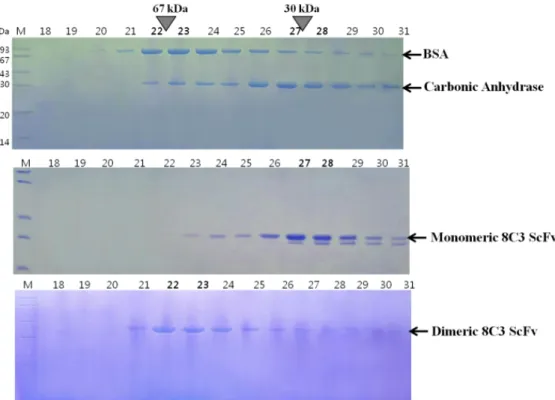
정제된 재조합 항체들은 Superdex G-75 gel (GE Health care, UK)이 채워져 25°C에서 10배 볼륨의 PBS (pH 7.4)로 equilibration 하였고, column에 1-1.5 ml/min의 속도로 통과 시켜 각 분획당 1 ml씩 모아주었다 (Model 2128, BioRad, USA). 이렇게 모아진 분획들을 위에서 언급한 방법대로 SDS- PAGE를 통해 정제하여 단백질의 분자량을 측정한다. 분자량 의 비교를 위해 크기가 알려진 단백질인 bovine serum albumin (67 kDa)과 carbonic anhydrase (30 kDa)을 같은 조건에서 column을 통과시켜 분획하였다.
Enzyme linked immunosorbent assay (ELISA)
4°C에서 2 μg의 Eimeria tenella antigen이 고정된 plate (Maxisorp, Nunc, Denmark)는 PBS에 0.1%의 Tween 20을 첨가한 PBS-T buffer로 세 번 세척하였고, 여기에 skim milk 를 2%포함한 PBS-T buffer를 blocking에 이용하였다. Blocking 이 끝난 후 정제된 ScFv 항체를 포함한 blocking buffer를 처 리하였고, PBS-T를 이용한 3번의 세척 후 horseradish pero- xidase가 conjugated polyhistidine monoclonal antibody (Sigma- Aldrich)를 처리하여 ABTS (Sigma-Aldrich)와 과산화수소로 발색 하였다. 발색된 plate는 Microplate reader (EXPERT 96, Asys, Austria)를 이용해 405 nm 파장에서 흡광도를 측정하였다.
Western blot
수용성의 Eimeria tenella antigen을 전기영동방법으로 SDS- PAGE하고 PVDF membrane (Millipore, USA)으로 transfer 하였다. 그리고 transfer 된 membrane을 2% (w/v) skim milk 를 포함한 PBS-T buffer를 이용하여 실온에서 1 h 동안 blocking한 다음, PBS-T로 2회 세척하였다. Membrane을 이 량체 형태의 8C3 ScFv 항체 10 μg을 포함하는 PBS-T blocking
buffer에 담가서 실온에서 1 h 동안 incubation한 후 PBS-T로 3 회 세척하였다. 발색을 위해 2차 항체인 peroxidase-conju- gated polyhistidine monoclonal antibody (Sigma-Aldrich)를 1:2,000 (v/v)으로 희석해서 membrane에 처리하여 실온에서 1 h 동안 incubation하였다. PBS-T washing buffer로 5회 세척 한 다음, 3,3-diaminobenzidine (Sigma-Aldrich)를 이용해 발 색시켜 이량체 8C3 ScFv 항체의 항원결합력을 재확인하였다.
Immunocytochemistry
PBS에 섞어 둔 Eimeria tenella sporozoites을 실리콘 처리 된 glass slide (Dako, Japan)위에 얹어 자연 건조시키고, 차가 운 methanol에 2분 동안 담궈 고정 시킨 후 PBS를 이용해 3 번 세척하였다. Slides에 고정된 sporozoites에 2 μg의 이량체 8C3 ScFv 항체를 처리 하여 습윤상자에 넣고 실온에서 1 h 동안 incubation하였다. Slides를 PBS로 3회 세척 후 PBS에 mouse anti-polyhistidine tag antibody를 1:1,000 (v/v)로 희석 해 준 항체용액을 100 μl 처리하여 1 h 동안 incubation한 다 음 PBS를 이용해 3회 반복 세척해주고, 100 μl의 1:1,000 (v/v)으로 희석된 fluorescein isothiocyanate (FITC) conjugated goat anti-mouse IgG F(ab) (Sigma-Aldrich)를 처리하여 1 h 동안 incubation 하였다. 최종적으로 Slides를 PBS로 3회 반 복 세척하고 공초점 주사 현미경 (Nikon, Japan)을 사용하여 sporozoites 항원의 이량체 8C3 ScFv 항체에 의한 형광염색정 도를 관찰하였다.
결과 및 고찰
이량체 8C3 ScFv 항체 발현 벡터는 합성된 leucine zipper motif 유전자를 클로닝하여 제한효소 NotI에 의해 단량체의 C-terminus에 삽입하여 8C3 ScFv/Leucine zipper motif형태 로 구축되었다(Fig. 1). 즉, leucine zipper motif 유전자의 upstream에 ScFv 항체 유전자를 SfiI과 NotI의 제한효소를 이 용하여 클로닝하면 자동적으로 leucine zipper motif와 융합된 발현벡터가 구축되도록 고안되었다(Fig. 1). 예측된 8C3 Fv
Fig. 3. SDS-PAGE analysis of dimeric 8C3 ScFv. The
monomeric 8C3 ScFv (Lane 1) and dimeric 8C3 ScFv (Lane 2) expressed in E. coli were purified and analyzed in 15% polyacrylamide gel under reducing condition.Fig. 4. Size exclusion chromatography. After gel filtration through Superdex G-75 column, SDS-PAGE showed recombinant
dimeric 8C3 ScFv has similar elution patterns with bovine serum albumin (BSA). BSA and carbonic anhydrase were molecular weight standard as 67 kDa and 30 kDa, respectively.항체 3차 구조를 보면 VH 및 VL의 각각 세 CDR 부위가 고 유한 loop 구조를 나타내며(Fig. 2A) 6개 각각의 CDR loop가 다시(Fig. 2B) 항원결합부위인 hydrophobic pocket을 형성하 여 항원과 특이적으로 결합할 수 있게 된다.
구축된 8C3 ScFv/Leucine zipper motif 발현벡터를 이용하 여 E. coli를 형질 전환하고, IPTG를 이용하여 단백질 발현을 유도한 후 Ni-NTA affinity chromatography를 이용하여 이량 체 8C3 ScFv 항체를 정제하였다. SDS-PAGE에서 이량체 분 자량을 분석해 본 결과 leucine zipper domain이 첨가된 관계 로 단량체 크기인 약 30 kDa 보다 큰 약 38 kDa으로 확인되 었다(Fig. 3). 그리고, SDS-PAGE 분석에 의해서는 비공유결 합에 의한 이량체 형성을 결정할 수 없으므로 비공유결합의 일종인 소수성결합 의한 이량체 형성을 확인하기 위해 정제된 ScFv 항체 단백질을 size exclusion chromatography를 통해 분획하였고, 이량체 및 단량체 8C3 ScFv 항체 단백질 분획의 용출 위치를 결정하기 위해 이미 분자량이 알려진 bovine serum albumin (67 kDa)와 carbonic anhydrase (30 kDa)을 동일 조 건에서 분획하였다. 이량체 8C3 ScFv 항체는 67 kDa 크기의 BSA와 같은 분획에서 주로 용출되었고, 단량체 ScFv 항체가 분획되는 pattern은 30 kDa 크기의 carbonic anhydrase와 유사 하였다(Fig. 4). 이 결과는 정제된 이량체 8C3 ScFv 항체가 leucine zipper motif간의 비공유결합인 소수성 결합에 의해 성공적으로 이량체를 형성하는 것을 보여주고 있다. 또한 발 현된 단백질의 회수율(yield)을 분석한 결과 이량체 형태의
ScFv 항체는 leucine zipper motif를 구성하는 수용성 아미노 산 잔기에 의한 수용성 증가 효과로 단량체일 때의 0.21 mg/L 에 비해 2배 정도 발현율이 증가된 0.42 mg/L로 발현되었다 (Fig. 5). 수용성 증가효과를 확인하기위해 leucine zipper motif의 소수성 정도를 Web-based 프로그램(http://web.expasy.
org/protscale/)을 이용하여 분석한 결과, leucine zipper motif
Recombinant Protein
Fig. 5. Protein expression yield. Expressed and purified
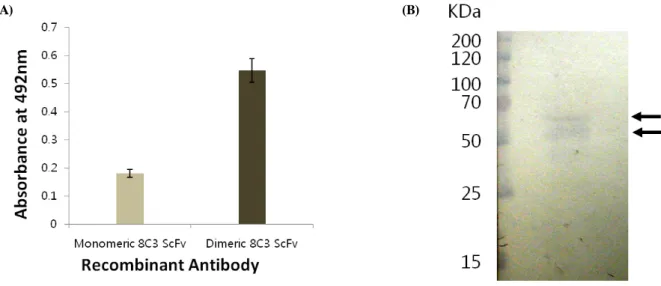
protein yield of recombinant dimeric 8C3 ScFv is 2 fold higher than monomer.Fig. 6. Antigen binding activities of dimeric 8C3 ScFv by ELISA and Western blot. (A) Two micrograms of soluble Eimeria
tenella sporozoites antigens were coated on 96 well plate and same amounts of monomeric and dimeric 8C3 ScFv were treated as primary antibody. The dimeric ScFv has 3 folds of antigen binding activity of monomer. (B) Eimeria tenella sporozoites antigens were resolved by SDS-PAGE and transferred to PVDF membrane. 10 μg of dimeric ScFv was treated to membrane as primary antibody. Membrane was developed with 3,3-diaminobenzidine/H2O2. After development, two specific bands of sporozoites antigen were detected as 55 kDa and 60 kDa.(A) (B)
는 그 자체로 매우 높은 친수성을 보여주었다. 그리고 leucine zipper motif는 소수성과 친수성을 동시에 갖는 특징(amphi- pathic nature)을 띄고 있다. 이는 기존의 단량체 형태의 ScFv 항체에 leucine zipper motif가 도입되어 친수성이 높은 영역 이 늘어남으로 상대적으로 단량체에 비해 친수성이 커지게 될 뿐만 아니라 leucine zipper motif상의 소수성 영역마저도 소 수성 결합시 alpha helix들 간의 결합에 의해 소수성 영역이 내부적으로 서로를 감싸는 형태가 되어 외부로 나타내는 친수 성 비율을 더욱 높임으로써 단백질 회수율(yield)이 2배 정도
증가하는 것으로 생각 되어진다.
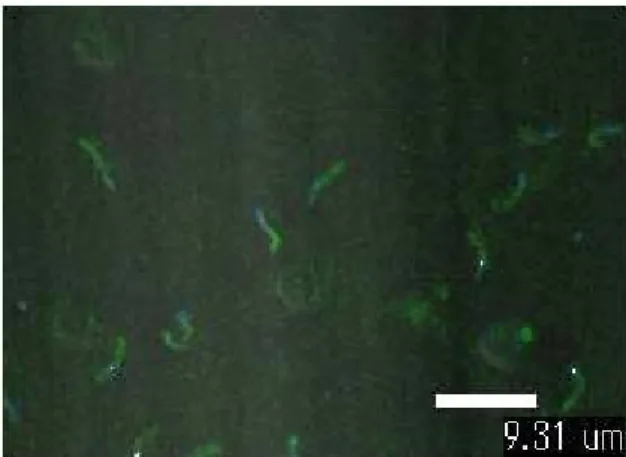
이량체 8C3 ScFv 항체의 주된 기능인 항원 결합 능력을 측정하고 단량체의 결합력과 비교하기 위해 ELISA 분석을 시 도한 결과 이량체 형태의 8C3 ScFv 항체가 단량체에 비해 대 략 3배 정도의 항원 결합능력을 가지고 있음을 확인할 수 있 었다(Fig. 6A). 그리고 Western blot 분석결과에서는 이량체 8C3 ScFv 항체가 55 kDa과 60 kDa의 sporozoites 항원을 특 이적으로 탐지하는 것을 확인 할 수 있었다(Fig. 6B). 이량체 8C3 ScFv 항체가 Figure 6B와 같은 다특이성(multispeci- ficity)을 나타내는 것은 이량체 8C3 ScFv 항체가 직접 결합 하는 부위(peptides: epitope)가 55 kDa과 60 kDa항원에 공통 적으로 존재하거나, 또는 인지하는 항원이 55 kDa과 60 kDa 항원에 존재하는 구조적으로 유사성이 높은 당(carbohydrate) 일 가능성을 암시해 주고 있다. 또한 Immunocytochemistry를 통해 이량체 8C3 ScFv 항체가 Eimeria tenella sporozoites의 conoid 구조에 특이적으로 결합하여 형광을 나타내는 것으로 이량체 8C3 ScFv 항체의 항원 결합능력을 재확인 할 수 있었 다(Fig. 7). 이러한 결과들로 이미 보고된 것처럼(5, 11, 13) leucine zipper motif의 도입이 소수성 결합에 의한 이량체를 형성하고, 이로 인한 항원 결합 부위 증가(bivalency)로 avidity 가 증가되어 항원 결합력이 단량체에 비해 3배 증가된 것을 알 수 있었다. 즉 다량체 형성(multimerization)으로 항원 결합 부위를 증가시켜 avidity를 향상시켜 전체 항원 결합 능력을 증가시키는 방법을 제시해 주고 있다.
자연계의 모든 항체는 Y 형태로써 2개의 항원 결합부위를 갖는다. 그러나 재조합 ScFv 항체는 단량체 형태로써 1개의 항원 결합부위만을 가지므로 Y형태의 모항체에 비해 항원결
Fig. 7. Immunocytochemistry. Eimeria tenella sporozoites
were fixed on siliconized glass slide and dimeric ScFv was treated on the slide. After FITC conjugated secondary antibody treatment and washing, slide was photographed using confocal laser scanning microscope (Nikon, Japan).합력 즉 avidity가 낮은 약점을 가지고 있으므로 이를 보완 하 기 위해, leucine zipper motif나 Fc region, hinge region, cysteine peptide등의 이량체 형성 유도인자를 첨가하여 이량 체 ScFv 항체 제조를 유도하는 다양한 방법이 보고되었다(1, 3, 5, 11, 14, 22). 이러한 형태의 이량체 ScFv 항체는 2개의 항원결합부위를 유지하게 되어 모항체와 동일한 항원결합력을 유지 할 수 있는 잇점 외에도 이량체 형성 유도인자의 친수성 에 의한 단백질의 발현 및 회수율, 단량체 ScFv 항체의 구조 적 불안정성을 보완해 주는 추가적인 효과를 얻을 수 있다.
또한 항원특이성이 다른 2개의 단량체 ScFv 항체를 위의 방법으로 이량체화 하면 전혀 다른 2가지 항원을 동시에 인지 하는 이중 특이성(bispecificity)을 갖는 재조합 ScFv 항체 개 발도 이미 보고되었다(5, 11, 17, 19).
본 연구의 내용을 요약하면 가금류의 대표적 질병인 Coccidi- osis를 일으키는 Eimerian sporozoite에 특이적으로 결합하는 닭의 재조합 이량체 8C3 ScFv 항체를 제조하여 avidity를 증 가시킴으로써 단량체 ScFv 항체의 단점을 극복하였으며 또한 Eimerian sporozoite항원의 성공적인 탐지 및 염색결과는 이 량체 8C3 ScFv 항체의 가금류 Coccidiosis 질병의 진단 및 치료제로 사용 할 수 있는 가능성을 제시해주고 있다.
적요
Leucine zipper motif는 여러 개의 주기적인 leucine 잔기 로 구성되어 amphipathic alpha helix형태의 구조를 나타내며 소수성 결합에 의해 이량체를 형성한다. 이 leucine zipper motif를 single chain Fv 항체의 C‐terminus에 도입하면 leucine zipper motif의 소수성 결합에 의해 amphipathic alpha helix의 이량체가 형성되면서 융합된 single chain Fv 항체의 이량체 (Dimer) 형성 또한 유도할 수 있다. 이량체 형태의 single chain Fv 항체는 2개의 항원 결합부위를 갖게 되므로
단량체 형태의(monomer) single chain Fv 항체에 비해 항원 결합력(Avidity)이 증가 될 것이다. 이 개념에 기초하여 이전 연구에서 제조된 단량체 형태인 닭 single chain Fv 항체인 8C3 ScFv 항체의 C‐terminus에 leucine zipper motif를 도입 하여 이량체 형태의 8C3 ScFv 항체를 개발하였다. 이량체 8C3 ScFv 항체는 가금류의 대표적인 기생충 질병인 cocci- diosis를 유발하는 Eimerian sporozoite에 특이적으로 결합하 는 기능을 나타내었다. 또한 이량체 8C3 ScFv 항체는 avidity 증가로 인하여 단량체에 비해 항원 결합력이 약 3배 증가됨을 확인할 수 있었으며 단백질 회수율 또한 2배 증가되는 부수적 인 효과를 얻을 수 있었다.
감사의 말
본 연구는 2011년도 창원대학교 교내공모과제 지원에 의해 서 수행되었으며 이에 감사드립니다.
참고문헌
1. Albrecht, H., G.L. Denardo, and S.J. Denardo. 2006. Mono- specific bivalent scFv-SH: effects of linker length and location of an engineered cysteine on production, antigen binding activity and free SH accessibility. J. Immunol. Methods 310, 100-116.
2. Bird, R.E., K.D. Hardman, J.W. Jacobson, S. Johnson, B.M.
Kaufman, S.M. Lee, T. Lee, S.H. Pope, G.S. Riordan, and M.
Whitlow. 1988. Single-chain antigen-binding proteins. Science 242, 423-426.
3. Brinkmann, U., M. Gallo, E. Brinkmann, S. Kunwar, and I.
Pastan. 1993. A recombinant immunotoxin that is active on prostate cancer cells and that is composed of the Fv region of monoclonal antibody PR1 and a truncated form of Pseudomonas exotoxin. Proc. Natl. Acad. Sci. USA 90, 547-551.
4. Brinkmann, U., Y. Reiter, S.H. Jung, B. Lee, and I. Pastan.
1993. A recombinant immunotoxin containing a disulfide- stabilized Fv fragment. Proc. Natl. Acad. Sci. USA 90, 7538-7542.
5. de Kruif, J. and T. Logtenberg. 1996. Leucine zipper dimerized bivalent and bispecific scFv antibodies from a semi-synthetic antibody phage display library. J. Biol. Chem. 271, 7630-7634.
6. Glockshuber, R., M. Malia, I. Pfitzinger, and A. Pluckthun.
1990. A comparison of strategies to stabilize immunoglobulin Fv-fragments. Biochemistry 29, 1362-1367.
7. Huston, J.S., D. Levinson, M. Mudgett-Hunter, M.S. Tai, J.
Novotny, M.N. Margolies, R.J. Ridge, R.E. Bruccoleri, E. Haber, R. Crea, and et al. 1988. Protein engineering of antibody binding sites: recovery of specific activity in an anti-digoxin single-chain Fv analogue produced in Escherichia coli. Proc. Natl. Acad. Sci.
USA 85, 5879-5883.
8. Kim, J.K., M.F. Tsen, V. Ghetie, and E.S. Ward. 1994.
Identifying amino acid residues that influence plasma clearance of murine IgG1 fragments by site-directed mutagenesis. Eur. J.
Immunol. 24, 542-548.
9. Landschulz, W.H., P.F. Johnson, and S.L. McKnight. 1988. The leucine zipper: a hypothetical structure common to a new class of DNA binding proteins. Science 240, 1759-1764.
10. Lawn, A.M. and M.E. Rose. 1982. Mucosal transport of Eimeria tenella in the cecum of the chicken. J. Parasitol. 68, 1117-23.
11. Muller, K.M., K.M. Arndt, and A. Pluckthun. 1998. A dimeric
bispecific miniantibody combines two specificities with avidity.
FEBS Lett. 432, 45-49.
12. O'Shea, E.K., R. Rutkowski, and P.S. Kim. 1989. Evidence that the leucine zipper is a coiled coil. Science 243, 538-542.
13. Pack, P., M. Kujau, V. Schroeckh, U. Knupfer, R. Wenderoth, D. Riesenberg, and A. Pluckthun. 1993. Improved bivalent miniantibodies, with identical avidity as whole antibodies, produced by high cell density fermentation of Escherichia coli.
Biotechnology (NY) 11, 1271-1277.
14. Pack, P., K. Muller, R. Zahn, and A. Pluckthun. 1995.
Tetravalent miniantibodies with high avidity assembling in Escherichia coli. J. Mol. Biol. 246, 28-34.
15. Pack, P. and A. Pluckthun. 1992. Miniantibodies: use of amphi- pathic helices to produce functional, flexibly linked dimeric FV fragments with high avidity in Escherichia coli. Biochemistry 31, 1579-1584.
16. Park, K.J., D.W. Park, C.H. Kim, B.K. Han, T.S. Park, J.Y.
Han, H.S. Lillehoj, and J.K. Kim. 2005. Development and characterization of a recombinant chicken single-chain Fv antibody detecting Eimeria acervulina sporozoite antigen.
Biotechnol. Lett. 27, 289-295.
17. Schoonjans, R., A. Willems, S. Schoonooghe, J. Leoen, J.
Grooten, and N. Mertens. 2001. A new model for intermediate molecular weight recombinant bispecific and trispecific antibodies by efficient heterodimerization of single chain variable domains through fusion to a Fab-chain. Biomol. Eng. 17,
193-202.
18. Shan, D., O.W. Press, T.T. Tsu, M.S. Hayden, and J.A. Ledbetter.
1999. Characterization of scFv-Ig constructs generated from the anti-CD20 mAb 1F5 using linker peptides of varying lengths. J.
Immunol. 162, 6589-6595.
19. Todorovska, A., R.C. Roovers, O. Dolezal, A.A. Kortt, H.R.
Hoogenboom, and P.J. Hudson. 2001. Design and application of diabodies, triabodies and tetrabodies for cancer targeting. J.
Immunol. Methods 248, 47-66.
20. Verma, R., E. Boleti, and A.J. George. 1998. Antibody engineering:
comparison of bacterial, yeast, insect and mammalian expression systems. J. Immunol. Methods 216, 165-181.
21. Winter, G., A.D. Griffiths, R.E. Hawkins, and H.R. Hoogen- boom. 1994. Making antibodies by phage display technology.
Annu. Rev. Immunol. 12, 433-455.
22. Wu, A.M., G.J. Tan, M.A. Sherman, P. Clarke, T. Olafsen, S.J.
Forman, and A.A. Raubitschek. 2001. Multimerization of a chimeric anti-CD20 single-chain Fv-Fc fusion protein is mediated through variable domain exchange. Protein Eng. 14, 1025-1033.
23. Yamanaka, H.I., T. Inoue, and O. Ikeda-Tanaka. 1996. Chicken monoclonal antibody isolated by a phage display system. J.
Immunol. 157, 1156-1162.
24. Young, N.M., C.R. MacKenzie, S.A. Narang, R.P. Oomen, and J.E. Baenziger. 1995. Thermal stabilization of a single-chain Fv antibody fragment by introduction of a disulphide bond. FEBS Lett. 377, 135-139.