Suspended Solids Export by the Outflowing Water
from Irrigation Paddy Field during Rice Growing Season of Korea
Yongseon Zhang, Kangho Jung, Hye-Rae Cho, Kyeong-Hwa Han, Min-Kyeong Kim, and Yeon-Kyu Sonn*
National Academy of Agricultural Science, RDA, Wanju, 55365, Korea
(Received: February 11 2016, Revised: April 20 2016, Accepted: April 24 2016)
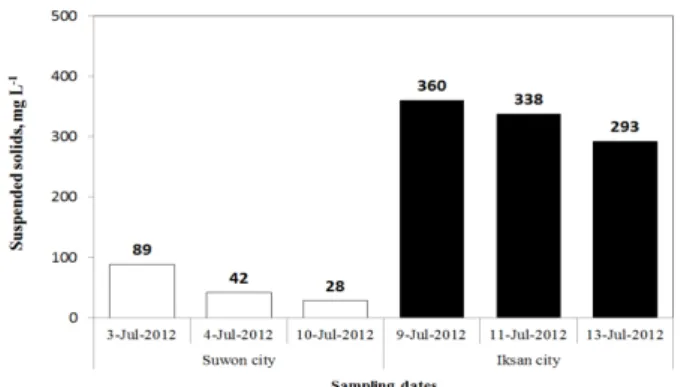
This experiment was conducted in Suwon and Iksan city from 2012 to 2014 to evaluate soil erosion and nutrient loss from irrigated paddy fields during cropping period. Rainfall amount and rainfall erosivity of EI 30 were, on average, 1,026 mm and 3,922 mm ha -1 yr -1 hr -1 for the cropping period, respectively, and the rainfall event with maximum EI 30 occurred in July. Annual average of runoff was 2,508 MT ha -1 yr -1 in Suwon and 3,375 MT ha -1 yr -1 in Iksan, accounting for 36% of rainfall of the cropping period. Nutrient loss by runoff, on average, was 7.0 kg N ha -1 yr -1 , 1.3 kg P ha -1 yr -1 , and 16.6 kg K ha -1 yr -1 ; N, P, and K loss were 5.0, 0.6, and 8.3 kg ha -1 yr -1 , respectively, in Suwon and 8.9, 1.9, and 16.7 kg ha -1 yr -1 in Iksan. Soil loss in Korean paddy rice was evaluated as 0.33 MT ha -1 yr -1 ranging from 0.05 MT ha -1 yr -1 to 0.88 MT ha -1 yr -1 . Amount of soil loss, however, depended on areas and year influenced by variation of rainfall amount and intensity. Interestingly, soil erosion in Iksan in 2012 was remarkably greater than those in other periods due to heavy rainfall between late May and June with soil flake dispersion right after the rice-planting season.
Key words: Soil loss, Runoff, Irrigation Paddy Field, Rice
Runoff and soil loss from irrigation paddy field during rice growing season by regional.
Region Runoff (MT ha
-1yr
-1) Soil loss (MT ha
-1yr
-1)
2012 2013 2014 Ave. 2012 2013 2014 Ave.
Suwon City 5,301 3,030 1,895 2,508 0.383 0.161 0.046 0.197
Iksan City 4,583 3,811 1,732 3,375 0.880 0.404 0.115 0.466
1)
*Corresponding author: Phone: +82632382425, Fax: +82632383822, E-mail: [email protected]
§