• 검색 결과가 없습니다.

Evaluation of Forage Yield and Feed Value of Winter Crops Following Rice Harvest at Paddy Field in the Southern Region of Korea

N/A
N/A
Protected

Academic year: 2021

Share "Evaluation of Forage Yield and Feed Value of Winter Crops Following Rice Harvest at Paddy Field in the Southern Region of Korea"

Copied!
6
0
0

로드 중.... (전체 텍스트 보기)

전체 글

(1)

Research Article

Evaluation of Forage Yield and Feed Value of Winter Crops Following Rice Harvest at Paddy Field in the Southern Region of Korea

Hui Mang Song, Sang Hyun Park and Hwan Kim

*

Department of Animal Science, College of Agriculture & Life Sciences, Chonnam National University, Gwangju 61186, Republic of Korea

ABSTRACT

This study was carried out to evaluate the forage yield and feed value of winter crops such as Italian ryegrass (IRG), oat, rye, barley, and hairy vetch. Forage crops were sown on 15

th

October 2018 in a paddy field after harvesting rice and forage crops were harvested at two times of 25

th

April 2019 and 18

th

May 201 9. The highest dry matter (DM) yield was harvested from rye among the five species of forage crop on 18

th

May. DM yield of all forages was increased 14.4% on 18

th

May compared to 25

th

April. The highest yield of crude protein (CP) was obtained from hairy vetch on 25

th

April, whereas it was decreased (38.1%) on 18

th

May.

Moreover, the highest total digestible nutrient (TDN) yield and relative feed value (RFV) was harvested respectively from rye and hairy vetch on 25

th

April. Delay of harvest time considerably increased DM yield but significantly decreased CP and RFV. In conclusion, rye was the best source of DM and TDN and hairy vetch was the high-quality feed. Rye harvested on 25

th

April is the proper forage for resolving Korea’s problem of insufficient forage yield.

(Key words: Cropping system, Rice harvesting, Forage field, Feed value, Winter crop)

Ⅰ. INTRODUCTION

In South Korea, forage production increased from 2,793 kt to 4,727 kt (2000-2017), but forage self-sufficiency has remained stable at around 82%. Moreover, imported forage crop has increased ev ery year, with 1,035 kt in 2016 (Lee et al., 2017). It is the main factor that reduces the international competitiveness of Korean beef cattle. Additionally, KORUS FTA has taken affect from 2019 and then completely apply in 2026. This fact means that the US beef tariff rate is 0% in 2026, which is a reason for more reduction of Korean beef self-sufficiency (Kim and Kim, 2020). In order to retain the international competitiveness of Korean beef cattle, it is necessary to improve forage productivity by self-sufficiency.

The winter forage crops such as Italian ryegrass (IRG), barley, rye, oat, and hairy vetch are widely used as cover crops, green manure crops, and forage crops because of their adaptability to the soil (Song et al., 2009). IRG has a high feed value and productivity, and especially it is resistant to wet

injury (Ji et al., 2011). Oat has a great tillering capacity and preference for livestock animals (Ju et al., 2011). Hairy vetch has high crude protein (CP) and low cellulose composition, moreover it is a good source of biological nitrogen fixation, then commercially used for N supplier as like maize (Pott et al., 2021). Several studies have been performed on each species of forage. However, to increase forage yield clearly, the cropping system needs to be clear.

Although the paddy field is not suitable for forage cultivation due to poor drainage, fallow paddy field in Korea are considered an alternative way to increase forage yield that does not cause a reduction of rice production. Some studies were performed about cropping systems, which cultivated forage in paddy fields. Kim et al. (2018) performed a study linked to forage cropping system cultivating whole crop rice and winter crop (rye, IRG, and triticale) in the paddy field in the southern region of Korea. Seo et al. (2018) evaluated the yield and quality of IRG and barley in paddy and upland field, respectively in the mid-west plain of Korea. Furthermore,

*Corresponding author : Tae Hwan Kim, Department of Animal Science, College of Agriculture & Life Sciences, Chonnam National

University, Gwangju 61186, Korea. Tel: +82-62-530-2126, E-mail: [email protected]

(2)

evaluation of feed value of IRG using the unmanned aerial vehicle (UAV) (Na et al., 2017), the effect of application of livestock manure and chemical fertilizer on the productivity of winter crops in paddy field (Cho et al., 2005; Jo et al., 2008) was performed. The evaluation of forage yield and feed value of various species according to the harvest time at a paddy field in the southern region of Korea is still insufficient.

Fallow paddy fields are common in Korea's southern region.

The purpose of this study was to compare and evaluate the forage yield, feed value, and cropping system of winter forage crops in the fallow paddy field after the rice harvest in Korea's southern region.

Ⅱ. Materials and Methods

1. Experimental site and plant species

The field experiment was conducted in an experimental paddy field in Naju (34.974698, 126.766432), the southern region of Korea from 15

th

October 2018 to 18

th

May 2019.

Total of five forage crops were used: rye (Blue land), oat (Donghan), barley (Yuyeon), IRG (Kowinner), and hairy vetch (Pebb-2). After rice harvesting, forage crops were planted. The characteristics of soil were shown in Table 1.

2. Plant growth and harvest

Each forage crop was sown at the 2 m × 5 m experimental site. The winter forage crops were sowed on 15

th

October 2018.

The seeding rate of crops were 50, 50, and 150 kg ha

-1

in hairy

Table 1. Chemical characteristics of the soil at experimental site (n=4)

Inorganic N Exchangeable cation

pH OM T-N NH

4+

NO

3-

P

2

O

5

K

+

Ca

2+

Mg

2+

Na

+

(%) (%) (mg N kg

-1

) (mg kg

-1

) (cmol

+

kg

-1

)

6.0 1.02 1.7 50.7 685.9 47.8 0.44 1.17 1.62 0.05

The values are mean ± SE of four replicates.

OM: organic matter; T-N: total nitrogen; NH

4+

: ammonium nitrogen; NO

3-

: nitrate nitrogen; P

2

O

5

: phosphorus pentoxide; K

+

: potassium; Ca

2+

: calcium; Mg

2+

: magnesium; Na

+

: sodium.

Table 2. Nutrient contents of forage crops by different harvest time in paddy field in the southern region of Korea

Harvest time Forage Nitrogen (%) NDF (%) ADF (%) TDN (%)

Hairy vetch 3.78 ± 0.13

a

36.04 ± 1.20e 25.51 ± 1.02c 68.7 ± 0.81

a

IRG 2.15 ± 0.04

b

52.76 ± 0.61d 28.94 ± 0.94b 66.0 ± 0.74

b

25

th

Apr Oat 1.36 ± 0.08

c

59.77 ± 0.23

b

31.36 ± 0.14

a

64.4 ± 0.31

bc

Rye 1.52 ± 0.08

c

62.57 ± 0.63

a

32.35 ± 0.52

a

63.3 ± 0.41

c

Barley 1.40 ± 0.08

c

56.95 ± 0.25

c

31.23 ± 0.55

a

64.2 ± 0.43

bc

Average 2.04 ± 0.46 53.62 ± 4.69 29.88 ± 1.23 63.53 ± 0.95

Hairy vetch 2.20 ± 0.14

a

48.47 ± 0.53

d

33.84 ± 0.54

d

64.7 ± 0.32

a

IRG 1.54 ± 0.02

b

62.36 ± 0.43

c

40.19 ± 1.04

c

57.2 ± 0.82

b

18

th

May Oat 1.03 ± 0.04

c

71.23 ± 1.72

b

45.18 ± 0.49

b

53.2 ± 0.38

c

Rye 0.98 ± 0.02

c

76.10 ± 0.96

a

48.49 ± 0.88

a

50.6 ± 0.70

d

Barley 1.27 ± 0.02

c

72.02 ± 0.26

b

47.26 ± 0.32

ab

51.6 ± 0.25

cd

Average 1.41 ± 0.22 66.03 ± 4.93 42.99 ± 2.69

**

55.45 ± 2.57 The values are mean ± SE of three replicates.

Different letters in vertical row indicate significantly different at p < 0.05 according to the Duncan’s multiple range test. 

The asterisks indicate significant difference of the each average value between data of 25

th

April and 18

th

May. *P < 0.05, **P < 0.01 , ***P

< 0.001.

(3)

v etch, IRG, and others (barley, oat, and rye), respectiv ely. For IRG, barley, oat, and rye, the fertilizer was applied in 200 kg ha

-1

of nitrogen (N), 150 kg ha

-1

of phosphorus (P), and 150 kg ha

-1

of potassium (K). For hairy vetch, the fertilizer was applied in 50 kg ha

-1

N, 120 kg ha

-1

of P, and 120 kg ha

-1

of K. The N fertilizer was applied at 50% before seedling and 50% at the 7-8 leaves stage. A randomized complete block design was used with five treatments and three replications.

Each forage was harvested on a different date (25

th

April and 18

th

May in 2019) to estimate the effect of harv est time.

3. Chemical analysis

All harv ested samples were collected 400 g and dried in 60°C for 48 hours in a dry oven for calculation of dry matter (DM) content. The dried samples were ground into powder undersize of 1.0mm. The ground samples were stored at 4°C dark-dried storage room prior to analysis. Total nitrogen (N) content was measured by digestion using the Kjeldahl procedure (Baker and Thompson, 1992). Crude protein (CP) was calculated from N content (CP = 6.25 × total N) according to the assumption that protein contained 16% of N. Neutral detergent fiber (NDF) and acid detergent fiber (ADF) were measured according to the method of Goering and Van soest (1970). Digestible dry matter (DDM) and dry matter intake (DMI) were calculated following equation: DDM (%) = 88.9 – (0.779 × ADF%) and DMI (%) = 120 / NDF%, respectiv ely.

Total digestible nutrient (TDN) and relative feed value (RFV) were calculated by the equation described by Holland et al.

(1990). TDN was calculated from ADF% (TDN = 88.9 – 0.79

× ADF%) and RFV was calculated from DMI and DDM (RFV

= DDM% × DMI% / 1.29).

4. Statistical analysis

Duncan’s multiple range tests were used to compare the means of three replications between treatments. Unless otherwise stated, conclusions are based on mean differences, with the significant level set at p < 0.05 by using SAS 9.1.3 software.

Ⅲ. Results and Discussion

The nutrient content of forages was shown in Table 2.

Harvesting on 25

th

April, the highest content of N was obtained from hairy vetch (p<0.001) followed by IRG. The lowest content of N was attained from oat, where no significant difference was observed for oat, rye, and barley. Harvesting on 18

th

May, hairy vetch had the significantly highest N content (p<0.001). The lowest N content was obtained from rye and barley. According to the delay of harvest time, the average N composition of forage was decreased at 27.8%.

The highest NDF and ADF of forage harvested on 25

th

April was obtained rye followed by oat and barley. The significantly lowest of NDF and ADF was found from hairy vetch.

Harvesting on 18

th

May, rye had the highest NDF and ADF composition, and hairy vetch had the lowest NDF and ADF composition. Similar results were reported that NDF and ADF of rye harvest on 1

st

May was 65.9, 42.9%, respectively, in addition, NDF and ADF of IRG harvested on 11

th

May was 56.1%, 36.1%, respectively (Kim et al., 2018). The NDF and ADF increased with the delay of harvest time before the heading stage then it decreased at the milk stage (Shin and Kim, 1995). Delogu et al. (2002) reported that the accumulation of starch in grain from the milk stage significantly decreased the NDF and ADF content.

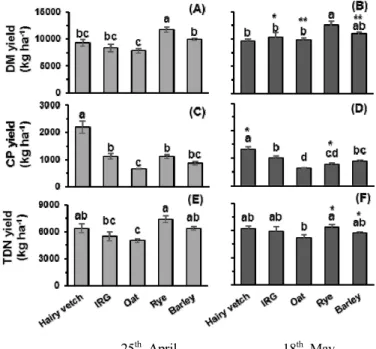
Figure 1 shows DM, CP, and TDN yield of forage by harvest time. The highest DM yield of forages harvested on 25

th

April was obtained from rye (11,662.3 ± 547.1 kg ha

-1

) that was significantly (p<0.01) different from other crops, the DM was for barley (9,916.4 ± 215.3 kg ha

-1

) and hairy vetch (9,257.6 ± 634.4). The lowest DM yield of forage harvested on 25

th

April was obtained from oat (7,779.8 ± 390.5 kg ha

-1

).

Harvesting on 18

th

May, rye had the highest DM yield (12,535.6 ± 748.8 kg ha

-1

) and hairy vetch had the lowest DM yield (9,576.1 ± 466.6 kg ha

-1

). With regard to the delay of harvest time, the increase of DM yield was 14.4%, on average.

Particularly, the increased DM yield of oat and IRG were 25.8 and 24.4%, respectively. Some studies revealed that delayed harvesting time increases DM yield of various crops as similar to the present study (Testa et al., 2011; Mandić et al., 2018).

Harvesting on 25

th

April, the highest CP yield was attained from hairy vetch (2195.1 ± 634.4 kg ha

-1

) followed by the IRG (1117.1 ± 114.1 kg ha

-1

) and rye (1109.1 ± 69.2 kg ha

-1

). The lowest CP yield was obtained from oat (656.0 ± 12.9. kg ha

-1

).

The highest CP yield was found from hairy vetch (1317.2 ±

106.9 kg ha

-1

) harvested on May 18, followed by IRG (997.4

(4)

25

th

April 18

th

May

Fig. 1. The yield of dry matter (DM, A, B), crude protein (CP, C, D) and total digestible nutrient (TDN, E, F) according to harvest time. Data are presented as means ± SE (n=3). Different letters indicate significantly different at p <

0.05 according to the Duncan’s multiple range test. The asterisks indicate significant difference of each value between data of 25th April and 18th May (*P < 0.05. **P < 0.01. ***P < 0.001.).

25

th

April 18

th

May

Fig. 2. The dry matter intake (DMI, A, B), digestible dry matter (DDM, C, D) and relative feed value (RFV, E, F) according to harvest time. Data are presented as means ± SE (n=3). Different letters indicate significantly different at p <

0.05 according to the Duncan’s multiple range test. The asterisks indicate significant difference of each value

between data of 25th April and 18th May (*P < 0.05. **P < 0.01. ***P < 0.001.).

(5)

± 87.7 kg ha

-1

) and barley (876.2 ± 47.9 kg ha

-1

). The lowest CP yield of forage was obtained from oat (628.9 ± 28.1 kg ha

-1

). When the harvest time was delayed, all kinds of forage without barley decreased CP yield. Particularly, hairy vetch and rye was significantly decreased CP yield (40.0% and 30.6%, respectively). Song et al. (2014) revealed that delay one month of harvesting time decreased the CP composition of forages (barley, rye, triticale, and wheat) from 19.1 to 9.0 %, on average. These results indicated that the delay of harvest time considerably affected the CP yield. Choi et al. (2011) reported that the CP yield of IRG and oat were with a range of 700.9

~ 1082.8 kg ha

-1

and 928.2 ~ 1249.5 kg ha

-1

, respectively, in the upland field. Moreover, the CP yield of IRG from paddy field similar to from upland field. On the other hand, CP yield of oat from paddy field quite lower than from upland field.

The highest TDN yield of forage harvest on 25

th

April was found from rye (7389.3 ± 368.4 kg ha

-1

) followed by hairy vetch (6374.2 ± 511.6 kg ha

-1

) and barley (6370.3 ± 166.6 kg ha

-1

). The lowest TDN yield was obtained from oat (5007.6 ± 234.0 kg ha

-1

). Rye had the highest TDN yield at 6337.2 ± 580.16 kg ha

-1

when harvested on 18

th

May. Oat had the lowest TDN yield, 5212.5 ± 493.69 kg ha

-1

. According to the delayed harvesting time, the TDN was decreased from all crops (Table 2). The late the harvest time before heading stage cause the increase of ADF and NDF resulting in the decrease of TDN (Shin and Kim, 1995). On the other hand, the TDN yield of IRG, and oat was increased according to the delayed harv est time (Fig. 1E, F). The DM yield harvested on 18 May was increased than on 25

th

April (Fig. 1A, B). Especially, the increase of DM yield from IRG and oat was higher than other crops. Heo et al. (2005) reported that the DM was increased resulting from that the water content was less than 40%.

Feed values of forage crop by harvest times were indicated in Fig. 2. Harvesting on 25

th

April, the average DMI and DDM were 2.33% and 65.6%, respectively. The highest DMI and DDM were obtained from hairy vetch, whereas the lowest DMI and DDM were obtained from rye. Harvesting on 18

th

May, the average DMI and DDM were 1.87% and 55.4%, respectively. Similar to harvesting on 25

th

, the highest DMI and DDM were found from hairy vetch, whereas the lowest DMI and DDM were obtained from rye. When the harvest time was delayed, the average DMI and DDM were decreased by 19.9% and 15.7 %, respectively.

Jo et al. (2008) reported that the NDF and ADF were lower

in hairy vetch compared to that of rye. These indicated that the DMI and DDM in hairy v etch higher than in rye. Kim et al.

(2018) evaluated the DMI of rye, IRG, and triticale at the paddy field in the southern region of Korea. The highest DMI and DDM were obtained from IRG (2.14% and 60.8%) and the lowest DMI and DDM were obtained from rye (1.82% and 55.5%). Song et al. (2009) reported that DMI and DDM were high in order of barley, oat, and rye. These results are similar to the present study. RFV, as an indicator of feed value according to DMI and DDM, was originally considered by the American Forage and Grassland Council (AFGC) for the evaluation of market hay (Rohweder et al, 1978). Harvest time both 25

th

April and 18

th

May, the highest RFV was obtained from hairy vetch (178.5 and 120.0, respectively) and the lowest RFV was obtained from rye (94.7 and 62.5, respectively). All of winter forage crops showed a reduction of RFV according to delay harvest time (p>0.05).

Ⅳ. Conclusion

The current study was carried to assess the forage yield and feed value of winter forage crops harvested at various times in the paddy field after rice harvesting. Rye is the highest source of DM yield and TDN yield. Hairy v etch had the highest CP yield and RFV. Additionally, hairy vetch is the second-highest source of TDN yield. Delay of harvest time caused an increase of DM at 14.4%, on average, reduction of CP yield without barley at 21.4%, on average, and reduction of RFV at 31.9%, on average. This finding suggested that rye harvested on April 25

th

is the best forage for resolving Korea’s problem of insufficient forage yield.

Ⅴ. Acknowledgments

This study was financially supported by Chonnam National University (Grant number: 2019-3901).

Ⅵ. REFERENCES

Baker, W. and Thompson, T. 1992. Determination of total nitrogen in

plant samples by kjeldahl. Plant Analysis Reference Procedures

(6)

for the Southern Region of the United States. 368:13-16.

Cho, H.S., Kim, C.G., Seo, J.H., Lee, J.K., Eom, S.P. and Oh, T.K.

2005. Effect of liquid pig manure on yield and grain quality of rice and barley under double cropping systems in paddy field.

Korean Journal of Crop Science. 50:99-103.

Choi, G.J., Lim, Y.C., Ji, H.C., Lee, S.H., Lee, K.W., Kim, D.K., Seo, S., Kim, W.H. and Kim, K.Y. 2011. Comparison of growth characteristics and forage productivity between Italian ryegrass and oat sown in early spring. Journal of the Korean Society of Grassland and Forage Science. 31:135-142.

Delogu, G., Faccini, N., Faccioli, P., Reggiani, F., Lendini, M., Berardo, N. and Odoardi, M. 2002. Dry matter yield and quality evaluation at two phenological stages of forage triticale grown in the Po Valley and Sardinia, Italy. Field Crops Research.

74:207-215.

Goering, H.K. and Van Soest, P.J. 1970. Forage fiber analyses (apparatus, reagents, procedures, and some applications). US Agricultural Research Service.

Heo, J.M., Lee, S.K., Lee, I.D. and Bae, H.C. 2005. Effect of different growing stages of winter cereal crops on the quality of silage materials and silages. Journal of Animal Science and Technology.

47(5):877-890.

Holland, C., Kezar, W., Kautz, W.P., Lazowski, E.J., Mahanna, W.C.

and Reinhart, R. 1990. The pioneer forage manual: A nutritional guide. Pioneer Hi-Bred International, INC., Desmoines, IA. pp. 1-55.

Ji, H.C., Lee, S.H., Yoon, S.H., Kim, K.Y., Choi, G.J., Park, H.S., Park, N.G., Lim, Y.C. and Lee, E.S. 2011. A very early-maturing Italian ryegrass (lolium multifilrum lam.) new variety, ‘green farm’

for double cropping system. Journal of the Korean Society of Grassland and Forage Science. 31:9-14.

Jo, I.H., Yun, Y.B., Park, W.R., HwangBo, S., Lee, S.H. and Lee, J.S.

2008. The effect of application of cattle slurry and chemical fertilizer on productivity of rye and hairy vetch by single or mixed sowing. Journal of the Korean Society of Grassland and Forage Science. 28:323-330.

Ju, J.I., Lee, D.H., Han, O.K., Song, T.H., Kim, C.H. and Lee, H.B.

2011. Comparisons of characteristics, yield and feed quality of oat varieties sown in spring and autumn. Journal of the Korean Society of Grassland and Forage Science. 31:25-32.

Kim, D.H. and Kim, I.S. 2020. An analysis of the impact of us beef import tariff rate changes on the korean beef cattle market. Korean Journal of Organic Agriculture. 28:31-57.

Kim, J.G., Liu, C., Zhao, G., Kim, H.J., Kim, M.J., Kim, C.M. and Ahn, E.K. 2018. Study on the forage cropping system linked to whole crop rice and winter crop in southern region. Journal of the

Korean Society of Grassland and Forage Science. 38:202-209.

Lee, S.C., Chun, H.S., Kim, A.E. and Jeong, S.H. 2017. Efficient establishing plan of distribution logistics system in accordance with forage production consumption behaviors. KLEI. Ministry of agriculture, Food and Rural Affairs. pp. 236-247.

Mandić, V., Bijelić, Z., Krnjaja, V., Simić, A., Petričević, M., Mićić, N. and Caro-Petrović, V. 2018. Effect of harvesting time on forage yield and quality of maize. Biotechnology in Animal Husbandry.

34:345-353.

Na, S.I., Kim, Y.J., Park, C.W., So, K.H., Park, J.M. and Lee, K.D.

2017. Evaluation of feed value of IRG in middle region using UAV. Korean Journal of Soil Science and Fertilizer. 50:391-400.

Pott, L.P., Amado, T.J.C., Schwalbert, R.A., Gebert, F.H., Reimche, G.B., Pes, L.Z. and Ciampitti, I.A. 2021. Effect of hairy vetch cover crop on maize nitrogen supply and productivity at varying yield environments in Southern Brazil. Science of the Total Environment. 759:144313.

Rohweder, D.A., Barnes, R.F. and Jorgensen, N. 1978. Proposed hay grading standards based on laboratory analyses for evaluating quality. Journal of Animal Science. 47:747-759.

Seo, J.H., Kwon, Y.U., Cho, G.O., Han, O.K. and Gu, J.H. 2018.

Changes of dry matter productivity and feed value of forage barley and Italian ryegrass according to cultivation conditions in mid-west plain of Korea. Journal of the Korean Society of Grassland and Forage Science. 38:84-90.

Shin, C.N. and Kim, B.H. 1995. Dry matter yield and chemical composition of spring oats at various stage of growth. Journal of the Korean Society of Grassland and Forage Science. 15(1):61-66.

Song, T.H., Han, O.K., Yun, S.K., Park, T.I., Seo, J.H., Kim, K.H. and Park, K.H. 2009. Changes in quantity and quality of winter cereal crops for forage at different growing stages. Journal of the Korean Society of Grassland and Forage Science. 29:129-136.

Song, T.H., Park, T.I., Park, H.H., Cho, S.K., Oh, Y.J., Jang, Y.W., Rho, J.H., Park, K.G. and Kang, H.J. 2014. Study of the use of winter forage crops, early maturing rice and summer oat in triple cropping systems at paddy field in southern region. Journal of the Korean Society of Grassland and Forage Science. 34:227-233.

Testa, G., Gresta, F. and Cosentino, S. 2011. Dry matter and qualitative characteristics of alfalfa as affected by harvest times and soil water content. European Journal of Agronomy. 34:144-152.

(Received : June 8, 2021 | Revised : June 14, 2021 | Accepted : June

21, 2021)

수치

Table  2.  Nutrient  contents  of  forage  crops  by  different  harvest  time  in  paddy  field  in  the  southern  region  of  Korea
Fig.  1.  The  yield  of  dry  matter  (DM,  A,  B),  crude  protein  (CP,  C,  D)  and  total  digestible  nutrient  (TDN,  E,  F)  according to  harvest  time

참조

관련 문서

Effect of green manure crops incorporation with rice cultivation on soil fertility improvement in paddy field. Effects of forage cropping system and cattle slurry

Average fresh and dry matter yield and water content of Italian ryegrass and winter feed crops when optimally cultivated in the central plains (Suwon, Korea 2016~2018,

Development of mechanized system model for the production of winter cereal wrap silage in the fallow paddy field(1) -Modelling mechanized roughage production

These experiments were carried out to compare the five winter cereal crops for whole crop silage on growth, yield and feed value as affected by soil organic

Total yield of winter forage crops and summer forage corn at harvest stage as affected by liquid-pig-manure and chemical fertilizer applications(NF: No-fertizer, LPM:Liquid

Comparison of forage yield and growth characteristic of two forage rice cultivars (cv. Mogyang and cv. Mogwoo) in a reclaimed rice field... 그러나 간척지는

This study was carried out to explore the accuracy of near infrared spectroscopy(NIRS) for the prediction of moisture content and chemical parameters on winter annual forage crops..

This study was conducted to evaluate forage production and nutritive value of winter type grasses (Italian ryegrass, Rye and Whole crop barley) in Korea Southern province in