ISSN: 1738-7167
DOI: http://dx.doi.org/10.7731/KIFSE.2014.28.4.021
1φ 2 W MCCB의 기준 비교 및 내열 특성 평가에 관한 연구
최충석
†
·이재혁전주대학교 소방안전공학과
Comparison of Standards for a 1φ 2 W MCCB and Study on the Evaluation of Heat Resistance Characteristics
Chung-Seog Choi
†
· Jae-Hyuk LeeDept. of Fire Safety Engineering, Jeonju University
(Received May 7, 2014; Revised July 4, 2014; Accepted August 14, 2014)
요 약
단상 2선식 MCCB의 관련 기준을 분석하고, 내열 특성을 평가하여 다음과 같은 결과를 얻었다. KS C 8321은 IEC 60947-2 의 규격을 부합화되어 관련 규정 대부분이 유사하다. NFPA는 사용자 중심의 안전 규정을 제시한 것으로 시험 또는 검사 등의 세부 사항은 없으나 안전에 직접 관련이 있는 규정이 구체적으로 명시되어 있다. KS C 8321은 시험과 검사에 대한 항목이 세부적으로 분류되어 있는 것을 알 수 있다. 그러나 IEC 60947-2와 IEEE C37.51의 경우 시험 및 검사 항목을 간소화하거나 일부 생략되어 있다. 내열 실험 장치를 이용하여 MCCB를 180
oC 에서 6 hr 동안 열적 스트레스를 인가하였을 때 작동 손잡이의 변형이 확인되었고, 트립 상태로 이동한 것이 확인되었다. 또한 고정걸이의 대 부분은 녹아서 기능이 상실되었다. 90
oC 에서 MCCB가 열적 스트레스를 받았을 때 특이 사항이 없었고, 105
oC 및 120
oC 의 온도에서는 고정걸이가 일부 변형되었다. 150
oC 에서는 고정걸이의 변형 및 명판의 변색 등을 확인할 수 있었 다. MCCB의 내부 분석에서 트립바가 녹아서 없어진 것을 알 수 있었고, 상하 가동편은 상부로 이동한 것이 확인되었 다. 내전압 6 kV를 60 s 동안 5회 인가한 실험에서 모든 항목이 안전하였다. 또한 절연저항계로 직류 500 V를 인가한 절연 성능 평가 역시 양호하였다.
ABSTRACT
This study obtained the following results by analyzing the standards related to a 1 φ 2W MCCB and evaluating its heat resistance characteristics. Since KS C 8321 corresponds to IEC 60947-2 standards, most of the related regulations are similar. The NFPA, which presents the user oriented safety regulations, contains no details about tests or inspections, etc., but it does specify in detail the regulations directly related to safety. It can be seen that KS C 8321 classifies in detail the items about tests and inspections. However, IEC 60947-2 and IEEE C37.51 simplified the test and inspection items or omitted some of them. When applying thermal stress to an MCCB for 6 hours at 180
oC using a heat resistant experimen- tal device, it was found that the actuator lever was transformed and moved in the tripped state. In addition, most of the fixing hanger was melted down, losing their function. When applying thermal stress to the MCCB at 90
oC, it showed nothing peculiar, but the fixing hanger was partly deformed at 105
oC and 120
oC. It was found that the fixing hanger was deformed and the name plate was discolored at 150
oC. It can be seen from the analysis of the internals of the MCCB that the trip bar has been melted away and that the up and down operator has moved up. The experiment performed by apply- ing a withstanding voltage of 6 kV for 60 s showed that all items remained intact. In addition, the evaluation of the insulation per- formance performed by applying DC 500 V using an insulation-resistance tester showed good insulation performance.
Keywords : Heat Resistance Characteristics; Thermal Stress; Fixing Hanger; Trip Bar; Withstanding Voltage
1. 서 론
배선용차단기(MCCB; Molded Case Circuit Breaker)는 전선로에 과전류 및 단락 등이 발생하였을 때 자동적으로
회로를 차단하는 기기이다. MCCB는 한국산업규격 KS C 8321에 정격 전압 교류 1,000 V 이하 또는 정격 전류 2,000 A 이하, 정격 차단 용량은 200 kA, 상용 주파수 60 Hz 등의 조건에서 사용하도록 되어 있다. KS C IEC 부합화
†
Corresponding Author, E-Mail: [email protected]
†
TEL: +82-63-220-3119, FAX: +82-63-220-2056
다(2-5). 전기설비 기계 기구에 적용되는 MCCB는 작동 손 잡이가 상부로 이동하면 켜짐(ON) 상태, 하부로 향하면 꺼짐(OFF) 상태이다. 그런데 과전류 또는 단락 등이 전선 로에 발생하면 트립 장치가 작동하도록 되어 있다(6). 그러 므로 전선로에서 발생되는 치명적인 단락 또는 과부하 등 으로부터 전기기기를 보호할 수 있는 것이다. 그러나 전기 설비의 노화에 따라 전기기기에서는 필연적으로 절연 불 량, 구조 변형, 성능 저하 등의 경년 열화(劣化)가 진행되 어 사고를 발생시킨다(7-9). 그래서 그 동안 많은 연구자들이 MCCB 접속 단자부의 접속 결함에 의한 화재 위험성(10), MCCB 및 단자대 접속부의 접촉 불량에 의한 소손 특성 및 과열 감지 기법(11), MCCB의 트래킹에 의한 전기화재 사례(12) 등은 있으나 열동전자식 MCCB의 내열 특성에 대 한 연구는 미진한 상태이다.
따라서 본 연구에서는 단상 2선식 MCCB의 관련 기준 을 비교하여 관련 규격의 적용 의미를 제시하고 내열 특성, 내전압 및 절연 성능 등을 평가하였다.
2. 실험 방법 및 절차
Figure 1은 열동전자식 MCCB의 내열 특성 분석을 위해 적용된 장치의 실체 사진이다. 실험은 KS C 0221을 준용 하였고, 내열 실험 장치(Temperature chamber, KM505, AC 220 V, Kwang myung Electric Co., Korea)를 이용하 였다. 실험실의 온도는 18~20oC, 상대 습도 18 ± 2 %를
유지하였다. 열동전자식 MCCB는 6 hr 동안 절연 등급에 따라 각각의 온도에서 열적 처리를 하였다. 실험이 완료된 후 열동전자식 MCCB의 내·외부 소손 패턴을 확인하고, 내전압측정기를 이용하여 절연 성능을 측정하였다(13,14). Figure 1. Photograph of the MCCB installed for the heat resistance test.
Figure 2. Sequence diagram for the MCCB heat resistance performance test.
Figure 3. Photograph of the MCCB for the withstand voltage test.
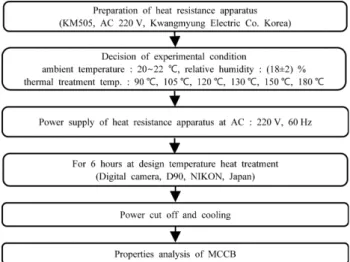
Figure 2는 MCCB의 내열 특성 실험 및 분석 과정을 나 타낸 것이다. KS C 0221을 준용하여 진행하였다. MCCB 의 열 열화 온도는 전기 제품의 내열 특성 시험 조건을 적 용하였다. 실험이 완료되었을 때 MCCB는 자연 냉각 시킨 후 소손 패턴은 디지털카메라(digital camera D90, 2009, Nikon, Japan)를 사용하여 분석하였다.
Figure 3은 열동전자식 MCCB의 내전압 실험을 위해 나 타낸 실체 사진이다. 내전압 실험은 KS C 2127을 준용하 였고, 내전압시험기(withstand voltage tester, Hitop Testere, TOS5101, Kikusui Electronics Co., Japan)를 이용하여 진 행하였다. 내전압 실험은 60 s 동안 6 kV의 내전압으로 전 원측과 부하측에 각각 인가하였다. MCCB의 전원측 내전 압 특성을 측정할 때는 부하측을 단락시켰으며, 부하측 내 전압을 측정할 때는 전원측을 단락시켰다(15). 내전압 실험 이 진행될 때 MCCB의 작동 손잡이는 꺼짐(OFF) 상태에 위치함에 따라 시험 조건을 만족시켰다.
Figure 4는 MCCB의 내전압 실험 및 분석 과정을 나타 낸 것이다. 내전압 실험 장치를 이용하여 MCCB에 6 kV 의 내전압을 60 s 동안 인가하여 5회 반복 실험하였다. 내 전압 실험이 진행될 때 MCCB의 작동 손잡이는 꺼짐 (OFF) 상태에 위치함에 따라 시험 조건을 만족시켰다. 즉, 전원측 내전압을 측정할 때는 부하측을 단락시켰으며, 부 하측 내전압을 측정할 때는 전원측을 단락시켰다.
Figure 5는 열동전자식 MCCB의 일반 방수 성능 실험을 위한 실체 사진이다. 분전반 또는 배전반 내에 설치되는 MCCB는 비, 눈, 우박 등의 직접적인 오염의 가능성은 적 다. 그러나 수분이 많은 곳에 설치되어 사용할 때 절연 성 능이 저하되는 경우가 있다. 따라서 일반 방수 실험을 통
해 MCCB가 어느 정도 안전성이 확보되는지 확인하였다.
KS C 0284를 준용하였으며, MCCB에 대한 주수는 원통 Figure 4. Sequence diagram for the MCCB withstand volt-
age test.
Figure 5. Photograph of the MCCB for the general MCCB waterproof test.
Figure 6. Photograph of the MCCB for which a general waterproof test is finished.
Figure 7. Sequence diagram for the general waterproof test of the MCCB and analysis.
Figure 7은 MCCB의 일반 방수 실험 및 분석 과정으로 KS C 0284를 준용하였다. MCCB에 900 s 동안 주수를 한
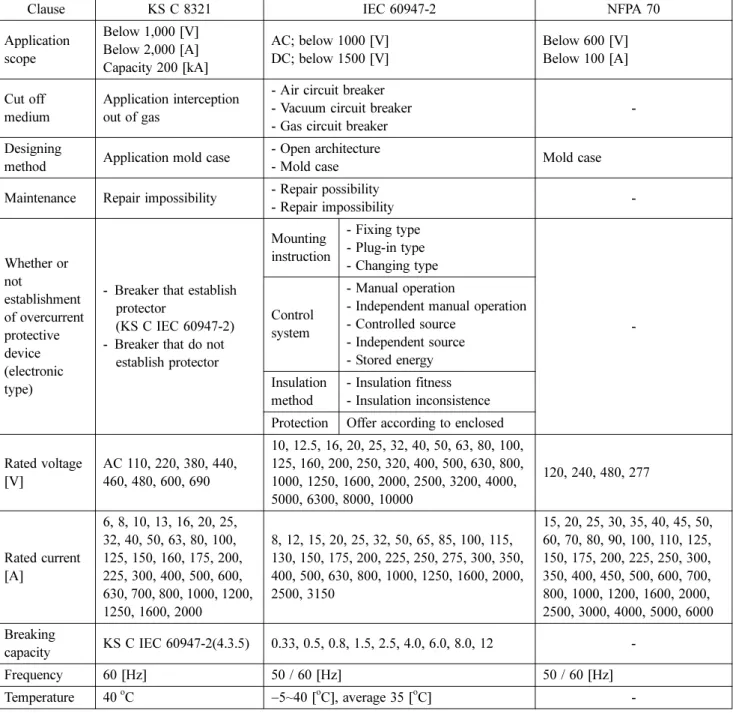
60947-2, NFPA 70 등을 대상으로 하였다. KS C 8321은 국제규격 IEC 60947-2의 규격을 부합화 하여 한국의 현실
Table 1. Classification of MCCBs and Comparison on Rating
Clause KS C 8321 IEC 60947-2 NFPA 70
Application scope
Below 1,000 [V]
Below 2,000 [A]
Capacity 200 [kA]
AC; below 1000 [V]
DC; below 1500 [V]
Below 600 [V]
Below 100 [A]
Cut off medium
Application interception out of gas
- Air circuit breaker - Vacuum circuit breaker - Gas circuit breaker
-
Designing
method Application mold case - Open architecture
- Mold case Mold case
Maintenance Repair impossibility - Repair possibility
- Repair impossibility -
Whether or not
establishment of overcurrent protective device (electronic type)
- Breaker that establish protector
(KS C IEC 60947-2) - Breaker that do not
establish protector
Mounting instruction
- Fixing type - Plug-in type - Changing type
Control - system
- Manual operation
- Independent manual operation - Controlled source
- Independent source - Stored energy Insulation
method
- Insulation fitness - Insulation inconsistence Protection Offer according to enclosed
Rated voltage [V]
AC 110, 220, 380, 440, 460, 480, 600, 690
10, 12.5, 16, 20, 25, 32, 40, 50, 63, 80, 100, 125, 160, 200, 250, 320, 400, 500, 630, 800, 1000, 1250, 1600, 2000, 2500, 3200, 4000, 5000, 6300, 8000, 10000
120, 240, 480, 277
Rated current [A]
6, 8, 10, 13, 16, 20, 25, 32, 40, 50, 63, 80, 100, 125, 150, 160, 175, 200, 225, 300, 400, 500, 600, 630, 700, 800, 1000, 1200, 1250, 1600, 2000
8, 12, 15, 20, 25, 32, 50, 65, 85, 100, 115, 130, 150, 175, 200, 225, 250, 275, 300, 350, 400, 500, 630, 800, 1000, 1250, 1600, 2000, 2500, 3150
15, 20, 25, 30, 35, 40, 45, 50, 60, 70, 80, 90, 100, 110, 125, 150, 175, 200, 225, 250, 300, 350, 400, 450, 500, 600, 700, 800, 1000, 1200, 1600, 2000, 2500, 3000, 4000, 5000, 6000 Breaking
capacity KS C IEC 60947-2(4.3.5) 0.33, 0.5, 0.8, 1.5, 2.5, 4.0, 6.0, 8.0, 12 -
Frequency 60 [Hz] 50 / 60 [Hz] 50 / 60 [Hz]
Temperature 40oC −5~40 [oC], average 35 [oC] -
에 맞도록 한 것으로 분석되었고, 주요 내용 대부분이 유 사한 것으로 확인되었다. 그러나 NFPA 70은 제품의 규격 시험 조건이 아니고 사용자 안전을 중심으로 다루고 있다 는 것이 확인된바 KS C 8321 및 IEC 60947-2 등과 일부 차이가 있음을 알 수 있다(2-5). 즉, NFPA는 사용자 중심의 안전 규정을 제시한 것으로 시험 또는 검사 등의 세부 사항 은 없으나 안전에 직접 관련이 있는 적용 범위, 정격 정압 및 전류 등은 구체적으로 명시하고 있는 것을 알 수 있다.
Table 2는 MCCB의 시험 방법 및 검사 기준에 대한 차이 를 비교한 것이다. 시험 방법 및 검사 기준에 대한 규격은 KS C 8321, IEC 60947-2, IEEE C37.51 등을 대상으로 하 였다. KS C 8321은 시험과 검사에 대한 항목이 세부적으 로 분류되어 있는 것을 알 수 있다. 그러나 IEC 60947-2와 IEEE C37.51의 경우 시험 및 검사 항목을 간소화하거나 일부 생략되어 있는 것을 확인 하였다(2-5). 따라서 산업 현 장에서 MCCB를 선정하고 설치하기 위해서 IEC 및 IEEE 등의 기준은 개괄적인 내용을 참고하는 것이 바람직하고 실질적인 적용 및 관리 등은 KS C 8321를 적용해야만 적
법한 것을 알 수 있다.
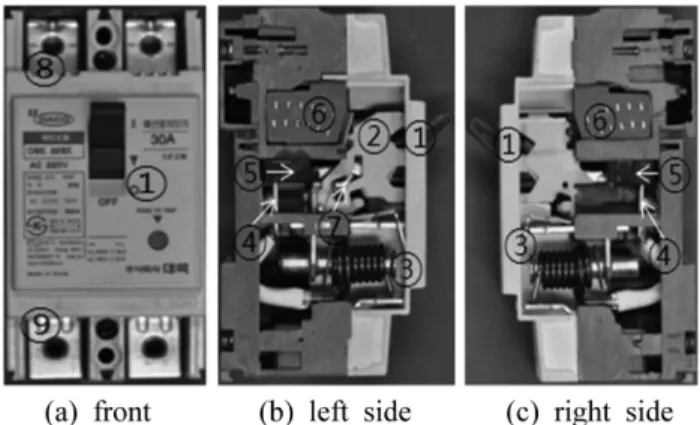
Figure 8은 본 실험에 적용된 열동전자식 MCCB의 실체 사진으로 ① 작동 손잡이(actuator lever), ② 작동 기구부 (actuator mechanism), ③ 온도 조절 장치(bimetallic strip),
④ 접촉점(contacts), ⑤ 상하 가동편(up and down operator),
⑥ 소호 장치(arc divider or extinguisher), ⑦ 금속 작동핀 (metal operation pin), ⑧ 전원측 단자(source terminal), ⑨ 부하측 단자(load terminal) 등으로 구성되어 있다(17,18).
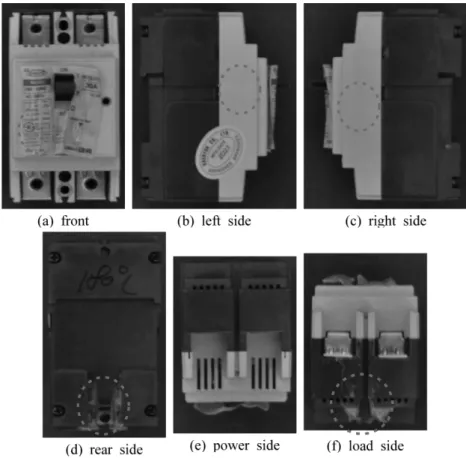
Figure 9는 동일한 제품의 MCCB를 내열 실험 장치 (KM505, AC 220V, Kwangmyung Electric Co., Korea)로 180oC에서 6 hr 동안 열적 스트레스를 인가하였을 때 소 손된 상태를 나타낸 실체 사진이다. Figure 9(a)는 MCCB 의 정면을 나타낸 것으로 작동 손잡이뿐만 아니라 덮개가 변형되고 변색된 것을 알 수 있다. 또한 작동 손잡이가 트 립 상태로 이동한 것으로 보아 내부 의 상태를 정밀 분석 할 필요가 있는 것으로 판단된다. Figure 9(b)와 (c)는 좌 측면 및 우측면을 나타낸 것으로 표면의 변색이 확인되고 부풀어 오른 것을 알 수 있다. Figure 9(d)는 후면을 나타 낸 실체 사진으로 몸체는 약간 변색되었으나 MCCB를 분 전반에 편리하게 착탈시키기 위해 설치된 고정걸이의 대 부분은 녹아서 기능이 완벽히 상실된 것을 알 수 있다.
Figure 9(e)는 전원측의 실체 사진이며 일부의 변색 외에 는 특이 사항을 발견할 수 없다. Figure 9(f)는 부하측의 실체 사진으로 후면에 설치된 고정걸이가 흘러 내려 달라 붙은 것을 확인 할 수 있다. 그러나 금속 단자대 및 외함 등은 비교적 양호한 상태를 유지하는 것으로 확인되었다.
그리고 동일한 조건에서 90oC의 온도에서 열적 스트레스를 인가하였으나 특이 사항을 발견할 수 없었다. 또한 105oC 및 120oC의 온도에서는 후면의 고정걸이가 일부 변형되 었고, 150oC에서 열적 스트레스를 받은 MCCB는 고정걸 이의 변형 및 명판의 변색 등을 확인할 수 있었다(17,18).
Figure 10은 Figure 9의 내부를 나타낸 실체 사진이다.
Table 2. Comparison of Test Method and Inspection Criteria
Clause KS C 8321 IEC 60947-2 IEEE C37.51
Test
- Trip limit, insulation property - Action performance
- Overload performance - Dielectric strength - Temperature rise - Overload release
- Under voltage and shunt release - Position of main contact etc
- Material & apparatus - Protection degree - Operating mechanism - Temperature rise - Insulation property
- Making and breaking capacity - Movement performance - Protection degree etc
- Alternating current
- Performance test of machinery - Continuos current
- Short-circuit time - Short-circuit current etc
Checkup Trip limit, insulation, movement,
overload and electric-short capacity etc Performance and insulation etc - Product
information Name, pole, voltage, current, capacity etc Name, trademark, form, the
manufacture´s serial number etc - Indication KS number, reference temperature,
production year etc
Name, trademark, form, the
manufacture´s serial number etc Voltage, position, switch etc
Figure 8. External view and part name of the thermal mag- netic type MCCB.
Figure 10(a)는 상부 덮개를 제거하였을 때의 실체 사진으 로 물리적인 변형은 없었으나 내부의 접점 및 지지대 등의 변색을 확인되었다. 또한 전기적인 단락 또는 과부하 등이 발생했을 때 회로를 차단하는 기구인 트립바(trip bar)가 녹아서 없어진 것을 알 수 있다. Figure 10(b)는 MCCB의 좌측면을 나타낸 것으로 상하 가동편이 상부로 이동하였 고, 작동 손잡이가 트립의 위치로 움직인 것을 알 수 있다.
Figure 10(c)는 MCCB의 우측면을 나타낸 실체 사진으로 온도 조절 장치의 표면이 변색되었고, 작동 손잡이가 트립 의 위치로 이동한 것을 알 수 있다. 즉, 코일의 절연을 위 해 코팅된 에나멜이 열적 스트레스에 의해 소손되어 흘러 내렸고 변색을 유발시킨 것으로 판단된다. Figure 10(d)는 부하측을 나타낸 것으로 고정걸이가 녹아 흘러내린 것으 로 확인되나 그 밖의 부품은 특이 사항이 없는 것을 알 수 있다. 이상의 결과에서 알 수 있듯이 내열 실험 장치에 의 해 MCCB가 소손되면 대부분의 부품 및 재료 등은 일정 한 패턴으로 변형 및 변색 등이 발생하는데 이것은 열적 스트레스의 인가 속도 및 시간 등이 일정하기 때문으로 판 단된다(17,18).
Table 3은 정상 MCCB의 내전압 실험이 완료되었을 때 의 측정 결과를 정리한 것이다. 내전압 실험은 KS C 2127 를 준용하여 내전압시험기(withstand voltage tester, Hitop Testere, TOS5101, Kikusui Electronics Co., Japan)를 이 용하여 실시하였다. 전원측의 내전압 성능을 평가하기 위 Figure 9. Photograph of the outside of the MCCB receiving stress at heat resistance of 180oC.
Figure 10. Internal damage pattern of the MCCB receiving stress at heat resistance of 180oC.
해서 부하측을 단락시키고, 전원측에 내전압을 인가하여 성능을 평가하였다. 부하측의 내전압 성능을 평가하기 위 해서 전원측을 단락시키고, 부하측에 내전압을 인가하였다.
실험 전압은 6 kV를 60 s 동안 공급하고 5회 반복한 결과 모두 특성이 양호한 것을 알 수 있었다.
Table 4는 본 실험에 적용된 MCCB의 일반 방수 실험이 완료된 후의 내전압 실험 결과를 나타낸 것이다. 일반 방 수 실험은 KS C 0284의 규정에 근거하여 실험이 진행되 었고, 내전압시험기(withstand voltage tester, Hitop Testere, TOS5101, Kikusui Electronics Co., Japan)를 이용하여 평 가하였다. MCCB에 일반 방수 실험 완료 후 MCCB의 전 원측 단자 및 부하측 단자에 60 s 동안 각각 6 kV의 내전 압을 인가하였다. MCCB의 내전압 측정은 각각 5회 반복 실시한 것이며 모든 항목의 특성이 양호한 것으로 확인되 었다. 즉, 본 연구에 적용된 MCCB는 일반 방수 성능 및 내전압 특성이 양호한 것을 알 수 있다.
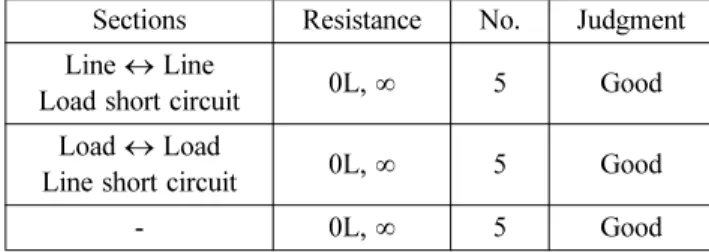
Figure 11은 MCCB의 일반 방수 실험을 완료된 후 절연 성능을 측정하는 실체 사진이다. MCCB의 전원측 및 부하 측 각각의 절연 성능을 절연저항계(megger, 2426, 500 V, Yokogawa M&C Co., Japan)를 이용하여 측정하였다.
MCCB의 절연 성능 평가를 실시할 때 작동 손잡이는 꺼 짐(OFF) 상태에 위치시킴으로서 시험 조건을 만족시켰다.
MCCB의 전원측을 분석할 때는 부하측을 단락시켰으며, 부하측을 분석할 때는 전원측을 단락시켜 각각 직류 500 V 를 인가하여 5회 반복 실시하였다. Table 5는 측정 결과이 며, 모든 조건에서 특성이 양호한 것으로 확인되었다(17,18).
4. 결 론
단상 2선식 MCCB의 관련 기준을 분석하고 관련 기준 에 근거한 내열 특성 평가를 실시하여 MCCB의 내·외부 의 소손 패턴 및 특징을 분석하여 다음과 같은 결과를 얻 었다.
(1) KS C 8321은 국제규격 IEC 60947-2의 규격을 부합 화하여 한국의 현실에 맞도록 한 것으로 분석되었고, 주요 내용 대부분이 유사한 것으로 확인되었다. NFPA는 사용 자 중심의 안전 규정을 제시한 것으로 시험 또는 검사 등 의 세부 사항은 없으나 안전에 직접 관련이 있는 적용 범 위, 정격 정압 및 전류 등은 구체적으로 명시하고 있는 것 을 알 수 있었다.
(2) KS C 8321은 시험과 검사에 대한 항목이 세부적으 Table 3. Withstand Voltage Test Result of Thermal-magnetic
MCCB
Sections Test voltage [kV] No. Judgment Line ↔ Line /
Load short circuit 6 5 Good Load ↔ Load /
Line short circuit 6 5 Good
- 6 5 Good
Table 4. Withstand Voltage Characteristics of the MCCB for which General Waterproof Test is Completed
Sections Test voltage [kV] No. Judgment Line ↔ Line
Load short circuit 6 5 Good Load ↔ Load
Line short circuit 6 5 Good
- 6 5 Good
Table 5. Insulation Resistance Characteristics of the MCCB for which General Waterproof Test is completed
Sections Resistance No. Judgment Line ↔ Line
Load short circuit 0L, ∞ 5 Good Load ↔ Load
Line short circuit 0L, ∞ 5 Good
- 0L, ∞ 5 Good
Figure 11. Measurement of the insulation resistance of the MCCB for which general waterproof test is finished.
이 완벽히 상실된 것을 알 수 있었다.
(4) 동일한 조건에서 MCCB를 90oC의 온도에서 열적 스트레스를 인가하였으나 특이 사항이 없었고, 105oC 및 120oC의 온도에서는 후면의 고정걸이가 일부 변형되었다.
150oC에서 열적 스트레스를 받은 MCCB는 고정걸이의 변형 및 명판의 변색 등을 확인할 수 있었다.
(5) MCCB의 내부 분석에서 회로를 차단하는 기구인 트 립바(trip bar)가 녹아서 없어진 것을 알 수 있었고, 상하 가동편은 상부로 이동한 것이 확인되었다. 또한 온도 조절 장치의 표면이 변색되었고, 코일의 절연을 위해 코팅된 에 나멜이 열적 스트레스에 의해 소손되어 흘러내렸고 변색 을 유발시킨 것으로 판단된다.
(6) 열 열화가 완료된 MCCB의 내전압 실험은 내전압시 험기를 이용하여 6 kV를 60 s 동안 5회 반복하였고, 절연저 항계를 이용한 성능 평가는 직류 500 V를 5회 반복 인가하 였으며 각각의 모든 조건에서 양호한 것을 알 수 있었다.
References
1. Korean Standards Association, “KS C 8321, 8111”, Korean Agency for Technology and Standards (2008).
2. Korean Standards Association, “KS C IEC 6060947-1”, Korean Agency for Technology and Standards (2008).
3. Korean Standards Association, “KS C IEC 6060947-2”, Korean Agency for Technology and Standards (2008).
4. Korean Standards Association, “K61009-1, K61009-2-1, K61009-2-2”, Electrical Appliances Safety Standards (2010).
5. Korean Standards Association, “K60898-2 Circuit-break- ers for Overcurrent Protection for Household and Similar Installations-Part 2: Circuit-breaker for a.c. and d.c. Opera- tion”, Electrical Appliances Safety Standards (2010).
6. C. S. Choi, H. W. Kim, K. S. Lee, Y. S. Lim, C. H. Lee and J. H. Chung, “Electrical Fire Engineering”, Dong-
10. D. O. Kim, K. Y. Lee, H. W. Moon, H. K. Kim and C. S. Choi, “Fire Hazard Analysis of MCCB Terminals in Resistance Load by Connection Failure”, Proceeding of 2007 Spring Annual Conference of the Korean Insti- tute of Electricsl Engineering, pp. 88-90 (2007).
11. D. O. Kim, K. Y. Lee, H. W. Moon, H. K. Kim and C. S.
Choi, “Damage Properties and Overheat Detection Tech- niques of Connection Parts of MCCB and Terminal Block”, Journal of Korean Institute of Fire Science & Engineer- ing, Vol. 22, No. 4, pp. 54-60 (2008).
12. D. O. Kim, D. W. Kim, H. K. Kim and C. S. Choi, “The Example of Electrical Fire due to the Tracking on the Circuit Breaker”, Proceeding of 2005 Fall Annual Con- ference of Korean Society of Forensic Science, pp. 213- 217 (2005).
13. Korean Standards Association, “KS C 4004, Kind of Electrical Appliances Insulation”, Korean Agency for Technology and Standards (2008).
14. Korean Standards Association, “KS C 0221, Environ- ment Test Method, High Temperature Test Method”, Korean Agency for Technology and Standards (1999).
15. Korean Standards Association, “KS C 2127, Withstand Voltage Test”, Korean Agency for Technology and Stan- dards (2008).
16. Korean Standards Association, “KS C 0284 Environment Test Method, Waterproofing Test Guide”, Korean Agency for Technology and Standards (2002).
17. J. H. Lee, “Study on the Examination of the Damage Pat- terns of a Thermal Magnetic MCCB and its Operation Mechanism”, Jeonju University, pp. 21-25,49-52 (2013).
18. J. H. Lee and C. S. Choi, “Damage Pattern and Opera- tion Characteristics of a Thermal Magnetic Type MCCB according to Thermal Stress”, Journal of the Korean Soci- ety of Safety, Vol. 28, No. 3, pp. 69-73 (2013).