CASE REPORT eISSN 2384-0293 https://doi.org/10.12701/yujm.2016.33.2.155 Yeungnam Univ J Med 2016;33(2):155-158
YUJM VOLUME 33, NUMBER 2, DECEMBER 2016 155
Secondary adrenal insufficiency caused by sorafenib administration in a patient with hepatocellular carcinoma
Soo Yeon Jo, Soo Hyung Ryu, Mi Young Kim, Jeong Seop Moon, Won Jae Yoon, Jin Nam Kim
Department of Internal Medicine, Seoul Paik Hospital, Inje University College of Medicine, Seoul, Korea
Sorafenib (Nexavar) has been regarded as a treatment for unresectable hepatocellular carcinoma (HCC), with side effects that include hand-foot skin reaction, diarrhea, rash, fatigue, hypertension, nausea, anorexia, weight loss, and alopecia. Thyroid disorder, such as endocrine side effect, has also been reported. However no case involving adrenal insufficiency has been reported. Here, we report a case of adrenal insufficiency which occurred after taking sorafenib in a patient with HCC. A 56-year-old man visited our hospital due to right upper quadrant abdominal pain and he was diagnosed as multiple disseminated and unresectable HCCs with portal vein invasion; therefore transarterial chemoembolization was performed and sorafenib administration was started. Two months later, he was admitted to the hospital complaining of severe fatigue.
The laboratory results showed cortisol of <0.2µg/dL and adrenocorticotropic hormone of <1.00 pg/mL. The patient had no history of taking steroids or herbal medications. Secondary adrenal insufficiency was diagno- sed and prednisolone 10 mg per day was started immediately; as a result, fatigue remarkably improved.
This may be the first report indicating a possible association between sorafenib and adrenal insufficiency and it implies that the possibility of adrenal insufficiency should be considered in patients taking sorafenib who complain of severe fatigue.
Keywords: Hepatocellular carcinoma; Sorafenib; Adrenal insufficiency; Adverse effects
Received: May 23, 2015, Revised: July 28, 2015 Accepted: July 28, 2015
Corresponding Author: Soo Hyung Ryu, Department of Internal Medicine, Seoul Paik Hospital, Inje University College of Medicine, 9, Mareunnae-ro, Jung-gu, Seoul 04551, Korea Tel: +82-2-2270-0012, Fax: +82-2-2279-4021
E-mail: [email protected]
Copyright ©2016 Yeungnam University College of Medicine
This is an Open Access article distributed under the terms of the Creative Commons Attribution Non-Commercial License (http://creative- commons.org/licenses/by-nc/4.0/) which permits unrestricted non-commercial use, distribution, and reproduction in any medium, provided the original work is properly cited.
INTRODUCTION
Hepatocellular carcinoma (HCC) is the fifth most prevalent cancer worldwide and the third leading cause of cancer mor- tality [1]. Sorafenib (Nexavar), which has been regarded as a drug for treatment of patients with unresectable or advanced HCC and it may have side effects, including hand-foot skin reaction, diarrhea, rash, fatigue, and hypertension, etc. [2]. Thy- roid disorders such as endocrine side effects have also been
reported, however no case involving adrenal insufficiency has been reported [3]. Here we report a first case of secondary adrenal insufficiency which occurred after taking sorafenib in a patient with HCC.
CASE
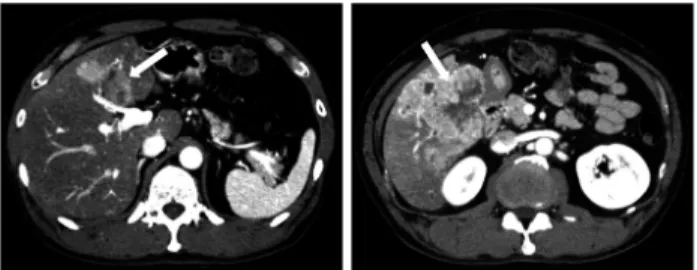
A 56-year-old man was referred to our hospital due to right upper quadrant abdominal pain. The patient had a history of chronic hepatitis B and heavy alcohol drinking. Abdominal computed tomography (CT) showed multiple disseminated tu- mors in the entire liver, which were invading the portal vein and were unresectable (Fig. 1). A liver biopsy for the masses in the liver revealed HCC. Transarterial chemoembolization (TACE) was performed immediately. Sorafenib was also start- ed at a dosage of 400 mg b.i.d. As the size and numbers of
Soo Yeon Jo et al.
156 YUJM VOLUME 33, NUMBER 2, DECEMBER 2016
Fig. 1. Abdominal computed tomography shows multiple hepato- cellular carcinomas in the entire liver with extensive involvement of segment 5.
Fig. 3. Cortisol level increased after stop taking sorafenib.
Fig. 2. Sella computed tomo- graphy shows intact hypothala- mic-pituitary gland structure.
HCC increased on follow up abdominal CT and background liver function was not poor, we did TACE 3 times over 2 months. Two months after administration of sorafenib, the patient complained of severe fatigue and general weakness.
He was not able to walk by himself or perform daily activity.
He had no history of diarrhea, vomiting, or fever, and his oral intake was not poor. He was admitted to the hospital for further evaluation and treatment. His blood pressure was 103/
74 mmHg, pulse rate was 125 beats/min, and temperature was 37.0℃. The laboratory results showed hemoglobin 11.9 g/dL, white blood cell 5,240/μL, platelet 474,000/μL, sodium 134 mmol/L, potassium of 4.6 mmol/L, glucose 128 mg/dL, aspar-
tate aminotransferase 75 IU/L, alanine aminotransferase 31 IU/L, total bilirubin 0.5 mg/dL, albumin 3.0 g/dL, prothrombin time 14.2 sec (79%), cortisol <0.2 μg/dL (range, 6.2-19.4 μg/
dL), adrenocorticotropic hormone (ACTH) <1.00 pg/mL (range, 7.2-63.3 pg/mL), thyroid stimulating hormone (TSH) 4.0139 μIU/mL (range, 0.35-4.94 μIU/mL), and T4 6.38 μg/dL (range, 4.87-11.72 μg/dL). There was no recent medication history of steroids or herbal medication. A sella CT performed for evalu- ation of anatomical abnormalities of hypothalamic-pituitary gland showed intact structure (Fig. 2). Secondary adrenal in- sufficiency was diagnosed and sorafenib medication was stop- ped immediately, while prednisolone 10 mg per day was star- ted. Fatigue symptoms remarkably improved and the level of cortisol and ACTH increased. Twenty days after stopping sora- fenib, the laboratory results showed cortisol 0.85 μg/dL and ACTH 1.46 pg/mL, and 40 days after, the level of cortisol showed 11.18 μg/dL and ACTH 25.61 pg/mL (Fig. 3). He was able to walk by himself and to perform daily activity soo- ner.
He continued to stop taking sorafenib and was discharged with medication of 10 mg per day of prednisolone.
Two months after stop taking sorafenib, the follow up lab- oratory results was checked at cortisol 13.67 μg/dL, ACTH
<1.00 pg/mL, TSH 2.4547 μIU/mL, and free T4 0.96 ng/dL (range, 0.70-1.48 ng/dL). Therefore sorafenib was restarted at a dosage of 400 mg q.d. and prednisolone was tapered to a dosage of 5 mg q.d.. One month after readministration of sorafenib, the patient came to hospital with general weak- ness again. At that time, the laboratory results showed cortisol 0.64 μg/dL, ACTH <1.00 pg/mL, TSH 2.1896 μIU/mL, and free T4 0.78 ng/dL. After taking sorafenib was stopped again, general weakness was improved dramatically and the cortisol level was elevated to 31.43 μg/dL (Fig. 3).
DISCUSSION
Over 650,000 people die from HCC each year worldwide;
at least two-thirds of deaths occur in East Asia [4]. TACE is a treatment modality for patients with unresectable HCC [5,6]. Sorafenib can target TACE-induced angiogenic factor and potentially enhance its efficacy, and significantly improved efficacy has been reported for the combination therapy of sorafenib and TACE in advanced HCC [7].
Sorafenib, a multi-tyrosine kinase inhibitor that targets vas- cular endothelial growth factor receptor, platelet-derived
Adrenal insufficiency caused by sorafenib
YUJM VOLUME 33, NUMBER 2, DECEMBER 2016 157
growth factor receptor, Raf kinase, c-kit, and RET, can block angiogenesis and tumor growth [1,7,8]. It is the first approved molecularly targeted agent for HCC and it is the only systemic treatment which has a statistically significant effect on pro- longing overall survival in patients with unresectable or advan- ced HCC in large phase III randomized, placebo-controlled trials.
In 2008, Llovet et al. conducted trials at 121 centers in 21 countries in Europe, North America, South Ame- rica, and Australasia. In this trial, patients with advanced HCC who received sorafenib treatment had nearly 3 months longer me- dian survival and the time to radiologic progression as com- pared with those who received placebo. In 2009, Cheng et al. also assessed the efficacy and safety of sorafenib in Asia- Pacific patients with advanced HCC. The patients who were randomised to treatment with sorafenib had significantly lon- ger overall survival, prolonged time to progression and impro- ved disease control rate than those who received placebo [8-10].
Frequently reported adverse events of sorafenib include hand- foot skin reaction, diarrhea, rash, fatigue, nausea, anorexia, hypertension, weight loss, alopecia, etc. [2]. Regarding endo- crine side effects, thyroid disorders have also been reported [3]. In addition, Okushin K et al. reported a case of a 77-year- old man who showed severe hypoglycemia and hyperkalemia during treatment with sorafenib for advanced HCC. It sug- gested that there might be two causes of hypoglycemia, adrenal insufficiency due to sorafenib and activation of the insulin-like growth factor (IGF) signal by excessive secretion of incom- pletely processed precursors of IGF-II. If it were sorafenib-in- duced adrenal insufficiency, it would be primary adrenal in- sufficiency because hyperkalemia was observed on initial lab- oratory results in that case, while our case was secondary adrenal insufficiency caused by sorafenib [11].
In the current case, a 56-year-old man diagnosed as HCC who started sorafenib developed severe fatigue, the level of cortisol and ACTH was severely suppressed at that time. The sella CT showed no abnormality and abdominal CT also showed intact adrenal gland. After discontinuing sorafenib and starting administration of steroids, fatigue symptoms and the levels of cortisol were recovered.
When fatigue occurred, the patient had been taking oxy- codone, which is known to be a cause of secondary adrenal insufficiency. However, adrenal insufficiency due to oxyco- done administration is known to occur several years after
its treatment, therefore the possibility of oxycodone as the cause of adrenal insufficiency is low. Oxycodone medication was stopped when severe fatigue occurred and twenty days later mypol, the drug of combination of codeine, ibuprofen, and acetaminophen was prescripted instead of oxycodone for pain control continuously.
The patient also had been taking viread 300 mg q.d., UDCA and legalon. However, these medications were constantly giv- en to the patient regardless of the cortisol level and fatigue symptom, while the change of symptoms and the cortisol level correlated to taking sorafenib.
TACE was done 3 times for 2 months before and 4 times for 4 months after diagnosis of adrenal insufficiency. Consi- dering of time relation, TACE and adrenal insufficiency does not correlate together which means TACE does not cause adrenal insufficiency. Furthermore, we could not find any case report of TACE-induced adrenal insufficiency.
To the best of our knowledge, this is the first report of secondary adrenal insufficiency developed during sorafenib treatment in a patient with HCC. This case suggests that sor- afenib could induce secondary adrenal insufficiency, there- fore, adverse effects of adrenal insufficiency should be consi- dered in patients taking sorafenib who complain of severe fatigue or general weakness.
REFERENCES
1. Abdel-Rahman O. Systemic therapy for hepatocellular car- cinoma (HCC): from bench to bedside. J Egypt Natl Canc Inst 2013;25:165-71.
2. Keating GM, Santoro A. Sorafenib: a review of its use in advanced hepatocellular carcinoma. Drugs 2009;69:223-40.
3. Feldt S, Schüssel K, Quinzler R, Franzmann A, Czeche S, Ludwig WD, et al. Incidence of thyroid hormone therapy in patients treated with sunitinib or sorafenib: a cohort study.
Eur J Cancer 2012;48:974-81.
4. Asia-Pacific Working Party on Prevention of Hepatocellular Carcinoma. Prevention of hepatocellular carcinoma in the Asia-Pacific region: consensus statements. J Gastroenterol He- patol 2010;25:657-63.
5. Bruix J, Sala M, Llovet JM. Chemoembolization for hepato- cellular carcinoma. Gastroenterology 2004;127(5 Suppl 1):
S179-88.
6. Kim H, Kim YH, Yoon HJ, Lee KH, Joo SM, Byun MK, et al. Lipiodol-induced pneumonitis following transarterial chemoembolization for ruptured hepatocellular carcinoma.
Yeungnam Univ J Med 2014;31:117-21. Korean.
7. Zhang L, Hu P, Chen X, Bie P. Transarterial chemoemboliza- tion (TACE) plus sorafenib versus TACE for intermediate or
Soo Yeon Jo et al.
158 YUJM VOLUME 33, NUMBER 2, DECEMBER 2016
advanced stage hepatocellular carcinoma: a meta-analysis.
PLoS One 2014;9:e100305.
8. Llovet JM, Ricci S, Mazzaferro V, Hilgard P, Gane E, Blanc JF, et al. Sorafenib in advanced hepatocellular carcinoma. N Engl J Med 2008;359:378-90.
9. Cheng AL, Kang YK, Chen Z, Tsao CJ, Qin S, Kim JS, et al.
Efficacy and safety of sorafenib in patients in the Asia-Pacific region with advanced hepatocellular carcinoma: a phase III randomised, double-blind, placebo-controlled trial. Lancet Oncol 2009;10:25-34.
10. Abdel-Rahman O, Fouad M. Sorafenib-based combination as a first line treatment for advanced hepatocellular carcinoma:
a systematic review of the literature. Crit Rev Oncol Hematol 2014;91:1-8.
11. Okushin K, Asaoka Y, Fukuda I, Fujiwara N, Minami T, Sato M, et al. IGF-II producing hepatocellular carcinoma treated with sorafenib: metabolic complications and a foresight to molecular targeting therapy to the IGF signal. Case Rep Gas- troenterol 2012;6:784-9.