86
Research Article Weed & Turfgrass Science
Weed & Turfgrass Science was renamed from both formerly Korean Journal of Weed Science from Volume 32(3), 2012, and formerly Korean Journal of Turfgrass Science from Volume 25(1), 2011 and Asian Journal of Turfgrass Science from Volume 26(2), 2012 which were launched by The Korean Society of Weed Science and The Turfgrass Society of Korea found in 1981 and 1987, respectively.
경기 남부지역 논잡초 발생분포 및 군락변화
박중수*·원태진·노안성·장재은·김희동 경기도농업기술원
Weed Population Distribution and Change of Dominant Weed Species in Paddy Field of Southern Gyeonggi Region
Jungsoo Park*, Taejin Won, Ahnsung Roh, Jaeeun Jang, and Heedong Kim Gyeonggi Agricultural Research & Extension Services, Hwaseong, 445-784, Korea
서 론
우리나라 농경지에 발생하는 잡초는 총 68과 433종으로 이 중 논에 발생하는 논잡초는 22과 77종으로 보고되었다 (Lee et al., 2007). 경기지역의 논잡초 분포는 1981년에는 화본과 2종, 사초과 5종, 광엽 및 기타 초종 13종 등 총 20종이었던 것이 1991년에는 화본과 4종, 사초과 7종, 광 엽 및 기타 14종 등 총 25종이 발생하였다. 2000년에는 화본과 4종, 사초과 6종, 광엽 및 기타 12종 등 총 22종, 2005년에는 화본과 3종, 사초과 4종, 광엽 및 기타 10종 등 총 17종이 발생하여 조사년도별로 잡초군락이 변화되 고 있다(Kim et al., 1992, 1997; Park et al., 2001, 2007).
또한 주요 우점 초종은 1981년에는 물달개비, 올미와 같 은 잡초(Oh et al., 1981)가 1995년 이후에는 올방개, 벗풀 등 다년생잡초의 우점화 현상이 매우 두드러졌다(Park et al., 1995; Kim et al., 1997). 이는 제초제 보급이 본격화 된 1980년대 이후에는 뷰타클로르 등 주로 일년생잡초 방 제약제 위주로 개발 보급되어 피 등과 같은 일년생잡초 발생이 급격히 줄었으나, 다년생잡초의 발생밀도는 오히 려 증가되는 결과를 보였다. 또한 설포닐우레아(SU)계 등 다년생잡초 방제 약제가 본격적으로 출하된 2000년 이후 에는 다년생인 올방개를 제외한 물달개비, 가막사리, 여뀌 바늘 등 일년생 광엽잡초의 발생이 증가되는 쪽으로 군락이 변화되고 있었다(Park et al., 2001, 2007). Lee et al.(2013)이 ABSTRACT. Survey was carried out in paddy fields to investigate the dominance of weed species and weed occurrence on 200 fields of southern Gyeonggi region in Korea during the year 2013. We observed 3 species of grass, 5 species of sedge, and 11 species of broadleaf and other weeds. The most dominant weed species was Eleocharis kuroguwai, followed by Echinochloa crus-galli, Sagittaria trifolia, Monochoria vaginalis, Scirpus juncoides and Bidens tripartita. The dominance value of E.
kuroguwai and B. tripartita decreased compared to the survey results performed in 2005 but that of M. vaginalis, S. juncoides, S.
trifolia and E. crus-galli increased. Weed occurrence increased from 2.83 g in 2005 to 3.51 g in 2013 based on weed dry weight per m2. Occurrence ratio of annual weeds to perennial weeds changed from 45.2% : 54.8% in 2005 to 45.8% : 54.2% in 2013. If we analyze dominance of weed species based on the rice transplanting timing, E. kuroguwai and E. crus-galli were the most dominant weed species at mid-May transplanting, and M. vaginalis and S. juncoides were the most dominant weed species at late- May transplanting, and M. vaginalis and E. kuroguwai were the most dominant weed species at early-June transplanting. Since paddy weeds resistant to sulfonylurea herbicides are expected to be continuously increased, the regular monitoring of their occurrence and efficient control methods should be considered in future.
Key words: Dominant weeds, Gyeonggi southern region, Paddy field, Weed species Received on March 13, 2014; Revised on June 9, 2014; Accepted on June 12, 2014
*Corresponding author: Phone) +82-31-229-5821, Fax) +82-31-229-5964; E-mail) [email protected]
© 2014 The Korean Society of Weed Science and The Turfgrass Society of Korea
This is an Open-Access article distributed under the terms of the Creative Commons Attribution Non-Commercial License & #160;
(http://creativecommons.org/licenses/by-nc/3.0) which permits unrestricted noncommercial use, distribution, & #160; and reproduc- tion in any medium, provided the original work is properly cited.
2011년과 2012년에 전국 3,200지점에서 SU계 제초제 저 항성잡초의 발생면적을 추산한 결과, 전국 벼 재배면적의 22.1%인 176,870 ha에서 발생이 확인되었고, 발생면적이 가장 넓은 초종은 전체의 32.2%(57,018 ha)를 차지한 물달 개비이었으며, 그 다음으로 올챙이고랭이, 밭뚝외풀 순이 었다. 이와 같이 논잡초 군락은 계속 변화되고 있으므로 효과적이고 경제적인 잡초방제법을 연구하고 문제잡초에 대한 적정 방제기술을 개발하기 위해서는 주기적으로 잡 초의 군락을 조사, 분석하는 것이 매우 중요하다.
따라서, 문제잡초의 지속적인 모니터링, 논잡초 방제 및 효율적인 잡초방제 기술 확립을 위한 기초자료로 활용코 자 경기 남부지역을 대상으로 논잡초 군락 변화를 조사하였다.
재료 및 방법
논잡초 분포 조사 및 분석
본 연구는 2013년 6월부터 7월까지 2개월간에 걸쳐 경 기도 남부지역 11개 시군의 벼 재배면적 64.9천ha를 대상 으로 약 325 ha당 1점씩으로 하여 각 시군별 재배면적 비 율에 따라 2005년에 조사가 이루어진 지역을 중심으로 논 200개 필지를 선정하여 논잡초 분포를 조사하였다. 논잡 초 조사는 이앙후 45~50일 정도인 논을 대상으로 잡초분 포 정도가 비교적 균일한 지점에서 1 m×1 m 격자를 이용 하여 잡초를 채취하였으며 이를 대상으로 초종별로 분류 후 본수와 건물중을 조사하였다. 논 재배유형은 보통답, 사질답, 습답, 염해답으로 구분하였으며, 농업지대는 경기 지역을 농업권역별로 남부평야지대(평택, 수원, 화성), 동 부내륙지대(광주, 여주, 이천, 안성, 용인, 양평), 서부해안 지대(시흥, 안산)로 구분하였다. 이앙시기는 5월 10일~20
일, 5월 21일~31일, 6월 1일~10일의 3시기, 경운방법은 춘 경, 추경 및 무경운으로 나누어 조사하였다. 주요 논잡초 의 분포변화는 1991년, 1995년, 2000년 그리고 2005년에 실시한 경기지역 논잡초 조사결과를 토대로 년도 및 초종 별 논잡초 발생량, 도내 농업 권역별 초종의 우점도 및 군 락변화, 제초제 처리실태 등을 비교 분석하였다.
설문조사 방법 및 내용
논잡초 분포조사를 위하여 시료를 채취한 필지를 실제로 경작하고 있는 벼 재배 200농가를 대상으로 이앙시기, 경 운방법, 농가 입장에서 방제가 어려워하는 문제잡초, 사용 제초제, 제초제 체계처리 횟수 및 처리시기 등 제초제 사 용실태를 설문조사하였다.
결과 및 고찰
논잡초 종류별 분포 및 우점도 변화
형태적 특성으로 본 논잡초 분포는 화본과 3종, 사초과 5 종, 광엽 및 기타 11종 등 총 19종으로 나타났다(Table 1).
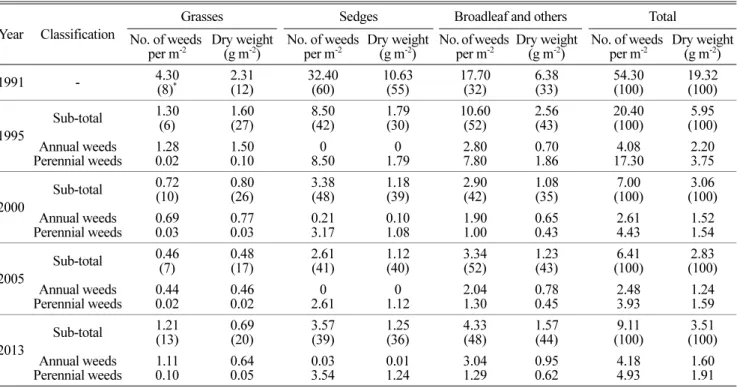
이는 1991년의 25종보다는 6종, 1995년과 2000년의 22종보 다는 3종 적었으나 2005년의 17종보다는 2종 많았다. 발생 잡초의 과별 본수 및 건물중은 Table 2에서와 같이 광엽 및 기타 > 사초과 > 화본과 순으로 발생량이 많아 1995년, 2005년과 같은 경향이었으나, 1991년과 2000년의 사초 > 광 엽 및 기타 > 화본과 순이었던 결과와 비교하면 사초과 잡 초의 발생이 적었다.
조사년도별 우점초종의 분포를 Table 3에서 보면, 논잡 초 우점도는 올방개 > 피 > 벗풀 > 물달개비 > 올챙이고랭 이 > 가막사리 순으로 나타나 1991년, 1995년, 2000년, 2005 Table 1. Weed species distribution observed in paddy fields of Gyeonggi region from 1991 to 2013.
Year Classification Grasses Sedges Broadleaf and others Total
1991 - 4(16)* 7(28) 14(56) 25(100)
1995
Sub-total 3(14) 5(23) 14(63) 22(100)
Annual weeds Perennial weeds
2 1
1 4
10 4
13 9
2000
Sub-total 4(18) 6(27) 12(55) 22(100)
Annual weeds Perennial weeds
3 1
2 4
10 2
15 7
2005
Sub-total 3(18) 4(23) 10(59) 17(100)
Annual weeds Perennial weeds
2 1
0 4
8 2
10 7
2013
Sub-total 3(15) 5(25) 11(60) 19(100)
Annual weeds Perennial weeds
2 1
1 4
8 3
11 8
*Ratio of distribution.
년과 마찬가지로 다년생잡초인 올방개, 벗풀과 일년생잡 초인 피의 우점화 현상이 뚜렷하였다. 초종별로 살펴보면 2005년에 비해 올방개는 30%에서 21%로, 가막사리는 10%
에서 6%로 우점도가 감소하였으나, 물달개비는 8%에서 15%로, 올챙이고랭이는 2%에서 9%로, 벗풀은 14%에서 16%로, 피는 16%에서 18%로 우점도가 증가하였다. 특히, Park et al.(2011)의 보고에서와 같이 SU계 제초제 저항성으 로 알려진 물달개비와 올챙이고랭이의 우점도는 크게 증 가한 것으로 나타났다.
년도별 m-2 당 논잡초 발생량은 Table 4에서와 같이 2013 년 3.51 g으로 1991년 19.32 g, 1995년 5.95 g, 2000년 3.06 g, 2005년 2.83 g으로 감소하는 경향이었으나 2013년에는 2005 년 이후 처음으로 증가되고 있는 것으로 나타났다. 또한, 생활사별 논잡초 분포는 일년생과 다년생잡초 비율이 각
각 45.8%, 54.2%로 나타나 2005년의 45.2%, 54.8%와 큰 차이가 없는 것으로 나타났다. Won et al.(2013)은 경기도 Table 2. Number of weeds and dry weight in the paddy fields of Gyeonggi region by the types of weed species.
Year Classification
Grasses Sedges Broadleaf and others Total
No. of weeds per m-2
Dry weight (g m-2)
No. of weeds per m-2
Dry weight (g m-2)
No. of weeds per m-2
Dry weight (g m-2)
No. of weeds per m-2
Dry weight (g m-2)
1991 - 4.30
(8)*
2.31 (12)
32.40 (60)
10.63 (55)
17.70 (32)
6.38 (33)
54.30 (100)
19.32 (100)
1995
Sub-total 1.30 (6)
1.60 (27)
8.50 (42)
1.79 (30)
10.60 (52)
2.56 (43)
20.40 (100)
5.95 (100) Annual weeds
Perennial weeds
1.28 0.02
1.50 0.10
0 8.50
0 1.79
2.80 7.80
0.70 1.86
4.08 17.30
2.20 3.75
2000
Sub-total 0.72 (10)
0.80 (26)
3.38 (48)
1.18 (39)
2.90 (42)
1.08 (35)
7.00 (100)
3.06 (100) Annual weeds
Perennial weeds
0.69 0.03
0.77 0.03
0.21 3.17
0.10 1.08
1.90 1.00
0.65 0.43
2.61 4.43
1.52 1.54
2005
Sub-total 0.46 (7)
0.48 (17)
2.61 (41)
1.12 (40)
3.34 (52)
1.23 (43)
6.41 (100)
2.83 (100) Annual weeds
Perennial weeds
0.44 0.02
0.46 0.02
0 2.61
0 1.12
2.04 1.30
0.78 0.45
2.48 3.93
1.24 1.59
2013
Sub-total 1.21 (13)
0.69 (20)
3.57 (39)
1.25 (36)
4.33 (48)
1.57 (44)
9.11 (100)
3.51 (100) Annual weeds
Perennial weeds
1.11 0.10
0.64 0.05
0.03 3.54
0.01 1.24
3.04 1.29
0.95 0.62
4.18 4.93
1.60 1.91
*Ratio of distribution.
Table 3. Changes of dominant weed speciesin the paddy fields of Gyeonggi region by the year.
Year Dominant weed species
1st 2nd 3rd 4th 5th Others
1991 1995 2000 2005 2013
Ekx (39)y St(31) Ek(30) Ek(30) Ek(21)
St(19) Ek(26) Ec(25) Ec(16) Ec(18)
Ec(11) Ec(24) St(14) St(14) St(16)
Cs(10) Bt(4) Mov(7)
Bt(10) Mov(15)
Mov(5) Mov(3) Bt(5) Mov(8)
Sj(9)
Sj and Ot(16) Spl, Aa and Ot(12) Spl(4), Ai and Ot(15) Spl(6), Ai and Ot(16) Bt(6), Spl, Ai and Ot(15)
x Ek: Eleocharis kuroguwai; Aa: Alopecurus aequalis; Ai: Aeschynomene indica; Bt: Bidens tripartite; Cs: Cyperus serotinus; Ec: Echinochioa crus-galli; Mov: Monochoria vaginalis; Sj: Scirpus juncoides; Spl: Scirpus planiculmis; St: Sagittaria trifolia; Ot: Others
yRatio of distribution.
Table 4. Weed occurrence of annual and perennial weeds on the basis of dry weight in the paddy fields of Gyeonggi region by the year.
Classification Year
Annual weeds (g m-2)
Perennial weeds (g m-2)
Total Dry weight
(g m-2) Index 1991
1995 2000 2005 2013
4.77(24.7)*
2.26(38.0) 1.52(49.7) 1.28(45.2) 1.60(45.8)
14.55(75.3) 3.69(62.0) 1.54(50.3) 1.55(54.8) 1.91(54.2)
19.32(100) 5.95(100) 3.06(100) 2.83(100) 3.51(100)
100 31 16 15 18
*Ratio of distribution.
내 벼 재배면적 2,000 ha이상인 6개 시군을 대상으로 논 토양을 채취하여 SU계 제초제 저항성잡초에 대한 포트검 정 결과 물달개비와 올챙이고랭이를 저항성잡초로 추정하 였다. 따라서, 우점도가 지속적으로 높은 난방제 다년생잡 초인 올방개, 벗풀은 물론 SU계 제초제 저항성잡초인 물 달개비, 올챙이고랭이의 효과적 방제를 위해서는 적정 제 초제의 선택, 제초제 2회 체계처리, 적정 사용시기 준수, 추경 등과 같이 종합적인 방제법을 적용한 포장관리가 선 행되어야 할 것으로 생각되었다.
유형별 논잡초 발생분포
논유형별 논잡초 발생분포를 Table 5에서 보면, 보통답 에서는 올방개, 피, 벗풀, 물달개비, 사질답에서는 올방개, 피, 벗풀의 우점도가 높았으나, 습답에서는 올방개, 올챙이 고랭이, 벗풀, 물달개비, 염해답에서는 새섬매자기, 피, 올 방개, 물달개비 등이 우점잡초로 나타나 논유형별로 발생 분포의 차이가 있었다. 또한, 일년생잡초 중 우점순위가 지속적으로 높은 초종은 습답에서 2005년과 2013년의 물 달개비를 제외하면 1991년 조사 이후 피가 가장 최우점 잡초였으며, 그 다음으로는 물달개비, 가막사리가 새로운 우점초종인 것으로 나타났다. 다년생잡초는 염해답에서 새 섬매자기가 최우점하였으나, 기타 논유형에서는 모두 올 방개, 벗풀, 올챙이고랭이가 우점되고 있는 것으로 나타났 다. Lee et al.(2012)은 우리나라에 발생하는 SU계 제초제
저항성 논잡초 초종별 발생면적 순위는 물달개비 > 올챙 이고랭이 > 알방동사니 순으로 발생이 많으며 이들 잡초 는 전국적으로 발생하는 제일 문제잡초라고 하였다. 경기 남부지역에서도 SU계 제초제 저항성잡초로 알려진 올챙 이고랭이는 최근 물달개비와 더불어 우점도 증가가 큰 잡 초이므로 금후 유의 깊게 발생추이에 대한 관찰이 필요한 것으로 생각되었다.
이앙기 및 경운방법별 논잡초 발생분포
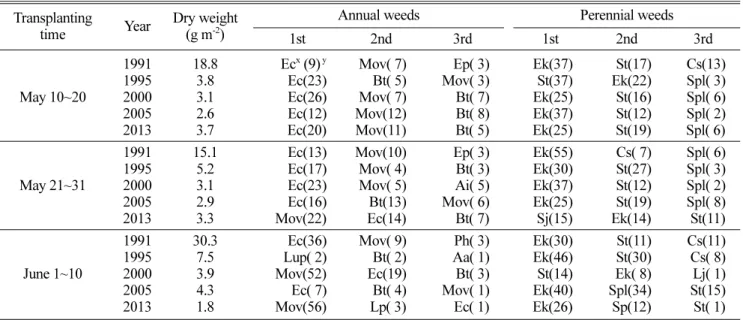
이앙기에 따른 주요 논잡초 발생분포는 Table 6에서와 같이 5월 10일~20일 이앙은 올방개, 피, 벗풀, 5월 21일
~31일 이앙은 물달개비, 올챙이고랭이, 올방개, 만식재배 인 6월 1일~10일 이앙에서는 물달개비, 올방개, 올미 등 의 발생이 많았다. 특히, 일년생잡초 중 물달개비의 발생 량은 5월 10일~20일 이앙과 6월 1일~10일 이앙에서 가장 많았다. 이는 써레질 이후 제초제 처리적기를 놓치거나, SU계 제초제 저항성 잡초에 약효가 적은 제초제의 선택, 제초제 처리전·후의 물관리 부실 그리고 이앙이 늦을수 록 기온이 높아 물달개비 발생과 발생잡초의 생육속도가 빨라지는 현상 등이 그 원인으로 추정되었다. 또한 다년 생잡초 중에서는 5월 10일~20일과 6월 1일~10일 이앙에 서는 올방개가 최우점 잡초였으나, 5월 21일~30일 이앙에 서는 올챙이고랭이의 우점도가 가장 높게 나타나 금후 이 에 대한 원인 구명과 아울러 효과적인 방제기술 개발이 Table 5. Changes of dominant weed species associated with different soil types in the paddy fields of Gyeonggi region.
Soil type Year Dry weight (g m-2)
Annual weeds Perennial weeds
1st 2nd 3rd 1st 2nd 3rd
Normal soil
1991 1995 2000 2005 2013
18.7 6.1 2.8 2.5 3.5
Ecx (10) y Ec(21) Ec(27) Ec(15) Ec(18)
Mov( 6) Bt( 4) Mov( 9) Mov( 8) Mov(17)
Bt ( 5) Mov( 3) Bt( 4) Bt( 7) Bt( 4)
Ek(41) St(28) Ek(35) Ek(38) Ek(22)
St(19) Ek(27) St(12) St(12) St(18)
Cs( 9) Cs( 1) Spl( 1) Cs( 1) Sj( 8)
Poorly drained soil
1991 1995 2000 2005 2013
21.8 4.6 4.0 4.5 3.7
Ec(13) Ec(11) Ec(12) Mov(11) Mov(14)
Mov( 4) Ph( 3) Mov(11) Bt( 6) Ec(12)
Cd( 3) Bt( 3) Bt( 7) Ec( 4) Bt(10)
Ek(39) St(48) Ek(39) Ek(39) Ek(17)
St(20) Ek(20) St(16) St(35) Sj(16)
Cs(11) Lj( 3) Cs( 1) Cs( 1) St(15)
Saline soil
1991 1995 2000 2005 2013
20.2 3.5 3.2 5.1 3.0
Ec( 4) Ec( 7) Ec(23) Ec(16) Ec(14)
Lp( 1) Bt( 1) Bt(11) Bt( 4) Mov(10)
- -
Lup( 1) Ai( 3) Bt( 7)
Sf(86) Spl(50) Spl(46) Spl(52) Spl(56)
Cs( 5) St(26) Cs(11) Ek(14) Ek(11)
Myv(2) Ek(16) Ek( 8) St( 4) Sj( 2) Sandy soil
2000 2005 2013
3.0 2.2 3.4
Ec(28) Ec(24) Ec(21)
Sj( 6) Bt(16) Bt(10)
Mov( 5) Mov(10) Ai(10)
Ek(26) Ek(24) Ek(24)
St(16) St( 7) St(12)
Lj( 1) Lj( 1) Sj(10)
xEc: Echinochioa crus-galli; Ai: Aeschynomene indica; Bt: Bidens tripartita; Cd: Cyperus difformis; Cs: Cyperus serotinus; Ek: Eleocharis kuroguwai; Lj: Leersia japonica; Lp: Lindernia procumbens; Lup: Ludwigia prostrate; Mov: Monochoria vaginalis; Myv: Myriophyllum verticillatum; Ph: Polygonum hydropiper; Sj: Scirpus juncoides; Sf: Scirpus fluviatilis; Spl: Scirpus planiculmis; St: Sagittaria trifolia
yRatio of distribution.
필요한 것으로 생각되었다.
경운방법별 잡초 발생분포는 Table 7에서와 같이 추경 에서 올방개> 피> 벗풀> 새섬매자기, 춘경에서는 올방개
> 벗풀> 피> 물달개비 순으로 우점도가 높은 것으로 나 타났으며, 무경운에서는 물달개비> 올챙이고랭이> 피 순 으로 우점도가 높았다. 일년생잡초는 2005년도에 비해 추 경과 춘경 모두 피> 물달개비> 벗풀 순으로 우점도가 높
아 차이가 없었으나, 무경운에서는 물달개비> 피> 벗풀이 우점잡초로 나타나 2005년의 피> 벗풀> 자귀풀에 비해 SU계 제초제 저항성잡초인 물달개비의 우점도가 급증함 을 알 수 있었다. 다년생잡초는 추경은 올방개> 벗풀> 새 섬매자기, 춘경은 올방개> 벗풀> 올챙이고랭이 순으로 우 점도가 높아 2005년도에 비해 올방개와 벗풀은 큰 차이 없었으나 SU계 제초제 저항성잡초로 알려진 새섬매자기 Table 6. Dominant weed species distribution in different transplanting timing in the paddy fields of Gyeonggi region.
Transplanting
time Year Dry weight (g m-2)
Annual weeds Perennial weeds
1st 2nd 3rd 1st 2nd 3rd
May 10~20
1991 1995 2000 2005 2013
18.8 3.8 3.1 2.6 3.7
Ecx (9) y Ec(23) Ec(26) Ec(12) Ec(20)
Mov( 7) Bt( 5) Mov( 7) Mov(12) Mov(11)
Ep( 3) Mov( 3) Bt( 7) Bt( 8) Bt( 5)
Ek(37) St(37) Ek(25) Ek(37) Ek(25)
St(17) Ek(22) St(16) St(12) St(19)
Cs(13) Spl( 3) Spl( 6) Spl( 2) Spl( 6)
May 21~31
1991 1995 2000 2005 2013
15.1 5.2 3.1 2.9 3.3
Ec(13) Ec(17) Ec(23) Ec(16) Mov(22)
Mov(10) Mov( 4) Mov( 5) Bt(13) Ec(14)
Ep( 3) Bt( 3) Ai( 5) Mov( 6) Bt( 7)
Ek(55) Ek(30) Ek(37) Ek(25) Sj(15)
Cs( 7) St(27) St(12) St(19) Ek(14)
Spl( 6) Spl( 3) Spl( 2) Spl( 8) St(11)
June 1~10
1991 1995 2000 2005 2013
30.3 7.5 3.9 4.3 1.8
Ec(36) Lup( 2) Mov(52) Ec( 7) Mov(56)
Mov( 9) Bt( 2) Ec(19) Bt( 4) Lp( 3)
Ph( 3) Aa( 1) Bt( 3) Mov( 1) Ec( 1)
Ek(30) Ek(46) St(14) Ek(40) Ek(26)
St(11) St(30) Ek( 8) Spl(34) Sp(12)
Cs(11) Cs( 8) Lj( 1) St(15) St( 1)
xEc: Echinochioa crus-galli; Aa: Alopecurus aequalis; Ai: Aeschynomene indica; Bt: Bidens tripartita; Cs: Cyperus serotinus; Ek: Eleocharis kuroguwai; Ep: Eclipta prostrate; Lj: Leersia japonica; Lp: Lindernia procumbens; Lup: Ludwigia prostrate; Mov: Monochoria vaginalis; Ph:
Polygonum hydropiper; Sj: Scirpus juncoides; Sp: Sagittaria pygmaea; Spl: Scirpus planiculmis; St: Sagittaria trifolia
yRatio of distribution.
Table 7. Dominant weed species distribution in different plowing time in the paddy field of Gyeonggi region.
Plowing
time Year Dry weight (g m-2)
Annual weeds Perennial weeds
1st 2nd 3rd 1st 2nd 3rd
Autumn plowing
1991 1995 2000 2005 2013
97.1 7.9 2.8 2.6 3.4
Ecx (4) y Ec(12) Ec(21) Ec(16) Ec(18)
Mov( 2) Mov( 2) Lup( 2) Bt(11) Mov( 8)
Ak( 1) Bt( 1) Bt( 2) Mov( 9) Bt( 4)
Ek(86) St(61) Ek(54) Ek(24) Ek(23)
Cs( 4) Ek(20) St(17) St(10) St(14)
St( 2) Sf( 3) Sp( 1) Sp( 6) Spl(13)
Spring plow- ing
1991 1995 2000 2005 2013
18.9 5.7 2.9 2.7 3.4
Ai(17) Ec(18) Ec(26) Ec(16) Ec(17)
Ec(12) Bt( 4) Mov( 7) Mov(10) Mov(14)
Mov( 6) Mov( 3) Bt( 5) Bt( 7) Bt( 6)
Ek(41) St(29) Ek(28) Ek(37) Ek(23)
Cs( 8) Ek(26) St(13) St(18) St(19)
Pd( 3) Spl( 1) Spl( 3) Spl( 3) Sj( 8) No plowing
2000 2005 2013
3.9 3.8 4.7
Ec(21) Ec(21) Mov(36)
Mov(12) Bt( 7) Ec(21)
Bt( 6) Ai( 5) Bt( 9)
Ek(27) Spl(38) Sj(23)
St(14) Ek(10) Ek( 1)
Spl(10) St( 9) Sp( 1)
xEc: Echinochioa crus-galli; Ai: Aeschynomene indica; Ak: Aneilema keisak; Bt: Bidens tripartita; Cs: Cyperus serotinus; Ek: Eleocharis kuroguwai; Lup: Ludwigia prostrate; Mov: Monochoria vaginalis; Pd: Potamogeton distinctus; Sj: Scirpus juncoides; Sf: Scirpus fluviatilis;
Sp: Sagittaria pygmaea; Spl: Scirpus planiculmis; St: Sagittaria trifolia
yRatio of distribution.
와 올챙이고랭이는 우점도가 증가하는 것으로 나타났다.
또한 무경운에서는 올챙이고랭이의 우점도가 가장 높게 나타나 2005년도에 가장 우점도가 높았던 새섬매자기와는 차이가 있었다. 이와 같이 무경운 재배에서 우점도의 차 이가 컸던 것은 농가에서 농가 사정이나 강우 등에 따른 경운시기 일실로 경운을 하지 못하고 무경운 재배를 하기 때문에 조사년도별로 조사대상 농가답이 다르고, 또한 무 경운 재배시에는 올방개 등과 같은 괴경번식 잡초에 비해 종자번식 잡초인 물달개비, 피, 올챙이고랭이 등이 상대적 으로 논에서 종자 확산과 잡초의 발생속도가 빠르기 때문 으로 추정되었다.
농업지대 및 시군별 논잡초 발생분포
농업지대별 잡초 발생분포는 Table 8과 같이 남부평야 및 동부내륙지대는 올방개, 서부해안지대는 물달개비가 최 우점 잡초로 나타났다. 2005년도에 비해 남부평야, 동부내 륙지대는 올방개와 벗풀을 제외하면 피와 물달개비의 우 점도가 증가한데 비해, 서부해안지대에서는 피의 우점도 는 감소하고 물달개비, 가막사리, 올챙이고랭이의 우점도 는 크게 증가하였다.
농업지대별 잡초 우점도를 생활형으로 살펴보면, 일년 생잡초는 남부평야지대와 동부내륙지대는 피> 물달개비>
가막사리, 서부해안지대는 물달개비> 가막사리> 밭뚝외풀 순으로 우점하는 것으로 나타나 2005년에 비해 남부평야,
동부내륙지대는 피, 서부해안지대는 물달개비의 우점도가 크게 증가하였다. 한편, 다년생잡초의 우점도는 남부평야, 동부내륙지대에서는 올방개, 벗풀 등으로 2005년에 비해 큰 변화가 없었으나, 서부해안지대에서는 올챙이고랭이가 최우점 잡초로 나타났다. 따라서 이들 지역의 논잡초 방 제시 일년생잡초인 피 외에도 우점잡초에 대한 적정 제초 제 선택이 필요할 것으로 생각되었으며, 특히 경기도에서 SU계 제초제 저항성잡초로 보고(Won et al., 2013)된 물달 개비, 올챙이고랭이에 대해서는 적정 제초제 선택 및 처 리방법 등에 대한 대농민 교육의 강화가 요구되었다.
경기 남부지역 시군별 논잡초 발생분포는 Table 9와 같 다. 본 조사는 331 ha당 1점을 기준으로 잡초를 채취하여 조사하였으므로 벼 재배면적이 적은 시군(수원, 광주, 시 흥, 안산)은 인접시군을 포함하여 잡초 발생분포를 분석하 였다. 우점초종을 시군별로 살펴보면, 올방개는 화성시, 수 원시, 평택시, 안성시에서, 벗풀은 여주시, 이천시에서 우 점하였으며, 올챙이고랭이는 용인시에서, 피는 광주시, 양 평군에서, 물달개비는 시흥시, 안산시에서 가장 우점하는 잡초로 나타났다. 본 조사결과를 참고로 하여 시군별 대 농민교육시 이들 우점잡초에 대한 방제법 교육이 필요한 것으로 생각되었다.
농가의 제초제 처리실태 및 처리방법별 논잡초 발생분포 농가의 제초제 처리실태는 Table 10과 같이 제초제 처 Table 8. Dominant weed species in different agricultural regions within Gyeonggi province.
Classification Year Dry weight (g m-2)
Annual weeds Perennial weeds
1st 2nd 3rd 1st 2nd 3rd
South plain region
1991 1995 2000 2005 2013
63.3 4.7 3.8 2.8 3.4
Ecx (58) y Ec(29) Ec(16) Bt(14) Ec(22)
Mov( 2) Mov( 3) Ai( 7) Ec(11) Mov(10)
Mov( 1) Ak( 1) Bt( 7) Ai( 4) Bt( 4)
Ek(19) Ek(27) Ek(37) Ek(35) Ek(27)
St( 6) St(23) Spl(11) Spl(19) St(15)
Cs( 5) Sf( 8) St( 8) St( 5) Spl( 9)
Western coast region
1991 1995 2000 2005 2013
16.4 7.1 1.8 2.6 6.3
Mov(12) Ec(35) Ec(33) Ec(40) Mov(66)
Ec( 6) Aa( 3) Mov( 6) Mov(11) Bt(19)
Aa( 3) Bt( 2) Lup( 2) Lup( 5) Lp( 1)
Ek(38) St(28) Ek(34) Ek(23) Sj( 9)
St(19) Ek(23) St(17) St(11) Ek( 4)
Cs(11) Cs( 2) Cs( 3) Spl( 4) Sp( 1)
Eastern inland region
1991 1995 2000 2005 2013
13.4 5.6 2.1 2.9 3.5
Ec( 8) Ec(10) Ec(21) Mov(11) Ec(16)
Cd( 5) Bt( 5) Mov( 7) Ec( 9) Mov(14)
Mov( 3) Ph( 4) Ak( 5) Bt( 9) Bt( 6)
Ek(38) St(40) Ek(34) Ek(34) Ek(18)
St(34) Ek(31) St(15) St(23) St(17)
Sp( 1) Pd( 1) Cs( 1) Sp( 1) Sj(13)
xEc: Echinochioa crus-galli; Aa: Alopecurus aequalis; Ai: Aeschynomene indica; Ak: Aneilema keisak; Bt: Bidens tripartita; Cd: Cyperus difformis; Cs: Cyperus serotinus; Ek: Eleocharis kuroguwai; Lp: Lindernia procumbens; Lup: Ludwigia prostrate; Mov: Monochoria vaginalis; Pd: Potamogeton distinctus; Ph: Polygonum hydropiper; Sj: Scirpus juncoides; Sf: Scirpus fluviatilis; Sp: Sagittaria pygmaea; Spl:
Scirpus planiculmis; St: Sagittaria trifolia
yRatio of distribution.
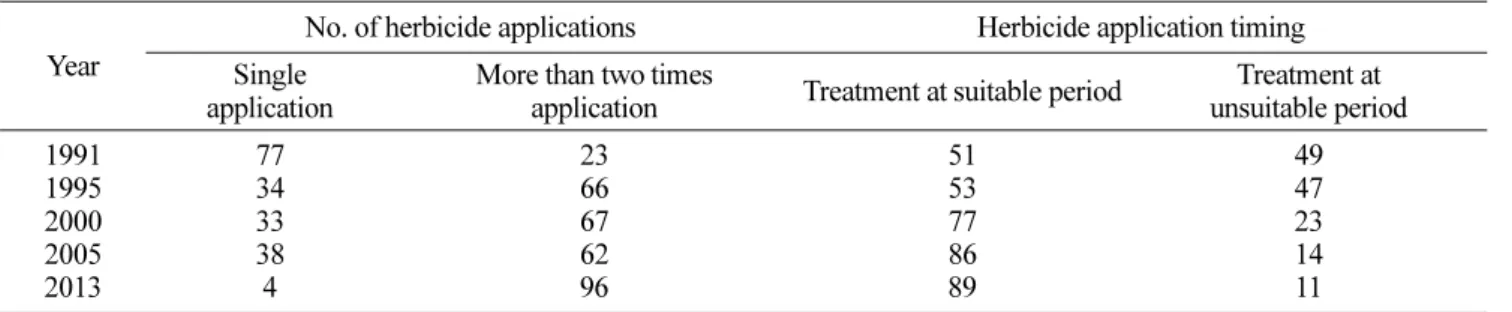
리횟수는 2005년의 2회 이상 62%에 비해 2013년에는 96%
로 크게 증가하였고, 적기처리 농가는 2005년 86%에서 2013년 89%로 소폭 증가하였다. 2005년 이후 제초제 1회 처리 농가의 비율이 크게 감소한 것은 Lee et al.(2013)의
보고에서와 같이 최근 전국적으로 문제가 되고 있는 SU 계 제초제 저항성잡초인 물달개비, 올챙이고랭이 등의 발 생으로 인해 제초제를 2회 이상 처리하는 것으로 생각된 다. SU계 제초제 저항성 논잡초를 효과적으로 방제하기 Table 9. List of dominant weed species by the agricultural district in Gyeonggi province in 2013.
Regions Dry weight (g m-2) Dominant weed species
Hwaseong, Suwon 3.34 Eleocharis kuroguwai(23), Echinochioa crus-galli(19), Scirpus planiculmis(15), Sagit- taria trifolia(13), M. vaginalis(9), Bidens tripartita(5), Others(16)
Pyeongtaek 3.42 Eleocharis kuroguwai(30), Echinochioa crus-galli(25), Sagittaria trifolia(18), Mono- choria vaginalis(12), Bidens tripartita(4), Cyperus serotinus(4), Others(7)
Yeoju 4.33 Sagittaria trifolia(30), Eleocharis kuroguwai(23), Echinochioa crus-galli(21), Scirpus juncoides(9), Bidens tripartita(5), Monochoria vaginalis(5), Others(7)
Icheon 3.15 Sagittaria trifolia(25), Eleocharis kuroguwai(20), Monochoria vaginalis(17), Echino- chioa crus-galli(17), Bidens tripartita(8), Aeschynomene indica(7), Others(6) Anseong 1.78 Eleocharis kuroguwai(30), Sagittaria trifolia(24), Monochoria vaginalis(18), Scirpus
juncoides(9), Bidens tripartita(6), Echinochioa crus-galli(5), Others(8)
Yongin 4.82 Scirpus juncoides(24), Monochoria vaginalis(18), Lindernia procumbens(13), Leersia japonica(13), Eleocharis kuroguwai(12), Sagittaria pygmaea(7), Others(13)
Gwangju,
Yangpyeong 4.44 Echinochioa crus-galli(25), Scirpus juncoides(23), Monochoria vaginalis(20), Aeschynomene indica(7), Eleocharis kuroguwai(5), Bidens tripartita(5), Others(15) Siheung, Ansan 6.33 Monochoria vaginalis(66), Bidens tripartita(19), Scirpus juncoides(8), Eleocharis
kuroguwai(3), Sagittaria pygmaea(1), Others(3)
Table 10. Percentage of farm households by the number of herbicide applications per year and application time in Gyeonggi region.
Year
No. of herbicide applications Herbicide application timing Single
application
More than two times
application Treatment at suitable period Treatment at unsuitable period 1991
1995 2000 2005 2013
77 34 33 38 4
23 66 67 62 96
51 53 77 86 89
49 47 23 14 11
*No. of survey was 330 farmers in 1991, 1995, 2000, 2005 and 200 farmers in 2013.
Table 11. Dominant weed species distribution in different herbicide application time in Gyeonggi region.
Herbicide application
timing Year Dry weight
(g m-2) Dominant weed species
Treatment at suitable period
2005x 2.80 Eleocharis kuroguwai(32)y, Sagittaria trifolia(15), Bidens tripartita(11), Echi- nochioa crus-galli(10), Scirpus planiculmis(9), Others(23)
2013x 3.38 Eleocharis kuroguwai(23), Sagittaria trifolia(18), Echinochioa crus-galli(18), Monochoria vaginalis(12), Scirpus juncoides(6), Others(23)
Treatment at unsuitable period
2005 3.35 Echinochioa crus-galli(47), Eleocharis kuroguwai(16), Sagittaria trifolia(11), Monochoria vaginalis(11), Bidens tripartita(5), Others(10)
2013 4.63 Monochoria vaginalis(33), Scirpus juncoides(24), Echinochioa crus-galli(18), Eleocharis kuroguwai(7), Bidens tripartita(7), Others(11)
xNo. of survey was 330 farmers in 2005 and 200 farmers in 2013.
yRatio of distribution.
위한 제초제 처리방법은 이앙전과 이앙후의 2회 체계처리 가 가장 일반적인 방법으로 알려져 있다(Park et al., 2013).
한편, 11%의 비적기처리 농가에 대해서는 앞으로도 지속 적인 영농기술 지도가 필요한 것으로 생각되었다.
농가의 제초제 적기 및 비적기 처리에 따른 논잡초 발 생분포는 Table 11에서와 같이 적기처리시에는 다년생잡 초인 올방개, 벗풀과 일년생잡초인 피의 발생량이 많은 반 면, 비적기 처리시에는 일년생잡초인 물달개비와 피 그리 고 다년생잡초인 올챙이고랭이의 발생량이 많은 것으로 나타났다. 200농가를 대상으로 방제가 어려운 문제잡초에 대하여 설문조사한 결과(Table 12), 가장 방제하기 어려운 문제잡초라고 응답한 잡초는 올방개> 피> 물달개비> 벗 풀> 올챙이고랭이> 없음> 자귀풀> 올미> 가막사리 순으 로 나타나 논잡초 채취 조사결과와 매우 유사하였다. 특 히 2013년에는 2005년에 문제잡초로 답하지 않았던 올챙 이고랭이, 올미, 새섬매자기를 새로운 문제잡초로 응답하였다.
이상의 결과에서 2005년도에 비해 우점도가 증가한 논 잡초는 물달개비가 8%에서 15%, 올챙이고랭이가 2%에서 9%, 피가 16%에서 18%로 우점도가 증가하였고, 이 중 물 달개비와 올챙이고랭이는 전국적으로도 빠르게 확산되고 있는 제초제 저항성 논잡초이다. 따라서, 경기도에서 이들 잡초의 확산방지를 위해서는 2~3년 주기로 제초제를 바꿔 사용하는 등 올바른 제초제를 선택할 수 있도록 농민교육 강화는 물론, 금후 제초제 저항성 논잡초 확산방지를 위 한 주기적인 논잡초 발생 모니터링과 아울러 효율적 방제 기술 체계 확립이 필요하였다.
요 약
2013년에 경기 남부지역 벼 재배면적 64.9천ha를 대상 으로 약 325 ha당 1점씩을 기준으로 하여 200개 지점에서 답유형, 이앙시기, 농업지대 등으로 구분하여 논잡초 분포 를 조사한 결과는 다음과 같다. 발생 논잡초 초종은 화본 과 3종, 사초과 5종, 광엽 및 기타 잡초가 11종 등 총 19 종으로 2005년 17종에 비해 2종이 증가하였다. 논잡초의
우점도는 올방개> 피> 벗풀> 물달개비> 올챙이고랭이>
가막사리> 순이었으며, 2005년 대비 올방개(30→21%), 가 막사리(10→6%)는 감소하였고, 물달개비(815%), 올챙이고 랭이(2→9%), 벗풀(14→16%), 피(16→18%)는 증가하였다.
m-2 당 논잡초 발생량은 2005년 2.83 g 에서 2013년에는 3.51 g으로 0.68 g 증가하였다. 일년생과 다년생잡초의 생 활형 비율은 2005년 각각 45.2%: 54.8%에서 2013년에는 각각 45.8%: 54.2%로 나타났다. 논유형별 논잡초 발생분 포는 보통답, 습답, 사질답에서 올방개, 염해답에서는 새 섬매자기가 최우점 잡초로 나타났다. 이앙기별 논잡초 발 생분포는 5월 중순은 올방개, 피, 5월 하순은 물달개비, 올 챙이고랭이, 6월 상순은 물달개비, 올방개가 우점하였다.
경운방법별 논잡초 발생분포는 추경은 올방개, 피, 춘경은 올방개, 벗풀이 우점하였으며, 농업지대별 논잡초 발생분 포는 남부평야는 올방개, 피, 서부해안은 물달개비, 가막 사리, 동부내륙은 올방개, 벗풀이 우점하였다. 농가의 제 초제 처리횟수는 2회 이상이 96%로 2005년 62%에 비해 크게 증가하였으며, 적기처리 농가는 89%로 2005년 86%
에 비해 소폭 증가하였다. 앞으로 전국적으로 문제가 되 고 있는 물달개비, 올챙이고랭이 등 SU계 제초제 저항성 논잡초의 발생 증가가 예상되므로 주기적인 논잡초 발생 모니터링과 아울러 효율적인 방제방법에 대한 연구가 필 요한 것으로 생각되었다.
주요어: 우점 잡초, 경기 남부지역, 논, 논잡초
Acknowledgement
This study was supported by an AGENDA (Project No.:
PJ00931904), National Academy of Agricultural Science, Rural Development Administration, Republic of Korea.
References
Kim, H.D., Kim, Y.H., Ju, Y.C., Sung, M.S., Choi, Y.J., et al. 1992.
Table 12. Problematic weed species of survey results from farmers in Gyeonggi region.
Year Problematic weed species
2005x Eleocharis kuroguwai(46) y, Echinochioa crus-galli(21), Sagittaria trifolia(14), Aeschynomene indica(8), None(4), Monochoria vaginalis(3), Bidens tripartita(2), Others (2)
2013x
Eleocharis kuroguwai(24), Echinochioa crus-galli(21), Monochoria vaginalis(15), Sagittaria trifolia(10), Scirpus jun- coides(10), None(5), Aeschynomene indica(4), Sagittaria pygmaea(3), Bidens tripartita(2), Scirpus planiculmis(2), Oth- ers(4)
xNo. of survey was 330 farmers in 2005 and 200 farmers in 2013.
yRatio of distribution.
The survey of weed population distribution in Gyeonggi area.
Korean J. Weed Sci. 12(1):46-51. (In Korean)
Kim, H.D., Park, J.S., Su, K.K., Moon, M.H., Jo, Y.C., et al. 1997.
Survey of weed population distribution and change of dominant weed species on paddy field in Gyeonggi area.
Korean J. Weed Sci. 17(1):1-9. (In Korean)
Lee, I.Y., Park, J.E., Kim, C.S., Oh, S.M., Kang, C.K., et al. 2007.
Characteristics of weed flora in arable land of Korea. Korean J.
Weed Sci. 27(1):1-21. (In Korean)
Lee, I.Y., Park, J.S., Seo, Y.H., Kim, E.J., Lee, S.G., et al. 2012.
Occurrence trends of herbicide resistant weeds in paddy fields in Korea. Korean J. Weed Sci. 32(2):121-126. (In Korean) Lee, I.Y., Won, T.J., Seo, Y.H., Kim, E.J., Yun, Y.T., et al. 2013.
Occurrence trends of Su-herbicide resistant weeds in paddy fields in Korea. Weed Turf. Sci. 2(3):318-321. (In Korean) Oh, Y.J., Ku, Y.C., Lee, J.H. and Ham, Y.S. 1981. Distribution of
weed population in the paddy field in Korea. Korean J. Weed Sci. 1(1):21-29. (In Korean)
Park, J.S., Cho, Y.C., Han, S.W., Lim, G.J. Lee, W.W., et al. 2001.
Weed population distribution and change of dominant weed
species on paddy field in Gyeonggi region. Korean J. Weed Sci. 21(4):320-326. (In Korean)
Park, J.S., Kim, H.D., Han, S.W., Lee, J.H. and Jang, J.H. 2007.
Weed population distribution and change of dominant weed species in paddy field in Gyeonggi region. Korean J. Weed Sci.
27(1):56-65. (In Korean)
Park, K.H., Oh, Y.J., Ku, Y.C., Kim, H.D., Sa, J.K., et al. 1995.
Changes of weed community in lowland rice field in Korea.
Korean J. Weed Sci. 15(4): 254-261. (In Korean)
Park, T.S., Lee, I.Y., Seong, K.Y., Cho, H.S., Park, H.K., et al.
2011. Status and prospect of herbicide resistant weeds in rice field of Korea. Korean J. Weed Sci. 31(2):119-133. (In Korean) Park, T.S., Lee, I.Y., Seong, K.Y., Cho, H.S., Kim, M.H., et al.
2013. Alternative herbicides to control herbicide-resistant and troublesome weeds in paddy fields. Weed Turf. Sci. 2(3):248- 253. (In Korean)
Won, T.J., Park, J.S., Kim, S.J. and Kim, H.D. 2013. Fact-finding survey on occurrence of weeds and herbicide usage for paddy rice cultivation in Gyeonggi province, Korea. Weed Turf. Sci.
2(4):352-357. (In Korean)