292
and Safety
Available online at http://www.foodhygiene.or.kr
http://dx.doi.org/10.13103/JFHS.2014.29.4.292
Development and Validation of an Analytical Method for Tridemorph Determination in Tea Samples by Liquid Chromatograph-Electrospray
Ionization-Tandem Mass Spectrometry
Jung-Ah Do, Hyejin Park, Ji-Eun Kwon, Yoon-Jae Cho, Moon-Ik Chang, Jae-Ho Oh, and In-Gyun Hwang* Food Chemical Residues Division, National Institute of Food and Drug Safety Evaluation,
Osong, Cheong-ju, Chungbuk 363-700, Korea
(Received May 19, 2014/Revised July 3, 2014/Accepted September 24, 2014)
ABSTRACT - Tridemorph is a systemic morpholine fungicide for crops. The objective of this study was to develop reliable and sensitive analytical method for determination of tridemorph residues in tea samples for ensuring the food safety. Tridemorph residues in samples were extracted with acetonitrile after hydration, partitioned with saline water, and then purified using an aminopropyl (NH2) SPE cartridge. The purified samples were detected and quantified using LC-ESI-MS/MS. The linear detection limits for tridemorph ranged from 0.02 to 1.0 mg L−1 with a correlation coefficient of 0.9999. The method was validated using tea samples spiked with tridemorph at different con- centration levels (0.02 and 0.05µg mL−1). The average recovery ranged between 75.0 and 84.7% with relative standard deviations less than 10%. The LOD and LOQ were 0.01 and 0.02 mg L−1, respectively. The developed method was applied successfully to the identification of tridemorph in real tea samples obtained from different sources, and tride- morph was not detected in any of the samples. The results show that the developed analytical method is accurate and suitable for tridemorph determination in tea samples.
Key words : Tridemorph, LC-ESI-MS/MS, Tea
Tridemorph, 2,6-dimethyl-4-tridecylmorpholine, is a sys- temic morpholine fungicide that is used to control the fungus Erysiphe graminis in cereals, Mycosphaerella species in bananas, and Caticum solmonicolor in tea by inhibition of ergosterol biosynthesis, steroid reduction, and isomerization1). Tridemorph is applied onto many crops across the world, but very little information on its usage and production is in the public domain. In the UK, there were 29 approved products, predominately for the control of powdery mildew on cereals and root crops, and in 1997 it was most commonly used on winter barley and wheat2). However, in November 1999, the Ministry of Agriculture, Fisheries and Food (MAFF) in the UK banned all uses of tridemorph because of the possible risk of harm to an unborn child if the mother is exposed to products containing the fungicide3). Moreover, in February 2012, Greenpeace conducted pesticide residue monitoring for Lipton-brand teas sold in Beijing, China. Seventeen different pesticides, including tridemorph (0.02 mg kg−1 de-
tected; EU maximum residue limits (MRLs) 0.05 mg kg−1), were found in the samples, while several pesticides in all samples exceeded the EU’s MRLs, some of which have been banned by China for use on tea plants and classified as highly toxic by the World Health Organization4). The US Environmental Protection Agency, CODEX, and Korea Ministry of Food and Drug Safety did not set MRLs5-7). In Japan, MRLs of 0.05-20 mg kg−1 for tridemorph residues have been established for 160 food items, including rice8). In Europe, the MRL set by the EU for tridemorph residues in both orange and banana samples is 0.01 mg kg−1 9). An accurate and sensitive analytical methodology that can determine the tridemorph concentration in such samples at low ppb levels is thus required. To date, various chromato- graphic procedures have been recommended for the identifi- cation of this fungicide in samples10-12).
LC coupled to MS or MS/MS has recently been the preferred approach for pesticide residue analysis. This is because LC is very effective for the separation analytes (selectivity), while MS allows their identification and/or con- firmation at low residue levels (sensitivity)13-15). By coupling LC with MS/MS, the formed precursor ion undergoes selective fragmentation via collision-induced dissociation.
The monitoring of the secondary fragmentation products provides greater discrimination from matrix interferences
*Correspondence to: In-Gyun Hwang, Food Chemical Residues Division, National Institute of Food and Drug Safety Evaluation, Ministry of Food and Drug Safety, Osong Health Technology Administration Complex, 187, Osongsaengmyeong2(i)-ro, Osong- eup, Cheong-ju, Chungcheongbuk-do 363-700, Korea Tel: 82-43-719-5305, Fax: 82-43-719-5300
E-mail: [email protected]
than the use of the primary fragmentation products that are generated in the single-stage MS operation mode. This technique thus enables the analysis of pesticides at trace levels in the presence of many interfering compounds. The controlled MS fragmentation is an essential tool for obtaining confidence in pesticide identification. In addition, this fragmentation generates cleaner signals, which results in an improved signal-to-noise ratio and an expansion of lower LODs.
Tridemorph is widely used over numerous crops in many countries around the world. Hence, it is necessary to deter- mine the levels of tridemorph residues in domestic and imported agricultural commodities with a very reliable and sensitive analytical method. A number of methods have been reported in the literature for individual or simultaneous determination of tridemorph in agricultural commodities. LC- MS/MS methods have been reported including a method for tridemorph quantification in fruit and vegetable samples16-20). One key challenge of all of these methods is that they are limited to the analysis of agriculgural commodities such as banana, lettuce, apple, and orange. Therefore, this study was conducted to develop an accurate and sensitive method for tridemorph residue analysis in tea samples using an LC-ESI- MS/MS system. The applicability of the developed method was assayed in tea samples sold in Korea to evaluate the presence of the fungicide residue.
Experimental
Reagents, Chemicals, and Samples
A certificated tridemorph analytical standard (98.5%) was purchased from Dr. Ehrenstorfer (Augsburg, Germany).
Pesticide grade acetonitrile, methanol, and dichloromethane were purchased from Merck (Darmstadt, Germany). LC grade water was obtained by purifying distilled water in a high-performance reverse osmosis system (Sartorius Stedim Biotech, Göttingen, Germany). Other reagents, such as sodium chloride and sodium sulfate anhydrous were purchased from Wako (Osaka, Japan). An aminopropyl SPE cartridge (NH2, 6 CC, 1 g) and a 0.45μm GHP syringe filter were purchased from Waters (Milford, MA, USA) and General Electric Company (Fairfield, CT, USA), respectively.
Twelve dried tea samples collected from different local markets in Korea, consisting of powdered teas and bagged teas, were analyzed for tridemorph residues.
Stock and Working Standard Solutions
A standard stock solution of tridemorph was prepared in acetonitrile at 500μg mL−1 and stored in a freezer at −18oC.
Suitable concentrations of working standards were prepared from the stock solution by serial dilution using acetonitrile,
immediately prior to sample preparation.
Extraction Procedure
A homogenized tea samples 5 g (± 0.1 g) was placed in a 400-mL capped beaker. The sample was hydrated with of distilled water (20 mL) for 15 min and then extracted with acetonitrile (100 mL) for 10 min. Next, the sample was subjected to vacuum filtration, and then transferred to a 500 mL separatory funnel. Sodium chloride (10 g) added, the mixture was vigorously shaken for 3 min, and then eluent (the acetonitrile layer) was passed through anhydrous sodium sulfate for dehydration. Next, an aliquot of the acetonitrile layer (20 mL) was transferred to a round bottom flask and evaporated to near dryness using a rotary evaporator at 40oC.
Finally, the concentrated sample was reconstituted with a 1% methanol in dichloromethane solution (4 mL).
Purification Procedure
To condition the NH2 SPE cartridge, dichloromethane (5 mL) was introduced and discarded. An extracted tea sample (4 mL in a 1% methanol in dichloromethane solution) was introduced into the NH2 cartridge and the eluate was collected in a 50 mL round bottom flask. The analytes were then eluted with 1% methanol in dichloromethane (7 mL).
The eluate was collected and evaporated to dryness using a rotary evaporator, and the concentrated residue was dissolved in acetonitrile (2 mL) and filtered through a 0.45μm GHP syringe filter.
Chromatographic Separation Parameters
A Waters Acquity (Waters, Milford, MA, USA) LC system was interfaced with a Quattro premier XE LC mass spectro- meter (Waters, Milford, MA, USA). The LC separation was performed using a Cpacell Pak UG 120 C18 column (150 mm× 2 mm i.d., 5 μm particle size, Shiseido, Tokyo, Japan) at a flow rate of 200μL min−1. The mobile phase was a 0.1%
formic acid in water-0.1% formic acid in acetonitrile gradient in which the percentage of organic modifier was changed linearly as follows: 0min, 30%; 3min, 30%; 4min, 70%; 10min, 70%; and 15min, 30%.
A Quattro LC (quadrupole-hexapole-quadrupole) MS with an orthogonal Z-spray-electrospray interface (Waters, Milford, MA, USA) was used. Nitrogen generated from pressurized air in a nitrogen generator (Peak Scientific, Billerica, MA, USA) was used for the drying, and nebulizing gases. The nebulizer gas flow was set to approximately 20 L h−1 and the desolvation gas flow to 600 L h−1. Infusion experiments were performed using a single syringe pump, directly connected to the interfaces. MS optimization achieved by infusion of standard solutions of each individual compound, at a con- centration of 1μgmL−1, in acetonitrile at a flow rate of 20μL
min−1.
For operation in the MS/MS mode, argon (99.999%) was used as the collision gas with a pressure of 1.2× 10⁻³ mbar in the collision cell. Capillary and extractor voltages of 1 kV and 5 V, respectively, were used in the positive ionization mode. The RF lens was set to 0.2, and the interface and source temperatures were set to 300 and 120oC, respectively.
Dwell times of 0.2s per scan were chosen. A resolution (low-mass resolution/high-mass resolution) of 15/15 was set for both quadrupoles, and ion energies of 0.5 and 1 were set for the first and the third quadrupoles, respectively. Finally, the electron multiplier was set to 655 V, and the entrance and exit voltages were each 2 V for performing the MS/MS methods analysis. Masslynx NT v 4.1 software was used to process the quantitative data obtained from for the calibration standards and the samples. The conditions for the LC-ESI- MS/MS analysis are summarized in Table 1.
Method Validation
Method validation ensures analysis credibility. In this study, the linearity, specificity, accuracy, precision, LOD and LOQ were considered.
The linearity was determined using different known con- centrations (0.02, 0.05, 0.1, 0.5, and 1.0μg mL−1), which were prepared by diluting the stock solution.
The specificity of the method was evaluated by injecting a procedure blank, tea blank samples, and blank samples spiked at the lowest fortification level assayed (LOQ), i.e., 0.02 mg kg−1.
The accuracy of the method was determined by means of
a recovery test using samples spiked at two concentration levels of (0.02 and 0.05 mg kg−1. The recovery experiments were performed in six replicates at each concentration level.
Precision was evaluated within the same day at each recovery level and was calculated in terms of RSD for six replicates.
The LOD (μg mL−1) was determined as the lowest con- centration giving a response of three times the baseline noise defined from the analysis of a control (untreated) sample.
The LOQ (μg mL−1) was determined as the lowest concen- tration validated that gave acceptable recoveries (70-120%) and precision (< 10%) and a response of 10 times the baseline noise.
Data Evaluation
To ensure the quality of analysis when processing the samples, each sample was injected in duplicate. Blank samples fortified at two levels (0.02 and 0.05 mg kg−1) were alternately used as a quality control and inserted every six injections.
The quantification of the sample list was considered satisfactory if the quality control recoveries were in the range 70-120%.
Results and Discussion
Extraction and Purification Optimization
Acetone21,22), acetonitrile23,24), methanol25,26), and ethyl acetate27,28) have been commonly used as extraction solvents for optimizing and improving pesticide residue analysis. In this study, acetonitrile was used as the extraction solvent because fewer co-extracted compounds, such as lipids, pig- ments, and starches were obtained. In addition, acetonitrile is completely miscible with water, yet it can be readily separated from water, not only by liquid-liquid separation with nonpolar solvents but also by the addition of salts such as sodium chloride29). The use of acetonitrile followed by the addition of salts proved to be better suited for the extrac- tion of both nonpolar and polar pesticides from vegetable samples30). This extraction technique is simple and fast, but the extracts still required further purification steps. Therefore, in this study, the acetonitrile layer was cleaned up using an aminopropyl (NH2) SPE cartridge. The aminopropyl cartridge is suitable for the purification of slightly polar tridemorph (LogPow= 4.2 at pH 7, 20oC) because it has (CH2)3NH2 groups at the chain ends; these groups have polar properties31).
Instrument Optimization
Tridemorph undergoes positive ionization, and the MS parameters were optimized to have at least two transitions with acceptable sensitivity. The most sensitive was selected as the quantitative transition, while the second most was Table 1. LC-MS/MS conditions for the determination of the tride-
morph residue
Instrument LC-MS/MS
(Quattro Premier XE, Waters, USA) Column HPLC packed column C18
(2 mm I.D.× 150 mm, 3 μm)
Mobile phase
Time (min)
0.1% formic acid in water (%)
0.1% formic acid in acetonitrile (%)
0 70 30
3 70 30
4 30 70
10 30 70
15 70 30
Flow 0.2 mL min−1 Column temperature 40oC
Ionization mode ESI positive-ion mode Cone voltage 50 V
Collision energy 32 eV Injection volume 5μL
used as a confirmative transition.
Fig. 1 shows the full-scan MS/MS spectrum for tridemorph.
The full scan spectrum (optimized at a cone voltage of 50 V) showed an abundant ion at m/z 298 corresponding to the [M+H]+ ion.
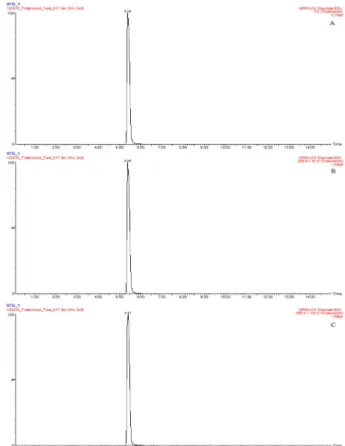
The MS/MS spectrum also presented major peaks at m/z 98 and 130 when optimized at a collision energy of 32 eV, which correspond to the fragmentation of tridemorph into 2,4,6-trimethylmorpholine. Therefore, 298→ 98 and 298 → 130 were selected as the quantitative and confirmative transitions, respectively (Fig. 2 and 3).
Initially, the mobile phase consisted of acetonitrile and water mixtures. However, such mixtures displayed broad and asymmetric peaks. The addition of 0.1% formic acid to the mobile phase, however, resulted in sharp peaks with good peak shapes. The use of a gradient enabled fast elution and a correct peak shape for tridemorph.
Linearity
In recent years, external matrix-matched standard calibration has been widely applied in pesticide residue analysis in plant matrices by LC-electrospray mass spectrometry. However, in this study, external solvent standard calibration was used because it was found that the response of the analyte in a pure solvent standard (y = 8742× −5.2442) did not differ from that obtained using external matrix-matched standard calibration (y = 8666× −3.3492). This similarity was obtained due to the small sample size (5 g) and the aliquot step (5
times dilution), which resulted in elimination or compen- sation of the matrix effect.
Different known concentrations of tridemorph (0.02, 0.05, 0.1, 0.5, and 1.0μg mL−1) were prepared in acetonitrile by diluting the stock solution. Each solution was prepared in triplicate. Standard solutions were injected into the LC column and the peak area was measured to calculate the tridemorph residue content. A calibration curve was plotted for the infected standard concentrations versus the peak area observed, and the linearity of the method was evaluated by analyzing five working solutions. The peak area obtained for each concentration of tridemorph was then used to calculate the residues (r = 0.9999).
Specificity
The specificity of the analytical method was judged from the absence of interfering peaks at the retention time of the analyte. The retention time of tridemorph was constant at 5.4 ± 0.1 min, and there were no interfering peaks at this retention time (Fig. 3).
Accuracy and Precision
Recovery studies were conducted at 0.02 and 0.05 mg kg−1
Fig. 1. Positive ion electrospray full-scan mass spectrum of tride- morph at 50 V.
Fig. 2. Fragmentation of tridemorph.
Fig. 3. LC-ESI-MS/MS chromatograms of standard solutions at 1μgmL−1 corresponding to: A, the total ion chromatograph (TIC);
B, m/z 298 → 98; and C, m/z 298 → 130.
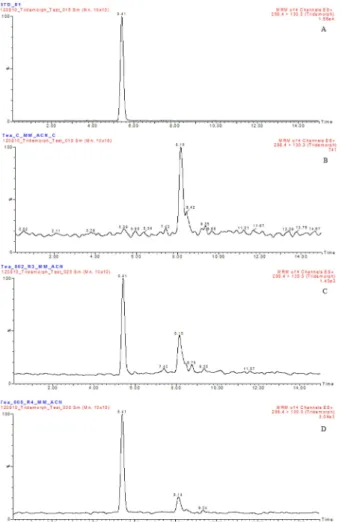
fortification levels for tridemorph in control tea samples (Fig. 4). The recovery data and relative standard deviations obtained using this method is summarized in Table 2. These values were calculated from six replicate analyses of the given samples. The repeatability of the method was satisfactory (RSD < 10%).
Detection and Quantification Limits
The LOQ was determined to be 0.02μg mL−1. The quanti- fication limit was defined as the lowest fortification level evaluated at which acceptable average recoveries (75.0- 84.7%, RSD < 10%) were achieved. This quantification limit also reflects the fortification level at which the analyte peak was consistently generated at approximately 10 times the baseline noise in the chromatogram. In addition, at a level of approximately three times the background of a control injection near the retention time of the peak of interest, the LOD was determined to be 0.01μg mL−1.
Application of the Method to Real Tea Samples The developed and validated method was applied to the routine analysis of 12 real tea samples taken from different local markets. The results for these samples are summarized in Table 3. Tridemorph was detected in one commercial sample, but at a concentration lower than the LOQ. The detection was confirmed by the selected qualification transition, however, and the obtained ion ratio was within the accepted tolerance in this case.
Conclusion
This study has demonstrated that LC-ESI-MS/MS is an accurate and sensitive technique for the determination of tridemorph residues in tea samples. The tridemorph extraction procedure for the described method is based on the Korean Food Standards Codex as a multi-class pesticide multi- residue method using an acetonitrile. An NH2 SPE cartridge was used for sample preparation. The process was simple and easy, providing adequate clean-up of the matrix. Most of the sample extracts were very clean, with no interfering peaks at the retention time of the target compound, indicating good sensitivity for the proposed method. Satis- factory validation parameters, such as linearity, recovery, precision and very low detection limits, were obtained according to the Korean Food Standards Codex32). For Table 2. Quantification limit (mgkg−1), mean recoveries (%), and relative standard deviations (%) (n = 6) for the analytical proce- dure
Sample Spiked (mgkg−1)
Recovery ± RSD (%)
LOQ (mgkg−1)
Tea 0.02 84.7 ± 8.9
0.05 75.0 ± 4.4 0.02
Table 3. Tridemorph detected in real tea samples
Sample Tridemorph
(mgkg−1)
Herb tea - Lime ND*
Herb tea - Lemon ND
Herb tea - Jasmine ND
Herb tea - Rosemary ND
Herb tea - Chamomile ND
Herb tea - Peppermint ND
Herb tea - Rooibos ND
Yellow label tea ND
Ice tea - Apple ND
Ice tea - Raspberry ND
Ice tea - Lemon ND
Ice tea - Peach ND
*ND, not detected
Fig. 4. LC-ESI-MS/MS chromatograms corresponding to: A, a tridemorph standard solution at 0.1 mg L−1; B, a blank tea sample;
C, a tea sample spiked at 0.02 mg kg−1; and D, a tea sample spiked at 0.05 mg kg−1.
tridemorph the sensitivity of the method was suitable enough to ensure reliable determination of levels lower than the respective MRLs. In addition, the evaluation time is suffi- ciently short to enable the routine analysis of many samples.
Therefore, the proposed analytical method should be useful for the regular monitoring of tridemorph residues in tea samples.
Acknowledgments
This study was supported by a grant (12161MFDS016) from the Ministry of Food and Drug Safety in 2012.
요 약
차 중에 있는 살균제 tridemorph의 잔류량을 검사하기 위 해 LC-ESI-MS/MS를 이용한 정확하고 감도가 좋은 분석방 법을 개발하였다. Tridemorph 잔류물은 샘플을 수화한 후 acetonitrile로 추출하고, NaCl을 이용한 액-액 분배, NH2
카트리지 정제를 거쳐 기기분석을 수행하였다. 직선성은 0.02~1.0µgmL−1범위에서 상관계수(r2) 0.9999로 높은 직선 성을 보였다. 0.02와 0.05 mgkg−1 처리수준으로 회수율을 실험한 결과는 75.0~84.7% 이었으며, 상대표준편차는 10%
미만이었다. 분석방법의 검출한계와 정량한계는 각각 0.01 와 0.02 mgL−1이었다. 이러한 결과들을 통해 확립된 분석 법은 차 중 tridemorph의 잔류량 분석에 적합함을 확인할 수 있었다.
References
1. Abul Kalam, A. and Banerjee, A.K.: Action of the fungicide tridemorph on the glucose, lactate and succinate dehydroge- nase activities of some tridemorph-sensitive and -resistant bacteria. Pestic Manage Sci. 43, 41-45 (1995).
2. Pesticide Usage Survey Group, MAFF, Pers. comm., Central Science Laboratory (1999).
3. http://www.pan-uk.org/pestnews/Issue/pn48/pn48p17a.htm.
4. http://www.greenpeace.org/eastasia/press/Releases/food-agri- culture/2012/pesticides- testing-lipton-tea/.
5. http://www.access.gpo.gov/nara/cfr/waisidx_07/40cfrv23_07.
html].
6. http://www.codexalimentarius.net/pestres/data/pesticides/index.
html?lang=en.
7. Ministry of Food and Drug Safety: Food Code. (2014).
8. http://www.m5.ws001.squarestart.ne.jp/foundation/agrdtl.
php?a_inq=45000.
9. http://ec.europa.eu/sanco_pesticides/public/index.cfm?event
=substance.resultat&s=1.
10. Stahl, E.: Thin Layer Chromatography - A Laboratory Hand- book. New York: Springer Berlin Heidelberg (1969).
11. Ramulu, S.: US Chemistry of Insecticides and Fungicides.
New Delhi: Oxford & IBH Publication Co. (1979).
12. Dhingra, V. and Pandey, J.: J. Indian Soc. Toxicol. 5, 32-33 (2009).
13. Bester, K., Bordin, G., Rodriguez, A., Schimmel, H., Pauwels, J., and Van Vyncht, G.: How to overcome matrix effects in the determination of pesticides in fruit by HPLC-ESI-MS-MS.
Fresenius Anal. Chem. 371, 550-555 (2001).
14. Blasco, C., Fernandez, M., Pico, Y., Font, G., and Manes, J.:
Simultaneous determination of imidacloprid, carbendazim, methiocarb and hexythiazox in peaches and nectarines by liq- uid chromatography-mass spectrometry. J. Anal. Chim. acta.
461, 109-116 (2002).
15. Taylor, M.J., Hunter, K., Hunter, K.B., Lindsay, D., and Le Bouhellec, S.: Multi-residue method for rapid screening and confirmation of pesticides in crude extracts of fruits and vege- tables using isocratic liquid chromatography with electrospray tandem mass spectrometry. J Chromatogr A. 982, 225-36 (2002).
16. Zaroma, T., Pozo, O.J., Lopez, F.J., Hernadez, F.: Dtermina- tion of tridemorph and other fungicide residues in fruit sam- ples by liquid chromatography-electrospray tandem mass spectrometry. J Chromatogr A. 1045, 137-143 (2004).
17. Raphaella P. Carneiro, Fabiano A.S. Oliveira, Fernando D.
Madureira, Gilsara Silva, Wesley R. de Souza, Renata Pereira Lopes, Development and method validation for determination of 128 pesticides in bananas by modified QuEChERS and UHPLC-MS/MS analysis, Food Control, 33, 413-423 (2013).
18. Garrido Frenich, A., Martínez Vidal, J. L., López López, T., Cortés Aguado, S., Martínez Salvador, I., Monitoring multi- class pesticide residues in fresh fruits and vegetables by liq- uid chromatography with tandem mass spectrometry, J Chro- matogr A. 1048, 199-206 (2004).
19. Gozde Turkoz B., Dilek Bengu Yaman A., Fatih B., Semih O., Pesticide residues in fruits and vegetables from the Aegean region,Turkey, Food Chemistry, 160, 379-392 (2014).
20. Maurice H., André de K., Comprehensive multi-residue method for the target analysis of pesticides in crops using liq- uid chromatography-tandem mass spectrometry, J Chro- matogr A. 1154, 3-25 (2007).
21. Luke, M.A., Froberg, J.E., and Masumoto, H.T.: Extraction and cleanup of organochlorine, organophosphate, organoni- trogen, and hydrocarbon pesticides in produce for determina- tion by gas-liquid chromatography. J. Assoc. Off. Anal. Chem.
56, 1020-1026 (1975).
22. Wong, J.W., Zhang, K., Tech, K., Hayward, D.G., Krynitsky, A.J., Cassias, I., Schenck, F. J., Banerjee, K., Dasgupta, S., and Brown, D.: Multiresidue pesticide analysis of ginseng pow- ders using acetonitrile- or acetone-based extraction, solid- phase extraction cleanup, and gas chromatography-mass spectrometry/selective ion monitoring (GC-MS/SIM) or -tan- dem mass spectrometry (GC-MS/MS). J Agric Food Chem.
58, 5884-96 (2010).
23. AOAC. AOAC Official 2007.01 Method: Pesticide Residues in Foods by Acetonitrile Extraction and Partitioning with Magnesium Sulfate. J AOAC Int. 485-493 (2007).
24. Mills, P.A., Onley, J. H., and Guither, R.A.: Rapid method
for chlorinated pesticide residues in nonfatty foods. J Assoc Off Anal Chem. 46, 186-191 (1963).
25. Cotterill, E.G.: The efficiency of methanol for the extraction of some herbicide residues from soil. Pestic Sci., 11(1), 23- 28 (1980).
26. Tsipi, D., Triantafylloub, M., and Hiskia, A.: Determination of organochlorine pesticide residues in honey, applying solid phase extraction with RP-C18 material. Analyst 124, 473- 475 (1999).
27. Aysal, P., Ambrus, A., Lehotay, S.J., and Cannavan, A.: Val- idation of an efficient method for the determination of pesti- cide residues in fruits and vegetables using ethyl acetate for extraction. J Environ Sci Health B 42, 81-90 (2007).
28. Pihlström, T., Blomkvist, G., Friman, P., Pagard, U., and Öster- dahl, B-G.: Analysis of pesticide residues in fruit and vegeta- bles with ethyl acetate extraction using gas and liquid
chromatography with tandem mass spectrometric detection.
Anal and Bioanal Chem. 386, 1773-1789 (2007).
29. Joe, T.: Multi-residue pesticide screens, California Depart- ment of Food and Agriculture, Division of Inspection Ser- vices, Chemistry Laboratory Services Branch, Pesticide Residue Program (1988).
30. Schenck, F.J. and Wong, J.W.: Analysis of Pesticides in Food and Environmental Samples, Tadeo, J.L. (ed.). CRC Press, Boca Raton, 154 (2008).
31. wir-Ferenc, M.B.: Solid phase extraction - trends, opportu- nities and applications. Polish J. of Environ. Stud. 15, 677- 690 (2006).
32. Ministry of Food and Drug Safety: Multi class pesticide mul- tiresidue methods. In Korean Food Standards Codex. 10-4- 10 (2011).
·Z