DOI: 10.5532/KJAFM.2014.16.3.219
ⓒ Author(s) 2014. CC Attribution 3.0 License.
거제수나무, 물푸레나무, 굴참나무 묘목의 실외 인위적 온난화에 대한 수종 특이적 생장 반응
한새롬1·안지애1·윤태경1·윤순진2·황재홍3·조민석3·손요환1*
1고려대학교 대학원 환경생태공학과, 2국립산림과학원 산림보전부,
3국립산림과학원 산림생산기술연구소
(2014년 8월 15일 접수; 2014년 9월 25일 수정; 2014년 9월 29일 수락)
Species-specific Growth Responses of Betula costata, Fraxinus rhynchophylla, and Quercus variabilis
Seedlings to Open-field Artificial Warming
Saerom Han1, Jiae An1, Tae Kyung Yoon1, Soon Jin Yun2, Jaehong Hwang3, Min Seok Cho3 andYowhan Son1*
1Department of Environmental Science and Ecological Engineering, Graduate School, Korea University, Seoul 136-713, Korea
2Department of Forest Conservation, Korea Forest Research Institute, Seoul 130-712, Korea
3Forest Practice Research Center, Korea Forest Research Institute, Pocheon 487-829, Korea (Received August 15, 2014; Revised September 25, 2014; Accepted September 29, 2014)
ABSTRACT
Evaluation of tree responses to temperature elevation is critical for a development of forest management techniques coping with climate change. We conducted a study on the growth responses of Betula costata, Fraxinus rhynchophylla, and Quercus variabilis seedlings to open-field artificial warming. Artificial warming set-up using infra-red heater was built in 2012 and the temperature in warmed plots was regulated to be consistently 3oC higher than that of control plots. The seeds of three species were sown, and the responses of growth, biomass allocation, and net photosynthetic rate of newly-germinated seedlings on the open-field artificial warming were determined. As a result, the growth responses of the seedlings differed with the species. B. costata showed decreases in the height to diameter ratio (H/D ratio), biomass, root weight to shoot weight ratio, and net photosynthetic rate.
However, root collar diameter (RCD), height, biomass, and net photosynthetic rate of Q. variabilis were increased, while the response of F. rhynchophylla was rather obscure. There was no significant difference between warmed and control plots in seedling growth for 3 species in July, whereas, RCD, height, and H/D ratio of Q. variabilis were increased and H/D ratio of B. costata was decreased in November under warming. Species-specific growth responses to warming were similar to the species- specific responses of net photosynthetic rate and biomass allocation; therefore, net photosynthetic rate and biomass allocation might attribute to growth responses to warming. Besides, a relatively obvious response in autumn compared to summer might be affected by the phenological change following artificial warming. Species-specific responses of three deciduous species to warming in this study could be applied to the development of adaptive forest management policies to climate change.
Key wordss: Artificial warming, Biomass partitioning, Elevated temperature, Korean birch, Oriental oak
* Corresponding Author : Yowhan Son ([email protected])
I. 서 론
지구 평균 기온은 21세기 말에 1.0-3.7oC 증가할 것으로 예측되며(IPCC, 2013), 이와 같은 기온 상승 은 산림생태계의 구조와 기능에 영향을 미칠 것으로 예상된다(Saxe et al., 2001). 기후변화 대응 산림 관 리 방법을 개발하기 위해서는 온난화에 따른 수목의 반응을 예측하는 것이 필수적이다(Kirschbaum, 2000).
한편 온난화에 대한 수목 생장 반응은 수종, 생장 단 계, 분류군, 산지, 광환경, 경쟁 등에 의하여 다양하게 나타나는 것으로 보고되고 있으며(Arend et al., 2011; Fisichelli et al., 2014; Wang et al., 2013; Yin et al., 2008), 특정 수종의 온난화에 대한 반응을 알기 위해서는 각 수종의 반응을 실험적으로 연구하는 것이 필요하다. 특히 묘목 시기는 수목의 생존 및 생장에 매 우 중요한 단계이므로(Danby and Hik, 2007) 온난화에 대한 수종별 묘목의 생장 반응을 연구할 필요가 있다.
기온 상승에 따른 묘목의 생장 반응은 생장 기간 및 광합성률의 증가로 인한 생장 증가와, 동해 및 호흡 률 증가로 인한 생장 저해 등에 영향을 받는다고 알려 져 있다(Saxe et al., 2001). 또한 순광합성률은 일반적 으로 모형에 의하여 온도 상승에 따라 증가하는 것으로 예측되나, 온난화에 대한 순광합성률 반응의 방향과 범 위는 수종이나 환경에 따라서 상이하게 나타난다 (Kirschbaum, 2000; Saxe et al., 2001; Way and Oren, 2010). 한편 온난화에 따른 묘목의 생장 반응을 예측하 기 위해서는 생장량 및 생물량 등의 전반적인 생장 반 응과 더불어 생물량 분배 반응을 연구하는 것이 필요하 다. 특히 부위별 생장 및 생물량 분배 비율은 온난화에 의한 증산량 증가나 수분 스트레스에 대한 적응 기작 중 하나이며(Domisch et al., 2002), 이의 반응에 따라 환경에 대한 수목의 생장 반응이 달라질 수 있다.
실외 인위적 온난화 실험은 온난화에 대한 묘목 및 산림의 반응을 효과적으로 예측할 수 있는 연구 방법 이다(Chung et al., 2013). 이는 실내 실험 및 온실 실험에 비하여 강수량, 토양 수분, 일사량, 풍량 등의 온도 이외의 환경을 실제 환경과 유사하게 조절할 수 있는 장점을 지닌다. 또한 장기관찰 연구에 비하여 관 측된 온도 범위 이상의 온난화에 대한 생태계의 반응 을 연구할 수 있다(Morin et al., 2010). 이에 따라 국외에서 다수의 실외 인위적 온난화 연구가 진행되고 있으나 국내의 수종 및 환경을 대상으로 한 연구는
매우 제한적이다(Chung et al., 2013). 따라서 본 연 구는 우리나라 주요 활엽수종인 거제수나무(Betula costata), 물푸레나무(Fraxinus rhynchophylla), 그리고 굴참나무(Quercus variabilis) 묘목의 실외 인위적 온 난화에 대한 생장 및 광합성 반응을 알아보고자 수행 되었다.
II. 재료 및 방법
2012년 9월 경기도 포천시 소재 국립산림과학원 산 림생산기술연구소 내 묘포장에 총 18개의 묘상(1m × 1m)을 구획하고, 묘상의 기온을 지속적으로 3oC 증가 시킬 수 있는 실외 인위적 온난화 시스템을 구축하였 다. 실외 인위적 온난화 시스템은 1) 적외선등(FTE- 1000, Mor Electric Heating Instrument Inc., USA) 을 이용한 가열 모듈(Kimball et al., 2007), 2) 적외 선 온도계(SI-111, Campbell Scientific, USA), 데이 터로거(CR-1000, Campbell Scientific, USA) 등을 이용하여 묘상의 온도를 지속적으로 모니터링하는 모 니터링 모듈, 그리고 3) 대조구와 온난화 처리구의 온 도 모니터링 자료를 바탕으로 온난화 처리구의 온도를 대조구 대비 3oC 증가시키는 제어 모듈 등으로 구성 하였다.
연구대상 수종으로는 우리나라의 주요 조림활엽수종 중 한반도 전역에 분포하는 수종인 굴참나무, 한반도 중북부에 주로 분포하는 물푸레나무, 중부 이북에 분 포하는 대표적인 아고산 수종인 거제수나무등 분포 범 위가 서로 다른 세가지 수종을 선정하였다(Han et al., 2012; Kim et al., 2003). 2013년 4월 실외 인 위적 온난화 시스템 내의 각 조사구(n=3)에 거제수나무, 물푸레나무, 굴참나무 종자를 종묘사업실시요령에 따라 파종하였다(Forest Resources Creation and Management Act, 2012). 그리고 2013년 7월과 11월에 발아 후 생장하고 있는 묘목을 조사구 당 30본씩 선정하여 근 원경과 묘고를 전자식캘리퍼스와 자를 이용하여 측정 하였으며, 묘목별 근원경 대비 묘고 비율(H/D율)을 계 산하였다. 또한 2013년 8월 조사구 당 9본의 묘목을 채취한 후, 묘목을 잎, 줄기, 뿌리 등의 부위별로 분 리하여 건조기에서 65oC로 48시간 이상 건조한 후 각 부위의 생물량을 측정하였다. 이를 이용하여 묘목 전체 대비 뿌리 중량 비율(root weight to total biomass ratio, RMR), 잎 대비 뿌리 중량 비율(root weight
to leaf weight ratio, RLR), 지상부 대비 뿌리 중량 비율(root weight to shoot weight ratio, RSR) 등을 산출하였다. 순광합성률 및 엽록소 함량은 2013년 8 월, 각 조사구 당 3본의 묘목을 선정하여 묘목 당 1 개의 잎을 대상으로 측정하였다. 순광합성률은 휴대용 광합성 측정기(CIRAS, PP-Systems, USA)을 이용하 여 챔버 내 이산화탄소 농도를 400ppm, 광도를 1,000±10µmol·m−2·s−1로 제어하여 측정하였다.
실외 인위적 온난화 처리에 따른 각 수종 묘목의 생장 변수 및 순광합성률과 엽록소 함량의 차이 (P < 0.05)는 분산분석을 이용하여 검정하였다. 모든 분 석에는 SAS 9.3 software (SAS Institute Inc., 2009)를 사용하였다.
III. 결과 및 고찰
실외 인위적 온난화 처리에 따른 묘목의 근원경과
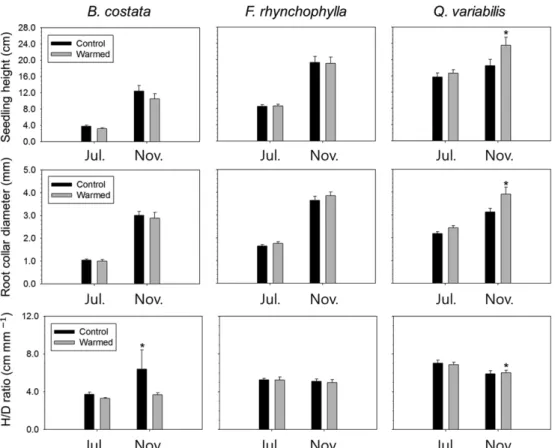
묘고, H/D율의 반응은 수종과 측정 시기에 따라 상이 하게 나타났다(Fig. 1). 온난화 처리구와 대조구 사이 의 묘목 근원경과 묘고의 차이는 굴참나무에서만 유의 하게 나타났고, 다른 수종에서는 통계적으로 유의하게 나타나지 않았다. 즉 굴참나무 묘목은 11월에만 온난 화 처리에 의하여 근원경(mm)과 묘고(cm)가 각각 25.0%(대조구: 3.13; 온난화 처리구 3.91), 26.9%(대 조구: 18.54; 온난화 처리구: 23.53) 증가하였다. H/D 율(cm mm−1)도 7월에는 모든 수종에 대하여 온난화 처리에 따른 변화가 나타나지 않았으나 11월에는 굴참 나무의 H/D율이 2.1%(대조구: 5.90; 온난화 처리구:
6.02) 증가한 반면 거제수나무의 H/D율이 42.6%(대조 구: 6.40; 온난화 처리구: 3.68) 감소하였다.
선행 실외 인위적 온난화 연구에서의 묘목 생장 반 응은 수종에 따라 다양하게 나타나며(Arend et al., 2011; Chung et al., 2013; Fisichelli et al., 2014), 특히 근원경과 묘고의 반응은 처리에 따라 모두 변화
Fig. 1. Seedling height, root collar diameter, and height to diameter (H/D) ratio of Betula costata, Fraxinus rhynchophylla, and Quercus variabilis seedlings in control and warmed plots. Error bars indicate standard errors of the mean. Asterisks show a statistical significance (P < 0.05).
(Wang et al., 2013; Xu et al., 2012)하거나, 근원 경 또는 묘고만 달라지거나(Arend et al., 2011), 아 예 변화가 없는(Wang et al., 2012) 것 등으로 보고 되고 있다. 2-3년생 굴참나무 묘목에 대한 선행 연구 에서도 본 연구의 결과와 유사하게 온난화 처리에 의 하여 굴참나무의 묘고와 근원경이 증가한 것으로 나타 났다(Lee et al., 2012). 한편 Quercus속의 다른 종 에 대한 연구 결과, 종과 산지, 생장 단계에 따라 서 로 다른 반응을 보였다. 온난화 처리에 따라 Q. robru, Q. petraea, 그리고 Q. pubescens의 묘고가 증가하였 으나 근원경은 감소하였고(Arend et al., 2011), Q.
rubra의 묘고와 근원경 생장이 모두 감소하는 것으로 보고된 바 있다(Wertin et al., 2011). 한편, H/D율은 일반적으로 온난화에 의하여 증가하는 것으로 알려져 있으며(Saxe et al., 2001), 굴참나무(Lee et al., 2012)와 Quercus 속의 다른 수종에 대한 연구(Arend et al., 2011)에서도 온난화 처리에 따라 H/D율이 증가한 것 으로 보고된 바 있다. 온도 증가에 따른 H/D율의 변 화는 다수의 연구에서 보고되어 왔음에도 불구하고 그 생태적 의미는 아직 명확히 밝혀지지 않고 있는데 (Arend et al., 2011), H/D율의 변화는 묘목의 품질 (Bayala et al., 2009) 및 묘목의 생존율에 영향을 주 는 것으로 추정되고 있다(Moore et al., 2008). 본 연구에서도 굴참나무와 물푸레나무에서는 H/D율과 생 존율이 온난화 처리에 의하여 변화되지 않았으나, 온 난화 처리에 의하여H/D율이 감소한 거제수나무는 온 난화 처리구에서 대조구보다 생존율이 낮아지는 것으 로 나타났다(Hwang et al., 2014).
묘목의 총생물량, 부위별 생물량 및 생물량 분배 반 응도 수종 및 측정시기에 따라 다른 결과를 보였다 (Table 1). 온난화 처리구의 묘목 총 생물량(g)은 대조 구에 비하여 거제수나무는 11월에 13.3% 감소(대조구:
0.256; 온난화 처리구: 0.222)한 반면, 굴참나무는 7월 에 10.6%(대조구: 3.071; 온난화 처리구: 3.397)와 11월에 16.7% 증가(대조구: 8.951; 온난화 처리구:
10.442)하였으며, 물푸레나무는 모든 시기에 차이가 나 타나지 않았다. 묘목의 부위별 생물량은 물푸레나무에 서만 온난화 처리에 따라 뿌리와 잎의 생물량의 차이 가 나타났으나, 처리에 따른 뿌리 생물량은 변화 양상 이 일정하지 않았으며, 잎의 생물량은 11월에만 증가 하는 것으로 나타났다. 굴참나무의 생물량 분배는 온 난화 처리에 따른 차이를 나타내지 않았으나, 거제수
나무의 RSR은 11월에 온난화 처리에 따라 감소하였 으며, 물푸레나무의 7월 RSR 및 11월의 RLR도 감 소하는 것으로 나타났다.
본 연구에서 묘목 생물량 및 생물량 분배의 온난화 에 대한 반응은 수종별로 상이하게 나타났는데, 선행 연구에서도 온난화에 의하여 생물량이 증가(Han et al., 2009; Liu et al., 2011; Wang et al., 2012; Wang et al., 2013; Zhao et al., 2009), 혹은 감소되는 등(Han et al., 2012; Wertin et al., 2011; Yang et al., 2013), 수종 및 광환경, 경쟁 등에 의한 변이를 보였다. 특히, 본 연구에서 굴참나무의 생물량은 근원경 및 묘고 생 장 반응과 유사하게 온난화에 따라 증가하였으며, 거 제수나무의 생물량은 이와 반대로 감소하였다. 이는 굴참나무가 우리나라 전역에 분포하는 수종인 반면, 거제수나무는 아고산대 수종으로서 상대적으로 온도 증가에 취약하기 때문으로 사료되며, 각 수종을 대상 으로 한 선행 온난화 연구에서도 이와 유사한 결과가 보고된 바 있다(Han et al., 2012; Lee et al., 2012).
본 연구에서 거제수나무는 다른 수종에 비하여 온난화 처리구에서 뿌리 중량의 비율이 크게 감소하였는데, Han et al.(2012)의 연구에서도 온난화에 의한 뿌리 탈락 및 분해 증가로 뿌리 생장이 감소됨에 따라 거 제수 묘목의 생물량이 감소함을 보고한 바 있다.
묘목의 순광합성률(µmol CO2 m−2·s−1)은 실외 인위 적 온난화 처리에 의하여 굴참나무에서 증가(대조구:
10.30; 온난화 처리구: 13.40)하고 거제수나무에서는 감소(대조구: 12.50; 온난화 처리구: 10.40)하였으며, 물푸레나무에서는 유의한 차이가 나타나지 않았다(Fig.
2). 순광합성률은 온난화에 따라 일정 온도까지는 증가 하는 것으로 알려져 있으나, 종에 따른 적응의 차이 또는 수분 스트레스 등의 환경의 영향에 의하여 증가 혹은 감소되는 등 다양한 반응을 보인다(Saxe et al., 2001). 이러한 순광합성률의 변화와 수목 생장 반응은 직접적으로 비례하지는 않으나(Saxe et al., 2001), 다 양한 연구에서 온난화에 의한 순광합성률의 변화가 생 장률과 상관관계가 있다는 결과가 보고되고 있다 (Tjoelker et al., 1998; Xu et al., 2012; Yin et al., 2008; Zhao and Liu, 2009).
지상부에 대한 지하부 비율의 변화는 뿌리를 통한 수분 흡수와 잎에 의한 수분 손실의 균형을 조정하는 적응 기작의 하나로 알려져 있다. 따라서 온난화 환경 에서의 지상부에 대한 지하부 비율이 증가되는 수종은
Table 1. Biomass allocation of Betula costata, Fraxinus rhynchophylla, and Quercus variabilis seedlings in control and warmed plots. Asterisks show a statistical significance (P < 0.05; Values are mean±SE) SpeciesMonthTreatmentRoot weight (g)Stem weight (g)Leaf weight (g)Total weight (g)RMRRLRRSR B. costata
Jul.Control0.032±0.0220.031±0.0060.033±0.01700.097±0.0380.334±0.007000.966±0.0310.501±0.03 Warmed0.021±0.1460.026±0.0100.025±0.00700.073±0.0180.293±0.006000.839±0.5240.415±0.016 Nov.Control0.106±0.0170.060±0.0760.090±0.01200.256±0.1580.414±0.146001.177±0.2460.706±0.041* Warmed0.091±0.0190.054±0.0850.077±0.0200.222±0.038*0.411±0.079001.195±0.0540.699±0.148 F. rhynchophylla
Jul.Control2.870±0.1821.688±0.0850.949±0.14605.507±0.0270.521±0.011003.026±0.1481.089±0.062* Warmed3.085±0.119*1.736±0.0141.165±0.01105.986±0.0300.515±0.012002.605±0.1601.064±0.056 Nov.Control6.481±0.253*3.811±0.0142.142±0.01912.434±0.1980.521±0.010003.026±0.056*1.089±0.005 Warmed6.242±0.0643.615±0.1262.516±0.010* 12.374±0.3080.504±0.146002.480±0.1391.018±0.198 Q. variabilis Jul.Control2.157±0.1680.857±0.0640.057±0.00903.071±0.0450.702±0.053037.750±0.0362.359±0.085 Warmed2.412±0.0850.912±0.8250.073±0.05303.397±0.038*0.710±0.067033.035±0.0472.449±0.198 Nov.Control7.545±0.1191.339±0.0510.067±0.00908.951±0.0310.843±0.010111.924±0.1465.363±0.038 Warmed8.831±0.0951.535±0.2360.076±0.01210.442±0.03*0.846±0.041115.965±0.0795.482±0.045 (RMR: root weight to total biomass ratio; RLR: root weight to leaf weight ratio; RSR: root weight to shoot weight ratio)
수분 부족 환경에서의 적응력이, 지상부에 대한 지하 부 비율이 감소되는 수종은 수분이 충분한 환경에서의 적응력이 더 높을 것으로 예상된다(Yin et al., 2008).
또한 온난화에 따라 묘목의 잎 생산이 증가하여, 묘목 의 생장이 촉진되는 것으로 보고된(Piper et al., 2013) 바 있으나 본 연구에서 온난화 처리에 의한 물푸레나 무의 잎 생물량의 증가는 묘목 전체 생물량의 증가를 가져오지는 않는 것으로 나타났다. 이는 잎의 생물량 이 증가한 것과 동시에 잎에 대한 뿌리 생물량 비도 함께 증가하여 잎 생물량 증가가 생산성 증가에 미치 는 영향이 감소하였기 때문으로 생각된다. 한편, 온난 화 처리구에서 굴참나무의 생장이 물푸레나무에 비하 여 뚜렷하게 증가한 것은 물푸레나무가 굴참나무보다 토양수분에 대한 요구도가 더 높기 때문인 것으로 사 료된다(Cho et al., 2012).
한편, 일반적으로 온난화에 따라 수목의 생장기간이 증가하는 것으로 알려져 있는데, 생장기간의 증가는 탄소 동화 기간을 증가시켜 생장량을 증가시키는 한편, 낙엽시기의 지연으로 인한 동해 가능성을 높여 수목의 생존이나 생장에 부정적인 영향을 줄 수 있다(Chung et al., 2013; Saxe et al., 2001). 본 연구에서도 활 엽수 3개 수종 모두에서 가을철 낙엽 시기가 지연된 것이 관찰되었으나(Han et al., unpublished data), 생 장량은 굴참나무에서만 증가한 것으로 나타났다. 또한 온도 증가에 따른 묘목 생장량은 높은 순광합성률 및 생장기간의 연장으로 인하여 증가되거나, 호흡률 증가, 광저해 현상 및 온도 스트레스에 의하여 감소되는 것 으로 알려져 있다(Saxe et al., 2001). 본 연구에서
나타난 거제수나무 생장 감소, 굴참나무의 생장 증가, 물푸레나무의 낮은 반응은 이와 같은 다양한 영향 요 인이 복합적으로 작용한 결과로 사료된다. 선행 온난 화 실험에서 온도 증가가 거제수나무 생장에 스트레스 요인으로 작용하는 것으로 나타났으며(Han et al., 2012), 온도 상승에 따라 호흡률이 순광합성률에 비하 여 더 크게 증가하여 Betula pendula, B. pubescens 의 생장이 감소되는 것으로 보고된 바 있다(Kramer et al., 2000). 즉, 거제수나무는 온난화에 의하여 저 하된 순광합성률, H/D율에 의하여 생장이 감소하고, 이에 더하여 온도 스트레스와 호흡률 상승도 생장량 감소에 영향을 미쳤을 것으로 사료된다. 반면 굴참나 무에 대한 선행 연구로서, 온난화에 의하여 굴참나무 의 생장기간과 순광합성률의 증가에 따라 묘목 생장이 증가한 사례가 보고된 바 있으며(Han et al., 2014;
Jo et al., 2011; Lee et al., 2012), 본 연구에서도 온도 상승에 의한 생장기간과 순광합성률의 증가가 굴 참나무의 생장량을 증가시킨 것으로 사료된다.
한편, 묘목 단계는 수목 생존에 중요하고, 환경의 영향에 민감하게 반응하는 시기이며(Danby and Hik, 2007), 특히 발아 당년의 묘목은 수목 갱신에 중요한 시기이므로(Fenner, 2000), 본 연구 결과는 온난화에 대한 산림 반응을 예측하는 데에 활용될 수 있을 것 으로 사료된다. 그러나 온난화에 대한 묘목의 생장 반 응은 묘목의 생장 단계 및 묘령에 따라 달라지는 것 으로 알려져 있으므로(Arend et al., 2011; Saxe 2001;
Wertin et al., 2011), 온난화에 대한 산림의 반응을 보 다 정확하게 예측하기 위해서는 향후 보다 장기적으로 묘목의 생장 반응을 연구하는 것이 필요하다.
IV. 결 론
본 연구 결과, 거제수나무, 물푸레나무, 굴참나무 묘 목의 생장은 실외 인위적 온난화 처리에 대하여 수종 과 시기에 따라 서로 다른 반응을 나타내었다. 거제수 나무는 온난화 처리에 따라 H/D율, 생물량, RSR, 순 광합성률 등이 감소한 반면, 굴참나무는 근원경, 묘고, 생물량, 순광합성률 등이 증가하였으며, 물푸레나무는 다른 수종에 비하여 생장 반응이 뚜렷하지 않았다. 한 편, 온난화에 대한 묘목의 생장 반응은 여름철보다 가 을철에 더 뚜렷하게 나타났다. 이와 같이 온난화에 따 른 생장 반응이 수종 및 시기별로 차이를 보이는 것 Fig. 2. Net photosynthetic rate of Betula costata, Fraxinus
rhynchophylla, and Quercus variabilis seedlings in control and warmed plots. Error bars indicate standard errors of the mean. Asterisks show a statistical significance (P < 0.05).
은 온난화에 의한 순광합성률과 생물량 분배 및 낙엽 시기의 지연의 복합적인 영향에 의한 것으로 생각된다.
활엽수 3개 수종에 대하여 온난화에 의한 수종 특이 적 묘목 생장을 구명한 본 연구 결과는 기후변화에 대응한 양묘 기술 개발과 기후변화에 따른 산림의 반 응을 예측하는 모형 개발에 활용될 수 있을 것으로 사료된다.
적 요
기후변화 대응 산림 관리 방법을 개발하기 위해서는 온난화에 따른 수목의 반응을 예측하는 것이 중요하다.
본 연구는 우리나라 주요 활엽수종인 거제수나무 (Betula costata), 물푸레나무(Fraxinus rhynchophylla), 굴 참나무(Quercus variabilis) 묘목의 실외 인위적 온난 화에 대한 생장 반응을 알아보기 위하여 수행되었다.
이를 위해 적외선등을 이용하여 지속적으로 기온을 3oC 증가시킬 수 있는 실외 인위적 온난화 시스템을 구축하고, 활엽수 3개 수종을 파종한 후, 온도 증가에 대한 발아 당년 묘목의 생장, 생물량 분배 및 순광합 성률의 반응을 분석하였다. 연구 결과, 거제수나무, 물 푸레나무, 굴참나무 묘목의 생장은 실외 인위적 온난 화 처리에 대하여 수종과 시기에 따라 서로 다른 반 응을 나타냈다. 즉 거제수나무는 온난화 처리에 따라 근원경 대비 묘고 비율, 총 생물량, 지상부 대비 뿌리 중량 비율, 순광합성률 등이 감소한 반면, 굴참나무는 근원경, 묘고, 총 생물량, 순광합성률 등이 증가하였으 며, 물푸레나무는 다른 수종에 비하여 생장 반응이 뚜 렷하지 않았다. 시기별 반응으로는, 7월에는 모든 수종 에 대하여 온난화 처리에 따른 변화가 나타나지 않았 으나 11월에는 굴참나무의 근원경, 묘고, H/D율이 증 가한 반면 거제수나무의 H/D율이 감소하였다. 온난화 에 대한 수종별 생장 반응의 차이는 순광합성률 및 생물량 분배의 수종별 반응과 유사하게 나타나, 온도 증가에 의한 순광합성률과 생물량 분배의 수종별 차이 가 생장에 영향을 미친 것으로 생각된다. 한편, 여름 에 비하여 가을에 더 두드러지게 나타난 생장 반응은 온난화에 의한 식물 계절 특성의 변화에 의한 것으로 보인다. 활엽수 3개 수종에 대하여 온난화에 의한 수 종 특이적 생장 반응을 밝힌 본 연구 결과는 기후변 화에 대응한 산림 관리 정책 개발에 활용될 수 있을 것으로 사료된다.
감사의 글
본 연구는 산림청 ‘임업기술연구개발사업(과제번호:
S111114L030100)’ 및 한국연구재단 ‘일반연구자 자원 사업(과제번호: 2013R1A1A2012242)’의 지원에 의하 여 이루어진 것 입니다.
REFERENCES
Arend, M., T. Kuster, M. S. Gnthardt-Goerg, and M. Dobbertin, 2011: Provenance-specific growth responses to drought and air warming in three European oak species (Quercus robur, Q. petraea and Q. pubescens). Tree Physiology 31(3), 287-297.
Bayala, J., M. Dianda, J. Wilson, S. J. Oudraogo, and K.
Sanon, 2009: Predicting field performance of five irrigated tree species using seedling quality assessment in Burkina Faso, West Africa. New Forests 38(3), 309-322.
Cho, M. S., S. W. Lee, J. Hwang, and J. W. Kim, 2012:
Growth performance and photosynthesis of two deciduous hardwood species under different irrigation period treatments in a container nursery system. Korean Journal of Agricultural and Forest Meteorology 14(1), 28-38. (in Korean with English abstract)
Chung, H., H. Muraoka, M. Nakamura, S. Han, O. Muller, and Y. Son, 2013: Experimental warming studies on tree species and forest ecosystems: a literature review. Journal of Plant Research 126(4), 447-460.
Danby, R. K., and D. S. Hik, 2007: Responses of white spruce (Picea glauca) to experimental warming at a subarctic alpine treeline. Global Change Biology 13(2), 437-451.
Domisch, T., L. Finr, and T. Lehto, 2002: Growth, carbohydrate and nutrient allocation of Scots pine seedlings after exposure to simulated low soil temperature in spring. Plant and Soil 246(1), 75-86.
Fenner, M., 2000: Seeds: The Ecology of Regeneration in Plant Communities. CABI Publishing, 410.
Fisichelli, N., A. Wright, K. Rice, A. Mau, C. Buschena, and P.
Reich, 2014: First-year seedlings and climate change: species- specific responses of 15 North American tree species. Oikos, Online published, DOI: 1-.1111/oik.01349.
Forest Resources Creation and Management Act No.
11456, Jun. 1, 2012.
Han, C., Q. Liu, and Y. Yang, 2009: Short-term effects of experimental warming and enhanced ultraviolet-β radiation on photosynthesis and antioxidant defense of Picea asperata seedlings. Plant Growth Regulation 58(2), 153-162.
Han, S., H. Chung, N. J. Noh, S. J. Lee, W. Jo, T. K. Yoon, K. Yi, C. W. Park, S. Ko, and Y. Son, 2014: Effect of open-field experimental warming on the leaf phenology of oriental oak (Quercus variabilis) seedlings. Journal of Plant Ecology, Online published, DOI: 10.1093/jpe/rtt067.
Han, S. H., D. H. Kim, G. N. Kim, J. C. Lee, and C. W.
Yun, 2012: Changes on initial growth and physiological characteristics of Larix kaempferi and Betula costata seedlings under elevated temperature. Korean Journal of Agricultural and Forest Meteorology 14(2), 63-70. (in Korean with English abstract)
Hwang, J., M. S. Cho, A. R. Yang, S. Han, and Y. Son, 2014: Seed germination and survival rate of Quercus variabilis and Betula costata in open-field experimental warming using the infrared lamp. 2014 Korean Forest Society Annual Meeting, Seoul, Korea, 47. (in Korean) Intergovernmental Panel on Climate Change (IPCC), 2013:
Summary for Policymakers. In: Climate Change 2013:
The Physical science basis. Contribution of working group I to the fifth assessment report of the Intergovernmental Panel on Climate Change, T. F. Stocker, D. Qin, G.-K.
Plattner, M. Tignor, S.K. Allen, J. Boschung, A. Nauels, Y. Xia, V. Bex and P.M. Midgley (Eds.), Cambridge University Press, 330.
Jo, W., Y. Son, H. Chung, N. J. Noh, T. K. Yoon, S. Han, S. J. Lee, S. K. Lee, K. Yi, and J. Lixia, 2011: Effect of artificial warming on chlorophyll contents and net photosynthetic rate of Quercus variabilis seedlings in an open-field experiment. Journal of Korean Forest Society 100(4), 733-737. (in Korean with English abstract) Kim, G. T., 2003, Ecological forest management and
reforestation problem-Comparison of diameter increment of Fraxinus rhynchophylla between artificial, natural and coppice forest, Korean Journal of Environment and Ecology 17(2), 105-111. (in Korean with English abstract) Kimball, B. A., M. M. Conley, S. Wang, X. Lin, C. Luo, J.
Morgan, and D. Smith, 2007: Infrared heater arrays for warming ecosystem field plots. Global Change Biology 14(2), 309-320.
Kirschbaum, M. U. F., 2000: Forest growth and species distribution in a changing climate. Tree Physiology 20(5- 6), 309-322.
Kramer, K., I. Leinonen, and D. Loustau, 2000: The importance of phenology for the evaluation of impact of climate change on growth of boreal, temperate and Mediterranean forests ecosystems: an overview. International Journal of Biometeorology 44(2), 67-75.
Lee, S. J., S. Han, T. K. Yoon, H. Chung, N. J. Noh, W. Jo, C.-W. Park, S. Ko, S. H. Han, and Y. Son, 2012: Effects of experimental warming on growth of Quercus variabilis seedlings. Journal of Korean Forest Society 101(4), 722- 728. (in Korean with English abstract)
Liu, Q., H. Yin, J. Chen, C. Zhao, X. Cheng, Y. Wei, and B. Lin, 2011: Belowground responses of Picea asperata seedlings to warming and nitrogen fertilization in the eastern Tibetan Plateau. Ecological Research 26(3), 637- 648.
Moore, J. R., J. D. Tombleson, J. A. Turner, and M. Colff, 2008: Wind effects on juvenile trees: a review with
special reference to toppling of radiata pine growing in New Zealand. Forestry 81(3), 377-387.
Morin, X., J. Roy, L. Soni, and I. Chuine, 2010: Changes in leaf phenology of three European oak species in response to experimental climate change. New Phytologist 186(4), 900-910.
Piper, F. I., A. Fajardo, and L. A. Cavieres, 2013: Simulated warming does not impair seedling survival and growth of Nothofagus pumilio in the Southern Andes. Perspectives in Plant Ecology, Evolution and Systematics 15(2), 97-105.
Saxe, H., M. G. R. Cannell, Ø. Johnsen, M. G. Ryan, and G.
Vourlitis, 2001: Tree and forest functioning in response to global warming. New Phytologist 149(3), 369-399.
Tjoelker, M. G., J. Oleksyn, and P. B. Reich, 1998: Seedlings of five boreal tree species differ in acclimation of net photosynthesis to elevated CO2 and temperature. Tree Physiology 18(11), 715-726.
Wang, J., B. Duan, and Y. Zhang, 2012: Effects of experimental warming on growth, biomass allocation, and needle chemistry of Abies faxoniana in even-aged monospecific stands. Plant Ecology 213(1), 47-55.
Wang, J., B. Duan, Y. Zhang, M. A. Bughio, and W. Jia, 2013: Density-dependent responses of Picea purpurea seedlings for plant growth and resource allocation under elevated temperature. Trees 27(6), 1775-1787.
Way, D. A., and R. Oren, 2010: Differential responses to changes in growth temperature between trees from different functional groups and biomes: a review and synthesis of data. Tree Physiology 30(6), 669-688.
Wertin, T. M., M. A. McGuire, and R. O. Teskey, 2011:
Higher growth temperatures decreased net carbon assimilation and biomass accumulation of northern red oak seedlings near the southern limit of the species range. Tree Physiology 31(12), 1277-1288.
Xu, Z., H. Yin, P. Xiong, C. Wan, and Q. Liu, 2012: Short- term responses of Picea asperata seedlings of different ages grown in two contrasting forest ecosystems to experimental warming. Environmental and Experimental Botany 77, 1-11.
Yang, Y., G. Wang, L. Yang, and J. Guo, 2013: Effects of drought and warming on biomass, nutrient allocation, and oxidative stress in Abies fabri in Eastern Tibetan Plateau. Journal of Plant Growth Regulation 32(2), 298- 306.
Yin, H. J., Q. Liu, and T. Lai, 2008: Warming effects on growth and physiology in the seedlings of the two conifers Picea asperata and Abies faxoniana under two contrasting light conditions. Ecological Research 23(2), 459-469.
Zhao, C. Z., and Q. Liu, 2009: Growth and physiological responses of Picea asperata seedlings to elevated temperature and to nitrogen fertilization. Acta Physiologiae Plantarum 31(1), 163-173.