Ⅰ. Introduction
Recently, the transmission of the multimedia data under internet environment has been wildly used in many applications. As transmission bandwidth in
An Error Concealment Technique for MPEG-4 Video Transmission over Wireless Networks
무선 네트워크 환경에서의 MPEG-4 비디오 전송을 위한 에러 은닉 기법
Jeong-Beom Park
*, Jin-Woo Eo
*★朴 正 範
*, 魚 鎭 愚
*★Abstract
The video data corrupted by the transmission error due to packet loss induce error propagation in decoded video data, and cause poor video quality. To remedy these corrupted video data, there have been introduced two types of error concealment techniques: spatial or temporal error concealment algorithm. Computational overhead by using spatial error concealment algorithm is a serious disadvantage in mobile video data streaming environment.
In this paper, we propose hybrid type error concealment technique recovering video quality of mobile device using MPEG-4 video streaming on error-prone wireless network. Our algorithm is implemented in MPEG-4 decoder. The algorithm adopts Intel Wireless MMX technology to provide high performance of portable embedded multimedia mobile device. It is proven that the proposed algorithm shows expected performance for a mobile streaming system(PDA) on IP channels. Our approach showed better processing speed and better video quality comparing with traditional error concealment algorithm.
요 약
비디오 통신에서의 에러 제어와 은닉 문제는 무선 네트워크들과 인터넷 같은 불안정한 채널 상에서의 비디오 전 달에 관심이 증가되면서 관심이 증대되고 있다. 훼손된 데이터들을 복구하기 위하여 공간적 또는 시간적, 두 가지의 에러 은닉 방법이 개발되고 있다. 또한 모바일 비디오 데이터 전송 환경에서 공간적 에러 은닉 알고리즘의 사용으로 인한 계산상의 오버헤드는 심각한 오버헤드로 나타난다.
본 논문에서는 에러 증식이 빈번한 무선 네트워크상의 비디오 스트리밍 시스템에서 모바일 단말 수신단의 저하 된 MPEG-4 비디오의 퀄리티를 복구하는 하이브리드 에러 은닉 기법을 제안하였다. 제안된 방법은 MPEG-4 디 코더 단에 위치한다. 또한 제안된 방법은 임베디드 멀티미디어 모바일 단말의 높은 성능을 제공하기 위해서 인텔 의 무선 MMX 기술을 이용하였고, IP 채널 상에서의 PDA와 같은 모바일 스트리밍 시스템에, 제안한 알고리즘을 채용하여 그 성능을 확인하였다. 제안된 방법은 기존의 전통적인 에러 은닉 알고리즘과의 성능 비교를 통해 낮은 복잡성의 요구와 작은 범위의 검색을 이용하여 인코딩단의 어떠한 변형 없이 비디오 플레이어에 대해 보다 빠른 처리능력과 뛰어난 비디오 품질을 제공하였다.
Key words : MPEG-4, Error Concealment, Wireless MMX,
* 檀國大學校 電氣電子컴퓨터工學部
(School of Electrical, Electronics, and Computer Engineering, Dankook University)
★교신저자 (corresponding author)
※ The present research was conducted by the research fund of Dankook University in 2004.
接受日:2005年 10月 21日, 修正完了日: 2005年 12月 25日
wireless LAN has been increased due to the development of 802.11.b/g/a technology, researches on multimedia contents service have been performed actively. A/V streaming services to provide high quality contents have actually been needed because of the demand of end-users who are using potable embedded multimedia devices such as PDA or PMP.
However the problems concerning error control and concealment in video communication have been increasingly noticed because of the growing interest in video delivery over unreliable channels such as wireless networks and internet[1-3].
The video data corrupted by the transmission error due to packet loss induce error propagation in decoded video data, and cause poor video quality. To remedy these corrupted video data, there have been introduced two types of error concealment techniques: spatial or temporal error concealment algorithm. Computational overhead by using spatial error concealment algorithm is a serious disadvantage in mobile video data streaming environment[4-7]. For video transmission, methods of temporally consistent concealment are of prior importance. The simplest concealment method to avoid visibility of strange errors is frame freezing, where the decoding process is stopped until the next re-synchronization point is reached. Even though the subjective perception in case of frame freezing may be less annoying than error propagation which would occur. Otherwise, it is not very convenient for subjective impression if applied frequently. An alternative are techniques of motion-compensated concealment, where it is tried to get as much as possible advantage from motion vectors correctly received to map previously correctly decoded areas into subsequent frames[8-9]. In principle, these methods have a certain similarity with frame interpolation. In cases where motion vectors are lost, techniques of motion vector field interpolation can be applied for concealment; temporally adjacent and spacially adjacent correctly received motion vectors can be used for this purpose. Both linear(e.g.bilinear) or nonlinear(e.g.median filtered) motion vector concealment is possible[10]. Nevertheless, there is no guarantee that motion compensated concealment will indeed lead to improved quality; in particular
in cases where the motion vector field is inhomogeneous, the danger of introducing unnatural artifacts is considerably high. From this point of view, the optimum solution would likely be between the simple freeze-frame concealment and more advanced methods, where the latter ones should only be applied where the motion information is classified as being consistent and reliable. Therefore, an indispensable method is to perform error concealment procedures in video decoder under video communication. It intends to compensate the effects of transmission errors by exploiting correlated information in decoded video to provide an approximation of original data, and can always provide perfect reconstructed image quality without increasing transmission overhead.
Thus, enhancement of error concealment capability is one of the most important issues to improve reliability of video transmission over noisy channels. Depending on the information used, error concealment schemes can be divided into two categories, namely, spatial error concealment and temporal error concealment. The former exploits the spatial redundancy in a frame, and the latter utilizes temporal redundancy in a sequence.
In this paper we address several algorithms for temporal and spatial error concealment techniques at MPEG-4 video standard. In Section Ⅱ and Ⅲ, temporal and spatial concealment schemes are discussed respectively. And we present in detail selected temporal and spatial concealment methods in Section Ⅳ. a strategy for selected temporal and spatial concealment techniques is presented in Section Ⅴ. In Section Ⅵ, simulation experiments are performed and results are discussed. Section Ⅶ draws the conclusions.
Ⅱ. Temporal Error Concealment
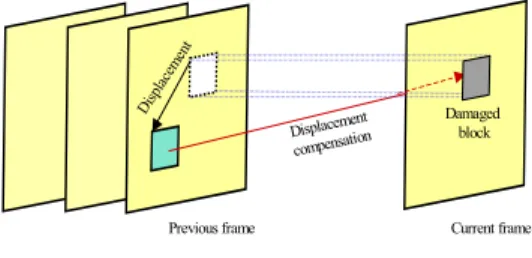
In existing temporal error concealment, correlation between current decoded frame and previous frame is exploited. An important class of error concealment methods is temporal error concealment techniques. Such techniques exploit the high temporal correlation of video signals and conceal damaged blocks using information from correctly received and/or previously concealed pels
in a reference frame. The procedure of temporal error concealment is illustrated in fig.1.
Previous frame Current frame
Displacement compensation Displacement
Damaged block
Fig. 1. General temporal error concealment procedure.
Due to the similarities with motion compensation, this process is also known as motion compensated concealment. The most important stage of this process is to estimate a suitable concealment displacement. This stage is also known as motion information recovery because it attempts to recover or provide an approximation to the original motion vector[12][15]. The most commonly used technique is to replace the damaged motion vector with (0.0).
This technique is usually referred to as temporal replacement. Another technique is to replace the damaged motion vector with the average or the median of neighbouring vectors. A boundary matching technique has also been used to select a suitable replacement from a set of candidate motion vectors. In this technique. each candidate vector is used to conceal the damaged block. The candidate vector that achieves the smoothest transition across the boundaries vector[13-15].
The damaged image is replaced with the MB in the reference frame specified by the motion vector of the damaged MB. A key problem with this approach is that it requires knowledge of the motion information. Due to variable length coding, the motion information of impaired MB may also be damaged and needs to be estimated. Motion compensated concealment, combining temporal replacement with motion estimation, can be used to improve the effectiveness of concealment. For estimation of motion vectors, the following methods have been proposed[15-16]. The simplest way is to set the lost vector as zero and replace the damaged MB with spatially coinciding MB in the
reference frame. It provides reasonably good approximation for video sequences with relatively low activity, e.g. stationary video background, but will fail for fast moving objects. Other methods include the prediction of missing motion vectors from vectors of spatially adjacent blocks and also the average and the median of these vectors. This approach relies on the assumption that motion vector field of moving areas is continuous. The common drawback of these methods is that they always introduce blocking artifacts in the recovered motion areas.
They usually estimate only one MV for a damaged MB. This works well in the areas involving translation motion, where pixels in the MB have almost identical motion. However, when the damaged MB is in the regions containing rotational or multi-directional movements, zooming, or deformation of objects, a simple compensation based on MB copying produces unsatisfied reconstruction artifacts, such as edge fragmentation effects.
Ⅲ. Spatial Error Concealment
In existing spatial error concealment, one implication of the smoothness property of video signals is that a coefficient in a damaged image block is likely to be close to the corresponding coefficients in spatially adjacent blocks. The spatial-domain concealment algorithms interpolate the missing block using decoded information from spatially surrounding image data.
Many spatial error concealment methods have been proposed in the past ten years. They do work better than general spatial error concealment method. However, most of them are time-consuming and complex. It is uncertain that the improvement in quality is worthy of the added massive computation. There may be a trade-off between quality and computation.
Y(i, j)
Y4
Y3
Y2 Y(x, y)
Damaged MB d
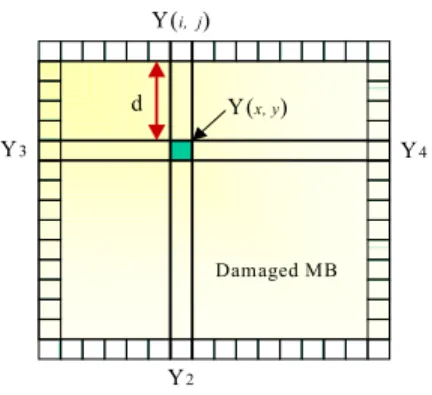
Fig. 2. General spatial error concealment procedure.
A well known spatial error concealment algorithm is based on weighted pixel interpolation.
It estimates each pixel from corresponding pixels in four adjacent MBs on the one pixel wide boundary, as shown in fig.2. The four neighboring pixels are weighted according to the inverse of distance d between the source and destination pixels, and then divided by sum of the distances. The pixel value Y(x,y) is interpolated as Eq. (1):
Y (x, y ) =(i, j )
Σ
NY (i, j ) [15− d ]( i, j )
Σ
Nd
, N =Y1, Y2, Y3, Y4
(x, y) lo st MB (Intra Mode) (1)
The spatial error concealment methods restore the missing blocks using the information in the current frame. In [17], to restore the missing data, a measure of variations (e.g., gradient or Laplacian) between adjacent pixels is minimized. The underlying smoothness assumption of this method limits its ability in restoring image details. In [18], each pixel in a damaged block is interpolated from the corresponding pixels in its four neighboring blocks such that the total squared border error is minimized. In [19] and [20], the missing information is interpolated utilizing spatially correlated edge information from a large local neighborhood. Note that although these edge-based methods are generally more accurate than other approaches, they are computationally more intensive. In [21], a computationally simple, spatial directional interpolation scheme has been proposed. The two
nearest surrounding layers of pixels of a missing block are converted into a binary pattern to reveal the local geometrical structure. Then, the missing pixels are interpolated in a way to preserve the local geometrical structures. In the statistical error concealment methods, for example the one proposed in [22], it is assumed that the pixel values in an image or video signal are realizations of an underlying statistical model (e.g., MRF model). The statistical approaches of spatial error concealment are expected to outperform the deterministic ones, as they provide a systematic way for incorporating the a priori information about the video signal in the restoration procedure.
Ⅳ. Proposed Error Concealment Technique
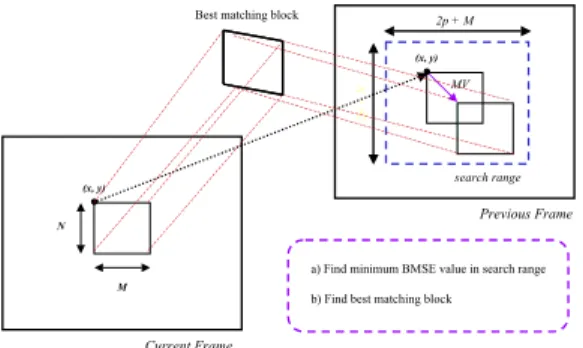
In this paper, we describe an efficient three-step search (TSS) algorithm with low complexity problem on mobile platform for temporal error concealment scheme. The TSS algorithm provides good results and has been widely used for the motion estimation step in the video encoding process. In this method, eight positions around a center in a reference region are compared to a block in the source frame. The eight positions around the center correspond to regular displacements in the row and columns of the reference region. For the first step, the displacement is either four or three pixels, followed by a displacement of two for the second, and finally one for the third. for the center (x, y) and displacement D, the SAD at these positions are calculated, as follows:
1
1 1
1
1 1
1
1 1
1
1 1
1
1 1
1
1 1
2 2 2
2 2 2 2 2 2
3
3 3
3 3
3
3 3
D k = 2 D k = 3 D k = 1
SAD(x-D, y-D) SAD(x, y-D) SAD(x+D, y-D) SAD(x-D, y) SAD(x, y) SAD(x+D, y) SAD(x-D, y+D) SAD(x, y+D) SAD(x+D, y+D)
M N
(x, y)
(x, y)
search range 2p + M
2p + N
Current Frame
Previous Frame MV
Best matching block
a) Find minimum BMSE value in search range b) Find best matching block
Fig. 3. Illustration of temporal error concealment using TSS algorithm.
In temporal error concealment scheme, we propose method using an initial displacement of three, a maximum displacement of ±6 pixels from center of the first nine point grid can result. The TSS algorithm is shown in fig. 3. Spatial interpolation algorithms are also proposed which use the available video data around the missing MB and interpolation formulation to achieve recovery of the missing video data within the MB.
In this paper, we propose an efficient spatial concealment algorithm with low complexity. The progressive interpolation is based on the linear interpolation formulation. However, under the video packet lost environment, the available video data around the missing MB may not be received correctly. In this case, we use the top side and the bottom side pixel value around the missing MB to interpolate the left side pixel value first. Then we use the three sides of pixel, top, bottom, and left value around the missing MB to interpolate the missing pixel value by linear interpolation using Eq. (2) and (3). The statement is illustrated in fig.
4.
Le ft (y ) = Top (15− y ) + Bo ttom y
15 (2)
where Left (y ) denote the left-pel value of missing MB in current frame. on the other hands, missing-pel in lost MB, Pixel(x, y) describe as Eq.
(3):
To p (x ) (1 5− y ) + B ot tom (x ) x + L e ft (y ) (1 5− x )
1 5 + ( 1 5− x )
(3)
Fig. 4. Progressive interpolation scheme for 16x16 MB.
Ⅴ. A Hybrid-Scheme Strategy for Error Concealment
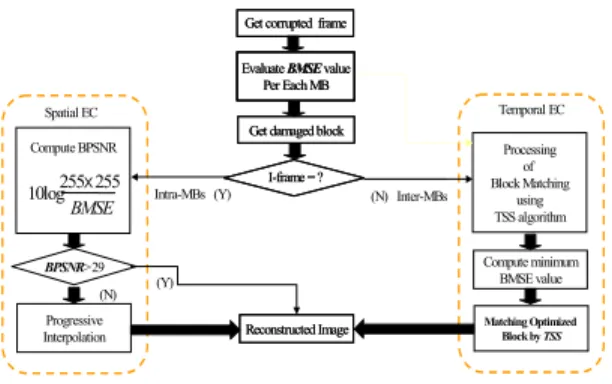
In this paper, we propose a hybrid (temporal and spatial) error concealment scheme to recover video quality of mobile device in MPEG-4 video streaming system on error-prone wireless network.
The proposed hybrid error concealment algorithm has a switching-type architecture. Fig. 5 shows the flow chart of the proposed error concealment technique.
Abbreviated words in the flowchart are defined as follows. A video frame is divided into some MBs with size of N M in this paper. Block mean square error (BMSE) is defined as Eq. (4).
BMSE = 1
N M Σi = 0N− 1 M− 1Σj = 0 ( CMBi, j − PMBi, j )2 (4) where CMBi, j and PMB i, j denote the pixel values in the current frame and the previous frame,
Get corrupted frame Get corrupted frame
I-frame = ? I-frame = ?
Reconstructed Image Reconstructed Image
Intra-MBs (Y) (N) Inter-MBs
Evaluate BMSE value Per Each MB Evaluate BMSE value
Per Each MB
Temporal EC Spatial EC
Progressive
Interpolation Matching Optimized
Block by TSS Processing
of Block Matching
using TSS algorithm Get damaged block
Get damaged block Compute BPSNR
Compute minimum BMSE value BPSNR>29
(N) (Y) BMSE 255 log255x 10
Fig. 5. Proposed error concealment technique.
respectively. Block mean square error between original image and concealed image (BMSEI) is defined as Eq. (5). Then we define the block peak signal-to-noise ratio (BPSNR) as Eq. (6):
BMSE I = 1
N M Σi = 0N− 1 M− 1Σj = 0 ( Ior iginal − I EC )2 (5)
BPS NR = 1 0 l og 255 255
BMS E (6) SAD (sum of absolute difference) is to be used as an error measure in block matching operation for the temporal concealment scheme.
SAD = Σi = 0 N− 1
Σj = 1 N− 1
│a (i, j) − b (i, j) │ (7) At the decoding end, spatial method is applied to I frames, and temporal method is applied to P and B frames. Proposed algorithm works as follows:
i. When the corrupted frame is detected, calculate the BMSE value for every MBs.
ii. If the current MB is lost and it was in the I-frame, the error concealment will be done by the spatial scheme. If the lost MB was in B- or P-frame, the error concealment will be performed by the temporal scheme.
iii. In the spatial error concealment scheme, compute BPSNR value using Eqs. (4) and (6).
If BPSNR value is larger than pre-established threshold value P, early termination of progressive interpolation will be done. Otherwise process goes to the progressive interpolation
routine. We used the parameter P as a value suggested in [21].
iv. In the temporal error concealment scheme, compute SAD value using Eq. (7) and then find a block with minimum BMSE within search window using the TSS algorithm.
Ⅵ. Experiments and Results
The proposed error concealment algorithm is simulated using the open source, mobile MPEG-4 video player. Test video sequences used in the simulation are "Foreman" (384kbps, QP=1) and
"Coast-guard" size of CIF(352x288, QP=1). The encoded data are generated using the MPEG-4 VM(verification model)-18 with different bit rates.
They are used to evaluate the performance of the proposed schemes on a CPU (Intel PXA270, 624MHz) using the Wireless MMXTM instruction set. The PSNR is employed as the objective performance measure.
The experimental results show that the proposed method is better than the existing error concealment algorithms based on C language in the sense of PSNR. It is observed that our proposed technique can be implemented at the mobile platforms (PDAs).
PDA PDA
Streaming Streaming
Network
Streaming Server
Data Files Data Files A/V Encoder A/V Encoder
A/V Source
Saving Live Webcast
Upload Streaming
Server
Data Files Data Files A/V Encoder A/V Encoder
A/V Source
Saving Live Webcast
Upload
Contents Metadata Upload
Contents Metadata Upload
Fig. 6. Overall simulation environment.
5 0 1 0 0 1 5 0 2 0 0 2 5 0 3 0 0 2 8
2 9 3 0 3 1 3 2 3 3 3 4 3 5 3 6 3 7
PS NR (d B)
B i t r a t e ( K b i t / s )
O r i g i n a l ( S e q u e n c e " F o r e m a n " ) P r o p o s e d A l g o r i t h m Existing Algorithm
Fig. 7. The PSNR comparision for "Foreman"
Sequence (CIF, 352x288, QP=1) with bit rate of 384Kbps,
Fig. 8. "Foreman" Sequence (CIF, 352x288, QP=1) with bit rate of 384Kbps. Top three images are from the original sequence. Middle three are from the decoded sequences with existing concealment method. Bottom three are from the result using the proposed concealment method.
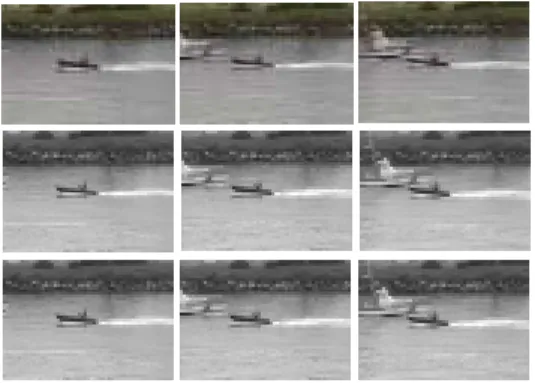
Fig 9. "Coastguard" Sequence (CIF, 352x288, QP=1) with frame rate of 30Hz. Top three are the decoded Y-pictures with existing concealment algorithm. Bottom three are the corresponding Y-ones with proposed concealment method.
(a)
(b) (c) (d)
Fig. 10 An intra-coded frame of the "Foreman"
sequence at 6% packet loss rate: (a) error free decoded frame (b) 6% corrupted frame(top) and 10% corrupted frame (bottom) (c) general linear interpolation for 6% (top) and 10% (bottom) PLRs (d) proposed algorithm for 6%(top) and 10%
(bottom) PLRs
Table 1. (a) PSNR(dB) measurement comparison for the "Foreman" video sequence at different packet loss rates.
PLRs 1% 3% 5% 10%
general algorithm 33.62 32.21 31.07 29.96 proposed algorithm 33.76 33.42 31.92 30.47
Table 2. Computation time(sec) measurement comparison for the "Foreman" video sequence on mobile device.
PLRs No Wireless MMX WMMX based Mobile
Device
General Proposed General Proposed
1% 4.15 4.12 2.89 2.67
3% 4.22 4.23 3.06 2.89
5% 4.89 4.61 3.61 3.12
10% 5.32 4.97 4.01 3.93
In spatial error concealment simulation for channel burst errors, we get the results at different packet loss rates (PLRs). Fig. 10 and tables 1and 2 show the simulation results for a "Foreman" intra coded frame with 6%(top) and 10%(bottom) packet
loss rates corrupted by burst errors. The results show that the performance of the proposed method is perceptually superior to general interpolation method on mobile device.
Ⅶ. Conclusions
In this paper, we proposed a new error concealment scheme based on the latest video standard MPEG-4 Part-2, MPEG-4 Part-10, and H.264/AVC video standard to improve error concealment performance for video consumer applications on a mobile platform with performance.
Proposed error concealment scheme includes methods of spatial concealment to reduce complexity of progressive interpolation with early termination scheme using BPSNR and BMSE energy values, and a method of temporal concealment to combine TSS algorithm with low complexity.
Conclusions can be drawn by observing the simulation results of transmission over real-time IP networks. The proposed technique outperforms existing error concealment algorithms adopted in the video decoder based on MPEG-4 VM-18 on error prone environments over wide range of bit rate and BER. The proposed one does not require any structure change on MPEG-4 video encoder and transmission technology. Proposed algorithm could be easily embedded in video decoder and widely employed in multiple video mobile devices with PXA 270 processor. Finally, with the proposed error concealment approach, better video quality and reduced computational complexity could be achieved.
Future work will be focused on the technology of error concealment with temporal-spatial concealment function, designing mobile codec using Wireless MMX instruction set, and development of multimedia application functions for mobile platforms.
References
[1] Yao Wang, and Qin-fan Zhu, "Error control and concealment for video communication: A Review,"
Proceedings of the IEEE, 86(5), pp.974-997, 1998
[2] Huifang Sun, Xuemin Chen, Tihao Chiang, Digital Video Transcoding for Transmission and Storage, CRC Press, 2005
[3] Iain E. G. Richardson, H.264 and MPEG-4 Video Compression: Video Coding for Next generation Multimedia, John Wiley & Sons, 2003 [4] Yao Wang, Stephan Wegner, "Error resilience video coding techniques, Real-time video communication over unreliable networks," IEEE Signal Processing Magazine, Vol.17, pp.61-82, 2000 [5] Rob Koenen, ”Overview of the MPEG-4 Standard,” ISO/IEC JTC1/SC29/WG11 M4030, 2001.
[6] Soares L.D., Pereira F., ”MPEG-4: a flexible coding standard for the emerging mobile multimedia applications,” The Ninth IEEE international Symposium on Personal, Indoor and Mobile Radio Communications, Volume:3 pp.1335 -1339, 1998.
[7] Requirements Group, ”MPEG-4 Applications,”
ISO/IEC JTC1/SC29/WG11 MPEG 99/N2724, March 1999.
[8] Talluri R., ”Error-resilient video coding in the ISO MPEG-4 standard,” IEEE Communications Magazine, Volume: 36 Issue: 6, pp.112 -119, June, 1998.
[9] Bo Yan, Kam W. NG, ”A Survey on the Techniques for the Transport of MPEG-4 Video Over Wireless Networks,” IEEE Transactions on Consumer Electronics, Volume:48, pp.863-873, November 2002.
[10] Wang Yong, Srinath Mandyam D., ”Error Resilient Video Coding with Tree Structure Motion Compensation and Data Partitioning,” The 12th International Packetvideo Workshop (PV 2002), 2002.
[11] Bhattacharyya K., Jamadagni H.S., ”DCT coefficient-based error detection technique for compressed video stream,” IEEE International Conference on Multimedia and Expo, Volume:3, pp.1483 -1486, 2000.
[13] Wen-Jeng Chu, Jin-Jang Leou, ”Detection and concealment of transmission errors in H.261 images,”
IEEE Transactions on Circuits and Systems for Video Technology, Volume: 8 Issue:1, pp.74 -84, Feb 1998.
[14] Jihua Cao, Zhaohua Wang, ”Analysis and detection of transmission errors for MPEG-2 video signa,l” The 2000 IEEE Asia-Pacific Conference on Circuits and Systems, pp.105 -108, 2000.
[15] Shirani, S.; Kossentini, F.; Ward, R. "Error concealment methods, a comparative study,"
Electrical and Computer Engineering, 1999 IEEE Canadian Conference, Volume 2, 9-12 May 1999 pp. 835-840 vol.2
[16] Al-Mualla, M.E.; Canagarajah, N.; Bull, D.R.;"Error concealment using motion field interpolation," ICIP 98 Proceedings, vol.3, pp 512-516, Oct. 1998.
[17] Y. Wang, Q. F. Zhu, and L. Shaw, “Maximally smooth image recovery in transform coding,” IEEE Trans. Commun., vol. 41, pp. 1544–1551, Oct. 1993.
[18] S. S. Hemami and T. H. Y. Meng, “Transform coded image reconstruction exploiting interblock correlations,”IEEE Trans. Image Processing, vol. 4, pp. 1023–1027, July 1995.
[19] H. Sun andW. Kwok, “Concealment of damaged block transform coded images using projection onto convex sets,” IEEE Trans. Image Processing, vol. 4, pp. 470– 477, Apr. 1995.
[20] W. Kwok and H. Sun, “Multi-directional interpolation for spatial error concealment,” IEEE Trans. Consumer Electron., vol. 39, pp. 455–460, Aug. 1993.
[21] W. Zeng and B. Liu,
“Geometric-structure-based error concealment with novel applications in block-based low bit-rate coding,” IEEE Trans. Circuits Syst. Video Technol., vol. 9, pp. 648–665, June 1999.
[22] P. Salama, N. Shroff, E. J. Coyle, and E. J.
Delp, “Error concealment in encoded video streams,” in Signal Recovery Techniques for Image and Video Compression and Transmission, N. P. Galatsanos and A. K. Katsaggelos, Eds.
Boston, Kluwer Academic, 1998.
저 자 소 개
박 정 범 (학생회원)
2003년 : 단국대학교 전자공학과 졸업 (공학사)
2005년 : 단국대학교 대학원 전 자·컴퓨터 공학과 (석사과정) 2003년 7월~현재 : 전자부품연구 원(KETI) 위촉연구원
<주관심분야> 영상처리, 동영상압축, 멀티미디어 통신
어 진 우 (정회원)
전기전자학회논문지 (Journal of IKEEE) Vol. 8, No.1, July 2004 참조.