I. Introduction
A number of studies have been carried on to
†
Corresponding author: SooKyeong Park, Tel.+82-52-259-2894 E-mail: [email protected]
This research is part of a master’s thesis.
reveal more about the relations between consumers’ traits and their purchase behaviors since the purchase behaviors of consumers vary
The Effect of Fashion Product Consumers’ Need for Uniqueness on their Criteria of Clothing Selection and
Switching Intentions
Soojin Park Sookyeong Park ․
†Dept. of Clothing and Textiles, University of Ulsan
Abstract
The purpose of this study was to investigate the The effect of fashion consumer's need for uniqueness in their clothing purchase behavior and switching intention. A total of 332 cases were included as the subjects of this study and a survey method was used. The data were analyzed by factor analysis, reliability analysis, t-test and multiple regression analysis using the SPSS 22.0 statistical program. The results were as follows. 1. The 3 dimensions (creative choice, unpopular choice, and avoidance of similarity) were extracted from the consumer's need for uniqueness and consumer divided high uniqueness group, middle uniqueness group, low uniqueness group. 2. The 3 factor (esthetic, functional, practical) were extracted from the clothing selection criteria. The three group had a significant difference in clothing selection and switching intention. Aesthetic factor and practical factor were the highest in high uniqueness group. 3. The need for uniqueness has influence on the aesthetic factor and practical factor. The creative choice factor had positive effect on the aesthetic and practical factor, yet unpopular choice factor had negative effect on the practical factor. The need for uniqueness and aesthetic factor has positive influence on brand switching intentions. 4. There was difference in unpopular choices factor by gender. A monthly average expenditure on fashion products had a significant difference in three kind of need for uniqueness. Results of this study provide a basis understand need for uniqueness and their effect on consumer behavior.
Keywords : Need for uniqueness, Fashion product, Criteria of clothing selection, Switching
intentions
according to their personal traits (Kim, 2008).
Individual taste of consumers is considered to be an important factor in explaining purchase behaviors. Diverse desires of customers toward products can be explained by the notion that consumers have desires to be different from others, which makes them want to express their personal characteristics through consuming products (Jung & Hwang, 2012). Such desires to be different from others can be described as the need for uniqueness. Individuals who seek to differ will pursue anticonformity, creativity, self-respect and independence (Synder &
Fromkin, 1977). Desire to be unique is also expressed as autonomy or identity (Cho, 2002).
Thus, more and more studies are found these days covering consumers’ need for uniqueness (Park & Yoo, 2012; Yuan & Kim, 2015). Fashion products are especially inclined to help consumers express their personal identities (Jeon
& Park, 2005), which makes it critical to study consumers’ need for uniqueness on fashion products.
Besides, the standards of selecting fashion products that consumers are known to have play a significant role in their purchase of clothes (Kang & Park, 2003). There have been many studies on criteria of clothing selection that consumers have when they purchase fashion goods. Studies investigated consumer’s criteria of clothing selection related to their lifestyle (Han, Yang, & Kim, 2002), shopping tendency (Lee & Lee, 2003), types of characteristics (Oh, 2004), consumers’ perceptions on their body shapes (Cho, 2005) and consumers’ brand choice behavior and their satisfaction (Kang &
Park, 2003). Consumers have shown to have diverse criteria of clothing selection in which they consider such factors as design, price, fitness, color and so on. Individuals have
different tasks or preferences in those factors according to their personal characteristics. Thus, criteria of clothing selection is worth studying for developing marketing strategy. Though practical studies on need for uniqueness are actively being made, we don’t seem to have enough study on specific factors shaping need for uniqueness, in turn which affect criteria of clothing selection. In studying such factors, we need to get the picture of the comprehensive characteristics of fashion products consumers with the understanding of criteria of clothing selection on the basis of the detailed factors comprising need for uniqueness.
The purpose of this study is to know the fashion product consumer’s need for uniqueness, to figure out the effects of need for uniqueness on criteria of clothing selection and switching intention. In addition, to find out the difference of demographic characteristics.
II. Theological Background
1. Need for Uniqueness
Human beings have strong inclinations to maintain and express their own individual personality which distinguishes them from others.
This is related to self identity that people
acknowledge themselves as different beings
from others (Gim & Yoo, 2003). Need for
uniqueness lies upon this assumption. People try
to satisfy their need to be unique in their own
ways by doing some exclusive behaviors to
enhance their self-esteem and to reduce
negative feelings (Lynn & Harris, 1997). They
would want to satisfy their need for uniqueness
by showing off their belongings or their styles in
social interaction settings. According to Tepper
and Hunter(2001), consumers’ desire to be unique are expressed as mainly three different kinds of behaviors. The first is unique choice.
This is to choose products that are rather one of a kind in order to express uniqueness of themselves creating their own styles. Their own unique styles are established by purchasing, collecting, or decorating themselves with unique goods. The consumers who choose to buy such unique goods try to distinguish themselves from others and at the same time they also take others’ good choices into account. The second is avoidance of similarity which is a tendency to lose interest in whatever became obsolete or common and not to choose to buy such goods.
Individuals with a keen need for uniqueness tend to avoid purchasing products or brands that seem to be plain and common since they disregard using plain items. People with a strong need to avoid similarity, who think they are unique and special, will stop purchasing and using those products that used to be unique but later widespread in the society through public imitation since they no longer work to make them look distinctive. They will keep looking for something new to avoid similarity. The third is unpopular choice, which is to choose or use some products or brands that are contrary to social norms. These people try to evade social norms in order to look distinguished. As much as creative choice, unpopular choice also results in giving a push up to their social image. When such an unpopular choice gets a social approval, they will be seen as a radical frontier or a fad leader, which in turn will make them look outstanding (Heckert, 1989).
Studies on the need for uniqueness originally started in the psychology and sociology area, and now they are also being utilized in exploring the relations between consumers’ behaviors and
marketing strategies (Kim, 2010). The theory of need for uniqueness developed by Synder and Fromkin(1980) involves various areas of characteristics resulting from diverse factors. The other aspect of need for uniqueness is to examine the relationship between the need for uniqueness and product and brand characteristic (Jung & Hwang, 2012) or consumer’s intention (Jeon & Park, 2015). Workman and Kidd(2000), in their study that analyzed consumers’ need for uniqueness in fashion field, suggested that there is a significant difference in the need for uniqueness between fashion leaders and followers that fashion leaders have higher degree of need for uniqueness than followers do.
People with higher degree of need for uniqueness are more likely to be independent, incoperative, innovative and to behave in the way that they can show their uniqueness without being afraid of getting social censure. They also show a lot of interest in brand new styles and peculiar products. They are innovative in choosing clothes for them always willing to try out something new. According to Jung and Hwang(2012)’s study about the consumer preference according to consumer’s need for uniqueness, types of brand name and fashion goods found out the interaction effect upon a favorite level and purchase intention by need for uniqueness. Jeon and Park(2015) studied that consumer’s need for uniqueness was indirectly related to the buying intentions through interest for luxury brands. The unpopular choice was negatively related to fashion interest, whereas the creative choice was positively related to it.
Thus and so, need for uniqueness works as a significant factor in predicting consumers’
purchase behaviors. Moreover, since fashion
products are more inclined than any others to
be used for expressing personal identity
(Solomon & Rablot, 2004). And many recent studies focused on the relationship and impact of need for uniqueness on product, brand characteristic, consumer’s intention, consumer’s attitude. So, more of further studies are needed on the need for uniqueness for fashion products.
2. Criteria of clothing selection
Criteria of clothing selection is factors or characteristics used by consumers to compare and evaluate many possible alternatives when they decide to choose fashion products. During the process of consumers’ decision making to buy fashion products, how they evaluate the products’ features greatly affects their decision making. Therefore, it is basically fundamental for a fashion goods company to figure out consumers’ criteria of clothing selection, which allows the company to be aware of how consumers understand the characteristics of the products and to be able to set up proper marketing strategies for their products (Park &
Park, 2009).
Earlier studies on criteria of clothing selection usually analyzed the criteria into two aspects such as fundamental traits and superficial traits;
outer properties and inner properties (Lee, 1997), Lee(2000) used 20 items to evaluate criteria of clothing selection, who derived out three factors such as esthetic aspects, practical aspects and symbolic expressive aspects concerning the criteria of clothing selection.
Recent studies, however, tend to dissect the criteria more in detail (Cho, 2005; Je, 2002;
Kang & Park, 2003; Park & Park, 2009). Kang and Park(2003) insisted that for female adults, the criteria are significant in such order as convenience of keeping, nobility/prestigious
brands, color/style, uniqueness, and practicality.
Cho(2005) used 35 items to evaluate criteria of clothing selection before she derives out five factors such as symbolic, practical, trendy, esthetic, and economical aspect concerning the criteria, out of which esthetic aspect is proved to be the most significant criterion. Park and Park (2009) studied the behaviors of jeans consumers by observing behaviors of university students’ purchasing jeans to learn about the difference in criteria of jeans selection according to demographical characteristics. The criteria were extracted into external criteria, internal/aesthetic criteria, internal/quality criteria, not esthetic, superficial and functional. Women respondents considered aesthetic criteria and quality criteria more importantly than men did.
Je(2012) found out that criteria of clothing selection such as material, function, design, style, clothing at various place impact on consumers satisfaction.
As shown above, there have been a number of previous studies concerning criteria of clothing selection as a significant factor in purchase decision, while studies are rarely found that are focussed on the need for uniqueness for criteria of clothing selection. This study is to understand the effects of the need for uniqueness from fashion products consumers upon their criteria of clothing selection.
3. Switching Intention
Switching intention largely works as a deciding
factor of switching behavior. Even when the
chosen alternative is satisfactory and fulfilling
expectations, if the alternative not taken is
acknowledged to be more appealing, switching
intention occurs. Switching intention is an
inclination that makes consumers want to move
from brand to brand. Consumers are more likely to purchase products by one certain brand over and over again when there are not many choices (Shin, 2009). However, in this modern society where consumers have a lot of brands out of which they can choose from, consumers may well shift brands without any specific reasons just to satisfy their needs to diversify their options (Kim, 2002). Consumers’s switching intention and the factors behind it are worth studying for companies planing to launch a new product or for ones that are marketing toward potential consumers who would be interested in buying rival brand’s products, wishing to keep their current status in the market (Kim, 2001).
The factors affecting consumers’ switching intention. According to the study by Lee(2000) on the switching intention for rival brand in jeans, discount rate and discount amount has significantly influenced the group of consumers interested in low price brands in their switching intention, while having not much influence on the group interested in higher price brands.
Kim(2002)’s study revealed that consumers’
complaint about service matter is also a significant factor that affects consumers’
switching intention. Chung and Jang(2012)’s study mentioned that consumer’s satisfaction of store attribute such as store comport, salesman service, product diversity, store location, price impact on the switching intention.
In the perspective of consumer behavior, consumers typically have a tendency that they are easily tired or bored of the same thing over time and are curious of anything new.
Consumers are always ready to turn to something new since they have desire to diversify their choices. In this respect, the need for uniqueness affects consumers’ switching intention not because they are not satisfied with
the previous choice, but because they have need to have more diverse options to choose from. Thus we will examine how consumers’
need for uniqueness affects switching intention.
. Research Methods
Ⅲ
1. Research objectives
The purpose of this study is to understand the need for uniqueness and its effect on their criteria of clothing selection and switching intention. Research objectives are following.
First, examine the consumers' need for uniqueness and categorize the consumers according to the need for uniqueness. Second, figure out the criteria of clothing selection and switching intention and its difference between groups. Third, examine the impact of need for uniqueness on criteria of clothing selection, and switching intention. Last, find out the difference in the need for uniqueness according to the demographic factors.
2. Data collection
For this study survey method was used. Study aims to figure out the need for uniqueness from fashion products consumers, the participants were undergraduate students in their twenties who are more interested in fashion products than any other age group (Huh & Lee, 2011).
The participants were selected by using
convenient sampling method targeting those who
live in Busan, Gyeongnam and Seoul region in
Korea. 380 questionnaires were distributed and
332 questionnaires were analysed after excluding
unreliable or no response questionnaires.
Table 1. Demographic Characteristic of Participants
General characteristic N %
Gender female
male
170 162
51.2 48.4
Age
Gyeongnam Pusan
Seoul
219 61 52
66.0 18.4 15.7 A monthly average
expenditure on fashion product
under 100,000 Won 100,000 200,000 Won ~ 200,000 400,000 Won ~
over 400,000 Won
120 151 46 15
36.1 45.4 13.9 4.5
Total 332 100
3. Measurements
Preliminary survey was taken to 63 undergraduate students in their twenties in Gyeongnam region, and the measurement was developed based on the result of the preliminary survey and the previous studies.
For the measurement for consumers' need for uniqueness, the one developed by Tepper and Hunter(2001) and Korean version of Consumers' Need for Uniqueness Scale (K-CNFU) developed by Kim and Yoo(2003) were used to be adjusted for fashion products and 20 questions were selected through preliminary survey. Criteria for clothing selection questionnaires were modified and revised and researchers have selected 18 questions based on previous studies (Cho, 2005;
Park & Park, 2009). 3 questions related to switching intention were selected based on previous studies (Kim, 2002; Shin, 2009). They were measured with 5-point Likert scale.
4. Data analysis
The data collected from the study has been analysed by SPSS version 22.0 using factor
analysis, reliability analysis, k-mean cluster analysis, ANOVA and multiple regression analysis.
. Research Results and
Ⅳ
Discussions
1. Need for uniqueness
1) Factor analysis of the need for uniqueness
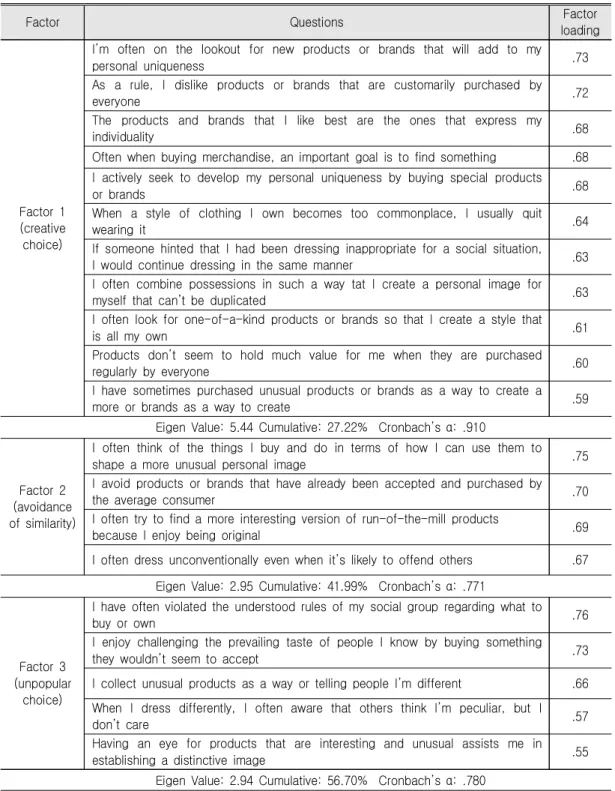
Factor analysis with Varimax Rotation was used to know the need for uniqueness. The three factors extracted was shown to have overall explanation power of 56.71% out of whole dispersion (Table 2). Three factor’s Cronbach’s ɑ reliability were .910, .771. .780, so the reliability were sufficient.
These result is consistent with the previous research (Jung, 2010; Kim, 2009; Kim, 2010) that proposes the ‘need for uniqueness’ is consists of three major lower dimensions of
‘creative choice’, ‘avoidance of similarity,’ and
‘unpopular choice.’
Table 2. Factor Analysis of the Need for Uniqueness
Factor Questions Factor
loading
Factor 1 (creative
choice)
I’m often on the lookout for new products or brands that will add to my
personal uniqueness .73
As a rule, I dislike products or brands that are customarily purchased by
everyone .72
The products and brands that I like best are the ones that express my
individuality .68
Often when buying merchandise, an important goal is to find something .68 I actively seek to develop my personal uniqueness by buying special products
or brands .68
When a style of clothing I own becomes too commonplace, I usually quit
wearing it .64
If someone hinted that I had been dressing inappropriate for a social situation,
I would continue dressing in the same manner .63
I often combine possessions in such a way tat I create a personal image for
myself that can’t be duplicated .63
I often look for one-of-a-kind products or brands so that I create a style that
is all my own .61
Products don’t seem to hold much value for me when they are purchased
regularly by everyone .60
I have sometimes purchased unusual products or brands as a way to create a
more or brands as a way to create .59
Eigen Value: 5.44 Cumulative: 27.22% Cronbach’s : .910 ɑ
Factor 2 (avoidance of similarity)
I often think of the things I buy and do in terms of how I can use them to
shape a more unusual personal image .75
I avoid products or brands that have already been accepted and purchased by
the average consumer .70
I often try to find a more interesting version of run-of-the-mill products
because I enjoy being original .69
I often dress unconventionally even when it’s likely to offend others .67 Eigen Value: 2.95 Cumulative: 41.99% Cronbach’s : .771 ɑ
Factor 3 (unpopular
choice)
I have often violated the understood rules of my social group regarding what to
buy or own .76
I enjoy challenging the prevailing taste of people I know by buying something
they wouldn’t seem to accept .73
I collect unusual products as a way or telling people I’m different .66 When I dress differently, I often aware that others think I’m peculiar, but I
don’t care .57
Having an eye for products that are interesting and unusual assists me in
establishing a distinctive image .55
Eigen Value: 2.94 Cumulative: 56.70% Cronbach’s : .780 ɑ
Table 3. Grouping by Need for Uniqueness (N=332) Group
Factor
High (N=71)
Middle (N=143)
Low
(N=118) F
Creative choice 3.79 3.06 2.21 273.139
***Avoidance of similarity 3.57 2.74 1.97 205.330
***Unpopular choice 3.24 2.19 1.72 231.218
******
p<.001
2) Categorization of consumer groups based on the need for uniqueness
Table 3 shows the result of the group analysis ran for consumer categorization based on the need for uniqueness using K-mean cluster analysis. High need for uniqueness group were 71 responses(21.4%), middle need for uniqueness group were 143 responses(43.1%), and low need for uniqueness group were 118 responses(35.5%).
2. The difference of each groups of need for uniqueness in criteria of clothing selection and switching intention
1) Factor analysis of the criteria clothing selection
The clothing selection factors were analyzed using Varimax Rotation through principal component analysis (Table 4). After removing two questions with under .30 factor loading and factors with credibility under .05, three factors were extracted and had overall explanation power of 52.36%. Three factor’s Cronbach’s ɑ reliability were .734, .741. .670, so the reliability were sufficient.
Such results support the previous research categorization done by Cho(2005) which had symbolism, functionality, mentality, and convenience
as lower dimension of clothes selection criteria.
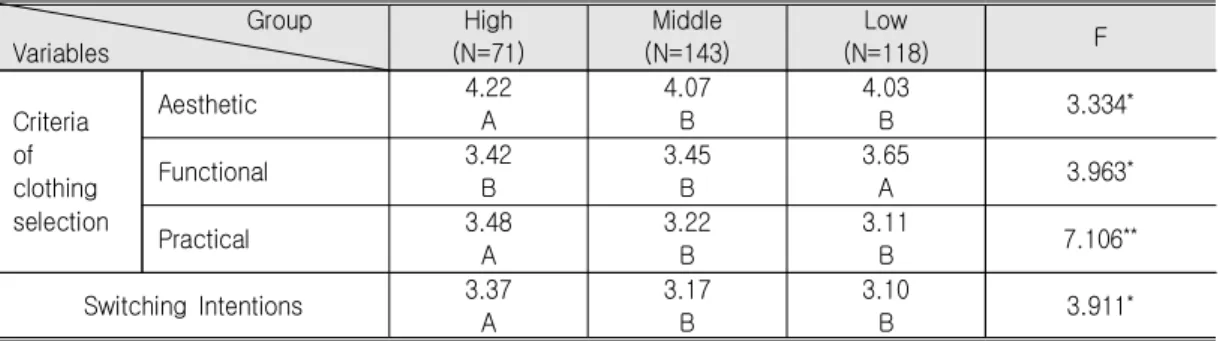
2) The difference between each groups in clothing selection and switching intentions depending on the need of uniqueness
ANOVA and Ducan test were used in order to
find out the difference among group and the
result is shown in table 5. The three group had
a significant difference in clothing selection
(aesthetic factor, functional factor, practical
factor) and switching intention. Aesthetic factor
and practical factor were the highest in high
uniqueness group, while function factor was the
highest in low uniqueness group. The fact that
there is a significant difference in aesthetic
factors shows that clothing is a visible symbolic
item that best represents one’s identity as
described in the research by Solomon and
Rabolt(2004). Practical factor was the highest in
high group, that’s because the factor involved
such as ‘material’ and ‘hide my figure’. It is
possible high group had much importance than
other group. Switching intention was the highest
in high uniqueness group. This supports the fact
that people try to express their uniqueness and
characteristics, which distinguishes themselves
from others, because what they wear, along with
what they look like, provides an important clue
in how others perceive the wearer.
Table 4. Factor Analysis of the Criteria of Clothing Selection
Factor Questions Factor
loading
Factor 1 (aesthetic factor)
Color .715
Coordinating with other clothing .709
Suitable for my style .702
Fit .625
Appearance .567
Personality expression .555
Eigen Value: 3.707 Cumulative:19.78% Cronbach’s : .734 ɑ
Factor 2 (Functional
Factor)
Comfortable for movement .802
Easy to wear .703
Touch .665
Texture .529
Eigen Value: 2.248 Cumulative:36.18% Cronbach’s : .741 ɑ
Factor 3 (practical
factor)
Care for management .739
Price .693
Material .655
Hide my figure .627
Eigen Value: 2.813 Cumulative:52.36% Cronbach’s : .670 ɑ
Table 5. Difference of Criteria of Clothing Selection and Switching Intentions by Need for Uniqueness Group
Variables
High (N=71)
Middle (N=143)
Low
(N=118) F
Criteria of clothing selection
Aesthetic 4.22
A
4.07 B
4.03
B 3.334
*Functional 3.42
B
3.45 B
3.65
A 3.963
*Practical 3.48
A
3.22 B
3.11
B 7.106
**Switching Intentions 3.37
A
3.17 B
3.10
B 3.911
**
p<.05,
**p<.01, Duncan test(A>B)
3. The relationship between the need for uniqueness, the criteria of clothing selection, and brand switching intention
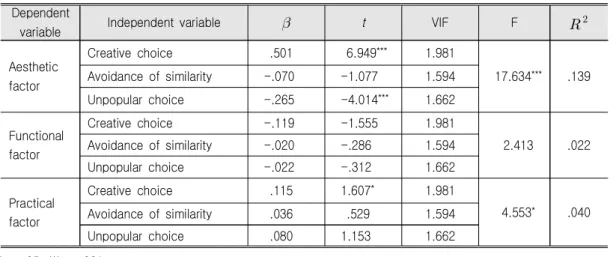
1) The effect of the need for uniqueness on the criteria for clothing selection
The table 6 shows the result of multiple
regression analysis implemented to identify the
effects that the need for uniqueness has on the
criteria of clothing selection and brand switching
intentions. The need for uniqueness has
influence on the aesthetic aspect and practical
Table 6. The Effect of Need for Uniqueness on the Criteria of Clothing Selection Dependent
variable Independent variable t VIF F
Aesthetic factor
Creative choice .501 6.949
***1.981
17.634
***.139
Avoidance of similarity -.070 -1.077 1.594
Unpopular choice -.265 -4.014
***1.662
Functional factor
Creative choice -.119 -1.555 1.981
2.413 .022
Avoidance of similarity -.020 -.286 1.594
Unpopular choice -.022 -.312 1.662
Practical factor
Creative choice .115 1.607
*1.981
4.553
*.040
Avoidance of similarity .036 .529 1.594
Unpopular choice .080 1.153 1.662
*
p<.05,
***p<.001
factor on clothing selection, in order of greater effect to less degree. To be more specific, aesthetic factor was positive influenced by creative choice ( =.501) and negative effect by unpopular choice ( =-.265). Practical factor got an effect on creative choice ( =-.115).
Functional factor didn’t get any effect. This means that criteria such as expression of individuality, harmony with other apparels, and matching with one’s style plays an important role in clothing selection with high need for uniqueness. The avoidance of similarity had not significant effect on criteria of clothing selection, and also three kind of need for uniqueness had not significant effect on functional factor. It means that consumer’s need for uniqueness had little interest in functional factor than other factors.
2) Effect of the need for uniqueness and criteria for clothing selection on the switching intention
This effect was also studied through the multiple regressive analysis, and the above table 7 is the
result of the analysis which shows that switching intention got an significant effect on need for uniqueness ( =.124) and aesthetic criteria (
=.165) in criteria of clothing selection. This means that higher need for uniqueness and greater interest in aesthetic aspect in clothing selection results in higher intention in brand switching in the following purchase.
4. The difference of the need for uniqueness by demographics
In order to figure out the difference in the need for uniqueness according to the demographics, t-test, ANOVA were used.
Analysis result has shown that there has difference in unpopular choices factor.
As for groups making unpopular choices
uniqueness factor, males had higher need for
uniqueness than females which can be
interpreted that males making greater number of
unpopular choices have great strong need for
uniqueness which leads to higher tendency of
breaking the general rule of clothing.
Table 7. The Effect of Need for Uniqueness and Criteria of Clothing Selection on Switching Intentions Dependent
variable
Independent
variable t VIF F
Switching Intentions
Need for Uniqueness .124 2.085
*1.190
2.814
*.033
Aesthetic factor .165 2.129
*1.132
Functional factor .033 .508 1.427
Practical factor .058 .902 1.383
*
p<.05,
**p<.01,
***p<.001
Table 8. Difference in Need for Uniqueness by Gender Gender
Factor
Female (N=170)
Male
(N=162) t
Creative choice 2.93 2.91 .212
Avoidance of similarity 2.72 2.59 1.476
Unpopular choice 2.16 2.33 2.161
**
p<.05
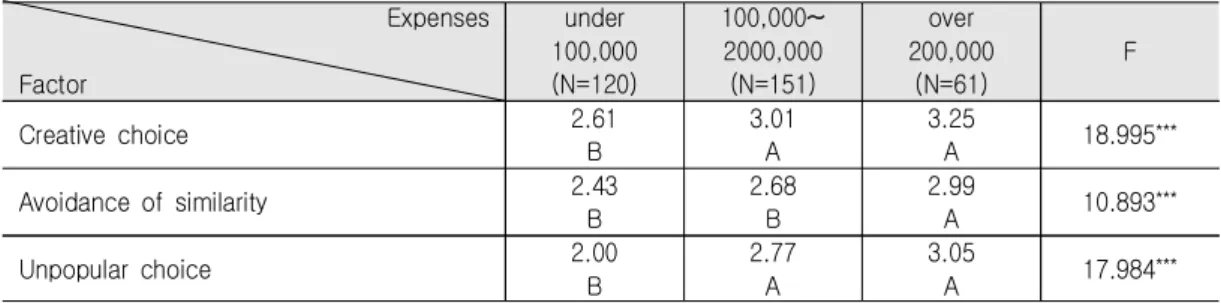
Table 9. Difference in Need for Uniqueness by Expenses for Clothing Purchasing per Month Expenses
Factor
under 100,000 (N=120)
100,000~
2000,000 (N=151)
over 200,000
(N=61)
F
Creative choice 2.61
B
3.01 A
3.25
A 18.995
***Avoidance of similarity 2.43
B
2.68 B
2.99
A 10.893
***Unpopular choice 2.00
B
2.77 A
3.05
A 17.984
*****