• 검색 결과가 없습니다.

First Case of Cellular Cannibalism in Small-Cell Carcinoma of the Bladder Detected in Peripheral Blood

N/A
N/A
Protected

Academic year: 2021

Share "First Case of Cellular Cannibalism in Small-Cell Carcinoma of the Bladder Detected in Peripheral Blood"

Copied!
3
0
0

로드 중.... (전체 텍스트 보기)

전체 글

(1)

ISSN 2234-3806 • eISSN 2234-3814

400 www.annlabmed.org https://doi.org/10.3343/alm.2019.39.4.400 Ann Lab Med 2019;39:400-402

https://doi.org/10.3343/alm.2019.39.4.400

Letter to the Editor

Diagnostic Hematology

First Case of Cellular Cannibalism in Small-Cell

Carcinoma of the Bladder Detected in Peripheral Blood

Hyein Kang, M.D.

1

, Do-Hoon Kim , M.D., Ph.D.

1

, Wonmok Lee, M.D., Ph.D.

1

, Jungsook Ha, M.D., Ph.D.

1

, Namhee Ryoo, M.D., Ph.D.

1

, Dong-Seok Jeon, M.D., Ph.D.

1

, and Hye Ra Jung, M.D., Ph.D.

2

Departments of

1

Laboratory Medicine and

2

Pathology, Keimyung University School of Medicine, Daegu, Korea

Dear Editor,

Cellular cannibalism, emperipolesis, and entosis are similar yet subtly different phenomena related to cell engulfment. Cellular cannibalism refers to one cell engulfing another living cell of its own or another type; emperipolesis refers to the presence of vi- able, undamaged hematopoietic cells in the cytoplasm of a host cell; and in entosis, a cell engulfs another cell of the same type, leading to the death of the engulfed cell [1]. Of these, cellular cannibalism is a characteristic morphological feature observed exclusively in aggressive malignancies that was first described in tumor cells in 1891 [2]. Cannibalistic cells ingesting other cells were noticed initially on cytological smears showing a vacu- ole containing the ingested cell [3]. Cellular cannibalism has been described in various types of tumors [4-6] and is closely related to the aggressiveness, degree of anaplasia, invasiveness, and metastatic potential of the tumor [1]. Cellular cannibalism in tissue sections [6] and malignant effusions of body fluids [7]

has been reported to indicate poor prognosis, but there is no such a report regarding peripheral blood (PB). We report the first case, to our knowledge, of cellular cannibalism in small-cell carcinoma of the bladder detected in PB. This retrospective study was approved by the Institutional Review Board/Ethics Committee of Dongsan Medical Center, Daegu, Korea, which

waived the need for informed consent.

The patient was a 66-year-old man with small-cell carcinoma of the urinary bladder that had been diagnosed nine months previously. He had received five cycles of chemotherapy. He also had been recently diagnosed as having anemia and thrombocy- topenia without any clinical symptoms. He was admitted to the hematology department of Dongsan Medical Center in January 2018 for transfusion and further evaluation to determine the cause of cytopenia. His complete blood count showed the fol- lowing: white blood cells, 5.45×10

9

/L; Hb, 98 g/L; and platelets, 24 ×10

9

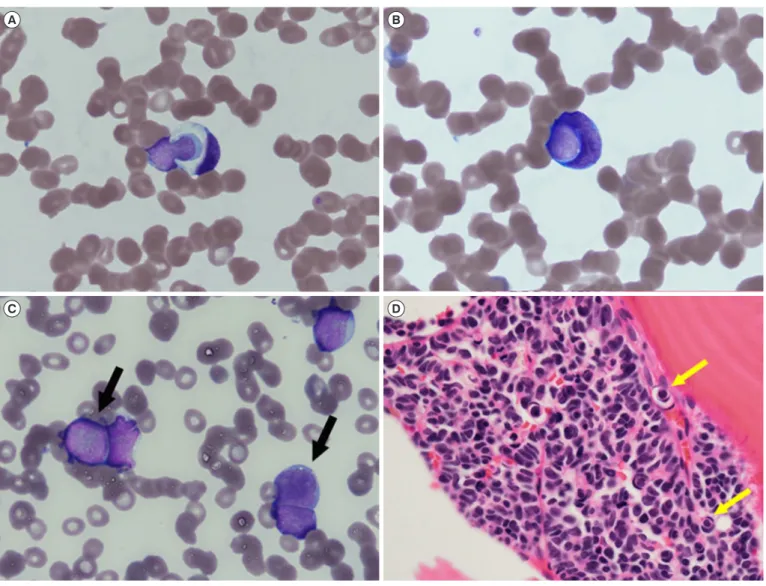
/L. A PB smear showed a few suspicious tumor cells (5% of total nucleated cells) exhibiting cellular cannibalism, which is characterized by a typically large cell with a crescentic nucleus engulfing another smaller cell with a round-to-oval nucleus rimmed by a halo of phagocytic vacuoles (Fig. 1A-C). Some flattening or

“molding” of adjacent cells was observed (Fig. 1C), which is a feature of small-cell carcinoma [8]. Subsequent bone marrow (BM) aspiration and biopsy revealed a markedly increa sed number of suspicious tumor cells exhibiting cellular cannibalism (Fig. 1D). The cells were large with a high nucleus-to-cytoplasm ratio, fine chromatin pattern, and scant cytoplasm. Myeloperoxi- dase and periodic acid-Schiff staining were negative. Flow cyto- metric analysis of the suspicious tumor cells in BM aspirate

Received: July 26, 2018

Revision received: January 2, 2019 Accepted: February 5, 2019

Corresponding author: Do-Hoon Kim, M.D., Ph.D.

https://orcid.org/0000-0002-9854-7850

Department of Laboratory Medicine, Keimyung University School of Medicine, 56 Dalseong-ro, Jung-gu, Daegu 41931, Korea

Tel: +82-53-250-7085, Fax: +82-53-250-7275, E-mail: [email protected]

© Korean Society for Laboratory Medicine

This is an Open Access article distributed under the terms of the Creative Commons Attribution Non-Commercial License (http://creativecommons.org/licenses/by-nc/4.0) which permits unrestricted non-commercial use, distribution, and reproduction in any medium, provided the original work is properly cited.

1 / 1 CROSSMARK_logo_3_Test

2017-03-16 https://crossmark-cdn.crossref.org/widget/v2.0/logos/CROSSMARK_Color_square.svg
(2)

Kang H, et al.

Cellular cannibalism in peripheral blood

https://doi.org/10.3343/alm.2019.39.4.400 www.annlabmed.org 401

sample showed that the population was negative for CD45, CD34, HLA-DR, TdT, and all lymphoid/myeloid markers. Chro- mogranin A staining on both PB smear and tissue section con- firmed the suspicious tumor cells as small-cell carcinoma.

Twenty-six hours after BM examination, the patient had a sud- den-onset mental change. Brain computed tomography revealed intracerebral hemorrhage. The patient could not undergo brain surgery because of the low platelet count, and he died six hours after the mental change.

Small-cell carcinoma of the bladder is generally diagnosed at an advanced stage and is believed to be highly metastatic [9].

By the time our patient was diagnosed as having small-cell car- cinoma of the bladder, the cancer had already metastasized to

multiple lymph nodes. As cannibalistic cells are related to the aggressiveness, invasiveness, and metastatic disposition of the malignancy [1, 6, 10], if cellular cannibalism is observed on a PB smear, the patient should be diagnosed precisely and treated intensively. More cases should be evaluated to confirm its pre- cise nature and clinical significance.

Authors’ Disclosures of Potential Conflicts of Interest

No potential conflicts of interest relevant to this article are re- ported.

Fig. 1. Cellular cannibalism on peripheral blood (PB) smear and bone marrow (BM) biopsy section. (A, B) PB smear showing a tumor cell with a crescentic nucleus engulfing another cell and a large tumor cell enclosing a smaller one in its cytoplasm. (C) PB smear showing “mold- ing” of adjacent cells (black arrows; ×1,000, Wright-Giemsa). (D) BM biopsy section showing cannibalistic cells (yellow arrows; ×400, he- matoxylin & eosin).

A B

C D

(3)

Kang H, et al.

Cellular cannibalism in peripheral blood

402 www.annlabmed.org https://doi.org/10.3343/alm.2019.39.4.400

REFERENCES

1. Gupta N, Jadhav K, Shah V. Emperipolesis, entosis, and cell cannibal- ism: demystifying the cloud. J Oral Maxillofac Pathol 2017;21:92-8.

2. Steinhaus J. Ueber carcinoma‐einschlüsse. Virchows Arch Pathol Anat 1891;126:533-41.

3. Bauchwitz MA. The bird’s eye cell: cannibalism or abnormal division of tumor cells. Acta Cytol 1981;25:92.

4. Towers KH and Melamed MR. Absence of prognostic features in the cy- tology of effusions due to mammary cancer. Acta Cytol 1979;23:30-4.

5. Craig ID, Desrosiers P, Lefcoe MS. Giant-cell carcinoma of the lung. A cytologic study. Acta Cytol 1983;27:293-8.

6. Sarode GS, Sarode SC, Karmarkar S. Complex cannibalism: an unusual finding in oral squamous cell carcinoma. Oral Oncol 2012;48:e4-6.

7. Bansal C, Tiwari V, Singh US, Srivastava AN, Misra JS. Cell cannibalism:

acytological study in effusion samples. J Cytol 2011;28:57-60.

8. Koss LG and Melamed MR. Koss’ diagnostic cytology and its histopatho- logic bases. Vol. 1. 5th ed. Philadelphia: Lippincott Williams and Wilkins, 2007:656-7.

9. Ismaili N. A rare bladder cancer-small cell carcinoma: review and up- date. Orphanet J Rare Dis 2011;6:75.

10. Sarode SC and Sarode GS. Cellular cannibalism in central and peripher-

al giant cell granuloma of the oral cavity and predict biological behavior

of the lesion. J Oral Pathol Med 2014;43:459-63.

수치

Fig. 1. Cellular cannibalism on peripheral blood (PB) smear and bone marrow (BM) biopsy section

참조

관련 문서

1 John Owen, Justification by Faith Alone, in The Works of John Owen, ed. John Bolt, trans. Scott Clark, "Do This and Live: Christ's Active Obedience as the

Differential Expression of Desmoglein1, Desmoglein3, Epithelial Membrane Antigen, Ber-EP4 and CD10 in Basal Cell Carcinoma and Squamous Cell Carcinoma

In vitro cell migration in APE or JAG1 siRNA-treated M059K cell line Fig,11 Down-regulation of JAG1 induces S phase arrest in

Objective: The purpose of this study was to analyze recent trend in incidence of basal cell carcinoma and squamous cell carcinoma in patients from the Gwangju City

In contrast, cells expressing wild-type form or constitutively active form of RapC (GFP-RapC and GFP-RapC G13V ) showed decreased cell area and cell adhesion, whereas rapC

 Often found connected to other molecules on the outsides of cells --- cellular recognition, cell signaling, cell

(1) PCR monitoring of bphC gene of Ralstonia eutropha H850 in soil Amount of bphC gene amplification of H850 cells was not generally proportional to the cell density

We investigated the effects of BIX01294 on cellular senescence in human BM-MSCs (hBM-MSCs), and identified that an optimal treatment of BIX01294 leads to attenuated