• 검색 결과가 없습니다.

Ameliorating Effects of Sulfonylurea Drugs on Insulin Resistance in Otsuka Long-Evans Tokushima Fatty Rats

N/A
N/A
Protected

Academic year: 2021

Share "Ameliorating Effects of Sulfonylurea Drugs on Insulin Resistance in Otsuka Long-Evans Tokushima Fatty Rats"

Copied!
6
0
0

로드 중.... (전체 텍스트 보기)

전체 글

(1)

7

ABBREVIATIONS: LETO, Long-Evans Tokushima Otsuka; SUR, sulfonylurea receptors; OLETF, Otsuka Long-Evans Tokushima Fatty rat; Kir, inwardly-rectifying K

+

channels; K

ATP

, ATP-sensitive potassium channels; GLUT, glucose transporters; IR, insulin receptor; IRS, insulin receptor substrates; PI, phosphoinositide.

Correspondence to: Dae-Kyu Song, Department of Physiology, Keimyung University School of Medicine, 194, Dongsan-dong, Jung-gu, Daegu 700-712, Korea. (Tel) 82-53-250-7490, (Fax) 82-53-252-1605, (E-mail) [email protected]; [email protected]

Ameliorating Effects of Sulfonylurea Drugs on Insulin Resistance in Otsuka Long-Evans Tokushima Fatty Rats

Jeong-Kwon Park

1

, Sang-Pyo Kim

2

, and Dae-Kyu Song

1

Departments of

1

Physiology and Chronic Disease Research Center and

2

Pathology, Keimyung University School of Medicine, Daegu 700-712, Korea

OLETF (Otsuka Long-Evans Tokushima Fatty) rats are characterized by obesity-related insulin resistance, which is a phenotype of type 2 diabetes. Sulfonylurea drugs or benzoic acid derivatives as inhibitors of the ATP-sensitive potassium (K

ATP

) channel are commercially available to treat diabetes. The present study compared sulfonylurea drugs (glimepiride and gliclazide) with one of benzoic acid derivatives (repaglinide) in regard to their long-term effect on ameliorating insulin sensitivity in OLETF rats. Each drug was dissolved and fed with drinking water from 29 weeks of age. On high glucose loading at 45 weeks of age, response of blood glucose recovery was the greatest in the group treated with glimepiride. On immunohistochemistry analysis for the Kir6.2 subunit of K

ATP

channels, insulin receptor β-subunits, and glucose transporters (GLUT) type 2 and 4 in liver, fat and skeletal muscle tissues, the sulfonylurea drugs (glimepiride and gliclazide) were more effective than repaglinide in recovery from their decreased expressions in OLETF rats. From these results, it seems to be plausible that K

ATP

-channel inhibitors containing sulfonylurea moiety may be much more effective in reducing insulin resistance than those with benzoic acid moiety. In contrast to gliclazide, non-tissue selectivity of glimepiride on K

ATP

channel inhibition may further strengthen an amelioration of insulin sensitivity unless considering other side effects.

Key Words: Diabetic rat, Sulfonylureas, K

ATP

channel, Glucose transporters

INTRODUCTION

Type 2 diabetic patients possess significant insulin resis- tance in peripheral tissues and impaired compensatory beta-cell insulin secretion. The Otsuka Long-Evans Tokushima Fatty (OLETF) rat used in the present study is a genetic model with the spontaneous development of type 2 diabetes (Kawano et al, 1992). OLETF rats acquire obesity with hyperglycemia and insulin resistance from an age of 20 weeks to 40 weeks, after which type 1 diabetes develop by progressive beta-cell destruction (Koike et al, 2005).

Postprandial hyperglycemia triggers insulin secretion in pancreatic beta cells in order to increase transport of blood glucose into insulin-sensitive peripheral tissues, such as adipocytes and skeletal muscles, and to decrease endogenous glucose production in liver. Mechanism of insulin action is preferentially through insulin receptors on the plasma membrane, then intracellular insulin receptor substrates (IRS) and the phosphoinositide (PI) 3-kinase signaling pathway (Kahn, 1996; Bajaj and Defronzo, 2003).

Five major glucose transporters (GLUT1-GLUT5) have been demonstrated. Of them, GLUT2 plays insulin-indepen- dently, which is linked to hexokinase type IV and largely found in liver and beta cells (Eisenberg et al, 2005). GLUT4

is insulin-regulatable, which is associated with hexokinase type II and distributed in skeletal muscles and adipocytes (Rodriguez et al, 2004). In animal models of diabetes, GLUT4 levels in both adipose and skeletal muscle tissues are known to be decreased (Kahn, 1996; Toide et al, 1997).

In human skeletal muscles, decrease of GLUT4 up to 20%

occurs in morbidly obesity diabetic and non-diabetic groups compared with lean control (Boyd et al, 1990). In fact, impairment in translocation of GLUT4 protein into the muscle plasma membrane is a characteristic of diabetic patients rather than numeric decrease of GLUT4 (Handberg et al, 1990; Pederson et al, 1990). Nevertheless, considering the fact that exercise can increase muscle GLUT4 expression (Hughes et al, 1993), it may be worth to increase GLUT4 expression in muscles in order to reduce insulin resistance.

Similarly, GLUT4 overexpression in adipocytes ameliorates insulin sensitivity and whole body glucose tolerance (Marin et al, 1987), even though adipose tissues account for a relatively small proportion of glucose uptake under normal circumstances. Moreover, GLUT4 gene disruption in fat tissues decreases not only insulin-stimulated glucose uptake in fat, but also insulin action in muscles and liver (Abel et al, 2001).

ATP-sensitive potassium (K

ATP

) channels have been known

(2)

moiety only, block channels containing SUR1 (beta cells, hepatocytes and neurons), but not SUR2 (skeletal and cardiac muscles), whereas glibenclamide and glimepiride, which have additional moieties with the sulfonylurea moiety, block both types of the channels (Proks et al, 2002).

Repaglinde does not have the sulfonylurea moiety, but has the benzoic acid moiety to block both types of the channels.

Hence, it is interesting to compare effects of different K

ATP

-channel blockers on amelioration of insulin sensitivity in peripheral tissues. The present study was undertaken to compare the potency of three commercially available K

ATP

-channel blockers in repairing insulin resistance of OLETF rats.

METHODS Experimental protocols

Experimental animals were divided into 4 groups with randomly selected OLETF male rats (550∼600 g): control, gliclazide-treated (16.1 mg/ 500 ml), glimepiride-treated (16.24 mg/ 500 ml), and repaglinide-treated (17.94 mg/ 500 ml) rats. As OLETF control, Long-Evans Tokushima Otsuka (LETO) rats of the same age were employed. OLETF and LETO rats were kindly provided by Otsuka Pharmaceutical Co. (Tokushima, Japan). Experimental groups included 7 rats in each group except LETO group (5 rats). The drugs were supplied into drinking water from 29 through 44 weeks of age.

Intraperitoneal glucose tolerance test

At the 45th week, the 12 h-fasted rats were injected with glucose (2 g/kg, i.p.). Blood was drawn by needle puncture of the tail at 0, 30, 60, 90, 120, 150 and 180 min for blood glucose assays (Glucocard test strip II, Arkray Inc, Japan).

Histopathological procedures

The control and experimental rats were anesthetized with sodium pentobarbital. The tissues from pancreas, liver, skeletal muscle and fat were removed, and the tissue fragments were fixed immediately in 10% neutral formalin solution, embedded in paraffin, and stained with haema- toxylin and eosin. All procedures were approved by the

Santa Cruz Biotechnology, Santa Cruz, CA), and anti-rabbit Kir6.2 polyclonal antibody (1:800, APC-020, Alomone Labs, Jerusalem, Israel) were used. All procedures were performed automatically in the BenchMark. For antigen retrieval, retrieval solution (Ventana) was automatically poured on the sections, and they were then heated on a slide heater at 100

o

C for 60 min. Endogenous peroxidase activity was quenched by immersion in 3% hydrogen peroxide for 4 min. The tissue sections were incubated with primary antibody for 32 min at 42

o

C. Immunoperoxidase staining was performed using the LSAB system, NeuVision, according to the manufacturer's instructions (Ventana), and sections were counterstained with hematoxylin. Negative controls lacking primary antibody were performed for each staining. Immunohistochemical slides were reviewed independently. The intensity of staining was evaluated for each group. The strength of staining and positive immunohistochemical expression were assessed by staining intensity indicated by easily detectable at × 40, and weak or reduced expression indicated by only faintly detectable at greater than × 100. Staining intensity was scored as 0 (negative), 1+ (weak), 2+ (medium), and 3+ (strong). Extent of staining was scored as 1 (0%), 1+ (1∼25%), 2+ (26∼50%), 3+ (51∼75%), and 4+ (76∼100%) according to the percentage of the positive staining areas in relation to the whole area.

The sum of the intensity and extent score was used as the final staining score (0∼7+).

Statistical analysis

Results are expressed as means ± S.E., and significance of differences was determined by ANOVA using Duncan test. p < 0.05 was considered significant.

RESULTS

Responses to intraperitoneal high glucose loading Glucose tolerance test (2 g/kg, i.p.) was performed at 45 weeks of age. After injecting glucose, changes in blood glucose level was measured every 30 min for 3 h (Fig. 1).

Fasting blood glucose levels measured before glucose injection were not different among the five groups (LETO:

106±3 mg/dl; OLETF: 90±2 mg/dl; Repaglinide: 95±7 mg/dl;

Gliclazide: 106±6 mg/dl; Glimepiride: 108±3 mg/dl). After

(3)

Fig. 1. Effect of gliclazide, glimepiride or repaglinide on changes in blood glucose level in response to high glucose loading (2 g/kg, i.p.) in LETO and OLETF rats. Each drug was dissolved in drinking water during 29 through 44 weeks of age. The experiments were done with rats aged at 45 weeks, after fasting for 12 h before the experiments. Data represent mean±S.E. # p<0.05 compared to the value of OLETF control rats at the same time period. n=7 except LETO group (n=5).

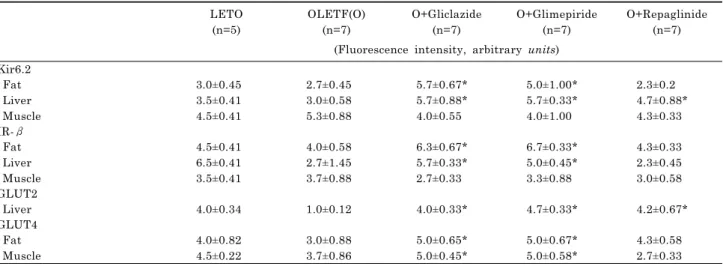
Table 1. Intensity of immunoflorescence of Kir6.2, IR-β, GLUT2, and GLUT4 in rat fat, liver, and skeletal muscle tissues LETO

(n=5)

OLETF(O) (n=7)

O+Gliclazide (n=7)

O+Glimepiride (n=7)

O+Repaglinide (n=7) (Fluorescence intensity, arbitrary units)

Kir6.2 Fat

Liver Muscle

3.0±0.45 3.5±0.41 4.5±0.41

2.7±0.45 3.0±0.58 5.3±0.88

5.7±0.67*

5.7±0.88*

4.0±0.55

5.0±1.00*

5.7±0.33*

4.0±1.00

2.3±0.2 4.7±0.88*

4.3±0.33 IR-β

Fat Liver Muscle

4.5±0.41 6.5±0.41 3.5±0.41

4.0±0.58 2.7±1.45 3.7±0.88

6.3±0.67*

5.7±0.33*

2.7±0.33

6.7±0.33*

5.0±0.45*

3.3±0.88

4.3±0.33 2.3±0.45 3.0±0.58 GLUT2

Liver 4.0±0.34 1.0±0.12 4.0±0.33* 4.7±0.33* 4.2±0.67*

GLUT4 Fat Muscle

4.0±0.82 4.5±0.22

3.0±0.88 3.7±0.86

5.0±0.65*

5.0±0.45*

5.0±0.67*

5.0±0.58*

4.3±0.58 2.7±0.33

*p<0.05 compared to the values of OLETF control rats. Data represent mean ± S.E. The n is number of animals. One data point was obtained from one rat.

high glucose loading, however, significant difference was detected in blood glucose levels between control OLETF and LETO rats. OLETF rats treated with either gliclazide or repaglinide did not show any difference compared to control OLETF rats. Notably, glimepiride-treated OLETF rats exhibited much lower blood glucose levels than the other OLETF groups. Blood glucose levels measured at 2 h after glucose loading was 176±23 mg/dl in LETO; 279±66 mg/dl in OLETF control; 284±55 mg/dl in repaglinide; 257±49 mg/dl in gliclazide; 216±24 mg/dl in glimepiride.

Expression of Kir6.2

The expression levels of IR-β, GLUT2, GLUT4, and Kir6.2 were semi-quantitatively analyzed in tissues prepared from pancreas, fat, liver, and skeletal muscles. Table 1 is to

compare the intensity of immunohistochemical staining.

Kir6.2, the subunit of K

ATP

channels, was expressed in the cell membrane of adipocytes in LETO rats (Fig. 2A). Compared with LETO, adipocytes from OLETF rats showed weaker expression of Kir6.2. Gliclazide and glimepiride appeared to potentiate the Kir6.2 expression, but repaglinide did not.

Kir6.2 expressed on the sinusoid of hepatocytes was decreased in OLETF control rats (Fig. 2B). In the three groups treated with gliclazide, glimepiride, or repaglinide, the staining for Kir6.2 was potentiated. In pancreas and skeletal muscles, there was no difference in Kir6.2 staining among all the five groups (data not shown).

Expression of IR- β subunits

IR-β was less stained in the cell membrane of adipocytes

(4)

Fig. 3. Representative photomicrographs of IR-β staining in murine fat and liver. (A) IR-β is expressed in the cell membrane of adipocytes of LETO rat, whereas staining is less in the cytoplasmic membrane in OLETF rat. It is recovered by treatment with gliclazide or glimepiride. (B) IR-β is strongly expressed on the sinusoids of hepatocytes in LETO rat, but it is markedly reduced in OLETF rat. Staining is increased at the sinusoids by treatment with gliclazide or glimepiride.

Fig. 4. Representative photomicrographs of GLUT-2 staining in murine liver. GLUT-2 is expressed in the sinusoids of hepatocytes in LETO rat, whereas GLUT-2 immunoreactivity is reduced in OLETF rat. In the groups treated with gliclazide, repaglinide, or glimepiride, GLUT-2 expression is enhanced.

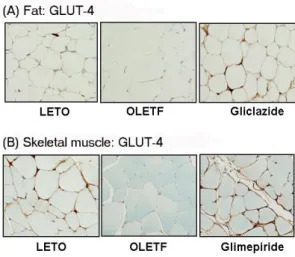
Fig. 5. Representative photomicrographs of GLUT-4 staining in murine fat and skeletal muscles. (A) GLUT-4 is expressed in the cell membrane of adipocytes in LETO rat, whereas staining is faintly present in OLETF rat. In the groups treated with gliclazide or glimepiride, expression of GLUT-4 is markedly increased. (B) GLUT-4 is expressed in the sarcolemma of skeletal muscles of LETO rat, whereas staining is reduced in OLETF rat. In the groups treated with gliclazide or glimepiride, the expression of GLUT-4 is increased.

Fig. 2. Representative photomicrographs of Kir6.2 staining in

murine fat and liver. (A) Kir6.2 is expressed in the cell membrane

of adipocytes in LETO rat, whereas Kir6.2 staining is markedly

reduced in OLETF rat. It is recovered by treatment with gliclazide

or glimepiride. (B) Kir6.2 is expressed on the sinusoids of

hepatocytes in LETO rat, but it is markedly reduced in OLETF

rat. Staining is increased at the sinusoids by treatment with

gliclazide, repaglinide or glimepiride.

(5)

was also decreased in OLETF rats compared to LETO rats.

Gliclazide or glimepiride potentiated staining, but not repaglinide.

DISCUSSION

Prospective diabetes study in UK suggested that intensive therapy with sulfonylurea or insulin over a 10-year period significantly reduced the risk of diabetes-related endpoints by 12% (UKPDS, 1998). However, significant weight gain was reported in the intensive therapy group with insulin or the first generation drug of sulfonylurea glibenclamide. When glimepiride and glibenclamide were compared in OLETF rats, both drugs induced a decrease of small fat cells and an increase of large fat cells (Mori et al, 2004). However, a greater increase in large fat cells and tumor necrosis factor (TNF)-α mRNA expression was observed in the glibenclamide-treated OLETF rats. Con- sidering the fact that the levels of TNF-α expression are positively correlated with obesity and hyperinsulinemia (Kern et al, 1995), glibenclamide and glimepiride can be different in the action on insulin sensitivity, even if both drugs share the K

ATP

channel as a primary target. Glime- piride is known to have extensive extrapancreatic effects and a mild insulin-stimulating effect (Kawamori et al, 1995;

Muller et al, 1995). The present study also revealed that glimepiride has an ability to reduce a risk of insulin resis- tance.

In the present study, gliclazide was also shown to have effects comparable to glimepiride in increasing expression levels of insulin receptors, glucose transporters and the K

ATP

channel subunits. However, glucose tolerance test appeared to be still abnormal in gliclazide-treated rats. It is plausible because glimepiride inhibits three types of the K

ATP

channels, while gliclazide inhibits only beta-cell type K

ATP

channels. Therefore, extrapancreatic effect of gliclazide may be attributable to another unknown mechanism of this sulfonylurea drug, although it is not enough to recover glucose intolerance. In addition, this may possibly be due to 1) complex expression of various types of K

ATP

channels in one tissue, or 2) amelioration of beta-cell insulin secretion by gliclazide may induce such peripheral changes in insulin sensitivity. Anyway, there are some lines of evidence in humans that gliclazide is at least as effective as glimepiride in reducing HbA1c, either as monotherapy or in combination with other drugs, such as metformin (Schernthaner et al, 2004). Rather, the safety of gliclazide was significantly better, demonstrating approximately 50% fewer confirmed hypoglycemic episodes in comparison with glimepiride. In another aspects, there is a report that gliclazide could enhance insulin signaling in insulin-resistant mouse skeletal muscle cells, but insulin-stimulated actual glucose uptake was unaffected (Kumar and Dey, 2002). Moreover, experiments performed in normal dogs showed that glimepiride had the highest total blood glucose-lowering activity during the 36-h post-treatment period when compared with glibenclamide, gliclazide, and glipizide (Lebovitz et al, 1977). Consistent with the present finding, there has been no observation reported for repaglinide to have extrapancreatic activity.

In conclusion, glimepiride and gliclazide, which have the sulfonylurea moiety, showed some evidence to ameliorate insulin resistance in addition to its insulin secretory action.

Repaglinide, a benzoic acid derivative, appeared to have

minimum extra-pancreatic effect among the three drugs tested.

ACKNOWLEDGEMENT

This work was supported by the Basic Research Program of KOSEF for medical research centers.

REFERENCES

Abel ED, Peroni O, Kim JK, Kim YB, Boss O, Hadro E, Minnemann T, Shulman GI, Kahn BB. Adipose-selective targeting of the GLUT4 gene impairs insulin action in muscle and liver. Nature 409: 729-733, 2001

Ashcroft FM. ATP-sensitive potassium channelopathies: focus on insulin secretion. J Clin Invest 115: 2047-2058, 2005 Bajaj M, Defronzo RA. Metabolic and molecular basis of insulin

resistance. J Nucl Cardiol 10: 311-323, 2003

Boyd JJ, Contreras I, Kern M, Tapscott EB, Downes DL, Frisell WR, Dohm GL. Effect of a high-fat-sucrose diet on in vivo insulin receptor kinase activation. Am J Physiol 259: E111-116, 1990 Eisenberg ML, Maker AV, Slezak LA, Nathan JD, Sritharan KC,

Jena BP, Geibel JP, Andersen DK. Insulin receptor (IR) and glucose transporter 2 (GLUT2) proteins form a complex on the rat hepatocyte membrane. Cell Physiol Biochem 15: 51-58, 2005 Handberg A, Vaag A, Damsbo P, Beck-Nielsen H, Vinten J.

Expression of insulin regulatable glucose transporters in skeletal muscle from type 2 (non-insulin-dependent) diabetic patients. Diabetologia 33: 625-627, 1990

Hughes VA, Fiatarone MA, Fielding RA, Kahn BB, Ferrara CM, Shepherd P, Fisher EC, Wolfe RR, Elahi D, Evans WJ. Exercise increases muscle GLUT-4 levels and insulin action in subjects with impaired glucose tolerance. Am J Physiol 264: E855-862, Kahn BB. Lilly lecture 1995. Glucose transport: pivotal step in 1993

insulin action. Diabetes 45: 1644-1654, 1996

Kawamori R, Morishima T, Kubota M, Matsuhisa M, Ikeda M, Kamada T. Influence of oral sulfonylurea agents on hepatic glucose uptake. Diabetes Res Clin Pract 28 Suppl: S109-113, Kawano K, Hirashima T, Mori S, Saitoh Y, Kurosumi M, Natori 1995 T. Spontaneous long-term hyperglycemic rat with diabetic complications. Otsuka Long-Evans Tokushima Fatty (OLETF) strain. Diabetes 41: 1422-1428, 1992

Kern PA, Saghizadeh M, Ong JM, Bosch RJ, Deem R, Simsolo RB.

The expression of tumor necrosis factor in human adipose tissue.

Regulation by obesity, weight loss, and relationship to lipoprotein lipase. J Clin Invest 95: 2111-2119, 1995

Koike T, Tomoda F, Kinuno H, Inoue H, Takata M. Abnormal renal structural alterations during the development of diabetes mellitus in Otsuka Long-Evans Tokushima Fatty rats. Acta Physiol Scand 184: 73-81, 2005

Kumar N, Dey CS. Gliclazide increases insulin receptor tyrosine phosphorylation but not p38 phosphorylation in insulin-resistant skeletal muscle cells. J Exp Biol 205: 3739-3746, 2002 Lebovitz HE, Feinglos MN, Bucholtz HK, Lebovitz FL. Potentiation

of insulin action: a probable mechanism for the anti-diabetic action of sulfonylurea drugs. J Clin Endocrinol Metab 45: 601-

604, 1977

Marin P, Rebuffe-Scrive M, Smith U, Bjorntorp P. Glucose uptake in human adipose tissue. Metabolism 36: 1154-1160, 1987 Miki T, Nagashima K, Tashiro F, Kotake K, Yoshitomi H, Tamamoto

A, Gonoi T, Iwanaga T, Miyazaki J, Seino S. Defective insulin secretion and enhanced insulin action in K

ATP

channel-deficient mice. Proc Natl Acad Sci U S A 95: 10402-10406, 1998 Minami K, Morita M, Saraya A, Yano H, Terauchi Y, Miki T,

Kuriyama T, Kadowaki T, Seino S. ATP-sensitive K

+

channel-

mediated glucose uptake is independent of IRS-1/phosphati-

(6)

수치

Table 1. Intensity of immunoflorescence of Kir6.2, IR-β, GLUT2, and GLUT4 in rat fat, liver, and skeletal muscle tissues LETO (n=5) OLETF(O)(n=7) O+Gliclazide(n=7) O+Glimepiride(n=7) O+Repaglinide(n=7) (Fluorescence intensity, arbitrary units)
Fig. 5. Representative photomicrographs of GLUT-4 staining in  murine fat and skeletal muscles

참조

관련 문서

Conclusions : No significant corelation of the patency rate was shown in the study on the effects of local irrigation and systemic application of heparin

The purpose of this study was to provide primary material in discussing methods to activate the treatment effects of diabetes and reduce the rate of

Effect of caloric restriction on the expression of PGC-1 and PPARs mRNA in liver of Otsuka Long-Evans Tokushima Fatty Rats.. Long-lived growth hormone

Effects of combined calcium and vitamin D supplementation on insulin secretion, insulin sensitivity and β -cell function in multi-ethnic vitamin D-deficient

The purpose of this study was to investigate the effects of 8 weeks trampoline exercise on health promotion (health related fitness, blood lipid) in

In the present study, consistent to that report, up-regulation of VEGF mRNA was observed in the colon cancer cell with the acquired resistance to 5-FU and this

Conclusion: In conclusion, the relaxant effects of neuromuscular blockers on the uterine smooth muscle may be transmitted via nicotinic acetylcholine receptors

This study was conducted to investigate the effects of a 12-week swimming exercise program on body composition, blood lipids and inflammatory indicators in