1836
B
lood pressure (BP) is an important modifiable risk fac- tor for stroke and may have prognostic significance after acute ischemic stroke (AIS).1 BP has been treated as a meanmeasure or variability index and in either case is associated with stroke outcomes.2 Less well elucidated, however, are pat- terns of BP changes during a certain period of time, which Background and Purpose—Blood pressure dynamics in patients with acute ischemic stroke may serve as an important
modifiable and prognostic factor.
Methods—A total of 8376 patients with acute ischemic stroke were studied from a prospective multicenter registry. Patients were eligible if they had been admitted within 24 hours of symptom onset and had ≥5 systolic blood pressure (SBP) measurements during the first 24 hours of hospitalization. SBP trajectory groups in the first 24 hours were identified using the TRAJ procedure in SAS software with delta-Bayesian Information Criterion and prespecified modeling parameters.
Vascular events, including recurrent stroke, myocardial infarction, and death, were prospectively collected. The risk of having vascular events was calculated using the frailty model to adjust for clustering by hospital.
Results—The group-based trajectory model classified patients with acute ischemic stroke into 5 SBP trajectory groups:
low (22.3%), moderate (40.8%), rapidly stabilized (11.9%), acutely elevated (18.5%), and persistently high (6.4%) SBP.
The risk of having vascular events was increased in the acutely elevated (hazard ratio, 1.28 [95% confidence interval, 1.12–1.47]) and the persistently high SBP groups (hazard ratio, 1.67 [95% confidence interval, 1.37–2.04]) but not in the rapidly stabilized group (hazard ratio, 1.13 [95% confidence interval, 0.95–1.34]), when compared with the moderate SBP group.
Conclusions—SBP during the first 24 hours after acute ischemic stroke may be categorized into distinct trajectory groups, which differ in relation to stroke characteristics and frequency of subsequent recurrent vascular event risks. The findings may help to recognize potential candidates for future blood pressure control trials. (Stroke. 2018;49:1836-1842. DOI:
10.1161/STROKEAHA.118.021117.)
Key Words: blood pressure ◼ brain ischemia ◼ death ◼ humans ◼ stroke
Received February 13, 2018; final revision received May 20, 2018; accepted June 14, 2018.
From the Department of Neurology, Cerebrovascular Center, Seoul National University Bundang Hospital, Seongnam-si, South Korea (B.J.K., M.-K.H., H.-J.B.); Department of Neurology, Ilsan Paik Hospital, Inje University, Goyang, South Korea (Y.-J.C., K.-S.H.); Department of Neurology, Yeungnam University Hospital, Daegu, South Korea (J.L.); Department of Neurology, Chonnam National University Medical School and Hospital, Gwangju, South Korea (J.-T.K., K.H.C.); Department of Neurology, Seoul Medical Center, South Korea (T.H.P., S.-S.P.); Department of Neurology, Eulji General Hospital (J.-M.P., K.K.) and Department of Neurology, Eulji University Hospital (S.J.L., J.G.K.), Eulji University, Daejeon, South Korea; Department of Neurology, Dong-A University College of Medicine, Busan, South Korea (J.-K.C., D.-H.K., H.-W.N.); Department of Neurology, Hallym University Sacred Heart Hospital, Anyang, South Korea (B.-C.L., K.-H.Y., M.-S.O.); Department of Neurology, Dongguk University Ilsan Hospital, Goyang, South Korea (D.-E.K., W.-S.R.); Department of Neurology, Jeju National University, South Korea (J.C.C.); Department of Neurology, Ulsan University Hospital, University of Ulsan College of Medicine, South Korea (W.-J.K.); Department of Neurology, Chungbuk National University Hospital, Cheongju, South Korea (D.-I.S., M.-J.Y.); Department of Neurology, Keimyung University Dongsan Medical Center, Daegu, South Korea (S.I.S., J.-H.H.); Clinical Research Center, Asan Medical Center, Seoul, South Korea (J.S.L.); Department of Biostatistics, College of Medicine, Korea University, Seoul, South Korea (J.L.); and Department of Translational Science and Molecular Medicine, Mercy Health Hauenstein Neurosciences, Michigan State University College of Human Medicine, Grand Rapids (P.B.G.).
Guest Editor for this article was Georgios Tsivgoulis, MD.
The online-only Data Supplement is available with this article at https://www.ahajournals.org/journal/str/doi/suppl/10.1161/STROKEAHA.
118.021117.
Correspondence to Hee-Joon Bae, MD, PhD, Department of Neurology, Cerebrovascular Center, Seoul National University Bundang Hospital, 82 Gumi- ro 173 beon-gil, Bundang-gu, Seongnam-si, 13520 Gyeonggi-do, Korea. Email [email protected]
© 2018 American Heart Association, Inc.
Acute Ischemic Stroke and Recurrent Vascular Events
Beom Joon Kim, MD, PhD; Yong-Jin Cho, MD, PhD; Keun-Sik Hong, MD, PhD; Jun Lee, MD, PhD;
Joon-Tae Kim, MD, PhD; Kang Ho Choi, MD, PhD; Tai Hwan Park, MD, PhD; Sang-Soon Park, MD;
Jong-Moo Park, MD, PhD; Kyusik Kang, MD, PhD; Soo Joo Lee, MD, PhD; Jae Guk Kim, MD, PhD;
Jae-Kwan Cha, MD, PhD; Dae-Hyun Kim, MD, PhD; Hyun-Wook Nah, MD, PhD;
Byung-Chul Lee, MD, PhD; Kyung-Ho Yu, MD, PhD; Mi-Sun Oh, MD, PhD; Dong-Eog Kim, MD, PhD;
Wi-Sun Ryu, MD, PhD; Jay Chol Choi, MD, PhD; Wook-Joo Kim, MD, PhD; Dong-Ick Shin, MD, PhD;
Min-Ju Yeo, MD, PhD; Sung Il Sohn, MD, PhD; Jeong-Ho Hong, MD, PhD; Ji Sung Lee, PhD;
Juneyoung Lee, PhD; Moon-Ku Han, MD, PhD; Philip B. Gorelick, MD, MPH; Hee-Joon Bae, MD, PhD
Stroke is available at https://www.ahajournals.org/journal/str DOI: 10.1161/STROKEAHA.118.021117
Downloaded from http://ahajournals.org by on August 6, 2019
could not be summarized into a single measure. Recent lon- gitudinal studies suggest that there may be subgroups with distinct BP trajectories, which are associated with clinical outcomes, among relatively healthy persons in the general population to high-risk persons, such as those with newly diagnosed coronary heart disease, with subclinical atheroscle- rosis, or >80 years of age.3–8 Subgrouping by BP trajectories has been estimated during a protracted time period, to help control for factors such as acute psychological stress or cir- cadian variation. However, a sufficiently large sample size may dampen such noise. By identifying BP trajectory and subgroups based on BP trajectory, one may be able to classify patients with AIS at high risk of subsequent vascular events and who may benefit from BP-lowering interventions.
In this context, we hypothesized that trajectory patterns of systolic BP (SBP) exist among patients with AIS, and the patterns would have prognostic significance for risk of sub- sequent vascular events. SBP, rather than diastolic BP, was selected as having stronger associations with cardiovascular risks and atheroscleortic burden.9,10 Our research objectives were to (1) establish reasonable BP trajectory subgroups using SBPs obtained during the first 24 hours of hospitalization in patients with AIS, (2) describe demographic and clinical fac- tors related to specific trajectory subgroups, and (3) clarify the influence of SBP trajectory on subsequent clinical events, including recurrent stroke, myocardial infarction, death, and a composite of the aforementioned outcomes until 1 year after the index stroke. We collected information from a prospective stroke registry on 8376 patients with AIS who arrived within 24 hours of symptom onset and who had complete profiles of SBP during the first 24 hours of hospitalization in 14 Korean hospitals participating in a nationwide stroke collaborative.
Methods
Study PopulationThe study was embedded in the Clinical Research Collaboration for Stroke in Korea registry—a prospective, ongoing, nationwide, mul- ticenter acute stroke registry that has recruited patients with acute stroke or transient ischemic attack admitted within 7 days from onset.11 During the prespecified study period (January 2011 to May 2015), 23 571 patients with stroke were admitted to the participating centers. Study eligibility criteria were as follows (1) admitted within 24 hours after onset (n=15 994), (2) relevant ischemic lesions by neuroimaging study (n=13 275), (3) able to obtain BP measurements from electronic health records (n=9887), and (4) ≥5 BP measure- ments during the first 24 hours of hospitalization (n=8376). A total of 8376 patients with AIS with 160 501 BP measurements during the first 24 hours were included in the analysis data set.
Patients with stroke were managed according to the institutional protocols that are based on the most up-to-date practice guidelines and at the discretion of individual vascular neurologists and other physicians with direct care responsibilities.12 BP-lowering medica- tion was prescribed on a case-by-case basis and according to guide- lines. Data collection and analysis for the study were approved by the ethics committees of participating centers. Patient-level data that support the findings of this study are available from the correspond- ing author on a reasonable request and after clearance by the ethics committee.
BP and Clinical Data Collection
BP measurements were made during the routine clinical practice of AIS patient care. All BP recordings and measurement time data were
collected and stored in the electronic health record systems of par- ticipating centers. When both of intra-arterial BP and noninvasive BP by plethysmography were recorded, we chose noninvasive BPs for comparability.
We also retrieved baseline demographic and clinical information for all the study participants from the Clinical Research Collaboration for Stroke in Korea registry database. Details of clinical definitions have been published and are referred to elsewhere.11 In relation to this particular study, hypertension was defined as a diagnosis of hyperten- sion made by a healthcare professional before an index stroke.
Outcome Events
A primary outcome event was defined as a composite of recurrent stroke, myocardial infarction, and all-cause death, and secondary outcome events were recurrent stroke and all-cause death. Outcome events were collected through identification of events in usual clinical practice or by structured telephone interview by trained study coor- dinators at participating hospitals. We collected outcome events ≤1 year after the index stroke and permitted a 2-month grace period (ie, 12±2 months).
Trajectory Group Modeling
We adopted a group-based trajectory modeling approach using the TRAJ procedure in SAS software to identify BP trajectories during the first 24 hours after admission.13 This is a specialized form of finite mixture modeling, and the longitudinal BP data were fitted by a maxi- mum likelihood method as a mixture of multiple latent trajectories in a censored normal model with a polynomial function of time.14 Because of repetitive measurements of BP during the acute and unsta- ble periods, we set up 9 time points for 24 hours starting on the time of arrival with 3 hour-intervals. Each time point was allocated by the nearest BP measurement. Median differences between the allocated time point and the actual time of BP measurement were 26 or 27 minutes for 3- to 21-hour time points and 52 minutes for the 24-hour time point (Table I in the online-only Data Supplement). We used the Bayesian Information Criterion to determine the optimal num- ber of strata and the highest significant order of individual trajectory groups through the modeling process. The proportion of the smallest group was specified to be >5%. Grid search strategy was applied to avoid a local minimum (Table II in the online-only Data Supplement).
For every stroke patient, we calculated the posterior probability of being a member of each group to which their posterior probability of membership was the greatest. We assigned a descriptive label for each trajectory group on the basis of the visual patterns of BP changes over time.
Statistical Analysis
Baseline clinical characteristics of included patients with stroke were summarized and compared according to the trajectory groups using a χ2 test or a 1-way ANOVA, as appropriate. To estimate asso- ciations between BP trajectories during the first 24 hours and out- come events, we utilized hierarchical frailty models, which address random effects from clustering of patients by treating hospitals. A hierarchical frailty model has been used with multivariable survival data where the unobserved frailty is shared among groups of individ- uals, as a generalization of a survival regression model.15 Hospitals were incorporated as a random effect into the frailty models (1 center having 1 contributing case was merged into other hospitals with the second smallest number of cases [n=105]). Following multivariable models were constructed: model 1 with no covariates, model 2 with clinically important covariates for outcomes (age, sex, stroke mecha- nism, and National Institutes of Health Stroke Scale score at arrival), and model 3 with model 2 and adding covariates of bivariate P val- ues <0.05. Effect modifications by recanalization treatment or stroke mechanisms were separately tested.
To explore the robustness of BP trajectory grouping during the acute period of stroke, we examined models with the number of tra- jectory groups having 1 less and 1 more than the optimal model with the lowest Bayesian Information Criterion.
Downloaded from http://ahajournals.org by on August 6, 2019
A significance level was set as a 2-tailed P value of <0.05.
Trajectory grouping was estimated using the SAS 9.4 software (SAS Institute, Inc, Cary, NC) as well as R 3.3.1 (R Foundation for Statistical Computing, Vienna, Austria).
Results
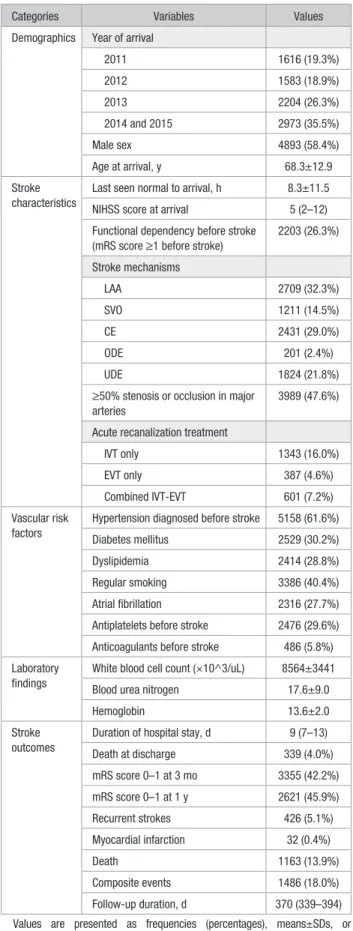
During the 4.5-year study period, a total of 8376 patients with AIS who arrived within 24 hours after stroke onset met the pre- specified eligibility criteria. Among them, 58.4% were men, mean age was 68.3±11.5 years, median National Institutes of Health Stroke Scale score at arrival was 5 (2–12), and acute recanalization treatment was done in 27.8% (Table 1).
Trajectory Groups Based on SBP During the First 24 Hours
The study subjects were classified into 5 groups based on his/
her BP trajectory during the first 24 hours of hospitalization as follows (Figure): group 1 (a low SBP group, 22.3%) indi- cates those who had lower-than-average SBP profiles; group 2 (a moderate SBP group, 40.8%) had stable BP measurements around 130 to 140 mm Hg; group 3 (a rapidly stabilized SBP group, 11.9%) had high SBP at initial presentation but rap- idly decreased over a few hours thereafter; group 4 (an acutely elevated SBP group, 18.5%) refers those who had BP levels similar to the moderate SBP group at initial presentation but increased acutely, however, the elevation was maintained throughout the remaining 24-hour period; and group 5 (a per- sistently high SBP group, 6.4%) represents patients having high SBP levels during the first 24 hours of hospitalization.
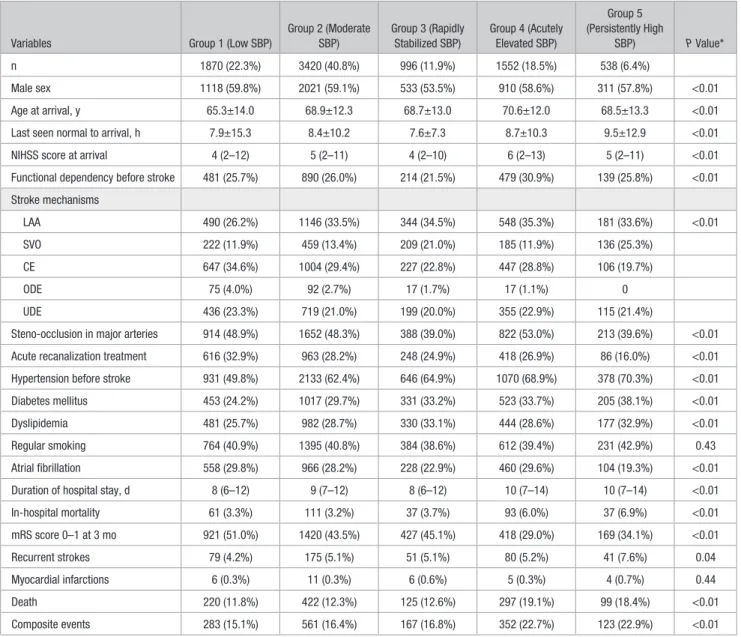
Patients in these 5 BP trajectory groups had distinct clinical profiles (Table 2). The low SBP group was relatively younger (mean, 65.3 years) with a low prevalence of hyper- tension before stroke (49.8%). This group had the highest pro- portion of cardioembolic stroke (34.6%), but the prevalence of atrial fibrillation was similar to others (29.8%). The persis- tently high SBP group had the highest prevalence of hyper- tension before stroke (70.3%) and the highest proportion of small vessel occlusion (25.3%). The rapidly stabilized SBP and the acutely elevated SBP groups differed in mRS score of >1 before stroke onset (21.5% versus 30.9%), the propor- tion of small vessel occlusion (21.0% versus 11.9%), and the prevalence of steno-occlusion in major arteries (39.0% versus 53.0%).
Trajectory Groups and Outcome Events
After the index stroke, 426 recurrent strokes (5.2%), 1163 deaths (14.1%), and 1486 composite events (18.0%) were captured during a median of 370 days of follow-up (interquar- tile range, 339–394 days).
BP trajectory groups during the first 24 hours of admis- sion showed differential associations with the selected out- come events (Table 3). Compared with the moderate SBP group as a referent, the persistently high SBP group had sig- nificantly increased risk of having primary and secondary out- come events in all 3 multivariate models considered; adjusted hazard ratios ranged from 1.53 to 1.86. The low SBP and the rapidly stabilized SBP group were not different from the moderate SBP group for the risk of having outcome events.
The acutely elevated SBP group had an increased risk for the
Table 1. Baseline Characteristics and Outcomes of Included Subjects (n=8376)
Categories Variables Values
Demographics Year of arrival
2011 1616 (19.3%)
2012 1583 (18.9%)
2013 2204 (26.3%)
2014 and 2015 2973 (35.5%)
Male sex 4893 (58.4%)
Age at arrival, y 68.3±12.9
Stroke characteristics
Last seen normal to arrival, h 8.3±11.5 NIHSS score at arrival 5 (2–12) Functional dependency before stroke
(mRS score ≥1 before stroke)
2203 (26.3%)
Stroke mechanisms
LAA 2709 (32.3%)
SVO 1211 (14.5%)
CE 2431 (29.0%)
ODE 201 (2.4%)
UDE 1824 (21.8%)
≥50% stenosis or occlusion in major arteries
3989 (47.6%)
Acute recanalization treatment
IVT only 1343 (16.0%)
EVT only 387 (4.6%)
Combined IVT-EVT 601 (7.2%) Vascular risk
factors
Hypertension diagnosed before stroke 5158 (61.6%)
Diabetes mellitus 2529 (30.2%)
Dyslipidemia 2414 (28.8%)
Regular smoking 3386 (40.4%)
Atrial fibrillation 2316 (27.7%) Antiplatelets before stroke 2476 (29.6%) Anticoagulants before stroke 486 (5.8%) Laboratory
findings
White blood cell count (×10^3/uL) 8564±3441
Blood urea nitrogen 17.6±9.0
Hemoglobin 13.6±2.0
Stroke outcomes
Duration of hospital stay, d 9 (7–13)
Death at discharge 339 (4.0%)
mRS score 0–1 at 3 mo 3355 (42.2%) mRS score 0–1 at 1 y 2621 (45.9%)
Recurrent strokes 426 (5.1%)
Myocardial infarction 32 (0.4%)
Death 1163 (13.9%)
Composite events 1486 (18.0%)
Follow-up duration, d 370 (339–394) Values are presented as frequencies (percentages), means±SDs, or median (interquartile ranges), as appropriate. CE indicates cardioembolism;
EVT, endovascular treatment; IVT, intravenous treatment; LAA, large artery atherosclerosis; mRS, modified Rankin Scale; NIHSS, National Institutes of Health Stroke Scale; ODE, other determined etiology; SVO, small vessel occlusion; and UDE, undetermined etiology.
Downloaded from http://ahajournals.org by on August 6, 2019
primary composite and mortality but not for recurrent stroke.
The associations between trajectory groups and mortality or composite events were significantly modified by recanaliza- tion treatment (P for interaction, 0.006 or 0.02) and stroke mechanisms (P for interaction, 0.002 or 0.003). Hazards for recurrent stroke was not changed (Results in the online-only Data Supplement).
Sensitivity analyses of estimating 4- or 6-group model, instead of the optimal 5-group model, did not provide any additional findings (Figures I and II in the online-only Data Supplement). Identical modeling parameters were applied to diastolic BP, mean arterial pressure, and pulse pressure (Figures III through V in the online-only Data Supplement), and trajectory models were constructed.
Discussion
Our study suggests that there are distinct subgroups of SBP trajectories during the first 24 hours of hospitalization in patients with AIS who were hospitalized within 24 hours of onset. We identified 5 unique SBP trajectories; namely, low, moderate, rapidly stabilized, acutely elevated, and persistently high SBP. These trajectory groups have different clinical pro- files and were significantly different in relation to risk for
recurrent stroke, all-cause death and the composite of stroke, myocardial infarction, and all-cause death after the index stroke. The persistently high SBP group had the highest risk of having outcome events until 1 year. Importantly, 2 subgroups with similar mean SBP during the 24 hours, the rapidly stabi- lized (149±14 mm Hg) and acutely elevated SBP (154±2.6) groups, differed in their risk of outcome events. Membership in a certain trajectory group was an independent predictor of clinical events beyond either initial or mean BP and may help identify high-risk patients for future vascular events and to require intervention.
Trajectory patterns of SBP changes in patients with AIS may reflect individual response of the autonomic nervous system to a perceived catastrophic stimulus. A recently published report suggested that increased variability of SBP in acute stressful conditions was modestly associated with functional outcomes, beyond conventional measures of SBP.16 Short-term BP variations usually reflect the influence of central and reflex autonomic modulation, elastic prop- erties of arteries, and the effects of humoral, rheological, and emotional factors of diverse nature and duration.17 For patients with acute stroke, BP change and trajectory patterns after ischemic stroke would be consequences of short-term
Figure. Trajectory groups of 24-h systolic blood pressure (SBP) after arrival; estimated blood pressures and 95% confidence intervals (CIs). Group 1, low SBP; group 2, moderate SBP; group 3, rapidly stabilized SBP; group 4, acutely elevated SBP; and group 5, persistently high SBP.
Downloaded from http://ahajournals.org by on August 6, 2019
autonomic neuroregulation mechanisms encompassing external stimuli, such as psychological stress, to emergent transfer to hospital or unfamiliar environment and internal stimuli, including ischemic stroke, increased intracranial pressure, or psychological response, to perceived neural deficit.18,19 Membership in an SBP trajectory subgroup dur- ing the acute stroke period may represent a composite of individual responses by the cardiovascular and neurohu- moral systems.20 Baroreceptor resetting and convergence to usual levels of SBP may explain the overall pattern of trajectory groups.21,22 Group 4—the acutely elevated SBP group, which had increased risk than group 3—showed a perverted response of acute baroreceptor resetting that may have altered and pathological neurovascular response there- after. This may partially explain the increased hazard of group 4 for 1-year vascular events. Considering the estab- lished associations between increased sympathetic tone and cardiovascular diseases,23 understanding of the effects of
temporal changes in SBP may be important for risk stratifi- cation and individual prediction for future vascular events.
There is ongoing discussion on when to commence BP-lowering medications for patients with acute stroke.24,25 BP is a well-known indicator of short-term and long-term prognosis for AIS, and it may be effectively modified through medication and nonpharmacological interventions. Theoretical consideration in relation to the potential penumbral area around ischemic brain tissue suggests that early BP-lowering therapy may lead to decreased perfusion and resultant poor outcomes.
Clinical trials such as INWEST (Intravenous Nimodipine West European Stroke Trial), SCAST (Scandinavian Candesartan Acute Stroke Trial), VENTURE (Valsartan Efficacy on Modest Blood Pressure Reduction in Acute Ischemic Stroke), and ENOS (Efficacy of Nitric Oxide in Stroke) reported unfavor- able or negative results for acute BP-lowering treatments.26–29 However, high SBP in acute phase of ischemic stroke is related to poor stroke outcomes,30 and a secondary analysis of the
Table 2. Patients’ Characteristics by Trajectory Groups of 24-h SBP
Variables Group 1 (Low SBP)
Group 2 (Moderate SBP)
Group 3 (Rapidly Stabilized SBP)
Group 4 (Acutely Elevated SBP)
Group 5 (Persistently High
SBP) P Value*
n 1870 (22.3%) 3420 (40.8%) 996 (11.9%) 1552 (18.5%) 538 (6.4%)
Male sex 1118 (59.8%) 2021 (59.1%) 533 (53.5%) 910 (58.6%) 311 (57.8%) <0.01
Age at arrival, y 65.3±14.0 68.9±12.3 68.7±13.0 70.6±12.0 68.5±13.3 <0.01
Last seen normal to arrival, h 7.9±15.3 8.4±10.2 7.6±7.3 8.7±10.3 9.5±12.9 <0.01
NIHSS score at arrival 4 (2–12) 5 (2–11) 4 (2–10) 6 (2–13) 5 (2–11) <0.01
Functional dependency before stroke 481 (25.7%) 890 (26.0%) 214 (21.5%) 479 (30.9%) 139 (25.8%) <0.01 Stroke mechanisms
LAA 490 (26.2%) 1146 (33.5%) 344 (34.5%) 548 (35.3%) 181 (33.6%) <0.01
SVO 222 (11.9%) 459 (13.4%) 209 (21.0%) 185 (11.9%) 136 (25.3%)
CE 647 (34.6%) 1004 (29.4%) 227 (22.8%) 447 (28.8%) 106 (19.7%)
ODE 75 (4.0%) 92 (2.7%) 17 (1.7%) 17 (1.1%) 0
UDE 436 (23.3%) 719 (21.0%) 199 (20.0%) 355 (22.9%) 115 (21.4%)
Steno-occlusion in major arteries 914 (48.9%) 1652 (48.3%) 388 (39.0%) 822 (53.0%) 213 (39.6%) <0.01 Acute recanalization treatment 616 (32.9%) 963 (28.2%) 248 (24.9%) 418 (26.9%) 86 (16.0%) <0.01 Hypertension before stroke 931 (49.8%) 2133 (62.4%) 646 (64.9%) 1070 (68.9%) 378 (70.3%) <0.01
Diabetes mellitus 453 (24.2%) 1017 (29.7%) 331 (33.2%) 523 (33.7%) 205 (38.1%) <0.01
Dyslipidemia 481 (25.7%) 982 (28.7%) 330 (33.1%) 444 (28.6%) 177 (32.9%) <0.01
Regular smoking 764 (40.9%) 1395 (40.8%) 384 (38.6%) 612 (39.4%) 231 (42.9%) 0.43
Atrial fibrillation 558 (29.8%) 966 (28.2%) 228 (22.9%) 460 (29.6%) 104 (19.3%) <0.01
Duration of hospital stay, d 8 (6–12) 9 (7–12) 8 (6–12) 10 (7–14) 10 (7–14) <0.01
In-hospital mortality 61 (3.3%) 111 (3.2%) 37 (3.7%) 93 (6.0%) 37 (6.9%) <0.01
mRS score 0–1 at 3 mo 921 (51.0%) 1420 (43.5%) 427 (45.1%) 418 (29.0%) 169 (34.1%) <0.01
Recurrent strokes 79 (4.2%) 175 (5.1%) 51 (5.1%) 80 (5.2%) 41 (7.6%) 0.04
Myocardial infarctions 6 (0.3%) 11 (0.3%) 6 (0.6%) 5 (0.3%) 4 (0.7%) 0.44
Death 220 (11.8%) 422 (12.3%) 125 (12.6%) 297 (19.1%) 99 (18.4%) <0.01
Composite events 283 (15.1%) 561 (16.4%) 167 (16.8%) 352 (22.7%) 123 (22.9%) <0.01
*Calculated by 1-way ANOVA or χ2 test. CE indicates cardioembolism; LAA, large artery atherosclerosis; mRS, modified Rankin Scale; NIHSS, National Institutes of Health Stroke Scale; ODE, other determined etiology; SBP, systolic blood pressure; SVO, small vessel occlusion; and UDE, undetermined etiology.
Downloaded from http://ahajournals.org by on August 6, 2019
SCAST trial and a subgroup analysis of the ENOS trial sug- gested improvement of outcomes by ultraearly initiation of BP-lowering therapy within 6 hours.31,32 Our study results may be interpreted as a preliminary support for therapeutic inter- vention of acute SBP mainly for those in the acutely elevated and persistently elevated SBP groups, that is, group 4 and group 5 of our trajectory modeling. Even though SBP levels at admission are high, those with rapidly stabilized SBP (group 3) may not benefit from BP-lowering medications.
This is the first study to apply group-based trajectory mod- els to investigate the heterogeneity in SBP trajectories during the acute stroke period. We have prospectively and systemati- cally gathered our study subjects and their clinical profiles, as well as a complete set of >160 000 BP measurements taken during the first 24 hours of hospitalization. Furthermore, sen- sitivity analyses that studied a different number of trajectory groups did not significantly alter the overall patterns of SBP trajectories. Therefore, our findings about the heterogeneity of SBP trajectories during the acute period of ischemic stroke and in relation to outcome events may be generalizable to patients with acute stroke in Korea.
Estimation of trajectory models was performed by a pre- specified statistical analysis plan with a reproducible manner.
However, it should be mentioned that the trajectory grouping through the model depends on the data. Participating centers were mostly university hospitals or referral centers, so that the results of our study may have limited generalizability. We had to designate a fixed time point of BP measurements for group- based modeling, and BP variations of an individual patient became nullified. The circadian effect was not considered to model the SBP trajectories. We did not consider the use of BP-lowering medications, but antihypertensive therapy is customarily not commenced during the first 24 hours except in the case of extremely high SBP.25 We could not consider a possible BP drop immediately after cerebral arterial recana- lization because of the lack of information on the exact time of recanalization (16% of subjects had intravenous throm- bolysis). Because of the observational nature of our study, BP management for individual patient was at discretion of
primary stroke physicians without any prespecified protocol.
Potential use of BP-lowering medications during the acute period has not been analyzed in the estimation of SBP trajec- tory groups and outcome models. We did not collect informa- tion on ischemic lesion locations.
This study suggests that SBP in patients with AIS may rea- sonably be grouped by distinct trajectory patterns, which have differential clinical characteristics and risks for subsequent vascular events. Trajectory patterns of SBP may be utilized as an additional prognostic indicator, which reflects the individ- ual characteristics of autonomic nervous system. Additional research is warranted to examine the relevance of SBP trajec- tory groups in different stroke populations and to explore the utility of trajectory patterns in identifying the best candidates for BP-lowering therapy in acute period of stroke.
Sources of Funding
This study was funded by an unrestricted research fund from Daiichi- Sankyo pharmaceuticals. The funding source had no role in the col- lection, analysis, interpretation, and report of the data.
Disclosures
Dr Gorelick serves on a data safety and monitoring board for Novartis for LCZ 696 in heart failure. The other authors report no conflicts.
References
1. Hong KS. Blood pressure management for stroke prevention and in acute stroke. J Stroke. 2017;19:152–165. doi: 10.5853/jos.2017.00164.
2. Chung JW, Kim N, Kang J, Park SH, Kim WJ, Ko Y, et al. Blood pres- sure variability and the development of early neurological deterioration following acute ischemic stroke. J Hypertens. 2015;33:2099–2106. doi:
10.1097/HJH.0000000000000675.
3. Maddox TM, Ross C, Tavel HM, Lyons EE, Tillquist M, Ho PM, et al. Blood pressure trajectories and associations with treatment intensi- fication, medication adherence, and outcomes among newly diagnosed coronary artery disease patients. Circ Cardiovasc Qual Outcomes.
2010;3:347–357. doi: 10.1161/CIRCOUTCOMES.110.957308.
4. Allen NB, Siddique J, Wilkins JT, Shay C, Lewis CE, Goff DC, et al. Blood pressure trajectories in early adulthood and subclinical atherosclerosis in middle age. JAMA. 2014;311:490–497. doi: 10.1001/jama.2013.285122.
5. Theodore RF, Broadbent J, Nagin D, Ambler A, Hogan S, Ramrakha S, et al. Childhood to early-midlife systolic blood pres- sure trajectories: early-life predictors, effect modifiers, and adult Table 3. Results of Frailty Models Presenting the Associations Between Trajectory Groups of 24-h SBP and Event Outcomes After Stroke
Composite Events Mortality Recurrent Strokes
Model 1 Model 2 Model 3 Model 1 Model 2 Model 3 Model 1 Model 2 Model 3
Group 1 (low SBP) 0.91 (0.79–1.06)
0.95 (0.82–1.09)
0.96 (0.83–1.11)
0.95 (0.81–1.12)
1.00 (0.85–1.18)
1.01 (0.86–1.19)
0.81 (0.62–1.06)
0.83 (0.63–1.09)
0.85 (0.65–1.11) Group 2 (moderate SBP) Referent Referent Referent Referent Referent Referent Referent Referent Referent Group 3 (rapidly
stabilized SBP)
1.07 (0.90–1.28)
1.10 (0.92–1.31)
1.13 (0.95–1.34)
1.06 (0.87–1.29)
1.09 (0.89–1.34)
1.14 (0.93–1.40)
0.96 (0.70–1.31)
0.99 (0.72–1.35)
0.98 (0.72–1.35) Group 4 (acutely
elevated SBP)
1.47 (1.29–1.69)
1.31 (1.15–1.50)
1.28 (1.12–1.47)
1.61 (1.38–1.87)
1.41 (1.21–1.64)
1.39 (1.19–1.61)
1.18 (0.90–1.54)
1.16 (0.89–1.51)
1.11 (0.85–1.45) Group 5 (persistently
high SBP)
1.58 (1.30–1.93)
1.70 (1.39–2.07)
1.67 (1.37–2.04)
1.64 (1.31–2.04)
1.86 (1.48–2.32)
1.82 (1.45–2.27)
1.53 (1.08–2.17)
1.67 (1.18–2.37)
1.62 (1.14–2.31) No. of recurrent strokes, 426 (5.1%). No. of mortality, 1164 (13.9%). No. of composite events, 1486 (18.0%). Values given are hazard ratios (95% confidence intervals) using a hierarchical frailty model. Model 1 was adjusted for no covariates. Model 2 was adjusted for age at arrival, sex, stroke mechanisms, and NIHSS scores.
Model 3 was adjusted for covariates in model 2 plus arrival delay, functional dependency before stroke, hypertension diagnosed before stroke, diabetes mellitus, dyslipidemia, atrial fibrillation, steno-occlusion in major arteries, acute recanalization treatment, and duration of hospital stay. NIHSS indicates National Institutes of Health Stroke Scale; and SBP, systolic blood pressure.
Downloaded from http://ahajournals.org by on August 6, 2019
cardiovascular outcomes. Hypertension. 2015;66:1108–1115. doi:
10.1161/HYPERTENSIONAHA.115.05831.
6. Portegies ML, Mirza SS, Verlinden VJ, Hofman A, Koudstaal PJ, Swanson SA, et al. Mid- to late-life trajectories of blood pressure and the risk of stroke: the Rotterdam Study. Hypertension. 2016;67:1126–1132.
doi: 10.1161/HYPERTENSIONAHA.116.07098.
7. Petruski-Ivleva N, Viera AJ, Shimbo D, Muntner P, Avery CL, Schneider AL, et al. Longitudinal patterns of change in systolic blood pressure and incidence of cardiovascular disease: the Atherosclerosis Risk in Communities Study. Hypertension. 2016;67:1150–1156. doi:
10.1161/HYPERTENSIONAHA.115.06769.
8. Ravindrarajah R, Hazra NC, Hamada S, Charlton J, Jackson SHD, Dregan A, et al. Systolic blood pressure trajectory, frailty, and all-Cause mortality
>80 years of age: cohort study using electronic health records. Circulation.
2017;135:2357–2368. doi: 10.1161/CIRCULATIONAHA.116.026687.
9. Rapsomaniki E, Timmis A, George J, Pujades-Rodriguez M, Shah AD, Denaxas S, et al. Blood pressure and incidence of twelve cardiovas- cular diseases: lifetime risks, healthy life-years lost, and age-specific associations in 1·25 million people. Lancet. 2014;383:1899–1911. doi:
10.1016/S0140-6736(14)60685-1.
10. Hao G, Wang X, Treiber FA, Harshfield G, Kapuku G, Su S. Blood pressure trajectories from childhood to young adulthood associ- ated with cardiovascular risk: results from the 23-year longitudinal Georgia Stress and Heart Study. Hypertension. 2017;69:435–442. doi:
10.1161/HYPERTENSIONAHA.116.08312.
11. Kim BJ, Park JM, Kang K, Lee SJ, Ko Y, Kim JG, et al. Case character- istics, hyperacute treatment, and outcome information from the clinical research center for stroke-fifth division registry in South Korea. J Stroke.
2015;17:38–53. doi: 10.5853/jos.2015.17.1.38.
12. Clinical Research Center for Stroke. Clinical Practice Guidelines for Stroke. 2nd ed. Seoul, South Korea: Clinical Research Center for Stroke;
2013.
13. Jones BL, Nagin DS. Advances in group-based trajectory modeling and an SAS procedure for estimating them. Sociol Method Res. 2007;35:542–571.
14. Nagin DS, Odgers CL. Group-based trajectory modeling in clini- cal research. Annu Rev Clin Psychol. 2010;6:109–138. doi:
10.1146/annurev.clinpsy.121208.131413.
15. Aalen OO, Valberg M, Grotmol T, Tretli S. Understanding varia- tion in disease risk: the elusive concept of frailty. Int J Epidemiol.
2015;44:1408–1421. doi: 10.1093/ije/dyu192.
16. Manning LS, Rothwell PM, Potter JF, Robinson TG. Prognostic significance of short-term blood pressure variability in acute stroke: systematic review.
Stroke. 2015;46:2482–2490. doi: 10.1161/STROKEAHA.115.010075.
17. Parati G, Ochoa JE, Lombardi C, Bilo G. Assessment and management of blood-pressure variability. Nat Rev Cardiol. 2013;10:143–155. doi:
10.1038/nrcardio.2013.1.
18. Salman IM. Major autonomic neuroregulatory pathways underlying short- and long-term control of cardiovascular function. Curr Hypertens Rep. 2016;18:18. doi: 10.1007/s11906-016-0625-x.
19. AlSibai A, Qureshi AI. Management of acute hypertensive response in patients with ischemic stroke. Neurohospitalist. 2016;6:122–129. doi:
10.1177/1941874416630029.
20. Blankestijn PJ, Tulen J, Boomsma F, Van Eck H. Support for adrenaline- hypertension hypothesis: 18 hour pressor effect after 6 hours adrenaline infusion. Lancet. 1988;332:1386–1389.
21. Munch PA, Andresen MC, Brown AM. Rapid resetting of aortic baroreceptors in vitro. Am J Physiol. 1983;244:H672–H680. doi:
10.1152/ajpheart.1983.244.5.H672.
22. Kanbar R, Oréa V, Barrès C, Julien C. Baroreflex control of renal sympathetic nerve activity during air-jet stress in rats. Am J Physiol Regul Integr Comp Physiol. 2007;292:R362–R367. doi:
10.1152/ajpregu.00413.2006.
23. Mancia G, Grassi G. The autonomic nervous system and hypertension. Circ Res. 2014;114:1804–1814. doi: 10.1161/CIRCRESAHA.114.302524.
24. Kleinig T. Antihypertensive treatment should be commenced in hospital after stroke: pro. Int J Stroke. 2017;12:121–122. doi:
10.1177/1747493016674958.
25. Phan T. Blood pressure-lowering therapy post stroke should be commenced before discharge from hospital: contra. Int J Stroke.
2017;12:119–120. doi: 10.1177/1747493016674957.
26. Ahmed N, Näsman P, Wahlgren NG. Effect of intravenous nimodip- ine on blood pressure and outcome after acute stroke. Stroke.
2000;31:1250–1255.
27. Sandset EC, Murray GD, Bath PM, Kjeldsen SE, Berge E; Scandinavian Candesartan Acute Stroke Trial (SCAST) Study Group. Relation between change in blood pressure in acute stroke and risk of early adverse events and poor outcome. Stroke. 2012;43:2108–2114. doi:
10.1161/STROKEAHA.111.647362.
28. Oh MS, Yu KH, Hong KS, Kang DW, Park JM, Bae HJ, et al; Valsartan Efficacy on Modest Blood Pressure Reduction in Acute Ischemic Stroke (VENTURE) Study Group. Modest blood pressure reduction with valsartan in acute ischemic stroke: a prospective, randomized, open-label, blinded-end-point trial. Int J Stroke. 2015;10:745–751. doi:
10.1111/ijs.12446.
29. Bath PMW, Woodhouse L, Scutt P, Krishnan K, Wardlaw JM, et al;
ENOS Trial Investigators. Efficacy of nitric oxide, with or without con- tinuing antihypertensive treatment, for management of high blood pres- sure in acute stroke (ENOS): a partial-factorial randomised controlled trial. Lancet. 2015;385:617–628.
30. Castillo J, Leira R, García MM, Serena J, Blanco M, Dávalos A. Blood pressure decrease during the acute phase of ischemic stroke is associated with brain injury and poor stroke outcome. Stroke. 2004;35:520–526.
doi: 10.1161/01.STR.0000109769.22917.B0.
31. Jusufovic M, Sandset EC, Bath PM, Berge E; Scandinavian Candesartan Acute Stroke Trial (SCAST) Study Group. Early blood pressure lower- ing treatment in acute stroke. Ordinal analysis of vascular events in the Scandinavian Candesartan Acute Stroke Trial (SCAST). J Hypertens.
2016;34:1594–1598. doi: 10.1097/HJH.0000000000000980.
32. Woodhouse L, Scutt P, Krishnan K, Berge E, Gommans J, Ntaios G, et al; ENOS Investigators. Effect of hyperacute administration (within 6 hours) of transdermal glyceryl trinitrate, a nitric oxide donor, on outcome after stroke: subgroup analysis of the Efficacy of Nitric Oxide in Stroke (ENOS) Trial. Stroke. 2015;46:3194–3201. doi:
10.1161/STROKEAHA.115.009647.
Downloaded from http://ahajournals.org by on August 6, 2019