1. Introduction
Rock falls in underground mine have been a significant issue for the safety of employees and the maintenance of facilities. Most of the rock falls are induced by the degradation of bearing capacity
1) 전북대학교 자원⋅에너지공학과 2) Hokkaido University, Japan
* 교신저자 [email protected] 접수일 : 2019년 9월 22일 심사 완료일 : 2019년 9월 24일 게재 승인일 : 2019년 9월 26일
of rock masses or blocks in blast-induced damage zone(BDZ) (Pappas, 2003). In blasting excavation, the rock burden near the blast hole can be exposed to strong shock waves, and thus it remains as damaged state with large number of induced cracks after the excavation. This damaged area called BDZ is an important issue for preventing the rock falls, over-breaks and under-breaks in underground excavation. To minimize the undesired breakdown, Swedish blasting engineers (Ouchterlony et al., 2002) suggested the estimation method for Abstract Controlling the blast-induced damage zone(BDZ) in mining excavation is a significant issue for the safety of employees and the maintenance of facilities. Numerous studies have been conducted to accurately predict the BDZ in underground mining. This study employed the dynamic fracture process analysis (DFPA) to estimate the BDZ from a single hole blasting. The estimated BDZ were compared with the results obtained by Swedish empirical equation. The DFPA was also used to investigate the control mechanism of BDZ and fracture plane formation around perimeter holes for underground mining blasting.
Key words Blast-induced Damage Zone, DFPA(Dynamic fracture process analysis), Crack Length, Contour Hole, Decoupling Index
초 록 지하광산의 갱내 굴착 과정에서 폭약을 사용하여 발파하는 경우, 최외곽공의 폭력을 조절하여 외부 암반 의 손상도 감소와 원활한 파단면을 형성하는 작업은 종업자의 안전 및 작업능률을 향상시키는 결과를 가져올 수 있다 . 본 연구는 2차원의 동적파괴과정해석기법인 DFPA-2D 코드를 사용하여 단일 장약공에서 발파 시, 장약공의
직경과 디커플링 지수에 따라 생성되는 균열손상범위를 수치해석적으로 확인하였고 Sweden의 발파손상영역 경험
식을 이용하여 암반손상범위를 예측하고 DFPA 해석결과와 비교하였다. 추가로 DFPA코드를 지하채광발파의 최
외곽공 발파균열예측에 적용하여 파단면형성 및 발파손상발생 메커니즘에 대하여 검토하였다 .
핵심어 발파손상영역, DFPA(동적파괴과정해석), 균열길이, 외곽공, 디커플링지수
Numerical Study on the Reduction of Blast-induced Damage Zone around Contour Holes
Se-Woong Park 1) , Se-Wook Oh 1) , Gyeong-Jo Min 1) , Daisuke Fukuda 2) , Sang-Ho Cho 1)*
3)최외곽공 주변암반의 발파굴착 손상영역 저감에 관한 수치해석적 연구
박세웅, 오세욱, 민경조, Daisuke Fukuda, 조상호
determining the blast-induced crack radius based on the empirical theories by the Swedish National Road Administration (SNRA). This method has an advantage that provides the user with an optimized blast damage crack length. But, it is difficult to apply directly the empirical theories to predicting blast damage zone around multi-blast holes.
In this study, we compared the blast-induced damage zones around a single blast hole by estimated by the recommended Swedish empirical theory and 2-dimensional dynamic fracture process analysis code(DFPA-2D). Different borehole diameters and decoupling index was considered to simulate the fracturing around the contour hole. The DFPA was also used to examine the fracture plane formation around perimeter holes for underground mining blasting.
2. Analyses of blast-induced fracturing around a contour hole
2.1 Modeling description
A dynamic analysis code based on implicit finite element scheme is capable of simulating generation, propagation and merging of cracks in rock mass subjected to blast loading (Cho and Kaneko, 2004).
The 2D DFPA has been used to simulate the rock fracturing around the blast holes and a resultant fracture plane along the contour blast holes.
Figure. 1 shows an FEM model for simulating a single blast hole and the calculation conditions. In
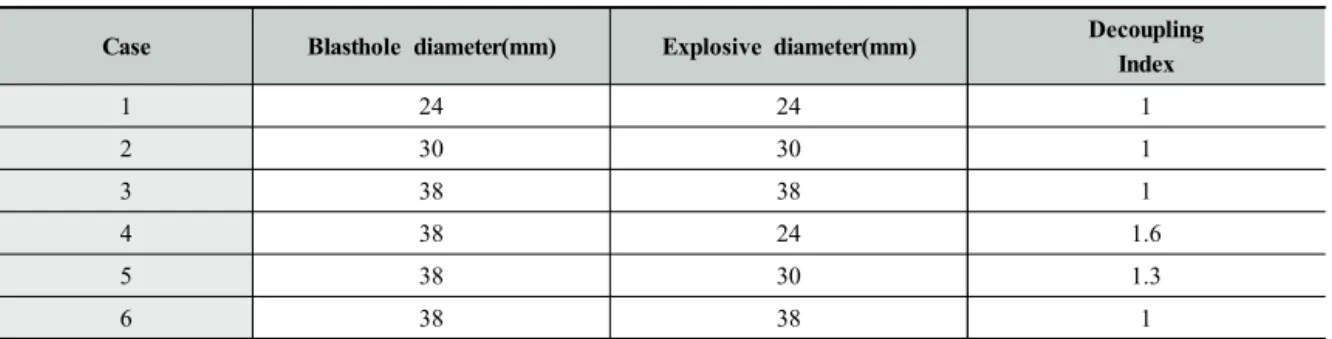
the model, all the elements have a triangular shape. The analysis model considers a continuous boundary condition for outer nodal points and force boundary conditions on the inner boundary for applying blast loading. Table 1 shows the calculation conditions for numerical analyses with different hole diameters and decoupling indexes.
Table 2 lists the physical and mechanical properties for the analysis model. To consider blast loading of ANFO and emulsion explosives on the blast hole, a JWL(Jones-Wilkins-Lee) equation, which is one of the most widely used equations of state (EOS) for calculating the detonation pressure of explosives, was used.
Fig. 1. Finite element layout of a single hole blasting
model.Case Blasthole diameter(mm) Explosive diameter(mm) Decoupling
Index
1 24 24 1
2 30 30 1
3 38 38 1
4 38 24 1.6
5 38 30 1.3
6 38 38 1
Table 1. Calculation condition for numerical analyses
In DFPA, the pressure time history P(t), was applied to the borehole boundary of the analysis model.
(1)
In Eq. (1),
is the pressure-time function suggested by Cho et al., (2004). The graph of
is shown in Fig. 2 for easy reference. In Fig. 2, t
1is the rising-time of the shock wave occurring on the blast-hole wall, and t
2and t
3determine the decay time. The decay time represents the duration of the gradually decreasing explosion gas pressure on the blast-hole wall. The peak pressure,
, was calculated using the JWL equation(Lee et al., 1973)
+ CV(t)
-(ω+1)(2)
There were two types of explosives used:
Emulsion and ANFO explosives. The parameters of the emulsion explosives are A = 365.29 [GPa], B = 2.703 [GPa], C = 0.227 [GPa], R1 = 4.999, R2 = 0.892, and ω = 0.23, and those of ANFO are A = 207.791 [GPa], B = 2.914 [GPa], C = 0.432 [GPa], R1 = 5.907, R2 = 1.079, and ω = 0.4 (Sanchidrian et al., 2015). V(t) is the relative volume, Ve(t)/Vo.
Here, Ve(t) is the volume of the gas produced, and Vo is the volume of the explosives. The pressure, varied due to a volume change of charge hole and the Decoupling hole, was expressed by the ratio of the relative volume.
Parameter Value
Compressive strength (KPa) 140,000
Tensile strength (KPa) 7,500
P-wave velocity (km/s) 4
Elastic modulus (MPa) 41,000
Density (t/m3) 2.6
Fracture energy (Pa⋅m) 200
Table 2. Physical and mechanical properties for the analysis model
Fig. 2. Pressure-time history for gas pressure in the blastholes.
3. Estimation of blast-induced damage radius using DFPA and empirical approach
Figs. 3(a) and 3(b) show the final fracture patterns of a single hole blasting model with various blast hole diameters and explosives. In Fig.
3, the green circles indicate the compressive failure zone by intensive blast loadings and the radial tensile cracks in the vicinity of the compressive failure zone was expressed as red lines. In the case of ANFO, the maximum length of the opening radial cracks was 1.09m when D
b= 24mm, 1.42m when D
b= 30mm, and 1.87m when D
b= 38mm.
In the case of emulsion, the maximum length of
opening crack length was 1.25m when D
b= 24mm, 1.52m when D
b= 30mm, and 2m when D
b= 38mm respectively. It is worth noting that the extension of radial tensile crack increases with the increasing blast hole diameter.
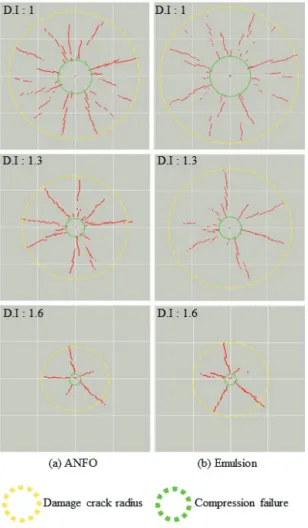
Figs. 4(a) and 4(b) shows the obtained fracture patterns of the single hole blasting model with different decoupling index(DI). In the case of ANFO, the maximum length of opening radial crack was 0.86m when DI=1.6, 1.29m when DI=1.3, and 1.87m when DI=1. In the case of emulsion, the maximum length of opening crack length is 0.97m when DI=1.6, 1.44m when DI=1.3, and 2m when DI=1 respectively. It is worth noting that the extension of radial tensile crack increases
Fig. 3. Resultant fracture patterns of a full charge blast
hole with different hole diameters.Fig. 4. Resultant fracture patterns of 38mm hole diameter
with different DI..with decreasing Decoupling Index value.
In the 1990s, the Swedish National Road Administration(SNRA) suggested a method for estimating BDZ using the borehole diameter and the types of explosives. Ouchterlony modified this method to predict the damage zone more reliably based on the experimental results(Ouchterlony, 1997). For the present study, the damage crack length,
∅, is calculated by the formula suggested by Ouchterlony.
∅ ∙ ∅∙
(3a)
∙
∅(3b)
∙ ∙
∙ ∅∅(3c)
(3d)
In the above equations,
is the borehole pressure required to initiate crack growth,
denotes the borehole pressure, and
is the estimated non-dimensional adiabatic expansion exponent of the explosive fumes. In addition, the various symbols are defined as follows.
∅
: Borehole diameter (m)
∅
: Explosive diameter (m)
: Velocity of the explosive (m/s)
: P-wave propagation velocity in rock (m/s)
: Density of the explosive (kg/m
3)
: Explosion energy, Heat of reaction of the explosive (J/kg)
: Static fracture toughness of the rock (Pa⋅m
0.5)
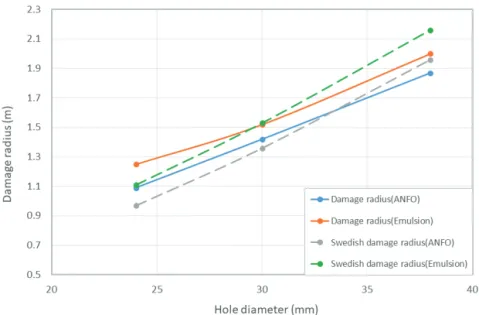
Eqs. 3(a) to 3(d) can be used to deduce the crack length using the borehole and the explosive diameter, explosion speed, the density, the explosive energy and the rock mass properties (i.e. P-wave velocity, fracture toughness). Fig. 5 shows the
comparative result of the estimated damage crack lengths obtained by 2D DFPA and the empirical equation (Eq. 3(a)) with different blast hole diameters and explosives. The deviation of the crack radius at a small diameter was about 30cm, and the similar tendency was observed in the case of the large diameter. It appears that the DFPA underestimates the crack length at large diameter.
Fig. 6 compares the predicted damage crack lengths obtained by 2D-DFPA and the empirical equation with different DI for each explosive. The deviation of the crack radius length at DI=1 was about 30cm, and a similar tendency was observed at the large DI.
4. Prediction of perimeter damage in underground mine blasting
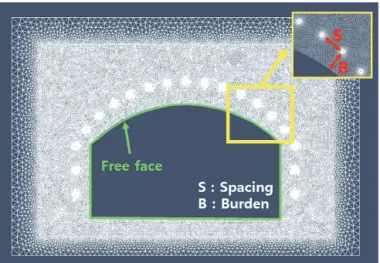
The role of the perimeter holes in a controlled blasting is a reduction of damage to the remaining rocks, and it can help develop the smooth fracture plane of blast excavation. In order to verify the numerical results of the fracture behavior near the blast holes, the real-scaled underground tunnel model was used(see Fig. 7). In Fig. 7, the finite element layout for nineteen perimeter holes is shown. The area formed by the previous blasting sequence was considered as a free face.
Fig. 8 shows the distribution of maximum
principal stresses and crack propagation along the
contour holes. The radial cracks are expressed as
black lines, and the color contours indicate the
magnitude of principal stress. Note that the
negative value of stress contour exhibits a
compression. At the elapsed time of 50μs, the
radial stress waves generated from each blast hole
propagate through the rock mass. At the elapsed
time of 150μs, the concentration of compressive
stress waves are observed in the middle parts
between the adjacent holes. The concentration of
compressive stress induces a tangential tensile
loadings, the cracks are initiated between the adjacent holes. At the elapsed time of 200μs, the cracks are propagated to the radial direction. At
the elapsed time of 500μs, the propagating cracks are connected to each other along the holes, which makes the smooth failure plane created.
Fig. 5. Comparison of damage radius obtained by numerical analyses and the empirical theory with increasing
hole diameter.Fig. 6. Comparison of damage radius obtained by numerical analyses and the empirical theory with increasing
hole diameter with increasing Decoupling Index.5. Conclusion
In this study, we compared the blast-induced damage zones around a single blast hole by estimated by the recommended Swedish empirical theory and 2-dimensional dynamic fracture process
analysis code(DFPA-2D). Different borehole diameters and decoupling index was considered to simulate the fracturing around the contour hole.
The JWL pressure-time history of ANFO and emulsion explosive was applied to describing the blast loadings, respectively. In the numerical
Fig. 7. Finite element layout for analysis model of the contour holes in
underground mine blasting.Fig. 8. Maximum principal stress distribution and crack propagation along the contour holes
simulation result of the single hole blasting with various hole diameters, it was found that the extension of radial tensile crack increases with increasing hole diameter. In the case of the correlation between Decoupling Index and the BDZ, it was obtained that the smaller the Decoupling Index, the longer the crack length. This result indicates that the extension of radial tensile crack increases with decreasing Decoupling Index value. The DFPA was also used to examine the fracture plane formation around perimeter holes for underground mining blasting. The result shows that the induced tangential stress by blast waves interaction between adjacent holes can lead to the smooth failure planes along the holes as well as the suppress of crack propagation to internal rock masses.
References
1. Cho, S. H. and K. Kaneko, 2004, Influence of the applied pressure waveform on the dynamic fracture processes in rock, International Journal of Rock Mechanics and Mining Sciences, Vol. 41. No. 5, pp.
771-784.
2. Cho, S. H. and K. Kaneko, 2004, Rock fragmentation control in blasting, Materials Transactions, Vol. 45, pp. 1722-1730.
3. Cho, S. H., Y. Y. Jeong, K. Y. Kim, K. Kaneko, 2009. Study on the Precise Controlling of Fracture
Plane in Smooth Blasting Method. Tunneling &
Underground Space, Vol. 19, No. 4, pp. 366-372.
4. Iverson, S. R., W. A. Hustrulid and J. C. Johnson, 2013, A new perimeter control blast design concept for underground metal/nonmetal drifting applications, Department of Health and Human Services, Centers for Disease Control, National Institute for Occupational Safety and Health, Report of Investigations 9691.
5. Japan Explosive Society, 2001, Blast engineering handbook for field engineers, Tokyo Kyoritsu shuppan.
6. Lee, E., M. Finger and W. Collins, 1973, JWL equation of state coefficients for high explosives, Lawrence Livermore National Lab(LLNL), No. UCID-16189.
7. Min, G. J., S. W. Park, S. W. Oh, S. H. Cho, B. H.
Kim, and D. Fukuda, 2019, Dynamic Fracture Process Analysis of Controlled Blasts to Minimize the Excavation Damage zone in Underground Excavations, American Rock Mechanics Association 19-0307, New York.
8. Ouchterlony, F., M. Olsson and I. Bergqvist, 2002, Towards New Swedish Recommendations for Cautious Perimeter Blasting, Fragblast, Vol. 6, No. 2, pp.
235-261.
9. Pappas, D. M., and L. J. Prosser, 2003, Ground fall injuries in underground stone mines, National Institute for Occupational Safety and Health.
10. Sanchidrián, J. A., R. Castedo, L. M. López, P. Segarra and A. P. Santos, 2015, Determination of the JWL constants for ANFO and emulsion explosives from cylinder test data, Central European journal of energetic materials, Vol. 12, No. 2, pp. 177-194.
11. Weibull, W., 1951, Statistical Distribution Function of
Wide Applicability. Journal of Applied Mechanics,
Vol. 18, pp. 293-297.
박 세 웅
전북대학교 자원⋅에너지공학과 석사과정
Tel : 063-270-4636 E-mail : [email protected]
오 세 욱
전북대학교 자원⋅에너지공학과 박사과정
Tel : 063-270-4636
E-mail : [email protected]
민 경 조
전북대학교 자원⋅에너지공학과 박사과정
Tel : 063-270-4636
E-mail : [email protected]
Daisuke Fukuda
Hokkaido University Professor Tel : 063-270-4636
E-mail : [email protected]
조 상 호
전북대학교 자원⋅에너지공학과 교수 Tel : 063-270-4636
E-mail : [email protected]