• 검색 결과가 없습니다.

The Impact of Exchange Rate on Exports and Imports: Empirical Evidence from Vietnam

N/A
N/A
Protected

Academic year: 2021

Share "The Impact of Exchange Rate on Exports and Imports: Empirical Evidence from Vietnam"

Copied!
8
0
0

로드 중.... (전체 텍스트 보기)

전체 글

(1)

Print ISSN: 2288-4637 / Online ISSN 2288-4645 doi:10.13106/jafeb.2021.vol8.no5.0061

The Impact of Exchange Rate on Exports and Imports:

Empirical Evidence from Vietnam

Nga Hong NGUYEN

1

, Hat Dang NGUYEN

2

, Loan Thi Kim VO

3

, Cuong Quoc Khanh TRAN

4

Received: January 15, 2021 Revised: March 21, 2021 Accepted: April 01, 2021

Abstract

The exchange rate is considered a tool improving the volume of exports and reducing imports. This paper aims to determine the impact of the exchange rate on exports and imports between Vietnam and the United States in the context of the trade war. The research uses Autoregressive Distributed Lag (ARDL) and Nonlinear Autoregressive Distributed Lag (NARDL) Model in the time-series data from 2010:1 to 2020:9. The ARDL’s results support that real exchange rate impact on export and import volumes, but less than the trade war.

The trade war helps trade balance increase 0.35%, while the exchange rate increases trade balance 0.191% when the Vietnamese currency devalues 1% in the long run. In the short term, the real exchange rate makes the trade balance decrease. Therefore, the J curve exists between Vietnam and the U.S. The NARDL expresses that the exchange rate is asymmetric both in the short term and the long term. The findings of this study point to two important elements. Firstly, the exchange rate plays a minor role in exports and imports. Secondly, trade war plays a vital role in increasing exports and imports volume between two countries, and the J curve exists between the two countries.

Keywords: Exchange Rate, Trade War, NARDL, Vietnam, Asymmetric JEL Classification Code: F10, F31, F32, F41

which are less value-added products. In contrast, Vietnam imports high value-added products such as computers and electronics.

Table 1 shows the export and import volume between the two countries during the period of 2010–2019. The data indicate the export volume growth rate to the U.S market from 2010 to 2019 is 17.4% on average. Especially, after the trade war (02/2018), export volume increased USD5.94 billion in absolute value or 14.28% in 2018. The record of export volume peaked at USD13.82 billion in absolute value or 29.07% in 2019. The acceleration has increased nearly the same as exports (16.29% per year) like imports. Vietnam’s import volume increased 36.4% in 2018 and continuously improved in 2019.

The reason why both exports and imports have sharply increased is explained as follows. When the trade war happened, Vietnam’s export products have had more opportunities to penetrate the U.S economy to replace the Chinese products. Besides that, to evade US taxation or technical barriers of the, Chinese enterprises have used the fake practice to have Vietnam Certification of Original (C/O) or “made in Vietnam” on exported products to the U.S. This volume of export is recorded as Vietnamese; however, the truth owners are Chinese.

1

First Author. Associate Professor, Head of Economics Department, Faculty of Economics, University of Economics and Law, National University Ho Chi Minh City, Vietnam. Email: [email protected]

2

Lecturer, Department of Business Administration, Faculty of Economics and Management, Hong Bang International University, Ho Chi Minh City, Vietnam. Email: [email protected]

3

Head, Department of Political Economy, Faculty of Basic Science, Van Lang University, Ho Chi Minh City, Vietnam.

Email: [email protected]

4

Corresponding Author. Lecturer, Department of Economics, Faculty of Basic Science, Van Lang University, Ho Chi Minh City, Vietnam [Postal Address: 45 Nguyen Khac Nhu Street, Co Giang Ward, District 1, Ho Chi Minh City, 71013, Vietnam]

Email: [email protected]

© Copyright: The Author(s)

This is an Open Access article distributed under the terms of the Creative Commons Attribution Non-Commercial License (https://creativecommons.org/licenses/by-nc/4.0/) which permits unrestricted non-commercial use, distribution, and reproduction in any medium, provided the original work is properly cited.

1. Introduction

As a small, open, and export-led economy, Vietnam relies

mainly on the U.S economy for exports. The trade surplus of

Vietnam may be caused by the structure of commodity in

exports and imports. Vietnam exports agricultural products

such as dragon fruit, cashew nut, and textiles, leathers, etc.,

(2)

Table 1: Exports and Imports Between Vietnam and United State in the Period 2010–2019

Year 2010 2011 2012 2013 2014 2015 2016 2017 2018 2019

Exports (billion USD) 14.24 16.93 19.67 23.84 28.64 33.47 38.45 41.59 47.53 61.35

Imports (billion USD) 3.77 4.53 4.83 5.23 6.3 2.79 8.7 9.35 12.75 14.36

Source: International Financial Statistics (2019).

The trade war caused companies to withdraw from China, and Foreign Direct Investment (FDI) was reduced in China.

Meanwhile, Vietnam witnessed a remarkable growth in FDI attractiveness. New factories need new tools and equipment, some of which are imported from the United States. The more increase in FDI, the more imports from the U.S.

However, in December 2020, the Trump administration labeled Vietnam as a money manipulator because Vietnam meets all three reasons. One of the three reasons is that Vietnam uses the exchange rate to make commodities cheaper; thus, the competitiveness is higher in the US market. Conversely, US goods in Vietnam are more expensive, reducing competitiveness, which means that US export volumes to Vietnam decreased. However, when we observed the data, we found that both exports and imports have increased sharply after the trade war between the United States and China. For that reason, this paper will examine the changes in exports and imports as it relates to the exchange rate in the context of the trade war. Suppose the trade war has a significant effect on imports and exports while the exchange rate plays a minor. In that case, the Biden administration should remove Vietnam from the country’s list as currency manipulators.

The contribution of this paper is twofold: first, we are using updated data from 2010:1 to 2020:9. Second, to the best of our knowledge, this is the first paper using the nonlinear autoregressive model for analyzing exports and imports between Vietnam and the United States in the trade war context.

The next part of this study is organized as follows:

section 2 discusses the literature review; section 3 briefly explains methodology and data; section 4 presents results and discussion, and section 5 concludes.

2. Literature Review

The exchange rate and the trade balance are among the hot topics and are always of interest to experts and policymakers. The trade balance is defined as exports minus imports. When the exchange rate is changed, such as the devaluation of the local currency, it will make the domestic currency cheaper, encouraging exports.

In contrast, devaluation makes imported goods more expensive and restricts imports.

The devaluation of a local currency that impacts the trade balance is known as the Marshall-Lerner (ML) condition.

However, the ML condition does not explain why the trade balance is still in deficit after devaluation of the domestic currency. After a while, the trade balance begins to improve.

This phenomenon was found by Magee (1973) when studying the relationship between exchange rate and U.S trade balance. Magee (1973) discovered the J curve, which was explained by Akbostanci (2004). Most exporters and importers have signed the contract before depreciation. In the short run, the volume of exports and imports does not change much; nevertheless, the depreciation makes imported goods cost more in the domestic currency. Therefore, the value of imported goods rises while exported products do not change a lot. As a result, the trade balance becomes deficit.

Besides, the import and export of goods depend on the income of domestic and foreign residents. As the income of the domestic resident increases, the import volume of goods increases. Similarly, a rise in the foreigner’s income causes an increase in the export of goods.

There are many papers on this topic looking at trade from developing to developed countries. The results fall into three categories. First, there is no evidence that indicates a relationship between exchange rate and trade balance (Rose

& Yellen, 1989; Rahman et al., 1997; Asteriou et al., 2016).

Second, there is a negative relationship between exchange rate and trade balance (Arora et al., 2003; Shahbaz et al., 2012; Poon & Hooy, 2013). This means that the devaluation of the domestic currency will make the trade balance deteriorate. Third, there is a long-run positive relationship between two variables (Rose & Yellen, 1989; Matesanz &

Fugarolas, 2009). Recently, Abbas et al. (2020) study the effects of the Chinese currency on its main partners; the conclusion is mixed. RMB devaluation improves the trade balance with some countries. However, with some other countries, this makes the balance of trade deteriorate.

The theory shows that the devaluation of the domestic currency will positively affect exports. However, a research paper by Ahmed et al. (2017) shows that the effect of exchange rate on merchandise export volume has declined after the Global Financial Crisis (GFC), especially for participating countries related to the global manufacturing process.

Kang and Dagli (2018) pointed out that the exchange rate’s

positive effect on exports occurred before the GFC. After the

(3)

GFC, this relationship has almost disappeared. The above conclusions are similar to the research paper by Khachatryan and Grigoryan (2020). The authors study the effects of domestic currency devaluation on exports in Armenia, a developing country. The conclusion is that exchange rate volatility has no impact on exports in the short run, and has little effect in the long run.

Many technical methods were applied in the studies, such as Vector Autoregression (VAR) method (Nguyen

& Do, 2020), and the ARDL method. However, after Shin et al. (2014) developed Nonlinear Autoregressive Distributed Lag (NARDL), many papers have applied it to conduct the research, such as Bahmani-Oskooee and Fariditavana (2015), and Nusair (2017). Because this NARDL has advantages as stated by Arize et al. (2017). First, this method provides asymmetric coefficient estimators in the short run and long run. Second, variables are required to be cointegrated as I(0) when using OLS method and cointegrated as I(1), while using VAR method, the ARDL and NARLD can apply when variables mix as I(0) and I(1).

There are a few papers on this topic in Vietnam. Trinh (2014) use quarterly data from 2000 to 2010 to find out the J curve between Vietnam and 17 primarily trading partners. With the ARDL and ECM methods, the paper finds that the J curve existence. Phan and Jeong (2015) research the impact of exchange rate on the trade balance of Vietnam with FMOLS and DOLS method. Although the long-term cointegration takes place, the exchange rate harms the trade balance. This means when Vietnam devaluates VND, the trade balance deteriorates. This result aligns with Shahbaz et al. (2012). Nguyen et al.

(2020) research intra-industry trade of Vietnam with TPP partners. The results support that the exchange rate does not have any effect on the trade balance.

As a developing country labeled as currency manipulation, it is a suitable time to re-examine the effect of exchange rates on the trade balance in Vietnam in the context of the trade war. Therefore, we can propose some suggestions for policymakers.

3. Methodology and Data 3.1. Methodology

We follow the research of Leigh et al. (2017) for modeling exports and imports.

Consider a “two-country” model of trade. The volume of goods that Vietnam exports to the U.S relies on the price of goods and U.S residents’ demand.

X = f (P

m*

, Y

*

) (1)

Where P

m*

represents the price of import in the U.S and Y

*

represents the U.S’ resident income.

This paper concentrates on the effect of exchange rate on exports and imports; therefore, the function for export volume is

X f eP

P Y

M

t j

M

t j

Y

j n

j t

j n

j t

=

= + + +

+

= − −

∑ ∑

=

( , )

ln ln

lnRER

*

*

∆ ∆ ∆

α β δ

π

1

1 0

−−

= − −

+ +

+ + +

j

j n

t t

t t

M D

0

1 1 2 1

3 1

θ θ

θ ε

ln lnY

lnRER

(2) Where e is the nominal exchange rate, P

*

is the price level of U.S, and P is the price level of Vietnam. The formula

eP P

*

is the real exchange rate (RER). As mentioned above, we concentrate on either exchange rate or trade war or both;

therefore, we add a dummy variable D to the equation (2) and take the log form. We have

Ln(X) = α

0

+ α

1

ln(RER) + α

2

ln(Y

*

) + α

3

D (3) Where D is a dummy variable that takes value 0 from 2010:1 to 2018:2 and 1 from 2018:3 to 2020:9.

Equation (3) is the long-form equation; therefore, to judge the short run, we add the method Autoregressive Distributed Lag (ARDL) into (3). ARDL was developed by Pesaran et al. (2001) as in equation (4).

∆ ∆ ∆

X

t j

X

t j

Y

j n

j t

j n

j t j

j n

= + +

+ +

= − −

=

=

∑ ∑

α β δ

π θ

ln ln

lnRER ln

* 1

1 0

0

1

XX Y

D

t t

t t

− −

+

+ + +

1 2 1

3 1

θ

θ ε

ln lnRER

*

(4)

ARDL model has the advantage compared with equation (3) because it allows analyzing the short run and the long lung. Besides, ARDL can be applied when time-series data are cointegration as I(0) or I(1).

The real exchange rate and export may have an asymmetric when VND depreciates or appreciate. Therefore, we create two new variables represent for VND appreciate, POS, and represent VND depreciate, NEG, as follow:

POS

t

RER

j

RER

j t

j j

=

+

=

t

= =

lnmax( ln , )

1 1

0 (5)

NEG

t

RER

j

RER

j t

j j

=

=

t

= =

lnmin( ln , )

1 1

0 (6)

POS is calculated by the sum of partial appreciation

change of Vietnam Dong, and NEG is calculated by the sum

of partial depreciation change of Vietnam Dong. Follow

(4)

Table 2: Unit Root Test

Variable ADF PP KPSS

Level 1

st

Difference Level 1

st

Difference Level 1

st

Difference

RER –5.538*** –5.458*** –4.872*** –10.056*** 1.197 0.717***

IIPUS 0.242 –11.690*** –3.035** –16.55*** 0.914 0.5**

IIPVN –2.440 –13.490** –4.331*** –16.68*** 0.364** 0.128*

M –0.254 –18.288*** –1.766 –52.408*** 1.382 0.102*

X 0.987 –9.906*** –1.003 –30.676*** 1.401 0.252*

Note: ***, ** indicate significant at 1% and 5% levels respectively.

Shin et al. (2014), we replace RER variable in equation (4) by POS and NEG variables. We have:

∆ ∆ ∆

∆ ∆

X

t j

X

t j

Y

j n

j t

j n

j t j n

j j

= + +

+ +

= −

= +

= −

∑ ∑

α β δ

π π

ln ln

*

1

1 0

0

POS NE EG

POS NEG

j t j n

t

t t t t

X

Y D

= − −

− +

− −

+

+ + + + +

0

1 1

2 1 3 1 3 1

θ

θ θ θ ε

ln ln

*

(7)

The equation (7) is Nonlinear Autoregressive Distributed Lag Model (ARDL). The coefficients estimation allows analyzing the change of exchange rate on the export in the short run and long run. ARDL also allows investigating the asymmetric of the change of real exchange rate on export. Symmetric is the effect of POS and NEG’s exchange rate on export is the same, and asymmetric is the effect of POS and NEG’s exchange rate on export is different.

Similarly, we use the equation (8) and (9) for the import model of Vietnam from the U.S in ARDL and NARDL. X f eP

P Y

M

t j

M

t j

Y

j n

j t

j n

j t

=

= + + +

+

= − −

∑ ∑

=

( , )

ln ln

lnRER

*

*

∆ ∆ ∆

α β δ

π

1

1 0

−−

= − −

+ +

+ + +

j

j n

t t

t t

M D

0

1 1 2 1

3 1

θ θ

θ ε

ln lnY

lnRER

(8)

∆ ∆ ∆

∆ ∆

M

t j

M

t j

j n

j t

j n

j t j n

j j

= + +

+ +

= − −

= +

= −

∑ ∑

α β δ

π π

ln lnY

1

1 0

0

POS NEG G

POS NEG

j t j n

t

t t t t

M

Y D

= − −

− +

− −

+

+ + + + +

0

1 1

2 1 3 1 3 1

θ

θ θ θ ε

ln ln

(9)

Where M represents import volume from the U.S, Y is the Vietnamese resident income.

3.2. Data

This procedure for conducting the models needs export and import volume between Vietnam and the United States, real exchange rate, and resident income of two countries.

RER = eP P

*

where e is nominal exchange rate defined as the number of VND over one USD, P

*

is Consumer Price Index of United States, and P is Consumer Price Index of Vietnam.

Because of the limitation of data, this paper uses Industrial Production Index as a proxy for Vietnam and the United States resident income. Data was collected from International Financial Statistics (IFS), except the Industrial Production Index of the Vietnam economy was collected from IFS and General Statistics Office of Vietnam (GSO) and spans from 2010:1 to 2020:9.

4. Results and Discussion

4.1. Unit Root Test and Optimal Lag

Because time-series data is used in this model, we first check the stationary of these data. Augmented Dickey-Fuller (ADF) test, Phillips-Perron (PP) test, and Kwiatkowski- Phillips-Schmidt-Shin (KPSS) test are used to check the stationarity at level and first different for all variables. The results are reported in Table 2.

Table 2 shows the unit root tests for Real Exchange Rate (RER), Industrial Production Index of the U.S (IIPUS), and Industrial Production Index of Vietnam (IIPVN). ADF and PP test support all variables have unit root or stationary at level or first difference. Additionally, we used KPSS test for a more persuasive conclusion. The LM-Statistical in KPSS test shows all variables stationary.

Because no variables are integrated as I(2), determining

the optimal lag is the next step before conducting ARDL

and NARDL. There are five lag-length criteria, namely,

(5)

Table 3: ARDL for Export and Import Model

Part 1: Short-Run Estimates

Lags 0 1 2 Lags 0 1 2

C 1.009 C –1.669

∆X 0.388*** 0.442*** ∆M 0.586*** 0.269***

∆RER –4.389*** 4.701*** ∆RER –1.69* 1.928**

∆IIPUS 1.607*** –1.303* –0.912 ∆IIPVN 0.758*** –0.719***

D 0.321** –0.196 D 0.056

Part 2: Long-Run Estimates

C 5.931 C –11.568*

RER 1.836** RER 1.645***

IIPUS –3.578 IIPVN 0.27

D 0.74*** D 0.39**

Sequential modified LR test statistic (LR); Final prediction error (FPE); Akaike information criterion (AIC); Schwarz information criterion (SC); and Hannan-Quinn information criterion (HQ), used to check. All five lag criteria have the same power. The FPE and AIC indicate lag 2, and SC and HQ indicate lag 1 for both export and import models. Therefore, we used lag 2 as state as Akaike information criterion for conducting the model as previous papers (Bahmani- Oskooee & Xu, 2012; Olowofeso et al., 2017; Khachatryan

& Grigoryan, 2020).

4.2. Linear Autoregressive Distributed Lag

The output of ARDL for export (left-hand side) and import (right-hand side) model are shown in Table 3. The results support that, in the short term, all three variables are statistically significant. RER has negative impact on lag 1 and positive impact after that. The IIPUS representing for the income of U.S’s resident have the positive at lag 0 and negative at lag 1. The dummy variable has a positive impact.

In the long run, the coefficient estimation of RER has positive impact on exports and significant at 5%. This implies that, when VND devalues 1%, the export volume increases by 1.836%. The dummy variable is statistically significant at 1%. This means after the trade war helps Vietnam export to the U.S 0.74%. When the trade war began, to avoid taxation or technical barriers, many Chinese enterprises took advantage of Vietnam’s origin to export commodities to the U.S. In brief, both the exchange rate and trade war support the export volume of Vietnam.

The import model on the right-hand side indicates the effect of independent variables on the import volume of Vietnam. The real exchange rate supports imports at lag 0;

after that, when the Vietnamese currency is devalued 1%,

the import volume increases by 1.928%. In contrast with exports, the trade war did not affect import volume in the short term. This happens maybe for three reasons. First, Vietnam’s economy is a small market for U.S enterprise and absorbs all the U.S products at that time. Second, Chinese enterprises in the struggle with the trade war have been replaced in the US market, and have turned to other countries especially Vietnam, which shares the same border and with people liking the same cheap price product because the Vietnamese GDP/capita is in the low middle income.

Finally, many contracts had been signed before the trade war happened.

In the long term, the dummy variable is significant, which implies the import volume increase by 0.39% when the trade war takes place. The reason is that Vietnam and the U.S enterprises have changed the structure of imports and exports. Vietnam’s companies have signed more contracts with the U.S because Vietnamese love the U.S commodity more than Chinese commodity and to reduce the potential risk in the future. The RER has significance at 1%, which implies that when VND devalues 1% the exports of the U.S increase 1.465%.

To sum up, both trade war and real exchange rate impact on trade balance between Vietnam and the U.S in the long term. The trade war helps trade balance increase 0.35%

(0.74–0.39%) more than RER 0.191% (1.936%–1.645%).

In the short term, the real exchange rate makes the trade balance decrease at lag 0 and lag 1. Therefore, the J curve exists between Vietnam and the U.S.

4.3. Non-Linear Autoregressive Distributed Lag

For a deeper understanding of the impact of the exchange

rate on import and export, NARDL is conducted. Table 4

shows the short-run and long-run output of exports and

(6)

Table 4: Nonlinear Autoregressive Distributed Lag for Export and Import Model Part 1: Short-Run Estimation

Lags 0 1 2 Lags 0 1 2

C 4.88*** C 2.043***

∆X 0.094 0.23*** ∆M 0.409*** 0.147**

∆POS –2.933*** 3.23*** ∆POS –1.224 2.714** –1.268

∆NEG –9.2*** ∆NEG –5.249***

∆IIPUS 1.629*** –0.654 –0.985** ∆IIPVN 0.669*** –0.559***

D 0.113*** D 0.084**

Part 2: Long-Run Estimation

C 7.217*** C 4.604***

POS 0.439* POS 0.499*

NEG –13.605*** NEG –11.826***

IIPUS –0.014 IIPVN 0.248*

D 0.167*** D 0.189***

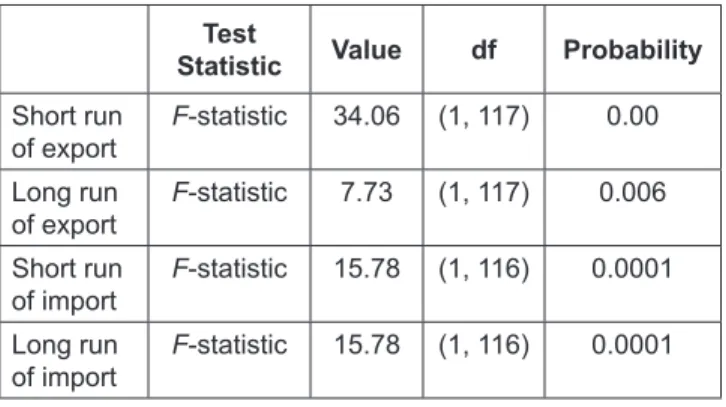
Table 5: Wald Test for Short Run and Long Run Asymmetric of Export and Import

Test

Statistic Value df Probability Short run

of export F-statistic 34.06 (1, 117) 0.00 Long run

of export F-statistic 7.73 (1, 117) 0.006 Short run

of import F-statistic 15.78 (1, 116) 0.0001 Long run

of import F-statistic 15.78 (1, 116) 0.0001 imports. The variables POS and NEG are statistically significant both on the short term and long term. In part 2, long-run estimation indicates when VND devalues 1%, exports increase by 0.439%, while imports increase by 0.499%. In contrast, when VND appreciates 1%, the exports decrease 13.61%, and Vietnam’s imports decrease 11.83%.

Table 4 shows the significant difference between POS and NEG in either exports or imports, which implies the asymmetric exchange rate on the trade balance. To answer that question more scientifically, Wald test is used for detecting the evidence. In all cases that have the null hypothesis, POS and NEG are symmetric.

Table 5 presents the Wald test for checking the asymmetric.

All cases show that the probability of chi-square is less than 1%. Therefore, the null hypothesis is rejected, which implies

the short-run and long-run asymmetric relation of export and import models.

4.4. Diagnostic Check

Table 6 shows the diagnostic check for the linear and nonlinear model. F test is significant at 1% (except import model significant at 5%) and supports the equation cointegration. Next, the Error Correction Model (ECM) has a negative sign and is significant implying the long-run causality running from independent variables to the dependent variable. In other words, the real exchange rate has impacted import and export volumes in the long run. Besides that, Breusch-Godfrey Serial Correlation LM test indicates there is no serial correlation (except the export model in ARDL);

Breusch-Pagan-Godfrey test shows heteroskedasticity did not accompany the export model. Normality test indicates the residuals are normally distributed on all of the models.

Cumulative sum of the recursive residuals (CUSUM) and CUSUM of squares test (CUSUMQ) are added to check the stability. The results express parameters stability at CUSUM and CUSUMQ (except the import model in the ARDL).

Although the import model in linearity has the disadvantages of heteroskedasticity and CUMSUMQ, the rest of the requirements are satisfied. As a result, this model is still considered being good. The other models are good, and the best model is the export model in the NARDL; it satisfies all the gauges of tests.

To summarize, the exchange rate has a slight impact on

trade balance, and the J curve exists between Vietnam and the

U.S. The diagnostic checks show that the four models are good.

(7)

The exchange rate is asymmetric in both the short term and long term. NARDL supports the minor impact of the exchange rate on exports. This result is similar to Khachatryan and Grigoryan (2020) in their research in Armenia, a developing country like Vietnam. Finally, the trade war had a vital impact on the trade balance between Vietnam and the U.S.

5. Conclusion

The U.S economy plays a vital role for the rest of the world, mainly for export–led growth countries like Vietnam. Vietnam’s government profoundly understand the consequence if U.S government labels it a currency manipulater. This paper proves that the main reason why the trade surplus of Vietnam increases in recent times is because of the trade war between the U.S and China. As a result, the Biden administration should remove Vietnam from the country’s list of currency manipulators.

Using the time-series data from 2010:1 to 2020:9, this paper also discovers the J curve, which is one of the most exciting topics in international economics, which takes place between two countries, reaching the same conclusion as Trinh (2014). However, there is a minor impact of the exchange rate on trade balance. This result suggests that Vietnamese policymakers should design suitable policy to stimulate exports. Besides, Vietnam’s government should prioritize fiscal policy for increasing the added value of the export products. The customs should pay more attention to the enterprises victims of the faking C/O. Finally, the nonlinear models support the asymmetric relationship in short run and long run for exports and imports.

References

Abbas, S., Nguyen, V. C., Yanfu, Z., & Nguyen, H. T. (2020). The Impact of China Exchange Rate Policy on its Trading Partners Evidence Based on the GVAR Model. Journal of Asian

Finance, Economics and Business, 7(1), 123–129. https://doi.

org/10.13106/jafeb.2020.vol7.no8.131

Ahmed, S., Appendino, M., & Ruta, M. (2017). Global value chains and the exchange rate elasticity of exports. The BE Journal of Macroeconomics, 17(1), 1–24. https://doi.org/10.1515/bejm- 2015-0130

Akbostanci, E. (2004). Dynamics of the trade balance: the Turkish J-curve. Emerging Markets Finance and Trade, 40(5), 57–73.

https://doi.org/10.1080/1540496X.2004.11052584

Arize, A. C., Malindretos, J., & Igwe, E. U. (2017). Do exchange rate changes improve the trade balance: An asymmetric nonlinear cointegration approach. International Review of Economics & Finance, 49, 313–326. https://doi.org/10.1016/j.

iref.2017.02.007

Arora, S., Bahmani-Oskooee, M., & Goswami, G. (2003).

Bilateral J-curve between India and her trading partners. Applied Economics, 35(9), 1037–1041. https://doi.

org/10.1080/0003684032000102172

Asteriou, D., Masatci, K., & Pılbeam, K. (2016). Exchange rate volatility and international trade: International evidence from the MINT countries. Economic Modelling, 58, 133–140. https://

doi.org/10.1016/j.econmod.2016.05.00

Bahmani-Oskooee, M., & Fariditavana, H. (2016). Nonlinear ARDL approach and the J-curve phenomenon. Open Economies Review, 27(1), 51–70. https://doi.org/10.1007/s11079-015- 9369-5

Bahmani-Oskooee, M., & Xu, J. (2012). Impact of exchange rate volatility on commodity trade between US and China: is there a third country effect. Journal of Economics and Finance, 36(3), 555–586. https://doi.org/10.1007/s12197-010-9126-y

Kang, J. W., & Dagli, S. (2018). International trade and exchange rates. Journal of Applied Economics, 21(1), 84–105. https://doi.

org/10.1080/15140326.2018.1526878

Khachatryan, G. A., & Grigoryan, A. (2020). Export Growth Dynamics and Real Exchange Rate: Evidence from Armenia. International Economic Journal, 34(3), 493–509.

https://doi.org/10.1080/10168737.2020.1750045 Table 6: Diagnostic Statistics

Part 1: Diagnostic Statistics Export and Import in ARDL Model F-bound

Test ECM

t-1

Serial

Correlation Heteroskedasticity Normality CUSUM CUSUMQ

Export model 5.752*** –0.17*** – + + + +

Import model 2.677** –0.144*** + – + + –

Part 2: Diagnostic Statistics Export and Import in NARDL Model

Export model 13.08*** –0.68*** + + + + +

Import model 4.28*** –0.44*** + – + + +

Note: ***, ** indicate significant at 1% and 5% levels respectively; +: Good; –: Bad.

(8)

Leigh, M. D., Lian, W., Poplawski-Ribeiro, M., Szymanski, R., Tsyrennikov, V., & Yang, H. (2017). Exchange rates and trade:

A disconnect? International Monetary Fund. http://dx.doi.

org/10.5089/9781475587494.001

Magee, S. P. (1973). Currency contracts, pass-through, and devaluation. Brookings Papers on Economic Activity, 1973(1), 303–325. https://doi.org/10.2307/2534091

Matesanz, D., & Fugarolas, G. (2009). Exchange rate policy and trade balance: a cointegration analysis of the Argentine experience since 1962. Applied Economics, 41(20), 2571–2582. https://doi.org/10.1080/00036840701222660 Nguyen, H. M., Quan, B. Q. M., Le, H. V., & Tran, T. V. (2020).

Determinants of intra-industry trade between Vietnam and countries in TPP. Journal of Asian Finance, Economics and Business, 7(1), 123–129. https://doi.org/10.13106/jafeb.2020.

vol7.no1.123

Nuyen, V. C., & Do, T. T. (2020). Impact of exchange rate shocks, inward FDI and import on export performance: a cointegration analysis. Journal of Asian Finance, Economics and Business, 7(4), 163–171. https://doi.org/10.13106/jafeb.2020.vol7.

no4.163

Nusair, S. A. (2017). The J-Curve phenomenon in European tran- sition economies: A nonlinear ARDL approach. International Review of Applied Economics, 31(1), 1–27. https://doi.org/10 .1080/02692171.2016.1214109

Olowofeso, O. E., Adeboye, A. A., Adejo, V. T., Bassey, K. J.,

& Abraham, O. (2017). Agricultural sector credit and output relationship in Nigeria: Evidence from nonlinear ARDL1. CBN Journal of Applied Statistics, 8(1), 101–122

Pesaran, M. H., Shin, Y., & Smith, R. J. (2001). Bounds testing approaches to the analysis of level relationships. Journal of Applied Econometrics, 16(3), 289–326. https://doi.org/10.1002/jae.616 Phan, T. H., & Jeong, J. Y. (2015). Vietnam trade balance and

exchange rate: Evidence from panel data analysis. Journal of Applied Economics and Business Research, 5(4), 220–232.

Poon, W. C., & Hooy, C. W. (2013). Exchange-rate volatility, exchange-rate regime, and trade in OIC countries. Journal of Asia-Pacific Business, 14(3), 182–201. https://doi.org/10.1080 /10599231.2013.772843

Rahman, M., Mustafa, M., & Burckel, D. V. (1997). Dynamics of the yen-dollar real exchange rate and the US-Japan real trade balance. Applied Economics, 29(5), 661–664. https://doi.

org/10.1080/000368497326868

Rose, A. K., & Yellen, J. L. (1989). Is there a J-curve? Journal of Monetary economics, 24(1), 53–68. https://doi.

org/10.1016/0304-3932(89)90016-0

Shahbaz, M., Jalil, A., & Islam, F. (2012). Real exchange rate changes and the trade balance: The evidence from Pakistan. The International Trade Journal, 26(2), 139–153. https://doi.org/10 .1080/08853908.2012.657588

Shin, Y., Yu, B., & Greenwood-Nimmo, M. (2014). Modelling asymmetric cointegration and dynamic multipliers in a nonlinear ARDL framework. In: Festschrift in honor of Peter Schmidt (281–314). Springer, New York, NY. https://doi.

org/10.1007/978-1-4899-8008-3_9

Trinh, P. T. T. (2014). The impact of exchange rate fluctuation

on trade balance in the short and long run: the case of

Vietnam. Journal of Southeast Asian Economies, 432–452.

수치

Table 1: Exports and Imports Between Vietnam and United State in the Period 2010–2019
Table 2 shows the unit root tests for Real Exchange Rate  (RER), Industrial Production Index of the U.S (IIPUS), and  Industrial Production Index of Vietnam (IIPVN)
Table 3: ARDL for Export and Import Model
Table 5: Wald Test for Short Run and Long Run Asymmetric  of Export and Import

참조

관련 문서

The English Language Centre The University of Adelaide Level 9, 115 Grenfell Street Adelaide SA 5005 Australia Phone: + 61 8 8313 4777 Fax: + 61 8 8313

 The Dutch physicist Pieter Zeeman showed the spectral lines emitted by atoms in a magnetic field split into multiple energy levels...  With no magnetic field to align them,

Modern Physics for Scientists and Engineers International Edition,

This paper investigates the effect of exchange rate fluctuations on the Korean manufacturing firm’s performance in the period of 1989~2006 using totally 6,801 firms,

Originally, one must prepare the required documents and visit the Immigration Office but the university provides a transportation service to get to

웹 표준을 지원하는 플랫폼에서 큰 수정없이 실행 가능함 패키징을 통해 다양한 기기를 위한 앱을 작성할 수 있음 네이티브 앱과

_____ culture appears to be attractive (도시의) to the

The index is calculated with the latest 5-year auction data of 400 selected Classic, Modern, and Contemporary Chinese painting artists from major auction houses..