Print ISSN: 2288-4637 / Online ISSN 2288-4645 doi:10.13106/jafeb.2018.vol5.no3.81
The Impact of Hallyu 4.0 and Social Media on Korean Products Purchase Decision of Generation C in Vietnam*
Nguyen Xuan Truong
1Received: May 30, 2018 Revised: July 18, 2018 Accepted: July 30, 2018
Abstract
This study developed and tested the impact of hallyu 4.0, social media, and consumer ethnocentrism on the decision to purchase Korean products of Generation C in Vietnam. Both qualitative and quantitative methodologies were utilized in this study. Qualitative research was first carried out with in-depth interview, conducted to derive measurement items for the interested constructs. Quantitative research used cross-sectional field design by pilot study and official study. The model was tested and developed using data collected by questionnaires, from a sample of 575 respondents, by both electronic and paper surveys with non-probability and convenience sampling techniques. SPSS 20 and AMOS 20 software were employed to analyze the data. The results of structural equation modeling showed that hallyu 4.0, social media, and consumer ethnocentrism influenced the intermediates variables: subject norms, trust, attitude and behavioral intention and influenced purchase decision. The hallyu 4.0, social media, and consumer ethnocentrism are independent variables. They impact purchase decision through mediating variables such as trust, subjective norms, attitude and behavioral intention. Social media influences not only to trust but also to subjective norms. Subjective norms influence on purchase decision. This study also discovers an interesting fact that trust and attitude variables have an impact on behavioral intention and purchase decision.
Keywords: Hallyu 4.0, Social Media, Korean Product, Generation C, Vietnam.
JEL Classification Code: M31, M37, M39.
1. Introduction 1
Generation C are connected, members of this generation have a tight connection with other people and things in the way people never had in the past. Specifically, they employ online channels to create content, post statuses or pictures, watch videos and exchange knowledge, etc. In terms of
* The paper was presented initially at 2018 International Conference on Business and Economics (ICBE2018) and the 14th International Conference of KODISA that was held in Seoul, South Korea, June 25-27, 2018. The paper has been recognized as one of Best Paper Awards at ICBE2018 conference. This paper is a substantially revised and expanded version of the paper presented at ICBE2018 conference. The authors have taken into account all the comments of Editors, Session Chairs and Reviewers in the revised manuscript. The authors greatly appreciate Editors, Session Chairs and Reviewers for their valuable comments, interest in and support of this research.
1 First Author and Corresponding Author. Professor and Dean, Faculty of Marketing, University of Finance – Marketing, Ho Chi Minh City, Vietnam [Postal Address: 105/1 Binh Quoi Street, Ward 27, Binh Thanh District, Ho Chi Minh City, 700000, Vietnam]
Email: [email protected]
generation C, researchers are having trouble pinpointing the main characteristics of this category and who should be included in this group. Some researchers used the year when a person was born to answer this question. Pikett (2017) showed research results of CEFRIO, a public-private technology transfer group in Quebec, Canada, defining generation C as a group of individuals born between the year of 1982 and 1996. This would actually place generation C within the group of generation Y or millennials. Others referred to generation C as a "psychographic" group, or a number of individuals who shared similar opinions and states of mind, whether that were certain personality traits, values, attitudes, interests, or lifestyles.
According to Booz & Company (2010), generation C was connected, communicating, content-centric, computerized, community-oriented, and always clicking. They were born after 1990 and lived their adolescent years after 2000. In this study, generation C is referred to as those who were born between 1990 to 2000. Besides, Korean new cultural trend also had a significant impact on the exports of Korean product and increased tourism (Lee, 2015; Hogarth, 2013).
According to Kim (2015), hallyu (Korean wave) 1.0 emerged
with K-drama exports in the late 1990s, then came hallyu
82 Nguyen Xuan Truong / Journal of Asian Finance, Economics and Business Vol 5 No 3 (2018) 81-93
2.0 with K-music, hallyu 3.0 with K-culture, and hallyu 4.0 with K-style. Hallyu had then increased the purchase of Korean-related products by foreign customers (Yu et al., 2012). The Internet and social media are growing fast globally and in Vietnam for the past 5 years. Overall, Vietnam had got over 64 million internet users (48,1%
population) as of December 31, 2017 (Internetwordstats, 2018) and 58 million Facebook users as of April 2018 (Statista, 2018). Hallyu 4.0 (K-style) had increased the purchase of Korean-related products among Vietnamese customers. Nowadays, generation C in Vietnam is influenced by hallyu 4.0 and social media and they usually search for information, prospective reviews from other people through social networking sites.
Despite the influence of hallyu 4.0 and social media to purchase decision of generation C has not been interested in researching and applying in business. In this study, conceptual model was developed, including hallyu 4.0, social media, consumer ethnocentrism, subjective norms, trust, and attitude constructs resulted from previous studies, in order to explain an individual’s intention and the purchase decision of Generation C in Vietnam.
2. Literature Review, Hypotheses Development and Conceptual Model
2.1.Social Media (SM)
Social media is an e-space for social activism and support, emotional expression, news updating, as well as friendship developing. It is a means for people to share their photos, post statuses, update their daily lives and communicate with other people, which derive a sense of self-assurance and belonging. Social media has been powerful in changing the way people connect with one another, and has brought many positive outcomes. In addition, when it comes to purchasing goods, users of social media can collect information from the huge online database to make their own decision. Social media independent variables played an important role in affecting purchase decision and its usage also impacted purchase decision (Mathupur, Black, Cao, Berger, & Weinberg, 2012). Furthermore, Mangold and Faulds (2009) stated that social media had influenced consumer journey from information acquisition to post purchase such as dissatisfaction statements and behaviors.
According to Cruz and Mendelsohn (2010), consumers who were fans of a brand on social media were more likely to recommend or buy from that brand. Specifically, consumers trust leaned toward their fellows’ information rather than the one created by organizations (Nielsen, 2009).
In contrast, millennials had an opposing idea when 51% of them stated that consumer opinions found on a company’s website had a greater impact. Besides, there has been one problem with social media, which is an ambiguity concerning what behavior is appropriate online. It happens when a recognized set of norms have not caught up with the speed in which social media has been adopted into our lives. The unique features, platform enforcement together with the nature of social media have created an environment in which healthy subjective norms are not ubiquitously followed.
This study was also conducted to understand the influence of social media on not only subjective norms but also trust.
Hence, I would expect hypotheses that:
H1: social media has a positive influence on subjective norms.
H2: social media has a positive influence on trust.
2.2.Hallyu 4.0 (HA)
The term "hallyu" or Korean wave first emerged in Taiwan and was referred to Korean companies and/or products in 1997 by The China Times. Hallyu and Korean wave are interchangeable as they both share the same meaning.
Hallyu was introduced with the film Jealousy shown in Fukuoka, Japan in 1993, opening a new era of Korea’s conquest of Asian entertainment industry. Hallyu is a Korean cultural production trend that comprises of all Korea- related fields such as music, film, foods, sports, and tourism.
According to Lee (2011), hallyu was the forefront of Korean dramas and Korean pop as these two popular cultural products were a catalyst to further promote other Korean cultural products. Although the “Korean wave” term consisted of both K-dramas and K-pop, K-pop resonated specifically well with Asian teenagers for creating a unique blend of Asian and Western sensibilities.
According to Kim (2015), hallyu 4.0 is K-style.
Vietnamese’s generation C has been blown away by the new wind of hallyu which inspires them to become younger, more dynamic, more active in the mainstream pop culture.
The positive impacts of hallyu are associated in the field of perception and hallyu indirectly influences attitude. Lee (2007) and Kim and Park (2004) found the positive and significant relationship between hallyu and the attitude toward Korean products. The research result of Yu et al.
(2012) showed that products relating to Korean culture such as tourism, contents, cosmetic products could be influenced.
Many researchers also proved that hallyu had positive
effects on the exports of Korean products and increased
tourism (Pang & Hwang, 2007). This study was then
conducted to understand the influence of social media to
perception. There was, thus, hypothesis:
H3: Hallyu 4.0 has a positive influence on trust.
2.3. Consumer Ethnocentrism (CE)
The term “consumer ethnocentrism” was first introduced by William (1906), a sociologist and researcher on the position of consumers on the rise which became very important in the process of globalization. Position of consumers is the result of their interest and love for the country along with their fear of adverse consequences, since imports rate can cause serious problems for local economic development method. Baughn and Yaprak (1996) stated that the intention and buying decision was treated as a reward while enjoying a psychological goal and a sense of achievements to avoid contact with other cultures and countries. The purchase of foreign products may lead to the involvement of high feelings especially when it comes to national security or job loss. Position of consumer strains had a negative and direct impact on intentions to purchase a foreign product (Shimp & Sharma, 1987).
Herche (1992) found that consumer strain tastes could be used to predict preferences to buy goods produced in the country instead of abroad. Shoham and Brenečić (2003) also reported that position of consumer strains had a significant impact on consumer's buying decision. Highest strain taste leads to detrimental attitudes with lower intention to buy foreign products. Many other studies had examined the impact of the position of consumers on purchase behavior tendencies; however, there were different results depending on characteristics of consumers and their country (Nguyen et al., 2008; Ranjbairn et al., 2011). Some studies by Ramaswamy et al. (2000), Balabanis and Diamantopoulos (2004), and Nguyen (2016) in developing countries had confirmed the existence of negative trend of consumer taste for foreign product purchase behavior. Thus, the hypotheses set out:
H4: consumer ethnocentrism negatively impacts trust.
H5: consumer ethnocentrism negatively influences purchasing decisions.
2.4. Subjective Norms (SN)
According to Ajzen (1991) and Fishbein and Ajzen (2010), subjective norms were the social determinants of intention and the reflection of social pressure perception on a given behavior. Subjective norms concerned the perceived social pressures to undertake or not undertake a particular behavior (Ajzen, 1991; Giffrin et al., 2007). They referred to an individual's perceptions of whether other people who were important to them think that they should or should not
perform one behavior (Ajzen & Fishbein, 1980). The concept of social influence assessed by social norms and normative belief was presented in both the theory of reasoned action and the theory of planned behavior. The theory of planned behavior specified the nature of relationships between beliefs and attitudes.
According to Ajzen and Fishbein (1975), people's evaluations of, or their attitudes toward a behavior were determined by their accessible beliefs about the behavior, where a belief was defined as the subjective probability that a certain outcome would happen as a result of the behavior.
According to the theory of reasoned action, if people evaluated the suggested attitude as positive, and if they thought that their significant others wanted them to perform the behavior (subjective norms), this resulted in a higher intention (motivations) and they would be more likely to undertake that behavior. Many studies have shown a high correlation of subjective norms and attitudes to behavioral intention, and subsequently to behavior (Sheppard, Hartwick,
& Warshaw, 1988). From some definitions above, it can be summarized that subjective norms in general is an individual’s set of perceptions of whether they should or should not do the behavior, taking social pressure and opinions of their important persons into consideration. Not only do subjective norms affect attitude, they also directly impact decision-making stage. Therefore, the specific hypotheses to be tested were:
H6: subjective norms positively impact attitude.
H7: social norms positively impact purchase decision.
2.5. Trust (TR)
Trust has been defined in different ways in the literature.
Trust played an important role in forming and maintaining long-term relationships (Sanchez Iniesta, Schlesinger, &
Rivera, 2010). According to Cho (2007), trust referred to the
confidence a person has in his or her favorable expectations
of what other people would do. Rousseau, Sim, Ronald and
Colin (1998) debated that trust was defined as a
psychological state comprising the intention to accept
vulnerability based on positive expectations of intentions or
behavior of another. In addition, trust had also been seen as
a set of specific, including ability, benevolence, integrity, and
predictability (Gefen, 2002). Gefen, Karahanna and Straub
(2003) showed that the people relied on trust in order to
reduce social ambiguity. The importance of trust has also
been cited in e-commerce. Social media network users
often expressed their thoughts, beliefs and choices and
showed trust in safety within the circle of netizens (Shin,
2010; Pitta & Fowler, 2005).
84 Nguyen Xuan Truong / Journal of Asian Finance, Economics and Business Vol 5 No 3 (2018) 81-93
According to a survey of US internet-using mom by an online video reviewing site expo, consumer reviews gained nearly 12 times more trust than descriptions of manufactures. Some results of study showed that trust had a great impact on consumers buying behavior. According to Smiciklas (2011), trust was important factor leading to a positive impact. The force that urges customers to share positive stories or messages about a certain brand or product is the trust they enjoy with that brand or product, and the trust between them and people they talk to. In accordance to Bazaavoice (2012), over half of millennials (consumers aged 18 to 34) trusted the opinions of strangers online over those of friends and family. Online trust would also function as the facilitator for formulating positive purchase intention and further purchase decisions. Yoon (2002) stated that both online and offline trust had had a great impact on the consumer’s purchase decision. Trust strongly affected specific behavioral intentions and trust had a strong influence on three key consumer intentions (Harrison, Vivek, & Charles, 2002; Nguyen, 2015). This study set out the hypothesis:
H8: Trust has a positive influence on attitude toward behavior.
2.6. Attitude Toward Behavior (AT)
Attitude describes the reviews, thoughts, relatively consistent tendencies of humans against an object or an idea. Attitude puts humans into the framework to think about things they like or don't like. The theory of reasoned action (TRA) and theory of planned behavior (TPB) were developed focusing on trust and attitudes as determinants of consumer buying behavior. According to Ahtola (1975) and Loudon and Della Bitta (1993), both TRA and TPB proposed that a person’s overall attitude toward an object was derived from his or her beliefs and feelings about various attributes of that object. The relative contributions of attitudes and subjective norms would not necessarily be equal in predicting behavior. In the TPB, behavioral intention was controlled by a dynamic mix of the attitude and subjective norm.
According to Ajzen (2006), actual behavior was again derived largely from behavioral intention, but was mediated to some degrees by perceived behavioral control. In the TRA, attitude toward the buying behavior is measured rather than simply the attitude toward the object. Consumers often buy when they trust and have a positive attitude to a seller, the product or service. The attitude has a long-term trend based on the values and beliefs of the people and are difficult to change. Attitudes affect buying intentions, thus posing the hypothesis:
H9: Attitudes positively influence behavioral intention.
2.7. Behavioral Intention (BI)
Intention refers to the willingness for a purchase decision.
It has a positive influence on the purchase decision.
According to Zeithaml, Berry and Parasuraman (1996), BI were indicators that customers will stay or leave the companies. Research following TRA and technical acceptance models (TAM) by Bernadette (1986) showed a high correlation between intentions and actual use. Ajzen and Fishbein (1980) and Featherman and Pavlou (2002) described the positive relationship between BI and action.
The study conducted by Sommer (2011) showed that BI referred to an individual motivation and conscious plan to expand effort and perform a behavior. In addition, research studies by Zeng, Hu, Chen and Yang (2009), Brady and Robertson (2001), and Jackson et al. (1997) revealed that service quality and consumer satisfaction affected BI and indicated that BI could be favorable and unfavorable as well.
Therefore, the following hypothesis was examined:
H10: behavioral intention positively influences purchase decision.
2.8. Purchase Decision (PD)
Individual factors mostly have control over their behavior,
which is voluntary and performed under the individual’s free
will. However, if there is a strong attitude and intention
toward undertaking a particular action, actual behavior will
occur. A favorable behavioral intention is more likely to
result in repurchase than in the case of an unfavorable
intention. According to Davis, Foxall and Pallister (2002), an
individual could intend to perform a particular activity but
might not realize it due to some outside conditions. A study
conducted by Akhter (2010) showed that overall satisfaction
had a significantly positive impact on purchase intention,
and purchase intention had a significantly positive impact on
actual repurchase. When asked which sources of
information “influence your decision to use or not to use a
particular company, brand or product”, 71% of people
surveyed claimed that reviews from family members or
friends exerted a “great deal” or “fair amount” of influence on
them (Nielsen, 2012).
2.9. Conceptual Model
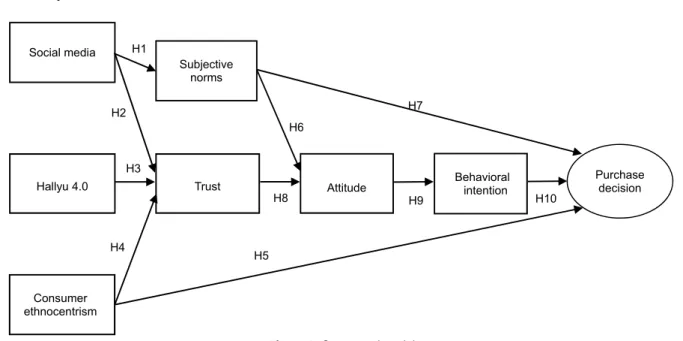
Figure 1: Conceptual model
In order to achieve the study’s objectives, the conceptual framework was developed based on the theory of reasoned action (TRA) (Fishbein & Ajzen, 1975), theory of planned behavior (Ajzen & Icek, 1991) and the trust model (Mayer, Davis, & Schoorman, 1995). According to TRA model, a person’s actual behavior could be determined by considering their prior intention along with the attitude that person would have for the given behavior. The intention that a person had prior to an actual behavior could be a factor affecting the behavioral intention, and defined it as a measure of one’s intention that could be determined by considering both the attitude which a person had toward the actual behavior (Fishbein & Ajzen, 1975).
The attitude variable eliminated any unexplained direct influence observed from the system characteristics to the attitude variable. This conceptual framework is modified by applying eight variables to find out the impact of hallyu 4.0, social media, social norm, consumer ethnocentrism, trust, attitude on behavioral intention to purchase and purchase decision on Korean products purchase of Generation C in Vietnam (Figure 1).
3. Research Methods
The conceptual model was developed on the basis of the hypotheses needed to be validated empirically using mixed research method. In order to do this, qualitative approach and quantitative approach were applied. Qualitative
research was carried out by in-depth interview with 15 participants. The questionnaire consisted of 2 sections of unstructured questions and structural questions. The unstructured questions were used to regulate the question for clarification, made them easy to understand.
The structural questions were used to test face/content validation. A total of 15 responses in the in-depth interview were to analyze each measurement items regarding essentiality and classified them into “not necessary”, “useful but non-essential”, and “essential” category. For each item, the number of judges categorizing the item as “essential”
was computed for calculation of the Content Validity Ratio (CVR). Following Laewshe’s (1975), the formula for the content validity ratio (CVR) was devised: CVR=[Ne- (N/2)]/(N/2), with: Ne was the number of participants indicating “essential” and N was the total number of participants. While the CVR was a direct linear transformation from the percentage saying “essential,” its utility derived from its characteristics: When fewer than half said “essential,” the CVR was negative. When half said
“essential” and half did not, the CVR was zero. To decide the significance of each item, Laewshe’s proposal (1975) was used, and a 5% significance level was adopted.
Quantitative approach was applied by the use of questionnaires. Quantitative approach used cross-sectional field design, as it was the best way to identify relatively strong effects on dependent variables and intermediate variables, enhancing the statistical results. This was a feasible approach for measuring complex variables and
Attitude H10Hallyu 4.0
Subjective norms
Trust
Consumer ethnocentrism
Social media H1
H3 H2
H4
H6
H7
H8
Behavioral intention
Purchase decision H9
H5
86 Nguyen Xuan Truong / Journal of Asian Finance, Economics and Business Vol 5 No 3 (2018) 81-93
forming hypotheses. For testing the conceptual model and hypotheses, SPSS 20 and AMOS 20 software were utilized.
This study applied non-probability with convenience sampling technical. The study was conducted in three regions of Vietnam: Northern, Central and Southern. A sample size of 575 satisfied the criteria for the statistical validity of the descriptive and SEM statistical techniques (Yurdugul, 2008).
Data was collected using a self-administered questionnaire where the measurement of variables was based on existing measuring instruments. The form of questionnaire in this research applied a 5-point Likert scale (1= strongly disagree; 5= strongly agree). The questionnaire was tested for validity and reliability by in-depth interview and was also done before collecting the data.
Questionnaires were distributed both electronically and by paper. The data for this study was obtained by an electronic survey distributed on Facebook, via email, and through face-to-face survey. Administration process took 30 days.
After a review of all responses, 592 responses (262 paper &
330 electronic) were considered proper. After being screened, 575 responses were considered proper and valid for further analysis.
4. Results
4.1. In-depth Interview
The 8 constructs (variables) with 40 measurement items draft was developed from theoretical basic to test by an in- depth interview through face/content validation. The result of the in-depth interview was one measurement item (CE4) was deleted from questionnaire and 39 measurement items was qualified to go through pilot study.
4.2. Pilot Study
Pilot study was used to test reliability of measurement items. 115 respondents for measurement items test by pilot study used in reliability analysis showed the homogeneity of questionnaires. Under this conceptual model, the alpha coefficients of the constructs and survey form were as follows. Cronbach’s alpha of 8 constructs was more than 0.7 and was acceptable exhibit high degrees of reliability. From 39 measurement items, only 2 measurement items HA5 and TR4 had corrected item-total correlation lower than 0.3 so it was not acceptable and 37 measurement items were acceptable (Nunnally, 1978; Peterson, 1994; Staler, 1995).
The 37 measurement items were reliable as shown in questionnaire in official study.
4.3. Official Study
4.3.1. Descriptive Analysis
This survey collected a total of 592 responses, in which 17 invalid responses were eliminated and 575 responses were retained for analysis. The response rate was, therefore, 97.13%. In the aggregate sample, 46.1% of respondents were males and 53.7% were females. 100% of them belonged to the Generation C, defined as people who were born between 1990 and 2000. 20.5% of respondents were from the North, 15.1% from the Central and 64.4% from the South of Vietnam. Almost 89.0% of the respondents’
education background was college/university level and above.
4.3.2. Cronbach Alpha Test
Before exploratory factor analysis (EFA), the measurement items were tested for reliability by Cronbach’s alpha coefficients. A higher Cronbach’s alpha score indicated greater reliability and its acceptable lower limit was 0.7 (Nunnally & Bernstein, 1994). In our research, the alpha scores of constructs were between 0.703 to 0.845.
Corrected item-total correlation of TR5 and IB5 were below 0.3, so they were removed from the conceptual model and 35 measurement items continue to go through exploratory factor analysis.
4.3.3. Exploratory Factor Analysis
The measurement items were refined using exploratory factor analysis and poorly fitted items were excluded from the study. The results of the conceptual model, which included the standardized factor loadings, standard errors, construct reliabilities, and proportions of variance extracted for each construct were presented. Factor loadings of the indicators for each construct were statistically significant and sufficiently high to demonstrate that the indicators and their underlying constructs were acceptable. In this study, extraction method principal axis factoring with Promax was used. The reliabilities and variance extracted for each latent variable revealed that the measurement model was reliable and valid. The result of Kaiser-meyer-olkin measure of sampling adequacy = 0.877. Extraction sums of squared loadings = 50,163%, Bartlett's test of sphericity Sig = 0.000.
The results of the factor analysis showed that the
dimensions proposed for each construct had been
demonstrated as acceptable. The result showed that only
CE3 measurement item was not acceptable because factor
loading was less than 0.5. The factor loadings of 34
measurement items of 8 constructs ranging from 0.508 to
0.848, were greater than the conventional value of 0.50 and were acceptable (Hair et al., 2006) (Table 1).
4.4.4. Confirmative Factor Analysis
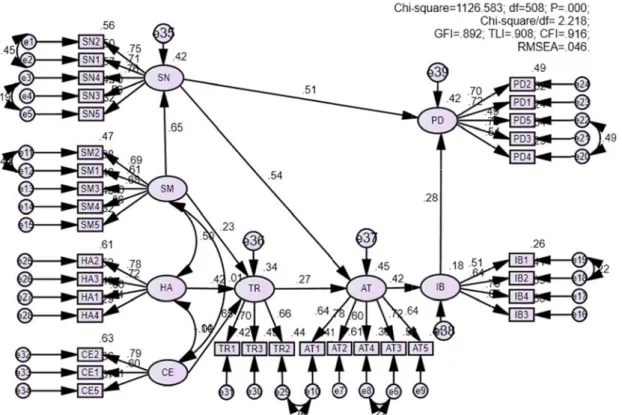
The results of confirmative factor analysis (CFA) showed an acceptable fit of the data (χ
2= 1048.573, df = 495, p = 0.000, χ
2/df = 2.123, GFI = 0.900, TLI = 0.915, CFI = 0.925, RMSEA = 0.044) (Figure 2). All factors loading were highly 0.5 significant on the expected constructs (Steenkamp &
Geyskens, 2006). Together, these demonstrated adequate convergent validity of the measures. Composite reliable and variance extracted was calculated on the basis of standardized weights estimated in the CFA model. Before the hypotheses test, the constructs of the questionnaire were tested for two psychometric properties: reliability and validity.
Table 1. Pattern matrix – EFA
Factor
1 2 3 4 5 6 7 8
SN2 .848 SN1 .799 SN4 .749 SN3 .672 SN5 .557
AT3 .774
AT2 .749
AT4 .668
AT5 .646
AT1 .621
SM2 .772
SM1 .730
SM3 .681
SM4 .659
SM5 .520
IB3 .841
IB4 .788
IB2 .681
IB1 .574
PD4 .683
PD3 .676
PD5 .664
PD1 .653
PD2 .620
HA2 .801
HA3 .702
HA1 .647
HA4 .508
TR2 .744
TR3 .677
TR1 .600
CE2 .803
CE1 .612
CE5 .602
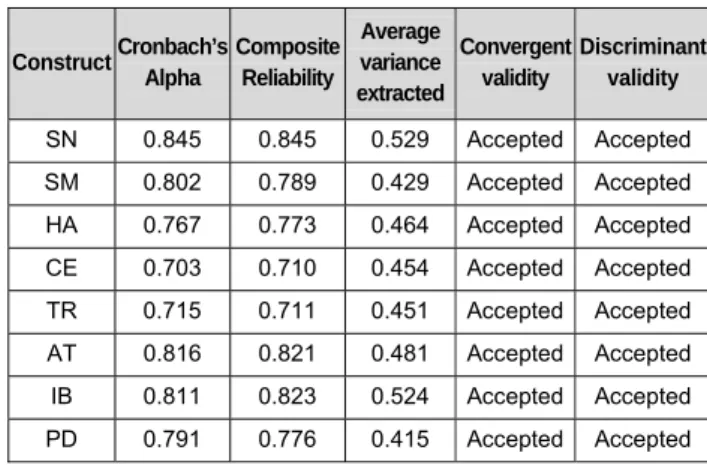
According to Bagozzi and Kimmel (1995), a factor displayed its reliability if its composite reliability was > 0.6.
The Cronbach’s alphas of all constructs in this study were from 0.703 to 0.845 and the composite reliability of all constructs were 0.711 to 0.845 (Table 2). Thus, reliabilities and variance extracted for each latent variable revealed that the measurement model was reliable and valid.
Measurement item achieved convergence validity if standardized regression weighted > 0.5 and significant p- value < 0.05 (Anderson & Gerbring, 1988).
The results of this study showed that all standardized regression weights of 34 measurement items were from 0.509 to 0.861, bigger than 0.5, therefore they were convergent validity. This model of measurement items was consistent with market data, and there was no correlation between the measurement error should it achieved unidimensional. The correlation coefficient between constructs with others had to be < 0.9 or p-value had to be <
0.05 the new gain discriminant validity. All correlation coefficient between constructs with other construct were <
0.9 and all p-value were < 0.05 so that the correlation coefficient of each pair of concepts were different from 1 at 95% confidence level (correlation coefficient which you could infer that it followed <1) therefore, the constructs were discriminant validity.
The results showed the values of composite reliable and variance extracted of variables were greater than 0.5 (Hair, 2000) Therefore, this variable had satisfactory reliability and variance extracted aggregate. Cronbach's coefficient alpha reliability of the variables that had values greater than 0.6 scales should also meet the requirements of reliability coefficients. The correlation coefficient results showed that P-value = 0.000 of each pair of variable different from the one at the 95% confidence level, the correlation coefficients were less than 1. Therefore, the variables gained valuable distinction.
Table 2. Reliability constructs
ConstructCronbach’s Alpha
Composite Reliability
Average variance extracted
Convergent validity
Discriminant validity
SN 0.845 0.845 0.529 Accepted Accepted SM 0.802 0.789 0.429 Accepted Accepted HA 0.767 0.773 0.464 Accepted Accepted CE 0.703 0.710 0.454 Accepted Accepted TR 0.715 0.711 0.451 Accepted Accepted AT 0.816 0.821 0.481 Accepted Accepted IB 0.811 0.823 0.524 Accepted Accepted PD 0.791 0.776 0.415 Accepted Accepted
88
4.3.5 St This study between hally subjective no and purchase was employe research co relationships equation mod The likeliho model fit. C square = 115 satisfying the indices of mo
Nguyen
ructural Equ
’s objective w yu 4.0, social orms, as well a e decision. To ed to test the onstructs, an
with the ob del proposed is ood ratio chi-s hi-square wa 1.977; df=510 e recommend odel fit include
n Xuan Truong / J
uation Mode was to identif media, consu as trust, attitud o achieve this
interrelations d to compa bserved scor s shown in (Fi square test as
s significant 0; p = 0.00). Ch
< 3 criterion f ed all exceed
Journal of Asian F
Figure 2. Confir
el
fy the relation umer ethnocen de, buying int
objective, the ships among a
are the mo res. The stru
gure 3).
ssessed the o in this case hi-square/df = for a good fit.
d the recomme
Finance, Econom
rmative factor a
nships ntrism, ention e SEM all the odelled uctural
overall (Chi- 2.259, Other ended
thre IFI=
app the RM (Mc Bou The coe R SEM rela con ethn stan
ics and Business
nalysis overall m
eshold level of
=0.916; GFI=0 proximation (R
proposed mo MSEA was 0.0 cKnight, Chou udreau, 2000) erefore, we efficients of the Results are pre M model for ationships we nstruct were
nocentrism wa ndardized regr
Vol 5 No 3 (2018)
model
f 0.9, except G 0.892). The RMSEA) descri odel and the p
046, below th udhury, & Kac
). Thus, the o could proce e structural mo esented in tab
the P-value ere significant positively c as negatively ression weight
8) 81-93
GFI (TLI= 0.9 root mean s ibed the discre population cov he recommen cmar, 2002; G overall model eed to exam odel.
ble 4, all the pa were less tha t in the mod correlated exc correlated to t t (Table 3).
07; CFI= 0.91 square error epancy betwee
variance matr nd < 0.08 lev Gefen, Straub, had a good f mine the pa
arameters in th an 0.05 so th del. All of th cept consum trust with -0.13
16;
of en rix.
vel
&
fit.
ath
he
he
he
mer
36
Table 3. Regre
TR SN TR TR AT AT IB PD PD
4.3.6. Bo Usually in reliability of t two samples.
parameters a is to repeat Bootstrap me Lomax, 2010 have replaced This study us 2010) with t
ession weights
<--- HA
<--- SM
<--- SM
<--- CE
<--- TR
<--- SN
<--- AT
<--- SN
<--- IB
ootstrap Es the quantitat the estimates, The first half and the other h
t the study ethod was su 0). Bootstrap i
d the original m sed bootstrap
he number o
Standardiz we
-
timate Mode tive research,
, researchers f is used for es half is for retes
using a diffe itable to repla is a repeated model in whic methods (Sch of repeated s
Figure 3. St
zed regression eights
.425 .646 .224 -.136 .271 .543 .421 .515 .280
el
so as to te have to divid stimating the sting. The othe erent sample ace (Schumac
sampling me h, as the popu humacker & L
amples N=10
tructural equatio
Estimate .253 .682 .171 -.080 .321 .466 .571 .382 .178
st the de the model er way . The cker &
ethods ulation.
omax, 000 to
esti abs that
T var sign exc hyp eth
on model analys
Unstanda S.E .04 .06 .04 .03 .06 .04 .06 .04 .03
imate the mo solute value w
t the estimates
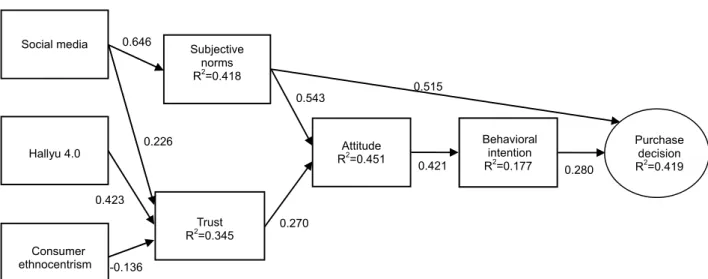
4.3.7 Mode The final mod iables were s nificant, with s cept H5. Ov potheses were nocentrism in
sis
ardized regress E.
40 63 49 31 60 47 68 46 32
odel in pract was less than 2
s in the model
el Fitting and del fit statistic supported. All
significant at verall, all th e supported fro
nfluenced trus
sion weights C.R.
6.302 10.767
3.511 -2.587 5.338 9.889 8.405 8.258 5.613
tice. The CR 2.0. Thus, we
s can be truste
d Hypothese cs indicated t the hypothes less than the e path coef om 0.226 to 0 st with the p
P
***
***
***
.010
***
***
***
***
***
R (bias/SE-bia could conclud ed and fit.
es Testing that the over ses paths we e p < 0.01 lev fficient-relate .446. Consum path coefficien
as) de
all
ere
vel
ed
mer
nt-
90 Nguyen Xuan Truong / Journal of Asian Finance, Economics and Business Vol 5 No 3 (2018) 81-93
Figure 4. Final model
Table 4. Summary of hypotheses testing
Hypotheses Results of testing
H1 Social media positively affects subjective norms. Supported
H2 Social media positively affects trust. Supported
H3 Hallyu 4.0 positively affects trust. Supported
H4 Consumer ethnocentrism negatively affects trust. Supported
H5 Consumer ethnocentrism positively affects purchase decision. Rejected H6 Subjective norms positively affect attitude toward behavior. Supported
H7 Subjective norms positively affect purchase decision. Supported
H8 Trust positively affects attitude toward behavior. Supported
H9 Attitude toward behavior positively affects behavioral intention. Supported H10 Behavioral intention positively affects purchase decision. Supported
related of -0.136. The purchase decision was explained by 41.9% (R
2= 0.419). An important result showed that hallyu 4.0 strongly impacted trust with the path coefficient-related = 0.423. Social media influenced not only trust but also subjective norms with the path coefficient-related = 0.646.
5. Conclusions and Research Limitations
The theoretical contribution of this study was to identify the impact of hallyu 4.0, social media, and consumer ethnocentrism on Korean products purchase decision of generation C in Vietnam. Based on the SEM model and final model described in this study, there are some primary conclusions: The hallyu 4.0, social media, and consumer ethnocentrism are independent variables. They impact purchase decision through mediating variables such as trust, subjective norms, attitude and behavioral intention. This study has shown that social media influences not only to trust but also to subjective norms. Subjective norms not only
influence attitude but also have a directly impact on purchase decision. Subjective norms influence stronger than behavioral intention. Consumer ethnocentrism influence negatively on trust. This study also discovers an interesting fact that trust and attitude variables have an impact on behavioral intention and purchase decision.
In spite of the limitations, the findings provide tentative conclusions which may stimulate future research. Based on the findings of the study, several additional studies could be developed. Firstly, in this study, the amount of sample is 575 respondents although satisfying requirements for research, but may not be large for multiple group analysis, such as effects of Southern, Central and Northern of Vietnam. The limitations of this research would be an interesting topic for future research. Secondly, future research could also seek to determine whether the effectiveness of hallyu 4.0 and social media varies based on the industry of the sender, i.e. convenience product; fast moving consumer goods or hi-tech products, etc.
Attitude R2=0.451 Hallyu 4.0
Subjective norms R2=0.418
Trust R2=0.345 Consumer
ethnocentrism
Social media 0.646
0.423 0.226
-0.136
0.543 0.515
0.270
Behavioral intention R2=0.177
Purchase decision R2=0.419
0.421 0.280
References
Ahtola, O. T. (1975). Toward a Vector Model of Intentions, in B. B. Anderson (Ed.) Advances in Consumer Research, Cincinnati: The Association for Consumer Research, III, 469-476.
Ajzen, I., & Fishbein, M. (1975). A Bayesian analysis of attribution processes. Psychological Bulletin. 82(2), 261-277.
Ajzen, I., & Fishbein, M. (1980). Understanding Attitudes and Predicting Social Behavior. Englewood Cliffs, New York: Prentice-Hall.
Ajzen, I. (1991). The theory of planned behavior.
Organizational Behavior and Human Decision Processes, 50, 179–211.
Ajzen, I. (2006). Constructing a TPB Questionnaire:
Conceptual and Methodological Considerations.
Retrieved May 27, 2018 from http://www.people.umass.edu/aizen/pdf/tpb.measure ment.pdf.
Akhter, S. H. (2010). Service attribute satisfaction and actual repurchase behavior: the mediating influence of overall satisfaction and purchase intention. Journal of Consumer Satisfaction, Dissatisfaction &
Complaining Behavior, 23, 52-64.
Anderson, J. C., & Gerbing, D. W. (1988). Structural Equation Modeling in Practice: A Review and Recommended Two-Step Approach. Psychological Bulletin, 103(3), 411-423.
Bagozzi, R. P., & Kimmel, S. K. (1995). A comparison of leading theories for the prediction of goal-directed behaviours. British Journal of Social Psychology, 34, 437-461.
Balabanis G., & Diamantopoulos, A. (2004). Domestic Country Bias, Country-of-Origin Effects, and Consumer Ethnocentrism: A Multidimensional Unfolding Approach, Academy of Marketing Science Journal, 32(1), 80-95.
Baughn, C. C., & Yaprak, A. (1996). Economic nationalism:
Conceptual and empirical development. Political Psychology, 17(4), 759-778.
Bazzarvoice. (2012a). Power of Word Of Mouth. Social Commerce Statistics. Retrieved May 3, 2013 from http://www.bazaarvoice.com/research-and-insight/
social-commerce-statistics/#Word of mouth Bazzarvoice. (2012b). Social Trends Report 2012. Social
commerce statistics. Retrieved May 10, 2013 from http://www.bazaarvoice.com/research-and-insight/
social-commerce-statistics/#Trust
Booz & Company. (2010). The rise of Generation C.
Implications for the world of 2020. Strategy &
Formerly Booz & Company, 1-15.
Brady, M. K., & Robertson, C. J. (2001). Searching for a consensus on the antecedent role of service quality and satisfaction: an exploratory cross-national study.
Journal of Business Research, 51(1), 53-60.
Cho, D. Y., Kwon, H. J., & Lee, H. Y. (2007). Analysis of trust in internet and mobile commerce adoption.
Proceedings of the 40th Hawaii International Conference on System Science, IEEE Computer Society, Washington, DC, USA, January 03 - 06, 2007. Doi:10.1109/HICSS.2007.76
Coyne, I. T. (1997). Sampling in qualitative research.
Purposeful and theoretical sampling; merging or clear boundaries. Journal of Advanced Nursing, 26, 623-630.
Cruz, B., & Mendelsohn, J. (2010). Why Social Media Matters to your Business. Chadwick Martin Bailey Research Report. Retrieved April 20, 2018 from http://www.cmbinfo.com/cmb-cms/wp-content/ploads /010/04/Why_Social_Media Matters_2010.pdf.
Davies, J., Foxall, G. R., & Pallister, J. (2002). Beyond the intention-behavior mythology: An integrated model of recycling. Marketing Theory, 2(1), 29-113.
Featherman, M., & Pavlou P. (2002). Predicting e-services adoption: A perceived risk facets perspective. In Proceedings of the Eighth Americas Conference on Information Systems. Dallas, TX, USA, August 9–11, 2002.
Fishbein, M., & Ajzen, I. (1975). Belief, Attitude, Intention, and Behavior: An Introduction to the Theory and Research. Reading, MA: Addison-Wesley.
Fishbein, M., & Ajzen, I. (2010). Predicting and changing behavior: The reasoned action approach. New York:
Taylor & Francis.
Foux, G. (2006). Consumer-generated media: Get your customers involved. Brand Strategy, 8, 38-39.
Gefen, D., Straub, D. W., & Boudreau, M. C. (2000).
Structural equation modeling and regression:
guidelines for research practice, Communications of the AIS, 4(7), 1-78.
Gefen, D. (2002). Reflections on the dimensions of trust and trust worthiness among online consumers. ACM SIGMIS Database, 33(3), 38-53.
Gefen D., Karahanna E., & Straub D. W. (2003). Trust and TAM in online shopping: an integrated model, MIS Quarterly, 27(1), 51–90.
Griffin, M. A., Neal. A., & Parker, S. K. (2007). A new model of work role performance: Positive behavior in uncertain and interdependent contexts. Academy of Management Journal, 50(2), 327-347.
Hair, J. F., Bush, R. P., & Artinau, D. J. (2000). Marketing
research: A practical approach for the new
millennium. Boston, MA: Irwin/McGraw-Hill.
92 Nguyen Xuan Truong / Journal of Asian Finance, Economics and Business Vol 5 No 3 (2018) 81-93