Spatial and Temporal Distribution of Macrobenthos in Intertidal Hard Bottoms in Dokdo Island
1Jong-Chun Kim2*, Kang-Wook Park3, Kyong-Dong Yoo4, Sung-Yong Jung5
ABSTRACT
This study was carried out to measure seasonal changes in the community structure and species composition of marobenthos in the intertidal area of Dokdo. The macrobenthos identified during this study was comprised of 36 species: predominately 25 species of mollusks(69.4 %), 6 species of arthropods(16.7 %), 3 species of echinodermata(8.3 %) and 1 species of cnidaria (5.6 %). The number of marobenthos species ranged from 27 in Spring to 33 in Autumn. In terms of the top 10 dominant species, there were 7 species of mollusks and 3 species of arthropods in the this study. After analyzing the bray-curtis similarity, it was divided into two large groups(A, B). Such group classification matched the SIMPROF(Similarity Profile Analysis) and the one-way ANOSIM(Analysis of similarities) analysis.
KEY WORDS: SPECIES COMPOSITION, DOMINANT SPECIES, SIMILARITY, SIMPROF, ANOSIM
1 Received 18 December 2014; Revised (1st: 22 January 2015, 2nd: 26 January 2015); Accepted 27 January 2015 2 Department of Marine Biotechnology, Soonchunhyang University, Asan, Chungnam, 336-745, Korea
3 Department of Life Science, Dongguk University, Jung-Gu, Seoul, Plidong-Ro 1gil, Korea 4 Eco-Technology Institute, Seodaemun-gu, Seoul, 120-829, Korea
5 Gyeonggi Institute of Science and Technology Promotion, Yeongtong-gu, Gyeonggi-do, 443-270, Korea
* Corresponding author: Tel: +82-41-530-1283, Fax: +82-41-530-1638, E-mail: [email protected]
INTRODUCTION
Dokdo is an island located at 7˚14´26.8˝ North latitude, 131˚52′10.4˝ East longitude (on the basis of the trigonometrical point in Dokdo); it is the Easternmost island of Korea. Its administrative address is 1-96 (101 lot), Dokdo-ri, Ulleung-eup, Ulleung-gun, Gyeongsangbuk-do, South Korea (KHOA, 2013). The Island is situated at a distance of about 200 kilometers east from the Korean peninsula. It is influenced by the East Korean Warm Current with high temperature and high salinity which flows from the south through the Straits of Korea, and the North Korean Cold Current, which flows south. Also, in case of the middle and bottom layers, they vary depending on the influence of the East Sea Proper Water (MOF, 1999). In regards to annual sea surface temperature distribution, it was 9 ℃ (February)~26 ℃ (August), which
is higher than that of the Korean peninsula coast on the same latitude (MOF, 2000).
The first comprehensive research of Dokdo’s marine biota was the academic report of marine biota in Ulleungdo and Dokdo that was conducted by the Korean Association for the Conservation of Nature in 1981. The report was about the biota of terrestrial and marine organisms in Ulleungdo and Dokdo, including the biota of the intertidal area (KACN, 1981). The Dokdo Marine/Fishery Study Group carried out basic research twice during three years of study (1997-1999) for Dokdo's marine environment and fishery resource conservation (MOF, 1999). In recent years, the Dokdo Fisheries Research Center at the National Fisheries Research &
Development Institute has been performing research on Dokdo's fishery resources and marine environment four times a year since 2006 (February, May, August,
November) (NFRDI, 2013). Research on biodiversity including species composition and population distribution was carried out several times at bedrock areas along the Dokdo coast (Je et al., 1997). Also, research on seasonal changes in zoobenthos that live in the intertidal areas in Ulleungdo and Dokdo (Cha et al., 2000); the spatial distribution of invertebrate community in Dokdo's rock littoral zone (Cha and Kim, 2012); and a preliminary study on the distribution of invertebrate fauna living in rock littoral zones in Ulleungdo, Dokdo and the eastern coast of Korea (Cha and Kim, 2013). Moreover, the Minister of Environment (MOE) designated Dokdo the 1st Special Island, and started to monitor marine invertebrates living in rock littoral zones in Dokdo since 2006 (ME, 2006;
ME DAEGU, 2007; 2008; 2009; 2010; 2011; 2012; 2013).
Intertidal areas in Dokdo, pebble seashores and bedrock areas, are occupied by the typical benthos ecosystem.
Apart from political and diplomatic issues, due to strong waves and poor weather conditions, the Island has been difficult to access. In that regard, its ecosystem was sheltered from artificial environmental threat. However, the ecosystem is recently being affected by dock construction, settlers and visitors. This study aims to identify seasonal and spatial changes in the community structure of macrobenthos, and uses the results as a basic form of data to maintain the health of Dokdo's ecosystem in the future.
MATERIALS AND METHODS
1. Research Period and Area Selection
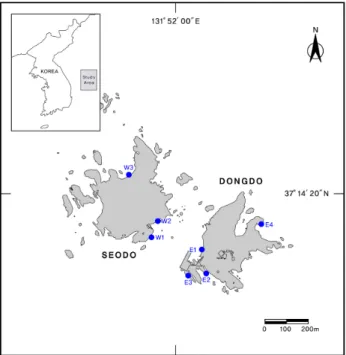
For this study, research was carried out at four stations on the Eastern Island and three stations on the Western Island in April, August and October, 2014 (Figure 1). The stations are shown as E1, E2, E3, E4 for the East Island, and W1, W2, W3 for the West Island. Among them, E1, W2 and W3 are pebble seashores. Wave-cut platforms are formed in E2, E3 and W1 which are made up of bedrocks.
E4 is a typical hard bottom composed of bedrocks. Entry to Dokdo is determined on the basis of weather conditions.
In particular, it is difficult to enter Dokdo during the winter season due to the harsh weather. In regards to transportation means, there are regularly scheduled passenger boats and fishing boats, but there isn't much time to spend on Dokdo
due to the lack of accomodations. Therefore, we were not able to conduct research at W3 in the spring (April) due to the poor weather conditions during the research period and the limited amount of time (Table 1).
Season Date Island Station
Spring 2014. 04. 16 East E1, E2, E3, E4
West W1, W2
Summe
r 2014. 08. 29 East E1, E2, E3, E4 West W1, W2, W3 Autumn 2014. 10. 09 East E1, E2, E3, E4
West W1, W2, W3 Table 1. Dates and stations of seasonal survey
2. Study Method
A quantitative collection method: the use of aquatic net was excluded because this method was thought to be unable to show the numerical representativeness due to Dokdo's environmental characteristics, the complexity of bedrock topography and imbalanced distribution of organisms. Instead, a 30minute-qualitative collection and photograph filming was carried out together. Although Dokdo has a small tidal range, the width of the intertidal areas was about 4~5m, or 10m at one station depending on the waves and currents. Each distance between survey stations varies but mostly the distance interval was about 50-60m. The survey tour was made on foot and the species were photographed while moving from one survey station to another. Some species that needed close identification were collected separately. The collected samples were fixed with a 5% neutral formalin and were transported to a laboratory. Then, they were classified by taxonomic group and then were identified by proper species.
3. Analysis Method
Among the three studied seasons of the seven stations, the data analysis was based on a total of 20 times (stations) of study besides W3 of spring (April) which was not studied, but some stations where research was not conducted were excluded. Based on this, species composition by station and community structure were analyzed according to the appearance ratio of each species. With regard to the
Figure 1. Map of sampling stations in the study area
Figure 2. Frequency of the number of species composition by taxon
selection of the dominant species, the population density shown in the quantitative research was excluded; the frequency ratio of each research session was divided by the number of total survey times and was converted into a percentage. This is because the species that appeared most often during the research could be considered a representative species of the station, and it was possible to find out the ecological representativeness of each station and species in the limited research period. The species where more than 40% appeared was designated to be the overall dominant species. This analysis was based on the standard that the frequently occurring species during the limited surveys were the representative species that were well adapted to the ecological environment.
FRO = NFO/Ntital × 100
FRO : Frequence Ratio of Occurrence NFO : Frequence of Occurrence of species Ntital : Frequence of total surveys
In case of a method to analyze the community of each station in Dokdo, based on the frequence ratio of the occurrence of species, we obtained a similarity index value of Bray-Curtis (1957) after converting it to presence/
absence, and expressed it in an nMDS (Non-metric
multidimensional scaling) array method. At this time, the SIMPROF (Similarity Profile Analysis) test was also carried out, and groups classified according to the test were considered to have a statistically similar community structure. The one-way ANOSIM (Analysis of similarities) analysis was used for each classified community's similarity verification. For statistics analysis, we used the PRIMER 6.0 (Plymouth Routines Multivariate Ecological Research) computer package.
RESULTS
1. Species Composition
During the survey period, after analyzing the fluctuating patterns of the number of species by taxonomic group, 25 species of mollusca (69.4%); 6 species of arthropoda (16.7%); 3 species of echinodermata (8.3%); and 2 species of cnidaria (5.6%) occurred (Figure 2). With regards to the survey periods, the total number of species identified in April stood at 27: 22 mollusks, 3 arthropods, 1 cnidarian and 1 echinoderm. In August, a total of 30 species were identified: 21 mollusks, 5 anthropods, 2 cnidarians and 2 echinoderm. A total of six new species, Ergalatax contracta, Turbo cornutus, Pagurus angustus, Chthamalus challengeri, Hemicentrotus pulcherrimus, Actinia equina, occurred in August compared to April. Also, three new species: Onithochiton hirasei, Ligia exotica and Asterina pectinifcera occurred compared to the research conducted in April and August (Figure 3).
Moreover, although we could not identify their direct inhabitation in the bedrock and pebbles in the intertidal
Figure 3. Number of species composition by taxon at each season
Rank Sp. Taxa* FO FRO
1 Pollicipes mitella Ar 19 95.0
2 Tetraclita japonica Ar 18 90.0
3 Chlorostoma lischkei Mo 14 70.0
4 Pachygrapsus crassipes Ar 13 65.0 5 Acanthopleura japonica Mo 10 50.0
6 Cellana grata Mo 9 45.0
7 Nodilittorina radiata Mo 9 45.0
8 Nipponacmaea schrenckii Mo 8 40.0
9 Omphalius pfeifferi Mo 8 40.0
10 Siphonaria sirius Mo 8 40.0
*Ar: Arthropoda, Mo: Mollusca
Table 2. The dominant species ranked by the frequency rate of occurrence(FRO) data from 20 surveys 7 stations
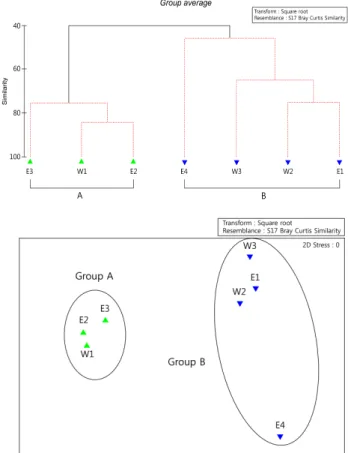
Figure 4. Dendrogram based on cluster analysis and nMDS at each station in the study area.
Broken lines indicate the same group by SIMPROF analysis
areas of Dokdo, we could identify a total of five species:
Balanus improvisus, Megabalanus rosa, Balanus trigonus, Lepas anserifera, Lapas anatifera, that were thought to have fallen from boats and fishing gears. However, they were not included in the species list as they were surmised to be from outside the area.
2. Dominant Species
Considering occurrence rates at the entire stations, we selected dominant species that has more than 40% of frequency ratio of occurrence. Among the total of 10 dominant species, seven were invertebrates and three were arthropods. To put them into an order, a fixed type arthropod Pollicipes mitella occurred 19 out of 20 times, showing the frequency rate of occurrence (FRO) of 95.0%;
an arthropod Tetraclita japonica 18 times (90.0%); an invertebrate Chlorostoma lischkei 14 times (70.0%); an arthropod Pachygrapsus crassipes 13 times (65.0%); an invertebrate Acanthopleura japonica 10 times (50.0%);
Cellana grata; Nodilittorina radiata; Nipponacmaea schrenckii; Omphalius pfeifferi; and Siphonaria sirius.
3. Community Analysis
The similarity of Bray-Curtis was evaluated targeting the seven survey stations, and comparison of survey stations was made by additionally performing the nMDS analysis. During the community analysis, groups that showed big differences through the SIMPROF test were classified into two groups (Figure 4). In order to identify the similarity between the two groups, the ANOSIM analysis was conducted, and community classification did
seem to have significance difference significance difference.
In regards to groups, three stations were included in A, where W1 and E2 showed maximum 84.2% of similarity index value; and four stations were included in B, where W2 and E1 showed maximum 75.0% of similarity index value. However, in case of nMDS, which analogizes a distance between stations considering relative location, because E4 was separated from other stations that were included in the Group B, the boundary between communities was uncertain.
To look into the species composition of each group, the Group A included a total of 34 species: 24 mollusca, 5 arthropoda, 3 echinodermate and 2 cnidaria according to taxonomic groups. In a total of 18 species included in the Group B, there were 12 mollusca, 5 arthropoda and 1 echinodermate (Table 3).
Group A Group B
Nb. of sp. % Nb. of sp. %
Mollusca 24 70.6 12 66.7
Arthropoda 5 14.7 5 27.8
Echinodermate 3 8.8 1 5.6
Cnidaria 2 5.9 - -
Total 34 100.0 18 100.0
Table 3. The faunal composition of marine invertebrate communities resulted by cluster analysis
DISCUSSION
The number of macrobenthos species and individuals that appear in survey area vary depending on survey period and method, but the comparison with a region with similar environment is considered one material to infer the biodiversity of the surveyed sea (Jeong, 2006). At the seven survey stations of this study, a total of 36 species were identified: 25 mollusks, 6 arthropods, 3 echinoderms and 2 cnidarians. According to MG DAEGU (2013), the preceding study paper of Dokdo, a total of 33 species (23 mollusks, 6 arthropods, 2 echinoderms, 2 cnidarians) were found to inhabit in Dokdo, showing similarity with this study in terms of species composition. In Cha and Kim (2013)'s preliminary study paper of the distribution of invertebrate fauna in rock littoral areas in Ulleungdo, Dokdo and the eastern coast of Korea, a total of 13 species
were found. The reasons behind the difference in the number of species were surmised to be due to Dokdo's weather conditions, survey period and stations.
Also, in terms of species composition, among the occurred taxonomic groups, Echinodermata played a crucial role as predators (Menge, 1976; Lubchenco and Menge, 1978;
Paine et al., 1985). In other words, they are keystone species that maximize species diversity in intertidal areas by creating spaces for other species to settle down by preying upon dominant species which occupy an area due to its excessive development (Paine 1966). However, in this study, most of them were found at the bottom of intertidal areas, and they were thought to have flowed in temporarily due to external power such as high winds and waves. Therefore, so far, there was the low possibility for them to stay long in the upper and middle parts of intertidal areas and perform their role as a keystone species.
Seasonal and spatial changes in dominant species provided the necessary information to identify their community structure and succession process (Dobbs and Scholly, 1986). mollusks (69.4%) occupied the highest portion among the entire occurrence species. This result is similar to Cha and Kim (2012)'s paper of the spatial distribution of the invertebrate community that inhabits the intertidal areas Dokdo, which revealed that the share of invertebrates was 66%. This is a common phenomenon in ecosystems in intertidal areas, and is surmised to be because invertebrates have thick outer shells that protect them from the external environment. Also, in case of Pollicipes mitella and Tetraclita japonica, the two most dominant species according to this study, Cha and Kim (2012) interpreted that they grow thick in the same space, and their life cycle is also accomplished in the same place.
In particular, the communities of Pollicipes mitella and Tetraclita japonica form a magnificent sight which cannot be seen in any other parts of the eastern coast. Also, with regard to the density of individuals, they are reported to have formed a considerably huge community (MG DAEGU, 2012).
The communities of macrobenthos that live in the intertidal areas of Dokdo were classified into two groups, and it was surmised that differences in species composition was derived from macrobenthos' adhesive feature and external environment. As for the macrobenthos living in
rock littoral areas, environmental factors such as substrate characteristics, gradient and water mass characteristics, and biological factors such as a reintroduction of individuals are important factors for vertical zonation (Witman, 1985;
Boero and Fresi, 1986; Alvarado et al., 2001). W1, E2 and E3, which belonged to Group A are extensive and relatively even bedrock areas where wave-cut platforms are formed. The areas that belong come under the Group B, W2, W3 and E1, are intertidal areas composed of pebbles. E4 is a narrow and simple bedrock area compared to the stations of Group A. Therefore, the stations of Group B lack adhesion and are continuously affected by disturbance due to wave energy. However, in case of Group A, there are wave-cut platforms and tide pools where various zoobenthos can live, and the outside bedrocks play the role of breakwaters, creating environmental differences.
During the survey period, we identified five species that were surmised to be foreign. This was also revealed in MG DAEGU (2013)'s Dokdo's ecosystem monitoring report. Regarding their ecological characteristics, they are generally known to live in flocks on floating objects, and they do not usually get attached to objects that are stationary. Therefore, it is difficult to judge that these species inhabit Dokdo. However, in case of barnacles, they are very adhesive and competitive among living species, and if they continuously influx in, then they may be able to hold an ecological niche in Dokdo's intertidal areas. If such environmental disturbance factors persist, then species diversity in the intertidal areas Dokdo would be directly and indirectly affected, and may have a negative influence on Dokdo's aboriginal ecosystem. Accordingly, it is necessary to come up with the proper measures.
In conclusion, the macrobenthos community in the intertidal areas of Dokdo are largely classified according to living environmental conditions, and there are also some differences in terms of species composition. Also, along with natural phenomena such as a rise in temperatures and changes in the Korean seas, artificial environmental changes due to artificial factors (visitors, incoming and outgoing vessels) continuously affect Dokdo's ecosystem.
Therefore, it is substantially important to identify changes in zoobenthos living in the intertidal areas of Dokdo. Also, it is necessary to periodically and systematically conduct monitoring as more efforts and research is needed to
investigate the ecological value of Dokdo.
ACKNOWLEDGEMENT
This research was conducted as a part of the Daegu Regional Environment Office's "Dokdo Ecosystem Monitoring Program." We would like to extend our gratitude to Team Leader Kim Du-Chan, and Mr. Kim Hyun-Min of the Natural Environment Department at the Daegu Regional Environment Office and the supporting institutions.
REFERENCES
Alvarado, J.L., R. Pinto, P. Marquet, C. Pacheco, R. Guinez and J.C.
Castilla(2001) Patch recolonization by the tunicate Pyura prae- putialis in the rocky intertidal of the Bay of Antofagasta, Chile:
evidence for self-facilitation mechanisms. Mar. Ecol. Prog.
Ser. 224: 93-101.
Boero, F. and E. Fresi(1986) Zonation and evolution of a rocky bot- tom hydroid community. Mar. Ecol. 7(2): 123-150.
Bray, J.R. and J.T. Curtis(1957) An ordination of upland forest communities of southern Wisconsin. Ecol. Monogr. 27:
325-349.
Cha, J.H. and M.K. Kim(2012) Spatial Distribution of Marine Invertebrate Communities on Intertidal Rocky Shore in Dokdo.
J. Biol. Env. Kor. 30(2): 143-150. (in Korean with English ab- stract)
Cha, J.H. and M.K. Kim(2013) A Preliminary Study for the Distribution of Rocky Intertidal Fauna in the Korean Coastal Areas of the East Sea including Dokdo and Ulleungdo. J. Biol.
Env. Kor. 31(3): 225-231. (in Korean with English abstract) Cha, J.H., J.G. Je and K. T. Kim(2000) Seasonal Variation of
Intertidal Organisms of Ullungdo and Dokdo Islands.
Underwater ScI. Tech. 2: 1-7. (in Korean with English abstract) Dobbs, F.C. and T.A. Scholly(1986) Sediment processing and se- lective feeding by Pectinaria koreni(Polychaeta:
Pectinariidae). Mar. Ecol. ··· Prog. Ser. 29:
165-176.
Je, J.G., R.S. Kang, C.S. Myung, J.S. Lee, S.W. Lee and S.H.
Shin(1997) Preliminary study on marine benthic organisms of Dokdo. Underwater ScI. Tech. 1(1): 67-80. (in Korean with English abstract)
Jeong, Y.H.(2006) Ecological studies and spatial patterns of macro- benthos on tidal flat around Anmyon-do. Ph.D. Soon chun hy- ang Univ, 113.
KACN(1981) Scientific investigation of Ullungdo and Dokdo Islands. The Korean Association for Conservation of Nature
Annual Report, 294pp. (in Korean)
KHOA(2013) http://www.khoa.go.kr/kcom/cnt/selectContents Page.do?cntId=dokdo_submain on Mar 15.
Lubchenco, J. and B.A. Menge(1978) Community development and persistence in a low rocky intertidal zone. Ecol. Monogr.
59: 67-94.
Menge, B.A.(1976) Organization of the New England rocky inter- tidal community; Role of predation, competition and environ- mental heterogeneity. Ecol. Monogr. 46: 355-393.
ME(2006) Scrutiny of Dokdo ecosystem. MG Annual Report, 178pp. (in Korean)
ME DAEGU(2007) Scrutiny of Dokdo ecosystem. Ministry of Environment Annual Report, 179pp. (in Korean)
ME DAEGU(2008) Scrutiny of Dokdo ecosystem. Ministry of Environment Annual Report, 179pp. (in Korean)
ME DAEGU(2009) Scrutiny of Dokdo ecosystem. Ministry of Environment Annual Report, 191pp. (in Korean)
ME DAEGU(2010) Scrutiny of Dokdo ecosystem. Ministry of Environment Annual Report, 218pp. (in Korean)
ME DAEGU(2011) Scrutiny of Dokdo ecosystem. Ministry of Environment Annual Report, 191pp. (in Korean)
ME DAEGU(2012) Scrutiny of Dokdo ecosystem. Ministry of Environment Annual Report, 180pp. (in Korean)
ME DAEGU(2013) Scrutiny of Dokdo ecosystem. Ministry of Environment Annual Report, 178pp. (in Korean)
MOF(1999) The Basic Study for Sustainment of Marine Environment and Fishery Resources of the Tokto Area.
Ministry of Oceans and Fisheries Annual Report, 544pp. (in Korean)
MOF(2000) The Basic research of the Dokdo Area. Ministry of Oceans and Fisheries Annual Report, 1033pp. (in Korean) NFRDI(2013) http://www.nfrdi.re.kr/dokdo on Mar 15.
Pain, R.T.(1966) Food web complexity and species diversity.
Amer. Nat. 100: 65-75.
Paine, R.T., J.C. Castillo and J. Cancimo(1985) Perturbation and re- covery patterns of starfish dominated intertidal assamblages in Chile, New Zealand and washington State. Amer. Nat. 125:
679-691.
Witman, J.D.(1985) Refuges, biological disturbance and rocky sub- tidal community structure in New England. Ecol. Monogr. 55:
421-445.