ORIGINAL ARTICLE
크릴(
Euphausia superba
)의 영양성분 및 아미노산 조성에 관한 연구김한수․김민아․Duan Yishan․강동수1)․장성호2)*․류재용3)․이춘식4)․이원기5)
부산대학교 식품공학과, 1)전남대학교 식품공학․영양학부, 2)부산대학교 바이오환경에너지학과
3)한국원자력연구원 공업환경연구부, 4)경남과학기술대학교 환경공학과,5)부경대학교 고분자공학과
Studies on the Nutritional Components and Amino Acid Compositions of Krill (Euphausia superba)
HanSoo Kim, Min-A Kim, Yishan Duan, Dong-Soo Kang1), Seong-Ho Jang2)*, Jae-Young Ryu3), Chun-Sik Lee4), Won-Ki Lee5)
Department of Food Science & Technology, Pusan National University, Miryang 627-706, Korea
1)Division of Food Technology & Nutrition, Chonnam National University, Yeosu 550-749, Korea
2)Department of Bioenviromental Energy, Pusan National University, Miryang 627-706, Korea
3)Division for Industrial & Environmental Research, Korea Atomic Energy Research Institute (KAERI), Jeollabuk-do 580-185, Korea
4)Department of Env. Eng. Gyeongnam National University of science and Technology ,Gyeongnam 660-758, Korea
5)Department of Polymer Engineering, Pukyung National University, Busan 608-739, Korea
Abstract
Despite abundant nutritions, krill is barely used for human consumption. The objective of this study was to investigate the nutritional component and amino acid composition of krill and further utilizes it for food resource. Proximate compositions of krill meal were consisted of crude protein 58.85%, ash 13.89%, crude fat 12.45%, carbohydrate 11.01% and moisture 3.80%.
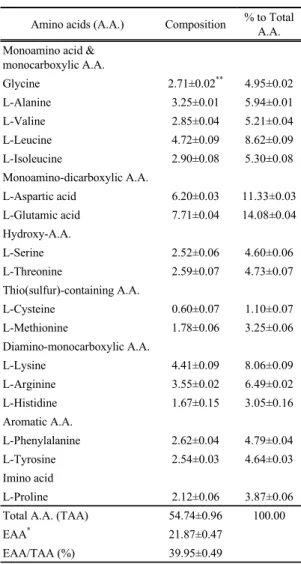
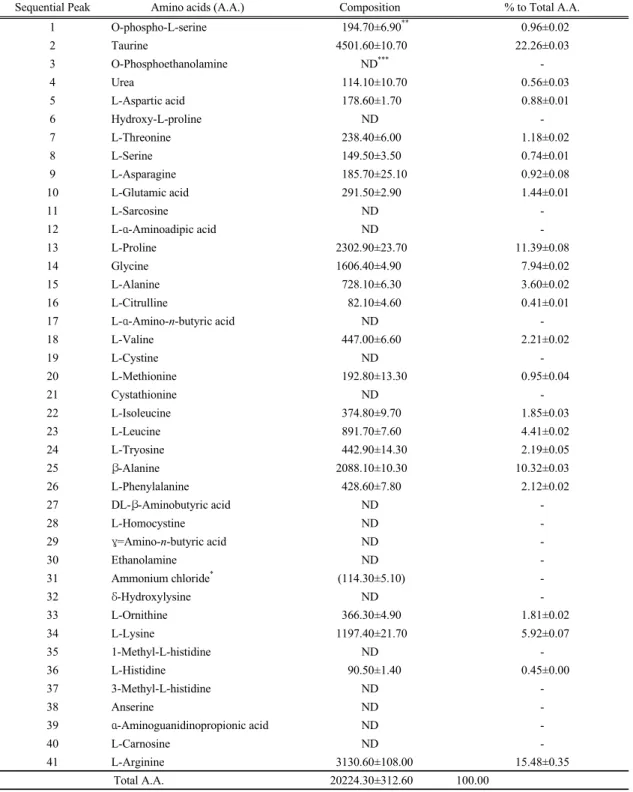
The amount of total amino acid was 54.74 g%, and the major amino acids were glutamic acid (7.71 g%), aspartic acid (6.20 g%), leucine (4.72 g%), lysine (4.41 g%), arginine (6.49 g%) and alanine (3.25 g%), respectively. Total essential amino acid content was 21.87%, and the major amino acids were leucine (4.72 g%), lysine (4.41 g%) and isoleucine (2.90 g%), respectively. Content of total free amino acid in krill meal was 20224.30 mg/kg, and the major free amino acids were taurine (4501 mg/kg), arginine (3130.60 mg/kg), proline (2302.90 mg/kg), alanine (2088.10 mg/kg), glycine (1606.40 mg/kg) and lysine (1197.40 mg/kg). Especially, taurine was the most abundant of all free amino acids. Thus, these data indicate that krill seems to be abundant protein source food.
Key words : Krill (Euphausia superba), Nutritional component, Amino acid composition
1. 서 론1)
최근 식생활의 다양화로 인해 well-being 및 기능성
식품의 관심이 증대되면서 독특한 맛과 풍미 및 풍부 한 영양가를 가진 새우, 가재, 게 등과 같은 갑각류 식 품의 소비가 증가 되었고(이 등, 2007), 이로 인해 기
Received 19 April, 2013; Revised 13 May, 2013;
Accepted 19 June, 2013
*Corresponding author : Seong-Ho Jang, Department of Bioenviro- mental Energy, Pusan National University, Miryang 627-706, Korea Phone: +82-55-350-5435
E-mail: [email protected]
ⓒ The Korean Environmental Sciences Society. All rights reserved.
This is an Open-Access article distributed under the terms of the Creative Commons Attribution Non-Commercial License (http://
creativecommons.org/licenses/by-nc/3.0) which permits unrestricted non-commercial use, distribution, and reproduction in any medium, provided the original work is properly cited.
능성 바이오 해양생물 소재의 연구가 활발하게 이루 어지고 있다. 크릴(Euphausia superba)은 난바다곤쟁 이목에 속하는 갑각류로 주로 남극해 일대에 많이 서 식하고 있으며 남극 해양의 생태계가 유지되는데 없 어서는 안 될 아주 중요한 해양생물자원이다(Chen과 Jaczynski, 2007). 크릴은 그 자원량이 방대하여 미래 식량자원으로 각광 받고 있으나 영양학적 가치와 풍 부한 자원량이라는 이점에도 불구하고 어획 후 가공 처리의 문제점, 빛을 받게 되면 나타나는 변색 등의 문 제점으로 아직까지 낚시 미끼, 사료 등의 용도로만 사 용되고 있어 식품으로의 이용은 거의 이루어지고 있 지 않은 실정이다(김과 김, 1995; 김 등, 2004). 한편, hTNFα로 형질 전환시켜 고지방 식이를 한 만성 염증 모델 수컷 마우스에 있어서 krill powder의 급여가 간 과 혈청의 중성지방 및 콜레스테롤을 감소시켰으며, 간장 중에서 TNFα를 감소시켜 항염증 효과가 있을 것이라고 보고된 바 있고(Bjørndal 등, 2012), 반응표 면법을 이용하여 크릴의 가수분해 조건을 최적화한 후 생크릴과 자숙크릴을 비교 분석한 결과, 총 지질의 구성지방산 조성은 비슷하게 나타났으며 자숙크릴의 항산화 효과를 최대화하기 위한 가수분해 최적 조건 은 pH7.4-8.7, 온도는 65.5℃라고 보고된바 있다(김 등, 2012). 또한, 크릴을 이용하여 제조한 간장의 아미 노산은 lysine, arginine, leucine이 많은 비율을 차지 하였고 핵산관련물질 중에서는 hypoxanthine이 높은 함량을 나타내었으며 냄새, 맛 등이 재래식 간장과 큰 차이가 없다고 보고되어 있다(이 등, 1984). 이에, 본 연구에서는 크릴의 영양성분 및 아미노산 조성을 분 석하여 크릴이 가지는 영양학적 가치를 확인하고 식 품 소재로서의 활용 가능성을 검토하기 위하여 실험 을 실시하였다.
2. 재료 및 방법
2.1. 실험 재료
실험에 사용된 시료는 동결건조시킨 후 처리한 krill meal을 국립수산과학원으로부터 제공 받아 본 연구의 실험재료로 사용하였다.
2.2. 분석 시약
본 실험에 사용된 유기용매 및 일반시약은 Merck
(Germany) 및 Junsei (Japan)의 특급 또는 1급 시약을 사용하였고 amino acid 표준품, ninhydrine 및 buffer 용액은 Pharmacia Biotech사(U.K)의 제품을 구입하 여 사용하였다.
2.3. 일반성분 분석
일반성분 분석은 Association of Official Analytical Chemists (AOAC)의 방법(AOAC, 1990)에 준하여 실시하였다. 수분은 상압가열건조법, 회분은 건식회 화법, 조단백질은 Kjehldahl 질소정량법, 조지방은 에 테르를 용매로 한 Soxhlet 추출법으로 분석하였다. 탄 수화물 함량(진 등, 2006)은 100%에서 수분, 회분, 조 단백 및 조지방의 양을 뺀 값으로 나타내었다.
2.4. 구성아미노산 조성 분석
Krill meal의 구성아미노산 종류와 함량은 Je 등 (2005)의 방법에 준하여 측정하였다. 시료 1 g정도를 취해 시험관에 넣고 6 N HCl 용액을 15 mL 가하여 감 압밀봉한 후 110℃의 dry oven에서 24시간동안 산가 수분해 시켰다. 가수분해시킨 분해액을 Glass filter로 여과하고 염산과 물을 완전히 증발시키기 위해 얻은 여액을 55℃에서 감압농축하였다. 농축된 시료를 sodium citrate buffer (pH 2.2)로 정용하여 0.45 μm membrane filter로 여과한 후, 아미노산 자동분석기 (Biochrom 20, Pharmacia Biotech. Ltd, U.K)를 이용 하여 구성아미노산 함량을 구하였다.
2.5. 유리 아미노산 조성 분석
Krill meal의 유리 아미노산 조성 분석은 Je 등 (2005)의 방법에 따라 측정하였다. 시료를 6.0% (v/v) perchloric acid로 12,000 rpm에서 마쇄한 후 2,000 g 에서 15분간 원심분리하고 침전물은 다시 perchloric aicd로 재추출 하여 같은 조건으로 원심분리하였다.
상등액을 여과지로 여과하여 33% (w/v) KOH solution을 이용하여 pH 7.0로 조정한 후, 2,000 g에 서 10분간 원심분리하여 potassium perchlorate를 제 거하였다. 상등액은 10 M HCl을 이용하여 pH 2.2로 산성화한 후 0.2 M lithium citrate buffer (pH 2.2)로 희석하였다. 유리아미노산 분석은 아미노산 자동분석 기(Biochrom 20, Pharmacia Biotech. Ltd, U.K)를 이 용하여 측정하였다. 구성아미노산 및 유리 아미노산 분석조건(Kim, 2007)은 Table 1과 같다.
Amino acids (A.A.) Composition % to Total A.A.
Monoamino acid &
monocarboxylic A.A.
Glycine 2.71±0.02** 4.95±0.02
L-Alanine 3.25±0.01 5.94±0.01
L-Valine 2.85±0.04 5.21±0.04
L-Leucine 4.72±0.09 8.62±0.09
L-Isoleucine 2.90±0.08 5.30±0.08
Monoamino-dicarboxylic A.A.
L-Aspartic acid 6.20±0.03 11.33±0.03 L-Glutamic acid 7.71±0.04 14.08±0.04 Hydroxy-A.A.
L-Serine 2.52±0.06 4.60±0.06
L-Threonine 2.59±0.07 4.73±0.07
Thio(sulfur)-containing A.A.
L-Cysteine 0.60±0.07 1.10±0.07
L-Methionine 1.78±0.06 3.25±0.06
Diamino-monocarboxylic A.A.
L-Lysine 4.41±0.09 8.06±0.09
L-Arginine 3.55±0.02 6.49±0.02
L-Histidine 1.67±0.15 3.05±0.16
Aromatic A.A.
L-Phenylalanine 2.62±0.04 4.79±0.04
L-Tyrosine 2.54±0.03 4.64±0.03
Imino acid
L-Proline 2.12±0.06 3.87±0.06
Total A.A. (TAA) 54.74±0.96 100.00
EAA* 21.87±0.47
EAA/TAA (%) 39.95±0.49
Items Operating Conditions Instrument Biochrom 20, Pharmacia Biotech. Ltd
(U.K)
Flow rate Buffer 24 mL/hr, Ninhydrin 20 mL/hr Wave length 440nm, 570 nm
Column
sodium (Sodium High Performance Column EEC, 200 mm X 4.6 mm), Lithium (Lithium High Performance Column, 200 mm X 4.6 mm) type ion exchange resin column Buffer Solution Sodium & Lithium citrate buffer
(Pharmacia Biotech. Chemical Reagent) Temperature 32℃-66℃-80℃-35℃
Table 1. Amino acid auto-analyzer operating conditions for protein bound amino acid and free amino acid analysis
2.6. 통계 처리
모든 실험은 3회 측정한 분석치를 평균값과 표준편 차로 표시하였다.
3. 결과 및 고찰
3.1. 일반성분 함량
Krill meal의 일반성분 함량은 Table 2와 같다. 조 단백 함량이 58.85%로 가장 많았고, 그 다음으로 조 지방 12.45%, 회분 13.89%, 탄수화물 11.01% 순으로 높게 나타났으며 수분이 3.80%로 가장 낮게 나타났 다. 김 등(2000)은 krill powder의 일반성분을 분석한 결과, 단백질 56.1%, 지방 18.8%, 회분 11.4%로 본 실 험결과와 유사하게 나타났고, 김 등(2004)의 크릴 분 말 실험 결과에서도 조단백 50.52%, 조지방 16.67%, 조회분 15.72%로 다소 차이는 있으나 본 실험 결과와 유사한 경향을 나타내었으며 이러한 실험 결과의 차 이는 실험 조건, 시료의 차이에 의한 것으로 사료된다.
Group Krill Meal
Crude protein 58.85±0.48*
Crude fat 12.45±0.18
Ash 13.89±0.28
Moisture 3.80±0.07
Carbohydrate 11.01±0.54
Table 2. Proximate compositions of krill meal (%)
*Mean±SD (n=3).
3.2. 구성 총 아미노산 조성
구성 아미노산 조성은 Table 3과 같이 구성 총 아미 노산의 함량은 54.74 g%였으며 glutamic acid가 7.71 g%
로 가장 많은 함량을 나타냈고 aspartic acid 6.20 g%, leucine 4.72 g%, lysine 4.41 g%, arginine 3.55 g%
alanine 3.25 g% 등의 순으로 높게 나타났다. 필수 구 성 아미노산인 valine, leucine, isoleucine, threonine, methionine, lysine, phenylalanine의 총 함량은 21.87 g%
Table 3. Compositions of protein bound amino acids of krill
meal (unit: g%)
*Essential amino acid ; valine, leucine, isoleucine, threonine, methionine, lysine, phenylalanine.
**Mean±SD (n=3).
Sequential Peak Amino acids (A.A.) Composition % to Total A.A.
1 O-phospho-L-serine 194.70±6.90** 0.96 ±0.02
2 Taurine 4501.60±10.70 22.26 ±0.03
3 O-Phosphoethanolamine ND*** -
4 Urea 114.10±10.70 0.56 ±0.03
5 L-Aspartic acid 178.60±1.70 0.88 ±0.01
6 Hydroxy-L-proline ND -
7 L-Threonine 238.40±6.00 1.18 ±0.02
8 L-Serine 149.50±3.50 0.74 ±0.01
9 L-Asparagine 185.70±25.10 0.92 ±0.08
10 L-Glutamic acid 291.50±2.90 1.44 ±0.01
11 L-Sarcosine ND -
12 L-α-Aminoadipic acid ND -
13 L-Proline 2302.90±23.70 11.39 ±0.08
14 Glycine 1606.40±4.90 7.94 ±0.02
15 L-Alanine 728.10±6.30 3.60 ±0.02
16 L-Citrulline 82.10±4.60 0.41 ±0.01
17 L-α-Amino-n-butyric acid ND -
18 L-Valine 447.00±6.60 2.21 ±0.02
19 L-Cystine ND -
20 L-Methionine 192.80±13.30 0.95 ±0.04
21 Cystathionine ND -
22 L-Isoleucine 374.80±9.70 1.85 ±0.03
23 L-Leucine 891.70±7.60 4.41 ±0.02
24 L-Tryosine 442.90±14.30 2.19 ±0.05
25 β-Alanine 2088.10±10.30 10.32 ±0.03
26 L-Phenylalanine 428.60±7.80 2.12 ±0.02
27 DL-β-Aminobutyric acid ND -
28 L-Homocystine ND -
29 γ=Amino-n-butyric acid ND -
30 Ethanolamine ND -
31 Ammonium chloride* (114.30±5.10) -
32 δ-Hydroxylysine ND -
33 L-Ornithine 366.30±4.90 1.81 ±0.02
34 L-Lysine 1197.40±21.70 5.92 ±0.07
35 1-Methyl-L-histidine ND -
36 L-Histidine 90.50±1.40 0.45 ±0.00
37 3-Methyl-L-histidine ND -
38 Anserine ND -
39 α-Aminoguanidinopropionic acid ND -
40 L-Carnosine ND -
41 L-Arginine 3130.60±108.00 15.48 ±0.35
Total A.A. 20224.30±312.60 100.00
*Not calculation, **Mean±SD (n=3), ***ND, not detected.
Table 4. Compositions of free amino acids of krill meal (unit: mg/kg)
로 나타났으며 leucine 4.72 g%, lysine 4.41 g%, isoleucine 2.90 g% 등의 순으로 높게 나타났다. 따라서 krill meal의 구성 아미노산 중 총 아미노산은 glutamic acid와 aspartic acid가 대부분을 차지하였고 필수 아 미노산은 leucine과 lysine이 대부분을 차지하였으며 함황아미노산인 methionine과 cysteine은 그 함량이 각각 1.78 g%, 0.60 g%로 가장 적게 나타났다. Chen 등(2009)에 의하면 lysine, leucine, isoleucine 순으로 krill의 필수 아미노산 대부분을 차지하는 것으로 나타 났고 비필수 아미노산 중에서는 glutamic acid, aspartic acid, arginine 순으로 높은 함량을 나타냈으 며 cysteine은 함량이 가장 낮게 나타나 본 실험 결과 와 유사한 경향을 나타내었다. Gigliotti 등(2008)은 krill 단백질 농축물이 FAO/WHO/UNU에서 권장한 성인 필요량보다 훨씬 많은 아미노산 함량을 나타내어 krill이 고품질의 단백질 대체 자원이라고 보고하였다.
3.3. 유리 아미노산 조성
Krill meal 중의 유리 아미노산을 아미노산 자동분 석기로 분석한 결과는 Table 4와 같다. Krill meal의 유리 아미노산 총 함량은 20224.30 mg/kg으로 나타 났고 taurine이 4501.60 mg/kg으로 가장 높은 함량을 나타내었다. 그 다음으로 arginine 3130.60 mg/kg, proline 2302.90 mg/kg, alanine 2088.10 mg/kg, glycine 1606.40 mg/kg, lysine 1197.40 mg/kg 등의 순으로 높게 나타났다. 유리 아미노산 중 taurine과 arginine이 각각 22.26%, 15.48%로 전체의 37.74%를 차지해 krill meal 유리 아미노산의 대부분을 차지하는 것으로 나타났다. 한편, taurine은 시스테인의 산화로 생성되는 아미노산으로 분자 구조내에 황을 함유하고 있는 함황아미노산이며(Chapman과 Greenwood, 1988), 항동맥경화(Petty 등, 1990), 콜레스테롤 저하(Taro 등, 2001), 관상동맥 심장질환의 예방(Wójcik 등, 2010), 당뇨병성 신장질환의 개선 효과(Winiarska 등, 2009) 등이 보고되어져 있다. 박 등(1996)에 의하면 민물새우인 토하와 바다새우인 젓새우의 평균 taurine 은 각각 100 g 당 55 mg, 90 mg으로 나타났고 김 등 (1999)의 결과에 의하면 시판 해산물 중 게와 새우의 taurine 함량은 각각 100 g 당 316.5 mg, 79.3 mg으로 본 실험의 taurine 함량 450 mg/100 g 보다 낮게 나타
나 krill meal은 taurine의 풍부한 급원 식품이 될 것으 로 사료된다.
4. 결 론
미래식량 자원으로 여겨지는 풍부한 해양자원인 krill을 식품 및 각종 가공품으로 활용하기 위해 krill meal의 영양성분 및 아미노산 조성을 분석하였다.
Krill meal의 일반성분은 조단백이 58.85%로 가장 많 았고, 그 다음으로 조지방 12.45%, 회분 13.89%, 탄수 화물 11.01% 그리고 수분이 3.80% 함유되어 있는 것 으로 나타났다. 구성 총 아미노산의 함량은 54.94 g%
로 이중 필수 아미노산은 21.87 g%로 나타났으며 glutamic acid 7.71 g%, aspartic acid 6.20 g%, leucine 4.72 g%, lysine 4.41 g%, arginine 3.55 g%
alanine 3.25 g% 등의 순으로 조성되어 있었으며 필수 아미노산은 leucine 4.72 g% 및 lysine 4.41 g%이 함 량의 대부분을 차지하였다. 유리 아미노산 총 함량은 20224.30 mg/kg으로 taurine, arginine, proline, alanine, glycine, lysine 등의 순으로 함량이 높게 나타 났다. 특히, 유리 아미노산 중 taurine(4501.60 mg/kg) 과 arginine(3130.60 mg/kg)이 각각 22.26%, 15.48%
로 전체의 37.74%를 차지해 krill meal 유리아미노산 의 대부분을 차지하였다. 본 실험 결과로 볼 때, krill 은 식품 및 가공품으로의 활용도가 높을 것으로 예상 되며 특히 양질의 단백질 급원으로 이용될 수 있을 것 으로 사료된다.
감사의 글
본 연구는 국립수산과학원 위탁과제의 일부이며, 분석에 도움을 주신 수산과학원 윤호동 선생님과 사 정량 실험보조원에게 감사드립니다.
참 고 문 헌
AOAC, 1990, Official method of analysis, Association of Official Analytical Chemists, Washington D. C., 15th eds., 994.
Bjørndal, B., Vik, R., Brattelid, T., Vigerust, N. F., Burri, L., Bohov, P., Nygård, O., Skorve, J., Berge,
R. K., 2012, Krill powder increases liver lipid catabolism and reduces glucose mobilization in tumor necrosis factor-alpha transgenic mice fed a high-fat diet, Metabolism Clinical and Experimental, 61, 1461–1472.
Chapman, G. E., Greenwood, C. E., 1988, Taurine in nutrition and brain development, Nutrition Research, 8, 955-968.
Chen, Y. C., Jaczynski, J., 2007, Gelation of protein recovered from whole antarctic krill (Euphausia superba) by isoelectric solubilization/precipitation as affected by functional additives, J. Agric. Food Chem., 55, 1814-1822.
Chen, Y. C., Tou, J. C., Jaczynski, J., 2009, Amino acid and mineral composition of protein and other components and their recovery yields from whole antarctic krill (Euphausia superba) using isoelectric solubilization/precipitation, J. Food Science, 74(2), 31-39.
Gigliotti, J. C., Jaczynski, J., Tou, J. C., 2008, Determi- nation of the nutritional value, protein quality and safety of krill protein concentrate isolated using an isoelectric solubilization/precipitation technique, Food Chem., 111, 209–214.
Je, J. Y., Park, P. J., Jung, W. K., Kim, S. K., 2005, Amino acid changes in fermented oyster (Crassostrea gigas) sauce with different fermentation periods, Food Chem., 91(1), 15-18.
Jin, Y. S., Yin, Y., Shim, T. H., Sa, J. H., Wang, M. H., 2006, Studies for component analysis and biological evaluation in picrasma quassioides (D. Don) Benn.
Extracts, Kor. J. Pharmacogn., 37(1), 37-41.
Kim, D. S., Do, J. R., Park, I. S., Rhee, S. K., 2000, Study on the manufacturing of chitosan using krill (Euphausia superba Dana) and quality characteristics, J. Kor. Soc. Agric. Chem. Biotechnol., 43(4), 309-313.
Kim, E. S., Kim, J. S., Moon, H. K., 1999, Taurine contents in commercial milks, meats and seafoods, J.
Kor. Soc. Food Sci. Nutr., 28(1), 16-21.
Kim, H. S., 2007, Studies of the Amino acid and fatty acid composition in the pulpy substanc of feral
peach (Prunus persica Batsch var. davidiana Max.), J. Life science, 17(1), 125-131.
Kim, J. D., Chang, J. I., Yoo, M. I., Chung, H. W., Kwon, C. H., Oh, D. S., Kim, C. H., 2004, Effect of krill meal as a feed addictive in laying hen diets, Kor. J. Intl. Agri., 16(1), 110-116.
Kim, K. M., Cho, Y. B., Hwang, Y. J., Lee, D. S., Lee, Y. B., 2012, Comparison of general composition of cooked krill and alcalase optimization for maximum antioxidative activity by using response surface methodology, Kor. J. Culinary Research, 18(1), 15-26.
Kim, S. A., Kim, D. Y., 1995, Status and prospect of antarctic krill fisheries, Ocean Policy Research, 10(2), 419-444.
Lee, E. H., Cho, S. Y., Cha, Y. J., Park, H. S., Kwon, C.
S., 1984, Studies on the processing of krill sauce, J.
Kor. Soc. Food Nutr., 13(1), 97-106.
Lee, K. I., Cho, J. E., Ahn, H. K., 2007, Volatile flavor compounds identified from the sauces made with waste of shrimp, crab and lobster, Kor. J. Culinary Research, 13(1), 119-128.
Wójcik, O. P., Koenig, K. L., Zeleniuch-Jacquotte, A., Costa, M., Chen. Y., 2010, The potential protective effects of taurine on coronary heart disease, Atherosclerosis, 208(1), 19-25.
Park, C. K., Park, J. N., 1996, Extractive nitrogenous constituents of Toha (Caridina denticulata denticulata, freshwater shrimp) and Jeotsaeu (Acetes japonicus, seawater shrimp), Kor. J. Food Sci. Technol., 28(6), 1111-1118.
Petty, M. A., Kintz, J., DiFrancesco, G. F., 1990, The effects of taurine on atherosclerosis development in cholesterol-fed rabbits, Eur. J. Pharmacology, 180, 119-127.
Taro, K., Toshiko, A., Kiyoshi, E., 2001, Influence of age and ovariectomy on the hypocholesterolemic effects of dietary taurine in rats fed a cholesterol-free diet, Nutrition Research, 21, 1025-1033.
Winiarska, K., Szymanski, K., Gorniak, P., Dudziak, M., Bryla, J., 2009, Hypoglycaemic, antioxidative and nephroprotective effects of taurine in alloxan diabetic rabbits, Biochimie, 91(2), 261-270.