Comparison between Japan, China, and Korea on How Parents with a Toddler Feel about Food Safety
Tomomi MIZUNO
1, Hong-Joong CHO
2*, GuoFeng QU
3, Katsum TOKUDA
41University of Tsukuba, Associate professor, 2Chonnam National University, professor,
3Beijing Normal University, professor, 4University of Tsukuba, Professor
일본, 중국, 한국 영유아 부모의 식품 안전에 대한 인식 비교
미즈노 토모미1, 조홍중2*, 취궈펑3, 토쿠다 카츠미4
1츠쿠바대학 의학의료계 준교수, 2전남대학교 특수교육학부 교수,
3북경사범대학 체육학과 교수, 4츠쿠바대학 의학의료계 교수
Abstract Purpose:The aim of this research was to clarify the difference in awareness of food safety and what they feel as dangerous among parents in Japan, China, and Korea and how they are different among the nations. Methods:Research subjects were 250 parents in Japan, 181 parents in China, 166 parents in Korea whose children attend a child institution or a day care center. We conducted a questionnaire survey that was self-written and anonymous. Results:Parents in Japan feel safer than Korea and China, and parents in Korea feel safer than China about food that are sold generally. Especially, in China, the average of 5 level scale was lower than the median so it shows that people do not trust food that are sold in the market. All 3 countries tend to have the awareness that "pesticide that is over the standard amount is detected from vegetables in China" and "vegetable grown without pesticides and organic produce are safe" and showed no significant difference. Also, there was a significant difference statistically for the awareness that "it makes it easier to get cancer if you eat food that contain radiation" and "there is a possibility that seafood caught near Japan contain radiation". Parents in Japan emphasize that "the price is low" the most and it was significantly higher than in China and Korea. Also, similar to parents in Japan, parents in Korea tend to emphasize that it is "domestic". On the other hand, it verified that parents in China emphasized "the meat or fish is grown without antibiotics" and "it uses vegetable grown without pesticides".
Key Words :Food safety, Parents, Japan, China, Korea
요 약 목적:본 연구의 목적은 일본, 중국, 한국에서 아이를 키우는 부모는 식품의 안전성과 위험성에 대해 어떠한 인식을 가지고 있는지, 그리고 국가 식품안전에 대한 인식의 차이는 어떠한지를 알아보고자 하였다. 방법:조사는 일본 보호자 250명, 중국 보호자 181명, 한국 보호자 166명을 조사 대상으로 하였다. 결과:조사 결과는 다음과 같다. 일본 보호자는 한국이나 중국 보호자보다 식품 에 대한 안심의 정도가 높은 것으로 나타났으며, 한국 보호자는 중국 보호자 보다 일반적으로 판매되는 식품에 대한 안심 정도가 높은 것으로 나타났다. 특히, 중국 보호자의 인식은 5단계 척도의 중앙값보다 평균이 낮은 것으로 나타났다. 즉, 시장에서 판매되고 있는 식품을 신뢰하지 않는 것을 확인할 수 있었다. 3개국 보호자 모두 “중국 야채에서는 기준을 초과 한 잔류 농약이 검출된다”,
“무농약 야채와 유기 농산물은 안전하다”는 항목을 중요하게 인식하는 경향은 있었지만 유의한 차이는 인정되지 않았다. 그러나
“방사성 물질이 함유 된 식품을 먹으면 암에 걸리기 쉽다”, “일본 근교에서 잡힌 어패류는 방사성에 오염 되어 있을 수 있다”에 관한 항목에 대해서는 통계적으로 유의한 차이가 인정되었다. 또한, 일본 보호자는 “가격이 싸다”는 항목을 가장 중시하고 있었으 며, 중국 및 한국 보호자에 비해 유의하게 중시하는 경향이 나타났다. 한편 중국 보호자는 “항생제를 사용하지 않은 육류, 생선이 있다”, “무농약 야채를 사용하고 있다”의 두 항목을 중시하고 있음을 확인할 수 있었다.
주제어 : 식품 안전, 보호자, 일본, 중국, 한국
*This work was supported by The Towa Foundation for Food Science & Research.
*Corresponding Author : CHO Hongjoong([email protected]) Received November 30, 2018
Accepted December 20, 2018
Revised December 13, 2018 Published December 28, 2018
1. Introduction
There are many people who are interested in food safety. According to the result of the research on
"awareness of food safety" conducted by National Consumer Affairs Center of Japan in 2014 (2015)[1], 72% of people feel "very worried" to "somewhat worried" about food safety. When the same research was done by National Consumer Affairs Center in 2011 after the Great Eastern Japan Earthquake, there were 75% of people who felt this way so it has not decreased very much. Since people in their 20s to 30s are especially worried about food safety (20s: 89%, 30s:
80%), it shows that people with toddlers are worried about food safety[2-4].
Kurihara(2005) analyzed the articles on Asahi Shinbun and clarified that until 2000, there were less than 100 articles about food safety a year, but after cow were infected with BSE in 2001, it increased to 400 articles and after bird flu was a problem in 2003, it increased even more[5]. After that, food safety was often focused on in mass media such as residual pesticide on vegetables from China, food poisoning from frozen pot stickers from China, and radiation contamination from Fukushima Daiichi Nuclear Power Plant accident during the Great Eastern Japan Earthquake[6].
Food safety is focused on a daily basis by mass media so it enhanced the worry of food safety among people. Based on the results of research subjecting specialists who research food safety, Masuyama, Horiguchi, Akamatsu & Marui (2012)mentioned that mass media greatly influences the knowledge and worry for food safety[7]. Also, Karaki(2009)explain the structure of worry for food safety in general population from the perspective of risk and hazard[8]. Even when there is a hazard in food safety, specialists examine it based on the scientific research results and narrow down the risks. On the other hand, if the general population encounter hazard, they enlarge the hazard with intuitive feeling of fear called "New Hysteric"
rather than the scientific results. What influences New Hysterics is the contents of mass media that trigger worries and regardless of how much they say "it is safe" in mass media, that information barely influences the general public. It is presumed that parents with toddlers have more concerns for food safety than the general public.
Furthermore, prevention of lifestyle diseases has been pointed out worldwide so the importance of food education since the young age is claimed. Especially in Korea, the necessity for reducing the intake of food that has high fat, high sodium, and high sugar for children was pointed out since there has been an increase in obesity in children and advertisement for such food is restricted by law[9-11].
In this research, we will clarify the difference in awareness of food safety and what they feel as dangerous among parents in Japan, China (since there is a large difference among the area, we will focus on the urban area in China), and Korea and how they are different among the nations.
2. Research Methods
2.1 Research Subjects 2.1.1 Japan
We researched 230 parents whose children attend a child institution or a day care center (3 centers) in Fukushima city, 150 parents whose children attend a child institution or a day care center (2 centers) in Kagoshima prefecture, and 140 parents whose children attend a daycare centers (2 centers) in Kumamoto prefecture, and received responses from 135 parents, 65 parents, and 68 parents each (52% collection rate). We eliminated the responses with defects and analyzed 126 responses, 62 responses, and 62 responses each.
2.1.2 China
We researched 330 parents whose children attend a kindergarten in Beijing and Shijiazhuang, and received
responses from 185 parents (56% collection rate). We eliminated the responses with defects and analyzed 181 responses.
2.1.3 Korea
We researched 200 parents whose children attend a kindergarten in Seoul and Yeosu, and received responses from 173 parents (86% collection rate). We eliminated the responses with defects and analyzed 166 responses.
2.2 Research Procedure 2.2.1 Japan
We requested the research to the manager of the child institutions and daycare center and sent the number of questionnaire survey and return envelope equal to the number of participants to the child institution and daycare centers who agreed to participate. The survey was distributed through the teacher in charge of the school to each family. We requested to put the survey in the envelop and send it in a mail after responding. Also, the survey was self-written and anonymous. Also, we indicated in the request letter not to put any information that could identify the individual such as the name of the institution, name, address, and others when they mail it.
The researched period was October to November 2014.
2.2.2 China
We priory requested the participation of research to a university professor who works in a university in China, and had the professor refer us the directors of kindergartens in Beijing and Shijiazhuang (3 kindergartens). We asked those directors the participation to the research and have them distribute the request letter and the survey to the parents whose children attend the kindergarten. The responded survey was collected via leaving method. Also, the survey was self-written and anonymous. The researched period was September to October in 2014.
2.2.3 Korea
We priory requested the participation of research to the university professor who work in a university in Korea, and had the professor refer us the directors of kindergartens in Seoul and Yeosu. We asked those directors the participation to the research and have them distribute the request letter and the survey to the parents whose children attend the kindergarten. The responded survey was collected via leaving method.
Also, the survey was self-written and anonymous. The researched period was November to December in 2014.
2.3 Ethical Considerations
This survey was conducted after obtaining the approval of the Ethics Committee of the University of Tsukuba Faculty of Medicine(approval number: 912).
3. Research Results
3.1 Awareness of food safety
We asked if they feel safe about food that are generally sold at a supermarket in 5 level of Likert scale from "I feel very safe" to "I do not feel safe at all"
(higher the score, safer they feel)". As a result, Japan had (M=3.60, SD=0.71), Korea had (M=3.15, SD=0.97), and China had (M=2.62, SD=0.99) so it showed a significant difference (F (2, 598), 63.88, p<0.01). Also, the result of multiple comparison using Tukey HSD showed significant difference of 1% level among Japan, Korea, and China and parents in Japan feel safer than Korea and China, and parents in Korea feel safer than China about food that are sold generally. Especially, in China, the average of 5 level scale was lower than the median so it shows that people do not trust food that are sold in the market.
Table 1 shows results of the awareness of the safety and danger of 12 items (higher the score, more they agree with the opinion) in Likert scale and the average was compared. All 3 countries tend to have the awareness that "pesticide that is over the standard
amount is detected from vegetables in China" and
"vegetable grown without pesticides and organic produce are safe" and showed no significant difference.
It means that parents in all 3 countries feel the danger of residual pesticide on vegetables and vegetable in China has a high amount, and vegetables grown without pesticides and organic produce have low risk of pesticide.
Also, there was a significant difference statistically for the awareness that "it makes it easier to get cancer
if you eat food that contain radiation" and "there is a possibility that seafood caught near Japan contain radiation". The result of multiple comparison using Tukey HSD showed that parents in Korea and China are worried about radiation than in Japan and believe that fish caught near Japan contain radiation.
Furthermore, we found statistical significant difference in items "food additives are safe", "food additives trigger allergy", and "food additives are carcinogenic" and the results of Tukey HSD multiple comparison showed that parents in Korea are more worried about food additives.
Furthermore, there was a significant difference for the item "genetically modified food is not good for our body" and parents in Korea and China are more worried about genetically modified food than in Japan.
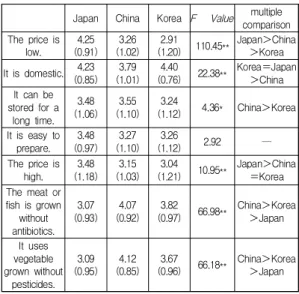
3.2 What they emphasize when they purchase food
Table 2 shows what they emphasize to what degree when they purchase food in 5 level Likert scale (higher the score, more emphasized they have). According to the table, parents in Japan emphasize that "the price is low" the most and it was significantly higher than in
Nation M(SD) F
Value multiple comparison Pesticide that is over
the standard amount is detected from vegetables in China.
Japan 4.43(0.67)
2.95 ―
China 4.25(0.89)
Korea 4.37(0.80)
Vegetable grown without pesticides and organic produce are safe.
Japan 3.93(0.75)
1.69 ―
China 4.02(0.97)
Korea 4.08(0.79)
It makes it easier to get cancer if you eat food that contain radiation.
Japan 3.78(0.87)
40.20**
Korea>
China>
Japan China 4.16(0.96)
Korea 4.54(0.67)
Food additives are safe.
Japan 3.69(0.79)
4.84** China>
Japan China 3.95(0.89)
Korea 3.83(0.93)
Food additives trigger allergy.
Japan 3.67(0.87)
21.04**
Korea>
Japan=
China China 3.64(0.91)
Korea 4.17(0.76)
Food additives are carcinogenic.
Japan 3.66(0.87)
16.56**
Korea=
China>
Japan China 3.98(1.00)
Korea 4.16(0.79)
Genetically modified food is bad for our body.
Japan 3.54(0.87)
45.49**
Korea=
China>
Japan China 4.21(0.91)
Korea 4.29(0.87)
There is a possibility that seafood caught near Japan contain radiation.
Japan 3.51(0.82)
77.36**
Korea>
China>
Japan China 4.00(1.00)
Korea 4.57(0.65)
Cut vegetables are cleaned with bleach.
Japan 3.51(0.91)
11.66**
Korea>
China=
Japan China 3.51(0.92)
Korea 3.92(0.91)
Food that satisfies the national standard is safe.
Japan 3.46(0.93)
9.52** China>
Japan China 3.86(1.00)
Korea 3.66(0.90)
Instant food is carcinogenic.
Japan 3.43(0.87)
33.83**
Korea=
China>
Japan China 3.95(0.89)
Korea 4.09(0.79)
Farmed fish may have residual dioxin.
Japan 3.05(0.68)
66.24**
Korea=
China
>Japan China 3.84(1.00)
Korea 3.90(0.84)
**:p<0.01
Table 1. Comparison of awareness of food safety and danger
Japan China Korea F Value multiple comparison The price is
low.
4.25
(0.91)
3.26
(1.02)
2.91
(1.20) 110.45** Japan>China
>Korea It is domestic. 4.23
(0.85)
3.79
(1.01)
4.40
(0.76) 22.38** Korea=Japan
>China It can be
stored for a long time.
3.48
(1.06)
3.55
(1.10)
3.24
(1.12) 4.36* China>Korea It is easy to
prepare.
3.48
(0.97)
3.27
(1.10)
3.26
(1.12) 2.92 ―
The price is high.
3.48
(1.18)
3.15
(1.03)
3.04
(1.21) 10.95** Japan>China
=Korea The meat or
fish is grown without antibiotics.
3.07
(0.93)
4.07
(0.92)
3.82
(0.97) 66.98** China>Korea
>Japan
It uses vegetable grown without
pesticides.
3.09
(0.95)
4.12
(0.85)
3.67
(0.96) 66.18** China>Korea
>Japan
**:p<0.01、*:p<0.05
Table 2. What they emphasize when they purchase food M(SD)
China and Korea. Also, similar to parents in Japan, parents in Korea tend to emphasize that it is
"domestic". On the other hand, it verified that parents in China emphasized "the meat or fish is grown without antibiotics" and "it uses vegetable grown without pesticides".
4. Discussion
In Japan and Korea, parents tend to emphasize that it is domestic, and parents in Japan valued that "the price is low". The background is that parents in Japan feel safe about food that is sold generally in supermarkets so as long as it is "domestic" they want to buy food that has "low price".
On the other hand, in Korea, they prohibit the import of food produced in 13 prefectures include Fukushima even now in 2017 due to the worries of radiation contamination and more people avoid traveling to Japan than other countries[12-14]. Based on this, it is presumed that parents in Korea have the awareness that "there is a possibility that radiation is contained in food" is higher than Japan and China. In addition, they are worried about cheap Chinese food so they emphasize "Korean produced food" that is not cheap and unsafe or food from Japan.
In China, there were reports of health hazard from eating meat and fish that was administered a large amount of chemical compounds that were called hormones and antibiotics, and people getting seriously ill from eating vegetables that had a large amount of illegal pesticides[15] so they are worried about antibiotics and pesticide and giving them to children who do not have sufficient physical strength. They recognize that food that has "low price" has higher possibilities of containing hazardous materials such as antibiotics and pesticides and that is why they do not emphasize the low price of food in order to buy the safety with money.
In this research, we found differences in worries for
radiation, food additives, and genetically modified food in 3 countries. It is presumed that the difference originates from how information is provided such as through mass media. In reality, food produced in Japan passes strict standard in Japan and it is said that food that are sold generally at supermarkets are safe so harmful rumors are gone. In the future, we would like to clarify how these worries are reduced by how information is provided.
REFERENCES
[1] National Consumer Affairs Center of Japan Awareness of Food Safety. (2015).http://www.fsc.go.jp/monitor/
2508moni-kadai-kekka.pdf>(18,July,2017)
[2] B. J. Choi. (2012). Research on a Child's Formation of Concept and Attitude toward Food Safety through an Integrative Culinary Activity Program and its Affects.
Department of Child and Family Studies Graduate School, Kyungpook National University.
[3] S. R. Lee. (1983). The study on food safety. Ewha University press, Seoul.
[4] H. J. Kim & M. R. Kim. (2003). Consumers’ awareness and information needs towards food hygiene (I): Focused on pesticide residues. Journal Korean Home Econ, 41, 15-16.
[5] W. J. Do, J. H. Lee & K. H. Kim. (2018). Recognition and Behavior of Female Workers for Irradiated Food. Journal of the Korea Convergence Society, 9(8), 87-94.
[6] S. Kurihara. (2005). Shokuhin ni taisuru Shohisya Ishiki to Anzen Hyoka, Journal of Food System Research, 12(2), 5-21.
[7] K. Masuyama, I. Horiguchi, R. Akamatsu & E. Marui.
(2012). Qualitative Study on Food Safety Commission Experts’ Views of Food-Safety Knowledge needed by Consumers, Japanese Journal of Food Chemistry and Safety, 19(1), 44-48.
[8] H. Karaki. (2009). Shokuhin no Anzen to Shohisya no Fuan, SCJ Forum, 14(2), 29-37.
[9] H. J. Nam & Y. S. Kim. (2009). A survey on perceived food safety in urban residents. Korean Journal Food &
Nurt, 19, 126-142.
[10] H. J. Kim & M. R. Kim. (2011). Concerns about Hazardous Elements on Foods and Recognition of the Roles of Government, Food Producers, and Consumers
in Securing Food Safety. Journal East Asian Soc Dietary Life, 21(3), 401-417.
[11] E. Osawai, M. Ishikawa & T. Sone. (2014). International Trends in Regulating the Marketing of Foods and Beverages High in Fat, Sugar or Salt to Children, The Japanese journal of nutrition and dietetics, 72(3), 147-155.
[12] T. Hashimoto, Y. Kaizu & T. Aizawa. (2015). Perceptions of Risk Affecting Tourism Due to the Great East Japan Earth 1uake: A Case Study of the Constrained Behavior of Tourists in a Village in Fukushima, Rikkyo University Bulletin of Studies in Tourism, 17, 3-12.
[13] G. Fred & H. Kuo. (2007). Demand for Food Quantity and Quality in China, Economic Research Report, 40, 3-7.
[14] Y. Okubo. (2013). Very poisonous food, Fusosha.
[15] S. Tomisaka. (2014). The truth of Chinese pollution, Chukyo Publishing.
미즈노 토모미(MIZUNO Tomomi) [정회원]
․1999년 10월 : University of Tsukuba 교육학 석사
․2005년 10월 : University of Tsukuba 교육학 박사(학술)
․2010년 10월 ~ 현재 : University of Tsukuba 의학의료계 준교수
․관심분야 : 보육、식생활、장애이해교육
․E-Mail : [email protected]
조 홍 중(CHO, Hong Joong) [정회원]
․1992년 3월 : University of Tsukuba 교육학 석사
․1998년 7월 : University of Tsukuba 교육학 박사
․2006년 3월 ~ 현재 : 전남대학교 특수교육학부 교수
․관심분야 : 특수교육, 장애이해교육, 보육
․E-Mail : [email protected]
취궈펑 屈 国鋒(QU GuoFeng) [정회원]
․2003년 3月 : University of Tsukuba 체육학 석사
․2007년 7월 : University of Tsukuba 체육학 박사
․2017年 3월 ~ 현재 : Beijing Normal University 체육학과 교수
․관심분야 : 스포츠교육、중국무술문화사상、중외격투 문화비교
․E-Mail : [email protected]
토쿠다 카츠미(TOKUDA Katsumi) [정회원]
․1983년 3월 : University of Tsukuba 교육학 석사
․1988년 3월 : University of Tsukuba 교육학 박사
․2010년 10월 ~ 현재 : University of Tsukuba 의학의료계 교수
․관심분야 : Barrier-free, 장애이해교육, 보육
․E-Mail : [email protected]