한수지 48(6), 982-987, 2015
982
Copyright © 2015 The Korean Society of Fisheries and Aquatic Science pISSN:0374-8111, eISSN:2287-8815 Korean J Fish Aquat Sci 48(6),982-987,2015
Original Article
서 론
갯벌
(tide flat)
은다양한생물의서식처,
성육장,
산란장의기 능을제공하며,
어류와각종무척추동물의풍부한생물자원을 제공해주는역할을한다.
이러한갯벌에는다양한어류가출현 하며,
특히망둑어과어류가우점하는것으로보고되었다(Sim and Lee, 1999; Seo and Hong, 2010).
망둑어과어류는전세계에약
212
속1,875
종,
국내에는약27
속59
종이출현한다고보고되었으며,
이중국내에출현하는Synechogobius
속어류는풀망둑(Synechogobius hasta) 1
종으 로알려져있다(Kim et al., 2005).
풀망둑은농어목
(Perciformes)
망둑어과(Gobiidae)
에속하는 어류로한반도동해북부를제외한전연안에분포하나,
넓은면 적의갯벌이산재하고있는서해와남해서부에집중적으로서 식한다.
국외에서는일본,
중국,
동남아시아등지에서도서식하는것으로보고되었다
(Jeong, 1977; Kim et al., 2005).
풀망둑 은식용으로이용되며천해의하구역,
내만이나갯벌에서식하 는어종중,
비교적대형으로낚시등의여가활동에있어중요한 종으로알려져있다(Kuno and Takita, 1997).
기존의선행연구를살펴보면국외에서는성장과성숙
,
지방 산조성,
사료의구성요소에관한연구등이있었다(Kuno and Takita, 1997; Luo et al., 2008; Luo et al., 2009).
국내에서는 체장·
체중의상관관계,
종합적인생태에관한연구등이있었 다(Paik, 1970; Choi et al., 1996).
식성에관한선행연구(Paik, 1969; Choi et al., 1996; Seo and Hong, 2006)
들을살펴보면,
풀망둑은게류,
소형어류,
새우류,
두족류,
갯지렁이류등다양 한대형저서동물을섭식하는것으로알려져있어,
연안생태계 에서상위포식자로판단되었다.
순천만갯벌역에출현하는풀 망둑또한해당생태계에서상위포식자로생태계내에서중 요한역할을할것이라는가설을세웠으며,
선행연구에서는강순천 상내리 갯벌역에 출현하는 풀망둑(Synechogobius hasta)의 식성
박종혁·정재묵 1 ·김현지·예상진 2 ·백근욱*
경상대학교 해양식품생명의학과/해양산업연구소/해양생물교육연구센터, 1국립수산과학원 남해수산연구소 자원환경과,
2한국수산자원관리공단 자원조성실
Feeding Habits of Javelin Goby Synechogobius hasta on Tide Flat in Sangnae-ri Suncheon, Korea
Jong Hyeok Park, Jae Mook Jeong, Hyeon Ji Kim
1
, Sang Jin Ye2
and Gun Wook Baeck*Department of Seafood and Aquaculture Science/Institute of Marine Industry/Marine BioEducation and Research Center, Gyeongsang National University, Tongyeong 53064, Korea
1
Fisheries Resources and Environment Division, South Sea Fisheries Research Institute, National Institute of Fisheries Science, Yeosu 59780, Korea
2
Resources Enhancement Division, Korea Fisheries Resources Agency, Busan 48058, Korea
During the study period, a total of 158 individuals of Synechogobius hasta were collected. The range of body length (BL) was 15.4-44.5 cm. The stomachs of 26.6% of the individuals were empty. The most abundant prey was shrimp.
Among shrimp, Exopalaemon orientis was the most abundant species, being present in 27% in %IRI (index of rela- tive importance). Fishes and crabs were also abundant prey. Analysis of ontogenetic changes, suggested that shrimp were the main prey of S. hasta of two size classes (<20 and 20-25 cm). The proportion of shrimp decreased, but that of fishes and crabs increased, with increasing body length, beginning at the 25-30 cm size class. In spring, fishes were the dominant prey, while shrimps, and crabs and fishes dominated in autumn and winter, respectively.
Key words: Synechogobius hasta , Feeding habits, Stomach contents, Ontogenetic change
This is an Open Access article distributed under the terms of the Creative Commons Attribution Non-Commercial Licens (http://creativecommons.org/licenses/by-nc/3.0/) which permits unrestricted non-commercial use, distribution, and reproduction in any medium, provided the original work is properly cited.
http://dx.doi.org/10.5657/KFAS.2015.0982 Korean J Fish Aquat Sci 48(6) 982-987, December 2015
Received 15 May 2015; Revised 26 October 2015; Accepted 21 December 2015
*Corresponding author: Tel: +82. 55. 772. 9156 Fax: +82. 55. 772. 9159
E-mail address: [email protected]
풀망둑의 식성
983
과서해의갯벌에서만진행되어
(Paik, 1969; Choi et al., 1996;
Seo and Hong, 2006),
생태적으로중요한순천만내에출현하 는풀망둑의식성연구가꼭필요하다고판단되었다.
이번연구의목적은순천만갯벌역에출현하는풀망둑의위내 용물을분석하여주먹이생물
,
크기와계절에따른먹이변화를 조사함으로써해당생태계내에서풀망둑의위치와순천만갯 벌역내의에너지흐름을확인하고기초생태학적인자료를제 공하기위함이다.
재료 및 방법
이번연구에사용된풀망둑은
2013
년9
월부터2014
년8
월까 지매월1
회전라남도순천시상내리갯벌에서폭20 m,
높이1 m,
망목1.5×1.5 cm
의저층자망(bottom gill net)
을이용하여 채집하였다(Fig. 1).
자망은간조시드러나는갯골을따라100 m
간격으로4
개정점을지정하여설치하였으며, 24
시간후수거하였다
.
채집된풀망둑은현장에서즉시10%
중성포르말린에고정하여실험실로운반한후
,
각개체의체장(body length)
과체중(weight)
을각각0.1 cm
와0.1 g
까지측정하였다.
이후,
각개체의위를적출하여해부현미경아래에서위내용물을분 석하였고
,
먹이생물은가능한종수준까지동정하였으며(Hong et al., 2006; Kim et al., 2005),
개체수를계수한후,
초정밀전자저울을이용하여습중량을
0.01 g
까지측정하였다.
위내용물조사를위한충분한표본크기를결정하기위하여누 적먹이곡선
(cumulative prey curve)
을사용하였다(Ferry and Cailliet, 1996).
분석된위내용물은어류(Pisces),
새우류(Ma- crura),
게류(Brachyura),
난바다곤쟁이류(Euphausiacea),
갯지 렁이류(Polychaeta),
이매패류(Bivalvia)
로구분하여위의순서 를100
번무작위화한뒤,
평균과표준편차를그래프상에나타 내었다.
이때곡선의점근선은위내용물분석을위한최소표본 크기를나타낸다.
위내용물분석결과는각먹이생물의출현빈도
(%F),
개체수 비(%N),
그리고습중량비(%W)
로나타내었으며,
다음식을이 용하여구하였다.
%F = A
i/ N×100
%N = N
i/ N
total×100
%W = W
i/ W
total×100
여기서
, A
i는위내용물중해당먹이생물이발견된풀망둑의 개체수이고, N
은먹이를섭식한풀망둑의총개체수, N
i와W
i 는해당먹이생물의개체수와습중량, N
total과W
total은전체먹이 개체수와습중량이다.
먹이생물의 상대중요성지수
(index of relative importance, IRI)
는Pinkas et al. (1971)
의식을이용하여구하였다.
IRI = (%N + %W)×%F
상대중요성지수는 백분율로 환산하여 상대중요성지수비
(%IRI)
로나타내었다.
풀망둑의성장과계절에따른먹이생물의변화를분석하기위 해서채집된시료를
5 cm
간격, 6
개의크기군(<20 cm, n=15;
20-25 cm, n=17; 25-30 cm, n=12; 30-35 cm, n=26; 35-40 cm, n=16; 40<, n=6)
으로구분하였고,
채집개체가없었던5-9
월을 제외한가을(10-11),
겨울(12-2),
봄(3-4)
으로구분하여먹이생 물의조성을확인하였다.
결 과
체장분포
이번연구에서채집된풀망둑은총
158
개체로15.6-44.5 cm
의체장범위를보였으며30-35 cm
크기군의개체가전체개체 수의26.6%
를차지하여가장많이채집되었다. 10
월에가장작 은크기인15.6 cm
개체가채집되었으며2014
년3
월에가장큰 Fig. 1. Location of the study area (O).박종혁
ㆍ
정재묵ㆍ
김현지ㆍ
예상진ㆍ
백근욱984
크기인
44.5 cm
개체가채집되었다(Fig. 2).
위내용물 조성
총
158
개체의풀망둑중위내용물이전혀발견되지않은개 체는42
개체로26.6%
의공복율을나타냈다.
위내용물이발견 된116
개체를 대상으로 조사한 누적먹이곡선은93
개체에서 점근선에근접하였다(Fig. 3).
이번연구는93
개체이상의표 본을조사하였기때문에풀망둑의위내용물을설명하기에충 분하였다.
위내용물이발견된116
개체의위내용물분석결과(Table 1),
풀망둑의가장중요한먹이생물은출현빈도72.4%,
개체수비40.5%,
습중량비35.1%,
상대중요성지수비57.9%
를차지한새우류
(Macrura)
로나타났다.
새우류중에서는흰새우(Exopalaemon orientis)
가출현빈도44.8%,
개체수비27.9%,
습중량비
28.9%
로가장중요한먹이생물이었다.
새우류다음으로 중요한 먹이생물은 출현빈도
36.2%,
개체수비24.3%,
습중량비
33.4%,
상대중요성지수비22.2%
를 차지한 어류(Pisces)
였다.
어류 중에서는민물두줄망둑(Tridentiger bifas- ciatus)
이출현빈도20.7%,
개체수비11.1%,
습중량비17.1%
로높은비율을차지하였다
.
다음으로우점한먹이생물은출현 빈도37.1%,
개체수비18.2%,
습중량비27.9%,
상대중요성지 수비18.1%
를차지한게류(Brachyura)
였으며,
게류중에서는 길게(Macrophthalmus abbreviatus)
가 개체수비11.1%,
습중량비
22.6%
를차지하여가장많이섭식되었다.
그외갯지렁이류
(Polychaeta),
난바다곤쟁이류(Euphausiacea),
이매패류(Bivalvia)
도섭식하였지만그양은많지않았다.
이번연구에 서풀망둑은새우류,
게류등의갑각류와어류를주로섭식하였 지만,
갯지렁이류,
이매패류등도섭식한것으로보아육식성어 류(carnivore)
임을알수있었다.
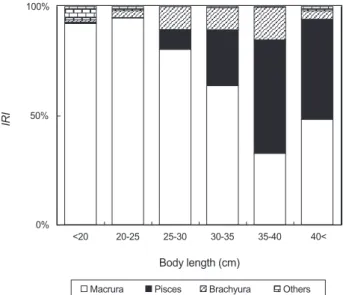
성장에 따른 먹이조성의 변화
풀망둑의크기군별먹이조성변화를분석한결과
(Fig. 4),
체장
20 cm
이하인가장작은크기군에서는새우류가상대중요성지수비
92.3%
로가장중요한먹이생물이었으며,
그다음으로난바다곤쟁이류가
5.8%
를차지하였다. 20-25 cm
크기군에서 는새우류가94.8%
로나타났으며,
게류가3.1%
로증가하였다. 25-30 cm
크기군에서새우류는80.4%
로감소하였으며,
게류 와어류가각각10.5%, 9.1%
로증가하였다. 30-35 cm
크기군 에서는새우류가63.8%
로감소하였으며,
게류는10.1%
로나 타났고,
어류는25.6%
로증가하였다. 35-40 cm
크기군에서는 어류가52.0%
로가장높게나타났으며,
새우류는32.8%
로감 소하였고,
게류는15.0%
로증가하였다. 40 cm
이상크기군에서는새우류가
48.3%
로가장높게나타났으며,
다음으로어류Fig. 2. Monthly variation in body length frequency of Syn- echogobius hasta.
0 50
100 Nov., n =21
0 50 100
0 50 100
0 50 100
0 50 100
0 50 100
0 50 100
<20 20-25 25-30 30-35 35-40 40<
2013. Oct., n =27
Dec., n =20
2014. Jan., n =18
Feb., n =20
Mar., n =35
Apr., n =17
Body length (cm)
Frequency (%)
0 1 2 3 4 5 6 7
Number of stomach samples
ax at yer pf or eb mu n evi tal u mu C
0 50 100
0%
50%
100%
<20 20-25 25-30 30-35 35-40 40<
Macrura Pisces Brachyura Others
Body length (cm)
IRI
0%
50%
100%
Autumn Winter Spring
Season
IRI
Pisces Macrura Brachyura Others
0 50
100 Nov., n =21
0 50 100
0 50 100
0 50 100
0 50 100
0 50 100
0 50 100
<20 20-25 25-30 30-35 35-40 40<
2013. Oct., n =27
Dec., n =20
2014. Jan., n =18
Feb., n =20
Mar., n =35
Apr., n =17
Body length (cm)
Frequency (%)
0 1 2 3 4 5 6 7
Number of stomach samples
ax at yer pf or eb mu n evi tal u mu C
0 50 100
0%
50%
100%
<20 20-25 25-30 30-35 35-40 40<
Macrura Pisces Brachyura Others
Body length (cm)
IRI
0%
50%
100%
Autumn Winter Spring
Season
IRI
Pisces Macrura Brachyura Others
Fig. 3. Cumulative prey curves of prey taxa per stomach of Syn- echogobius hasta.
풀망둑의 식성
985
가
45.9%
로나타났고,
게류는3.8%
로감소하였다. 계절에 따른 먹이조성의 변화
풀망둑이 채집되지 않았던
5-9
월을 제외한 계절별 먹이조성변화를분석한결과
(Fig. 5),
우점먹이생물인새우류는가을에
56.6%
로가장높은비율을차지하였으나겨울과봄에는감소하였다
.
다음으로우점한먹이생물이었던어류는가을에25.1%
로나타났으며,
비율이점차증가하여봄에는63.2%
를 차지하였다.
다음으로우점한게류는겨울에38.1%
를차지하여높은값을나타내었으나가을과봄에는낮게나타났다
.
고 찰
이번 연구에서 채집된 풀망둑은
10
월에 가장 작은크기인15.6 cm
개체가채집되었으며, 3
월에가장큰크기인44.5 cm
개체가채집되었다.
이와같은체장조성은풀망둑의산란기가4-5
월(Choi et al., 1996)
로알려져있는데,
봄에부화한개체가 성장하여10
월에가장작은크기의개체가채집된것으로판단 되었다.
그리고가장큰크기의풀망둑이채집된3
월에는같은 해에산란을위해갯벌역으로유입된개체수가많아졌기때문 인것으로추측된다.
또한5
월부터9
월까지는채집개체가없었 Table 1. Composition of the stomach contents of Synechogobius hasta by frequency of occurrence (F), number of individuals (N), wet-weight (W) and index of relative importance (IRI)Prey organisms %F %N %W %IRI
Polychaeta 7.8 4.4 2.9 0.6
Glycera decipiens 3.4 1.8 0.4
Nereidae spp. 6.0 2.6 2.5
Euphausiacea 10.3 9.4 0.2 1.0
Eupausia sp. 10.3 9.4 0.2
Macrura 72.4 40.5 35.1 57.9
Alpheus brevicristatus 6.0 2.1 0.6 Alpheus digitalis 2.6 1.5 0.7 Exopalaemon orientis 44.8 27.9 28.9 Palaemon ortmanni 9.5 3.8 1.9 Palaemon paucidens 7.8 3.2 1.7 Unidentified Macrura 4.3 2.1 1.2
Brachyura 37.1 18.2 27.9 18.1
Gaetice depressus 4.3 1.8 0.6
Helice tridens 3.4 1.5 2.1
Macrophthalmus abbreviatus 28.4 11.1 22.6 Sesarmops intermedius 6.0 3.8 2.6
Bivalvia 4.3 3.2 0.5 0.2
Glauconome chinensis 4.3 3.2 0.5
Pisces 36.2 24.3 33.4 22.2
Mugil cephalus 9.5 4.4 5.2
Periophthalmus modestus 2.6 1.2 0.9 Pseudogobius masago 3.4 3.5 0.6
Thryssa adelae 2.6 1.5 3.3
Thryssa hamiltoni 0.9 0.6 2.3 Tridentiger bifasciatus 20.7 11.1 17.1 Unidentified Pisces 3.4 2.1 4.0
Total 100.0 100.0 100.0
Fig. 4. Ontogenetic changes in composition of stomach contents by %IRI (index of relative importance) of Synechogobius hasta.
0 50
100 Nov., n =21
0 50 100
0 50 100
0 50 100
0 50 100
0 50 100
0 50 100
<20 20-25 25-30 30-35 35-40 40<
2013. Oct., n =27
Dec., n =20
2014. Jan., n =18
Feb., n =20
Mar., n =35
Apr., n =17
Body length (cm)
Frequency (%)
0 1 2 3 4 5 6 7
Number of stomach samples
ax at yer pf or eb mu n evi tal u mu C
0 50 100
0%
50%
100%
<20 20-25 25-30 30-35 35-40 40<
Macrura Pisces Brachyura Others
Body length (cm)
IRI
0%
50%
100%
Autumn Winter Spring
Season
IRI
Pisces Macrura Brachyura Others
Fig. 5. Seasonal variation in composition of stomach contents by
%IRI (index of relative importance) of Synechogobius hasta.
0 50
100 Nov., n =21
0 50 100
0 50 100
0 50 100
0 50 100
0 50 100
0 50 100
<20 20-25 25-30 30-35 35-40 40<
2013. Oct., n =27
Dec., n =20
2014. Jan., n =18
Feb., n =20
Mar., n =35
Apr., n =17
Body length (cm)
Frequency (%)
0 1 2 3 4 5 6 7
Number of stomach samples
ax at yer pf or eb mu n evi tal u mu C
0 50 100
0%
50%
100%
<20 20-25 25-30 30-35 35-40 40<
Macrura Pisces Brachyura Others
Body length (cm)
IRI
0%
50%
100%
Autumn Winter Spring
Season
IRI
Pisces Macrura Brachyura Others
박종혁
ㆍ
정재묵ㆍ
김현지ㆍ
예상진ㆍ
백근욱986
다
.
이는풀망둑이4
월부터5
월초까지산란후사망하며(Choi et al., 1996),
이후부화한작은개체의경우,
연구지역보다깊은 곳으로회유하기때문인것으로생각된다(Paik, 1969).
이번연구에서풀망둑의 공복율은
26.6%
로나타났으며,
과거연구에서망둑어과에속하는문절망둑
(Acanthogobius fla- vimanus)
은2.6%,
쉬쉬망둑(Chaeturichthys stigmatias)
은19.8%(Huh and Kwak, 1999; Seo and Hong, 2006)
로 비교 적낮은공복율의결과를나타냈다.
선행연구와비교해보았을 때풀망둑의공복율은각각17.7%, 9.3%(Paik, 1969; Seo and
Hong, 2006)
로이번연구에서채집된풀망둑의공복율이비교적높게나타났다
.
이와같이순천만에출현하는풀망둑의공복율이비교적높은이유는
21 cm
이하의개체가선행연구에비해낮은비율을보인반면
,
대부분큰크기의먹이생물을섭식하 는큰개체의비율이높았기때문인것으로판단되었다.
선행연구에서풀망둑은새우류
,
어류,
게류를주로섭식한것 으로확인되었는데(Choi et al, 1996; Seo and Hong, 2006),
이 와같은결과는이번연구의결과도유사한양상을보였다.
이 와같은결과로볼때,
풀망둑은우리나라남서해,
서해연안역 에서섭식가능한먹이생물을가리지않고섭식하는포식자인 것으로추측된다.
위내용물에서가장높은비율을보였던흰새 우는남해안의내만이나하구의모래또는진흙에주로서식하 며,
포란기는5-10
월,
수명은1
년으로알려져있다(Hong et al.,
2006).
이와같이흰새우가우점한이유는생활사주기가짧고포란기가길어
,
한겨울을제외하면,
풀망둑의주변환경에가장 풍부한출현량을보였기때문인것으로판단된다.
어류중가장 많이섭식된민물두줄망둑의경우,
강하구의기수및담수역에 서식하는것으로알려져있으며(Kim et al., 2005),
순천만갯벌 역에서수행된선행연구에서우점종으로연중출현하는것으로 나타났다(Ye et al., 2014).
이와같은결과로볼때,
민물두줄망 둑도흰새우와마찬가지로주변환경에개체수가많고,
에너지 효율이높아풀망둑이선호한것으로생각된다.
이번연구에서풀망둑은성장함에따라
25 cm
이상의크기군에서부터주먹이생물이새우류에서어류와게류로전환되 는것으로나타났다
.
같은망둑어과어류들의연구를살펴보면,
줄망둑(Acentrogobius pflaumi),
문절망둑,
별망둑(Chaenogo-
bius gulosus)
의경우에도성장함에따라먹이전환을하는것으로나타났다
(Huh and Kwak, 1998; Huh and Kwak, 1999;
Baeck et al., 2010).
이와같은먹이의전환은형태학적인발달 로인한유영능력향상,
입크기의증가,
생리학적인소화능력향 상등으로이루어지는일반적인현상이지만,
수명이1-2
년으로 짧은풀망둑의경우번식을위하여보다많은에너지가필요하 기때문인것으로판단된다.
풀망둑의계절별먹이생물의변화를분석한결과
,
가장우점 한먹이생물이었던새우류는가을에가장높은비율을차지하 였다.
겨울과봄에는비율이감소하였는데이는새우류중가 장높은비율을차지한흰새우의포란기가5
월에시작되어10
월에끝나대부분이산란후사망하였기때문인것으로추측된 다
.
어류는가을에서봄까지점차증가하여봄에가장우점한먹 이생물로나타났다.
이는연구지역에서봄에부화한개체들이 많았기때문으로판단된다.
게류의경우겨울에가장높은비율 을차지하였다.
이는주요먹이생물이었던새우류와어류의출 현량이상대적으로감소하였기때문으로판단된다.
그러나상 내리갯벌역에서식하는생물의계절별종조성에대한자료가 전무하여,
정확한조사를위해서는이에대한연구가필요할것 으로생각된다.
사 사
이논문은
2013
년도정부(
교육부)
의재원으로한국연구재단의 지원을받아수행된기초연구사업임(2013R1A1A2004483).
References
Baeck GW, Park CI, Jeong JM, Kim MC, Huh SH and Park JM.
2010. Feeding habits of Chaenogobius gulusus in the coastal waters of Tongyeong, Korea. Korean J Ichthyol 22, 41-48.
Choi Y, Kim IS, Ryu BS and Park JY. 1996. Ecology of Syn
echogobius hasta (Pisces : Gobiidae) in the Kum River Es-
tuary, Korea. J Kor Fish Soc 29, 115-123.Ferry LA and Cailliet GM. 1996. Sample size and data analy- sis: are we characterizing and comparing diet properly. In:
MacKinlay, D. and K. Sheare (eds.), Feeding Ecology and Nutrition in Fish, Symp. Proc., American Fisheries Society.
San Francisco, CA, 71-80.
Hong SY, Park KY, Park CW, Han CH, Suh HL, Yun SG, Song CB, Jo SG, Lim HS, Kang YS, Kim DJ, Ma CW, Son MH, Cha HK, Kim KB, Choi SD, Park KY, Oh CW, Kim DN, Shon HS, Kim JN, Choi JH, Kim MN and Choi IY. 2006.
Mairne Invertebrates in Korean Coasts. Academybook, 328- Huh SH and Kwak SN. 1998. Feeding habits of Acentrogobius 329.
pflaumii in the eelgrass (Zostera marina) bed in Kwangyang
Bay. Korean J Ichthyol 10, 24-31.Huh SH and Kwak SN. 1999. Feeding habits of Acanthogobius
flavimanus in the eelgrass (Zostera marina) bed in Kwang-
yang Bay. J Kor Fish Soc 32, 10-17.Jeong MK. 1977. The Fishes of Korea. Iljisa, Seoul, Korea, 486.
Kikuchi T and Yamashita Y. 1992. Seasonal occurrence of gobi- id fish and their food habits in a small mud flat in Amakusa.
Bubl Amakusa Mar Biol Lab 11, 73-93.
Kim IS, Choi Y, Lee CR, Lee YJ, Kim BJ and Kim JH. 2005.
Illustrated Book of Korean Fishes. Kyohaksa, Seoul, Korea, 420-443.
Kuno Y and Takita T. 1997. The growth, maturation and feeding habits of the gobiid fish Acanthogobius hasta distributed in Ariake sound, Kyushu, Japan. Fish Sci 63, 242-248.
Luo Z, Li X, Bai H, and Gong S. 2008. Effects of dietary fatty
풀망둑의 식성
987
acid composition on muscle composition and hepatic fatty acid profile in juvenile Synechogobius hasta. J Appl Ich- thyol 24, 116-119.
Luo Z, Li XD, Gong SY, and Xi WQ. 2009. Apparent digestibil- ity coefficients of four feed ingredients for Synechogobius
hasta. Aquaculture Res 40, 558-565.
Paik EI. 1969. A Study on the food of the goby, Synechogobius
hasta. Bull. Korean Fish Soc 2, 47-62.
Paik EI. 1970. Length-weight relationship of Synechogobius
hasta. Bull Korean Fish Soc 3, 117-119.
Pinkas L, Oliphant MS and Iverson ILK. 1971. Food habits of albacore, bluefin tuna and bonito in California waters. Fish Bull 152, 1-105.
Seo IS and Hong JS. 2006. Feeding ecology of Javelin goby (Acanthogobius hasta) and fine spot goby (Chaeturichtys
stigmatias) in the Jangbong tidal flat, Incheon, Korea. J Kor
Fish Soc 39, 165-179.Seo IS and Hong JS. 2010. Seasonal variation of fish assem- blages on Jangbong tidal flat, Incheon, Korea. Korean J Fish Aquat Sci 43, 510-520. http://dx.doi.org/10.5667/
kfas.2010.43.5.510.
Sim GS and Lee CR. 1999. Fish fauna of the Saemankum area, Chollabuk-do. Korean J Environ Biol 17, 293-303.
Ye SJ, Jeong JM, Kim HJ, Park JM, Huh SH and Baeck GW.
2014. Fish assemblage in the tidal creek of Sangnae-ri Sun- cheon, Korea. Korean J Ichthyol 26, 74-80.