한수지 52(2), 114-120, 2019
114
Copyright © 2019 The Korean Society of Fisheries and Aquatic Science pISSN:0374-8111, eISSN:2287-8815 Korean J Fish Aquat Sci 52(2),114-120,2019
Original Article
서 론
전라북도부안군과고창군에걸쳐형성되어있는곰소만해역 은만의형태로면적은
76 km
2,
평균수심은6-8 m,
조수간만의 차는6 m
로썰물때는넓은간석지가드러나기때문에이해역 에서생산되는패류의경우수심이낮아뻘등퇴적물의영향을 많이받는다.
또한썰물때는공기중에노출되어패각의온도가 상승하기도하며,
밀물때에는해수에잠겨해수에떠오른퇴적 물의영향을받는특성을가지고있는해역이다.
양식면허허가 건수는250
개소로어류,
패류,
해조류등다양한수산물을양식 하고있으며,
바지락,
가무락,
동죽,
대합,
꼬막,
김등이주로생 산된다(MOF, 2016).
패류는이동성이거의없고
,
여과섭이(filter feeding)
활동을통하여주위해수중에부유하는먹이생물은물론병원성세균 도함께섭취하여체내에축적하게된다
(Ripabelli et al., 1999:
Edwards et al., 2005; US FDA, 2007).
또한패류는패각을제 외한장기관및연체부전체를가식부로이용하는비율이높아 타식품보다병원성미생물에의한질환의발생율이높은위생 적인취약점을갖고있다.
병원미생물에오염된패류의섭취로 인한감염증발생사례는오래전부터알려져있으며(Di Pinto et al., 2008; Baker-Austin et al., 2010),
패류생식으로인한식 중독중대표적인것은병원성비브리오균이다.
비브리오균은그람음성간균으로포자를형성하지않는통성 혐기성 세균이며 병원성비브리오균은우리나라뿐만아니라 전세계적으로해수
,
어패류등에서검출되고있다(Iwamoto et al., 2010; Hartnell et al., 2019).
총77
종의비브리오균중병원곰소만의 해수 및 패류에 있어서 장염비브리오균(Vibrio parahaemolyticus) 과 비브리오패혈증균(Vibrio vulnificus)의 분포
이동수·신혜영·박권삼 1 ·신일식*
강릉원주대학교 해양식품공학과, 1군산대학교 식품생명공학과
Distribution of Vibrio parahaemolyticus and Vibrio vulnificus in Seawa- ter and Shellfish at Gomso Bay
Dong-Soo Lee, Hye-Young Shin, Kwon-Sam Park
1
and Il-Shik Shin*Department of Marine Food Science and Technology, Gangneung-Wonju National University, Gangneung 25457, Korea
1Department of Food Science and Biotechnology, Kunsan National University, Gunsan 54150, Korea
In the case of being contaminated with pathogenic Vibrio , shellfish pose a serious threat for public health. This study was conducted to investigate the presence of Vibrio parahaemolyticus and V. vulnificus in the seawater, bottom de- posit and shellfish samples collected from the Gomso Bay, west coast of Korea. V. parahaemolyticus (30-80 CFU/g) was detected from seawater Jul. to Oct. and highest at Sep. V. parahaemolyticus was detected less than 10 CFU/g from seawater at Nov. with 14.6℃ of seawater temperature. V. parahaemolyticus (180-1,850 CFU/g) was detected more than 100 CFU/g from 3 kinds of shellfish, Short-necked clam Ruditapes philippinarum , Corb shell Cyclina sinensis , and Surf clam Mactra veneriformis , Jul. to Oct. and was highest in Surf clam at Oct. V. parahaemolyticus was detected less than 20 CFU/g from all tested shellfish at Nov. V. vulnificus (1.8-2.7 MPN/100 mL) was detected from seawater Jul. to Oct. and was not detected at Nov. V. vulnificus (18-236.7 MPN/100 g) was also detected from 3 kinds of shellfish Jul. to Oct. and was highest in Corb shell at Jul. V. vulnificus was not detected from all tested shellfish at Nov.
Key words: Public health, Vibrio parahaemolyticus , Vibrio vulnificus, Shellfish, Seawater
*Corresponding author: Tel: +82. 33. 640. 2346 Fax: +82. 33. 640. 2346 E-mail address: [email protected]
This is an Open Access article distributed under the terms of the Creative Commons Attribution Non-Commercial Licens (http://creativecommons.org/licenses/by-nc/3.0/) which permits unrestricted non-commercial use, distribution, and reproduction in any medium, provided the original work is properly cited.
Received 30 January 2019; Revised 15 February 2019; Accepted 5 April 2019 저자 직위: 이동수(대학원생), 신혜영(대학원생), 박권삼(교수), 신일식(교수) https://doi.org/10.5657/KFAS.2019.0114
Korean J Fish Aquat Sci 52(2), 114-120, April 2019
장염 비브리오균과 비브리오 패혈증균의 분포
115
성비브리오균은
12
종으로,
그중장염비브리오균(Vibrio para- haemolyticus)
과비브리오패혈증균(Vibrio vulnificus)
이대표 적이다(Newton et al., 2012).
장염비브리오균에의한식중독은오염된어류
,
패류,
두족류 등의섭취(Iwamoto et al., 2010; Huang et al., 2018)
로인해발 생할수있으며,
국내장염비브리오균에의한식중독환자발생 현황(2012-2016
년)
을살펴보면, 2012
년195
명, 2013
년40
명, 2014
년78
명, 2015
년25
명, 2016
년251
명의환자가발생하였 으며,
월별환자수는8
월233
명, 9
월109
명으로8-9
월에집중 적으로많이발생되고있으나3
월-7
월, 10
월-12
월에도장염비 브리오균에의한식중독환자가발생한바있다.
비브리오패혈 증은국내법정감염병제3
군감염병에속하여매년50
명의환자 가발생하고있으며,
일본,
대만,
이스라엘,
스페인등에서도보 고되고있다(MFDS, 2016).
비브리오패혈증의원인으로는비 브리오패혈증균에오염된음식을날것으로섭취하거나충분 히익혀먹지않을경우(Baker-Austin et al., 2010; Elmahdi et al., 2018; Tokarskyy et al., 2019),
혹은피부상처가비브리오 패혈증균에노출되었을때발생한다(D’Souza et al., 2018).
국 내비브리오패혈증환자발생현황(2012-2016
년)
을살펴보면, 2012
년64
명, 2013
년56
명, 2014
년61
명, 2016
년43
명으로지 속적으로발생하고있으며,
월별환자수는9
월에총112
명으로 가장많았고8
월(52
명), 10
월(52
명), 7
월(26
명)
순으로나타났 으며해수온도가상승하는8-9
월에집중되어비브리오패혈증 환자가발생한다고보고하고있다(KCDC, 2018).
우리나라는지리적으로해양환경과밀접하여병원성비브리 오균에의한위험에항상노출되어있고
,
기후변화에따른해수 온도상승으로인해병원성비브리오균에대한우려가증가하 고있기때문에병원성비브리오균으로인한식중독사고를예 방하고관리하기위해서는수산물의안전관리가매우중요한 실정이다.
전라북도부안군과고창군사이에있는곰소만해역의경우
,
바지락,
가무락,
동죽,
대합,
꼬막등다양한수산물이생산되 고있는해역이지만,
곰소만해역해수에서분리한장염비브리 오균(Vibrio parahaemolyticus)
의항균제내성및최소발육억 제농도의규명(Kim et al., 2016a),
곰소만해역의바지락(Ru- ditapes philippinarum)
에서분리한대장균(Escherichia coli)
의 항균제내성및병원성유전자의보유성(Kim et al., 2016b)
등 에대한연구는있으나,
해수와패류에서병원성비브리오균의 분포를조사한논문은거의없는실정이다.
이에본연구에서 는패류생산해역의위생관리를위한기초자료를제공하고자 곰소만해역에서생산되는패류와해수,
해저퇴적물등환경 을대상으로장염비브리오균과비브리오패혈증균의분포를 조사하였다.
재료 및 방법
시료
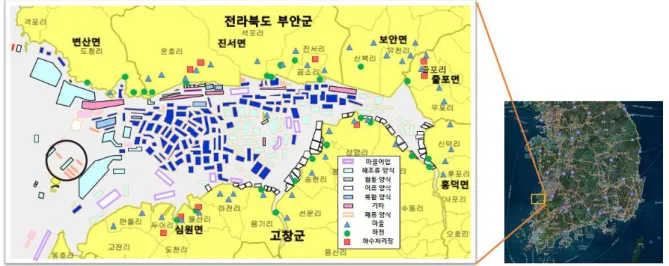
실험에제공된시료는곰소만해역
(Fig. 1)
의해수와패류로병원성비브리오균이집중적으로검출될것으로예상되는시 기인
2017
년7
월부터11
월까지월3
회씩채취하였다.
해수와 퇴적물은곰소만해역의해수와퇴적물을무균적으로채취하 였고,
패류는다생산다소비패류인바지락(Short-necked clam Ruditapes philippinarum),
가무락(Corb shell Cyclina sinen- sis),
동죽(Surf clam Mactra veneriformis)
을생산해역에서직 접채취하여, ice box
에넣어10℃
이하로유지하면서실험실로 운반한후즉시실험에사용하였다.
병원성 비브리오균의 정량
해수 및 패류 시료 중의 장염비브리오 및 비브리오패혈증 균의정량은
recommended procedures for the sea water and
Fig. 1. Location of sampling site (in black circle), Gomso bay, the west coast of Korea, for seawater, bottom deposit and shellfish.
이동수
ㆍ
신혜영ㆍ
박권삼ㆍ
신일식116
shellfish (APHA, 1984)
에 준하여시험하였다.
해수는 최종 농도2%
의sodium chloride
가첨가된alkaline peptone water (Merck, Darmstadt, Germany) 10 mL
에3
개시험관법으로10, 1, 0.1
및0.01 mL
씩접종한후35℃
에서16
시간정치배양하 였다.
또한패류는무균적으로탈각한육25 g
을멸균된waring blender cup (Torrington, USA)
에넣고여기에9
배량의멸균인 산완충액(phosphate buffered saline, pH7.4)
을가하여90
초동 안균질화한다음10
진법으로적절한단계까지희석하여해수 와동일하게3
개시험관법으로alkaline peptone water 10 mL
에접종후35℃
에서16
시간정치배양하였다.
각배양액1.0 mL
를eppendorf tube
에취해원심분리(12,000 rpm, 2
분)
한후 배양액을완전히제거하여균체를회수하였다.
여기에멸균증 류수0.1 mL
를가하여현탁후100℃
에서5
분간열처리하여상 층액은PCR assay
용주형DNA
로사용하였다.
표적유전자의 증폭산물이확인된시험관은양성으로판정하여최확수(most probable number, MPN)
에적용하여100 mL
또는100 g
중에 존재하는균수로계산하였다.
PCR assay 조건
유전자증폭에는
emeraldAmp GT PCR master mix (Takara,
Japan)
를사용하였다.
프라이머의최종농도는반응액에 각각2.0 pmol
이되도록조정하였으며,
반응액은총25 µL
가되도 록하였다.
장염비브리오증폭용프라이머
(5'-AAACACGTTAACCTAT- TAATAGG-3'
및5'-AACGGGAGCCTTTTTAAACAAGA-3')
를사용하였으며PCR
조건은95℃
에서1
회3
분간열변성후95℃ 30
초, 55℃ 30
초, 72℃ 30
초를한단위로하여이를30
회 반복하여DNA
를증폭하였다(No et al., 2011).
비브리오패혈증균은프라이머
(5’-CAGCCGGACGTCGTC- CATTTTG-3'
및5’-ATGAGTAAGCGTCCGACGCGT-3')
를사용하였으며PCR
조건은94℃
에서1
회5
분간열변성후94℃ 30
초, 60℃ 30
초, 72℃ 30
초를한단위로하여이를25
회실시하고,
최종적으로72℃
에서10
분간1
회신장반응을수 행하였다(Jang et al., 2018).
증폭된DNA
산물은1.5% aga- rose gel
에서전기영동후ethidium bromide
로염색하여Vilber Lourmat (Bio-Paint ST4, Marne-la-Vallee, France)
사Gel- Doc system
으로증폭여부를확인하였다.
통계분석
실험은
3
회 반복하여 수행하였으며 분석 후의 결과 값은SPSS 23.0 (SPSS Inc. Chicago, IL, USA)
을이용하여분석하 였다.
각결과는일원분산분석(One-Way ANOVA)
에의해유 의성을 검정하였고, Duncan
의 다중범위검정(Duncan's mul- tiple range test)
을P<0.05
의유의수준에서평가하였다.
결과 및 고찰
해수의 일반적 성상
2017
년7
월부터11
월까지월3
회씩채취한곰소만해역의월 별평균수온및평균염분의변화는Fig. 2
와같다.
해수의평 균수온범위는14.6-28.9℃
로7
월이가장높았으며(28.9℃) 9
월부터낮아지기시작하여11
월에는14.6℃
까지낮아졌다.
염 Fig. 2. Temperature and salinity of seawater collected at Gomso bay, west coast of Korea from Jul. to Nov., 2107.a a
b
c
d
a a
a
a a
0.0 5.0 10.0 15.0 20.0 25.0 30.0 35.0
0.0 5.0 10.0 15.0 20.0 25.0 30.0 35.0
Jul. Aug. Sep. Oct. Nov.
Sa lin ity (p su)
W ate r tem pe ra tu re (℃ )
Month Water temperature
Salinity
c
b
a
bc c c
b
bc
bc
c c
b
bc
a
c c
b
ab
a
c 0.0
5.0 10.0 15.0 20.0 25.0 30.0 35.0
0 500 1,000 1,500 2,000 2,500
Jul. Aug. Sep. Oct. Nov.
W at er te m pe ra tu re (℃ )
CFU/g or mL
Month
Sea water Bottom deposit Short-necked clam Corb shell Surf clam Water temperature
c c c c c
a
b
c
b
c a
b
ab
c c
a
ab
c
b
c
ab ab
b b
c
0.0 5.0 10.0 15.0 20.0 25.0 30.0 35.0
0.0 50.0 100.0 150.0 200.0 250.0 300.0
Jul. Aug. Sep. Oct. Nov.
W at er te m pe ra tu re (℃ )
Cell count (M PN/100 g or mL)
Month
Sea water
Bottom deposit
Short-necked clam
Corb shell
Surf clam
Water temperature
장염 비브리오균과 비브리오 패혈증균의 분포
117
분의범위는
29.3-32.7 psu
이었으며강수량이많았던9
월이가 장낮았으며, 7
월에가장높았으나유의할만한변화는없었다(P>0.05).
장염 비브리오균
2017
년7
월부터11
월까지월3
회씩채취한곰소만해역의해 수,
퇴적물과3
종의패류에대한장염비브리오균오염도를조 사한결과는Fig. 3
과같다.
해수의경우
, 7
월에4.7×10
1colony form unit (CFU)/mL
이 검출되었으며, 9
월에80.0 CFU/mL
로가장높은수치를나타 내었으며,
수온이14.6℃
로떨어진11
월에10 CFU/mL
로감 소하였다.
퇴적물의경우, 7
월에2.9×10
2CFU/g
이검출되었 으며, 9
월에1.1×10
3CFU/g
으로가장높은수치를나타내었 으며,
수온이14.6℃
로떨어진11
월에2.2×10
2CFU/g
으로감 소하여유의할만한차이를나타내었다(P <0.05).
패류의경우,
바지락은7
월에1.9×10
2CFU/g
이검출되었고,
그이후증가하 기시작하여바지락은8
월에8.9×10
2CFU/g
으로가장높은수 치를나타내었고, 10
월에도6.5×10
2CFU/g
이검출되었다.
가 무락과동죽은7
월에각각4.8×10
2CFU/g
과1.8×10
2CFU/
g
이검출되었으며,
역시그이후증가하기시작하여10
월에각 각1.4×10
3CFU/g, 1.9×10
3CFU/g
으로가장높은수치를나 타내었으며,
수온이14.6℃
로떨어진11
월에는3
종의패류모 두2.0×10
1CFU/g
이하로급격하게감소하였다(P<0.05).
해 수,
퇴적물,
패류중장염비브리오균의검출율은패류가가장 높았으며,
그다음이퇴적물,
해수순이었다.
다만퇴적물의경우
,
균수가2.0×10
1CFU/g
이하로급격히감소한패류와균이 검출되지않았던해수와는달리11
월에도2.2×10
2CFU/g
의 균이검출되었다.
비브리오 패혈증균
2017
년7
월부터11
월까지월3
회씩채취한곰소만해역의해 수,
퇴적물과3
종의패류에대한비브리오패혈증균오염도를 조사한결과는Fig. 4
와같다.
해수의경우, 7
월부터10
월사이 에1.8-2.7 MPN/100 mL
이검출되었고11
월에는검출한계이 하로나타났으나유의할만한차이는없었다(P>0.05).
퇴적물 은7
월에140.0 MPN/100 g
으로가장높은수치를나타내었 으며,
그이후감소하여11
월에가장낮은수치(32.7 MPN/100 g)
를나타내었다.
패류의경우, 3
종류모두수온이가장높았던
(28.9℃) 7
월에유의적으로가장높은수치를나타내었으며(P<0.05),
가무락(236.7 MPN/100 g),
바지락(206.7 MPN/100 g),
동죽(166.7 MPN/100 g)
순이었다.
그 이후 수온의 저하 와 함께균수가감소하였지만,
가무락과 동죽의경우수온이16.6℃
이었던10
월에도136.7 MPN/100 g
이검출되었으며수온이
14.6℃
이었던11
월에는세종류의패류모두검출한계이하로감소하였다
.
해수,
퇴적물,
패류중비브리오패혈증균 의검출율은패류가가장높았으며,
그다음이퇴적물,
해수순 이었다.
다만퇴적물의경우,
균수가검출한계이하로감소한 패류와해수와는달리11
월에도32.7 MPN/100 g
의균이검출 되었다.
우리나라에있어서병원성비브리오균은
5
월부터10
월사이 Fig. 3. Change of Vibrio parahaemolyticus in seawater, bottom deposit, short-necked clam Ruditapes philippinarum, corb shell Cyclina sinensis and surf clam Mactra veneriformis collected at Gomso bay, west coast of Korea from Jul. to Nov., 2017.a a
b
c
d
a a
a
a a
0.0 5.0 10.0 15.0 20.0 25.0 30.0 35.0
0.0 5.0 10.0 15.0 20.0 25.0 30.0 35.0
Jul. Aug. Sep. Oct. Nov.
Sa lin ity (p su)
W ate r tem pe ra tu re (℃ )
Month Water temperature
Salinity
c
b
a
bc c c
b
bc
bc
c c
b
bc
a
c c
b
ab
a
c 0.0
5.0 10.0 15.0 20.0 25.0 30.0 35.0
0 500 1,000 1,500 2,000 2,500
Jul. Aug. Sep. Oct. Nov.
W at er te m pe ra tu re (℃ )
CFU/g or mL
Month
Sea water Bottom deposit Short-necked clam Corb shell Surf clam Water temperature
c c c c c
a
b
c
b
c a
b
ab
c c
a
ab
c
b
c
ab ab
b b
c
0.0 5.0 10.0 15.0 20.0 25.0 30.0 35.0
0.0 50.0 100.0 150.0 200.0 250.0 300.0
Jul. Aug. Sep. Oct. Nov.
W at er te m pe ra tu re (℃ )
Cell count (M PN/100 g or mL)
Month
Sea water
Bottom deposit
Short-necked clam
Corb shell
Surf clam
Water temperature
이동수
ㆍ
신혜영ㆍ
박권삼ㆍ
신일식118
에주로검출되는것으로알려져있다
(Na et al., 2016). Lee et al. (2007)
은2007
년6
월부터9
월사이에서울의소매점으로부터구입한굴에서검출된장염비브리오균수는
100-10,000
MPN/g
이었으나, 5
월과9
월은각각100 MPN/g
이하로검출되 었다고보고하였으며,
본연구에서도해수의경우7
월부터10
월사이에서는4.7-8.0×10
2CFU/g
의장염비브리오균이검출 되어이와유사한경향을나타내었다.
그러나Na et al. (2016)
은 최근3
년간11
개지역(
부산,
인천,
군산,
목포,
여수,
마산,
통영,
울산,
포항,
동해,
제주)
에서총2,220
건의해수중1,548
건에서 장염비브리오균이검출되었으며(69.7%)
계절에따른검출율 의차이는있었으나연중해수에서검출되었다고보고한바있 다.
한편패류의경우7-10
월에3
종의패류모두에서1.0×10
2CFU/g
이상의장염비브리오가검출되어, “
최종소비자가그대로섭취할수있도록유통판매를목적으로위생처리하여용기
·
포장에넣은수산물은장염비브리오균이g
당100
이하이어야 한다.”
는식품공전의허용기준치를고려한다면7-10
월에는패 류섭취시주의를기울여야할것이다.
Tamplin et al. (1982)
은미국플로리다지역에서해수,
굴,
조 개를채취하여오염실태를조사한결과,
해수온도가17℃
이상 일때더많은비브리오패혈증균이검출되었고, 17℃
이하의 수온에서는모든시료에서검출되지않았으며또한채취한시료의온도가
29℃
이상일때비브리오패혈증균의검출율이높았다고보고하여본연구의결과도이와유사한경향을나타내 었다
. Kaysner et al. (1987)
이미국서해안에서해수,
해변침전 물,
굴,
홍합등529
종을분석하여총31
균주의비브리오패혈증균을분리하였고
,
그중해수,
해변침전물,
굴,
홍합에서각각17, 12, 1, 1
균주의비브리오패혈증균이검출되었으며,
비브리 오패혈증균이검출된해수의경우,
수온이15℃
이상이었다고 보고한바있다.
또한Na et al. (2016)
은최근3
년간11
개지역 에서총2,220
건의해수중58
건에서비브리오패혈증균이검 출되었으며1
월, 12
월을제외하고연중검출되었다고보고한 바있다.
본연구에서도수온이16.6-28.9℃
이었던7-10
월에는 해수및패류에서비브리오패혈증균이검출되었지만수온이15℃
이하(14.6℃)
이었던11
월에는검출한계이하로나타나 해수의온도가비브리오패혈증균의생장에큰영향을미치는 것을알수있었다.
한편균수가급격히감소한패류와균이검 출되지않았던해수에비하여11
월에퇴적물에서균수가높게 검출된이유로는병원성비브리오균이동절기에동물플랑크톤의일종인
copepods
등에부착하여월동하고수온이상승하는하절기에다시증식한다는연구보고를들수있다
(Perez-Rosas and Hazen, 1988; Tamplin et al., 1990).
본연구는
2017
년7
월부터11
월까지전라북도곰소만에서해 수와패류에있어서병원성비브리오균의분포를조사한것으로조사지역과시기가제한적인점은있지만
,
수온이15℃
이상인
7
월에서11
월사이에병원성비브리오균이검출된다는사 실을확인할수있었으며,
병원성비브리오균에의한식중독혹 은전염병을예방하기위해서는이시기에수산물의생식에는 주의를기울여야하며,
해수와패류에대한병원성비브리오균 의지속적인모니터링이필요할것으로사료된다.
Fig. 4. Change of Vibrio vulnificus in seawater, bottom deposit, short-necked clam Ruditapes philippinarum, corb shell Cyclina sinensis and surf clam Mactra veneriformis collected at Gomso bay, west coast of Korea from Jul. to Nov., 2017.
a a
b
c
d
a a
a
a a
0.0 5.0 10.0 15.0 20.0 25.0 30.0 35.0
0.0 5.0 10.0 15.0 20.0 25.0 30.0 35.0
Jul. Aug. Sep. Oct. Nov.
Sa lin ity (p su)
W ate r tem pe ra tu re (℃ )
Month Water temperature
Salinity
c
b
a
bc c c
b
bc
bc
c c
b
bc
a
c c
b
ab
a
c 0.0
5.0 10.0 15.0 20.0 25.0 30.0 35.0
0 500 1,000 1,500 2,000 2,500
Jul. Aug. Sep. Oct. Nov.
W at er te m pe ra tu re (℃ )
CFU/g or mL
Month
Sea water Bottom deposit Short-necked clam Corb shell Surf clam Water temperature
c c c c c
a
b
c
b
c a
b
ab
c c
a
ab
c
b
c
ab ab
b b
c 0.0
5.0 10.0 15.0 20.0 25.0 30.0 35.0
0.0 50.0 100.0 150.0 200.0 250.0 300.0
Jul. Aug. Sep. Oct. Nov.
W at er te m pe ra tu re (℃ )
Cell count (M PN/100 g or mL)
Month
Sea water
Bottom deposit
Short-necked clam
Corb shell
Surf clam
Water temperature
장염 비브리오균과 비브리오 패혈증균의 분포
119
사 사
이논문은
2016
년도식품의약품안전처에서시행한용역연구개발과제
(16162
수산물607)
의연구개발비지원에의해수행되 었으며이에감사드립니다.
References
APHA (American Public Health Association). 1984. Laboratory procedures for the examination of sea water and shellfish.
5th ed. APHA, Washington DC, U.S.A.
Baker-Austin C, Stockley L, Rangdale, R and Martinez-Urtaza J. 2010. Environmental occurrence and clinical impact of
Vibrio vulnificus and Vibrio parahaemolyticus: a European
perspective. Environ Microbiol Rep 2, 7-18. https://doi.org/10.1111/j.1758-2229.2009.00096.x.
Di Pinto A, Ciccarese G, De Corato R, Novello L and Terio V.
2008. Detection of pathogenic Vibrio parahaemolyticus in southern Italian shellfish. Food Cont 19, 1037-1041. https://
doi.org/10.1016/j.foodcont.2007.10.013.
D’Souza C, Kumar BK, Kapinakadu S, Shetty R, Karunasagar I and Karunasagar I. 2018. PCR-based evidence showing the presence of Vibrio vulnificus in wound infection cases in Mangaluru, India. Inter J Infect Dis 68, 74-76. https://doi.
org/10.1016/j.ijid.2018.01.018.
Edwards WJ, Rehmann CR, McDonald E and Culver DA. 2005.
The impact of a benthic filter feeder: Limitations imposed by physical transport of algae to the benthos. Can J Fish Aquat Sci 62, 205-214. https://doi.org/10.1139/F04-188.
Elmahdi S, Parveen S, Ossai S, DaSilva LV, Jahncke M, Bow- ers and Jacobs J. 2018. Vibrio parahaemolyticus and Vib-
rio vulnificus recovered from oysters during an oyster relay
study. Appl Environ Microbiol 84, e01790-17. https://doi.org/10.1128/AEM.01790-17.
Hartnell RE, Stockley L, Keay, W, Rosec JP, Hervio-Heath D, Van den Berg H, Leoni F, Ottaviani D, Henigman U, De- nayer S, Serbruyns B, Georgsson F, Krumova-Valcheva G, Gyurova E, Blanco C, Copin S, Strauch E, Wieczorek K and Baker-Austin C. 2019. A pan-European ring trial to validate an International standard for detection of Vibrio cholerae,
Vibrio parahaemolyticus and Vibrio vulnificus in seafoods.
Inter J Food Microbiol 288, 58-65. https://doi.org/10.1016/j.
ijfoodmicro.2018.02.008.
Huang YS, Hwang CA, Huang L, Wu VCH and Hsin-I Hsiao HI 2018. The risk of Vibrio parahaemolyticus infections as- sociated with consumption of raw oysters as affected by pro- cessing and distribution conditions in Taiwan. Food Cont 86, 101-109. https://doi.org/10.1016/j.foodcont.2017.10.022.
Iwamoto M, Ayers T, Mahon BE and Swerdlow DL. 2010.
Epidemiology of seafood-associated infections in the United States. Clin Microbiol Rev 23, 399-411. https://doi.
org/10.1128/CMR.00059-09.
Jang YM, Park SK, Jeong HJ, Lee JW, Yoon YH, Park KS, Shin IS and Kim YM. 2018. Quantitative cell count of Vibrio vul-
nificus cells based on MPN-PCR Method. J Food Hyg Saf
33, 412-415. https://doi.org/10.13103/JFHS. 2018.33.5.412.Kaysner CA, Abeyta C JR, Welell MM, DePaola A JR, Stott RF and Leitch JM. 1987. Virulent strains of Vibrio vulnificus isolated from estuaries of the United States west coast. Appl Environ Microbiol 6, 1349-1351.
KCDC (Korea Centers for Disease Control and Preven- tion). 2018. This year's first case of Vibrio vulnificus sep- sis. Retrieved from http://www.cdc.go.kr/CDC/notice/
CdcKrIntro0201.jsp?menuIds=HOME006-MNU2804- MNU2937&cid=121780 on Jun 12, 2018.
Kim TO, Eom IS, Kim HD and Park KS. 2016a. Antimicro- bial resistance and minimum Inhibitory concentrations of
Vibrio parahaemolyticus strains Isolated from Gomso Bay,
Korea. Korean J Fish Aquat Sci 49, 582-588. http://dx.doi.org/10.5657/KFAS.2016.0582.
Kim TO, Eom IS, Park KH and Park KS. 2016b. Antimicro- bial resistance and the presence of virulence genes in Esch-
erichia coli strains Isolated from Ruditapes philippinarum in
Gomso Bay, Korea. Korean J Fish Aquat Sci 49, 800-806.http://doi.org/10.5657/KFAS.2016.0800.
Lee JK, Jung DW, Eom SY, Oh SW, Kim YJ, Kwak HS and Kim YH. 2007. Occurrence of Vibrio parahaemolyticus in oysters from Korean retail outlets. Food Control 19, 990- 994. https://doi.org/10.1016/j.foodcont.2007.10.006.
MFDS (Ministry of Food and Drug Safety). 2016. Korean food standards codex. Retrieved from http://www.foodsafe- tykorea.go.kr/foodcode/01_01.jsp on Jun 17, 2017.
MOF (Ministry of Oceans and Fisheries). 2016. Statistical year- book of fisheries production. Retrieved from http://www. fips.
go.kr/jsp/sf/ss/ss_kind_law_list.jsp? menuDepth= 070104 on Jun 1, 2017.
Na HY, Hong SH and Chung GT. 2016. The relationship of pathogenic Vibrio spp. with marine environmental factors, Korea, 2013-2105. Pub Health Weekly Rep 9, 154-158.
Newton A, Kendall M, Vugia DJ, Henao OL and Mahon BE.
2012. Increasing rates of vibriosis in the United States, 1996-2010: review of surveillance data from 2 systems. Clin Infect Dis 5, 391-395. https://doi.org/10.1093/cid/cis243.
No AR, Okada K, Kogure K and Park KS. 2011. Rapid detec- tion of Vibrio parahaemolyticus by PCR targeted to the histone-like nucleoid structure (H-NS) gene and its genetic characterization. Lett Appl Microbiol 53, 127-133. http://
dx.doi.org/10.1111/j.1472-765X.2011.03072.x.
Perez-Rosas N and Hazen TC. 1988. In situ survival of Vibrio
cholerae and Escherichia coli in tropical coral reefs. Appl
Environ Microbiol 54, 1-9.Ripabelli G, Sammarco ML, Grasso GM, Fanelli I, Caprioli A and Luzzi I. 1999. Occurrence of Vibrio and other pathogen- ic bacteria in Mytilus galloprovincialis (mussels) harvested
이동수
ㆍ
신혜영ㆍ
박권삼ㆍ
신일식120
from Adriatic Sea, Italy. Int J Food Microbiol 49, 43-48.
https://doi.org/10.1016/S0168-1605(99)00056-2.
Tamplin ML, Gauzens AL, Huq A, Sack DA and Colwell RR.
1990. Attachment of Vibrio cholerae serogroup O1 to zoo- plankton and phytoplankton of Bangladesh waters. Appl Environ Microbiol 56, 1977-1980.
Tamplin ML, Rodrick GE, Blake NJ and Cuba T. 1982. Isola- tion and characterization of Vibrio vulnificus from two Flori- da estuaries. Appl Environ Microbiol 44, 1466-1470.
Tokarskyy O, Marshall DL, Dillon J and Andrews LS. 2019.
Long-Term depuration of Crassostrea virginica Oysters at different salinities and temperatures changes Vibrio vulnifi-
cus counts and microbiological profile. Food Prot 82, 22-29.
https://doi.org/10.4315/0362-028X.JFP-18-225.
US FDA (U.S. Food and Drug Administration). 2007. National shellfish sanitation program, guide for the control of mollus- can shellfish, model ordinance. Retrieved from http://www.
fda.gov/Food/FoodSafety/Product-Specific Information/Sea- food/Federal State Programs/National Shellfish Sanitation Program/defaulthtm on Dec 12, 2018.