This is an Open Access article distributed under the terms of the Creative Commons Attribution License (http://creativecommons.org/licenses/by/4.0) which permits unrestricted use, distribution, and reproduction in any medium, provided the original work is properly cited.
Copyright © 2021 Korean Society of Women Health Nursing
Does a nurse-led postpartum self-care program for first-time mothers in Bangladesh improve postpartum fatigue, depressive mood, and maternal functioning?: a non-synchronized quasi- experimental study
Fahima Khatun
1, Tae Wha Lee
2, Hye Jung Lee
2, Jeongok Park
2, Ju Eun Song
3, Sue Kim
21
National Institute of Advanced Nursing Education and Research, Dhaka, Bangladesh
2
College of Nursing, Mo-Im Kim Nursing Research Institute, Yonsei University, Seoul, Korea
3
College of Nursing, Ajou University, Seoul, Korea
Purpose: This study aimed to test the efficacy of a nurse-led postpartum self-care (NLPPSC) inter-
vention at reducing postpartum fatigue (PPF) and depressive mood and promoting maternal func- tioning among first-time mothers in Bangladesh.
Methods: A non-synchronized quasi-experimental design was used. First-time mothers were re-
cruited during postpartum and assigned to the experimental or control group (34 each). The experi- mental group received the NLPPSC in the hospital, a 1-day intervention that focused on increasing self-efficacy. The control group received usual care. Data on PPF, depressive mood, maternal func- tioning, self-care behaviors, postpartum self-efficacy, and self-care knowledge were collected at post- partum 2 weeks (attrition 23.5%) and 6 weeks (attrition 16.1%). Data were analyzed using descrip- tive statistics, bivariate statistics, and linear mixed model analysis.
Results: One-third (33.3%) of new mothers experienced depressive mood (Edinburgh Postnatal
Depression Scale scores of ≥13 points). The NLPPSC intervention was statistically significant in decreasing PPF (β=–6.17, SE=1.81, t=–3.39, p<.01) and increased maternal functioning at postpar- tum 6 weeks in the experimental group (β=13.72, t=3.73, p<.01) compared to the control. Knowl- edge was also statistically significant for increased maternal functioning over time (β=.37, SE=.18, t=2.03, p<.05). However, there were no statistically significant differences in depressive mood over time.
Conclusion: The NLPPSC intervention was feasible and effective in improving fatigue and mater-
nal functioning in Bangladeshi mothers by postpartum 6 weeks and thus supports implementing the NLPPSC intervention for new mothers after childbirth.
Keywords: Fatigue; Intervention; Postpartum depression; Postpartum period; Self-care Korean J Women Health Nurs 2021;27(3):196-208
https://doi.org/10.4069/kjwhn.2021.09.08
Received: June 1, 2021 Revised: August 29, 2021 Accepted: September 8, 2021 Corresponding author:
Sue Kim
College of Nursing, Yonsei University, 50 Yonsei-ro,
Seodaemun-gu, Seoul 03722, Korea Tel: +82-2-2228-3276
E-mail: [email protected]
Introduction
Postpartum fatigue (PPF) has a negative impact on maternal de- pression [1] and self-care in daily functioning [2,3]. Inversely, maternal functioning has a significant positive correlation with
first-time mothers’ self-efficacy (SE) [4]. Thus, less PPF can be
influential in increasing maternal functioning. Nurses are in a key
position to intervene to alleviate PPF [5], screen for depression
[6], and increase maternal functioning [7] for the well-being of
mothers and newborns in the early postpartum period. However,
according to the 2014 Bangladesh Demographic and Health Sur- vey [8], 63.6% of mothers do not receive care from trained per- sonnel within 2 days of childbirth in Bangladesh. This is most likely due to the high rate of home births (69%), which is reflect- ed in Bangladesh Bureau of Statistics data [9].
The findings of a quasi-experimental study on safe mother- hood [10] highlighted an urgent need for programs in Bangla- desh to increase knowledge and SE, and positively affecting ma- ternal health outcomes. Complications such as PPF, depressive mood, and maternal malfunctioning are important issues that re- quire special attention from nurses and health care professionals, especially for new mothers. Also, a an earlier randomized control trial (RCT) [11] reported that compared to providing standard care, it was more feasible and cost-effective to implement a nurse- led intervention for care. In order to promote maternal health in Bangladesh, some communities and rural areas are covered by programs such as the International Center for Diarrheal Disease and Research, Bangladesh, and the Bangladesh Rural Advanced Community, which provide door-to-door services including iden- tifying complications and arranging referrals [12]. In addition, the government is expanding health access through electronic media, especially for maternal health services. For example, national elec- tronic health (eHealth) strategies have been initiated to incorpo- rate information communication technologies into the Bangla- desh health system to align with the Digital Bangladesh Vision 2021 [13]. Various stakeholders are involved, especially the Mo- bile Alliance of Maternal Action Bangladesh [14], which is a lead- ing mobile health service for maternal health outcomes. However, these services lack opportunities for exchange and assurance of understanding, or individualized care, and cannot substitute care
provided by health care professionals in the early period.
In Bangladesh, these findings underscore the need for particular attention on PPF, including access to care and increased aware- ness and knowledge of activities, especially among young mothers who lack resources and those with vulnerabilities such as fatigue or depression. Maternity nurses’ initiation of PPF management has been shown to increase efficacy [3], and nurses have a role to promote mothers’ knowledge and influencing mothers to under- take at home. Maternal nurses—who are mostly women—also fit the cultural expectations of Bengali women regarding care and play a strategic role in delivering postpartum care. However, there is a current lack of studies focusing on nurse-led programs in Ban- gladesh.
This study aimed to test the efficacy of a nurse-led postpartum self-care (NLPPSC) program that was developed for first-time mothers in BBangladesh, on maternal health outcomes. The spe- cific goals were as follows:
First, it examined the differences in process indicators (SE, and postpartum care knowledge) within and between the experimen- tal and control groups.
Second, it examined the differences of outcome indicators (PPF, depressive mood, and maternal functioning) between the experimental and control groups, over three time-points. In this study, it was hypothesized that mothers in the experimental group would demonstrate the greater decrease in PPF than the control group, greater decrease in depressive mood than the control group, and greater increase in postpartum maternal functioning than the control group.
Summary statement
•
What is already known about this topic?
First-time mothers in Bangladesh have limited opportunities to gain knowledge and self-care skills, which may have a negative impact on postpartum fatigue, depressive mood, and maternal functioning.
• What this paper adds
A nurse-led postpartum self-care intervention (NLPPSC) that focused on strategies for increasing self-efficacy was feasible and effective at improving fatigue and maternal functioning in new mothers by 6 weeks postpartum.
• Implications for practice, education, and/or policy
The NLPPSC can be used to support first-time mothers in Bangladesh before discharge from the hospital. Future studies that ex-
pand the intensity and/or frequency of contact, as well as longer follow-up period would be beneficial. Further exploratory and in-
terventional studies are also needed on postpartum depressive mood and develop postpartum self-care instruments based on the
Bangladeshi context.
Methods
Ethics statement:
This study was approved by the Institutional Review Board of Yonsei University College of Nursing (YU- CON-IRB 2017-0021). Informed consent was obtained from the subjects.
Study design: This study employed a non-synchronized qua- si-experimental design with a baseline and two post-test periods.
To avoid diffusion of the intervention, data from the control group were collected first (May to June 2017), followed by the experimental group (July to September 2017). This study report followed the TREND reporting guidelines [15].
Participants: Women who delivered and received postpartum care at Dhaka Medical College Hospital (DMCH), Dhaka, Ban- gladesh, were recruited via convenience sampling. DMCH is a large public tertiary hospital where women from across Bangla- desh come to give birth.
Inclusion criteria were (1) First-time mother, (2) spontaneous vaginal delivery, (3) newborn 5 min APGAR ≥ 6, (4) postpar- tum duration ≤ 1 week; and (5) ability to read and understand written Bengali. Exclusion criteria were (1) multiple infants, (2) chronic disease (i.e., diabetes, hypertension, bronchial asthma, etc.) or any postpartum complication (i.e., postpartum bleeding, puerperal sepsis, or psychosis), (3) had received newborn’s vac- cines at places other than DMCH and the Expanded Program of Immunization (EPI) center in Mohakhali, Dhaka, and (4) no ac- cess to telephone. For recruitment, flyers were posted around the postpartum unit to invite new mothers to voluntarily join the
study under the permission from hospital executives. Potential participants could show their interest by approaching nurses on the postpartum ward, who acted as a ‘bridge’ between the poten- tial participants and the researcher. The ward-in-charge nurse ad- vertised the study and performed the initial screening for poten- tial participants.
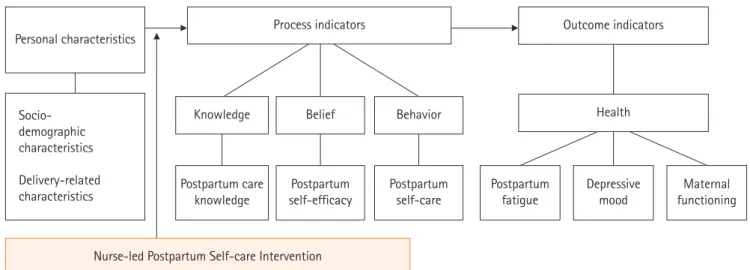
Interventions: The conceptual framework for this study was based on the concepts of SE as a component of social cognitive theory [16] and linked to health as the final outcome. postpar- tum SE has been shown to positively affect mothers’ ability to perform self-care behaviors and promote postpartum health [17,18]. A modified conceptual framework for postpartum SE was conceptualized for this study in three constructs (Figure 1):
(1) personal characteristics (sociodemographic and delivery-re- lated characteristics) was postulated to influence (2) process in- dicators (postpartum care knowledge, postpartum SE, and post- partum self-care); and (3) outcome indicators (PPF, depressive mood, and maternal functioning). The NLPPSC program was posited to affect process and outcome variables. The NLPPSC program built on the four sources of SE, enactive mastery, vicari- ous experience, verbal persuasion, and physiologic arousal, and ultimately aimed to alleviate PPF and depressive mood, and pos- itively affect maternal functioning.
Sample size: It was calculated by using G*Power, with effect size dz 0.5; α of 0.05; and Power (1-β error probability) 0.95, which showed a minimum of 27 participants in each group. The expect- ed attrition rate was estimated at range 15%–25% due to possibil- ity of drop out in 2 and 6 weeks post intervention [3]. Therefore, 68 participants were recruited allocated to the experimental
Figure 1. Conceptual framework of the study.
Postpartum
fatigue Depressive
mood Maternal
functioning Outcome indicators
Health Knowledge
Postpartum care
knowledge Postpartum self-efficacy
Belief
Postpartum self-care Behavior Process indicators
Nurse-led Postpartum Self-care Intervention Personal characteristics
Socio- demographic characteristics Delivery-related characteristics
(n= 34) or control groups (n= 34).
Instruments
The questionnaire set consisted of 104 items, which took around 20–30 minutes to answer. Permission to use instruments was ob- tained from the original authors unless available for free access.
For instruments not available in Bengali, translation-back transla- tion was done and independently reviewed by Bangladesh ex- perts (English lecturer and obstetrician) to check for appropriate meaning and to ensure the equivalence of the two versions.
Outcome indicators Postpartum fatigue
The 10-item Postpartum Fatigue Scale [19] measured on a 4 point Likert scale (1= not at all; 4 = all the time) was used. It consists of physical fatigue (four items) and mental fatigue (six items) dimensions. Total summed scores can range from 10–40, and higher scores indicate greater fatigue. Internal consistency was .77 in the original study [19] and in this study the Cron- bach’s alpha ranged from .35 to .82 across the three time points.
Depressive mood
Depressive mood was measured by using the 10-item Edinburgh Postnatal Depression Scale [20]. A 4-point Likert (0–3) is used and higher summed scores possible (range, 0–30) indicate greater depressive symptoms. In Western countries a cutoff of greater than 12 or 13 indicates the need for professional aid [20]. Due to cultural stigmatization towards postpartum depression in Bangla- desh [21] and noting prior research [3], 13 or above was used as the cutoff for this study. Cronbach’s alpha was .86 in the original study [20], .70 in a prior survey of Bangladesh new mothers [22], and ranged from .48 to .56 across the three time points in this study.
Maternal functioning
Postpartum maternal functioning was measured using the Barkin Index of Maternal Functioning (BIMF) [23]. The BIMF is a 20 item 7 point Likert scale (0 strongly disagree, 6 strongly agree) and scores are summed (possible range, 0–120), with higher scores indicating higher postpartum maternal functioning. The Cronbach’s alpha of this tool was .87 at development [23] and ranged from .53 to .89 across the three time points in this study.
Process indicators Postpartum self-care
Denyes’(1990) 8-item Self-Care Practice Instrument (DSC- PI-90) [24] was used as a general measure of self-care actions
that meet universal self-care requisites, and items were adapted for the postpartum context. A 7 point Likert (1= strongly dis- agree, 7= strongly agree) is used and items are summed with a total possible range of 18–126 points. Higher scores reflect high- er levels of self-care behavior. Cronbach’s alpha coefficients have been reported as between .82 to .89 [24] and ranged from .47 to .86 across the three time points in this study.
Postpartum self-efficacy
Postpartum SE was measured by modifying the Postpartum Management Self Efficacy Tool [25]. From the original 16 items, one item (sitz bath use) was deleted, as it was not relevant for use in Bangladesh context. The 15 items were scored on a 4 point Likert scale (1= not confident at all, to 4= very confident) and higher summed scores indicated higher levels of postpartum SE (possible range,15–60). Cronbach’s alpha was .90 at develop- ment [25] and ranged from .33 to .93 across the three time points in this study.
Postpartum Care Knowledge
The 20-item Postpartum Self-Care Knowledge scale [26] was modified, by deleting one item on sitz bath knowledge that was not relevant to Bangladesh context. Only correct answers re- ceived a score and scores for the 19 items were added to obtain a total score (possible score range, 0–19). Higher scores indicated high level of postpartum care knowledge. The Kuder Richard- son-20 of this instrument in the original study was .76 at baseline and .73 for posttest [26] and for this study ranged from .55 to .85 across the three time points.
Personal characteristics
Personal characteristics consisted of socio-demographic charac- teristics (five items) and delivery-related characteristics (seven items), derived from the literature.
Procedures
The data were collected by the first author with help from two trained local research assistants (RA), from May to December, 2017. The data were collected at baseline, postpartum 2 weeks, and postpartum 6 weeks.
1) Baseline (between postpartum day 1–6): Participants returned
completed questionnaires in a collection box placed in the ward
and the researcher checked for any missing items. Phone number
were obtained for the purpose of further contact. The posttest 1
questionnaire was provided along with a stamped envelope and
participants were requested to complete the second questionnaire
and send it via mail 2 weeks later. The researcher provided a card marked with the code number to show the RA at posttest to avoid unnecessary exposure of personal information.
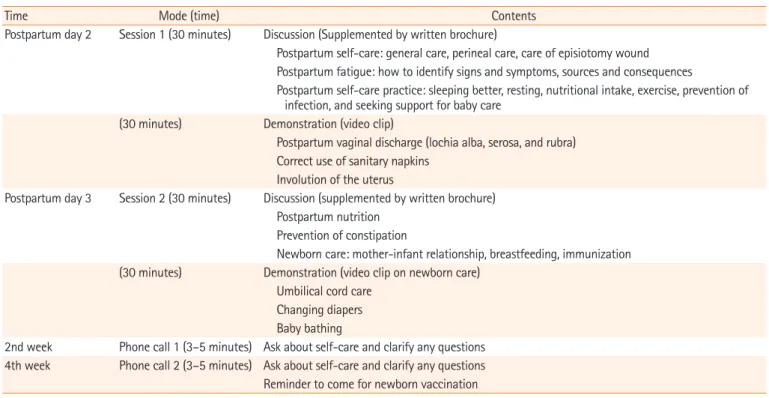
The NLPPSC was developed following the ADDIE model [27], according to the following phases (Supplementary materi- al): Analysis phase: Data on postpartum care and interventions from WHO, UNFPA, World Bank, and a literature review was done using PubMed, CINHAL, EMBASE, Cochrane, PsycInfo, and Google Scholars database, for English publications from 2000–2017. Eleven related articles were identified but none were found for Bangladesh. Interviews with three first-time postpartum mothers in Bangladesh, who were purposively selected, explored actual postpartum needs and wishes for aid from maternal nurses or midwives, especially relating to practicing self-care behaviors at home. Participants noted at least one home visit and/or telephone calls could bridge the connection with maternal nurse/midwives and mothers and would be helpful to carry out effective postpar- tum self-care. Design phase: Program components built on using SE sources [28] of verbal persuasion (face-to-face discussion with interpretation of the participants’ responses, supplemented by a brochure containing postpartum care information). SE enactive mastery and vicarious experiences were designed as providing op- portunity for participants to demonstrate skills and role play how to perform. The intervention period was drafted to be provided in the hospital before discharge, as two 30-minute sessions to ac- commodate maternal attention span to avoid fatigue. The initial
program consisted of two phone calls at 2nd and 4th weeks to stimulate mothers to perform self-care actions and to clarify any ambiguities. Development phase: Program content and format were reviewed by an expert panel in Bangladesh (n= 5) consist- ing of 2 obstetricians, 1 head nurse of the postpartum unit, and 2 women’s health nursing faculty. Panel consensus were obtained with criteria of CVI > 85% for each item (mean CVI was .94).
Timing for the second follow-up was modified to occur at 6 weeks. Implementation & evaluation phase: The program was pro- vided to 2 postpartum mothers by convenience sampling at DMCH, using the same inclusion/exclusion criteria for the main study. Based on participant suggestions, we determined a larger space was necessary for the small groups and decided to add us- ing a model placenta and uterus and a newborn doll. Thus, the NLPPSC program was finalized.
The experimental group received the finalized NLPPSC (Table 1), face-to-face education in four 30-minute sessions (small group format of 3–5 mothers) over 2 days during hospital stay, and rein- forcement by phone calls (duration 3–5 minutes each) at postpar- tum 2 weeks and 4 weeks. The control group received the hospi- tal’s standard care (5-minute verbal instruction at the time of hos- pital discharge).
2) Posttest 1 (postpartum 2 weeks): The response rate for the mailed questionnaires was 76.4%.
Table 1. The nurse-led postpartum self-care program
Time Mode (time) Contents
Postpartum day 2 Session 1 (30 minutes) Discussion (Supplemented by written brochure)
Postpartum self-care: general care, perineal care, care of episiotomy wound Postpartum fatigue: how to identify signs and symptoms, sources and consequences
Postpartum self-care practice: sleeping better, resting, nutritional intake, exercise, prevention of infection, and seeking support for baby care
(30 minutes) Demonstration (video clip)
Postpartum vaginal discharge (lochia alba, serosa, and rubra) Correct use of sanitary napkins
Involution of the uterus
Postpartum day 3 Session 2 (30 minutes) Discussion (supplemented by written brochure) Postpartum nutrition
Prevention of constipation
Newborn care: mother-infant relationship, breastfeeding, immunization (30 minutes) Demonstration (video clip on newborn care)
Umbilical cord care Changing diapers Baby bathing
2nd week Phone call 1 (3–5 minutes) Ask about self-care and clarify any questions 4th week Phone call 2 (3–5 minutes) Ask about self-care and clarify any questions Reminder to come for newborn vaccination
3) Posttest 2 (postpartum 6 weeks): Mothers were contacted to identify date and location of the EPI center they would visit for infant vaccination. A trained research assistant met the participant and checked the card’s code number, provided the questionnaire, which was completed on site. Upon completion a gift voucher of Bangladeshi taka (BDT; approximately 4 US dollars) was given as a token of appreciation for participation. For the control group, a postpartum self-care brochure was provided at the end of data collection along with gift voucher. The response rate of partici- pants was 83.8%.
Data analysis
The data were analyzed by IBM SPSS statistics version 21 (SPSS Inc., chicago, IL, USA). Descriptive statistics, bivariate statistics t-test, chi-square was used to examine homogeneity of variables, and paired sample t-test, and independent sample t-test were used to examine differences within and between groups. Due to attri- tion rate in follow up (23.5% at 2 weeks, 16.1% at 6 weeks) lin- ear mixed model (LMM) was used to adjust for covariates and examine the treatment effects over three time periods. LMM was used for repeated measurements to explore the change in PPF, depressive mood, and maternal functioning between base- line and at 2 weeks; and baseline and 6 weeks while adjusting age, living status, and family income for baseline differences in the two groups. The LMM is a powerful advanced statistics tool that can estimate changes over time despite missing data points of a subsample, and thus, data from all 68 participants were in- cluded for analysis.
Results
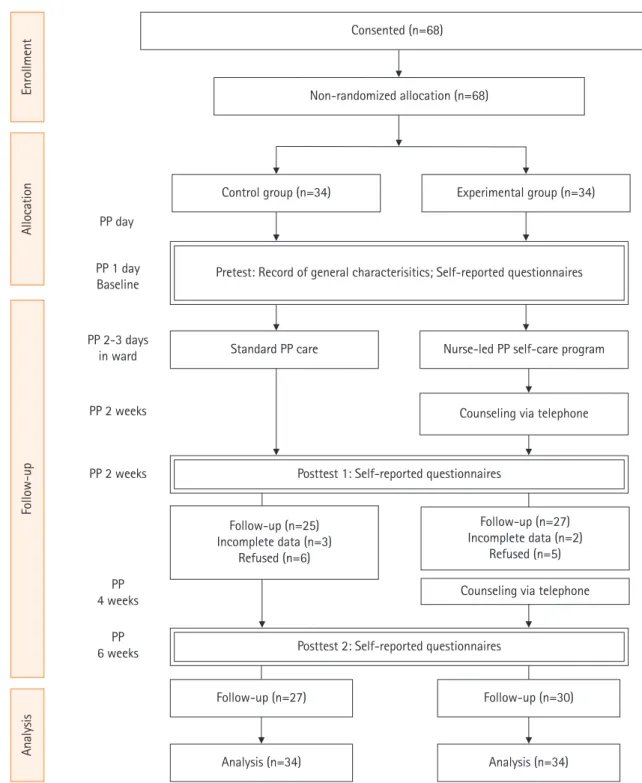
Participation flow: Flow of participation through each stage is presented in Figure 2.
Recruitment: Data from the control group were collected from May to June 2017, followed by the experimental group from July to September 2017.
Baseline data
The average age of the participants was 20.71 years old. Most lived with their husbands without extra family members (61.8%), and did not work out of the home (85.3%). Monthly family income averaged 25,155 BDT (approximately 300 US dollars). The aver- age gestational age at delivery was 37 weeks, and newborn condi- tions were generally good (APGAR scores of 8 and more, 92.6%).
Forty-seven percent had participated in at least one parenting preparation class, and all had at least one antenatal care (ANC)
visit, of whom 52.9% had received at least three ANC, the mini- mum number recommended by WHO.
The experimental group was slightly older (t=2.90; p <.01), and more participants tended to live with their husband, including other family members (X
2=3.98; p <.05). They also showed slightly higher income compared to the control group (t= –2.38;
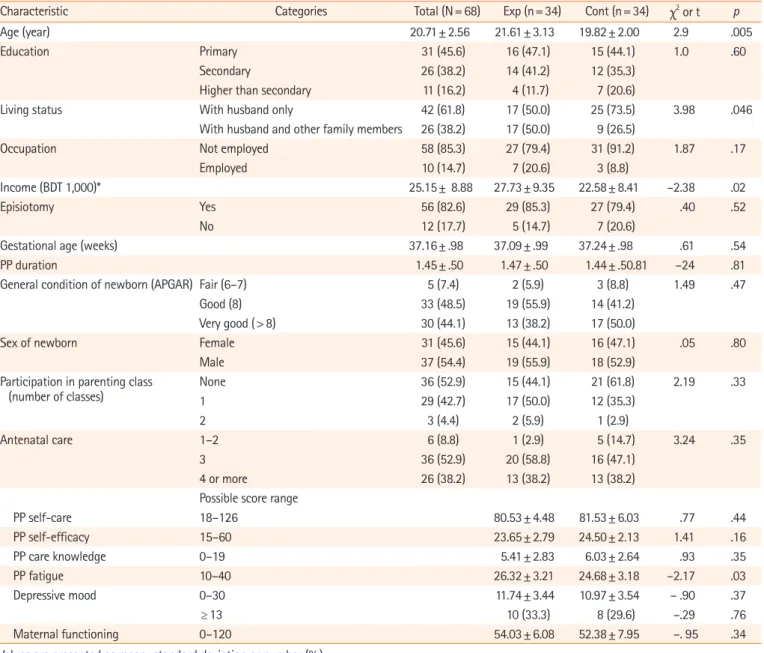
p<.01). There were no differences in delivery-related information or main variables between the experimental and control groups (Table 2).
Baseline equivalence
For baseline PPF, both the experiment (mean±SD, 26.32±3.21) and control groups (24.68±3.18) showed a moderate level and the experiment group showed statistically significantly higher fa- tigue (t= –2.17, p<.05). Depressive mood (cutoff of ≥13) was noted in both the experimental (33.3%) and control group (29.6%), although there were no statistically significant differences (χ
2= –.29; p=.76). The level of postpartum maternal functioning was slightly less than midpoint, and postpartum maternal function- ing was not significantly different between the groups.
Differences from baseline to 2 weeks
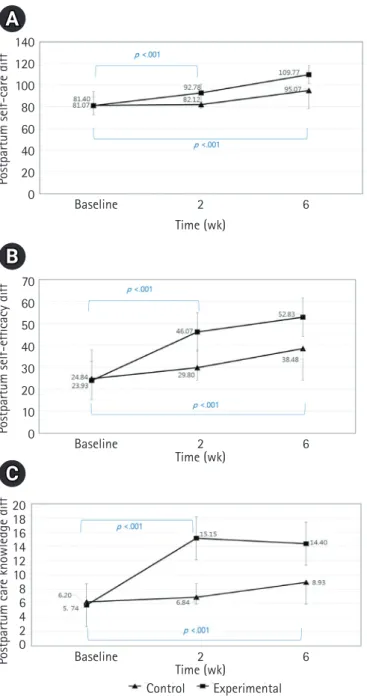
The process variables, postpartum self-care, postpartum SE, and postpartum care knowledge are conceptually meaningful for ef- fects on the output variables. Within the experimental group be- tween baseline and postpartum 2 weeks, all variables showed sig- nificant improvement, while for the control group, only postpar- tum SE was improved (t= –9.08, p<.01). For between group dif- ferences at postpartum 2 weeks, postpartum self-care (M
dif10.98;
t=9.49, p<.01), postpartum SE (M
dif17.18; t=18.30, p<.01) and postpartum self-care knowledge (M
dif8.76; t=11.08, p<.01) of the experiment group were significantly higher compared to the control group (Figure 3).
Differences from baseline to 6 weeks
From baseline to postpartum 6 weeks, the experimental group
showed significantly greater differences (p<.01) compared to the
control group (Figure 3). For within group differences, there were
significant mean differences in all three variables for both the ex-
perimental and control groups: For example, the experimental
group’s postpartum self-care (M
dif15.28; t= 10.02, p<.01), post-
partum SE (M
dif15.04; t= 19.72, p<.01) and postpartum care
knowledge (M
dif5.82; t= 6.91, p<.01) levels all improved by 6
weeks. The same pattern was found for the control group, which
may suggest that by 6 weeks after childbirth, a natural improve-
ment is likely for mothers in general.
Figure 2. Flowchart of participants.
PP: postpartum.
Consented (n=68)
Non-randomized allocation (n=68)
Analysis (n=34) Analysis (n=34)
AnalysisFollow-upAllocationEnrollment
Post-test 1: Self-reported questionnairesPosttest 2: Self-reported questionnaires PP day
PP 1 day Baseline
PP 2-3 days in ward
PP 2 weeks
PP 2 weeks
PP 4 weeks
PP 6 weeks
Follow-up (n=25) Incomplete data (n=3)
Refused (n=6)
Follow-up (n=27) Follow-up (n=30)
Counseling via telephone Control group (n=34) Experimental group (n=34)
Standard PP care Nurse-led PP self-care program Pretest: Record of general characterisitics; Self-reported questionnaires
Post-test 1: Self-reported questionnairesPosttest 1: Self-reported questionnaires
Follow-up (n=27) Incomplete data (n=2)
Refused (n=5) Counseling via telephone
Effectiveness of the intervention over time
For the LMM analysis to test the effectiveness of NLPPSC inter- vention on PPF, depressive mood, and postpartum maternal functioning, the covariates that showed statistical significance, i.e., maternal age, living status, and monthly income, were adjust- ed in the equation. In addition, conceptually meaningful vari- ables of this study, i.e., postpartum self-care behavior, postpartum
SE, and postpartum self-care knowledge, were also loaded as co- variates (Table 3).
Effects on PPF: The mothers who received the NLPPSC inter-
vention showed statistically significant levels of slightly higher fa-
tigue (β= 1.45, SE = .72, t= 1.98, p<.05) over time when com-
pared to the control. However, the treatment effects of NLPPSC
intervention group at 6 weeks postpartum was statistically signif- icant in decreased fatigue (β=–6.17, SE= 1.81, t=–3.39, p<.01) compared to the control group.
Effects on depressive mood: The estimated treatment effects did not find significant changes related to the NLPPSC interven- tion for depressive mood compared to the referent group.
Effects on postpartum maternal functioning: For postpartum maternal functioning, the estimated treatment effects showed that living with husband but not with other family members, was statistically significant (β= 4.44, SE= 1.30, t= 3.39, p<.01) com-
pared to women who also lived with other family members.
Among other variables, more postpartum self-care knowledge was also statistically significant (β= .37, SE= .18, t= 2.03, p<.05) for maternal functioning for the NLPPSC participants. Maternal functioning at both 2 weeks (β = 12.76, SE = 1.55, t = 8.20, p <.01) and 6 weeks (β =24.54, SE =3.12, t =7.84, p <.01) showed statistically significant improvement over time. Finally, the treatment effects at 6 weeks were statistically significant (β = 13.72, SE = 3.67, t = 3.73, p <.01) in increased maternal functioning in the experimental group compared to the control group.
Table 2. Homogeneity testing of participants (N=68)
Characteristic Categories Total (N= 68) Exp (n= 34) Cont (n= 34)
χ
2 or t pAge (year) 20.71± 2.56 21.61± 3.13 19.82± 2.00 2.9 .005
Education Primary 31 (45.6) 16 (47.1) 15 (44.1) 1.0 .60
Secondary 26 (38.2) 14 (41.2) 12 (35.3)
Higher than secondary 11 (16.2) 4 (11.7) 7 (20.6)
Living status With husband only 42 (61.8) 17 (50.0) 25 (73.5) 3.98 .046
With husband and other family members 26 (38.2) 17 (50.0) 9 (26.5)
Occupation Not employed 58 (85.3) 27 (79.4) 31 (91.2) 1.87 .17
Employed 10 (14.7) 7 (20.6) 3 (8.8)
Income (BDT 1,000)* 25.15± 8.88 27.73± 9.35 22.58± 8.41 –2.38 .02
Episiotomy Yes 56 (82.6) 29 (85.3) 27 (79.4) .40 .52
No 12 (17.7) 5 (14.7) 7 (20.6)
Gestational age (weeks) 37.16± .98 37.09± .99 37.24± .98 .61 .54
PP duration 1.45± .50 1.47± .50 1.44± .50.81 –24 .81
General condition of newborn (APGAR) Fair (6–7) 5 (7.4) 2 (5.9) 3 (8.8) 1.49 .47
Good (8) 33 (48.5) 19 (55.9) 14 (41.2)
Very good (> 8) 30 (44.1) 13 (38.2) 17 (50.0)
Sex of newborn Female 31 (45.6) 15 (44.1) 16 (47.1) .05 .80
Male 37 (54.4) 19 (55.9) 18 (52.9)
Participation in parenting class
(number of classes) None 36 (52.9) 15 (44.1) 21 (61.8) 2.19 .33
1 29 (42.7) 17 (50.0) 12 (35.3)
2 3 (4.4) 2 (5.9) 1 (2.9)
Antenatal care 1–2 6 (8.8) 1 (2.9) 5 (14.7) 3.24 .35
3 36 (52.9) 20 (58.8) 16 (47.1)
4 or more 26 (38.2) 13 (38.2) 13 (38.2)
Possible score range
PP self-care 18–126 80.53± 4.48 81.53± 6.03 .77 .44
PP self-efficacy 15–60 23.65± 2.79 24.50± 2.13 1.41 .16
PP care knowledge 0–19 5.41± 2.83 6.03± 2.64 .93 .35
PP fatigue 10–40 26.32± 3.21 24.68± 3.18 –2.17 .03
Depressive mood 0–30 11.74± 3.44 10.97± 3.54 – .90 .37
≥ 13 10 (33.3) 8 (29.6) –.29 .76
Maternal functioning 0–120 54.03± 6.08 52.38± 7.95 –. 95 .34
Values are presented as mean±standard deviation or number (%).
Cont: control group; Exp: experimental group; PP: postpartum.
*Bangladeshi taka (BDT) 1,000 is approximately 12 US dollars.
Ancillary analyses: There was no ancillary analysis.
Discussion
Effectiveness of the NLPPSC intervention
The NLPPSC significantly increased scores in process indicators, postpartum care knowledge, postpartum SE, and postpartum self- care behavior; and postpartum fatigue and maternal functioning was improved among the outcome indicators. As there were no intervention studies found in Bangladesh to directly compare with
this study, studies from others countries were compared in the following discussion. Discussion on outcome indicators are pre- sented first, as they were the main study hypotheses.
NLPPSC effects on postpartum fatigue
Fatigue decreased over time in the experimental group compared to the control. Among the time points (within 2 days after deliv- ery, postpartum 2 weeks, and postpartum 6 weeks), the decrease in fatigue at postpartum 6 weeks was statistically significant in the experimental group. This finding is similar with previous studies that used a psycho-educational program with telephone support to manage PPF with a RCT design [2,3]. Both studies encouraged mothers to prioritize their tasks, and plan for and en- gage in postpartum self-care behaviors. Although this study found statistically significant improvement in SE at postpartum 2 weeks and postpartum 6 weeks in the NLPPSC group, LMM analysis did not find direct influences of SE for fatigue. This sug- gests indirect effects of SE on fatigue, which may need to be fur- ther explored in future studies. This study found a mid-level of fatigue at baseline. Although using a different measurement of fa- tigue, a prior survey of new mothers in Bangladesh reported a lower mean fatigue score [22]. This may be related to measure- ment time or differences in sample characteristics, but further studies are needed to clarify.
NLPPSC effects on depressive mood
The NLPPSC intervention was not statistically significant in de- creasing depression scores, when treated as a continuous variable.
This finding is similar to a RCT study of a nurse-led postpartum discharge education program to reduce postpartum depressive mood, which did not find differences at 6 weeks nor at 3 months [29]. In contrast, Giallo’s study (2014) [3] used a fatigue man- agement booklet, a home visit, and three telephone support ses- sions led by a professional, and was effective in decreasing post- partum depressive mood after 6 weeks. Differences might be due to the intensity and number of contacts, as the NLPPSC did not include home visits and had one less telephone contact. Another RCT with first-time mothers [30] reported that the treatment group (12.5%) had lower depression than the control group (25%) at 6 months postpartum. This suggests the possibility that NLPPSC participants may have shown effects over a longer peri- od of time, assuming continued practice of self-care.
This study found a high proportion of mothers with postpar- tum depression (33% in the intervention group) at 2–3 days with- in delivery. Of these mothers, 82.4% had received an episiotomy, which may be related to their perception of fatigue. At 6 weeks, the control group showed a high proportion of postpartum de-
140120 100 80 60 40 20 0
70 60 50 40 30 20 10 0
2018 1614 1210 86 42 0
Postpartum self-care diffPostpartum self-efficacy diffPostpartum care knowledge diff
Baseline
Baseline
Baseline
2
2
2 Time (wk)
Time (wk)
Time (wk)
6
6
6 Control Experimental
A
B
C
Figure 3. Differences (diff) in postpartum self-care (A), self-
efficacy (B), and self-care knowledge (C) between the two groups
over time.
pression (n=9, 33% with scores ≥ 13), much higher than 9% re- ported in a previous study of Bangladeshi women at 6–8 weeks postpartum [31]. This may be due to demographic differences in the two studies. The previous study involved 100 multiparous postpartum mothers with mean age 25.5 years, of whom 54% had one child, whereas this study mostly included young first-time mothers, who may have been more sensitive to depressive mood.
When analyzing depression based on cut off categories, the pattern of depression over the three time points (up to 6 weeks) in mothers in the NLPPSC group steadily decreased, resulting in none at ≥ 13 at 6 weeks, which is in contrast to the pattern of in- creased depression in the control group over time (33% at ≥ 13 at 6 weeks). Future studies are needed to employ the NLPPSC program with more contact intensity and may be needed to be followed up for longer periods, to more accurately manage de- pressive moods of new mothers in Bangladesh.
NLPPSC effects on maternal functioning
In maternal functioning, maternal age and family income had a statistically significant association with increased maternal func- tioning. Women living with their husband only, reported signifi- cantly higher maternal functioning than women also living with other family members. As it happens that after childbirth in Ban- gladesh, other relatives will often come to support the new moth- er or she will stay at her parents’ home for some time to aid post- partum recovery, the postpartum living status may temporarily change. Thus, usual living status may not offer clear understand- ing of how it may be related to postpartum maternal functioning.
The process indicator postpartum self-care knowledge was statis-
tically significantly associated with increasing maternal function- ing over time. The intervention was significantly effective in in- creased maternal functioning at 2 weeks and also at 6 weeks fol- low-up. These findings are supported by findings from the litera- ture. For example, a postpartum educational intervention for first- time mothers consisting of four sessions and phone calls found improvement in maternal functioning status and self-confidence after 8 weeks [7]. In addition, another study [23] found that post- partum knowledge and efficacy influenced maternal functioning.
NLPPSC effects on process indicators
For the process indicators, self-care behavior, SE, and postpar- tum care knowledge showed statistically significant increases at both postpartum 2 weeks and 6 weeks, compared to baseline lev- els. This finding is similar to studies such as a nurse-led self-care intervention for primiparas after birth [32] and a prenatal and postnatal self-care educational program focused on perineal care, nutrition, and sexual activities [17], which found improvement in postpartum self-care knowledge and self-care efficacy.
Overall, the participants in this study were young age (average 20.71 years) and had completed primary to secondary level edu- cation (83.8%), which may have helped them to understand the NLPPSC content. In addition, as the majority of the mothers (85.3%) did not work out of the house they may have had suffi- cient time to perform self-care behaviors at home.
As such, this NLPPSC intervention offers implications for nursing practice, theory development, and research. In practice, maternal nurse caring for new mothers in Bangladesh should provide psycho-educational support using strategies for fatigue
Table 3. Estimated effects of the nurse-led postpartum self-care intervention (N=68)Parameter Postpartum fatigue Depressive mood Postpartum maternal functioning
Estimate SE t Estimate SE t Estimate SE t
Intercept 22.71 5.21 4.36*** 15.77 5.87 2.68** 37.2 11.96 3.11**
Age –.16 .09 –1.64 .136 .15 .93 .45 .27 1.66
Lives with husband only† –.23 .44 –.52 –.88 .70 –1.26 4.44 1.30 3.39**
Income –4.06 2.62 –.015 –7.39 4.08 –1.80 2.88 7.62 .37
Self-care behavior .08 .05 1.69 –.06 .05 –1.31 –.04 .10 –.39
PP self-efficacy –.05 .08 –.66 .00 .08 .05 .01 .17 .03
PP self-care knowledge .02 .08 .25 .06 .08 .80 .37 .18 2.03*
Experimental group† 1.45 .72 1.98* 1.55 .89 1.74 1.62 1.74 .93
PP 2 weeks† .47 .83 .56 .67 .71 .94 12.76 1.55 8.20***
PP 6 weeks† –1.66 1.52 –1.08 –.51 1.46 –.35 24.54 3.12 7.84***
PP 2 weeks × experimental† –.99 1.94 –.50 –.60 1.84 –.32 4.74 3.94 1.20
PP 6 weeks × experimental† –6.17 1.81 –3.39* –2.29 1.71 –1.33 13.72 3.67 3.73***
†References were living status (lived with husband and other family members), group (control), PP weeks (baseline), PP weeks × group (same week × control).
PP: Postpartum.
*p<.05, **p<.01, ***p<.001.