JESK
http://jesk.or.kr eISSN:2093-8462A Study on the Applicability of PTS to Establish Standard Time for Agricultural Work of Korea
Hee Sok Park
Department of Industrial Engineering, Hongik University, Seoul, 121-791
Corresponding Author Hee Sok Park
Department of Industrial Engineering, Hongik University, Seoul, 121-791 Mobile : +82-10-2389-1473 Email : [email protected]
Received : March 10, 2015 Revised : March 25, 2015 Accepted : April 02, 2015
Objective: This study aims to analyze qualitatively if PTS methods are applicable to the agricultural works of Korea.
Background: Many studies on setting standard time have been performed for manufacturing and service industries, not many studies on agricultural work have been carried out domestically and internationally.
Method: MTM, MOST, Work Factor, MODAPTS were applied to some agricultural works, and limitations of each method were found out.
Results: MTM was found to be more applicable than other methods, except for mental works.
Conclusion: In general, many Korean agricultural works need squat postures, which are not taken into account in most of PTS methods. Continuous observation with stop watch is recommended for establishing the standard time for the agricultural works of Korea.
Application: The information drawn from this study would be helpful to the farmer safety assurance system being established by Korean government.
Keywords: Agricultural work, Standard time, PTS, Ergonomic factors
Copyright@2015 by Ergonomics Society of Korea. All right reserved.
○ccThis is an open-access article distributed under the terms of the Creative Commons Attribution Non-Commercial License (http://
creativecommons.org/licenses/by-nc/3.0/), which permits unrestricted non-commercial use, distribution, and reproduction in any medium, provided the original work is properly cited.
1. Introduction
Time study started by Frederick Taylor's measurement of work with a stop watch in 1880. Time study is the field addressing the technique to determine standard time, namely the time required to perform work in normal speed by a skilled worker (Mundel and Danner, 1994). In other words, the technique is to find out unnecessary factors and time in carrying out work, to improve the work, and to set the proper time required for the work.
More specifically, standard time is defined as the time required to carry out work in normal speed by a worker having enough skills to perform a certain work under given working conditions and environment (Niebel and Freivalds, 1999). Standard time is the most basic and important data to determine fair daily work amount and establish a schedule plan. Standard time also becomes the basis of worker's wage and incentive.
There are two methods to measure working time: one is to measure working time using a stop watch by observing the work concerned, and the other is predetermined time standard (PTS), through which standard time can be determined without measuring working time. PTS is to classify basic motions that a human can take, and predetermine time required for each motion.
Therefore, if one knows what necessary motions are, when a work is performed, the standard time of the work can be determined by adding up the required time using without measuring time with a stop watch. PTS can be used to determine the standard time of currently carried out work, however, it has a merit that PTS can be used to predict new working time.
PTS can be standard data that summarizes the required time of basic motion, based on long-term research results. Since A. B.
Segur released motion-time-analysis (MTA) for the first time in 1924, various PTS methods were developed. The PTS methods currently used in Korea include WF (work factor), MTM (methods-time measurement), MOST (Maynard operation sequence technique), MODAPTS (modular arrangement of predetermined time standards).
Although, many studies on standard time setting have been performed for manufacturing and service industries, not many studies on agricultural work have been carried out domestically and internationally. Actually, it is difficult to find out studies on standard time determination of agricultural work that applied PTS methods. In this regard, this paper introduces representative PTS methods in brief, and qualitatively reviews whether the standard time of Korean agricultural work can be set with PTS methods targeting house crops.
2. Procedure of Establishing Standard Time using PTS
2.1 WFIn WF, all types of works are classified into one of eight basic factors - transport, grasp, pre-positioning, assemble, use, disassemble, mental process and release, and time with four variable factors affecting working time by basic factor is determined. The variable factors are motion body part, motion distance, weight or resistance and artificial adjustment. Namely, in WF, how much specific body part moves is recorded, and working time is determined, according to the degree and weight of work adjustment in terms of work performed by a worker. Especially, motion body part and motion distance are called basic motion, and weight or resistance and artificial adjustment are called work factor. The body part is divided into seven parts, namely, finger or hand, arm, lower arm, torso, foot, leg and head, and time value is set by motion distance or by motion size. In addition, time on walking and brain work is presented by separate table, respectively.
2.2 MTM
MTM-1, the most basic type of MTM, divides human's basic motions into reach, move, turn, grasp, apply pressure, position, release, disengage and eye time. And, it provides time value, according to each basic motion's movement distance, situation, motion type and weight. In addition to basic motions, motions relevant with body, leg and foot are separately presented.
2.3 MOST
The most basic type, basic MOST, classifies general movement and controlled movement, according to object's movement type, and also applies tool use, as necessary. General movement is to move an object freely in space, and when the object contacts other objects or is limited by other objects, such a case is excluded. A worker grasps an object by bending body, and places it on another location, which is a type often occurring in industrial site.
In general movement, four variables, namely, A (action distance), B (body motion), G (gain control) and P (placement), and detailed
values of each variable are presented in each table. The procedures of general movement are getting, putting and returning.
Getting consists of A, B and G. Putting consists of A, B and P, and returning consists of A. The general movement procedure of an object generally occurring in industrial site can be described as AGB, ABP and A like the work grasping a part from a box and putting it on a working table or putting it in a box.
Controlled movement means to move an object attached to another object, according to controlled path, like pushing an object placed on a working table or turning a handle. If an object to move, away from other objects, can move through free path in space, this becomes a general movement. Controlled movement includes seven variables, A, B, G, M (movement controlled), X (process time), I (align) and A, and classification of each variable and detailed values are presented in table.
2.4 MODAPTS
MODAPTS divides motion into movement activity, terminal activity and other activities. For 21 detailed activities, time value (unit: MOD = 0.129 seconds) is presented. Movement activity (M) is reaching empty hand or moving an object, terminal activity (G or P) is grasping or putting an object. Therefore, the activity analysis of MODAPTS is the combination of movement activity and terminal activity, and indicates basic activity (MGMP). Time value is granted to each activity, and activity combination is made by adding up each motion's time value. Therefore, working time can be calculated more easily than other PTS methods, if the body part used, activity and weight are identified.
3. Method
3.1 ParticipantsThis study targeted three men in their 60s, three women in their 60s and four foreign workers in their 20s, who were engaged in agriculture.
3.2 Tasks
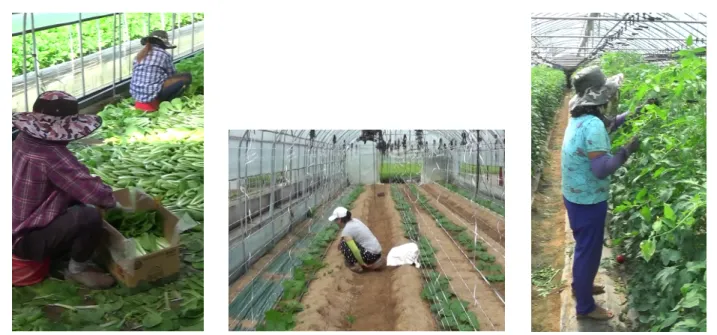
There are various types of agricultural work, according to subject and working period. This study targeted winter grown Chinese cabbage harvesting (Figure 1), zucchini double shoot picking (Figure 2), tomato support erecting and cording (Figure 3) and pollen selection and replacing of horticultural farm.
3.3 Procedure
The above-mentioned types of agricultural work were videotaped, and the weight and size of the crops were measured. This study analyzed using process degree signs (Barnes, 1980), and time values were calculated using various PTS methods.
4. Results
As a result of analyzing target works using several PTS methods, this study described typical cases for which time values could not be calculated.
In WF, the time values of complex work using hands and work to put down an object were not presented, and therefore, it had some difficulty to apply to agricultural work.
In MOST, the time value was presented on the basis of the number of footsteps for mainly lower body using work, and other motions of the lower body were not considered. Many errors occurred in measuring time value with only the number of footsteps in the work of agriculture, where various types of movements occur.
In MODAPTS, works using upper body were diversely distributed, the lower body using works were not. Therefore, many limitations occurred to application.
Generally, PTS methods are divided, focusing on upper body. In this regard, lower body motions are not divided in detail, and thus squat motion frequently found in Korean agricultural work does not exist.
5. Conclusion
Among the PTS methods that became the analysis subjects in this study, the applicability of MTM was relatively higher. Other methods did not present enough time values for squat work or work using lower body and complex hand motions. However, if brain work is involved, the limitation of application was found in MTM as well. In this regard, continuous observation method using a stop watch is recommended to determine standard time of agricultural work, rather than PTS methods.
Irrelevant of the method type adopted upon determining standard time, a performance rating process should be conducted.
To this end, the selection of standard workers from worksite is an essential stage. Although, standard workers can be selected in commercial agriculture, where many workers are inputted in the same work, it can be impossible in small scale agriculture, where small number of labor force is inputted. Actually, a caution is needed in that realistic restrictive conditions, under which standard workers are difficult to be found, exist in Korea's agricultural reality.
The Korean government tries to adopt a farmer safety assurance system. In doing so, standard time is necessary as basic data, and a proper method needs to be applied for standard time setting. There are many limitations for the methods on time research,
Figure 2. Zucchini double shoot picking Figure 1. Chinese cabbage
harvesting
Figure 3. Tomato support erecting and cording
which have been traditionally applied to manufacturing industry, to be generally applied to Korean agricultural work, where atypical factors or lower body is used a lot or there are many squat working postures.
Many ergonomic studies on musculoskeletal disorders and so forth have been performed in agriculture so far (Lee et al., 2010).
However, studies on the standardization of agricultural work and standard time setting are relatively insufficient domestically and internationally. Therefore, further studies for Korean situation are urgently needed now.
Acknowledgement
This work was supported by Rural Development Administration (PJ010079052015).
References
Barnes, R.M., Motion and Time Study: Design and Measurement of Work, 7th ed., John Wiley & Sons, 1980.
Lee, K.S., Kim, H.C., Chae, H.S., Kim, K.R., Lee, S.J. and Lim, D.S., A study on agricultural safety technology for ergonomic intervention in farm-work, Journal of the Ergonomics Society of Korea, 29(2), 225-239, 2010.
Mundel, E. and Danner, D.L., Motion and time study improving productivity, 7th edition, Prentice-Hall, 1994.
Niebel, B. and Freivalds, A., Methods, Standards, and Work Design, 10th edition, McGraw-Hill, 1999.
Oberholtzer, J.W., The application of motion and time study technique to certain agricultural enterprises, Journal of Farm Economics, 27(3), 702-704, 1945.
Author listings
Hee Sok Park: [email protected]
Highest degree: Ph.D from The University of Michigan
Position title: Professor, Department of Industrial Engineering, Hongik University
Areas of interest: Work-related musculoskeletal disorders, human vibration, work analysis and design