한국암반공학회 국제학술회의
2008 / 2008.10.21 - 10.23
Analysis for Mechanism of Rockfall on Slope Using Discrete Element Method
Hyun-Woo Ji (Master's course, Geosystem Engineering College, Kangwon National University, Chuncheon), Sung O. Choi (Professor, Geosystem Engineering College, Kangwon National University, Chuncheon)
1. Introduction
The rapid increase of the development of mountain region from the frequent occurrence of typhoon and regional downpour by the recent earthshock and the advance of industry is generating a few of slope-disasters. Slope-disaster results in the severe economic losses as well as the direct causalities. The losses from slope breaking are being gradually increased by the development of instable slope along with the economical advance. The landslide may not only give the damages on habitation site, industrial site, crops and forests but also have the effects on the water quality of rivers and lakes and consequently has the severe social and economic effects.
Although many persons are damaged by the natural disaster every year, the preparation of the permanent and fundamental measurements has been practically limited so far due to the economic restriction. The personal damages occurred due that the responsibilities of ground engineering science were not fulfilled are mostly resulted from the landslide which occurs during the period of downpour. The forms may be largely classified into the perforated slope closed to the road, the collapse of perforated slope, the landslide at the natural slope, and the collapse of embankment and revetment of residential district, etc.
Although the recent development of city and the increase of populations are
increasing the weakness of this slope disaster, the measurements preventing the
collapse of slope are frequently performed without the prior forecast and the close
examination on the occurrence of landslide and breaking of perforated slope. Thus,
to decrease the damages of human lives and properties by the slope disasters
repeated every year, the various discussions at the aspect of engineering science
and policy are practically necessary.
2. Method and System of Research
The general direction of research was to executing modeling as giving the changes on the parameters of the visible features which the slope has. Accordingly, the focus was laid on the verification of the risk of rockfall. It was forecasted that, if the object of rockfall is occurred, the specific characteristics of movement might be appeared by the previously mentioned various factors. The focus was laid on the evaluation of the risk of rockfall as calculating the result value of the sequent kinetic energy.
This study was performed with the research on the rockfall occurred at the slope as utilizing PFC (Particle flow Codes). What is firstly thought to simulate rock movement with DEM is the matter modeling the slope and the rockfall.
Here, as the method modeling the slope, the method modeling the slope as the standing statue and the method modeling as the rigid wall can be thought. The former method has the strong point that it can consider the transform of slope but it has the weak point that the more the number of factors becomes, the more the calculating hours required for the interpretation become. The latter method has the weak point that it cannot directly consider the effects which the slope transform actually occurred at the slope has on the movement of rockfall because the transform would not be occurred at the slope due to modeling as the rigid-wall.
But, as it is sufficient if the judgment of contact is done only between the factors of rockfall and the slope, it has the strong point that the hours for interpretation and the amount of calculations are decreased. This study, after the sufficient considerations, executed modeling as selecting the former method to obtain the result values of further engineering science and precision. And in order to examine the correlations of the visible features of the slope and the characteristics of movement of rockfall, as making the condition of slope-surface, slope-incline, number of bench and bench-width different, the correlations with mechanism of rockfall were identified.
3. Definition and Characteristic of Rockfall 3.1 Definition
The rockfall means the phenomenon that the stones, etc which are projected by the relaxation of discontinued surface with the rock mass or the discriminative weathering are fallen down in the direction of gravity by the visible features. On the other hand, the collapse of slope generally means the phenomenon that a majority of soils or rocks are destroyed from the slope and then fallen down.
Because the collapse occurred at the rock mass is similar to the rockfall, it has not
been surely classified. But, the rockfall means the small things of which the scale can be expressed by the number of stones and, on the other hand, the collapse means the great quantity which is simulated as the dimension of moving stones.
The small-scaled collapse of rock mass is frequently treated samely with rockfall in case of considering the countermeasure (Gu Ho-Bon, 2001).
3.2 Types of Rockfall
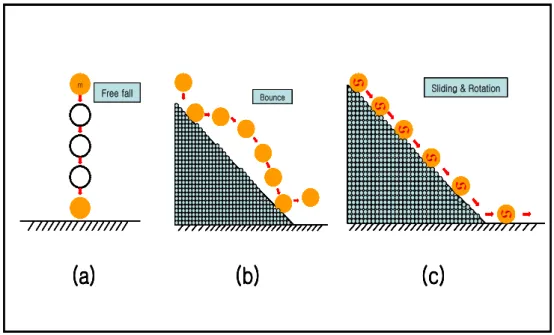
types of rockfall occurred by the influence of gravity can be expressed as free fall, bounce, rotation and sliding, etc. The free fall is the moving form of the same form with Fig. 1. (a) and the motion of object fallen down to the ground by the acceleration
m Free fall
m
m Free fall BounceBounceBounce Sliding & RotationSliding & RotationSliding & RotationSliding & Rotation
(a) (b) (c)
m Free fall
m
m Free fall BounceBounceBounce Sliding & RotationSliding & RotationSliding & RotationSliding & Rotation
(a) (b) (c)
m Free fall
m
m Free fall BounceBounceBounce Sliding & RotationSliding & RotationSliding & RotationSliding & Rotation m Free fall
m
m Free fall BounceBounceBounce Sliding & RotationSliding & RotationSliding & RotationSliding & Rotation
(a) (b) (c)
Fig. 1. Types of rockfall.
of gravity from the state that the initial speed is 0. It effects uniformly accelerated
motion with the acceleration of gravity of the globe and the speed during the fall
equals to the times of the acceleration of gravity and the hours of falling. And the
bounce is the moving form for the same form with Fig. 1. (b) As the phenomenon
that a certain energy loss is occurred when the rockfall collides with the surface of
slope and then it is bounced up, it is operated as the important factor in grasping
the characteristics of movement of rockfall. Lastly, the rotation and the sliding, as
the moving form of the same form with Fig. 1. (c), is the phenomenon that a
certain energy loss is occurred by the friction contained by a certain slope when
the rockfall is fallen down along the slope and then the sliding and the rotation are
generated. These moving forms largely depend on the state of the surface of slope.
2.3 Kinetic Energy Analysis of Rockfall
The mechanical energy of falling object can be calculated as the sum of potential energy (E
P) and kinetic energy (E
K) and this study calculated the result value as measuring kinetic energy converted while the rockfall which has the initial potential energy by the gravity collapses against the slope. The value of kinetic energy of falling rockfall was calculated in the method as per (1) formula and, at this time, m means the weight of rockfall and v means the speed of rockfall.
E
K= 0.5 m v ⋅ ⋅
2(1)
3.1 Modeling of Slope by the Visible Feature as Utilizing PFC Code
This study executed the research on the rockfall occurred on the slope as utilizing PFC (Particle flow Codes). What is firstly thought to simulate rock movement with DEM is the matter modeling the slope and the rockfall.
Here, as the method modeling the slope, the method modeling the slope as the standing statue and the method modeling as the rigid wall can be thought. The former method has the strong point that it can consider the transform of slope but it has the weak point that the more the number of factors becomes, the more the calculating hours required for the interpretation become. The latter method has the weak point that it cannot directly consider the effects which the slope transform actually occurred at the slope has on the movement of rockfall because the transform would not be occurred at the slope due to modeling as the rigid-wall.
But, as it is sufficient if the judgment of contact is done only between the factors
of rockfall and the slope, it has the strong point that the hours for interpretation
and the amount of calculations are decreased(Dae-Sang Kim, 2002). This study,
after the sufficient considerations, executed modeling as selecting the former
method to obtain the result value of further engineering science and precision. And
to closely examine the correlations of the visible features of the slope and the
characteristics of movement of rockfall, as making the condition of slope-surface,
slope-incline, number of bench and bench-width different, the correlations with the
movement of rockfall were grasped. In the same manner, the modeling by the
visible feature of slope was executed and finally, as placing wall on the lower part
of slope, the speed value when the rockfall was arrived at was measured to
calculate the value of kinetic energy.
3.1.1 Surface State of Slope
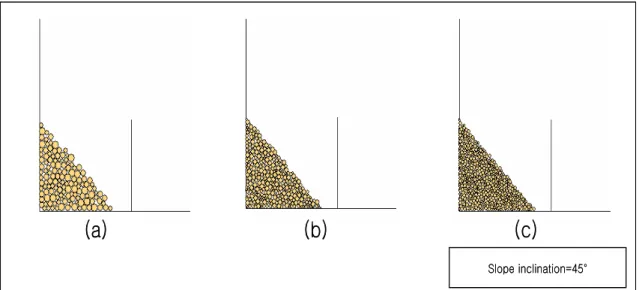
The modeling was executed as adjusting the size of particle and then determining the surface state of slope. Fig. 2 gave the generally same height of slope and inclination of 45° provided that the size of particle was given differently like (a), (b) and (c). And additionally, as giving the bench at a random point of the midway like Fig. 3, the numerical analysis was executed and the mechanism of rockfall which can be additionally occurred by the bench was considered.
Slope inclination=45°
(b) (c)
(a)
Slope inclination=45°
(b) (c)
(a)
Fig. 2. Modeling for surface state of slope.
(a) (b) (c)
(a) (b) (c)
Fig 3. Modeling for surface state of slope.
3.1.2 Slope-Inclination
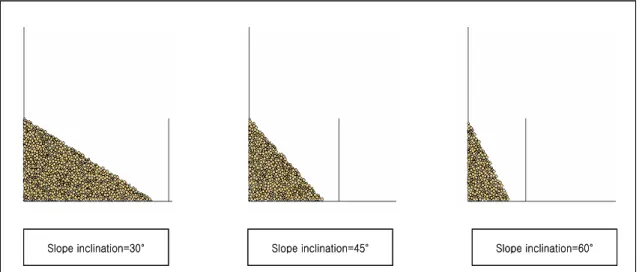
The sizes of particles were equally granted, provided that the modeling was executed as making only the condition of inclination different. Hereby, the initial potential
energy value of rockfall is determined by the gravity and the height and, at this point, Fig. 4 granted the width condition of the sa me slope to minimize the result error which might be occurred and Fig. 5 executed the modeling as granting the same slope heights.
Slope inclination=30° Slope inclination=45° Slope inclination=60°
Slope inclination=30° Slope inclination=45° Slope inclination=60°
Fig. 4. Modeling for Slope-inclination. (In case of same width)
Slope inclination=30° Slope inclination=45° Slope inclination=60°
Slope inclination=30° Slope inclination=45° Slope inclination=60°
Fig. 5. Modeling for Slope-inclination. (In case of same height)
3.1.3 Number of Slope-Benches (N)
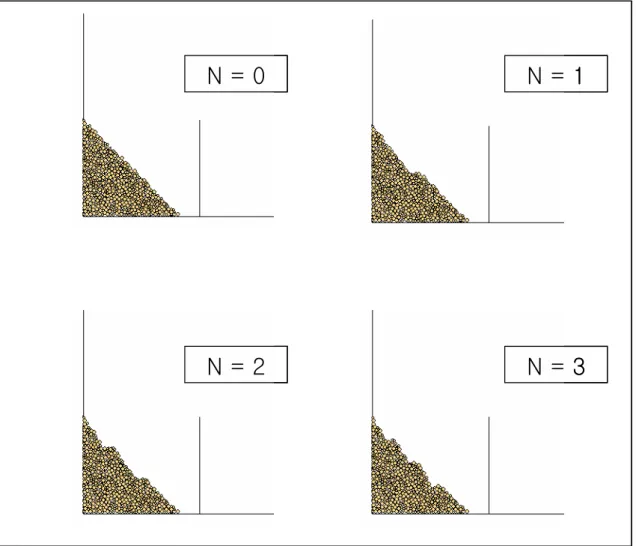
N means the number of benches and the conditions, the size of particle and the height of slope, were equally granted, provided that the changes were given only to the number of benches to execute the numerical analysis about what effects the number of benches has on the mechanism of rockfall.
3.1.4 Slope-Width
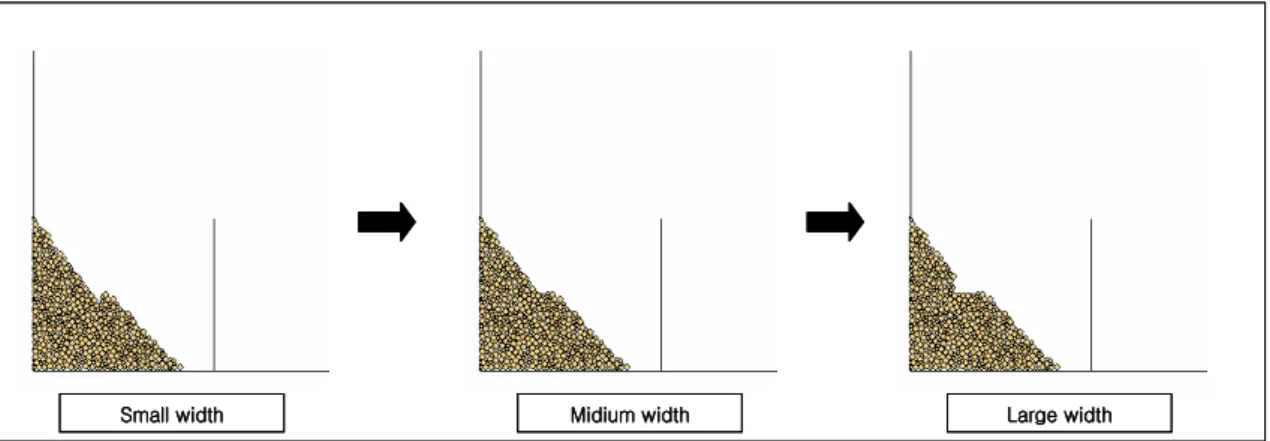
Like Fig. 7, the height of slope and the size of particle, etc were equally ranted, provided that only the width of slope were made differently to review the orrelation with the movement of rockfall.
N = 0 N = 1
N = 2 N = 3
N = 0 N = 1
N = 2 N = 3
Fig. 6. Modeling for number of slope-benches.
Small width Midium width Large width
Small width Midium width Large width
Fig. 7. Modeling for slope-width.
3.2 Determination of Rockfall Shape
As per Fig. 8, the shape of rockfall as the circular particle can be modeled in the various forms. But, the most suitable form of rockfall in the process of the numerical analysis was the form like a. That's why, in case that the rockfall was modeled as the more complicated forms in the forms like b and c, the phenomenon that this rockfall, when there was the windings of the particles composing the slope in the process that the sliding was occurred along the surface of slope, was held in such windings used to be often occurred. So, to review only the correlation of the visible features of slope and the movements of rockfall to meet the purpose of this study, expressing rockfall as a particle was considered as the most appropriate.
Of course, as the matters on the shape of rockfall are the matters to be
Pbond Lacations
(a) (b) (c)
Pbond Lacations Pbond Lacations
(a) (b) (c)
Fig 7. Determination of rockfall shape.
importantly treated in the future studies, finding the shape of rockfall of which the applicability to the site is further reinforced will be operated as an important factor.
4. Analysis on the Correlations of the Visible Features of Slope and the Movement of Rockfall
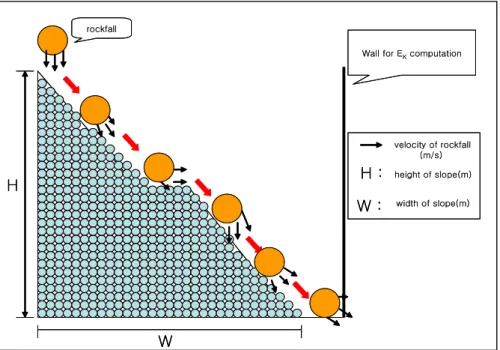
Fig. 9 is the diagram on the form of basic modeling. The slope was modeled with the circular particles and the rockfall was composed of a circular particle. If the rockfall drops and finally falls down, it gives the impact on the wall set up at the lower part of slop and this study measured the value of kinetic energy (E
K) as measuring the speed of rockfall at that moment.
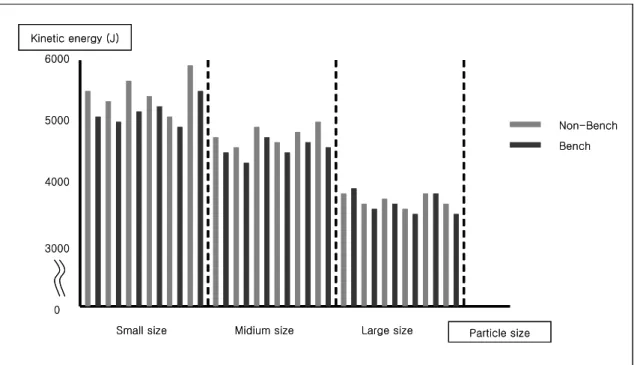
4.1 Analysis on Rockfall Kinetic Energy by the Condition of Surface State
Fig. 10 shows the results of numerical analysis by each case. It was classified into two kinds of cases, the form with benches and the form without benches, and 6 representative result values were appeared. The result is known to show the tendency that the larger the size of particle is, says, the more the windings of surface are, the smaller the kinetic energy of rockfall is, as known in Fig 9. For instance, as the same principle with speed downer laid on the road, the windings of surface convert the kinetic energy of rockfall into another form of energy, which
H
W
Wall for EKcomputation rockfall
velocity of rockfall (m/s)
H :
height of slope(m)W :
width of slope(m)H
W
Wall for EKcomputation rockfall
velocity of rockfall (m/s)
H :
height of slope(m)W :
width of slope(m)Fig. 8. Diagram of the form in basic modeling.
can be explained as the loss of energy. For the reference, Giani(1992), in the classification of the rotation and the sliding, reported that, in case that the size of stone is larger than the winding of perforated surface, the tendency of sliding while accompanying some bounces is appeared and, in case that the size of winding is larger, the tendency of rotating along with some sliding on the contact surface of perforated surface and stones.
4.2 Analysis on Rockfall Kinetic Energy by the Condition of Inclination
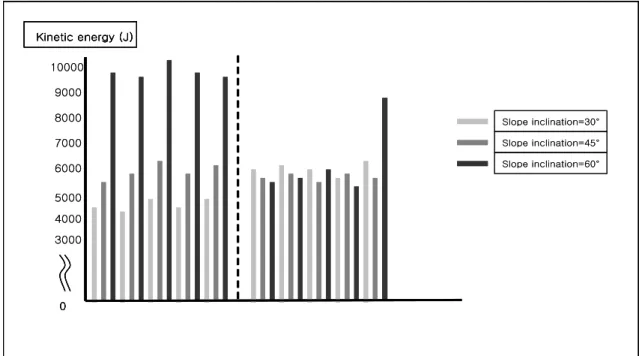
Fig 11. was simulated as giving the same width of slope to the left on the basis of dotted line and giving the same height of slope to the right. As known at the graph, there is the tendency that the higher the inclination is, the larger the kinetic energy of rockfall becomes. In case of giving the same width, as the inclination became large, the height of slope became large proportionally and the difference of kinetic energy according to the inclination was appeared to be large. On the other hand, in case of giving the same height, except for some values, most of them show almost similar energy values. This result is due that the moving distance of rockfall becomes short as the inclination becomes high. Thus, the case of 60°, the large inclination, appears the distance almost close to 1/2 of the moving distance of 30°. From this characteristic, the difference of the values of final kinetic energy seem not to be largely remarked.
Small size Midium size Large size
Kinetic energy (J)
Particle size 3000
4000 5000 6000
0
Non-Bench Bench
Small size Midium size Large size
Kinetic energy (J)
Particle size 3000
4000 5000 6000
0
Non-Bench Bench
Fig. 9. Analysis of rockfall kinetic energy by the condition of surface state.
4.3 Analysis on Rockfall Kinetic Energy by the Condition of the Number of Slope-Benches
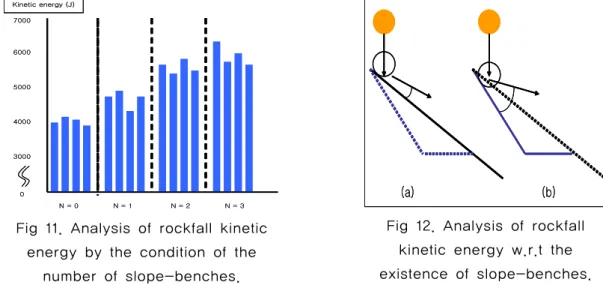
There is the tendency that, as the number of benches become more, the value of kinetic energy is increased (Fig 12). Before executing this study, it was expected that the bench might operate as the factor decreasing the kinetic energy of rockfall.
But, the result of interpretation was the reverse to what was expected. Seeing the diagram pf Fig 13, a is a case without bench, b is a case with bench and then the angle between the bounced rockfall and the slope is known to be further largely bounded at b rather than a. As the bounce of a is weak, a comes in contact with the surface of slope upon the bounce and then enters the sphere of influence of friction of slope. On the other hand, b stays at the sphere of influence of friction of slope only for the shorter time than a does. This result can be said as the result responding to the result of the analysis on rockfall kinetic energy by the condition of inclination mentioned hereinbefore.
Kinetic energy (J)
3000 6000 9000 10000
0
Kinetic energy (J)
0
Slope inclination=45°
Slope inclination=60°
Slope inclination=30°
8000 7000
5000 4000
Kinetic energy (J)
3000 6000 9000 10000
0
Kinetic energy (J)
0
Slope inclination=45°
Slope inclination=60°
Slope inclination=30°
8000 7000
5000 4000
Fig 10. Analysis of rockfall kinetic energy by the condition of inclination.
4.4 Analysis of Rockfall Kinetic Energy by the Condition of Bench-Width
4 representative values by the size of each bench were showed at Fig. 14. The width of bench does not show the large difference in two result values of the small size and the midium size. On the other hand, the large size shows the tendency that the value is decreased by a little compared to the above two values. This is presumed that, although the small size and the midium size frequently pass by the bench alone while rockfall bounces, if the width of bench is beyond a certain length, the cases that bouncing rockfall is impacted on the bench again are occurred and result in the losses of energy. If the trace of rockfall is simulated in the future study, much better result value is expected to be obtained.
7000
6000
5000
4000
3000
0
N = 0 N = 1 N = 2 N = 3
Kinetic energy (J)
7000
6000
5000
4000
3000
0
N = 0 N = 1 N = 2 N = 3
Kinetic energy (J)
Fig 11. Analysis of rockfall kinetic energy by the condition of the
number of slope-benches.
7000
6000
5000
4000
3000
0
Small size Midium size Large size Size of bench Kinetic energy (J)
7000
6000
5000
4000
3000
0
Small size Midium size Large size Size of bench Kinetic energy (J)
Fig 13. Analysis of rockfall kinetic energy by the condition of bench-width
(a) (b)
(a) (b)