1. INTRODUCTION
The modern cruise industry emerged in the late 1960s and early 1970s (Rodrigue & Notteboom, 2013). The cruise industry is the fastest-growing category in the leisure travel market experiencing a steady 8.4% increase per year since 1984.
According to the Cruise Line International Association (CLIA, 2015), the number of cruisers in 2016 is approximately 22.9 million, and the development of the cruise industry has created 119.9 billion dollars in global economic impact and 939,232 jobs around the world.
Given the worldwide cruise market size and potential growth of the whole market, cruise operators are presented with not only an abundance of opportunities, but also challenges.
While the lack of hospitality-oriented understanding of food hygiene about cruise industry is one of the major factors con- straining market expansions. The importance of good food hy- giene is much bigger for ship itself, due to the possibility of food born disease epidemics (Addiss, Yashuk, Clapp, & Blake, 1989; Koo, Maloeny, & Tauxe, 1996). The conditions of food hygiene of cruise ship have been studied while the number of studies is limited and mostly are specific case studies with Information available at the Culinary Society of Korea (http://www.culinary.re.kr/)
Culinary Science & Hospitality Research
Journal & Article Management System: https://cshr.jams.or.kr/
21-28
http://dx.doi.org/10.20878/cshr.2018.24.2.005
Understanding the Food Hygiene of Cruise through the Big Data Analytics using the Web Crawling and Text Mining
Tao Shuting
1, Byongnam Kang
2& Hak-Seon Kim
11
School of Hospitality & Tourism Management, Kyungsung University
2
Dept. of Foodservice Management & Culinary, Hyejeon College
KEYWORDS ABSTRACT
Cruise food hygiene, Big data,
Language network analysis,
Web crawling, Text mining.
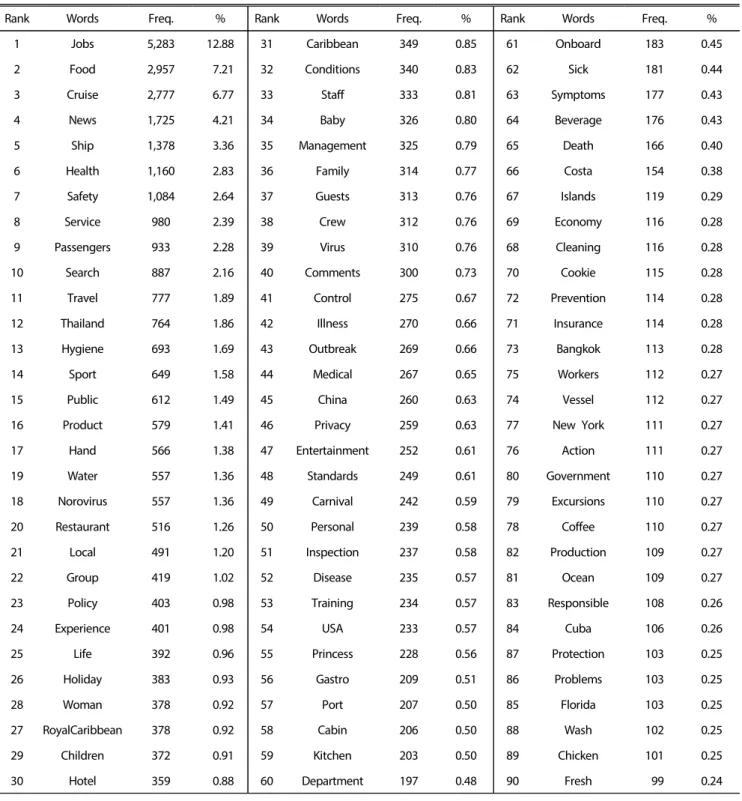
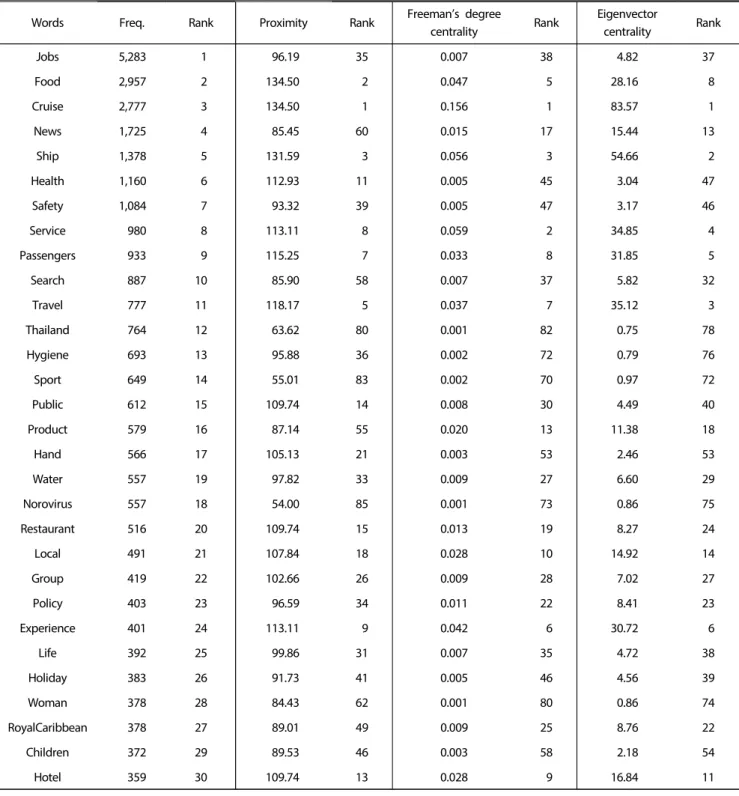
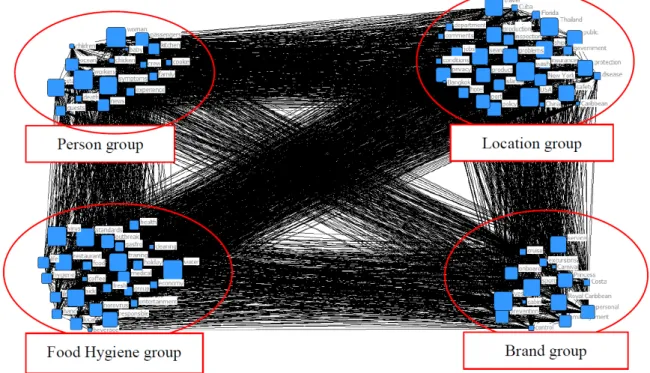
The objective of this study was to acquire a general and text-based awareness and recognition of cruise food hygiene through big data analytics. For the purpose, this study collected data with conducting the keyword “food hygiene, cruise” on the web pages and news on Google, during October 1st, 2015 to October 1st, 2017 (two years). The data collection was processed by SCTM which is a data collecting and processing program and eventually, 899 kb, approximately 20,000 words were collected. For the data analysis, UCINET 6.0 packaged with visualization tool-Netdraw was utilized. As a result of the data analysis, the words such as jobs, news, showed the high frequency while the results of centrality (Freeman's degree centrality and Eigenvector centrality) and proximity indicated the distinct rank with the frequency. Meanwhile, as for the result of CONCOR analysis, 4 segmentations were created as “food hygiene group”, “person group”, “location related group” and “brand group”. The diagnosis of this study for the food hygiene in cruise industry through big data is expected to provide instrumental implications both for academia research and empirical application.
*