Received: March 12, 2012 ; Accepted: March 22, 2012 Corresponding author: Young Ju Jee
Tel: +82 (51) 720-2450 e-mail: [email protected] 1225-3480/24419
북방전복, Haliotis discus hannai 3배체의 세포유전학적 연구
지영주, 장영진1
국립수산과학원 생명공학과, 1부경대학교 해양바이오신소재학과
Cytogenetic Analysis of the Triploid Pacific Abalone, Haliotis discus hannai
Young Ju Jee and Young Jin Chang1
Biotechnology Research Division, National Fisheries Research and Development Institute, Gijang-gun, Busan 619-705, Korea
1Department of Marine Bio-materials and Aquaculture, Pukyong National University, Nam-gu, Busan 608-737, Korea
ABSTRACT
In this study, we invesgated a cytogenetic analysis of the Pacific triploid abalone, Haliotis discus hannai induced by low temperature treatment. We got a lot of mitotic metaphase chromosome spreads from the triploid and diploid Pacific abalones' hatched larvae (trochophores). The chromosome number of diploid abalone was 2n = 36 and that of triploid abalone was 3n = 54, so the chromosome number of triploid abalone was 1.5 times higher than that of diploid abalone. We developed a modified flow cytometric method for Pacific abalone from the existing methods.
We uesd 51 months aged triploid and diploid Pacific abalones' hemolymph to get the DNA contents by flow cytometry. The DNA content of diploid abalone was 1.743 pg/cell and the DNA content of triploid abalone was 1.49 times higher than that of diploid one. It proved that triploid abalone was consisted with two sets of maternal diploid and one set of paternal genome.
Keywords : 북방전복, 3배체, 염색체수, 유세포분석기, DNA함량 (Pacific abalone, Haliotis discus hannai, Triploid, Chromosome number, Flow cytometry, DNA content)
서 론
수산동물에 있어서 염색체 조작에 의해 생산된 3배체 성체 의 생식세포는 감수분열 동안 상동염색체가 짝을 짓기 못하기 때문에 염색체 3쌍의 분리는 부정확하게 되거나 중지되어 3배 체는 보통 불임이 된다 (Beaumont and Fairbrother, 1991). 이러한 불임으로 인해 성적 성숙에 쓰일 대사 에너지 가 체성장에 이용될 수 있어 3배체는 2배체보다 크게 성장되 는 장점이 있다.
이러한 패류의 3배체에 관한 연구로는 1981년 버지니아굴, Crassostrea virginica (Stanley et al., 1981, 1984) 에
cytochalasin B (CB) 를 처리함으로써 최초의 패류 3배체가 유도된 이 후 굴, Crassostrea gigas (Chaiton and Allen, 1985; Downing and Allen, 1987), 가리비류인 Argopecten irradians (Tabarini, 1984), Chlamys nobilis (Komaru et al., 1988) 에서도 유도된 바 있다. 이 외에도 진주담치, Mytilus edulis (Yamamoto and Sugawara, 1988), 유럽 산 바지락, Tapes semidecussatus (Beaumont and Contaris, 1988), 진주조개, Pinctada fucata martensii (Wada et al., 1989), 북방전복, Haliotis discus hannai (Jee and Chang, 1995), Mulinia lateralis (Yang and Guo, 2006) 및 호주산 전복, Haliotis laevigata (Li et al., 2007) 등에서 고온, 저온 및 압력 등의 물리적 자극과 CB 등 의 약품 처리에 의한 3배체 유도가 연구되어왔다
어류 및 패류의 다배체를 유도하기 위한 처리에서 그 결과 가 항상 100%의 다배체 유도율을 보이는 것은 아니다 (Stanley et al., 1981; Chaiton and Allen, 1985;
Downing and Allen, 1987; Yamamoto and Sugawara,
1988; Tabarini, 1984; Komaru et al., 1988; Wada et al,. 1989). 그러므로 수산 동물 다배체 유도 실험구에서의 배 수성 판정 및 분리는 다배체의 계속적인 연구를 위해서도 필요 하다.
유도된 3배체의 배수성 분석법 중 중요시 되는 것이 세포유 전학적 분석법이다. 이는 유도된 개체들의 유전인자를 직접 분 석하는 방법으로 적혈구 세포 및 핵의 크기 측정, 염색체 수 및 핵형 분석 그리고 DNA 함량 측정 등이 주로 이용되고 있 다 (Chevassus, 1983). 어류의 경우, 적혈구의 세포 및 핵 크 기의 측정은 이들 중 가장 손쉬운 방법으로 다배체의 특성을 잘 나타낼 수 있어 여러 어종에서 배수성 판별의 기준으로 사 용되고 있다 (Benfey and Sutterlin, 1984; Wolters et al., 1982;, Kim et al., 1994; Park and Kim, 1994; Park and Park, 1995; Jeong et al., 1995). 그러나 대부분의 패 류에는 적혈구가 존재하지 않고 hemolymph cell이 존재하는 데, 이 hemolymph cell은 모양이 일정하지 않고 크기도 다양 (Tanaka et al., 1961; Chang, 1993)하기 때문에 세포 및 핵의 크기 측정에 의한 배수성 판정은 불가능하다.
염색체 수 및 핵형 조사에 의한 배수체의 유전자 분석은 특 별한 기기도 필요 없고 비용도 들지 않는 방법이지만, 세포의 분열 증식이 활발한 어린 배나 유생 시기 및 치어기 외에는 세 포 배양을 하지 않으면 염색체 표본을 쉽게 얻을 수 없는 단점 이 있다 (Thorgaard et al., 1982). 그러나 이 방법은 배수성 을 구별하는 가장 확실한 방법으로, 2조의 모계 반수체 유전자 와 1조의 부계 반수체 유전자로 구성되어 있는 3배체를 확인 할 수 있는 방법이다.
염색체 수 및 핵형 분석법은 세포 주기의 일정 기간에 국한 되는데 비해 최근 많이 이용되고 있는 flow cytometry는 혈 구 등의 DNA 함량을 측정하는 방법으로서 단시간 내에 다량 의 세포핵 분석이 가능한데다 정확성이 높으며, 무엇보다도 실 험동물을 죽이지 않고 DNA 함량을 측정할 수 있다는 장점 (Allen, 1983)이 있으며 적혈구를 가지고 있는 어류에서도 수 많은 형광 염색된 세포핵을 처리할 수 있는 flow cytometry 분석은 배수성 판정에 이상적인 수단으로 인정되고 있다 (Lamatsch et al., 2000; Peruzzi and Chatain, 2003).
Flow cytometry에 의한 DNA 함량 측정은 2배체 대서양 연어, Salmo salar (Allen, 1983), 3배체 무지개송어, Oncorhynchus mykiss (Thorgaard et al., 1982)와 coho salmon, Oncorhynchus kisutch (Utter et al., 1983)에서 측정되었고, 미꾸리, Misgurnus anguillicaudatus와 미꾸 라지, M. mizolepis의 잡종 및 잡종 3배체 (박, 1992), 4배체 미꾸리 (Kim et al., 1993) 및 3배체 및 4배체 솔종개 (Juchno et al., 2010) 등에서 측정된 바 있다. 패류의 경우 에는 3배체 버지니아굴, Crassostrea virginica (Allen,
1983), 흔한가리비, Chlamys nobilis (Komaru et al., 1988), 굴, Crassostrea gigas (松谷 等, 1994) 및 지중해담 치, Mytilus galloprovincialis (Bihar et al., 2003) 등에서 측정된 바 있다.
본 연구는 북방전복의 세포유전학적 특성을 밝히고 아울러 효과적인 3배체 판정 방법에 대해 조사하였다.
재료 및 방법
1. 염색체 표본제작
북방전복의 염색체 수를 조사하기 위한 염색체 표본 제작은 다음과 같은 방법으로 하였다. 즉, 부화 직후의 담륜자 (trochophore) 유생 약 30마리를 해수가 담긴 20 ml 시험관 에 수용하고 0.1% colchicine액에 2시간 동안 처리하였다. 이 후 시험관에 같은 용적의 0.075M KCl 용액을 첨가해서 저장 액 처리를 하고 표본이 침전하면 새로운 KCl 용액으로 치환하 여 1시간 이상 저장액 처리를 반복했다. KCl 용액의 상등액을 버리고 냉장된 Carnoy액을 넣어 1시간 이상 고정한 다음 4℃
에 보관했다. 고정 처리된 담륜자 유생은 50 g로 10분간 원심 분리해서 피펫으로 상등액은 버리고 50%의 acetic acid 용액 이 든 원심관에 수용하고 20분 정도 유리막대로 저어서 담륜 자 유생이 완전히 마쇄되도록 교반시켰다. 10분 정도 정치 후 파스퇴르 피펫으로 뽑아서 50℃로 가열한 슬라이드 글라스에 도말했다. 공기 건조 후 phosphate buffer (pH 6.4) 로 희석 된 4% Giemsa 염색액에 15분 정도 염색한 다음 수세 건조 후 100-200배의 배율로 현미경 검경을 해서 염색체를 조사하 고 조사된 염색체는 1,000배의 광학현미경 하에서 염색체수 를 계수하였다.
2. DNA 함량 측정
DNA 함량 측정에 사용한 북방전복은 저온처리에 의해 3배 체로 유도되어 육상 수조에서 유수식으로 4년 3개월동안 사육 한 것이었다. DNA의 함량 측정은 flow cytometry를 사용하 였는데, 3배체 버지니아굴, Crassostrea virginica에 대해 flow cytometry로 DNA 함량을 측정한 Allen (1983) 의 방 법과 3배체 흔한가리비, Chlamys nobilis에 대해 flow cytometry로 DNA 함량을 측정한 Komaru et al. (1988) 의 방법을 약간 변형해서 측정하였다. 즉 각 처리구의 북방전 복을 대상으로 5 ml 주사기 (주사바늘 23G × 1") 로 북방전 복 위심강으로부터 약 1 ml의 hemolymph를 채취하였다. 채 취된 hemplymph에 cold marine phosphate buffered saline (MPBS) 용액 (NaCl 11.00 g, KCl 0.20 g, Na2HPO4․H2O 1.15g, KH2PO4 0.20 g) 1 ml를 가하여 희 석시킨 후 200 g로 10분간 2-3회 원심하여 반복 세척하였다.
그 후 MPBS로 1%가 되게 희석한 포르말린에 수용하여 4℃
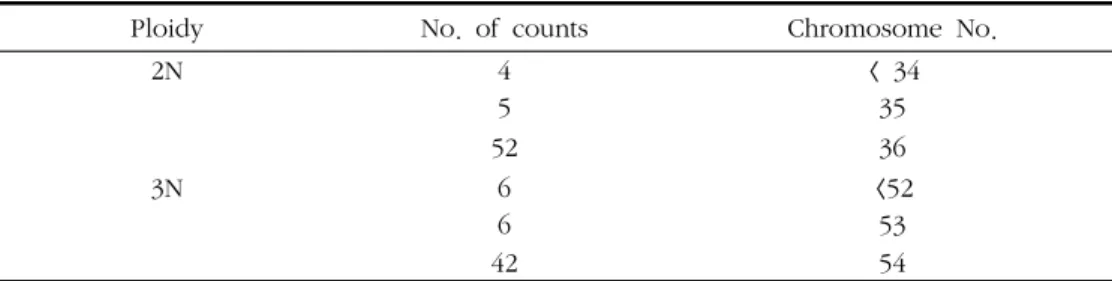
Ploidy No. of counts Chromosome No.
2N 4 < 34
5 35
52 36
3N 6 <52
6 53
42 54
Table 1. Numbers of chromosome in the diploid and triploid Pacific abalone, Haliotis discus hannai a)
b)
Fig. 1. Mitotic metaphase chromosomes of the Pacific abalone, Haliotis discus hannai.
a) diploid (2n = 36). b) triploid (3n = 54). Bars indicate 5 μm.
에서 over night시킨 다음, cold MPBS로 다시 한 번 세척하 였다. RNase 처리는 RNase A (Cooper) 용액 (Ribonuclease A 300 U/ml in MPBS) 에서 37℃로 배양 하였으며 200 g로 5분간 원심 분리한 후 상등액을 버리고 1 ml의 propodium iodide (PI) 용액 (50 μg/ml in 0.1%
sodium citrate) 에서 4℃ 암냉 상태로 30분간 염색하였다.
PI 염색이 끝난 세포 부유액으로 DNA 함량을 측정했는데 DNA 함량측정은 FACStar PLUS (Becton Dickinson Immuno cytometry System, BDIS; Mountain View (A) flow cytometry) 를 이용하였다. 각각의 세포 DNA함량은 488 nm 강도로 발광된 argon-ion laser beam 200 mw 출 력에서 분석되었다. 적색 형광은 630 band pass filter에서 선택적으로 투과되어 각각 감지되었다. 북방전복 2배체 세포 핵의 picogram 단위의 상대 DNA 함량을 측정하기 위해 standard로 7.0 pg의 DNA 함량을 가지는 인간 백혈구를 사 용하였으며 (Jakobsen, 1983; Iverson and Laerum, 1987) 닭의 적혈구는 낮은 coefficient of variation (CV) 을 가지므로 시간의 흐름에 따른 기기의 안정성을 모니터하는 standard로 사용되었다 (Allen, 1983). DNA 함량은 약 5
× 105 개의 세포내 정보를 수집하여 BDIS의 LYSIS Ⅱ Ver 1.1 프로그램에 의해 측정되었다.
결 과
1. 염색체 수
2배체 및 유도된 3배체의 염색체 수를 조사한 결과는 Table 1과 같다. 2배체 북방전복의 염색체 수는 전체 관찰 중 기분열상의 대부분 (85.2%) 이 2n = 36으로 나타났고 34개 및 35개인 것도 소수 나타났다. 3배체의 경우에는 전체 관찰 중기분열상의 대부분 (77.8%) 이 3n = 54로 나타났고 52개 및 53개인 것도 소수 나타났다. 3배체는 2배체에 비해 1.5배 의 염색체 수를 나타내었다 (Fig. 1).
2. DNA 함량 측정
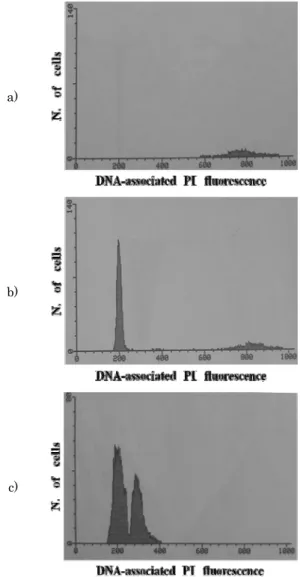
각 실험군의 DNA 함량 분석 결과는 Fig. 2 및 Table 2와 같다. Fig. 2a는 standard인 인간 백혈구의 DNA 함량 분석
결과이고 Fig. 2b는 standard인 인간 백혈구와 북방전복 2배 체의 DNA 함량을 동시에 측정한 결과이고, Table 2는 인간 백혈구와 북방전복 2배체의 DNA 함량을 비교한 것인데 인간 백혈구는 평균 CN 817.98, 북방전복 2배체는 평균 CN 203.61을 나타내어 북방전복은 standard인 인간 백혈구 7.0 pg/cell의 24.89%의 DNA 함량을 가지고 있으므로 북방전복 의 DNA 함량은 1.743 pg/cell로 계산되었다.
Fig. 2c는 북방전복 2배체와 3배체의 DNA 함량을 측정한 결과이고, Table 3은 2배체와 3배체 북방전복의 DNA 함량 을 나타낸 것인데 2배체의 평균값은 CN 209.14, 3배체의 평
Case
number Mean peak of sample Mean peak of human leukocytes
Mean ratio of peak
(abalone/human) pg/cell
1 206.92 (CV% 6.70) 810.88 (CV% 9.96) 0.2552 1.786
2 200.30 (CV% 4.86) 825.08 (CV% 7.29) 0.2428 1.700
Mean 203.61 ± 4.68 817.98 ± 10.04 0.2489 ± 0.0088 1.743 ± 0.061 Table 2. Comparison of DNA content of Pacific abalone, Haliotis discus hannai and standard human leukocytes a)
b)
c)
Fig. 2. Flow cytometry analysis of the diploid and triploid Pacific abalone, Haliotis discus hannai.
a) standard from human cell. b) diploid and standard.
c) diploid and triploid.
DNA content 1 2 Mean
2N 206.47 (CV% 10.32) 211.80 (CV% 9.29) 209.14 ± 3.77 3N 301.42 (CV% 8.60) 321.08 (CV% 13.73) 311.25 ± 13.90
Mean ratio of peak (3N/2N) 1.46 1.52 1.49 ± 0.04
Table 3. Comparison of DNA content of the diploids and triploids Pacific abalone, Haliotis discus hannai
균값은 CN 311.25로서 3배체가 2배체보다 1.49배의 DNA 함량을 나타내어 3배체는 3배체 특성인 모계 2n DNA 함량 과 부계 n DNA 함량을 가지고 있음을 나타내었다. Flow cytometry로 북방전복 2배체와 3배체의 DNA 함량을 측정 시 coefficients of variation (CV%) 의 범위는 4.86-13.73 이었다.
고 찰
염색체 수 및 핵형 조사에 의한 배수체의 유전자 분석은 특 별한 기기도 필요 없고 비용도 들지 않는 방법이지만, 세포의 분열 증식이 활발한 어린 배나 유생 시기 및 치어기 외에는 세 포 배양을 하지 않으면 염색체 표본을 쉽게 얻을 수 없는 단점 이 있다 (Thorgaard et al., 1982).
이 밖에도 패류의 배수성 판정 방법으로는 isozyme에 의한 3배체의 배수성 분석법이 있다. 이 방법은 isozyme의 농도비 로부터 3배체를 판정하는 방법인데, 예를 들면 monomeric enzyme에서 모계와 부계 대립유전자의 비는 2배체에서 1 : 1 이지만 극체 방출 억제에 의해 1개의 모계 염색체 조가 더 많 은 3배체에서는 모계와 부계 대립유전자의 비가 2:1이 되어 모 계 대립유전자가 부계 대립유전자의 2배가 된다. 따라서 이러 한 모계 유래의 대립유전자에 의해 표현되는 isozyme은 3배체 의 밴드가 2배체보다 더 진하게 나타나므로 3배체가 유도된 것 을 알 수 있다 (Seeb et al., 1988). 이러한 isozyme에 의한 3 배체의 배수성 분석법은 굴, C. gigas (赤繁 等, 1992) 의 IDH 와 6PGD isozyme을 이용해서 연구된 바 있다.
극체 계수를 하는 방법도 패류의 배수성 판정을 할 수 있는 방법이다. 이 방법은 패류의 발생란 단계에서 극체의 갯수를 파악함으로써 배수성을 판정하는 가장 간단한 방법인데, 정상 적인 2배체의 발생 과정에서는 제1극체, 제2극체를 방출하므 로 2개의 극체를 관찰할 수 있지만, 어느 한 극체의 발생을 억 제해서 유도하는 3배체는 극체를 1개만 방출하게 되므로 1개
만 관찰할 수 있게 된다. 그러나 이 방법은 발생란 시기에서만 배수성을 파악할 수 있으므로 치패 시기 이상에서는 다른 방법 이 요구된다 (Komaru et al., 1988). Beaumont (1986) 는 가리비류, Pecten maximus의 3배체에 대해 극체 계수 방법 에 의해 3배체 유도율을 조사한 바 있다.
Komaru and Wada (1985) 는 패류의 체세포 염색체는 어 류와는 달리 그 크기가 매우 작고 세포 분열이 왕성하지 못하 여 양호한 핵상을 얻기가 매우 어렵다고 하였다. 그러나 그들 은 패류의 담륜자 유생에서는 쉽게 염색체 표본을 관찰할 수 있어서 진주조개에서 명확한 중기분열상을 얻을 수 있었다고 하였다. 북방전복의 경우도 Arai et al. (1982) 과 본 연구에서 담륜자 유생으로부터 염색체 표본을 손쉽게 만들 수 있었다.
2배체 북방전복의 염색체수는 2n = 36으로 나타났고 3배 체의 경우에는 3n = 54로 나타나 3배체는 모계의 2n과 부계 의 n으로 구성되어 있음을 알 수 있었다. 한편 염색체 수가 부 족한 것은 aneuploid가 아니라 염색체가 서로 겹치거나 압착 할 때 서로 떨어져 나간 것으로 추정된다. 이러한 현상은 유럽 산 바지락, Tapes semidecussatus의 3배체 유도 (Beaumont and Contaris, 1988) 에서도 나타나고 있다.
Allen (1983) 은 flow cytometry에 의한 DNA 함량 측정 은 혈구 등에 대한 DNA 함량의 측정 방법으로서 단시간 내 다량의 세포핵 분석이 가능하고 정확성이 높으며 무엇보다도 실험동물을 죽이지 않고 DNA 함량을 측정할 수 있다는 장점 이 있다고 하였다.
본 연구에서도 북방전복의 DNA의 함량 측정을 위해 flow cytometry를 사용하였는데, Allen (1983) 의 3배체 버지니 아굴, Crassostrea virginica에 대한 flow cytometry DNA 함량측정 방법과 Komaru et al. (1988) 의 3배체 흔한가리 비, Chlamys nobilis에 대한 flow cytometry DNA 함량측 정 방법을 응용한 방법이었다. 그 결과 북방전복에서도 flow cytometry에 의한 DNA 함량 측정과 배수성 판정이 가능하 였다.
Allen (1983) 은 어류의 적혈구를 이용한 flow cytometry 분석에서 어류의 적혈구는 세포형이 동질하므로 coefficients of variation (CV) 값이 1.8-3.5%로 낮은데 비해 패류에서는 혈구 혹은 분해된 조직세포가 동질하지 않기 때문에 버지니아 굴 배수체에서의 CV값은 6-20%로 높았다고 하였다. 본 연구 에서 북방전복 배수체의 CV값은 4.86-13.73%의 범위로 Allen (1983) 의 버지니아굴보다는 값이 낮았는데 북방전복 이 가리비보다는 위심강으로부터 hemolymph만 정확히 추출 할 수 있는 종의 차이인 것으로 생각된다.
Ciudad et al. (2002) 은 flow cytometry로 경골어류 3종 의 DNA 함량을 측정했는데 금붕어, Carassius auratus는 3.584 pg, 제브라피쉬, Danio rerio는 3.357 pg, 유럽산 잉
어, Tinca tinca는 2.398 pg이라고 밝혔고 Juchno et al.
(2010) 은 기름종개, Cobitis taenia의 적혈구를 사용해서 측정한 DNA 함량은 3.15 pg/cell이라고 밝혔는데 북방전복 의 DNA 함량은 1.743 pg/cell으로 경골어류보다 적었다. 3 배체 북방전복의 DNA함량은 2배체 북방전복의 1.49배의 DNA 함량을 나타내 3배체 특성인 모계 2n DNA 함량과 부 계 n DNA함량을 나타내었다.
따라서 본 연구에서 유도된 3배체 북방전복의 세포당 DNA 함량은 2배체 북방전복의 세포 당 DNA 함량의 거의 1.5배를 나타내 그 정확도와 신속도 등을 고려할 때, flow cytometry 가 배수성 판별 및 DNA 함량 측정에 매우 유용한 것으로 판 단되었다.
요 약
북방전복, Haliotis discus hannai의 3배체를 제온자극으 로 유도하고 부화유생인 trochophore를 이용하여 염색체 표 본을 만들었고, 유도된 3배체와 정상 2배체 북방전복은 실내 유수식의 동일 환경에서 51개월 동안 사육되었으며 채취된 혈 구를 채취하여 DNA 함량 측정에 사용되었다.
2배체 및 유도된 3배체의 염색체 수를 조사한 결과, 2배체 염색체 수는 2n = 36으로 나타났고, 3배체의 경우에는 3n
= 54로 나타나 3배체는 2배체에 비해 1.5배의 염색체 수를 나타내었다.
Flow cytometry로 인간의 백혈구를 control로 하여 북방 전복의 DNA 함량을 측정한 결과, 북방전복의 DNA 함량은 1.743 pg/cell이었으며 3배체 북방전복의 DNA함량은 2배체 전복의 1.49배의 DNA 함량을 나타내어 3배체 특성인 모계 2n DNA 함량과 부계 n DNA함량을 나타내었다.
감사의 글
본 연구는 국립수산과학원 연구사업비 (RP-2012-BT-009) 지원에 의해 수행된 연구결과이며, low cytometry 사용을 허 락해 주신 서울대학교 자연과학대학 정가진 교수님과 직접 기 기를 운영하면서 배수성 판정과 DNA 함량 측정에 많은 도움 을 주신 고상혁, 강영준 선생님께 감사드립니다.
REFERENCES
Allen, Jr.S.K. (1983) Flow cytometry: assaying experimental polyploid fish and shellfish. Aquaculture, 33: 317-328.
Arai, K., Tsubaki, H., Ishitani, Y. and Fujino, K. (1982) Chromosomes of Haliotis discus hannai INO and H.
discus REEVE. Bulletin of the Japanese of Society of Scientific Fisheries, 48: 1689-1691.
Beaumont, A.R. (1986) Genetic aspects of hatchery
rearing of the scallop, Pecten maximus (L.).
Aquaculture, 57: 99-110.
Beaumont, A.R. and Fairbrother, J.E. (1991) Ploidy manipulation in molluscan shellfish: a review.
Jounal of Shellfish Research, 10: 1-18.
Beaumont, A.R. and Contaris, M.H. (1988) Production of triploid embryos of Tapes semidecussatus by the use of cytochalasin B. Aquaculture, 73: 37-42.
Benfey, T.J. and Sutterlin, A.M. (1984) Triploidy induced by heat shock and hydrostatic pressure in Atlantic salmon (Salmo salar L.). Aquaculture, 36:
359-367.
Bihari, N., Micic, M., Batel, R. and Zahn, R.K. (2003) Flow cytometric detection of DNA cell cycle alterations in hemocytes of mussels (Mytilus galloprovincialis) off the Adriatic coast, Croatia.
Aquatic Toxicology, 64: 121-129.
Chaiton, J.A. and Allen, Jr.S.K. (1985) Early detection of triploidy in the larvae of Pacific oyster, Crassostrea gigas, by flow cytometry. Aquaculture, 48: 35-43.
Chang, Y.J. (1993) Identification of blood cells and their physiological functions in the scallop, Patinopecten yessoensis. Journal of Aquaculture, 6: 1-12. [in Korean]
Chevassus, B. (1983) Hybridization in fish. Aquaculture, 33: 245-262
Ciudad, J., Cid, E., Velasco, A., Lara, J.M., Lara, J. and Orfao1, A. (2002) Flow Cytometry Measurement of the DNA Contents of G0/G1 Diploid Cells From Three Different Teleost Fish Species. Cytometry, 48:
20-25.
Downing, S.L. and Allen, Jr.S.K. (1987) Induced triploidy in the Pacific oyster, Crassostrea gigas:
Optimal treatment with cytochalasin B depend on temperature. Aquaculture, 60: 1-15.
Iverson, O.E. and Laerum, O.D. (1987) Trout and salmon erythrocytes and human leukocytes as internal reference standards for ploidy control in flow cytometry. Cytometry, 8: 190-196.
Jakobsen, A. (1983) The use of trout erythrocytes and human lymphocytes for standardization in flow cytometry. Cytometry, 4: 161-165.
Jee, Y.J. and Chang, Y.J. (1995) Induction of triploid abalone, Haliotis discus hannai, and its biological characteristics Ⅰ. Induction of triploid abalone.
Journal of Aquaculture 8, 159-170. [in Korean]
Jeong, C.H., Ahn J.H., Kim, B.S. and Kim, D.S. (1995) Mass production of all-female triploid eggs in rainbow trout (Oncorhynchus mykiss) during the fall season by chromosome manipulation. Journal of Aquaculture, 8: 141-148. [in Korean]
Juchno, D., Lackowska, B., Boron, A. and Kilarski, W.
(2010) DNA content of hepatocyte and erythrocyte nuclei of the spined loach (Cobitis taenia L.) and its polyploid forms. Fish Physiology and Biochemistry, 36: 523-529
Kim, D.S., Jeong, C.H. Lee, Y.D. and Rho, S. (1994)
Triploidy induction in oliver flounder, Paralichthys olivaceus. Journal of Aquaculture, 7: 55-61. [in Korean]
Kim, D.S., Noh, C.H. and Nam, Y.K. (1993) Induction of tetraploid cyprinid loach, Misgurnus anguillicaudatus. Journal of Aquaculture, 6: 55-62.
[in Korean]
Komaru, A. and Wada, K.T. (1985) Karyotype of the Japanese pearl oyster, Pinctada fucata martensii, observed in the trochophore larvae. Bulletin of National Research Institute of Aquaculture, 7:
105-107.
Komaru, A., Uchimura, Y., Ieyama, H. and Wada, K.T.
(1988) Detection of induced triploid scallop Chlamys nobilis, by DNA microfluorimetry with DAPI staining. Aquaculture, 69: 201-209.
Lamatsch, D.K., Steinlein, C., Schmid, M. and Schartl, M (2000) Noninvasive determination of genome size and ploidy level in fishes by flow cytometry:
detection of triploid Poecillia formosa. Cytometry, 39:
91-95.
Li, Y., Li, X. and Qin, J.G. (2007) Triploidy induction in Australian greenlip abalone Haliotis laevigata (Donovan) with cytochalasin B. Aquaculture Research, 38: 487-492.
Park, I.S. and Kim, H.B. (1994) Induction of triploid cherry salmon, Oncorhynchus masou. Journal of Aquaculture, 7: 207-223. [in Korean]
Park, I.S. and Park, K.Y. (1995) Haematological and physiological characteristics of diploid and triploid in cherry salmon, Oncorhynchus masou. Journal of Aquaculture, 8: 21-29. [in Korean]
Peruzz,i S. and Chatain, B. (2003) Induction of tetraploid gynogenesis in the European sea bass (Dicentrarchus labrax L.). Genetica, 119: 225-228.
Seeb J.E., Thorgaard, G.H. and Utter, F.M. (1988) Survival and allozyme expression in diploid and triploid hybrids between chum, chinook, and coho salmon. Aquaculture, 72, 31-48
Stanley, J.G., Allen, Jr.S.K., and Hidu, H. (1981) Polyploidy induced in the American oyster, Crassostrea virginica, with cytochalasin B. Aquaculture, 23: 1-10.
Tabarini, C.L. (1984) Induced triploidy in the bay scallop, Argopecten irradians, and its effect on growth and gametogenesis. Aquaculture, 42: 151-160.
Tanaka, K., Takasugi, T. and Maoka, H. (1961) Morphological characteristics of the blood-corpuscles of the common oyster, Gryphea gigas. Bulletin of the Japanese of Society of Scientific Fisheries, 27:
365-371.
Thorgaard G.H., Rabinovitch, P.S., Shen, M.W., Gall, G.A.E., Propp, J. and Utter, F.M. (1982) Triploid rainbow trout identified by flow cytometry.
Aquaculture, 29: 305-309.
Utter, F.M., Johnson, O.W. Thorgaard, G.H. and Rabinovitch, P.S. (1983) Measurment and potential applications of induced triploidy in pacific salmon.
Aquaculture, 35: 125-135.
Wada, K.T., Komaru, A. and Uchimura, Y. (1989) Triploid induction in the Japanese pearl oyster, Pinctada fucata martensii. Aquaculture, 76: 11-19.
Wolters. W.R., Chrisman C.L. and Libey, G.S. (1982) Erythrocyte nuclear measurements of diploid and triploid channel catfish, Ictalurus punctatus (Rafinesque). Journal of Fish Biology, 20: 253-258.
Yamamoto, S. and Sugawara, Y. (1988) Induced triploidy in the mussel, Mytilus edulis, by temperature shock.
Aquaculture, 72: 21-29.
Yang, H. and Guo, X. (2006) Polyploid induction by heat
shock-induced meiosis and mitosis inhibition in the dwarf surfclam, Mulinia lateralis Say. Aquaculture, 252: 171-182.
박인석. (1992) 미꾸리와 미꾸라지의 잡종 및 잡종 3배체에 관 한 연구. 부산수산대학교 대학원 박사학위 청구논문, 85pp.
松谷武成․高橋計介․森 勝義. (1994) フロ-サイトメトリ-よるマガ キ成貝の三倍體檢出のための簡易試料調整法. 第1回 韓․日 水 産增養殖學術 Symposium 發表要旨集, 94pp
赤繁悟․池田 實․藤尾芳久. (1992) アイソザイム遺傳子からみた三 倍體マガキと二倍體マガキの差異. 水産育種, 18: 33-39.