151
Availability and Reproducibility Evaluation of High-dose-rate Intraluminal Brachytherapy for Unresectable Recurrent Cholangiocarcinoma
Jukyeong Park*, Seunghun Lee*, Seokyong Cha*, Yangsu Kim*, Sunyoung Lee*,**
Department of Radiation Oncology, Chonbuk National University Medical School*, Research Institute of Clinical Medicine, Chonbuk National University**, Jeonju, Korea
재발한 간담도암 환자에서 시행 한 high-dose-rate intraluminal brachytherapy의 유용성 및 재현성 평가
박주경*, 이승훈*, 차석용*, 김양수*, 이선영*,**
전북대학교병원 방사선종양학과*, 전북대학교 임상의학연구소**
Abstract
General treatment for cholangiocarcinoma is complete surgical resection. However recurrence is common in those patients. In most of cases the purpose of the treatment for patients with recurrent is palliative.
Therefore we adopt intraluminal catheter to treat a recurrent patient with high-dose-rate intraluminal brachytherapy. This study aims to evaluate the treatment procedure and set-up reproducibility of intraluminal brachytherapy in the recurrent patient. Study patient was diagnosed at rcT1N0M0 and undergone intraluminal brachytherapy after Arrow Sheath insertion. 3 Gy was delivered in every fraction with a total dose of 30 Gy.
We planned dose normalization at distal, proximal and central axis point of narrowed bile duct far from 1 cm.
To evaluate set-up reproducibility, we measured distance between distal, proximal treatment target volume point and anterior surface of the thoracic vertebral body respectively for five times before every treatment with dummy seed insertion. Mean distance between distal, proximal treatment target volume point and anterior surface of 10th and 11th thoracic vertebral bodies is 0.5 cm, 6.1 cm and standard deviation is 0.06, 0.08 respectively. In addition, set-up reproducibility was maintained significantly. The patient has been alive with no evidence of disease recurrence for more than a year and has not yet reported severe complications. In conclusion, high-dose-rate intraluminal brachytherapy for unresectable recurrence of cholangiocarcinoma maintains high set-up reproducibility without severe side effects.
Key Word: cholangiocarcinoma, high-dose-rate intralunimal brachytherapy, arrow sheath, set-up reproducibility
요약
간담도암의 일차적 치료법은 수술적 제거이나, 초기 병기로 수술을 하여도 재발이 흔하며, 재발 후에는 근치적 목적 이 아닌 주로 증상 완화 목적의 치료를 하고 있다. 이에 본 연구에서는 재발한 환자에서 자체 도입한 특수 관을 이용한 근치적 목적의 high-dose-rate intraluminal brachytherapy의 치료법과 치료 set-up 재현성 유지에 대하여 고찰하고
This paper was supported by Fund of Reserch Institute of Clinical Medicine, Chonbuk National University Hospital.
Corresponding Author: Sunyoung Lee E-mail:[email protected], Tel: +82-(0)63-250-2183 Addr :20, Geinji-ro, Deokjin-gu, Jeonju-si, Jeollabuk-do 561-712, Republic of Korea
문합 부위의 재발이 확인된 임상 병기 rcT1N0M0인 환자를 대상으로 하였다. 근접 치료를 위하여 경피적 담도 배액관 을 치료 전용관인 Arrow Sheath로 교체 후, intraluminal catheter를 삽입하여, 일회 치료당 3 Gy 씩 총 30 Gy 근접치 료를 시행하였다. 협착 된 담도의 distal and proximal 그리고 central axis point로부터 1 cm 떨어진 지점을 선량표준 화였으며, 5회에 걸쳐 치료 전 dummy seed 삽입 후, 치료 표적 용적 근위부와 말단부의 기준점에서 흉추 사이의 거리 를 측정하여 set-up 재현성을 평가하였다. 매주 치료 전 근위부와 말단부위 치료 표적 용적 기준점에서 흉추 사이의 거리를 5회 측정한 값과 simulation image에서 측정된 거리를 비교한 결과 평균값과 표준편차가 오차율 5% 이내로 유 의한 수준으로 측정되어 매회 치료시 재현성이 유지 되었다, 본 연구 환자의 추적 검사 상 1년 이상 무병 생존하고 있 으며, 심각한 부작용 또한 관찰되지 않았다. 따라서, 수술이 불가능한 재발한 간담도암 환자에서 본원에서 자체 도입한 관으로 시행한 근접치료는 주변 인접 장기의 심각한 부작용 발생 없이, 매 회 치료 시 재현성이 유의한 수준으로 유지 되는 것으로 평가되었다.
중심단어: 간담도암, high-dose-rate intraluminal brachytherapy, arrow sheath, set-up 재현성
I. 서론
간내 그리고 간외 담도암(intra and extra hepatic bile duct cancer)은 비교적 드문 종양으로 근치적 절제술이 주 치료 방법이나, 진단 당시 수술적 절제가 가능한 경우는 20~50%정도이며, 대부분은 수술이 불가능한 진행성 병기에서 진단되고 있다[1-3]. 그러나, 수술을 시 행하여도 병변이 간내 담도를 포함하고 있는 경우가 많아 완전 절제가 어려워, 25~40%의 환자에서는 국소 재발이 발생하고 있으며, 5년 생존율 10~20%, 중앙 생 존기간은 8~24개월 정도로 보고되는 예후가 불량한 암중의 하나이다[4],[5]. 특히, 근치적 수술 후 재발이 된 경우, 재수술은 어려우며 대부분의 환자에서 경피적 담도 배액술이나 stent 삽입 등의 고식적 치료가 시행 되고 있고, 이러한 고식적인 치료법만으로는 중앙 생 존기간이 약 2~5개월 정도로 보고되고 있다[6]. 또한, 재발한 환자에서는 항암 화학치료나 방사선 치료 등 을 시행할 수 있으나, 간담도암의 경우 항암제에 대한 민감도가 낮으며, 이전에 시행하였던 외부 조사 방사 선 치료의 경우 인접 장기인 간과 장의 한계 선량 제 한에 의해 종양의 제어에 미치지 못하는 선량이 조사 되기도 하는 등 치료 시행 상 제한점이 보고되고 있어, 방사선 치료에 의한 부작용을 줄이며, 보다 많은 선량 을 조사하기 위하여 삼차원 입체 조형 방사선 치료나
담도 부위에만 병변이 있는 경우, 외부조사 방사선 치 료 보다는 근접 치료의 시행 시 증상 완화 목적으로 삽입된 경피적 담도 배액관을 치료에 이용할 수 있어 서, 방사선 동위 원소의 병변 접근성이 높아 주변 장 기에 불필요한 방사선의 조사를 피할 수 있으며, 치료 재현성이 높고, 외래 통원 치료가 가능하여, 재발 후 수술이 불가능한 환자에서 근치적 목적으로 고려해 볼 수 있는 치료법중의 하나이다[8]. 그러나, 경피적 담 도 배액관은 체내 삽입되는 관의 끝부분이 pig tail 형 태여서, straight end 형태인 관내 근접 치료 전용관인 intraluminal catheter가 방사선 치료 표적 용적이 되는 distal end portion까지 적절하게 삽입되기에는 형태학 적으로 제한적이라는 단점이 있다. 이에 본 연구에서 는, 재발한 간담도암 환자 중 임상 병기 rcT1N0M0 (재 발임상병기 I기)인 환자에서 경피적 담도 배액관을 근 접 치료를 위하여 배액관이 체내 삽입되는 부분이 straight end 형태를 가지면서, 동시에 담즙 배액 기능 을 할 수 있는 Arrow Sheath (Arrow international, U.S.A) 로 교체한 후, 근접치료 전용 Lumencath (Cook, U.S.A) 를 삽입하여 시행한 high-dose-rate intraluminal brachytherapy의 치료법과 distal end portion이 고정되지 않는 straight end open 관을 사용한 근접 치료 시 치료 set-up 재현성 유지 여부에 대하여 고찰하고자 한다.
II. 대상 및 방법
1. 대상
본 연구 대상은 68세 여자로 Klatskin tumor bismuth type IIIa, cT2N0M0 (임상병기 2기)로 진단되어, 2009년 우측 간 부분 절제술 및 담낭 절제술을 시행 받은 환 자이다. 수술 후 6개월 간격으로 복부 자기 공명 영상 을 이용하여 시행 한 추적 검사 상, 수술 시행 후 13개 월째 수술 문합 부위에 국한되어 병기 rcT1N0M0 (재 발임상병기 I기)인 종양의 재발이 확인되었다. 혈액 검 사 상 빌리루빈 수치 증가만 관찰되었으며, 간 기능 수치는 정상이었다. 연구 대상자는 이전 수술로 인하 여 남아 있는 담도의 여유 길이가 짧아 재수술이 불가 능하였으나, 재발 병변의 조직 검사 상 수술 문합 부 위 담도 내 점막에서만 국한되어 암세포가 관찰되어, 근치적 목적의 관내 근접 치료를 시행할 수 있는 적응 증에 해당하였다. 협착이 관찰된 병변을 포함하여 치 료 표적 용적이 되는 담도의 길이는 6 cm이었다.
2. 방법
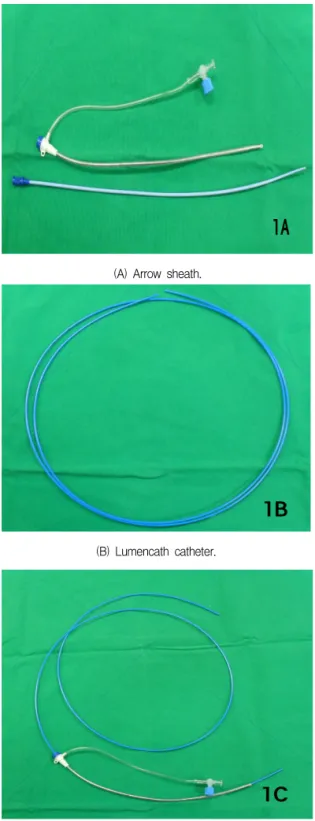
재발하여 협착이 진행된 간담도내에 혈액 내 빌리 루빈 수치 정상을 위하여, 우선적으로 경피적 담도 배 액관 및 stent를 삽입 후 치료를 진행하였다. 일차적으 로 삽입된 경피적 담도 배액관은 치료용 관이 삽입되 기에는 직경이 좁고, distal end portion이 pig tail 형태 로, 관내 근접 치료용 관이 삽입되기에는 부적절하였 다. 이에 본 연구에서는 담도 배액 기능을 고려하여, 직경이 7 french인 말단부가 일직선으로 개방 된 Arrow Sheath (Straight end open sheath, Arrow international, U.S.A)로 교체 후, 근접치료 전용 Lumencath (Intraluminal catheter, Cook, U.S.A)를 삽입하 여 simulation (conventional simulation, 일차 모의 치료) 및 치료를 진행하였다(Fig 1).
(A) Arrow sheath.
(B) Lumencath catheter.
(C) Lumencath catheter was adapted in Arrow sheath.
Figure 1. Arrow sheath and Lumencath catheter.
치료 계획은 Plato planing system (BPS v14.2.6 Neucletron, Netherlands)으로 orthogonal film을 이용하였고, 치료 표적 용적인 협착 된 담도의 distal and
proximal end point에서 1 cm, central axis로부터 1 cm 떨어진 지점을 선량표준화(normalization) 하였다(Fig. 2).
(A) Coronal image.
(B) Sagittal image.
(C) 3D image.
Figure 2. The geometrically optimized dose generated using Plato planning system. 300 cGy was given to the
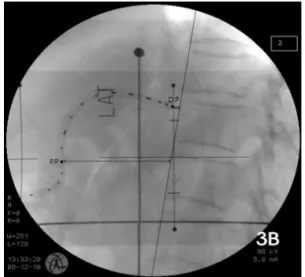
open 형태이어서, 경피적 담도 배액관처럼 내부에 일 정하게 고정하기 어려운 점을 감안하여, 근접 치료 시 set-up 재현성 유지 여부를 확인하기 위하여, 치료 전 치료 표적 용적 말단부와 흉추 10번, 근위부와 흉추 11 번 anterior body surface사이의 거리를 dummy seed 삽입 후 lateral image에서, 매주 1회씩 총 5회에 걸쳐 측정하 여 평균값을 계산하였다. Simulation 시행 시에 측정된 거리와 치료 시에 측정된 거리의 평균과 표준편차의 변이 정도를 비교하여, SPSS ver. 12.0 (SPSS Inc., Chicago, IL, USA)을 사용하여 오차율 5% 이내로 유의 수준을 평가하였다.(Table 1. Fig. 3).
Point Area Distance (cm)
Distal Point to Thoracic
vertebrae 10 0.5
Proximal Point to Thoracic
vertebrae 11 6.0
Table 1. Distance between dummy source position and vertebral body anterior surface in simulation film
(A) Anterior-Posterior image.
(B) Right-Left lateral image.
Figure 3. Orthogonal image by conventional simulation with dummy source in Intraluminal brachytherapy
catheter.
P.P: treatment target volume proximal end point.
D.P; treatment target volume distal end point.
환자의 치료는 Ir-192 HDR micro selectron after-loading system (Neucletron, Netherlands)을 이용하여 일 회당 3 Gy 씩 일주일 두 번 시행을 원칙으로 하여 총 10회 시행하여 30 Gy를 조사하였다.
III. 결과
Simulation 시행 시 치료 표적 용적 말단부와 근위부 의 기준점에서 흉추 10번, 11번 anterior body surface 사 이의 거리는 각각 0.5 cm, 6 cm 이었으며, 매주 치료 전 근접치료용 관에 dummy seed 삽입 후 5회 반복하 여 측정한 거리 평균값은 각각 0.5 cm, 6.1 cm, 표준편 차는 각각 0.06과 0.08이었다. 각각 말단부와 근위부에 서 치료 전 측정한 거리를 치료 계획 설계시의 기준 거리인 0.5 cm, 6 cm과 비교한 결과, 오차율 5% 이내 로 유의한 수준으로 매회 치료시마다 set-up 재현성이 유지되는 것으로 평가할 수 있었다(Table 2).
Distance (cm) 1 2 3 4 5 Mean SD p-value
Distal Point
Distance 0.4 0.5 0.5 0.6 0.5 0.5 0.06 < 0.01 Proximal
Point Distance
6.0 6.2 6.2 6.0 6.1 6.1 0.08 < 0.01
SD: standard deviation
Table 2. Mean distance between dummy source and anterior vertebral body surface
특히, 치료 계획 coronal image상 (Fig. 2.,) 근위부에 서 장과 담도의 연접 부위는 매회 3 Gy 방사선 조사 시 마다 75 cGy 이하로 선량 표준화 되는 지점에 위치 해 있었으며, 총 30 Gy 조시 시 전체 선량의 25%인 7.5 Gy가 조사되는 것으로 계산되었다. 이는 방사선 치료 를 받은 환자 5%에서 5년 이내 만성 부작용을 일으킬 수 있는 평균 장의 한계 선량인 (TD5/5) 45 Gy보다[7]
적게 방사선이 조사가 된 것으로 판단할 수 있으며, 본 연구에서 시행한 근접 치료 또한 심각한 부작용 발 생 없이 완료할 수 있었고, 치료 후 추적 검사 상에서 도 특이할만한 만성 부작용은 관찰되지 않았다. 치료 종료 두 달 후 시행 한 조직 검사 상 종양 세포는 관 찰되지 않았으며, 방사선 치료 후 생존 기간에 대한 추적 검사 상에서도 무병생태로 1년 이상 생존하고 있 다.
IV. 고찰 및 결론
간담도암은 수술적 절제가 일차적인 근치적 치료 법이나, 진단 당시 간 실질 및 간내 담도까지 병변이 진행된 경우가 많아 완전 절제가 어려우며, 종양 경계 면에서 수술적 절제연까지 여유 경계가 짧아 완전 절 제술을 시행하였다 하더라도 국소 재발이 많이 발생 하고 있는 암종이다[1],[2]. 또한, 재발이 된 경우 남아 있 는 담도의 여유 길이가 부족하여 재수술은 시행이 어 려운 상태이어서, 재발시 대부분의 경우 경피적 담도 배액관이나 stent 삽입 등의 고식적 치료를 시행하고 있다. 그러나, 이러한 고식적 치료만 시행한 경우, 대 게 평균 생존 기간은 5개월 미만이고, 대부분의 환자 들은 담도 폐색에 의한 간 기능 부전으로 사망하고 있 다[4],[6].
환자에서 항암 화학 치료가 시도되고 있으나, 간담도 암은 세포 특성상 항암 화학제에 대한 반응률이 낮고, 수술 후 혈류가 감소되어 저산소 세포 분할이 높아 항 암 화학제에 대한 반응률은 10-30% 정도로 낮게 보고 되고 있고, 항암 화학 치료 결과에 대한 연구 보고 또 한 많지 않아서 적절한 화학용법 제제의 선택이 어려 운 상태이다[9],[10].
간 담도암의 경우는 성장 속도가 빠르지 않고, 원격 전이 보다는 국소적인 침습이 특징으로, 근치적 절제 술을 받았더라도 원발 병소와 주변 임파절에서의 재 발이 치료 실패의 주된 원인이기에, 국소 재발을 막 는 것이 치료 효율을 상승시킬 수 있는 방법이다. 이 에, 수술 외에 국소 치료법으로 방사선 치료의 시행이 최근 많이 고려되고 있다. 간 담도암의 방사선 치료 시 치료 효과를 높이기 위하여, 최대한 종양에 50 Gy 이상의 방사선을 조사하는 것이 종양 제어에 효과적 이라는 연구 보고가 있으며[7], 최근 삼차원 입체 조형 방사선 치료 및 세기 변조 방사선 치료와 근접치료가 시도되면서, 주변 정상 장기인 간과 장에는 만성 부작 용 발생 가능 한계선량 이하로 조사가 되도록 하면서, 치료 표적 용적에는 심각한 부작용의 발생 없이 효과 적으로 종양을 제어 할 수 있도록 고선량을 조사할 수 있게 되었다[7],[9]. 특히, 주변 임파절에 재발 소견 없이 수술 문합 부위인 간담도 부위만 재발한 경우, 외부 방사선 치료 보다는 근접 치료를 우선적으로 고려해 볼 수 있으며, Bruha 등[11]이 발표한 연구결과에 따르 면 30 Gy 관내 근접치료를 시행한 11명 환자의 중앙 생존 기간은 7개월, 1년 생존율은 18%였으며, Yoon 등
[12]이 발표한 24명 환자의 고선량율 관내 근접치료 결 과에서도 중앙 생존 기간은 7.3개월, 1년 이상 생존율 은 20.8%로, 고식적 치료만 시행 받은 환자와 비교하 여 생존율이 향상되는 것을 보고하였다.
그러나, 고선량율 근접치료의 경우 기존의 경피적 담도 배액관을 이용할 수 있다는 장점이 있으나, 치료 용 관이 치료 표적 용적인 distal end portion까지 적절 하게 삽입되기에는 배액관의 직경이 좁고, 형태학적 문제로 치료하고자 하는 부위까지 intaluminal catheter 를 충분히 삽입하기에는 어려움이 많아 제한점으로
피적 담도 배액관보다 직경이 더 넓고 end portion의 형태가 일직선으로 개방되어 담도 배액 기능도 할 수 있는 Arrow Sheath로 교체 후 치료를 진행 하였다. 기 존의 경피적 담도 배액관이 pig tail 형태로 체내에서 고정되었으나, 본 연구에서 사용한 관은 straight end open관이어서 고정상의 문제가 염려되었으나, 매회 치 료 시 set-up 재현성은 유의할만한 수준으로 유지되었 으며, 치료 중 심각한 부작용의 발생 없이 치료를 완 료할 수 있었고 ,치료 결과 또한 만족할 만한 수준이 었다.
따라서, 새로운 관내 치료용 관의 임상 활용을 위해 서는, 추후 재발한 많은 환자에서 Arrow Sheath를 이용 한 근치적 목적의 근접치료를 시행하여, 치료 부작용 발생 정도 및 set-up 재현성 유지 정도, 그리고 생존율 향상 정도에 대한 장기적인 평가가 필요하며, 간담도 암의 경우 재발 시에는 1년 이상 생존하는 경우가 흔 치 않고 전반적으로 예후가 불량하기 때문에, 향후 표 적 맞춤 항암 화학 치료 및 방사선 민감제와의 병용치 료 등을 고려하여 치료 반응률을 높이기 위한 연구 또 한 추가적으로 필요하다고 하겠다.
Acknowledgements
This paper was supported by Fund of Reserch Institute of Clinical Medicine, Chonbuk National University Hospital.
Reference
[1] Takada T, Miyazaki M, Miyakawa S, Tsukada K, Nagino M, Kondo S, Furuse J, Saito H, Tsuyuguchi T, Kimura F, Yoshitomi H, Nozawa S, Yoshida M, Wada K, Amano H, Miura F. Purpose, use, and preparation of clinical practice guidelines for the management of biliary tract and ampullary carcinomas.J Hepatobiliary Pancreat Surg. Vol. 15, no. 1, pp.2-6, 2008.
[2] Klempnauer J, Ridder GJ, Werner M, Weimann A, Pichlmayr R. What constitutes long term survival after surgery for hilar cholangiocarcinoma? Cancer. Vol. 79, pp.26-34, 1997.
[3] Lee SG, Lee YJ, Pa가 KM, Hwang S, Min PC. One houndred and eleven liver resections for hilar bile duct cancer. J Hepatobiliary Pancreat Surg. Vol. 7, pp.135-141, 2000.
WMC, Taylor-Robinson SD, Thillaianayagam AV, Thomas HC, Thursz MR, Wasan H. Guidelines for the diagnosis and treatment of cholangiocarcinoma: consensus document. Gut. Vol.
51(Suppl. 6), VI1-9, 2002.
[5] Shirabe K, Shimada M, Harimoto N, Sugimachi K, Yamashita Y, Tsujita E, Aishima S. Intrahepatic cholangiocarcinoma: its mode of spreading and therapeutic modalities. Surgery. Vol.
131(Suppl 1), S159-164, 2002.
[6] Sagawa N, Kondo S, Morikawa T, Okushiba S, Katoh H.
Effectiveness of radiation therapy after surgery for hilar cholangiocarcinoma. Surg Today. Vol. 35, pp.548-552, 2005.
[7] Ove R, Kennedy A, Darwin P, Haluszka O. Postoperative endoscopic retrograde high dose rate brachytherapy for cholangiocarcinoma. Am J Clin Oncol. Vol 23, pp.559-561, 2000.
[8] Lu JJ, Bains YS, Abdel-Wahab M, Brandon AH, Wolfson AH, Raub WA, Wilkinson CM, Markoe AM. High dose rate remote afterloading intracavitary brachytherapy for the treatment of extrahepatic biliary duct carcinoma. Cancer J. Vol. 8, pp.74-48, 2002.
[9] Sauz-Altamira PM, Ferante K, Jenkins RL, Lewis WD, Huberman MS, Stuart KE. A phase II trial of 5-fluorouracil, leucovorin, and carboplatin in patients with unresectable biliary tree carcinoma. Cancer. Vol. 82, pp.2321-2325, 1998.
[10] Todoroki T. Chemotherapy for bile duct carcinoma in the light of adjuvant chemotherapy to surgery. Hepatogastroenterology.
Vol. 47, pp.644-649, 2000.
[11] Bruha R, Petrtyl J, Kubecova M, Marecek Z, Dufek V, Urganek P, Kodadova J, Chodounsky Z. Intraluminal brachytherapy and selfexpendable stents in nonresectable biliary malignancies - The question of long term palliation.
Hepatogastroenterology. Vol. 48, pp.631-637, 2001.
[12] Yoon WS, Kim TH, Yang DS, Choi MS, Kim CY.
High-dose-rate intraluminal brachytherapy for biliary obstruction by secondary malignant biliary tumors. J The Korean Soc Ther Radiol Oncol, Vol. 21, No. 1, pp.35-43, 2003.