Corresponding author: Insun Jang
Department of Nursing, Korean Bible University, 32 Dongil-ro, 214-gil, Nowon-gu, Seoul 01757, Korea.
Tel: +82-2-950-5485, Fax: +82-2-950-5484, E-mail: [email protected] Received: Feb 28, 2020 / Revised: Apr 24, 2020 / Accepted: Apr 24, 2020
This is an open access article distributed under the terms of the Creative Commons Attribution Non-Commercial License (http://creativecommons.org/licenses/
by-nc/3.0), which permits unrestricted non-commercial use, distribution, and reproduction in any medium, provided the original work is properly cited.
Factors Affecting Vaccination Status of Female Adolescents Subject to the Korean National HPV Immunization Program: Focusing on Mothers' HPV
Knowledge and Heath Beliefs of HPV Vaccines
Seungmi Park1 · Insun Jang2 · Jung Lim Lee3 · Youngji Kim4
1Department of Nursing, Hoseo University, 2Department of Nursing, Korean Bible University, 3Department of Nursing, Daejeon University,
4Department of Nursing, College of Nursing and Health, Kongju National University
ABSTRACT
Purpose: HPV vaccination is important for the prevention of cervical cancer and genital warts and it is recom- mended that females be vaccinated against HPV before having sexual contact. Although the national HPV immunization has recently started in Korea, the vaccination rate is still not high. This is a relevant study attempting to investigate the factors affecting the vaccination status of female adolescents in the target age groups focusing on mothers' knowledge and health beliefs of HPV vaccines. Methods: Participants were 206 mothers who had daughters at the target age for the national HPV vaccination program living in a metropolitan city. Data were collected using a self-reported questionnaire about HPV knowledge and health beliefs of HPV vaccines, consisting of perceived susceptibility seriousness, benefits, barriers, and cues to action. Results: The participants’
knowledge of HPV was significantly correlated with the overall health beliefs. The factors influencing mothers regarding the HPV vaccination status of their adolescent daughters were found to be perceived barriers, advice on vaccination from medical staff, and perceived benefits. Conclusion: There is a need to organize subject-specific education programs focusing on correcting misinformation about the side effects and benefits of HPV vaccines.
When operating education programs, it is recommended that participants include both students and their parents, that various approaches be implemented such as formal health classes, home correspondence and online education, and that medical personnel be also involved as education providers.
Key Words: Human papillomavirus; Vaccination; Mothers; Knowledge
INTRODUCTION
Human papillomavirus (HPV) is a common sexually transmitted infection and persistent infection with high risk types of HPV can lead to development of cervical, anal, penile, vaginal, vulvar, and oropharyngeal cancers [1]. The HPV prevalence worldwide among women with normal cytologic findings is estimated to be 11.7% [2].
Overall HPV infection rate of 60,775 Korean women from 2006 to 2011 was 34.0% and high-risk infection rate in- cluding primary carcinogenic types was 17.5%[3]. HPV vaccination can prevent more than 70% of cervical cancer [1] and is a cost-effective and cost saving way, particularly in settings without organized cervical screening program- mes in low and middle income countries [4]. By 2017, glo-
bally 71 countries had introduced HPV vaccine in their national immunization program for girls since the WHO’s 2009 recommendation [2]. The prevalence of abnormal cytology results was significantly lower in women aged 20~24 years who had received an HPV vaccination (0.242%) than in those who had not (2.04%) and the reduction in the rate of abnormal cervical cytology results by HPV vacci- nation was 88.1%[5]. Common side effects of the HPV vaccine to be reported are minor such as localized pain (80%), redness and swelling of the injection site, and sys- temic reactions such as fever, dyspepsia, abdominal pain, myalgia and arthralgia [2]. All HPV vaccines demonstrated an acceptable safety profile [6]. The WHO Global Advisory Commiiee for Vaccine Safety (GACVS) concluded that the available evidence did not suggest any safety concern re-
garding the use of HPV vaccines [2].
HPV vaccination is recommended for prevention of cer- vical cancer and genital warts and it is recommended that females be vaccinated against HPV before sexual contact [1,2]. In Korea, the Korea Centers for Disease Control and Prevention recommended routine immunization for 11~
12 year old girls in 2017. The 2-dose series HPV vaccine is recommended for girls aged 9 to 14, and the 3-dose series is recommended for those aged 14 or older. Additionally, quadrivalent HPV vaccine (Gardasil®) has been approved for males and is being used to vaccinate males aged 9~26 [1].
Since HPV vaccine was developed, it has been recom- mended as the most effective preventive measure among methods of preventing cervical cancer [1,2]. Because the Korean government has tried to manage to prevent cer- vical cancer by including it in the national immunization program, HPV vaccine was included in the national im- munization program in 2015, at which time it was im- plemented on a limited basis. In June of 2016, HPV was designated as a national immunization project, and for Gardasil and Survarix, two doses of the vaccines were given to girls aged 12 and 13[1]. Although it has not yet been designated as a nationally notifiable infectious dis- ease, HPV is expected to be designated as such by the Minister of Health and Welfare, at which time it will be managed as a vaccine-preventable group 2 infectious dis- ease through the subsequent revision of the relevant laws [7].
It has been reported that the HPV vaccine immuniza- tion rate is 43.8% among adolescent girls born in 2003, who were the target group for the national HPV immuni- zation program in 2016, while it is 35.0% among those born in 2004, indicating that the vaccination rates in Korea are low [1]. Also, the secondary vaccination rate was 41.8%
and less than half of adolescent girls completed their vac- cination [8]. Considering these vaccination rate, it is nec- essary to investigate the cause of low immunization and develop a strategy to increasing it.
The Health Belief Model (HBM) is one of the most fre- quently applied research frameworks for understanding health behaviours including vaccine uptake [9,10]. Health beliefs affect individuals' performance regarding vacci- nation and have been identified as a significant factor in- fluencing HPV vaccination [11]. The HBM's constructs, which have previously been adopted in HPV vaccine re- search, include self-efficacy and perceived threats, sus- ceptibility, severity, benefits, and barriers [9]. It is well known that mothers' knowledge, intentions and attitudes are important in decision-making regarding vaccination
of female adolescents [12]. Therefore, when analysing the causes of the low HPV vaccination rate in Korea, it is im- portant to investigate the individual factors affecting these rates focusing on health beliefs.
This study was conducted to investigate knowledge re- garding HPV vaccine, related beliefs, and vaccination sta- tus of female adolescents among mothers with female adolescents of the target age group (born in 2004 or 2005) for the national HPV immunization program in a metro- politan area in Korea. The specific objectives are as fol- lows: 1) To investigate general characteristics, HPV know- ledge, and health beliefs related to HPV. 2) To compare the differences in HPV vaccination status according to these characteristics. 3) To investigate the correlation be- tween HPV knowledge and health beliefs related to HPV, 4) To identify factors influencing HPV vaccination status.
Through this research, we intend to provide basic data for establishing an effective program to increase the imple- mentation of national HPV immunization in Korea.
METHODS
1. Design and ParticipantsThis investigation was a descriptive study to identify the factors influencing the vaccination status of target- aged female adolescents for national HPV vaccination fo- cusing on the mothers' knowledge and health beliefs re- lated to HPV. The participants of this study were mothers with female adolescents of the target age for national HPV vaccination (first- and second-year students in middle school, i.e. adolescents born in 2004 or 2005) living in a metropolitan city in Korea. Participants were recruited through convenient sampling in visiting mothers' meet- ings of three middle schools.
2. Data Collection/ Ethical Consideration
A survey was conducted from April to June 2018 by re- searchers' visiting mothers' meetings to distribute struc- tured questionnaires individually. The survey was con- ducted after asking mothers whether they would volun- tarily agree to participate in the study using research gui- dance materials explaining the purpose, contents, and pro- cedures of the research and the absolute confidentiality of the research data and obtaining informed consent forms from them. Data collection was conducted after receiving approval from the IRB (201803-SB-001-02). The sample size was determined using the G power 3.1 program. When logistic regression analysis was conducted by applying a
significance level of ⍺=.05, power of 1-β=.95, and odds ratio of 2.0, which is approximately a median value of the odds ratios of 1.16~3.78 reported in Park [13], the mini- mum sample size was calculated to be 180. Therefore, the survey was conducted with the goal of collecting data from 210 individuals considering the withdrawal rate (about 15%), and 206 questionnaires were included in the final analysis.
3. Measurements 1) General Characteristics
The mother's age, education level (high school, college or university, or graduate school or higher), economic sta- tus (high, medium, low), employment status, presence of family history of cervical cancer, only-child status and birth order (only child, first-born, second-born, and third- or later-born), awareness of HPV vaccine, experience of education regarding HPV vaccine, advice regarding HPV vaccination from school, and advice regarding HPV vac- cination from medical staff such as a medical institution were recorded.
2) HPV Vaccination Status
To determine the free HPV vaccination status of their female adolescents, the participants were asked to answer yes or no in response to the question “Did your daughter get the HPV vaccine?”.
3) HPV Knowledge
The level of HPV knowledge was assessed using the HPV knowledge assessment tool developed by Park and Choi [14] and modified by researchers. Park and Choi [14]
developed it based on the recommendations about vacci- nation from the United States Centers for Disease Control and Prevention and previous studies. To increase the val- idity of the tool, it was verified by an obstetrician-gynae- cologist and two professors in maternity nursing. The tool was composed of a total of 15 questions consisting of spe- cific items pertaining to the association between HPV and cervical cancer, the range of the symptoms of HPV, the in- cubation period, its prognosis and association with im- munity, affected ages, infection routes, testing and diag- nosis, prevention and treatment, and HPV vaccine. The response of each item were scored by giving 1 point for each correct response and 0 points for each incorrect re- sponse, with the total scores ranging between 0 and 15 points, and higher scores indicating higher levels of know- ledge about HPV and HPV vaccine. Regarding the reli- ability of the tool, the KR-20 coefficient was estimated to
be .89 by Park and Choi [14], and it was .78 in this study.
4) Health Beliefs Related to HPV
The health beliefs about HPV were assessed using the tool proposed by Lee and Park [16], who developed it by modifying and supplementing the original version cre- ated by Choi et al. [16] based on the health belief model.
The tool was used after receiving approval from the de- veloper of the original version and permission from the developer of the modified version by email.
This tool includes 6 subfactors: perceived susceptibility, perceived seriousness, perceived benefits, perceived bar- riers, self-efficacy, and cues to action. The tool consists of 15 questions; two items on perceived susceptibility (ask- ing about the possibility and fear of HPV infection), two on perceived seriousness (asking about psychological se- riousness of the disease, and seriousness that would affect future life in case the disease becomes serious), two on perceived benefits (asking about the benefits of vaccina- tion), three on perceived barriers (asking about the side ef- fects of vaccination, the inconvenience of the 2-dose vacci- nation schedule, and pain caused by injection). In addi- tion, three items for self-efficacy regarding the ability and motivation to put into practice cervical cancer prevention behaviours used in Cho [17], and three items pertaining to three types of cues to action, such as internal, interper- sonal, and media communication cues, were used; there- fore, the tool was comprised of a total of 15 items.
The responses for each item were scored on a Likert 4- point scale, with 4 points indicating 'strongly agree', 3 points 'generally agree', 2 points 'generally disagree', and 1 point 'strongly disagree.' The items of perceived barriers were reverse coded, so higher scores indicate lower levels of perceived barriers. Higher total scores indicate higher levels of HPV-related health beliefs. In Lee and Park [15], the reliability of each subdomain of the tool was .71 for perceived susceptibility, .74 for perceived seriousness, .74 for perceived benefits, .62 for perceived barriers, and .62, for self-efficacy. In Cho [18], Cronbach's ⍺ was .66 for self- efficacy and .72~.83 for cues to action. In this study, Cron- bach's ⍺ was .70 for perceived susceptibility, .80 for per- ceived seriousness, .79 for perceived benefits, .65 for per- ceived barriers, .68 for self-efficacy, and .71 for cues to action.
4. Data Analysis
The collected data were analysed using the SPSS 21.0 statistical program. The statistical significance level was always set to .05.
Data describing general characteristics, HPV knowl- edge, and HPV-related health beliefs were analysed to calculate descriptive statistics such as the frequency, percentage, mean, and standard deviation.
The differences in HPV vaccination status according to the characteristics were analysed using the x2 test and t-test.
The correlations between HPV knowledge and HPV- related health beliefs were analysed using the Pearson correlation coefficient.
The factors influencing the HPV vaccination status of the female adolescents of the participants were ana- lysed using the logistic regression model.
RESULTS
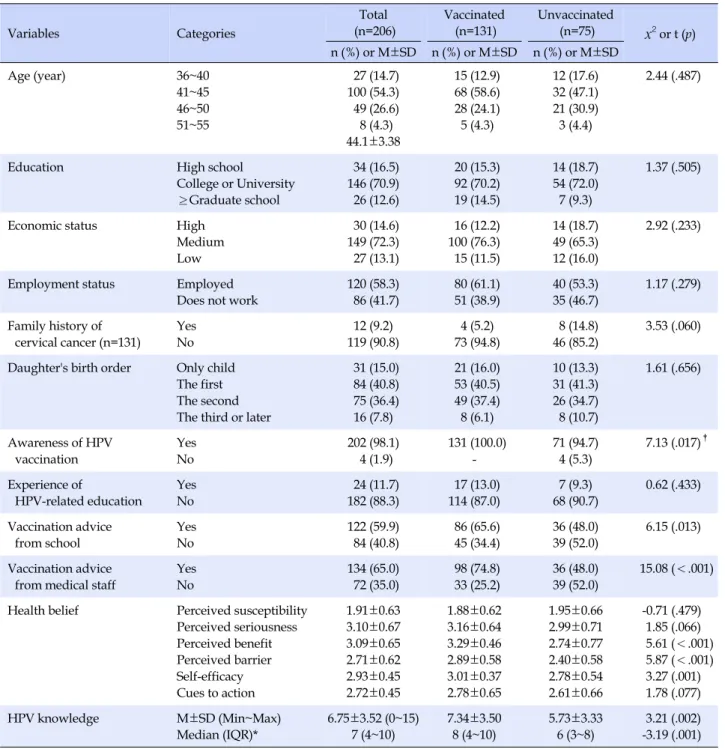
1. Differences in the General Characteristics, HPV Knowledge, and Health Beliefs Related to HPV of the Participants according to the Vaccination Status of Female Adolescents in the Target Age Group for the National HPV Immunization Program The general characteristics of mothers with female ado- lescents of the target age groups for national HPV immu- nization were as follows: the 41~45 age group accounted for the largest proportion (54.3%, 100 persons), followed by the 46~50 age group (26.6%, 49 persons), and the mean age was 44.1 years (SD=3.38). Regarding the educational level, college or university graduates accounted for the largest proportion of the participants (70.9%, 146 persons), followed by high school graduates (16.5%, 34 persons) and participants with a master's degree or higher (12.6%, 26 persons). The economic status of 72.3% (149 persons) of the participants was medium, and 58.3% (120 persons) were employed. Among 131 respondents, 9.2% (12 persons) had a family history of uterine cancer. Evaluation of the birth- order of the female adolescents revealed that first-born fe- male adolescents accounted for the largest proportion (40.8%, 84 persons), followed by second-born female ado- lescents (36.4%, 75 persons), female adolescents being the only child (15.0%, 31 persons), and third- or later-born fe- male adolescents (7.8%, 16 persons). A total of 98.1% (202 persons) were aware of the HPV vaccine, but 63.6% (131 persons) had their daughters vaccinated with HPV vac- cine. Additionally, 11.7% (24 persons) had education re- garding HPV vaccination, 59.9% (122 people) had received advice (or family correspondence, promotion materials, etc.) about getting their female adolescents vaccinated against HPV from their homeroom teacher or health teach- er at school, and 65.0% (134 people) had received advice
about getting their female adolescents vaccinated against HPV from medical staff (doctors, nurses, etc.) in a medical institution or public health centre. In relation to these characteristics, the HPV vaccination rate was higher in the group of mothers who were aware of HPV vaccination (p=.017), and in the group of the mothers who had re- ceived advice from the school (p=.013) or from medical staff (p<.001).
Higher scores for health beliefs related to HPV indicate higher levels of health beliefs, and the score of the vacci- nated group was 2.85±0.30 points, which was higher than that of the unvaccinated group (2.58±0.36; p<.001). In terms of the subdomains, the scores for perceived benefits (p=.005), perceived barriers (p=.001), and self-efficacy (p=
.001) were higher in the vaccinated group than in the un- vaccinated group.
The mean score of the total participants for 15 questions about HPV knowledge was 6.75±3.52 points (range: 0~15 points), and the mean score of the vaccinated group was 7.34±3.50 points, which was higher than 5.73±3.33 points of the unvaccinated group (p=.002). Because the mean values of correct responses did not follow the normal dis- tribution, the medians and interquartile ranges were pre- sented, and there was also a statistically significant dif- ference (p=.001) between the vaccinated group with a median of 8 points (interquartile range: 4~10) and the unvaccinated group with a median of 6 points (interquar- tile range: 3~8) (Table 1).
2. Correlations between HPV Knowledge and Health Beliefs Related to HPV
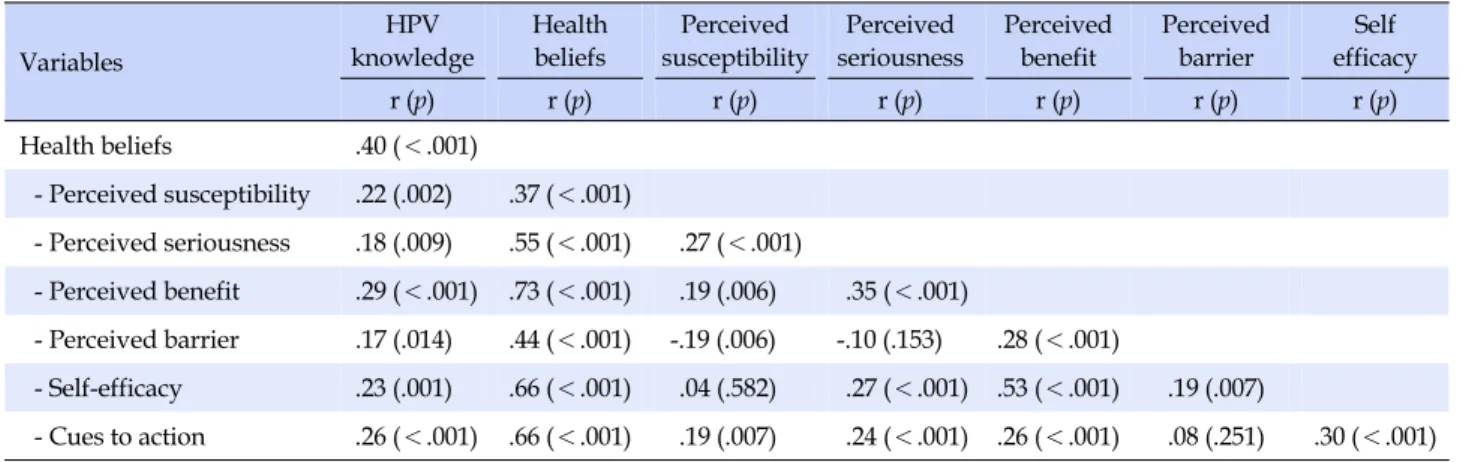
The HPV knowledge of the participants was signifi- cantly correlated with the overall health beliefs (r=.40, p<.001) and with all the subdomains of this factor, i.e.
perceived susceptibility (r=.22, p=.002), perceived serious- ness (r=.18, p=.009), perceived benefits (r=.29, p<.001), perceived barriers (r=.17, p=.014), self-efficacy (r=.23, p=
.001), and cues to action (r=.26, p<.001)(Table 2).
3. Influences on the HPV Vaccination Status of Fe- male Adolescents of the Participants
To identify the factors influencing the vaccination sta- tus of female adolescents of the target age group of the na- tional HPV immunization program, a binary multiple lo- gistic regression analysis was performed by entering the variables that showed significant differences in the HPV vaccination status of female adolescents among variables of general characteristics, HPV knowledge, and health be-
Table 1. Descriptive Statistics and Bivariate Relationships between Vaccinated and Unvaccinated Participants (N=206)
Variables Categories
Total (n=206)
Vaccinated (n=131)
Unvaccinated
(n=75) x2 or t (p) n (%) or M±SD n (%) or M±SD n (%) or M±SD
Age (year) 36~40
41~45 46~50 51~55
27 (14.7) 100 (54.3) 49 (26.6) 8 (4.3) 44.1±3.38
15 (12.9) 68 (58.6) 28 (24.1) 5 (4.3)
12 (17.6) 32 (47.1) 21 (30.9) 3 (4.4)
2.44 (.487)
Education High school
College or University
≥Graduate school
34 (16.5) 146 (70.9) 26 (12.6)
20 (15.3) 92 (70.2) 19 (14.5)
14 (18.7) 54 (72.0) 7 (9.3)
1.37 (.505)
Economic status High
Medium Low
30 (14.6) 149 (72.3) 27 (13.1)
16 (12.2) 100 (76.3) 15 (11.5)
14 (18.7) 49 (65.3) 12 (16.0)
2.92 (.233)
Employment status Employed
Does not work
120 (58.3) 86 (41.7)
80 (61.1) 51 (38.9)
40 (53.3) 35 (46.7)
1.17 (.279)
Family history of cervical cancer (n=131)
Yes No
12 (9.2) 119 (90.8)
4 (5.2) 73 (94.8)
8 (14.8) 46 (85.2)
3.53 (.060)
Daughter's birth order Only child The first The second The third or later
31 (15.0) 84 (40.8) 75 (36.4) 16 (7.8)
21 (16.0) 53 (40.5) 49 (37.4) 8 (6.1)
10 (13.3) 31 (41.3) 26 (34.7) 8 (10.7)
1.61 (.656)
Awareness of HPV vaccination
Yes No
202 (98.1) 4 (1.9)
131 (100.0) -
71 (94.7) 4 (5.3)
7.13 (.017)†
Experience of
HPV-related education
Yes No
24 (11.7) 182 (88.3)
17 (13.0) 114 (87.0)
7 (9.3) 68 (90.7)
0.62 (.433)
Vaccination advice from school
Yes No
122 (59.9) 84 (40.8)
86 (65.6) 45 (34.4)
36 (48.0) 39 (52.0)
6.15 (.013)
Vaccination advice from medical staff
Yes No
134 (65.0) 72 (35.0)
98 (74.8) 33 (25.2)
36 (48.0) 39 (52.0)
15.08 (<.001)
Health belief Perceived susceptibility Perceived seriousness Perceived benefit Perceived barrier Self-efficacy Cues to action
1.91±0.63 3.10±0.67 3.09±0.65 2.71±0.62 2.93±0.45 2.72±0.45
1.88±0.62 3.16±0.64 3.29±0.46 2.89±0.58 3.01±0.37 2.78±0.65
1.95±0.66 2.99±0.71 2.74±0.77 2.40±0.58 2.78±0.54 2.61±0.66
-0.71 (.479) 1.85 (.066) 5.61 (<.001) 5.87 (<.001) 3.27 (.001) 1.78 (.077)
HPV knowledge M±SD (Min~Max)
Median (IQR)*
6.75±3.52 (0~15) 7 (4~10)
7.34±3.50 8 (4~10)
5.73±3.33 6 (3~8)
3.21 (.002) -3.19 (.001) Missing values are excluded; IQR=Interquartile range; *Non-normal distribution, †Fisher's exact test.
liefs related to HPV. As a result, the factors that had a sig- nificant impact on the HPV vaccination status of female adolescents of the target age group were identified as fol- lows: the odds ratio (OR) for the group of mothers that were advised to get their child vaccinated against HPV by health care providers (doctors, nurses, etc.) in a medi- cal institution or public health centre was 3.12 (95% CI 1.44~6.78), the odds ratio for the group with high levels of
perceived benefits among the sub-factors of health beliefs was 2.74 (95% CI 1.31~5.70), and the odds ratio for the group showing high scores of perceived barriers (low level of per- ceived barriers) was 3.33 (95% CI 1.67~6.61). Therefore, ad- vice given by health care providers, higher perceived bene- fit, and lower perceived barriers of mothers increase the in- tention of HPV vaccination of their daughters. However, awareness of HPV vaccine, advice given by the homeroom
Table 2. Correlations among HPV Knowledge and Health Beliefs Related to HPV (N=206) Variables
HPV knowledge
Health beliefs
Perceived susceptibility
Perceived seriousness
Perceived benefit
Perceived barrier
Self efficacy
r (p) r (p) r (p) r (p) r (p) r (p) r (p)
Health beliefs .40 (<.001)
- Perceived susceptibility .22 (.002) .37 (<.001)
- Perceived seriousness .18 (.009) .55 (<.001) .27 (<.001)
- Perceived benefit .29 (<.001) .73 (<.001) .19 (.006) .35 (<.001)
- Perceived barrier .17 (.014) .44 (<.001) -.19 (.006) -.10 (.153) .28 (<.001)
- Self-efficacy .23 (.001) .66 (<.001) .04 (.582) .27 (<.001) .53 (<.001) .19 (.007)
- Cues to action .26 (<.001) .66 (<.001) .19 (.007) .24 (<.001) .26 (<.001) .08 (.251) .30 (<.001)
Table 3. Percentage and Odds Ratio (95% CI) of Intention of HPV Vaccination (N=206)
Variables Odds ratio 95% CI p
Awareness of HPV vaccination (1=Yes) 1679303361 - .999
Vaccination advice from school (1=Yes) 1.78 0.86~3.70 .120
Vaccination advice from medical staff (1=Yes) 3.12 1.44~6.78 .004
Perceived susceptibility 0.71 0.37~1.37 .306
Perceived seriousness 1.50 0.81~2.80 .198
Perceived benefit 2.74 1.31~5.70 .007
Perceived barrier 3.33 1.67~6.61 .001
Self-efficacy 1.09 0.40~2.98 .866
Cues to action 0.78 0.40~1.52 .466
HPV knowledge 1.10 0.98~1.22 .103
teacher or health teacher at school, and perceived suscepti- bility, perceived seriousness, self-efficacy, and cues to ac- tion among health beliefs and HPV knowledge were not statistically significant (Table 3).
DISCUSSION
In Korea, HPV vaccination started to be implemented for 12-year-old girls in 2016, but the vaccination rate is currently only 43.2%[1]. Moreover, the secondary vacci- nation rate is only 41.8% and more than half of adolescent girls did not complete their HPV vaccination [8]. Although the vaccination rate is expected to increase gradually in the future, it is currently very low; therefore, this study was conducted to examine the factors influencing the vac- cination status based on HPV knowledge and health be- liefs by conducting a survey of mothers in Korea who are decision-makers about vaccination of their female adoles- cents.
The results showed that perceived barriers, vaccination advice from healthcare providers, and perceived benefits are significant factors influencing the HPV vaccination status of the female adolescents of surveyed mothers, among which the factor off perceived barriers is the stron- gest predictor. The perceived barrier refers to the percep- tion of undesirable consequences that may result from vaccination [18]. The perceived barriers were found to be side effects, inconvenience of the 2-dose vaccination sched- ule and pain. Among these, fear of side effects is the factor for which interventions can be conducted through the cor- rection of misinformation and education. The results of a recent study of the barriers to HPV vaccination conducted in the United States among parents who did not begin or complete HPV vaccination of their female adolescents were similar to those of this study, and identified factors such as safety of vaccines and problems with perceived bar- riers such as the inability to recognize the necessity for a multi-dose vaccination series [19]. Park [20] investigated
the reasons for which some mothers do not get their daughters vaccinated against HPV and found that more than half of the respondents attributed it to the side ef- fects. There are considerable public concerns about vac- cines because of the side effects of HPV vaccines reported in Japan in 2016[21], and although the researchers at Tok- yo University withdrew their study results from the jour- nal in which the paper was published, many parents still have incorrect information that the HPV vaccine may cause brain damage [22]. However, studies based on clin- ical data have reported that the most common side effects of the HPV vaccine are localized pain at the injection site (80%), redness and swelling of the injection site, and sys- temic reactions such as fever, dyspepsia including nausea, vomiting, abdominal pain, myalgia and arthralgia; how- ever, there no significant differences in safety between HPV vaccine and other vaccines have been reported [2].
Therefore, the safety of HPV vaccines should be empha- sized in the education for prevention of cervical cancer, and it is necessary to reduce the perceived barriers of mothers via improvement of public awareness through mass media and effective and systematic education pro- grams.
The second factor influencing the HPV vaccination sta- tus of the daughters of the surveyed mothers was vacci- nation advice given by health care providers. In this study, 65% of the participants responded that they were recom- mended to get their daughters vaccinated by healthcare professionals, showing the necessity for healthcare pro- fessionals' active promotion of national HPV vaccination.
A previous study reported that the HPV vaccination rate was more than four times higher among people who re- ceived strong recommendations for HPV vaccination from doctors compared to those who did not receive such advice [23]. In a study of mothers with high school stu- dent daughters, the largest proportion of the respondents selected healthcare providers as the persons giving most effective advice about vaccination [24].
However, since medical staff's attitudes toward vacci- nation have been reported to be inactive, further research in connection to this problem is also required. In a study of the knowledge, attitudes and acceptability of HPV vac- cine among health practitioners conducted in Thailand concerning the necessity of HPV vaccines, 53.8% of nurses and 43% of doctors responded that they needed vaccines, and 73.1% of nurses and 76.1% of doctors said that they would recommend HPV vaccination to their patients [25].
However, when doctors were asked whether they would get their daughters vaccinated against HPV, only 64% re- sponded that they would [26]. Therefore, considering the
fact that healthcare providers are perceived to be an im- portant factor in mothers' decisions about HPV vacci- nation, it is necessary to conduct further research regard- ing healthcare providers' perception of HPV vaccination and to conduct education regarding HPV vaccination based on the results.
The results of this study also showed that perceived benefits were a significant factor influencing female ado- lescents' HPV vaccination status. A prior study reported that as the level of perceived benefits of vaccination be- came higher, the behaviour of choosing to get vaccinated increased among people considering vaccination [27]. It was also reported that emphasizing the benefits vacci- nation will give to female adolescents more effectively changes parents' intentions to get their female adolescents vaccinated than providing parents with knowledge of the benefits of HPV vaccination [28]. Therefore, we suggest that healthcare providers should use a strategy that fo- cuses on the benefits given to female adolescents when counselling or providing education to their parents.
Most of the participants knew about HPV vaccine, but 63.6% of them actually had their female adolescents vacci- nated against HPV, and only 11.7% of them received edu- cation about the HPV vaccine. In other words, they did not have sufficient opportunities to acquire professional, scientific and accurate knowledge through education. The score for HPV knowledge was an intermediate level of 6.75 out of 15 points, and it was higher in the vaccinated group than the unvaccinated group. Knowledge regard- ing HPV was found to be significantly correlated with health beliefs. Thailand is among the countries with the highest prevalence of cervical cancer in the world, and a study by Grandahl et al. [29] conducted in this country re- vealed high correlations between HPV knowledge, health beliefs, and receptivity toward HPV vaccination. Thus, it is necessary to provide support for Korean mothers re- garding their decision-making about HPV vaccination of their female adolescents by improving the health beliefs about HPV vaccines, emphasizing the benefits, and im- plementing education programs that provide correct in- formation about the perceived barriers.
In this study, the age of onset of sexual activity of the fe- male adolescents of the participants and risk factors of cervical cancer were not investigated, and the rate of nor- mal adolescents among the female adolescents of the par- ticipants is thought to be higher than that of the high-risk group for HPV. In a typical family environment, the mo- ther manages vaccination schedules and tries to increase the rates of medical examination and treatment. Although runaway adolescents and delinquent adolescents are in-
cluded in the high-risk group of cervical cancer, there is a lack of preventive measures for them [30]. Therefore, it is necessary to investigate the current HPV vaccination sta- tus of the adolescents in the high-risk group and to estab- lish and take measures to manage it.
Although this issue was not included as an item of per- ceived barriers, many parents are worried that the HPV vaccination may encourage indiscriminate sex life, or low- er the age of onset of sexual activity. To address these is- sues, the barriers to vaccination need to be studied ex- tensively with consideration of sociocultural factors.
CONCLUSION
In view of the fact that the National HPV Vaccination Support Project was started in June, 2016, this study is a relevant research attempt to investigate the factors affect- ing the vaccination status of female adolescents of target age groups focusing on mothers' knowledge and health beliefs of HPV. The factors influencing mothers regarding the HPV vaccination status of their female adolescents were found to be perceived barriers, advice on vaccina- tion from medical staff, and perceived benefits. The study results suggest that there is a need to organize education programs focused on the correction of misinformation about side effects and the benefits of HPV vaccination when operating education programs about the HPV vac- cine. In addition, it is necessary to clearly recognize the importance of the role of healthcare providers, who were found to be people who can effectively recommend vacci- nations, as well as to explore an approach to healthcare providers to increase their participation in the national HPV vaccination program so that they can actively publi- cize and provide advice regarding HPV vaccination.
CONFLICTS OF INTEREST
The authors declared no conflict of interest.
REFERENCES
1. National Cancer Information Center. Cervical cancer: Human papilloma virus vaccination [Internet]. Ilsan: National Cancer Information Center; 2017 [cited 13 March 2018]. Available from:
https://www.cancer.go.kr/lay1/program/S1T211C223/canc er/ view.do?cancer_seq=4877&menu_seq=4885#go3.
2. World Health Organization. Human papillomavirus vaccines:
WHO position paper. Weekly Epidemiological Record. 2017;
92:241-268.
3. Lee EH, Um TH, Chi HS, Hong YJ, Cha YJ. Prevalence and distribution of human papillomavirus infection in Korean wom- en as determined by restriction fragment mass polymorphism assay. Journal of Korean Medical Science. 2012;27:1091-1097.
https://doi.org/10.3346/jkms.2012.27.9.1091
4. Fesenfeld M, Hutubessy R, Jit M. Cost-effectiveness of human papillomavirus vaccination in low and middle income coun- tries: A systematic review. Vaccines. 2013;31(37):3786-3804.
https://doi.org/10.1016/j.vaccine.2013.06.060
5. Tanaka H, Shirasawa H, Shimizu D, Sato N, Ooyama N, Takahashi O, et al. Preventive effect of human papillomavirus vaccination on the development of uterine cervical lesions in young Japanese women. Journal of Obstetrics and Gynaecol- ogy Research. 2017;43(10):1597-1601.
https://doi.org/10.1111/jog.13419
6. Phillips A, Patel C, Pillsbury A, Brotherton J, Macartney K.
Safety of human papillomavirus vaccines: an updated review.
Drug Safety. 2018;41(4):329-346.
https://doi.org/10.1007/s40264-017-0625-z
7. Korea Policy News. Some amendments to the act on the preven- tion and management of infectious diseases [Internet]. Seoul:
Korea Policy News; 2015 [cited 13 March 2018]. Available from:
http://www.kpinews.co.kr/news/articleView.html?idxno=
13088.
8. Lee JH. HPV vaccination coverage 41.8% ... 'concerns side ef- fects' reluctance to vaccination [Internet]. Seoul: The Korean Economics Daily; 2017 [cited 13 March 2018]. Available from:
https://www.hankyung.com/it/article/201708174356f.
9. Brewer NT, Fazekas KI. Predictors of HPV vaccine acceptability:
a theory-informed, systematic review. Preventive medicine.
2007;45(2-3):107-114.
https://doi.org/10.1016/j.ypmed.2007.05.013
10. Painter JE, Borba CP, Hynes M, Mays D, Glanz K. The use of the- ory in health behaviour research from 2000 to 2005: a systematic review. Annals of Behavioral Medicine. 2008;35(3):358-362.
https://doi.org/10.1007/s12160-008-9042-y
11. Wheldon CW, Daley EM, Buhi ER, Nyitray AG, Giuliano AR.
Health beliefs and attitudes associated with HPV vaccine inten- tion among young gay and bisexual men in the southeastern United States. Vaccine. 2011;29(45):8060-8065.
https://doi.org/10.1016/j.vaccine.2011.08.045
12. Choi MS, Cheon S. HPV vaccination coverage and intention among female middle school and high school Students. Jour- nal of Korean Society of Living Environmental System. 2015;
22(1):93-105. https://doi.org/10.21086/ksles.2015.02.22.1.93 13. Park H. Predictors of HPV vaccination status in female nursing
university students: HPV related knowledge and perception.
Journal of the Korean Society of School Health. 2016;29(3):
123-131. https://doi.org/10.15434/kssh.2016.29.3.123 14. Park S, Choi JS. Comparison of human papillomavirus vacci-
nation status, associated with health belief and knowledge between male and female high school students. Journal of Korean biological nursing science. 2013;15(1):24-32.
https://doi.org/10.7586/jkbns.2013.15.1.24
15. Lee EJ, Park JS. Knowledge about cervical cancer, health beliefs and human papillomavirus vaccination rate in female univer- sity students. Journal of Korean Oncology Nursing. 2011;11(1):
65-73. https://doi.org/10.5388/jkon.2011.11.1.65
16. Choi KA, Kim JH, Lee KS, Oh JK, Liu SN, Shin HR. Knowledge of human papillomavirus infection and acceptability of vacci- nation among adult women in Korea. Korean Journal of Ob- stetrics and Gynecology. 2008;51(6):617-623.
17. Cho SY. Predicting women's cervical cancer prevention behav- iors: Extending health belief model. Advertising Research. 2011;
91:348-377.
18. Rosenstock IM. Historical origins of the health belief model.
Health education monographs. 1974;2(4):328-335.
19. O'Leary ST, Lockhart S, Barnard J, Furniss A, Dickinson M, Dempsey AF, et al. Exploring facilitators and barriers to initia- tion and completion of the human papillomavirus (HPV) vac- cine series among parents of girls in a safety net system. Inter- national Journal of Environmental Research and Public Health.
2018;15(2):185. https://doi.org/10.3390/ijerph15020185 20. Park HS. Factors associated with parental intention to vaccinate
adolescent daughters against HPV [dissertation]. Seoul: Seoul National University; 2018. p. 1-106.
21. Korea Policy News. Three out of four non-vaccinated cervical cancer vaccines were "scared of side effects" [Internet]. Seoul:
Korea Policy News; 2017 [cited 13 March 2018]. Available from:
http://www.kpinews.co.kr/news/articleView.html?idxno=
51127.
22. Hackett DW. HPV vaccine research from Japan withdrawn [Internet]. Houston, TX: Precision Vaccinations; 2018 [cited 13 March 2018]. Available from:
https://www.precisionvaccinations.com/scientific-reports-retr acting-hpv-article-because-research-approach-did-not-support- study-objectives.
23. Rosenthal SL, Weiss TW, Zimet GD, Ma L, Good MB, Vichnin MD. Predictors of HPV vaccine uptake among women aged 19-26: importance of a physician's recommendation. Vaccine.
2011;29(5):890-895.
https://doi.org/10.1016/j.vaccine.2009.12.063
24. Yoo MS. Knowledge level of human papillomavirus, cervical cancer and vaccination status among mothers with daughters in high school. Korean Journal of Women Health Nursing. 2014;
20(1):105-114.
https://doi.org/10.4069/kjwhn.2014.20.1.105
25. Songthap A, Pitisuttithum P, Kaewkungwal J, Fungladda W, Bussaratid V, Koonsaeng S. Knowledge, attitudes, and accept- ability of a human papillomavirus vaccine among healthcare providers. Southeast Asian Journal of Tropical Medicine and Public Health. 2009;40(5):1048.
26. Egawa-Takata T, Ueda Y, Tanaka Y, Morimoto A, Kubota S, Yagi A, et al. Mothers' attitudes in Japan regarding cervical cancer screening correlates with intention to recommend cer- vical cancer screening for daughters. International Journal of Clinical Oncology. 2016;21(529):962-968.
https://doi.org/10.1007/s10147-016-0970-4
27. Lee EN, Bae SH, Choi EH, Hwang HJ, Lee YO, Cho JL. Factors influencing human papillomavirus vaccination adoption stages based on the precaution adoption process model. Asian Oncol- ogy Nursing. 2015;15(2):89-96.
https://doi.org/10.5388/aon.2015.15.2.89
28. Dempsey AF, Zimet GD, Davis RL, Koutsky L. Factors that are associated with parental acceptance of human papillomavirus vaccines: a randomized intervention study of written informa- tion about HPV. Pediatrics. 2006;117(5):1486-1493.
https://doi.org/10.1542/peds.2005-1381
29. Grandahl M, Paek SC, Grisurapong S, Sherer P, Tydén T, Lund- berg P. Correction: Parents' knowledge, beliefs, and acceptance of the HPV vaccination in relation to their socio-demographics and religious beliefs: A cross-sectional study in Thailand. PloS One. 2018;13(4):e0196437.
https://doi.org/10.1371/journal.pone.0196437
30. Kang JH, Kim HB, Sohn JW, Lee SO, Chung MH, Cheong HJ, et al. Adult immunization schedule recommended by the Ko- rean Society of Infectious Diseases, 2007. Infection and Chemo- therapy. 2008;40(1):1-13.
https://doi.org/10.3947/ic.2008.40.1.1