• 검색 결과가 없습니다.

Evaluation of Sound Insulation Performance of Extruded Cement Panel with a-Hemihydrate Gypsum

N/A
N/A
Protected

Academic year: 2021

Share "Evaluation of Sound Insulation Performance of Extruded Cement Panel with a-Hemihydrate Gypsum"

Copied!
11
0
0

로드 중.... (전체 텍스트 보기)

전체 글

(1)

pISSN 1598-2033 eISSN 2233-5706

Journal of the Korea Institute of Building Construction, Vol. 12, No. 6

http://dx.doi.org/10.5345/JKIBC.2012.12.6.575 www.jkibc.org

Evaluation of Sound Insulation Performance of Extruded Cement Panel with a-Hemihydrate Gypsum

Kim, Jin-Man Choi, Duck-Jin

* 1)

Department of Architectural Engineering, Kongju National University, Cheonan-si, Chongnam, 330-717, Korea

Abstract

The extruded cement panel, which has many advantages as a prefabricated method, has been limited in its application due to its low fire-resistance. However, an extruded cement panel produced by mixing a-hemihydrate gypsum offers dramatically improved fire-resistance and is expected to have wide-ranging applications in the construction sector as an interior material or partition wall between housing units. Sound insulation performance is very important for the partition wall between housing units. In this study, the sound insulation performance of the extruded cement panel produced through the mixture of a-hemihydrate gypsum is reviewed in order to determine its usability for a partition wall between housing units and for interior materials. Through the review it was found that the wall formed using the extruded cement panels produced by mixing the a-hemihydrate gypsum have ★★★ class in sound insulation test, equal or superior compared with the other two types of extruded cement panel walls currently available in the market.

Keywords : sound insulation performance, a-hemihydrate gypsum, extruded cement panel, partition wall

1. Introduction

As higher, larger and more densely populated apartment buildings are being built in Korea, more and more complaints, including civil complaints, about the residential environment of apartment buildings have been being made. For this reason, in January 2006 the Korean government enforced the Housing Performance Indicator System, which allows the general public to investigate the performance of a building in advance. The Housing Performance Indicator System has a guideline that forms the basis of an objective and guaranteed evaluation of various residential environment

Received : May 21, 2012 Revision received : July 17, 2012 Accepted : August 6, 2012

* Corresponding author : Choi, Duck-Jin

[Tel: 82-41-521-9338, E-mail: [email protected]]

ⓒ2012 The Korea Institute of Building Construction, All rights reserved.

factors. The grading items for boundary noise between housing units include light-weight impact sound, heavy-weight impact sound, sound in the bathroom, and boundary noise between housing units. Of these items, the boundary noise between housing units is becoming more significant with the trend of composite structures, including flat plate structures[1].

Sound insulation structures for walls are regulated by Article 14 Clause 1 of the Regulations on Standards of Housing Construction and Public Notification No. 2012-7 Housing Performance Indicator System and Management Criteria. Sound insulation performance is divided into four grades.

The wall systems that satisfy sound insulation

performance requirements are mostly made using a

gypsum board. Gypsum board has a number of

advantages, including being easy to install,

provided at a reasonable price and fire-resistant

(2)

performance. However, gypsum board also has disadvantages, including vulnerability to dampness, poor structural strength and low bearing load. For this reason, it cannot be installed in a damp place, is easily broken by external impact and has difficulty holding wall fixtures. Extruded cement panel is presented as a material that can resolve these disadvantages. An extruded cement panel is formed as a panel with continuous patterns in the axial direction that are generated by extrusion and then hardened by hydrothermal reaction.

Itsstrength depends on the hydrothermal synthesis reaction. Extruded cement panels are resistant to dampness, and are easy to apply in composite structures since they are sturdy with high areal density. However, if they are exposed to fire, hydrates are dehydrated, which triggers explosive spalling due to the internal vapor pressure caused by the vaporization of hydrates. For this reason, the extruded cement panel has its limited applications in terms of partition walls or boundary walls between housing units in high-rise or large buildings, since safety is considered more significant in these building types than in other.

For this reason, we have conducted diverse studies to develop an extruded panel that causes no explosive spalling, and ultimately focused on one using a-hemihydrate gypsum. The extruding panel satisfies strength and dimension stability requirements, and has been reported in a previous paper[2] as being fire-resistant for two hours with no explosive spalling. This paper examines the required sound insulation of the extruded cement panel produced using a-hemihydrate gypsum when it is applied as interior material or partition wall between housing units. The sound insulation performance of the panel was examined in a standardized reverberation chamber and the simulation chamber of an actual residential space

by using the panel only, and a composite panel made of insulation and air layer based on the panel. The sound insulation class of the extruded panel with a-hemihydrate gypsum was evaluated to estimate the applicability of the extruded panel to the housing units.

Sound

receiving Sound generating

(325㎥) (249㎥)

Figure 1. Floor plan of the reverberation chamber of room type I

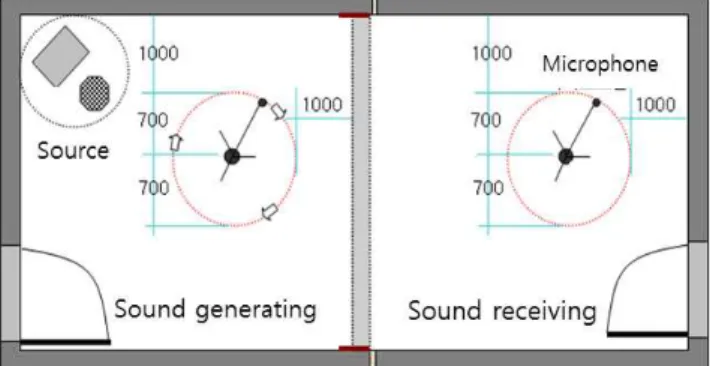
Figure 2. Floor plan of the reverberation chamber of room type II

Figure 3. Design condition of room type II

(3)

H35 T-C

H50 T-C

H50 A-C

I50 A-C

Extruded panel with a-hemihydrate gypsum Controlled panel

Figure 4. Section of panel used in sound insulation test

2. Experiment plan and method

2.1 Experiment plan

The goal of this study is to understand the sound insulation performance of the extruded panel made with a-hemihydrate gypsum. As indicated in Table 1, the sound insulation performance was measured by difference in flat structure, type and shape of the panel used in this study.

Table 1. Design of Experiments

Factors Test

Item Types of Panel Type of

Module Test Room Test

Item Extrudi

panel ng develop

ed

Hollowed 35THollo wed 50T Insulation

50T

Panel Module Wall

Type 1(Standard Insulation Room) Type 2(Real Habitat Model)

Insulati Perfor on mance

Control T-C A-C

Panel Module Wall

Type 1(Standard Insulation Room) Type 2(Real Habitat Model)

Insulati Perfor on mance

Three types of panel with a-hemihydrate were used in the experiments: 35mm-thick and 50mm-thick panels with air layer and 50mm-thick panel developed for sound insulation. They were

compared to the light-weight concrete sandwich panel of Company T and the concrete panel of Company A. A comparative analysis was conducted of the panels above following KS F 2862:2002

“Rating of Airborne Sound Insulation in Building and of Building Elements”

2.2 Experiment method

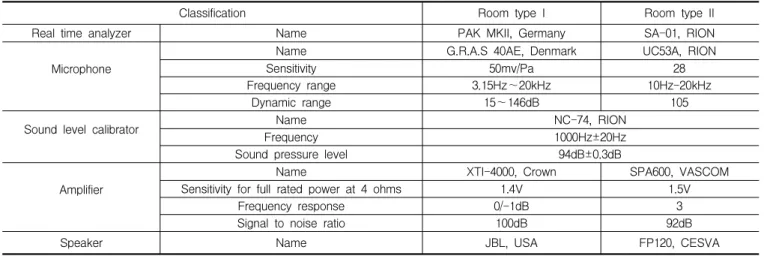
2.2.1 Reverberation chamber and the test rig The sound insulation characteristics and performance of a-hemihydrate gypsum were measured based on KS F 2808:2001 Rating of Airborne Sound Insulation in Building and of Building Elements in two types of chamber: Type I for the standardized sound insulation performance evaluation and Type II for the simulated space of actual residential space[3].

Room Type I consists of two transformed

pentagon-shaped rooms with different actual

capacity connected to each other on a wall, which

is a standard chamber generally used in sound

insulation performance tests. The standard

temperature range is between 8℃ and 12℃, and

(4)

Classification Room type I Room type II

Real time analyzer Name PAK MKII, Germany SA-01, RION

Microphone

Name G.R.A.S 40AE, Denmark UC53A, RION

Sensitivity 50mv/Pa 28

Frequency range 3.15Hz~20kHz 10Hz-20kHz

Dynamic range 15~146dB 105

Sound level calibrator Name NC-74, RION

Frequency 1000Hz±20Hz

Sound pressure level 94dB±0.3dB

Amplifier

Name XTI-4000, Crown SPA600, VASCOM

Sensitivity for full rated power at 4 ohms 1.4V 1.5V

Frequency response 0/-1dB 3

Signal to noise ratio 100dB 92dB

Speaker Name JBL, USA FP120, CESVA

Table 2. Specifications of measuring equipment

the standard humidity is between RH 45% ~55%, and in terms of the volume of the reverberation chamber for measuring sound reduction coefficient (sound transmission loss), the sound generating reverberation chamber is 249㎥ and the sound receiving reverberation chamber is 325㎥.

The Room Type II is a simulation chamber of a living room or bedroom of an apartment, and Figure 2 shows the floor plan of Room Type II.

The room was made using reinforced concrete to have 200mm-thick walls that satisfy the specifications stipulated in the measurement criteria, including dimension ratio and insulation of a room. To insulate bypass sound, 10mm-thick PE(polyethylene) form was inserted between the sound generating room and the sound receiving room. The detailed design standard is illustrated in Figure 3.

The specimen was installed in the frame (width 3.5m x length 3.0m, area: 10.5㎡opening) as shown in Figure 6. The gap between the frame and the panel was finished using a sealing material, and it was used in the test. . The specifications of the test rig used in the test are indicated in Table 2.

2.2.2 Panel and wall composition

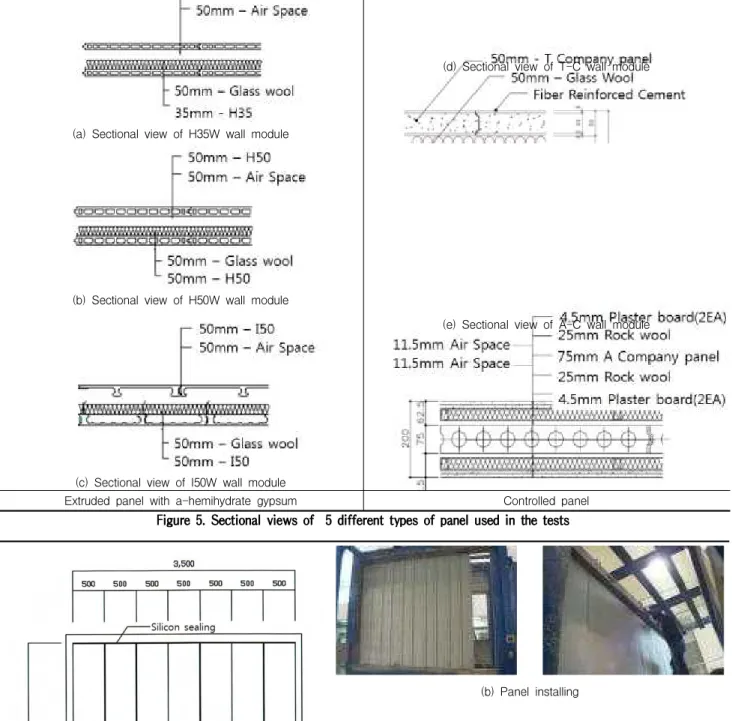
Sectional views of 5 different types of panel used in the tests are shown in figure 5. The extruded panels used to conduct performance tests were 35mm-thick H-type panel (hereinafter H35) and 50mm-thick panel (hereinafter H50), and 50mm-thick I-type panel with a 100mm-thick hollow section cut in the lateral direction. The panels used for comparison were the 50mm-thick light-weight concrete sandwich panel of Company T with density of 0.78㎤/g and weight of 39kg/㎡, which was covered with pressed cement on the surface, and the 75mm-thick vibration concrete panel of Company A with density of 1.92㎤/g and weight of 85kg/㎡.

The T-C module used as the standard of

comparison was made by placing a sandwich panel

with porous concrete covered with pressed cement

plates and 50mm-thick insulation and 50mm-thick

air layer inside of the composite panel, totaling

200mm in thickness. The A-C module was made of

75mm-thick perforated concrete panel as the core

material, and 25mm-thick insulation and plaster

board were attached to it, totaling 200mm in

thickness.

(5)

(a) Sectional view of H35W wall module

(d) Sectional view of T-C wall module

(b) Sectional view of H50W wall module

(e) Sectional view of A-C wall module

(c) Sectional view of I50W wall module

Extruded panel with a-hemihydrate gypsum Controlled panel

Figure 5. Sectional views of 5 different types of panel used in the tests

(b) Panel installing

(a) Assembly drawing (c) Sound absorbing material (d) Sealing

Figure 6. Panel assembly drawing and installing process

(6)

<Step 1> <Step 2>

<Step 3> <Step 4>

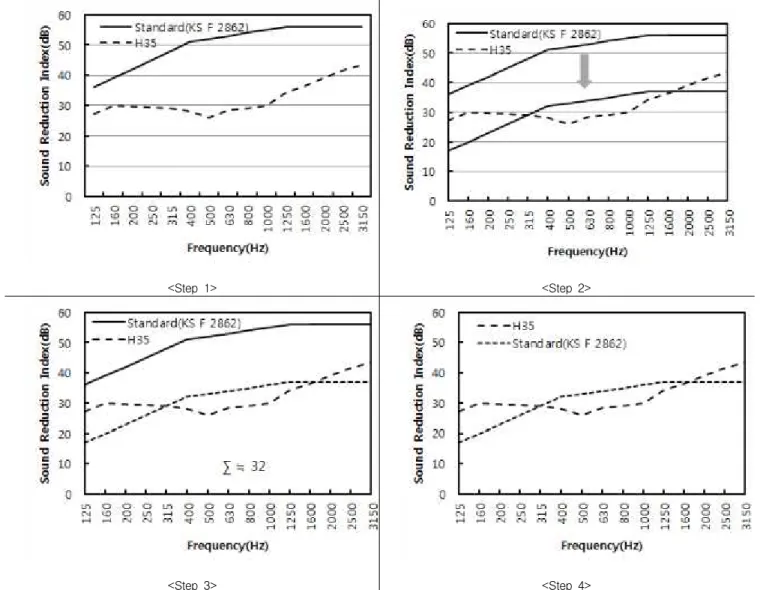
Figure 7. Calculation methods of single-number quantity for airvorne sound(Ex. H35) 2.2.3 Calculation of sound insulation performance

To evaluate the sound insulation performance, the specimens were installed between the sound generating room and the sound receiving room based on KS F 2808:2001, and each were measured in terms of average sound pressure level, sound absorbing power and sound reduction coefficient. To measure the average sound pressure level, 5 points were selected 0.7m away from the boundary of the sound generating and sound receiving rooms, at least 1m away from the sound source in the sound generating room and at least

0.7m away from the microphone. In terms of single number quantity (Rw), the KS standard curve corresponding to the curve that connected the measured values was moved up and down in the unit of 1dB. 16 sound values were measured in 1/3 octave band, and the standard curve was moved as much as possible within the range where the sum of the values found to be smaller than the standard curve did not exceed 32dB. The sound reduction coefficient(R) was obtained at 500Hz in the standard curve moved.

The term and symbol of the single-number

(7)

Frequency(Hz) Room type I Room type II

Panel Wall module Wall module

H35 H50 I50 H35W H50W I50W H50W I50W T-C A-C

125 27.2 27 24.5 45.9 42.2 41.6 25.2 24.4 33.8 17.8

160 29.9 28.3 23.6 49.6 47.4 46.8 33.7 33.6 32.7 23.5

200 29.6 28.2 21.6 50.8 48.2 51.8 37.8 37.1 36.2 30.2

250 29.3 29.7 26.1 49.8 51.5 54.3 41.7 42.2 40.9 36.8

315 28.9 31.2 28.9 51.6 56.7 57.7 43.9 46.6 44.2 44.7

400 28.0 31.8 26.8 51.7 57.9 57.5 49.0 48.4 49.0 48.2

500 26.0 30.0 29.4 50.5 56.5 59.5 51.4 51.6 49.6 54.7

630 28.4 29.3 29.7 53.0 51.4 58.1 48.1 52.2 47.7 58.9

800 29.0 29.5 32.4 57.1 56.2 60.9 51.9 54.3 44.6 62.7

1,000 30.1 29.8 31.6 60.4 60.0 67.7 53.8 57.3 49.1 64.5

1,250 34.2 31.7 30.2 63.5 63.1 66.4 54.2 59.4 52.3 66.1

1,600 36.4 35.7 28.0 67.9 68.4 68.6 55.5 58.2 57.3 69.0

2,000 39.1 38.6 28.4 72.3 71.2 68.6 58.1 58.4 60.5 73.7

2,500 41.6 40.6 32.3 73.9 73.7 71.2 62.3 60.9 64.6 69.4

3,150 43.5 42.2 33.7 75.3 74.7 72.9 67.4 66.3 67.9 72.0

4,000 47.8 43.7 36.8 74.9 73.7 69.7 66.5 66.0 68.9 69.1

Rw 34.0 34.0 32.0 59.0 59.0 61.0 53.0 54.0 52.0 49.0

C -2.0 -1.0 -2.0 -1.0 -1.0 0.0 -5.0 -6.0 -4.0 -8.0

Ctr -4.0 -3.0 -3.0 -4.0 -4.0 -4.0 -10.0 -11.0 -7.0 -13.0

Table 5. Data acquired by sound insulation performance test

quantity for airborne sound vary depending on measurement type. Using the single-number quantity set in the Housing Performance Indicator System and Management Criteria notified by the Ministry of Construction and Transportation, the sound insulation performance was examined. The spectrum constant, C, is a value expressed by adding to the single number quantity (Rw) when considering the spectrum of a specific note. Spectrum 1(C) is a constant related with noise sources in the middle and upper registers such as daily living noise, expressways and jet planes. Spectrum 2(C

tr

) is a constant related with noise sources in the lower register, such as city roads and low-speed railroads. Spectrum constants (C and C

tr

) were calculated based on the spectrums given in KS F 2862[4].

  

  

 

,



 

  

 

--- (1)

Here, : single number quantity(weighted sound reduction coefficient. Rw)

  

 log  



,

  

 log  



: sound reduction coefficient in the i

th

frequency band

Here,  : octave band indicator



: a value given in KS F 2862 Table 4 in respect to the i

th

frequency band of Spectrum 1



: a value given in KS F 2862 Table 4 in respect to the i

th

frequency band of Spectrum 2

The value of sound transmission loss calculated using the equation above was determined based on the sound insulation performance grade of the boundary wall between housing units stipulated in Annex 1 of Public Notification No. 2012-7

“Housing Performance Indicator System and Management Criteria” from the Ministry of Construction and Transportation and “Structural Sound Insulation Requirements and Management Criteria for Walls” from the Ministry of Construction and Transportation[5].

Table 4. Sound insulation performance grades for apartment housing

Grade Single number quantity

★★★★ 63=Rw+C

★★★ 58=Rw+C<63

★★ 53=Rw+C<58

★ 48=Rw+C<53

(8)

3. Test results

The sound reduction coefficients measured from 16 octave bands within 125 Hz to 4,000Hz are divided by each test factor and indicated in Table 5. In Room Type I for standard sound insulation test, the individual panels and the three types of wall module made with the panel as the main component were tested, and in Room Type II for the simulation chamber of an actual residential space, 4 types of wall module were tested.

Figure 8. Sound reduction index according to section shape of extruded panel

Figure 9. Sound reduction index according to wall type

Figure 10. Comparison of sound reduction index between room type I and room type II

Figure 11. Comparison of sound reduction index between commercial products and this study

3.1 Sound insulation performance of individual panel in the standard sound insulation chamber (Room Type I)

Figure 8 illustrates the results of tests of three

types of extruded cement panel with a-hemihydrate

gypsum with 35mm H sectional thickness (H35),

50mm H sectional thickness (H50), and 50mm I

sectional thickness (I50), in the standard insulation

test chamber (Room Type I). From the test results,

it is found that after taking spectrum constant into

account, the single number quantity of H50, H35

(9)

and I50 (Rw+C) stood at 32dB, 31dB and 30dB, respectively. The panels with air space, H50 and H35, showed sound transmission loss in the frequency range between 125Hz and 1000Hz, which is almost similar to that of I50; however, they showed higher loss in frequency ranges other than I50, and in particular showed a much greater difference in the frequency range of 1600Hz or higher. From the analysis, it is revealed that the panels with an air layer showed better performance than the panel with no air space.

3.2 Sound insulation performance of wall modules in the standard insulation test chamber (Room Type I)

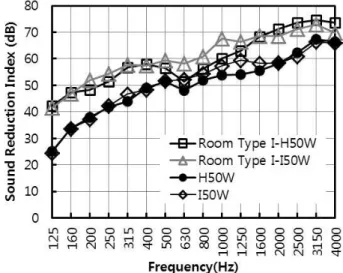
The sound insulation performance of the wall modules made using each extruded panel with a-hemihydrate gypsum as cover with air layer and insulation inside was evaluated, and is shown in Figure 9. From the analysis, taking the spectrum constant into account, the single number quantity (Rw+C) stood at 58 dB, 58dB and 61dB, respectively. In terms of sound reduction coefficient by panel type, I50 showed better sound transmission loss than wall modules of H35W and H50W that had air layer in frequency ranges other than 160Hz or lower or 1600Hz or higher, which was the opposite of the test results of individual panels. The thinner and wider panel structure is believed to have helped increase the noise reduction effect.

3.3 Sound insulation performance under conditions of Room Type I and Room Type II

The results of a comparative analysis of sound insulation performance under conditions of Room Type I and Room Type II are shown in Figure 10.

The tests were performed for the modules made with the cover of 50mm-thick H panel with an air

layer and I panel with no air layer. Both H50W and I50W showed a lower single number quantity in the standard test chamber, Room Type I, than in the simulation chamber of an actual residential space, Room Type II. The single number quantity was measured at 10dB in H50W and at 13dB in I50W. The difference was shown to be greater in the panels with no air layer than in the panels with air layer. The bypass noise is believed to be the cause of these results, because the bypass noise was not completely blocked in Room Type II due to its structural characteristics of walls and floor.

3.4 Comparison of sound insulation performance between the existing panels and the newly developed panels in an actual residential space The results of a comparative analysis of sound insulation performance between the conventional wall systems of Company T and Company A and H50W and I50W in Room Type II are shown in Figure 11. The existing products of Company T and Company A used as the standard of comparison showed better performance. The product of Company T was better at frequencies lower than 500Hz, while the product of company A was better at 500Hz or higher. The panels developed in this study showed similar characteristics overall to those of the product of Company A, though slightly different in the range between 630Hz and 1250Hz, and it was determined that the sound insulation performance of the panels developed in this study was good in the low frequency range.

Likewise, the extruded panels manufactured

using a-hemihydrate gypsum are shown to have

had a similar level of sound insulation performance

compared to the existing products, and they can

be utilized in an actual residential space.

(10)

3.5 Sound insulation performance evaluation of the developed panels

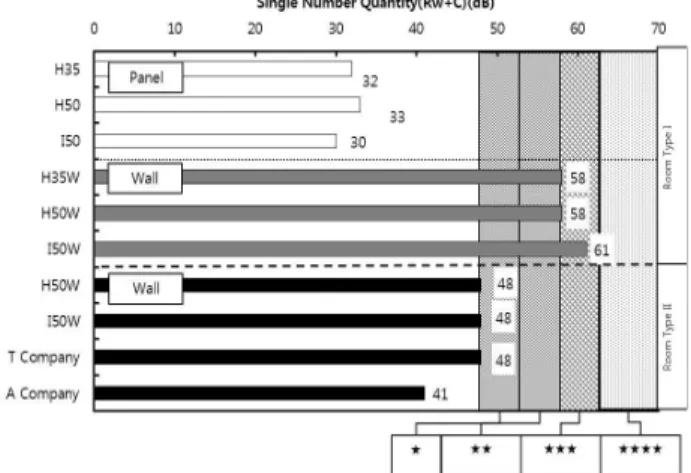
Figure 12 shows the results of an analysis of sound insulation performance based on the sound insulation performance of a boundary wall between housing units. Under the condition of Room Type I, the individual panels did not provide sufficient sound insulation performance. However, the sound insulation performance was evaluated to be ★★★

class in all three types of wall module developed by combining the panels with air layer and insulation, which can be applied to an actual residential space. However, the sound insulation performance was evaluated to be ★★ class under the condition of Room type II due to bypass sound, as mentioned previously. Nevertheless, the panels developed in this study showed similar or better sound insulation performance compared to the existing products of two companies, and on this basis they are believed to have a competitive edge as sound insulation materials.

Figure 12. Grade of sound insulation performance

4. Conclusions

This paper is part of ongoing research to examine the applicability of extruded cement panels with a-hemihydrate gypsum, known to improve fire-resistance, to interior material and

partition walls between housing units. To accomplish this, sound insulation performance was analyzed and the findings of this research are as follows:

1) The sound insulation performance was analyzed differently depending on test factor: sectional shape or wall composition, which is believed to have been affected by areal density, sectional shape, air layer and thickness of the wall, and the sound reduction effect was developed in a complex manner. For this reason, we believe that the factors above should be considered in a subsequent study in order to gain a clearer understanding of the sound insulation performance of extruded panels with a-hemihydrate gypsum.

2) Through tests of sound insulation performance with the same panels under different room conditions, it is found that the sound insulation of a boundary wall between housing units was evaluated to be about two grades lower in the simulation chamber of an actual residential space, Room Type II, than in the standard sound insulation test chamber, Room Type I. For this reason, the sound insulation performance should be examined under an actual residential condition that a resident can actually experience.

3) The extruded panels with a-hemihydrate gypsum developed in this study showed sound insulation performance equivalent to or better than that of two types of existing panels, on which basis they were confirmed as having sufficient sound insulation performance to be utilized as partition walls between housing units.

Acknowledgement

This work was supported by Business for

Cooperative R&D between Industry, Academy, and

(11)

Research Institute funded Korea Small and Medium Business Administration in 2012(Grants No.

C00-56377) and by the R&D Center for Valuable Recycling (Global-Top Environmental Technology Development Program) funded by the Ministry of Environment(Project No.:11-C21-ID).

References

1. Nam JC. Development of an Inter-Household Light Weight Wall for Improvement of the sound reduction in the Apartments [dissertation]. Seoul (Korea): University of Hanyang. 2007. p. 1-2

2. Kim JM, Kang SP, Choi DJ, Ra JM. Hydration Behavior and Fire-Resistance Property of Cement Mortars Mixed with Various Types of Gypsum. Korea. Journal of Architectural Institute of Korea 2010 December;26(12):128-13.

3. Korean Standards Association. KS F 2862 Rating of Airborne Sound Insulation in Buildings and of Building Elements.

Seoul (Korea): KSA. 2002.

4. Ministry of Construction & Transportation. Control Standard of Housing Performance Grade. Gwacheon (Korea): Ministry of Construction & Transportation. 2012.

5. Jang GS, Lee TG, Song MJ, Kim SW. Classification of Transmission Loss for Steel Panel and Extrusion Concrete Panel. Journal of Korean Society for Noise and Vibration Engineering. 2003 November;Autumn conference:864-9.

6. Korean Standards Association. KS F 2808 Laboratory Measurements of Airborne Sound Insulation of Building Elements: KSA. 2011.

7. Kang C. Experimental Study on the Development of Light Weight Non-Bearing Wall using Bottom Ash [dissertation].

Kongju (Korea): University of Kongju; 2006. p. 57-9.

8. Kim KW, Choi HJ, Yang KS. Methods of Measuring Sound Insulation Performance of Building. Journal of Korean Society for Noise and Vibration Engineering. 2010 May;Spring confernce:325-6.

9. Baek, SK, Go JC, Lee JI, Kim HB, Chang CS. Analysis and Evaluation of Sound Reduction Performance of Drywall System. Journal of Korean Society for Noise and Vibration Engineering 2009 November;Autumn conference:727-32.

10. Park HK. Analysis of characteristics and User's Evaluation for Lightweight Panel in Apartment. Journal of Korea Institute of Building Construction 2010 February;10(1):181-91.

11. UM TH, Kim YT. Properties of Concrete Panel made by

Light Weight Aggregates. Journal of Korean Ceramic

Society 2004 March;41(3):221-8.

수치

Figure 2. Floor plan of the reverberation chamber of room type II
Figure 4. Section of panel used in sound insulation test
Table 2. Specifications of measuring equipment
Figure 5. Sectional views of 5 different types of panel used in the tests
+5

참조

관련 문서

In this study, the performance characteristics of a two-stage CO 2 system with two-different evaporator temperature have been analyzed according to outdoor

Background : The E133K genetic variation of AGGF1 gene that is a potent angiogenetic factor have been assumed genetic susceptible factor for Klippel-Trenaunay

This research further enriches the previous research on the influencing factors of employee organizational commitment and OCB, which help Chinese companies

(4)the spiral ganglion (5)the auditory nerve fibres.. The Basilar Membrane is a Mechanical Analyzer of Sound Frequency The Basilar Membrane is a Mechanical Analyzer of

Greco-Roman wrestlers of high school, college, and the professionals players showed significant differences depending on their performance when measuring the maximum muscle

Performance evaluation of Volume PTV based on Affine Performance evaluation of Volume PTV based on Affine Performance evaluation of Volume PTV based on Affine Performance

As with storage, it’s critical to consider the access patterns of your workload, and also to consider if other non-database solutions could solve the problem more

1 John Owen, Justification by Faith Alone, in The Works of John Owen, ed. John Bolt, trans. Scott Clark, &#34;Do This and Live: Christ's Active Obedience as the