ORIGINAL ARTICLE Open Access
Factors Affecting Health-Promoting Behaviors among Vietnamese Students in Korea
Tran Thi Quynh Anh1 · Kang, Minkyung2 · Kim, Nahyun3
1Doctoral Candidate, Graduate School, Department of Nursing, Keimyung University, Daegu, Korea
2Assistant Professor, College of Nursing, Keimyung University, Daegu, Korea
3Professor, College of Nursing, Keimyung University, Daegu, Korea
Purpose: This study aimed to examine health-promoting behaviors among Vietnamese students in Korea and identify the factors affecting these behaviors. Methods: A survey using self-administered questionnaires was employed. Data were collected between October 2020 and May 2021 from 260 Vietnamese students whose stay in Korea has been for longer than six months and who agreed to participate in the study. Variables included health-promoting behaviors (physical activity, nutrition, stress management, and health risk behavior), self-esteem, acculturative stress, and social support. A multiple regression analysis was performed to assess the factors that might influence health-promoting behaviors. Results: Of the total participants, 56.9% were women, and the mean age was 24.60±2.58 years. The mean score of the participants on total health-promoting behaviors was 2.64±0.36, on self-esteem 2.96±0.35, on acculturative stress 2.39±0.15, and on social support 2.53±0.24. Self-esteem, acculturative stress, social support, length of stay in Korea, and education level were found to affect health- promoting behaviors, and these variables explained 76.2% of the variance. Conclusion: There is a need to develop intervention strategies for promoting self-esteem and social support programs and coping strategies for managing acculturative stress to increase health-promoting behaviors among Vietnamese students.
Key Words: Health behavior; Self-esteem; Psychological stress; Social support
Corresponding author: Kim, Nahyun https://orcid.org/0000-0002-3005-2720
College of Nursing, Keimyung University, 1095 Dalgubeol-daero, Dalseo-gu, Daegu 42601, Korea.
Tel: +82-53-258-7654, Fax: +82-53-258-7616, E-mail: [email protected] Received: Apr 29, 2021 / Revised:Jul 2, 2021 / Accepted: Aug 5, 2021
This is an open access article distributed under the terms of the Creative Commons Attribution Non-Commercial License (http://creativecommons.org/licenses/
by-nc/3.0), which permits unrestricted non-commercial use, distribution, and reproduction in any medium, provided the original work is properly cited.
INTRODUCTION
The Korean cultural influence has expanded globally, but more so in Asian countries, especially those in South- east Asia [1,2]. The Korean wave began in Southeast Asia in the late 1990s with Korean popular culture, food, fash- ion, and make-up trends gaining immense popularity across Asian countries [2]. This could be attributed to fac- tors such as cultural proximity between the Korean and Asian peoples [2]. This led to an increasing interest in vari- ous aspects including studying abroad in Korea [1]. More- over, in 2001, the Korean government set up the “Study Korea Project” to attract international students to Korean colleges and universities. This led to a skyrocketing in the number of international students in Korea. According to
the Korea Ministry of Education, the number of interna- tional students in Korea was 91,332 in 2015 and 160,165 in 2019, showing a total growth of 75% between 2015 and 2019 [3]. By country of origin, the total number of Chinese students in 2019 was 71,067, the highest with 44.4%, but the total rate decreased by 3.8% from the previous year (48.2%). On the contrary, the number of Vietnamese stu- dents was 37,426 in 2019 (23.4% of the total), up 1,365 from the previous year (27,061, 19.0%) [3].
International students, such as Vietnamese students, studying in Korea face several problems in the new envi- ronment encountering cultural differences, language bar- riers, difficulty in socio-cultural adaptation, discrimination, financial constraints, and homesickness [4,5]. Having to leave friends and family behind, these students often feel
a deep sense of loss and loneliness. This situation leads to the challenge of establishing comparable social networks among the international students to provide social support to overcome language and cultural barriers and to resolve interpersonal problems [6]. Social support typically vali- dates one’s self-esteem and self-concept; it also provides necessary emotional and instrumental support. Loss of so- cial support can lead to feelings of isolation or disorienta- tion [7]. Previous research has shown that elevated levels of acculturative stress can lead to serious health risks [6].
Social support increases the self-esteem of international students by reducing their acculturative stress. Self-esteem leads to better health and social behavior [6,7]. Internatio- nal students with a high level of self-esteem, together with strong social support, are less vulnerable to stressors [6].
These factors contribute to improving the health-promot- ing behaviors of international students.
As one of the major criteria that determines health, health-promoting behaviors are crucial in avoiding many illnesses. Health promotion and disease prevention are as- sociated with these behaviors [7,8]. International students living in an unfamiliar environment may find it difficult to engage in health-promoting behaviors [7-9]. Difference in lifestyle and the socio-cultural background of interna- tional students are factors that influence their health-pro- moting behaviors [9,10]. Therefore, not engaging in health- promoting behaviors can be a significant risk factor for international students’ overall health status and chronic health conditions.
Vietnamese students studying in Korea too face many such problems owing to their lack of language skills, their financial difficulties, interpersonal relationships, lack of social support, and the cultural differences between Viet- nam and Korea. These factors affect their health and qual- ity of life [11,12]. When faced with problems while study- ing in an unfamiliar environment, Vietnamese students too do not engage themselves in health-promoting behav- iors, thus causing a significant risk factor for their overall health status and chronic health condition. Not engaging in health-promoting behaviors thus leads to a deteriora- tion of their physical health.
With the sharp increase in Vietnamese students in Ko- rea, currently, much research has focused on their accom- modation status or the relationship between acculturative stress and the mental health status [11,12]. However, con- sidering that Vietnamese students account for the second- highest number of students among the international stu- dents studying in Korea, their health-promoting behaviors has not been explored in research so far. This study aims to bridge this gap and identify the health-promoting behav-
iors and factors affecting these behaviors among the Viet- namese students in Korea. The findings from this study provide basic data for the developing a healthcare program to maintain and promote the health of Vietnamese students studying in Korea.
METHODS
1. Study DesignThis study employed a cross-sectional design using self- administered questionnaires to analyze and identify the health-promoting behaviors and factors affecting health- promoting behaviors of Vietnamese students in Korea.
2. Setting and Sample
The participants of the study were Vietnamese students studying at K University, D city, in Korea. Students who have lived in Korea for longer than six months were chos- en to participate in the study. The required sample size was calculated using the G-power 3.1.9.2 program, a sig- nificance level of .05, a power of .90, effect size of 0.15, and with 14 independent variables. It was estimated as 194 stu- dents, with at least 213 students (plus 10%) needed for this study. A convenience sample of 260 students participated in the study.
3. Instruments
The research instrument is the Vietnamese version of a self-reported questionnaire. It was translated from pre- vious instruments that have proven its validity and reli- ability. The research subjects’ general characteristics, such as gender, age, religion, marital status, residence type, length of stay in Korea, education, Korean language abil- ity, and finance, were obtained apart from their health in- surance and self-rated health status.
The Health-Promoting Behavior (HPB) scale was used to assess Vietnamese students’ health-promoting beha- viors. The HPB was developed by Belloc and Breslow.
The items in the questionnaire were revised and supple- mented with items suggested by Kang [13] and Sun [14].
This modified scale was translated into Vietnamese and used to measure the HPB of the Vietnamese students in this study. The 18-item profile measures 4 self-reported sub-categories: 4 on physical activity, 4 on nutrition, 4 on stress management, and 6 on health risk behaviors man- agement, rated on a 4-point Likert scale, ranging from 1 (never) to 4 (regularly). On this scale, higher points in-
dicate a higher level of health-promoting behaviors. The Cronbach’s ⍺ value of the questionnaire tool, modified and supplemented by Kang [13], was .73, and the one by Sun [14] was .78. The Cronbach’s ⍺ reliability coefficient for our study was determined to be .75, and for the sub- scales, it varied between .72 and .77.
Acculturative stress was measured using the Accultur- ative Stress Scale for International Students (ASSIS) devel- op by Sandhu and Asrabadi [15]. The questionnaire was translated into Vietnamese by Ninh [11] and used to meas- ure the acculturative stress of the Vietnamese students in this study. The 36 items measure stress-related themes found to be associated with acculturation, with 6 sub-cate- gories, such as "perceived discrimination", "culture shock",
"guilt", "perceived hatred", "homesickness", "fear", and
"others". The items were rated on 5-point Likert scale, ranging from 1 (strongly disagree) to 5 (strongly agree). A higher score indicates a higher perceived stress level aris- ing from acculturation. The Cronbach’s ⍺ of the original scale by Sandhu was .87, the Cronbach’s ⍺ was .94 in Ninh [11], and in this study, Cronbach’s ⍺ was .89.
The Interpersonal Support Evaluation List (ISEL) devel- oped by Cohen was used to measure social support re- ceived by Vietnamese students [16]. ISEL evaluates how others affect a person’s responses to stressful events. Ques- tionnaire items were revised and supplemented as sug- gested by Park et al. [17] and Sun [14]. The modified scale was translated into Vietnamese and used to measure the social support obtained by Vietnamese students in this study. The 16-item tool measures self-reported social sup- port rated on a 4-point Likert scale, ranging from 1 (defi- nitely false) to 4 (definitely true). A higher score indicates higher perceived social support. Cronbach’s ⍺ for the ori- ginal instrument was .90 and .84 in Sun [14]. The internal consistency for the scale in the present study was .78.
Self-esteem was measured using Rosenberg’s Self-Es- teem Scale [18]. This scale conceptualizes self-esteem as a single dimension so that participants can evaluate them- selves comprehensively. This scale was translated into Vietnamese and used to measure the self-esteem of the Vietnamese students in the study. The self-esteem scale consists of 10 items, rated on 4-point Likert scale ranging from 1 to 4 [18]. On this scale, higher points indicate a higher level of self-esteem. In terms of the tool’s reliability, Cronbach’s ⍺ of the original tool was .90 and that of the present study was .73.
The questionnaire was based on related literature and academic experiences. A small pilot study was conducted with ten students to ensure that the questions were under- standable. As there was no negative feedback from stu-
dents, the contents of the questionnaire were not changed.
4. Data Collection
The researcher contacted the executive committee of the Vietnamese international students’ association at K Uni- versity for a list of students (their duration of study in Korea and information contact, email, phone number) at- tending school and randomly selected students qualified to participate in the research. Students were invited to take part in the study through email because of the coronavirus outbreak. On receiving their consent to participate in the study, the researcher contacted the participants regarding the location and data collection time. Data were collected using self-administered questionnaires from October 2020 to May 2021. All participants submitted a written agree- ment to take part in the research. They then filled out self- reported questionnaires. It took participants an average of 45 minutes to complete the questionnaire. When the ques- tionnaires were collected, the researcher reviewed the questionnaire immediately to check for any missing items.
The participants were asked to supplement the question- naire if necessary.
5. Ethical Consideration
Before implementing the study, ethics approval was re- ceived from the Institutional Review Board (IRB) of K University (40525-202004-HR-008-01). Finally, verbal con- sent was obtained, and an informed consent form was giv- en to all participants. Only those who voluntarily agreed to take part could fill out the questionnaire. We explained the research purpose and the questionnaire. It was clari- fied to the students that they were free to withdraw their participation at any time even if they had initially con- sented to participate. They would not be at any dis- advantage for doing so.
6. Data Analysis
The collected data were analyzed using the IBM SPSS 20.0 program. The general characteristics of the partic- ipants as well as their health-promoting behaviors, accul- turative stress, social support, and self-esteem were in- dicated in frequency, percentages, means, and standard deviations, respectively. The level of health-promoting be- haviors, depending on participants’ general character- istics, was measured using an independent t-test and one- way ANOVA followed by post hoc Scheffé’s comparison.
Each variable was tested for normality using the Kolmo-
gorov-Smirnov test, and a normal distribution was veri- fied. A Variance Inflation Factor (VIF) was used to identify the degree of multicollinearity. A review of the regression analysis assumptions showed that the residuals were nor- mally distributed; in terms of multicollinearity, the varia- tion information factor was 1.05 to 1.22. Therefore, multi- collinearity was not present. Besides, the straight-line rela- tionship between the variables was examined and ana- lyzed as Pearson’s correlation coefficients. Dummy varia- bles were used to perform stepwise regression analysis to identify the factors affecting the health-promoting behav- ior of the subjects. Education and length of stay in Korea were coded as dummy variables (yes=1, no=0). The refer- ence group was the "undergraduates" group with which we compared the other groups. About the length of stay in Korea, "6~12 (months)" was the reference group. Statisti- cal significance was adopted at the level of p<.05.
RESULTS
1. Health-Promoting Behaviors according to General Characteristics
The study population comprised 260 Vietnamese stu- dents in Korea. The average age of the participants was 24.60±2.58 years. The Vietnamese students were predom- inately women (56.9%), and most of the students claimed that they did not follow anyreligion (51.5%). Most of the student participants were single (96.9%). About 154 (59.2%) students were in undergraduate programs, and 94 (36.2%) were in the Korean language course. The average length of stay in Korea was 37.12±17.07 months. Regarding their Korean language ability, 32.4% were in the advanced level and 61.1% in the intermediate level. Most of the partic- ipants (82.7%) had a health insurance plan and 64.6% lived with friends. A total of 23.1% stated that they lived in a studio, and 9.6% of students stayed in a dormitory. Al- most all Vietnamese students lived on their personal earn- ings (96.5%). About their self-rated health status, almost half the number of students (49.2%) answered "normal,"
while 24 participants (9.2%) responded with "very well"
(Table 1).
The mean total HPB scores and the mean scores on physical activity, nutrition, stress management, and health risk behavior subscales determined a significant differ- ence between the scores of women and men (F=2.15, p<
.001; Table 1). The nutrition scores differed significantly with age (F=2.31, p<.001), education (F=5.47, p<.001), and length of stay in Korea (F=4.83, p<.001). Scheffé’s posthoc test showed a difference between the groups. The
mean nutrition subscale scores of doctorate students (3.77
±0.38) and masters’students (2.92±0.57) were significant- ly higher than those of undergraduate students (2.57±0.39).
Mean nutrition scores of the students whose length of stay in Korea >61 months (2.97±0.73) were significantly higher than those of students whose length of stay in Korea was 13~36 months (2.28±0.39) and 6~12 months (2.07±0.19).
There were significant differences in the mean total HPB scores according to education level (F=3.75, p=.012) and length of stay in Korea (F=5.78, p<.001). Scheffé’s post- hoc test showed that the mean total HPB scores of the doc- torate students (2.79±0.18) and masters’ students (2.73±
0.14) were significantly higher than those of students in the undergraduate group (2.66±0.21). The posthoc test showed that health-promotion behaviors among students whose length of stay in Korea >61 months (2.78±0.23) and 37~60 months (2.66±0.22) were significantly higher than those whose length of stay in Korea was 6~12 months (2.59±
0.14).
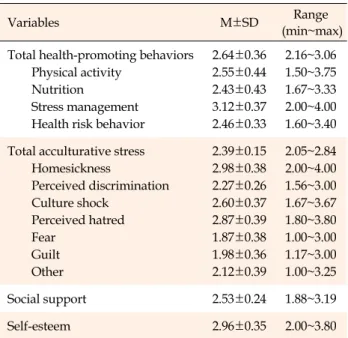
The mean score of the total HPB of the students was 2.64±0.36. In the sub-categories, the highest mean score was of stress management, 3.12±0.37. Nutrition shows the lowest mean score of 2.43±0.43. The mean total accultur- ative stress score of the students was 2.39±0.15. Home- sickness shows the highest score among the sub-catego- ries, 2.98±0.38. The mean score of social support was 2.53
±0.24 out of a maximum of 3.19. The mean score of self-es- teem was 2.96±0.35 (Table 2).
As a result of the correlation between health-promoting behaviors and other factors such as self-esteem, accultur- ative stress, social support, a statistically significant corre- lation was seen between health-promoting behaviors and variables (Table 3): Health-promoting behaviors showed a positive correlation with self-esteem (r=.32, p<.01) and social support (r=.13, p=.024), but a negative correlation with acculturative stress (r=-.15, p<.01). Self-esteem showed a positive correlation with social support (r=.22, p<.01). Acculturative stress showed a negative correla- tion with self-esteem (r=-.27, p=.023) and social support (r=-.11, p=.016). Students with higher self-esteem and higher social support had higher health-promoting beha- viors. Conversely, students with high acculturative stress showed low health-promoting behaviors. Self-esteem was positively correlated with physical activity, nutrition, stress management, and health risk behavior. Acculturative stress showed a negative correlation with nutrition (r=-.17, p=
.022) and health risk behavior (r=-.16, p=.025). Students with high self-esteem showed more physical activity and better stress management. Social support was positively correlated to stress management and health risk behavior.
Table 1. Sociodemographic Characteristics and Health-Promoting Behavior Score of Students (N=260)
Variables Categories n (%) or
M±SD
Physical activity Nutrition Stress management Health risk
behavior Total HPB score
M±SD t or F (p)
Scheffé́́ M±SD t or F (p)
Scheffé́́ M±SD t or F (p)
Scheffé́́ M±SD t or F (p)
Scheffé́́ M±SD t or F (p) Scheffé́́
Gender Men
Women
112 (43.1) 148 (56.9)
2.90±0.35 2.28±0.29
5.93 (<.001)
2.13±0.27 2.65±0.39
4.61 (<.001)
3.33±0.30 2.96±0.35
3.71 (<.001)
2.38±0.33 2.52±0.32
2.10 (.001)
2.73±0.19 2.57±0.32
2.15 (<.001) Age (year) ≤21a
22~24b 25~27c 28~30d
≥31e
15 (5.8) 120 (46.2) 90 (34.6) 30 (11.5) 5 (1.9) 24.60±2.58
2.56±0.39 2.57±0.43 2.44±0.44 2.54±0.48 2.25±0.38
0.41
(.331) 2.37±0.56 2.31±0.38 2.56±0.44 2.50±0.47 2.86±0.69
2.31 (<.001)
a, c<e
3.05±0.28 3.10±0.40 3.11±0.35 3.22±0.36 3.18±0.48
0.56
(.687) 2.52±0.30 2.46±0.36 2.48±0.31 2.40±0.29 2.28±0.33
0.78
(.543) 2.66±0.11 2.63±0.17 2.66±0.18 2.62±0.17 2.52±0.13
0.25 (.281)
Religion Buddhist Christian Others None
79 (30.4) 40 (15.4) 7 (2.7) 134 (51.5)
2.51±0.50 2.63±0.45 2.70±0.42 2.54±0.40
1.03
(.370) 2.52±0.44 2.44±0.43 2.52±0.32 2.37±0.42
2.05
(.110) 3.10±0.40 3.12±0.35 3.18±0.28 3.13±0.38
0.29
(.958) 2.41±0.31 2.64±0.34 2.51±0.23 2.43±0.33
3.12
(.102) 2.63±0.17 2.70±0.15 2.62±0.17 2.64±017
3.63 (.137)
Marital status
Married Single
8 (3.1) 252 (96.9)
2.46±0.55 2.55±0.43
0.54 (.681)
2.62±0.57 2.42±0.42
0.95 (.361)
3.21±0.39 2.40±0.28
0.73 (.478)
2.40±0.28 2.46±0.33
0.62 (.542)
2.67±0.21 2.64±0.16
0.48 (.631) Education Korean language coursea
Undergraduateb Mastersc Doctorated
94 (36.2) 154 (59.2) 9 (3.5) 3 (1.2)
2.59±0.43 2.54±0.45 2.39±0.37 2.33±0.38
1.01
(.380) 2.11±0.27 2.57±0.39 2.92±0.57 3.77±0.38
5.47 (<.001)
b<c, d
2.66±0.33 3.07±0.37 3.13±0.38 3.21±0.63
4.51 (.041)
c>b
2.45±0.34 2.47±0.33 2.46±0.26 2.40±0.40
0.20
(.951) 2.59±0.17 2.66±0.21 2.73±0.14 2.79±0.18
3.75 (.012) c, d>b
Length of stay in Korea (month)
6~12a 13~36b 37~60c
>6d
25 (9.6) 137 (52.7) 65 (25.0) 33 (12.7) 37.12±17.07
2.62±0.42 2.59±0.43 2.49±0.43 2.53±0.51
0.67
(.570) 2.07±0.19 2.28±0.39 2.64±0.46 2.97±0.73
4.83 (<.001)
a, b<d
3.06±0.36 3.10±0.38 3.19±0.36 3.26±0.37
2.25 (.032)
c>a
2.44±0.26 2.48±0.37 2.45±0.26 2.41±0.28
0.56
(.641) 2.59±0.14 2.60±0.21 2.66±0.22 2.78±0.23
5.78 (<.001)
c, d>a
Korean language ability (TOPIK)
Elementary (level 1,2) Intermediate (level 3,4) Advanced (level 5,6)
17 (6.5) 159 (61.1) 84 (32.4)
2.67±0.32 2.55±0.47 2.62±0.34
0.94 (.470)
2.32±0.23 2.56±0.48 2.74±0.52
1.21 (.341)
3.17±0.12 3.22±0.30 3.13±0.40
0.54 (.502)
2.45±0.28 2.34±0.42 2.67±0.28
0.71 (.601)
2.62±0.19 2.61±0.13 2.65±0.14
1.81 (.089)
Health insurance Yes
No 215 (82.7)
45 (17.3) 2.56±0.43 2.48±0.45 0.91
(.310) 2.42±0.43 2.48±0.44 1.01
(.362) 3.12±0.36 3.10±0.44 0.31
(.771) 2.46±0.32 2.45±0.39 0.23
(.803) 2.65±0.16 2.63±0.18 0.34
(.722) Residence Dormitory
Studio
Living with family Living with friends
25 (9.6) 60 (23.1)
7 (2.7) 168 (64.6)
2.69±0.45 2.42±0.43 2.60±0.45 2.57±0.43
1.81
(.061) 2.56±0.39 2.38±0.40 2.39±0.40 2.38±0.43
1.41
(.071) 3.01±0.42 2.96±0.27 3.12±0.37 2.44±0.29
1.90
(.076) 2.44±0.29 2.55±0.36 2.40±0.25 2.43±0.32
0.91
(.141) 2.67±0.15 2.63±0.17 2.58±0.17 2.64±0.16
0.58 (.631)
Finance Scholarship Parents Own
4 (1.5) 5 (1.9) 251 (96.5)
2.50±0.54 2.65±0.28 2.55±0.44
0.15 (.851)
2.75±0.56 2.46±0.80 2.42±0.43
1.09 (.331)
3.25±0.35 3.12±0.37 3.14±0.39
0.49 (.610)
2.45±0.25 2.44±0.26 2.46±0.33
0.16 (.901)
2.63±0.14 2.64±0.17 2.64±0.16
0.64 (.530)
Self-rated health status
Very well Well Normal Bad Very bad
24 (9.2) 98 (37.7) 128 (49.2) 7 (2.7) 3 (1.2)
2.50±0.41 2.59±0.41 2.52±0.46 2.53±0.56 2.50±0.67
0.44 (.771)
2.51±0.54 2.43±0.41 2.43±0.43 2.33±0.51 2.23±0.19
0.47 (.752)
3.01±0.39 3.13±0.35 3.12±0.39 3.07±0.31 3.36±0.27
0.71 (.601)
2.49±0.38 2.45±0.32 2.46±0.33 2.40±0.36 2.47±0.41
0.12 (.902)
2.60±0.13 2.65±0.17 2.63±0.18 2.58±0.15 2.61±0.14
0.43 (.781)
HPB=health-promoting behavior; M=mean; SD=standard deviation; TOPIK=test of proficiency in Korean.
2. Variables Affecting Health-Promoting Behaviors Multiple regression analysis with health-promoting be- haviors scored as a dependent variable showed that health- promoting behavior was most related to self-esteem (β= .39, p<.001), followed by acculturative stress (β=-.37, p<
.001), social support (β=.32, p<.001), length of stay in Korea (β=.25, p=.004) and education (β=.11, p=.003). In particular, acculturative stress was negatively associated
with health-promoting behaviors (β=-.37, p<.001). The explanatory power of these variables was 76.2%(R2=.762, Adjusted R2=.748, F=117.33, p<.001) on the health-pro- moting behaviors of the participants (Table 4).
DISCUSSION
This study investigated the health-promoting behaviors of Vietnamese students in Korea and identified factors af-
Table 3. Correlations between Health-Promoting Behaviors and Other Variables (N=260) Variables
Health-promoting behaviors
Physical
activity Nutrition Stress management
Health risk behavior
Acculturative stress
Social support
r (p) r (p) r (p) r (p) r (p) r (p) r (p)
Acculturative stress -.15 (<.01) -.18 -.17 (.022) -.14 -.16 (.025) 1 -
Social support .13 (.024) .09 .04 .17 (.021) .29 (.031) -.11 (.016) 1
Self-esteem .32 (<.01) .29 (<.01) .06 (.014) .15 (.015) .16 (.020) -.27 (.023) .22 (<.01)
Table 4. Multiple Regression Analysis of Participants' Health-Promoting Behaviors (N=260)
Variables B SE β t p VIF
Education† 0.09 0.02 .11 2.72 .003 1.06
Length of stay in Korea† 0.14 0.03 .25 3.56 .004 1.08
Acculturative stress -0.24 0.02 -.37 -4.84 <.001 1.10
Social support 0.22 0.03 .32 3.88 <.001 1.13
Self-esteem 0.26 0.03 .39 5.07 <.001 1.22
R2=.762, Adjusted R2=.748, F=117.33, p<.001 B=unstandardized regression coefficient ; SE=standard error; VIF=variance inflation factor; †Dummy variable.
Note. Education (Undergraduate=0, Korean language course, Masters=1, Doctorate=1), Length of stay in Korea (6~12 [months]=0, 13~36=1, 37~60=1, >61=1).
Table 2. Levels of Health-Promoting Behaviors, Acculturative Stress, Social Support, and Self-Esteem (N=260)
Variables M±SD Range
(min~max) Total health-promoting behaviors
Physical activity Nutrition
Stress management Health risk behavior
2.64±0.36 2.55±0.44 2.43±0.43 3.12±0.37 2.46±0.33
2.16~3.06 1.50~3.75 1.67~3.33 2.00~4.00 1.60~3.40 Total acculturative stress
Homesickness
Perceived discrimination Culture shock
Perceived hatred Fear
Guilt Other
2.39±0.15 2.98±0.38 2.27±0.26 2.60±0.37 2.87±0.39 1.87±0.38 1.98±0.36 2.12±0.39
2.05~2.84 2.00~4.00 1.56~3.00 1.67~3.67 1.80~3.80 1.00~3.00 1.17~3.00 1.00~3.25
Social support 2.53±0.24 1.88~3.19
Self-esteem 2.96±0.35 2.00~3.80
M=mean; max=maximum; min=minimum; SD=standard deviation.
fecting these behaviors. The number of female participants was more than the number of male participants; the max- imum age was 22~24 years, and most of them were un- married. The findings from this study are consistent with those from other studies [11,12]. Many Vietnamese stu-
dents in Korea aimed to learn Korean and joined under- graduate programs. Most of them lived with friends (64.6%). However, previous research has shown that most Vietnamese students in Korea live in dormitories [12], a departure from the results of this study.
According to this study’s findings, the health-promot- ing behaviors of students were on average 2.64 points.
This score is higher than that in Sun [14] (2.44) but lower than that in Kim and Yoo [10] (2.77), whose sample com- prised Chinese students in Korea. This difference could be due to the unique characteristics of the participants. In the current study, the students responded to all levels of the questionnaire thus revealing the difference in scores. In addition, the differences in socio-cultural background, in- cluding cultural attitudes, beliefs, interpersonal relation- ships, and adjusting to the new environment, could also be the reason for the difference in the scores. Furthermore, life experience and health consciousness can influence health-promoting behaviors [14,19]. It has been reported that health-promoting behavior increases with age; or, age has a positive effect on health-promoting behavior [20].
There were significant gender differences in the overall health-promoting behavior and its sub-categories. The overall health-promoting behavior score of men was high- er (2.73) than that of women (2.57). This result is similar to the results of Sun [14] conducted on Chinese students in Korea. Additionally, this study showed that the students
in the masters’ and doctorate programs had a higher HPB score than undergraduate students. In the Korean lan- guage course, students with a long length of stay in Korea showed higher health-promoting behavior than those a short length of stay. This is consistent with the results of previous studies, which reported differences in health promotion behaviors depending on the length of stay [19, 21] and the education level [7] of the respondents. This is probably because as freshmen newly arriving in Korea, these students have trouble in managing new life experi- ences, a new culture, and college life. Accordingly, it is necessary to recognize that these students are vulnerable to health-related problems compared to those from other college periods. Several studies were done with Viet- namese students in other countries, but they did not use the same measurements; thus, it is difficult to compare students’ level of health-promoting behaviors directly.
When the sub-categories of these behaviors were exam- ined, the mean score of stress management (3.12) was the highest. Arguably, stress management scores were higher as Vietnamese students were away from home, and study- ing abroad can be difficult. They live in an unfamiliar envi- ronment, usually have a lot more to think about than just their studies, and this can cause them more stress [11,12], taking a toll on their everyday lives and making their stay difficult. Therefore, they were interested in mental stress management while studying and living abroad. While physical activity (2.55) was higher than the midpoint but lower than stress management, health risk behavior (2.46) and nutrition (2.43) were lower than the midpoint. The level of physical activity and health risk behavior being lower than stress management could be because the stu- dents were away from their parents and families and had more freedom on entering a new country. They were more likely to experience lifestyle changes. Therefore, it may be difficult to maintain health-promoting behaviors, such as exercising, or refraining from harmful health behaviors.
Additionally, without recognizing the importance of health and due to lack of management from their parents, they may try health risk behaviors to control stress and anxiety when they are living away from home [22]. Fur- ther, as students adjust to unfamiliar social, cultural, and educational environments, they experience acculturation.
This process also can adversely impact such international students. Especially the fear and culture shock experi- enced can precipitate the development of negative coping strategies, including health risk behaviors. The nutrition scores being the lowest might be related to irregular eating habits and life schedule, requiring dietary acculturation by the student. Moving to a new country may have af-
fected their food practices and changed their eating beha- viors.
The acculturative stress level of the Vietnamese stu- dents was 2.39 out of 5 points. In similar studies, accultur- ative stress among Vietnamese students in Korea was 2.3 [11]. The score in this study was higher than that in Sun [14], who conducted the survey on Chinese students in Korea (2.15) but lower than the stress management score in Kim and Yoo [10], whose sample also comprised Chi- nese students in Korea (2.55). When international students move to a new socio-cultural environment, they may be unfamiliar with the host culture. Korean culture and Viet- namese culture show many similarities. Sharing a histori- cal and cultural background in Sino-centric Confucianism, Vietnam and South Korea have many religions, and both countries respect religious pluralism. However, there are also differences (e.g., climate, food, language, and culture).
Vietnamese students experience more acculturative stress than Chinese students, probably because of cultural and climate differences. Since China is a neighbor country of Korea, the cultural norms and the climate of these coun- tries are similar. Vietnamese students experience accumu- lated pressure to adjust to the new environment, and thus their stress levels increase. They face obstacles, such as dif- ferent food cultures, unfamiliar living circumstances, fi- nancial problems, studying schedules, or difficulties re- lated to language and culture. In this study, homesickness, perceived hatred, and culture shock affect most Viet- namese students. These results are similar to a study on in- ternational students from China and other studies [14,23], showing that Vietnamese and other international students miss their parents and friends in their hometowns. Lea- ving their homeland to study in a new environment in an- other country could lead students to experience stress and shock caused by their new life experiences and their con- tact with a new culture. They miss their friends, family, and all things familiar. They may lose optimism if they find it difficult to make friends and communicate in Ko- rean. Especially international students labeled as foreign- ers find it a stressful experience and difficult to assimilate into a new culture [23]. Sometimes international students might face challenges as discrimination directed at them by the host nationals and other international students; this factor can add to international students’ perceived hatred and stress [6,22].
The mean score of social support was 2.53. The score was lower than that in Sun [14], where the social support score among Chinese students was 3.08. This difference could be due to individual differences that may influence one’s perception of social support or lack of unsupport.
Life in a new country could often lead to losing the social support established in the home country. A new social support network could balance the loss of support from the host country. However, international students often have limited opportunities to connect with mainstream society and same-ethnic communities in the host country because of barriers such as financial difficulties and trans- portation limitations [5]. Over time, there is increased risk of isolation; therefore, seeking help for emotional or social problems can reduce differences in the level of perceived social support.
In this study, the mean score of self-esteem score was 2.96, which is higher than that in Sun [14], who conducted the survey on Chinese students in Korea (2.88) but lower than that in Kim and Yoo [10] (3.01). This difference could be due to individual differences such as interpersonal life experiences, childhood, society, the media, and people in their lives, which can all add or take away from how they feel about themselves [24,25]. These factors can affect their self-esteem. In previous research, there is a significant dif- ference in the self-esteem of European students and Asian students [24]. Asian students showed lower self-esteem than their European counterparts. This could be due to cultural differences in terms of modesty in cognitive self- esteem. Research has also suggested that Asians feel as positively toward themselves as Americans do but are less inclined to evaluate themselves in an excessively positive manner [24]. Comparing results on self-esteem from this study with that of others is limited because research on students’ self-esteem is lacking. Moreover, the same meas- urements were not used and hence, it is difficult to make a direct comparison.
Multiple regression analysis showed that health-pro- moting behaviors were affected by self-esteem, accultur- ative stress, social support, length of stay in Korea, and education. The explanatory power of all the influencing variables was 76.2%. In particular, self-esteem was the most influential factor. It found that self-esteem can lead to better health and social behavior and poor self-esteem was associated with a broad range of mental disorders and social problems [18,25]. Self-esteem plays a significant role in the adaptation of the individual. It is a protective factor against risks related to student development, including health risk behaviors [18]. Students with a high level of self-esteem are reported to exhibit high levels of health- promotion behaviors [18,25,26]. Positive self-esteem may be considered a good indicator of psychological well-be- ing as it averts depression and anxiety and it is positively associated with school engagement and academic achieve- ment [25,26]. Conversely, negative self-esteem (dissatis-
faction with the self) is related to negative developmental outcomes, such as academic failure and dropout [25,27].
Vietnamese students, especially those who drop out of school will find it more challenging to engage in health- promoting lifestyle behaviors. Thus, self-esteem is key to achievement in school for students. Students with low self-esteem can also suffer from depression and anxiety, thus becoming vulnerable to health-risk behaviors, in- cluding smoking and consumption of alcohol [25,28]. Ac- cordingly, self-esteem is an important factor for the con- tinuity of healthy behaviors.
Acculturative stress was also found to influence health- promoting behaviors. Previous research has shown that high acculturation has positive outcomes, including better education and access to health insurance and health-pro- moting behavior [29-31]. A higher level of acculturation has been shown to reduce anxiety and depression, while a lower level of acculturation is associated with poor health outcomes, more anxiety, and stress [30]. High accultur- ation is a protective factor against health risk behavior and depression [30,31]. Vietnamese students face unique chal- lenges in adjusting to living and learning in a new envi- ronment [11,12,25]. According to the results, almost all Vietnamese students studying in Korea have to live on their personal earnings (96.5%) and thus undergo addi- tional pressures of everyday life. These factors increase their acculturative stress. Previous studies on Vietnamese students in Korea mostly examined the relationship be- tween acculturation stress and mental health [11,12]. Evi- dence from this study is useful in designing interventions to minimize acculturative stress for Vietnamese students and improve health-promoting behaviors among them.
Multiple regression analysis revealed that social sup- port also affects health-promoting behaviors. This is con- sistent with the results of previous studies, which reported on how social support is integral to health promotion [5,22,31]. Considerable evidence links social support with increased health-promoting behaviors and decreased health risk behaviors such as dietary habits, physical ac- tivity, smoking habits, and alcohol intake [22,32]. Social support buffers the effects of life stress and acculturative stress [31,33,34]. This seems to contribute to the health- promoting behaviors of Vietnamese students studying in Korea by promoting psychological adaptation to Korean cultural context [31,35].
The study findings showed how length of stay and edu- cation level also affected health-promoting behaviors, with students whose length of stay was short showing lower health promotion behaviors than those students whose length of stay in Korea was longer. This is con-
sistent with the results of previous studies. Students with a short length of stay reported higher acculturative stress and poorer health [19,21]. Length of stay has been exam- ined in previous research as an important factor that has affects the level of acculturative stress, adjustment, and health-promotion behaviors. During the cross-cultural ex- perience, a longer duration of stay increases students’ lin- guistic ability, enhances their health-promoting behav- iors, and increases their cultural knowledge about the host country, which are all essential for the adjustment process [19,21]. The findings of our study highlight the need to de- velop a health promotion program for all students, espe- cially newly arrived international students whose length of stay in Korea has been short. The education level of stu- dents also affects health-promoting behaviors; Students in the masters’ and doctorate programs had a higher level of HPB than undergraduate students. Undergraduate stu- dents have trouble adapting to the new culture and college life. Students gain new responsibilities and experience the stress of adjusting to that new environment. Consequently, to overcome the stress, they may take to habits such as choose smoking and drinking. Previous research has shown that education is directly and meaningfully asso- ciated with health literacy and health-promoting behavior [6,35]. Thus, it is necessary to provide a health promotion plan for Vietnamese international students, especially freshmen, to habituate them to health-promoting behavior such as stress management, physical activities, and health maintenance.
Most previous studies conducted so far have focused on health perceptions, physical activity, acculturative stress, and social support related to health-promoting behavior, but self-esteem as one of the core factors in health promo- tion needs to be considered. For international students, self-esteem is important because it influences their choices and decisions. Self-esteem is a protective factor that con- tributes to better health and positive social behavior.
Focusing on self-esteem is considered a core element of health promotion. The finding that length of stay also af- fects health-promoting behavior is another important factor in building strategies to enhance health for interna- tional students. Factors affecting the health-promoting be- haviors of Vietnamese students in Korea is a topic not ad- dressed in previous studies. Our study thus provides basic data for developing programs aimed at enhancing health- promoting behavior among Vietnamese students. Based on these results, a health promotion program can be devel- oped for Vietnamese students in Korea and its effective- ness verified.
Apart from its contributions, this study has some limi-
tations as well: the cross-sectional design may hinder the ability to infer the causal effect relationship. The conveni- ence sampling method for recruiting the study partici- pants is another limitation; therefore, this sample may not produce representative results of the entire population.
Another limitation is that self-reported data may be exag- gerated. More studies using mixed qualitative and quanti- tative methods are needed for a better understanding of health-promoting behaviors. Finally, the original ques- tionnaires of HPB and ISEL were first developed in En- glish, then translated into Korean, and again they were translated into Vietnamese in this study. Although the translation-reverse translation process was performed, and the reliability and validity of the Vietnamese version were tested, the possibilities for misunderstanding of items due to cultural differences may remain.
CONCLUSION
This research sought to identify the levels of health-pro- moting behaviors among Vietnamese students in Korea and identify the factors affecting the same. The score on health-promoting behaviors was at a medium level, with factors like self-esteem, acculturative stress, social sup- port, length of stay in Korea, and education level influenc- ing it. The strongest influence was self-esteem. These vari- ables explained 76.2% of the variance in health-promoting behavior.
Being in a new country like Korea and a relatively free environment makes it easy for Vietnamese students to ne- glect health-promoting behaviors in their regular daily activities. This study provides evidence on the need for de- velopment of interventions for health-promoting behav- iors during the period of their study abroad. Students with a high level of self-esteem, high acculturation levels, and strong social support contribute to improving health-pro- moting behaviors. To achieve this, it is necessary to devel- op intervention strategies for health-promoting behaviors such as self-esteem improvement program, managing ac- culturative stress, by engagement in club activities, volun- teering, and receiving support from experiences of friends, and strategies for cultural adaptation. These social sup- port programs must be comprehensive and must address perceived academic, health, social, and cultural issues so that students can integrate healthy behaviors into their daily lives by understanding ways by which they can pro- tect their health.
CONFLICTS OF INTEREST
The authors declared no conflict of interest.
AUTHORSHIP
Study conception and design acquisition - TTQA and KN; Data collection - TTQA and KN; Analysis and interpretation of the da- ta - TTQA, KM and KN; Drafting and critical revision of the manuscript - TTQA, KM and KN.
ACKNOWLEDGEMENT
This work was supported by a research promoting grant from the Keimyung University Dongsan Medical Center in 2021.
REFERENCES
1. Jang G, Paik W. Korean wave as tool for Korea's new cultural diplomacy. Advances in Applied Sociology. 2012;2(3):196-202.
https://doi.org/10.4236/aasoci.2012.23026
2. Trolan J. A look into Korean popular culture and its tourism benefits. International Journal of Educational Policy Research and Review. 2017;4(9):203-9.
https://doi.org/10.15739/IJEPRR.17.022
3. Ministry of Education. Statistics of foreign students in Korea 2019 [Internet]. Sejong: Ministry of Education; 2019 [cited 2020 August 12]. Available from:
https://www.moe.go.kr/boardCnts/view.do?boardID=350
&lev=0&statusYN=W&s=moe&m=0309&opType=N&board Seq=79011
4. Kim JW, Kim EJ. A study of Chinese student adaptation to Korean universities and level of satisfaction with university life. Journal of the Korea Industrial Information Systems Re- search. 2019;24(4):99-112.
https://doi.org/10.9723/jksiis.2019.24.4.099
5. Cordier J, Mengistu AA. Factors influencing international stu- dent satisfaction in Korean universities. International Journal of Educational Development. 2017;57:54-64.
https://doi.org/10.1016/j.ijedudev.2017.08.006
6. Bhochhibhoya A, Dong Y, Branscum P. Sources of social sup- port among international college students in the United States.
Journal of International Students. 2017;7(3):671-86.
https://doi.org/10.5281/zenodo.570032
7. Mak YW, Kao AHF, Tam LWY, Tse VWC, Tse DTH, Leung DYP. Health-promoting lifestyle and quality of life among Chinese nursing students. Primary Health Care Research &
Development. 2018;19(6):629-36.
https://doi.org/10.1017/S1463423618000208
8. Almutairi KM, Alonazi WB, Vinluan JM, Almigbal TH, Batais MA, Alodhayani AA, et al. Health promoting lifestyle of uni- versity students in Saudi Arabia: a cross-sectional assessment.
BioMed Central Public Health. 2018;18(1):1093.
https://doi.org/10.1186/s12889-018-5999-z
9. Kim SJ, Choi K. Health promotion behavior and health-related quality of life by acculturation levels among Chinese universi-
ty students in Korea. The Journal of the Korea Contents As- sociation. 2017;17(8):66-79.
https://doi.org/10.5392/JKCA.2017.17.08.066
10. Kim SJ, Yoo IY. Health promotion behavior of Chinese interna- tional students in Korea including acculturation factors: a structural equation model. Asian Nursing Research. 2016;10 (1):25-31. https://doi.org/10.1016/j.anr.2015.10.008
11. Ninh T. The effect of scculturative stress and social support on depression among Vietnamese students in Korea [master's thesis]. Seoul: Ewha Womans University; 2017.
12. Lan NT. A study on the adaption and satisfaction survey of Vietnamese students' university life in Korea- focused on the Vietnamese student in Gwangju-Jeonnam region [master's thesis]. Gwangju: Honam University; 2017.
13. Kang H. The Relationship between health promotion behavior and psychological well-being of university students in inde- pendent residence according to residential types. Journal of Sport and Leisure Studies. 2019;75:301-16.
https://doi.org/10.51979/KSSLS.2019.02.75.301
14. Sun Y. A study on the actual health promotion behaviors and influential factors of Chinese international students in Korea [master's thesis]. Seoul: Ewha Womans University; 2018.
15. Sandhu DS, Asrabadi BR. Development of an acculturative stress scale for international students: preliminary findings.
1994;75(1):435-48. https://doi.org/10.2466/pr0.1994.75.1.435 16. Cohen S, Hoberman H. Positive events and social support as
buffers of life changes stress. Journal of Applied Social Psy- chology. 1983;13(2):99-125.
https://doi.org/10.1111/j.1559-1816.1983.tb02325.x
17. Park HJ, Kim MY, Jung DY. The effect of stress, social support and self-efficacy on the mental health of female undergraduate students. Journal of Korean Academy of Fundamentals of Nursing. 2008;15(4):513-21.
18. Rosenberg M, Schooler C, Schoenbach C. Global self-esteem and specific self-esteem: different concepts, different outcomes.
American Sociological Review. 1995;60(1):141-56.
https://doi.org/10.2307/2096350
19. Kotera S, Uetani M, Nakashima A, Senba N. Health behaviors and related factors concerning international university stu- dents in Japan: a pilot study. Journal of International Health.
2018;33(4):325-36. https://doi.org/10.11197/jaih.33.325 20. Polat Ü, Özen Ş, Kahraman BB, Bostanoğlu H. Factors affecting
health-promoting behaviors in nursing students at a university in Turkey. Journal of the Transcultural Nursing. 2016;27(4):
413-9. https://doi.org/10.1177/1043659615569536
21. Ayoob M, Singh T, Jan M. Length of stay, acculturative stress, and health among Kashmiri students in central India. Pakistan Journal of Social and Clinical Psychology. 2011;9:11-5.
22. Lashari S, Kaur A, Awang HR. Home away from home-The role of social support for international students' adjustment.
Malaysian Journal of Learning and Instruction. 2018;15(2):
33-54.
23. Bae ES, Kang HS, Lee SY. Mediating effects of acculturative stress in the relationship between satisfaction with life, career identity and depression among Vietnamese students. Journal of Korean Academy of Community Health Nursing. 2020;31(1):
76-85. https://doi.org/10.12799/jkachn.2020.31.1.76
24. Cai H, Brown JD, Deng C, Oakes MA. Self-esteem and culture:
differences in cognitive self-evaluations or affective self-re- gard? Asian Journal of Social Psychology. 2007;10(3):162-70.
https://doi.org/10.1111/j.1467-839X.2007.00222.x
25. Nguyen DT, Wright EP, Dedding C, Pham TT, Bunders J. Low self-esteem and its association with anxiety, depression, and suicidal ideation in Vietnamese secondary school students:
across-sectional study. Front Psychiatry. 2019;10:698.
https://doi.org/10.3389/fpsyt.2019.00698
26. Park J, Kim YH, Park SJ, Suh S, Lee HJ. The relationship be- tween self-esteem and overall health behaviors in Korean adolescents. Health Psychology and Behavioral Medicine.
2016;4(1):175-85.
https://doi.org/10.1080/21642850.2016.1246971
27. Bianchi D, Cavicchiolo E, Lucidi F, Manganelli S, Girelli L, Chirico A, et al. School dropout intention and self-esteem in immigrant and native students living in poverty: the protec- tive role of peer acceptance at school. School Mental Health.
2021;13(2):266-78.
https://doi.org/10.1007/s12310-021-09410-4
28. Sowislo JF, Orth U. Does low self-esteem predict depression and anxiety? A meta-analysis of longitudinal studies. Psycho- logical Bulletin. 2013;139(1):213-40.
https://doi.org/10.1037/a0028931
29. Gebregergis WT. Major causes of acculturative stress and their
relations with sociodemographic factors and depression among international students. Open Journal of Social Sciences. 2018;
6(10):400-19. https://doi.org/10.4236/jss.2018.610007 30. Iorga M, Soponaru C, Muraru ID, Socolov S, Petrariu FD.
Factors associated with acculturative stress among interna- tional medical students. BioMed Research International. 2020;
2564725. https://doi.org/10.1155/2020/2564725
31. Ra YA. Social support and acculturative stress among Korean international students. Journal of College Student Develop- ment. 2016;57(7):885-91.
https://doi.org/10.1353/csd.2016.0085
32. Bender M, van Osch Y, Sleegers W, Ye M. Social support bene- fits psychological adjustment of international students: evi- dence from a meta-analysis. Journal of Cross-Cultural Psycho- logy. 2019;50(7):827-47.
https://doi.org/10.1177/0022022119861151
33. Singh S, McBride K, Kak V. Role of social support in examining acculturative stress and psychological distress among Asian American immigrants and three sub-groups: results from NLAAS. Journal of Immigrant and Minority Health. 2015;17 (6):1597-606. https://doi.org/10.1007/s10903-015-0213-1 34. Misra R, Crist M, Burant C. Relationships among life stress, so-
cial support, academic stressors, and reactions to stressors of international students in the United States. International Jour- nal of Stress Management. 2003;10(2):137-57.
https://doi.org/10.1037/1072-5245.10.2.137
35. Lee JS, Koeske GF, Sales E. Social support buffering of accul- turative stress: a study of mental health symptoms among Ko- rean international students. International Journal of Intercul- tural Relations. 2004;28(5):399-414.
https://doi.org/10.1016/j.ijintrel.2004.08.005