Copyright ⓒ 2015 by the Korean Society of Breeding Science
This is an Open-Access article distributed under the terms of the Creative Commons Attribution Non-Commercial License (http://creativecommons.org/licenses/by-nc/3.0) which permits unrestricted non-commercial use, distribution, and reproduction in any medium, provided the original work is properly cited.
미성숙 화기를 이용한 ‘우람’ 억새 식물체 재분화
유경단
1*
⋅장윤희1
⋅김정일2
⋅이지은1
⋅안기홍1
⋅문윤호1
⋅차영록1
⋅최인후1
⋅안종웅1
⋅구본철3
⋅이경보1
1농촌진흥청 국립식량과학원 바이오에너지작물연구소, 2전남대학교, 3농촌진흥청 기술협력국
Plant Regeneration of M. sacchariflorus cv. Wooram Using Immature Inflorescence
Gyeong-Dan Yu
1*
, Yun-Hui Jang1
, Jeong-Il Kim2
, Ji-Eun Lee1
, Gi Hong An1
, Youn-Ho Moon1
, Young-Lok Cha1
, In-Hu Choi1
, Jong Woong Ahn1
, Bon-Cheol Koo3
, and Kyung-Bo Lee1
1Bioenergy Crop Research Institute, National Institute of Crop Science, RDA, Muan 58545, Korea
2Department of Biotechnology, College of Agriculture and Life Science, Chonnam National University, Gwangju 61186, Korea
3International Technology Cooperation Center, Rural Development Administration, Jeonju 54875, Korea
Abstract : This study was carried out to establish the optimal conditions for callus induction and plant regeneration using immature inflorescence of M. sacchariflorus cv. ‘Wooram’, a bioenergy crop selected in Korea. Callus induction rate was the highest (93.3%) in MS medium containing 3 mg L
-12,4-D, and 86.7% in MS medium containing 3 mg L
-12,4-D combined with 0.1 mg L
-1BA. Plant regeneration rate was high when the calli derived from the medium containing BA was used, as compared with those derived from the BA-minus medium. The results showed that the medium conditions containing 5 mg L
-1BA combined with 0.1 mg L
-1NAA was the most effective in plant regeneration of which the rate reached 86.7%. The regenerated shoots were separated from the calli and roots over 3 cm were developed from the shoots after 4 week culture on basal MS medium without supplementation. The plantlets were then transferred to soil and cultured in greenhouse. After 5 weeks, the plants with the height of at least 20 cm were successfully acclimatized.
Keywords : Miscanthus, Immature inflorescence, Callus, Regeneration
*Corresponding author (E-mail: [email protected], Tel: +82- 61-450-0138, Fax: +82-61-453-0085)
(Received on September 08, 2015. Revised on October 29, 2015.
Accepted on November 02, 2015.)
서 언
세계는 화석연료의 과잉 생산 공급과 조기 고갈 예견으로 인한 원유 가격 불안정과 온실가스 배출에 따른 지구온난화 등 지구적 환경오염이라는 커다란 문제에 직면해 있으며 이 를 극복하기 위한 노력이 각국에서 이루어지고 있다. 이러한 문제를 해결하기 위해 세계적으로 화석연료를 대체할 바이오 연료, 풍력, 태양열, 지열 등 지속 가능한 신 재생에너지 개발 을 가속화하고 있으며, 그 중 바이오에너지는 수송용 연료의 핵심 대체에너지로 간주하고 있다(Chung et al. 2008, Lim et
al. 2008, Won et al. 2008). 한편, 식량 부족 현상 등의 윤리 적 문제를 회피하기 위해서는 비식용 바이오매스를 이용해야 하는데 유럽에서는 억새가 바이오에너지로서 잠재성이 크고, 환경 친화적이기 때문에 바이오 연료의 생산 원료로 매우 적 합하다고 보고된 바 있다(Lewandowski et al. 2006).
억새는 화본과(Poacea) 중 광합성 효율이 높은 C4 식물 군 인 기장아과(Panicoideae)의 쇠풀족(Andropogoneae) 억새속 (Miscanthus)에 속하는 식물로 한국, 일본, 중국 등 동아시아 가 원산지로 알려져 있다(Lewandowski et al. 2000, Trevor et al. 2002). 세계적으로 억새속 식물은 17 종이 존재하는 것 으로 알려져 있으며 국내에는 참억새(M. sinensis)와 물억새 (M. sacchariflorus)가 주로 자생하고 있다. 일본, 유럽 등에서 는 주로 3배체 억새를 이용하여 바이오에너지작물에 대한 연 구를 진행하고 있고, 우리나라의 경우 2009년부터 농촌진흥
청 바이오에너지작물연구소를 중심으로 국내 억새 자원 확보 에 착수하여 연구를 진행 중에 있다. 현재 1000여 점 이상의 국내 자원을 확보하였으며, 자생 물억새(M. sacchariflorus)의 하나로 간장이 크고 경태가 굵어 바이오매스 수량이 일반 물 억새에 비해 50% 이상 우수한 ‘거대1호’, ‘우람’ 억새 등을 개발하였다(Moon et al. 2010).
유망 바이오매스 자원인 억새의 신품종을 빠른 시간 내에 육성하기 위해서는 캘러스 유도 및 식물체 재분화에 있어서 효율적인 조직배양 기술을 확립하는 것이 중요하다. 식물조직 배양기술은 유용자원의 증식과 돌연변이 육종 및 형질전환 기술을 이용한 신품종 육종의 기반기술로 활용될 수 있어 안 정적인 식물 바이오매스의 대량 생산 및 산업적 이용에 유용 하다(Cho et al. 2011).
억새와 같은 기장아과(Panicoideae)에 속하는 수수(Sorghum bicolor L.), 옥수수(Zea mays L.), 들잔디(Zoysia japonica), 페레니얼 라이그라스(Lolium perenne L.) 등 다양한 식물의 경 우 자원 증식 및 품종 개발을 위한 조직배양 연구가 이미 수행 된 반면 국내 억새 자원에 대한 조직배양 연구는 미미한 실정 이다(Lee et al. 2004, Lee et al. 2007, Song et al. 2010). 억 새 조직배양의 경우 미성숙 화서, 정단 조직, 종자 등을 이용한 재분화 연구가 보고되어 있고 캘러스 형성율 및 식물체 재생율 을 높이기 위한 연구가 계속되고 있으나(Cho et al. 2011, Glowacka et al. 2010, Lewandowski et al. 1993, Park et al.
2009, Perterson et al. 1999), 주로 참억새(M. sinensis)와 3배 체 억새(M. × giganteus)를 대상으로 하고 있어 국내에서 유망 바이오매스 자원으로 개발한 물억새(M. sacchariflorus)의 미 성숙 화기를 이용한 조직배양 연구는 미미한 실정이다.
본 연구에서는 국내 억새 자원의 증식 및 조직배양기술을 이용한 신품종 개발에 활용할 목적으로 농촌진흥청 바이오에 너지작물연구소에서 개발한 국내 자생 물억새인 ‘우람’ 억새 (M. sacchariflorus cv. Wooram)의 미성숙 화기로부터 캘러 스 유도 및 식물체 재분화 체계를 확립하고자 하였다.
재료 및 방법
식물 재료 준비
본 실험에 사용한 식물재료는 전남 무안군 소재의 농촌진흥 청 바이오에너지작물연구소의 억새 재배포장에서 채취하여 사 용하였다. 사용된 ‘우람’ 억새(M. sacchariflorus cv. Wooram) 는 염색체 수가 76개인 4배체 물억새이며, 기존의 ‘거대1호’
억새(M. sacchariflorus cv. Geodae 1)와 간장은 비슷하나 경 태가 굵고 건물수량이 많은 특징을 가진다. 또한 줄기 하부가 자색이며 속이 비어있다는 특징을 가지고 있다. 억새는 줄기 를 화기 위치에서 25 ~ 30 cm로 절단하여 실험실로 옮긴 후 냉장실에 보관하여 사용하였고 배지 치상 재료는 줄기의 잎 집을 모두 벗겨내어 미성숙 화기의 길이가 1 ~ 5 mm로 분화 한 재료만을 사용하였다. 실험실로 옮긴 시료는 미성숙 화기 가 완전히 외부로 노출되지 않도록 잎이 두 세 겹 남을 때까 지 겉잎을 제거하고, 멸균을 위해 70% 에탄올에 2분간 침지 후 에탄올을 제거하여 멸균수로 1회 세척하였다. 이어 0.45%
NaOCl 용액에 20분 동안 침지한 다음 멸균수로 3회 이상 세 척하여 filter paper 위에서 물기를 제거 후 실험에 사용하였 다. 소독한 줄기는 무균작업대에서 현미경을 이용해 나머지 잎집을 벗겨내고 미성숙 화기만 줄기에서 분리하여 배지에 치상하였다.
캘러스 유도
캘러스 유도 배지는 MS배지(Murashige & Skoog 1962)에 2,4-dichlorophenoxyacetic acid(2,4-D), 6-benzyl-adenine(BA), MgCl2·6H20 750 mg L-1, L-proline 2.8 g L-1, sucrose 30 g L-1, gelrite 2 g L-1를 첨가한 것을 사용하였다(Gawel et al.
1990, Holme et al. 1997, Petersen et al. 1997). 캘러스 유도에 영향을 미치는 2,4-D와 BA의 적정 농도를 구명하고자, 2,4-D 농도별 0, 1, 3, 5, 10 mg L-1와 BA 농도별 0, 0.1 mg L-1를 조 합 처리한 배지에 소독한 미성숙 화기를 치상하여 배양하였다.
배지는 gelrite를 넣기 전에 pH를 5.7로 조정한 다음 121℃에서 15분간 고압 증기 살균하였다. 배양은 25 ± 2℃의 배양기에서 암조건으로 실시하였고 미성숙 화기에서 분화된 캘러스의 유지 와 증식을 위해 2주에 한 번씩 같은 조성의 신선한 배지로 옮겨 주었다.
식물체 재분화
신초 재생배지는 MS배지, BA, α-naphthalene acetic acid(NAA), MgCl2·6H20 750 mg L-1, L-proline 2.8 g L-1, sucrose 30 g L-1, gelrite 2 g L-1를 첨가한 것을 사용하였다.
배지에 gelrite를 넣기 전에 pH를 5.7로 조정하여 121℃에서 15분간 고압 증기 살균하였다. 캘러스 유도 배지에서 BA의 첨가 유무가 식물체 재분화 단계에 미치는 영향을 알아보기 위해 2,4-D 3 mg L-1와 BA 0, 0.1 mg L-1를 조합한 배지에 서 형성된 캘러스를 재료로 사용하였다. 신초 재생에 영향을
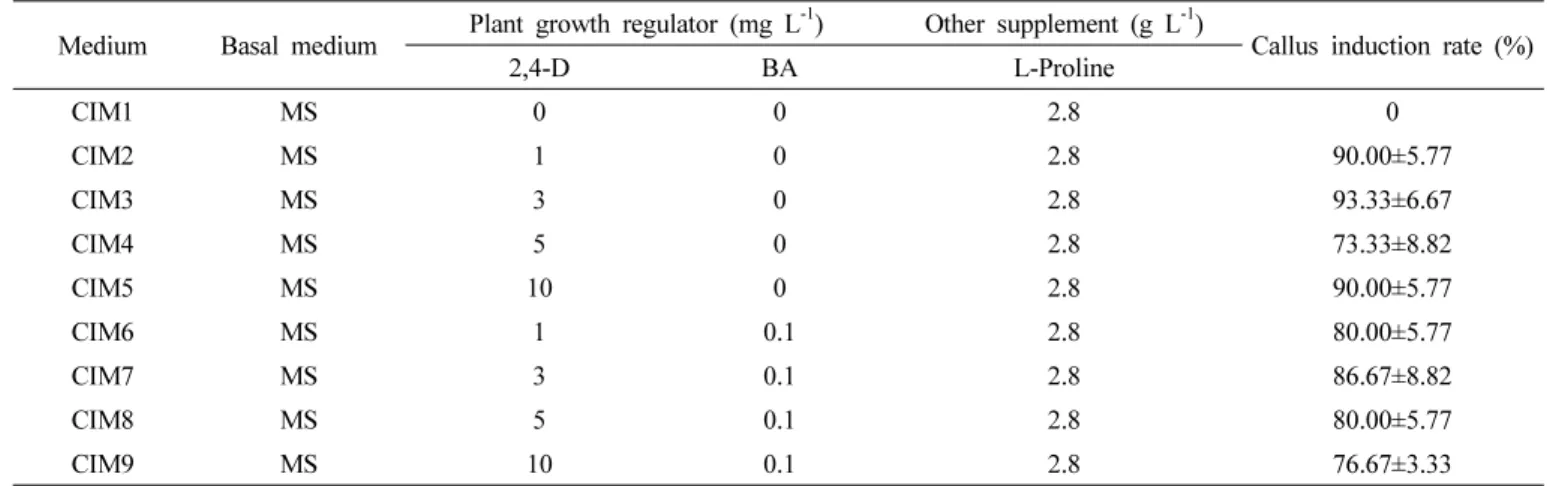
Table 1. Composition of the media used for induction of callus and callus induction rate.
Medium Basal medium Plant growth regulator (mg L
-1) Other supplement (g L
-1)
Callus induction rate (%)
2,4-D BA L-Proline
CIM1 MS 0 0 2.8 0
CIM2 MS 1 0 2.8 90.00±5.77
CIM3 MS 3 0 2.8 93.33±6.67
CIM4 MS 5 0 2.8 73.33±8.82
CIM5 MS 10 0 2.8 90.00±5.77
CIM6 MS 1 0.1 2.8 80.00±5.77
CIM7 MS 3 0.1 2.8 86.67±8.82
CIM8 MS 5 0.1 2.8 80.00±5.77
CIM9 MS 10 0.1 2.8 76.67±3.33
미치는 BA와 NAA의 적정 농도 조건을 알아보고자 BA 0, 1, 2, 3, 5 mg L-1와 NAA 0, 0.1, 1 mg L-1를 조합한 배지에 캘러스를 치상하여 배양하였다. 배양은 25 ± 2℃의 배양실의 형광등 하에서 16/8 (day/night)시간 주기로 배양하였다. 캘러 스로부터 재생된 소식물체의 발근을 위하여 소식물체를 캘러 스가 붙어있는 상태로 분리하여 MS배지에 sucrose 20 g L-1, gelrite 2 g L-1가 첨가된 뿌리 신장배지에 치상하였다. 발근 하여 신장한 식물체는 배지를 제거하고 상토가 담긴 비닐 포 트에 이식하여 식물체가 20 cm 이상으로 성장하였을 때 1/5000아르의 와그너포트에 옮겨 심어 가온하지 않은 온실에 서 재배하였다.
재분화 억새의 RAPD 분석 및 배수성 분석
재분화 억새의 동일성을 확인하기 위한 randomly amplified polymorphic DNA (RAPD) 분석을 위해 온실에서 배양한 재분화식물체 및 ‘우람’ 억새, 3배체 억새, 일반 물억새의 genomic DNA를 추출하여 실험에 이용하였다. RAPD analysis를 위한 primer들은 An et al. (2013)에서 sequence 정보를 얻어 제작 의뢰하여 사용하였다(RAPD primer:
5’-TACCTAAGCG–3’ (N8018)). PCR은 94℃에서 1분간 denaturation, 36℃에서 1분간 annealing, 72℃에서 2분간 extension하는 cycle을 45회 반복하였다. 증폭된 PCR 산물은 1.5% agarose gel을 이용하여 0.5% TAE buffer에 100 V로 전기영동하여 밴드를 확인하였다.
Flow cytometry (PAII, Partec, Germany)를 이용한 재분 화 억새의 배수성 분석 실험은 가온하지 않은 온실에서 배양 중인 ‘우람’ 재분화 식물체의 어린 줄기를 이용하였다. 온실
에서 채취한 어린 줄기는 지퍼백에 담아 실험실로 옮겨 겉잎 을 한 두 겹 제거한 후 증류수에 담가 마르지 않도록 유지하였 다. 배수성 검정은 배수성 검정용 시약 kit인 high resolution kit(Partec CyStain UV Precise, Partec)을 이용하여 실시하 였고 대조 식물로 2배체 수수(Sorghum bicolor)를 이용하였 다. 배수성은 flow cytometry에서 최소 10,000개의 nuclei를 분석하였다(Chae et al. 2013, Moon et al. 2013).
결 과
캘러스 유도 배지 조건 및 배양 환경 확립
미성숙 화기를 이용한 캘러스 유도 최적 조건을 구명하고 자 ‘우람’ 억새의 미성숙 화기를 절단하여 호르몬이 첨가된 캘러스 유도배지에 치상하여 배양하였다. 배양 2주 후부터 캘 러스가 형성되는 것이 관찰되었고 배양 3주 후에는 다수의 캘 러스들이 나타나기 시작하였다(Fig. 1A). 캘러스 유도를 위해 1 ~ 5 mm의 미성숙 화기를 이용하였을 때 1 mm 이하의 미 성숙 화기는 소독 및 적출 과정에서 손상을 받기 쉬워 배지에 치상 시 거의 대부분 캘러스로 분화하지 못하였다. 5 cm 이 상 분화한 억새 미성숙 화기를 절단해서 실험한 기존의 연구 에서도 캘러스의 재분화가 잘 되는 것으로 보아 발생 초기 단 계의 미성숙 화기보다는 어느 정도 분화한 미성숙 화기를 이 용하는 것이 시험 재료 채취 및 캘러스 유도율 향상에 유리할 것으로 보인다(Glowacka et al. 2010, Kim et al. 2012, Seong et al. 2010).
캘러스의 유도는 캘러스 유도 배지 치상 4주 후 조사를 실 시하였으며 생장조절제 2,4-D 3 mg L-1가 첨가된 배지에서
Fig. 1. Callus induction and plant regeneration from immature inflorescences of M. sacchariflorus cv. Wooram.
(A) Induced callus from immature inflorescences. (B) Shoot induction from calli.
93.3%로 가장 높은 캘러스 유도율을 나타내었다(Table 1).
또한 2,4-D 1 mg L-1, 10 mg L-1 첨가 배지에서도 90%의 유 도율을 나타내었으나 0.1 mg L-1 BA가 첨가된 배지에서는 2,4-D 3 mg L-1와 BA 0.1 mg L-1 혼합 배지에서 최고 86.7%의 유도율을 보여 2,4-D 단일 처리 배지에 비해 캘러스 유도율이 낮았다.
재분화 유도 배지 조건 및 배양 환경 확립
억새의 미성숙 화기로부터 유도된 캘러스로부터 신초를 재 분화시키기 위한 배지 조건 확립을 위해 생장조절제의 농도 별 재분화 실험을 수행하였다. 생장조절제로는 옥신류 NAA 와 사이토키닌류 BA를 사용하였고 캘러스는 0.1 mg L-1 BA 가 첨가된 배지에서 유도된 캘러스와 BA의 첨가 없이 2,4-D 단일배지에서 유도된 캘러스를 구분하여 실험을 수행하였다.
재분화 유도배지에 치상 2주 후 green spot이 형성되는 것이 관찰되었고 치상 3주 이상 되었을 때 small shoot가 관찰되는 것을 확인할 수 있었다(Fig. 1B). 생장조절제 농도에 따른 재 분화율을 조사한 결과 2,4-D 단일배지에서 유도된 캘러스는
대부분 조건에서 50% 이상의 green spot을 형성하였으나 재 분화율은 1 mg L-1 BA와 0.1 mg L-1 NAA가 혼합 처리된 배지에서 53%로 가장 높았다(Fig. 2). 2,4-D와 BA의 혼합배 지에서 유도된 캘러스의 재분화 실험에서는 모든 호르몬 처 리 조건에서 80% 이상의 green spot 형성율을 보였고, 재분 화율은 5 mg L-1 BA 와 0.1 mg L-1 NAA혼합 배지에서 86.7%로 가장 높았다. 그 이외에도 2, 3 mg L-1 BA 단일처 리 배지에서 80% 및 76.7%의 재분화율을 보였다. 물억새(M.
sacchariflorus)의 미성숙 화기를 이용한 재분화 실험에서 100% 재분화율을 보인 선행연구 결과와 비교하였을 때 재분 화율이 낮은 이유는 본 실험에서 캘러스 유도 시 배 발생 캘 러스를 따로 선별하지 않고 재분화 실험에 이용하였기 때문 에 식물체 재분화율의 저하에 영향을 미쳤을 것으로 생각된 다(Zhao et al. 2013).
재분화 유도 배지에서 재생된 신초는 2 cm 이상 신장하였 을 때 뿌리 유도를 위해 MS배지에 20 g L-1 sucrose를 첨가 한 배지로 옮겨 배양하였다(Fig. 3A). 뿌리 유도 배지에 치상 2주 후 뿌리가 유도되었으며 이후 1 ~ 2주 더 배양하여 뿌리
Fig. 2. Effects of 6-benzyl-adenine (BA) and α-naphthalene acetic acid (NAA) concentrations on shoot regeneration from calli.
Two different callus induction medium supplemented with 2,4-D and BA were used to derive shoots from immature inflorescences of M. sacchariflorus cv. Wooram. Error bar indicates ± SE of data obtained from three independent replications.
의 길이가 3 cm 이상 신장하였을 때 토양으로 이식하였다.
이때의 재분화 신초는 약 10 cm 이상 신장한 상태였다.
발근된 소식물체는 배지 및 캘러스를 제거한 후 상토가 담 긴 비닐포트로 이식하였다. 이식한 소식물체는 1주일간은 잎 끝이 마르고 시드는 경향을 보였으나 그 이후 정상적인 생육상 태를 보이며 5주 후에는 20 cm 이상으로 지상부가 신장하였 다. 신장된 식물체는 와그너 포트로 옮겨 심어 온실에서 재배 하였고 이후 많은 분얼이 형성되는 경향을 보였다(Fig. 3B).
재분화 억새의 RAPD 분석 및 배수성 확인
재분화된 억새 식물체가 원 식물체인 ‘우람’ 억새와 동일한
지를 확인하기 위해 RAPD primer를 이용해 PCR을 수행하였 다. 실험에 이용된 N8108 primer는 3배체나 일반 물억새, 참 억새 등에서는 나타나지 않으나 4배체 물억새의 일종인 거대 억새류에서만 약 1,800 bp의 밴드가 보이는 특징을 가지고 있 다(An et al. 2009). 실험 결과 3배체 억새와 일반 물억새는 1,800 bp 부근에서 증폭된 밴드가 관찰되지 않았고, 4배체 물 억새인 ‘우람’ 억새와 재분화 개체들에서 1,800 bp의 밴드가 나타남을 확인할 수 있었다. 이 결과로 재분화 개체들이 원 식 물체인 ‘우람’ 억새와 동일함을 확인할 수 있었다(Fig. 4).
RAPD primer를 이용한 분석 이외에도 재분화 개체의 동 일성 여부를 확인하기 위해 Flow cytometry를 이용하여 억새
Fig. 3. Rooting and acclimation of regenerated plantlets.
(A) Regenerated shoots on MS medium. (B) Acclimation of plants on greenhouse condition.
Fig. 4. RAPD analysis of regenerated plant. SM, size marker; W, Wooram; S, M. sacchariflorus; g, M. × giganteus; R1-10, regenerated
plants. The result showed that the approximately 1,800 bp bands were generated in Wooram and regenerated plants.
Fig. 5. Flow cytometric histogram of stem samples of Miscanthus species and regenerated plants.
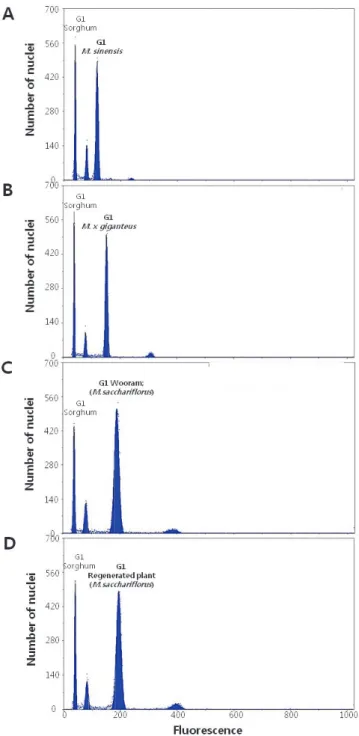
(A) M. sinensis. (B) M. × giganteus. (C) M. sacchariflorus cv. Wooram. (D) regenerated plant of ‘Wooram’. DAPI fluorescence of the nuclei (x-axis) versus the number of nuclei counted (y-axis).
의 배수성을 확인하고자 하였다. 배수성 분석 결과, 2배체 참 억새는 G1 peak 중앙값이 110 ~ 120 사이, 3배체 억새는 150
~ 160 사이에 나타났다. 이와 달리 4배체 물억새인 ‘우람’은
G1 peak의 중앙값이 190 ~ 200 사이에 위치하였고 재분화 개체들 또한 ‘우람’ 억새와 동일하게 peak의 중앙값이 190 ~
200 사이에 위치함을 확인하였다(Fig. 5).
적 요
본 연구는 한국형 바이오에너지작물로 선발된 물억새인
‘우람’의 미성숙 화기를 이용한 캘러스 유도 및 식물체 재분 화 조건을 확립하고자 하였다. 캘러스 유도율은 MS배지에 2,4-D 3 mg L-1 첨가에서 93.3%로 높게 나타났으며, 2,4-D 3 mg L-1과 BA 0.1 mg L-1 처리에서 86.7%로 높게 나타났 다. 식물체 재분화율은 BA가 첨가된 배지에서 유도된 캘러스 를 이용하였을 경우 BA가 첨가되지 않은 배지에서 유도된 캘 러스보다 높게 나타나는 것을 확인하였다. 재분화를 위한 배 지 조성은 BA 5 mg L-1과 NAA 0.1 mg L-1 호르몬 조합에 서 재분화율이 86.7%로 가장 효과적이었다. 재분화된 소식물 체는 캘러스로부터 분리하여 MS배지에서 발근을 유도하였을 때 배양 4주 이후 뿌리가 3 cm 이상 신장하였다. 기내에서 발 근이 된 소식물체의 순화를 위해 상토에 이식하고 온실에서 재배하였을 때, 5주 후 지상부가 20 cm 이상으로 신장하여 성공적으로 활착되었다.
사 사
본 논문은 농촌진흥청 연구사업(세부과제명: 억새 품종육 성을 위한 특성 구명 및 교배 방법 개발, 세부과제번호:
PJ00930402)의 지원에 의해 이루어진 것임.
REFERENCES