K. H. Bae
National Institute of Biological Resources, 42 Hwangyeong-ro, Seo-gu, Incheon, 404-708, Republic of Korea
M. H. Lee
R&D center, Asiaseed Co. Ltd., Icheon, 447-2, Gyeonggi Province, Republic of Korea
Y. E. Choi
Division of Forest Resources, College of Forest and Environmental Sciences, Kangwon National University, Chuncheon, Kangwon-do 200-701, Republic of Korea E. S. Yoon ( )
Department of Biology, College of Nature Sciences, Kongju National University, Kongju 314-701, Republic of Korea e-mail: [email protected]
Callus induction and plant regeneration of Lychnis wilfordii (Regel) Maxim a critically endangered plant in Korea
Kee Hwa Bae ・ Mi Hyun Lee ・ Yong Eui Choi ・ Eui Soo Yoon
Received: 26 February 2014 / Revised: 3 March 2014 / Accepted: 17 March 2014
ⓒKorean Society for Plant Biotechnology
Abstract Lychnis wilfordii (Regel) Maxim is a rare and valued ornamental plant. Germination rate reached 46.6%
when seeds were treated with 100 mg‧l-1 GA (Gibberellic acid)3. The highest callus induction was observed in the leaf explants of the seedlings on MS medium containing specific concentrations of 0.5 mg‧l-1 BA (N6-benzyladenine) and 3.0 mg‧l-1 NAA (a-naphthalene acetic acid). The adventitious shoot was formed in 97.3% of calli on 1/2 WPM (Woody Plant Medium) medium. Shoot elongation of in vitro propagated plantlets was no difference among various medium. The plantlets grew well after transferring to the pot. This in vitro propagation protocol should be useful for conservation of this endangered plant.
Keywords callus, endangered plant, in vitro, germination, L. wilfordii
Introduction
The genus Lychnis belongs to the family Caryophyllaceae and consists of about 30 species in the world. Lychnis spp.
are distributed throughout the temperate regions of the Northern Hemisphere, from East Asia to Europe (Magnus
et al. 2008), and four Lychnis spp. are native to Korea (Lee 1974). Some species of Lychnis spp. are frequently grown in Korea for horticultural use.
Lychnis wilfordii (Regel) Maxim is a perennial and narrowly distributed in Kangwon province of Korea. Also, it is rare and critically endangered species which is subjected to strict protection as an endemic plant. The population size declines rapidly. For this reason, the Ministry of Environment (MEV) has designated the species as ‘Threatened to extincts : the second grade for preservation’ (Lee and Choi 2006).
Also, the reproduction of this species by seeds is rarely used due to poor seed germination and low seed production.
L. wilfordii is a valued ornamental plant with orange-red flowers. However, little attention was paid to this material by Korean botanists and horticulturists. The main reason for this is the limitation of suitable environments and low productivity of the species. In nature, the species propagates through seed and vegetative perennial rootstock. According to our preliminary investigations on propagation of L. wilfordii via seed, we found that seed germination took 2 ~3 months and was sporadic from ex vitro or in vitro culture. Meanwhile, vegetative propagation was not possible as the process of rooting was too slow. Therefore, the development of an in vitro protocol will be of great importance for conservation and sustainable utilization of this species. However, propagation protocols for this species in vitro have not yet been reported.
The purpose of this study of L. wilfordii in vitro propagation methods was to improve the germination rates of seeds and develop a protocol for in vitro propagation via organogenesis.
Materials and methods
Plant material and seed germination test
Seeds of L. wilfordii were collected from a wild population of Mt. Odae National Park in Korea late September of R es earc h Arti cle
Fig. 1 Effect of GA3 on germination of L. wilfordii: Thirty seeds were incubated for each treatment with five replicates.
Germination rate (%) was recorded after 4 weeks of culture
2010. Mature seeds of L. wilfordii were scarified by immersion in 70% EtOH for 1 min and then sterilized with 1% sodium hyporchloride (NaOCl) (v/v) (5% of sodium hypochlorite, Sigma, USA) and a few drops of Tween-20 (Sigma, USA) for 30 min. For the GA3 treatment, seeds were soaked in 100 mg‧l-1 GA3 solution for 24h before incubation. The seeds were washed 5 times in sterile water and placed into petri-dishes containing hormone-free MS (Murashige and Skoog 1962) medium under white fluorescent lights (30 μ mol m-2 s-1) on a 16 h photoperiod or in the dark at 25°C.
The germination rate was tested after 8 weeks of culture.
Thirty seeds were incubated for each treatment and repeated five times, and the seeding used in subsequent experiments.
Effects of explant type and PGR’s on callus induction
After cutting the leaf, stem and root explants into 10 mm in sizes from in vitro plantlet (Fig. 2A), they were cultured on MS medium supplemented with auxins (0, 1.0 and 3.0 mg‧l-1 NAA : a-naphthalene acetic acid, 0, 1.0 and 3.0 mg‧l-1 IAA : indole acetic acid ) and/or cytokinin (0, 0.5 mg‧l-1 BA : N6-benzyladenine). All media were supplemented with 30 g l-1sucrose and solidified with 8.0 g l-1 plant agar, and then adjusted to pH 5.8 before autoclaving at 121°C for 20 min. Calli were maintained under cool white fluorescent lights (30 μmol m-2 s-1) on a 16 h photoperiod at 25°C.
The frequency of callus induction was evaluated after 12 weeks of culture. Thirty explants (leaf, stem and root) were incubated for each treatment and repeated five times.
In vitro plant regeneration
Calli were transferred to WPM (Lloyd and McCown 1980), half-strength WPM, one-third strength WPM medium, MS, half-strength MS, and one-third strength MS medium for the plant regeneration. The culture room was maintained at 25°C with a 16 h photoperiod under 30 μmol m-2 s-1 white fluorescent light. Adventitious shoot formation rate was evaluated by counting plantlets with well-developed shoot primordia after 4 weeks of culture. And, plants with better roots were transplanted into a mixture composed of vermiculite and pealrite (1:1) in the single pot. Plantlet height was evaluated by measuring average length of shoots and roots after 4 weeks of culture.
Statistical analysis
All data were analyzed using ANOVA and expressed as means ± standard error (SE). To examine significant differences
among the treatments, multiple comparison tests were then performed by Duncan’s multiple range test at p ≤ 0.05 (SAS 2001).
Results and discussions
Treatment of GA3 on seed germination
The germination rate of seeds was increased with GA3
treatment as shown in Figure 1. The germination rate reached 46.6% when seeds were treated with 100 mg‧l-1 GA3. However, the germination rate was still not sufficient for production of the species by seed propagation. Therefore, in vitro propagation of L. wilfordii was performed in the subsequent experiments. Based on our preliminary study, L. wilfordii seeds have a poor and unpredictable germination rate. The result suggested that L. wilfordii seeds have deep dormancy.
It has been reported that approaches to break seed dormancy such as hormonal, temperature, etc. are necessary (Seiler 1998; Mabberley 1989). GA3 treatment was resulted in improve germination of many plant species (Nicolas et al. 1996;
Rehman and Park 2000). In the present study, it was found that the germination rate was increased in of GA3
treated seeds comparison to the control treatments.
Callus induction
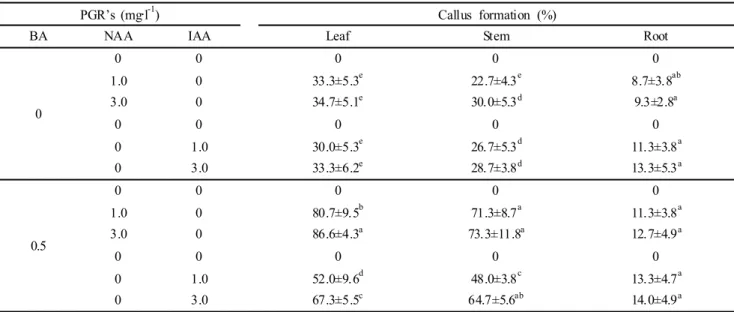
Callus formation varied significantly depending on kind of explants and plant growth regulator (PGR) in L. wilfordii (Table 1). When explants were cultured on medium with BA, callus formation was more efficient compared to the
Table 1 Effects of NAA and IAA in combination with BA on callus formation from leaf, stem and root explants of L. wilfordii.
MS medium containing 30 g‧l-1 sucrose. Data were collected after 12 weeks of culture
PGR’s (mg‧l-1) Callus formation (%)
BA NAA IAA Leaf Stem Root
0
0 0 0 0 0
1.0 0 33.3±5.3e 22.7±4.3e 8.7±3.8ab
3.0 0 34.7±5.1e 30.0±5.3d 9.3±2.8a
0 0 0 0 0
0 1.0 30.0±5.3e 26.7±5.3d 11.3±3.8a
0 3.0 33.3±6.2e 28.7±3.8d 13.3±5.3a
0.5
0 0 0 0 0
1.0 0 80.7±9.5b 71.3±8.7a 11.3±3.8a
3.0 0 86.6±4.3a 73.3±11.8a 12.7±4.9a
0 0 0 0 0
0 1.0 52.0±9.6d 48.0±3.8c 13.3±4.7a
0 3.0 67.3±5.5c 64.7±5.6ab 14.0±4.9a
Data are the means ± SD, of five time experiments, n=30. Different alphabetical letters are significantly different according to Duncun's multiple range test at P≤ 0.05.
Fig. 2 Plant regeneration from callus derived from L. wilfordii. A: In vitro seedling of L. wilfordii. B: Initiation of callus induction from leaf explants on MS medium with 0.5 mg‧l-1 BA and 3.0 mg‧l-1 NAA. C: Initiation of callus induction from root explants on MS medium with 0.5 mg‧l-1 BA and 3.0 mg‧l-1 NAA. D: Conversion of shoot and root on 1/2MS medium without PGR’s after 4 weeks of culture. E: Proliferation of shoots on 1/2MS medium without PGR’s after 8 weeks of culture. F: Plantlet in sterile soil, vermiculite and pealrite (1:1) mixture for 10 day
explants without BA treatment. Leaf explants formed callus after 8 weeks of culture, but stem and root generated callus from cut surfaces after 10 weeks of culture. Calli of leaf (Fig. 2B) and root (Fig. 2C) were compact, globular and yellowish on MS medium with both 0.5 mg‧l-1 BA and 3.0 mg‧l-1 NAA after 12 weeks of culture, but control (non-treated PGR) did not form callus (Table 1). However, stem and
root explants exhibited 73.3% and 12.7% callus formation, respectively (Table 1). Callus induction in monocots requires long time for its initiation (Geier 1986). It was reported that the induction of callus was difficult and the proliferation of initiated callus was very slow and somehow difficult to maintain in other allium species (Zheng et al. 1998; Luciani et al. 2006).
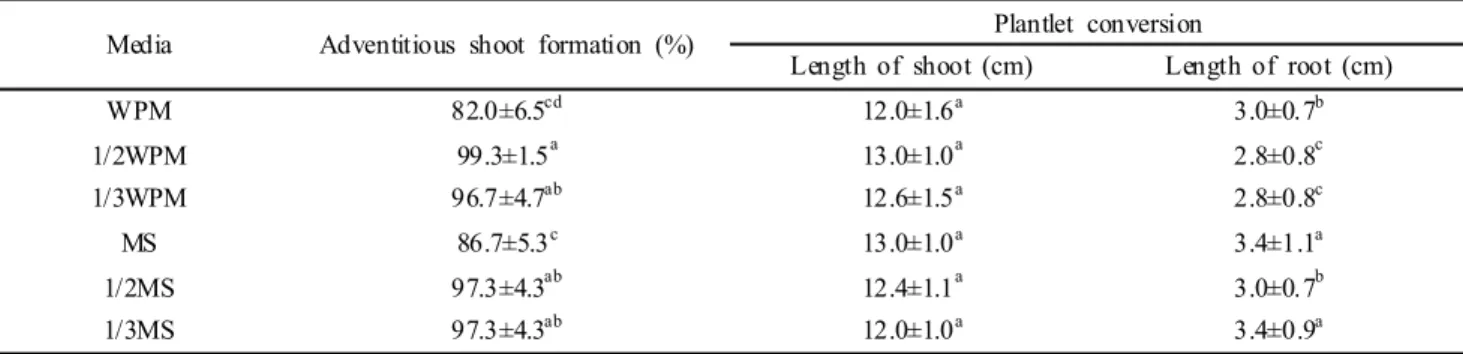
Table 2 Effect of various kinds of medium on adventitious shoot formation and plantlet conversion of L. wilfordii from callus.
Adventitious shoot formation (%) was collected after 8 weeks of culture. Plantlet conversion was collected after 12 weeks of culture
Media Adventitious shoot formation (%) Plantlet conversion
Length of shoot (cm) Length of root (cm)
WPM 82.0±6.5cd 12.0±1.6a 3.0±0.7b
1/2WPM 99.3±1.5a 13.0±1.0a 2.8±0.8c
1/3WPM 96.7±4.7ab 12.6±1.5a 2.8±0.8c
MS 86.7±5.3c 13.0±1.0a 3.4±1.1a
1/2MS 97.3±4.3ab 12.4±1.1a 3.0±0.7b
1/3MS 97.3±4.3ab 12.0±1.0a 3.4±0.9a
Data are the means ± SD, of five time experiments, n=30. Different alphabetical letters are significantly different according to Duncun's multiple range test at P ≤ 0.05.
In vitro plant regeneration
To determine adventitious shoot induction from callus, both types of callus (compact and friable ones) were transferred onto media (WPM, 1/2WPM, 1/3WPM, MS, 1/2MS, and 1/3MS). After 20 to 25 days of culture, calli turned greenish (Fig. 2D) and several adventitious shoot regenerated on 1/2MS medium (Fig. 2E). The highest adventitious shoot induction rate was obtained in 1/2WPM medium (99.3%) (Table 2). However, there was not a remarkable difference on the growth of plantlets among the six media. The height of in vitro propagated plants in pot was around 20 ~ 35 cm (Fig. 2F). Adventitious shoot regeneration on different media may be due to the differences of NO3-/NH4+ ratio, an important factor on nitrogen uptake and pH regulation during plant tissue culture (Fracago and Echeverrigaray 2001).
Lower NO3-/NH4+ ratio in B5 medium stimulated shoot conversion and growth from other allium species (Gamborg et al. 1968; Chu et al. 1975; Luciani et al. 2006). In vitro culture technique is an alternative ways for germplasm conservation and micropropagation of valuable endangered plants. It has the advantages of preserving healthy plant material in a small space, easy and rapid multiplication for international exchange as well as cost reduction. Generally, addition of BA to the medium could induce the formation of adventitious buds (Ayabe et al. 1995; Ayabe et al. 1998;
Guo et al. 2005; Xu et al. 2008). In the present study, the multiplication coefficient rose with the treatment of BA and NAA, respectively, but there was no interactive effects of BA and NAA.
In conclusion, we established the tissue culture system to propagate L. wilfordii and this technique may be applicable to commercially propagated the endangered L. wilfordii speices.
Acknowledgement
This work was supported by the research grant of the Kongju National University in 2012.
References
Ayabe M, Sumi S (1998) Establishment of a novel tissue culture method, stem-disc culture and its practical application to micropropagation of garlic (Allium sativum L.). Plant Cell Rep, 17:773-779
Ayabe M, Taniguchi K, Sumi SI (1995) Regeneration of whole plants from protoplasts isolated from tissue cultured shoot primordia of garlic (Allium sativum L.). Plant Cell Rep, 15:17-21
Chu CC, Wang CC, Sun CS (1975) Establishment of an efficient medium for anther culture of rice through comparative experiments on the nitrogen sources. Sci Sin 18:659-668 Fracago F, Echeverrigaray S (2001) Micropropagation of Cunila
galioides, a popular medicinal plant of south Brazil. Plant Cell Tissue Organ Cult 64:1-4
Gamborg O, Miller R, Ojima K (1968) Nutrient requirements of suspension cultures of soybean root cells. Exp Cell Res 50:
151-158
Geier T (1986) Anthurium. In: Evans, P.V., Sharp, D.A., Bajal, Y.P.S. (Eds.), Handbook of Plant Cell Culture, vol. 5. Collier Macmillan/Macmillan. New York/London pp228-252 Guo DP, Zhu ZJ, Hu XX, Zheng SJ (2005) Effect of cytokinins on
shoot regeneration from cotyledon and leaf segment of stem mustard (Brassica juncea var. tsatsai). Plant Cell Tissue Organ Cult, 83:123-127
Lee YN (1974) New taxa on Korean flora (1). Kor J Bot 17:33-35 Lee JS, Choi BH (2006) Distribution and red data of wild orchids
in the Korean Peninsula. Korea J Plant Taxon 36:335-360 Lloyd E, McCown B (1980) Commercially feasible micropropagation
of mountain laurel (Kalmia latifolia) by use of shoot tip culture. Comb Proc Int Plant Prop Soc 30:421-427
Luciani GF, Mary AK, Pellegrini C, Curvetto NR (2006) Effects of
explants and growth regulators in garlic callus formation and plant regeneration. Plant Cell Tissue Organ Cult 87:139-143 Magnus P, Abel G, Sileshi N, Jan S, Christian B (2008) Colonization
and diversification in the African ‘sky islands’ by Eurasian Lychnis L. (Caryophyllaceae). J Biogeography 35:1016-1029 Mabberley DJ (1989) The plant-book: a portable dictionary of the
higher plants. Cambridge: Cambridge University Press Murashige T, Skoog F (1962) A revised medium for rapid growth
and bioassays with tobacco tissue culture. Physiol Plant 15:
473-497
Nicolas C, Nicolas G, Rodriguez D (1996) Antagonistic effects on abscisic acid and gibberellic acid on the breaking of dormancy of Fagus sylvatica seeds. Physiol Plant 96:244-250
Rehman S, Park IH (2000) Effect of scarification, GA and chilling on the germination of golden rain-tree (Koelreuteria paniculata
Laxm.) seeds. Sci Hort 85:319-324
SAS (2001) SAS/STAT User’s guide (8.02) SAS Institute Inc., Cary, NC, USA
Seiler GJ (1998) Seed maturity, storage time and temperature, and media treatment effects on germination of two wild sunflowers.
Agron J 90:221-226
Xu Z, Um YC, Kim CH, Lu G, Guo DP, Liu HL, Bah AA, Mao A (2008) Effect of plant growth regulators, temperature and sucrose on shoot proliferation from the stem disc of Chinese jiaotou (Allium chinense) and in vitro bulblet formation. Acta Physiol. Plant, 40:521-528
Zheng SJ, Henken B, Sofiari E, Jacobsen E, Krens FA, Kik C (1998) Factors influencing induction, propagation and regeneration of mature zygotic embryo-derived callus from Allium cepa.
Plant Cell Tissue Organ Cult 53:99-105