• 검색 결과가 없습니다.

Evaluation of Fracture Toughness of Paper in Wet State (I) - Effect of Fiber Furnish and Refining -

N/A
N/A
Protected

Academic year: 2021

Share "Evaluation of Fracture Toughness of Paper in Wet State (I) - Effect of Fiber Furnish and Refining -"

Copied!
9
0
0

로드 중.... (전체 텍스트 보기)

전체 글

(1)

• Dept. of Bio-based Materials, Chungnam National Univ., Daejun, Yousung-Gu, Gung-Dong 220, Republic of Korea 1 Hansol Paper Co., Republic of Korea

† Corresponding Author: E-mail: [email protected], Fax: 82-42-821-6159

http://dx.doi.org/10.7584/JKTAPPI.2016.08.48.4.62 Printed in Korea

Evaluation of Fracture Toughness of Paper in Wet State (I) - Effect of Fiber Furnish and Refining -

You Sun Roh

1

and Yung Bum Seo

Received July 30, 2016; Received in revised form August 17, 2016; Accepted August 19, 2016

ABSTRACT

Fracture toughness is considered to be a good estimate of the paper breaking tendency of a paper web in a paper machine and press room. Paper breaks are caused by many fac- tors, such as the irregular vibrations of a paper machine, impurities in the fiber furnish, and presence of shive. On a paper machine, the dryness of the paper web changes very rapidly from less than 1% to more than 95%. We tried to measure the fracture toughness of a paper web at different dryness levels in order to acquire a fundamental knowledge of paper breaks. Stretches of wet webs were also measured and compared to the changes in fracture toughness. Four different fiber furnishes were refined to different degrees, and their fracture toughness values were measured at different dryness levels (40%, 60%, 80%, and 95%). Two fracture toughness measurement methods (essential work of fracture and Tryding’s load-widening method) were compared, and found to give identical results.

However, Tryding’s method was much easier to implement. The highest stretch was most- ly at 80% solid content, where the highest fracture toughness occurred.

Keywords: Fracture toughness, dryness, stretch, essential work of fracture, load-widen- ing, paper break

1. Introduction

Frequent paper breaks in the middle of the pa- per manufacturing process are the worst possible nightmare for papermakers.

1)

Loss of productivi- ty, energy, raw materials, and manpower are often the results. A large amount of under-spec paper

products produced during a paper break should

be handled properly so that such products do not

reach the customers. However, papermakers can-

not avoid paper breaks, but they can reduce the

frequency of breaks. The paper breaks in a paper

machine usually occur at three sites: wet web pick-

up roll at the end of the wire, between the last wet

(2)

press stack and the dryer section, and after the surface size press. The paper webs at those sites have a high moisture content, a significant amount of loading in the machine direction, and an abrupt change of running angle.

Papermakers usually install special devices and apply special technologies at these sites in order to prevent the paper breaks. However, paper breaks still occur, resulting in large economic losses. We need to know how much the wet web is susceptible to breaking at those sites for a better understand- ing of the paper breaks.

1-5)

The influencing factors include the dryness of the web, fiber types (me- chanical or chemical pulp, softwood or hardwood), refining degree, paper machine speed, wire type, wet press type, size press type, and web tension.

In this study, we focused on the first three fac- tors (web dryness, fiber type, refining degree). The other factors are mainly due to the paper machine itself, which is difficult and expensive to change.

In this study, we measured the fracture toughness of paper webs under different dryness levels, fiber types, and refining degrees. Fracture toughness is not directly related to paper breaking, but until now, it is the best indicator known in this field so far. The measurement of fracture toughness is not easy at all, even nowadays. Paper is a nonlinear viscoelastic material and its load-elongation curve forms a curve with the initial rise of a straight line.

Therefore, linear elastic fracture mechanics is not applicable, but elastic-plastic fracture mechanics is applicable. In paper mechanics, J integral

6-10)

and essential work of fracture

11-15)

, which are appli- cable to nonlinear elastic materials, were used to estimate the fracture toughness. Tryding

16)

used a load-widening curve in the tension test, and ob- tained a fracture energy value per test specimen.

We used both the essential work of fracture and the load-widening curve technique

16)

to estimate the fracture energy and fracture toughness.

2. Materials and methods

We used SwBKP (softwood bleached kraft pulp: a mixture of hemlock, Douglas fir, and cedar, Can- ada), HwBKP (hardwood bleached kraft pulp: a mixture of aspen and poplar, Canada), OCC (old corrugated container, donated by D Paper Co. in Korea), and ONP (old newspaper, donated by H Paper Co. in Korea) fibers and applied different refining times to the fibers in a valley beater. Their handsheet properties are presented in Table 1. The solid contents of the wet paper webs were con- trolled by changing the drying times (40%, 60%, 80%, and 95%). We made handsheets with a Wil- liams handsheet machine (Daelim Paper Machin- ery Co. in Korea). After applying an identical wet

Sample Refining time (min.)

Freeness (mL CSF)

Basis weight (g/m

2

)

Density (g/cc)

Breaking length (km)

23℃ / 50% RH

30 530 102.2 0.52 8.30

50 423 101.3 0.65 9.07

70 325 103.8 0.70 8.69

Hardwood

15 520 101.5 0.54 2.41

30 356 100.1 0.57 4.50

45 250 105.2 0.65 5.75

Old newspaper 10 320 103.3 0.50 5.07

20 250 100.8 0.43 5.54

OCC 20 310 102.5 0.61 4.88

30 225 101.8 0.65 5.46

Table 1. Handsheet physical properties of the fiber furnishes

(3)

pressing intensity and sequence, we varied the drying times of the wet webs, and sampled small pieces to measure their dryness levels. We kept the dryness of the wet webs until all of the physical testing was finished. The wet web was dried to the predetermined solid content, then put into a vinyl folder and sealed. This wet web was packed again in a second vinyl folder, and also sealed. The dou- ble-time packed wet web was kept in a refrigerator until testing. We checked the solid contents of the sample after 3 weeks in the refrigerator, and did not notice any significant changes.

When testing the samples, we brought the sample in the vinyl folder, and cut the sample to the de- sired shape with the vinyl still attached. After the sample was securely connected between the grips in the tensile tester (Micro 350 tensile tester. Tes- tometrics, England), we removed the vinyl, and ran the test. After the test, we measured the weight of the sample, and checked its solid contents. We found no significant differences in the solid con- tents of the samples before and after the test.

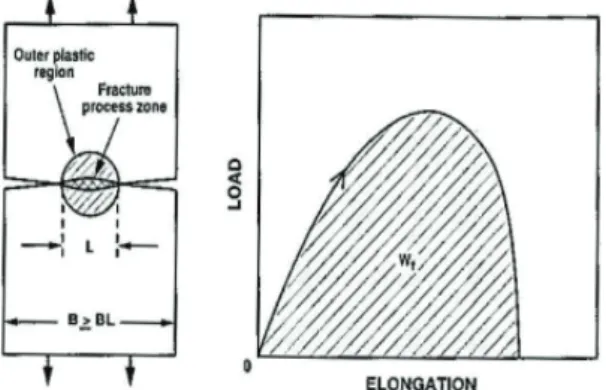
The measuring procedure of the essential work of fracture is simple and well known. We use deep double-edge notched tension specimens (DENT) containing varying ligament lengths (L), as shown in Fig. 1 and Fig. 2.

15)

In the measurement of the essential work of the fracture of sample paper, we made a paper test

specimen, as shown in Fig. 1, where we could find DENT specimen with B≥3L (B: sample width, L:

ligament length). In Fig. 2, as the ligament length of the specimen changes, W

f

(total strain energy of the specimen) changes. The intercept of the line is called the essential work of the fracture (W

e

). It is already well established that W

e

is a good estimate of the fracture toughness of a material independent of the specimen’s size and shape.

15)

Another way of measuring fracture toughness is based on the analysis of the stress-widening curve at the stable fracture region suggested by Try- ding

16)

. In the stress-widening method, the speci- men dimension should be controlled in such a way that the specimen fails at the stable fracture region in the tensile test. Fig. 3 shows a stable and an immediate unstable fracture. To make sure that the fracture occurs at the stable fracture region, one should find the appropriate length-to-width ratio of the specimen before the fracture test. How to select the ratio is well described in the reference

16)

. Usually, at very low length-to-width ratio, a sta- ble fracture occurs. In our experiment, we used the specimen dimension of 50 mm in width, and de- cided the span length depending upon the dryness level before the experiment by pretesting. For 40%

and 60% dryness cases, a span length of 50 mm, for 80% dryness, a span length of 25 mm, and for 95% dryness, a span length of 15 mm was decided,

Fig. 2. Calculation of essential work of frac- ture (W

e

, from ref. 15).

Fig. 1. Schematic of measuring the essential

work of fracture (from ref. 15).

(4)

respectively. At those length-to-width ratios, it was found that there were no unstable fracture or abrupt break of the samples.

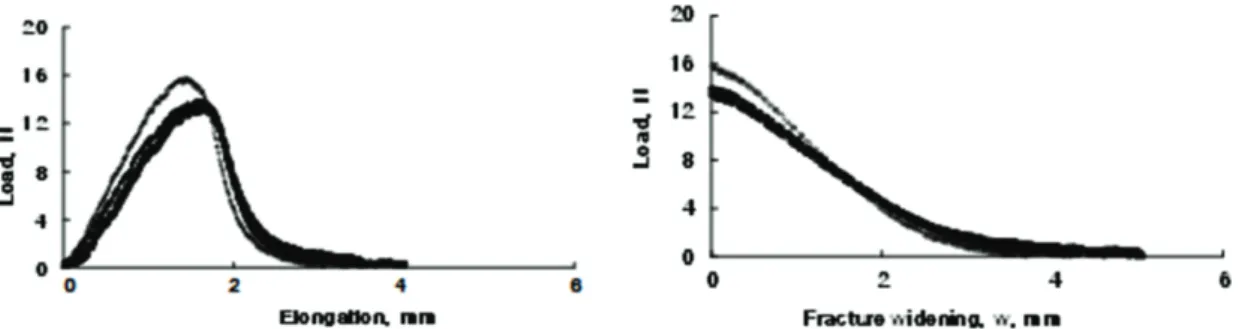
Fig. 4 shows the elongation vs. load and frac- ture widening vs. load curves in the tensile test.

Multiple curves denote replication of the tests. The fracture widening curve starts from the peak load in the elongation vs. load curve, where the sta- ble fracture starts. As elongation increases further from the peak load, the load decreases. We calcu- lated the elongation loss caused by the load de- crease after the peak load, and subtracted it from the total elongation. The resultant elongation is called fracture widening. The area under the frac- ture widening vs. load curve is the fracture energy, G

f

, which can be calculated by numerical analysis.

16)

3. Results and discussion

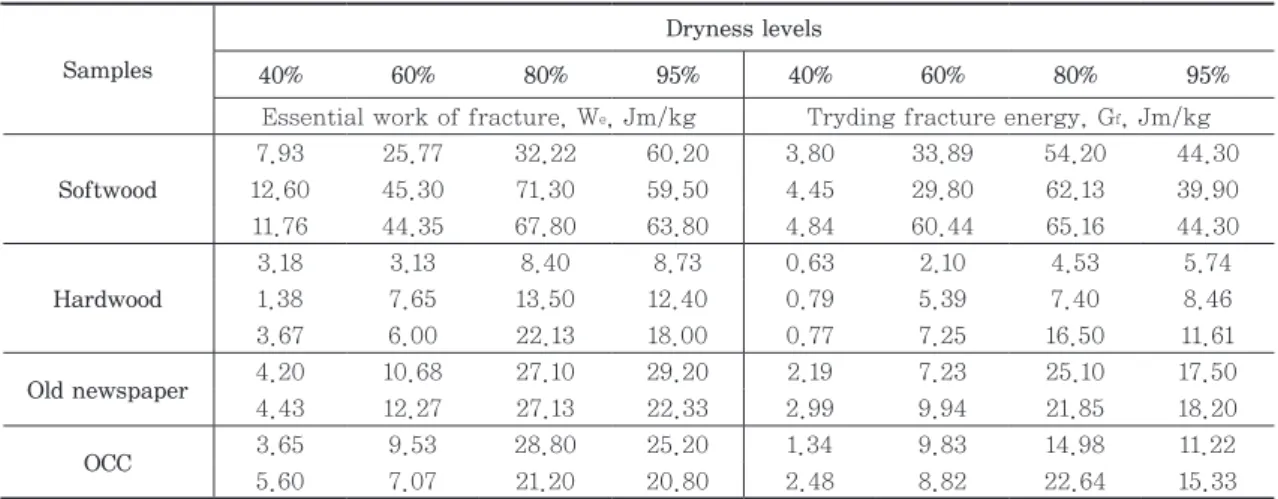
Four different fiber furnishes were used to in- vestigate the change of fracture toughness at dif- ferent dryness and refining levels. Their densities, breaking lengths, fracture toughness values, and stretches are shown in Table 2. In the handsheet making process, we controlled the dryness levels of the handsheets by varying the drying time.

In Table 2, the fracture energy values of soft- wood furnish were much higher than those of the other furnishes. We think that is because the soft- wood fibers are longer than the other fibers, and the paper containing the long fibers is difficult to break apart. Hardwood virgin fibers gave the low- est fracture energy at all dryness levels. Even the old newspaper furnish gave higher fracture ener- gy than did the hardwood virgin bleached chemical pulp fibers. The OCC usually has longer fibers, and it did not surprise us by giving a higher fracture energy than that of the hardwood furnish.

Fig. 5 shows the close relationship between the essential work of fracture and Tryding’s fracture energy (R

2

= 0.8835). Tryding’s method was very easy to implement, and gave a stable test value every time. The method needed only one sample for obtaining one fracture toughness value. However, the essential work of fracture needed at least four tests to obtain one fracture toughness value in the experiment. Furthermore, care should be taken in Fig. 3. Example of stable and immediate frac-

ture for the sack kraft paper specimen (ref. 16).

Fig. 4. Example fracture widening curves made from tensile tests (softwood 50 min. refining, 40%

solid content case).

(5)

cutting the samples exactly up to ligament lengths.

Two methods gave almost identical trends of frac- ture toughness variation, even though the dryness levels and the kinds of furnishes had changed.

The curves of fracture energy, breaking lengths, and stretches of four different furnishes at 40%, 60%, 80%, and 95% dryness levels are shown in Figs. 6-9. Four different furnishes gave almost the same characteristic maximum of fracture energy at 80% solid contents. Another observation is that the stretches of four furnishes exhibited similar trends as the fracture energy (maximum at 80% and drop at 95% dryness level). If the fracture energy is high

at a certain dryness level, we may expect the high stretch value of the wet web at that dryness lev- el. Refining caused a higher breaking length and higher fracture energy for each fiber furnish.

The breaking length curves of the furnishes were different from those of the fracture energy and the stretch. The highest breaking length was always at the highest dryness level. Stretch values were low at 40% and 95% dryness levels, but were high at 60% and 80% dryness levels. Therefore during the papermaking process, care should be taken at around 40% dryness level, where both breaking length and stretch must be the lowest. At the 40%

dryness level in the paper machine, the location of the paper is at or right after the wet press.

4. Conclusions

We measured the fracture energy values of four different fiber furnishes (SwBKP, HwBKP, ONP, and OCC) at four different dryness levels (40%, 60%, 80%, and 95%), while varying the refining time. Two different fracture toughness measure- ment methods, which were the essential work of fracture and the Tryding’s load-widening meth- od, were used in the measurements. We found that Samples

Dryness levels

40% 60% 80% 95% 40% 60% 80% 95%

Essential work of fracture, W

e

, Jm/kg Tryding fracture energy, G

f

, Jm/kg

Softwood

7.93 25.77 32.22 60.20 3.80 33.89 54.20 44.30

12.60 45.30 71.30 59.50 4.45 29.80 62.13 39.90

11.76 44.35 67.80 63.80 4.84 60.44 65.16 44.30

Hardwood

3.18 3.13 8.40 8.73 0.63 2.10 4.53 5.74

1.38 7.65 13.50 12.40 0.79 5.39 7.40 8.46

3.67 6.00 22.13 18.00 0.77 7.25 16.50 11.61

Old newspaper 4.20 10.68 27.10 29.20 2.19 7.23 25.10 17.50

4.43 12.27 27.13 22.33 2.99 9.94 21.85 18.20

OCC 3.65 9.53 28.80 25.20 1.34 9.83 14.98 11.22

5.60 7.07 21.20 20.80 2.48 8.82 22.64 15.33

Table 2. Physical properties of the handsheets (100 g/m

2

)

Fig. 5. Relationship between the fracture

toughness values measured by the es-

sential work of fracture and Tryding’s

load-widening method. The overall re-

gression coefficient is 0.8835 (R

2

).

(6)

Fig. 6. Fracture toughness, breaking length, and stretch of SwBKP.

Fig. 7. Fracture toughness, breaking length, and stretch of HwBKP.

(7)

Fig. 8. Fracture toughness, breaking length, and stretch of old newspaper.

Fig. 9. Fracture energy, breaking length, and stretch of OCC.

(8)

the two measurement methods produced the same trends. A few conclusions were made as follows:

* The essential work of fracture and the Tryding’s load-widening method gave almost identical curves at different fiber furnishes and at each wet web dryness level.

* The Tryding’s method gave one fracture tough- ness value per test. It was much more conve- nient than the essential work of fracture meth- od in practice.

* The fracture toughness and the stretch curves gave maximum values at around 80% dryness levels for four different fiber furnishes and at different refining degrees.

* The SwBKP gave the highest fracture toughness values at each dryness level.

* The HwBKP gave the lowest fracture toughness values (lower than ONP and OCC).

Literature Cited

1. Park, J. M. and Thorp, J. L., Yield and frac- ture of paper - Angle of initial crack propa- gation and yield zone propagation, Journal of Korea TAPPI 31(5):57-72 (1999).

2. Swinehart, D. E. and Broek, D., Tenacity, fracture mechanics, and unknown coater web breaks, Tappi J. 79(2):233-237 (1996).

3. Seth, R. S., Optimizing reinforcement pulps by fracture toughness, Tappi J. 79(1):170-178 (1996).

4. Kazi, S. M. and Kortschot, M. T., The frac- ture behavior of TMP/kraft blends, Tappi J.

79(5):197-202 (1996).

5. Seth, R. S., Plane stress fracture toughness and its measurement for paper, In Products of Papermaking, Transactions of the 10th Fun- damental Research Symposium, Vol. III, Bak- er, C. F. (ed.), Pira, UK, pp. 1529-1560 (1993).

6. Yuhara, T. and Kortschot, M. T., The J-in- tegral as a parameter for characterizing the fracture toughness of paper, In Products of Papermaking, Transactions of the 10th Fun- damental Research Symposium, Vol. 2, Baker, C. F. (ed.), Pira, UK, pp. 783-807 (1993).

7. Begley, J. A. and Landes, J. D., The J intergral as a fracture criterion, Fracture Toughness:

Part II, ASTM International, pp. 1-23 (1972).

8. Rice, J. R., Paris, P. C., and Merkle, J. G., Some further results of J-integral analysis and estimates, In Progress in Flaw Growth and Fracture Toughness Testing, Special Tech.

Publication 536, ASTM International, pp. 231- 245 (1973).

9. Uesaka, T., Specimen design for mechanical testing of paper and paperboard, In Handbook of Physical and Mechanical Testing of Paper and Paperboard, Chapter 3, Mark, R. E. (ed.), Marcel Decker, Inc., New York, pp. 77-113 (1983).

10. Uesaka, T., Okaniwa, H., Murakami, K., and Imamura, R., Tearing resistance of pa- per and its characterization, Japan TAPPI J.

33(6):403-409 (1979).

11. Mai, Y. W. and Cotterell, B., On the essential work of ductile fracture in polymers, Int. J.

Fract. 32(2):105-125 (1986).

12. Mai, Y. W., Cotterell, B., Horlyck, R., and Vigna, G., The essential work of plane stress ductile fracture of linear polyethylenes, Polym.

Eng. Sci. 27(11):804-809 (1987).

13. Wu, J., Mai, Y. W. and Cotterell, B., Fracture toughness and fracture mechanics of PBT/PC/

IM blend: Part 1. Fracture properties, J. Mater.

Sci. 28(12):3373-3384 (1993).

14. Paton, C. A. and Hashemi, S., Plane-stress essential work of ductile fracture for polycar- bonate, J. Mater. Sci. 27(9):2279-2290 (1992).

15. Seth, R., Robertson, A. G., Mai, Y. W., and

Hoffmann, J. D., Plane stress fracture tough-

(9)

ness of paper, Tappi J. 76(2):109-116 (1993).

16. Tryding, J. and Gustafsson, P. J., Character-

ization of tensile fracture properties of paper,

Tappi J. 83(2):84-89 (2000).

수치

Table 1.   Handsheet physical properties of the fiber furnishes
Fig. 1.   Schematic  of  measuring  the  essential  work of fracture (from ref. 15).
Fig.	 5	 shows	 the	 close	 relationship	 between	 the	 essential	 work	 of	 fracture	 and	 Tryding’s	 fracture	 energy	 (R 2 	 =	 0.8835).	 Tryding’s	 method	 was	 very	 easy	 to	 implement,	 and	 gave	 a	 stable	 test	 value	 every	time.	The	method	neede
Table 2.   Physical properties of the handsheets (100 g/m 2 )
+3

참조

관련 문서