• 검색 결과가 없습니다.

Performance Evaluation of Bar Plates without a Draft Angle to Improve Refining Efficiency

N/A
N/A
Protected

Academic year: 2021

Share "Performance Evaluation of Bar Plates without a Draft Angle to Improve Refining Efficiency"

Copied!
7
0
0

로드 중.... (전체 텍스트 보기)

전체 글

(1)

Performance Evaluation of Bar Plates without a Draft Angle to Improve Refining Efficiency

Min-Seok Lee

1

, Chul-Hwan Kim

2†

, Ji-Young Lee

2

, See-Han Park

3

and Byeong-Geol Min

4

Received September 19, 2019; Received in revised form October 4, 2019; Accepted October 18, 2019

ABSTRACT

Most of the refiner plates currently in use are made via sand casting, so a draft angle is given to prevent damage to the mold; in addition, the draft angle can reduce the flow rate of the pulp stock and sharpness of the bar edge. In this study, the effect of a bar plate without a draft angle was compared by manufacturing the bar plate using lost-wax casting technology. The vertical bar had a larger cutting edge load and consumed less refining energy than the tapered bar until the target freeness was reached. Instead, more fiber cutting by the vertical bar caused more sacrifice of fiber length and more fines content, which resulted in a faster reduction in the tear strength properties of the paper. Moreover, the tensile and burst strength of the paper was more developed by the vertical bar plate.

The rectangular groove inlet of the vertical bar had a larger surface area than the trapezoidal groove of the tapered bar, so more throughput of pulp stock could be processed in a certain period. In conclusion, the vertical bar-shaped plate is expected to yield better results than the tapered bar-shaped plate in terms of energy saving and refining effects on pulp fibers.

Keywords: Stock preparation, refining, energy, fine bar, vertical bar plate

1. Introduction

Refining during stock preparation is one of the most important papermaking processes to improve machine runnability and paper quality.

1)

However,

Printed in Korea http://dx.doi.org/10.7584/JKTAPPI.2019.10.51.5.84

1 Department of Forest Products, Gyeongsang National University, Jinju, 52828, Republic of Korea

2 Major of Environmental Material Science, IALS, Gyeongsang National University, Jinju, 52828, Republic of Korea 3 Major in Pulp & Paper Chemical Engineering, Gyeongsang National University, Jinju, 52828, Republic of Korea 4 KOS1 Inc., Gimhae, 50873, Republic of Korea

† Corresponding Author: E-mail: [email protected]

since low-consistency refining is the largest energy

consumer within stock preparation,

2)

energy saving

is necessary to reduce paper machines’ running

costs during refining. Furthermore, refining is

necessary to improve paper quality.

(2)

To achieve these two goals, several companies, including Valmet, Voith, and Aikawa, have devel- oped finer bar fillings by using the tungsten inert gas (TIG) welding, diffusion bonding, and laser cutting and welding processes. The TIG welding process welds every bar in grooves by a process in which an arc is generated between a tungsten electrode and the base metal to be welded,

3)

which results in less stock throughput and less mechanical strength of bars. Diffusion bonding is a solid-state joining process by which the surfaces of two nomi- nally flat metals are joined by the atomic diffusion of elements at the interface.

4,5)

This technology also has some disadvantages, such as weaker mechanical strength of bars and fibers caught in the boundary lines between bars and the plate base. The conven- tional casting method adopts a draft angle (3°-5°) for the easy removal of the sand mold without tearing away the sides of the mold and without excessive rapping by the molder.

6)

The draft angle in the casting process may lead to the reduction of the stock throughput passing through grooves and the sharpness of the bar’s leading edges. Apart from the general casting method used for the re- finer plate, other manufacturing methods require complicated precision techniques, resulting in an increase in manufacturing costs. This will inevitably lead to a rise in the market price of refiner plates, which will eventually add to the cost burden on paper mills. To date, studies on refining have focused on the improvement of the properties of pulp and paper and not on the bar pattern change or the manufacturing methods of the refiner plate.

7,8)

This study attempted to develop a refiner plate without a draft angle by using the general casting method. Ultimately, the refining effects of the new

bar plate on pulp and paper properties were eval- uated to confirm whether it had a positive effect on energy saving, cost reduction, and quality im- provement.

2. Materials and Methods

2.1 Raw materials

Softwood bleached kraft pulp (SwBKP) was sup- plied by the Moorim Paper Mill in Jinju, Korea. Fiber dimension of SwBKP is summarized in Table 1. It was torn into small pieces and soaked in distilled water for 4 h before disintegration.

2.2 Manufacturing process of refiner plates without a draft angle

Most refiner plates are manufactured through a metal casting process, with sand as the mold ma- terial. Sand casting requires a draft angle in order to remove the casting from the sand mold success- fully. However, refiner plates with a draft angle in the grooves between adjacent bars lead to a reduc- tion in bar sharpness and flow rate.

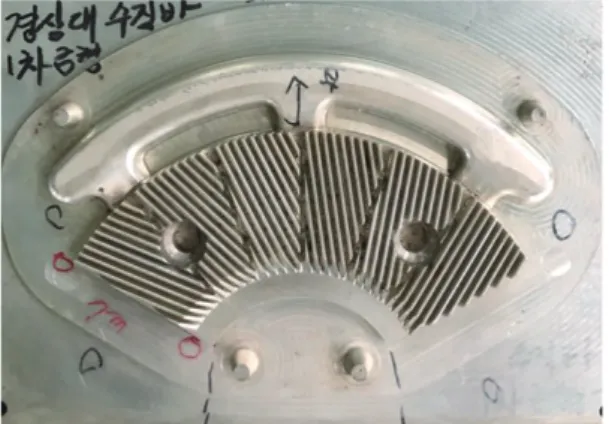
In this study, in order to remove the draft angles between neighboring bars, a lost-wax casting method was applied to manufacture the refiner plate. Initially, the plate mold cavity without a draft angle was made, considering shrinkage in the final product (Fig. 1). Melted wax was injected into the mold cavity under high pressure. In order to build a ceramic shell around the wax pattern, it was dipped into a high-grade ceramic slurry con- sisting of ethyl silicate, sand, and water. The wax pattern covered by the ceramic slurry was then inserted into a furnace for the slurry to solidify and

Table 1. Fiber dimensions of the softwood pulp used for refining Arithmetic mean

fiber length (mm)

Length-weighted mean fiber length (mm)

Fiber width (μm)

Coarseness (mg/100 m)

SwBKP 1.25 2.34 34.4 15.5

(3)

for the reusable wax to flow out. The solidified mold was preheated and possibly placed in a sand vat to avoid defects when molten metal was poured into the mold. Once the molten metal had solidified, the mold was removed with a hammer. The final casting plates were further treated to improve wear resistance and remove any surface irregularities.

The composition of the molten metal for the refiner plate is shown in Table 2.

Table 3 compares the dimensions of a typical casting plate with a draft angle and the new plate without a draft angle.

2.3 Refining

The soaked pulp specimens were disintegrated using a valley beater with no load at a consistency of 1.57±0.04% for between 3 min and 5 min. When the pulp had completely disintegrated, extra water

Table 2. Composition of the molten metal for manufacturing refiner plates without a draft angle

Components C Si Mn P S Ni Cr V Mo

wt. % 0.53 0.70 0.86 0.014 0.030 1.11 14.8 0.06 0.40

Table 3. Refiner plates with and without a draft angle

Refiner plate with a draft angle Refiner plate without a draft angle

Bar dimension (mm)

Bar shape

Tapered bar plate Vertical bar plate

Draft angle 4° 0°

Bar number 108 121

Cutting edge length (m/rev) 590.8 706.9

Fig. 1. Metal molds for making wax patterns.

(4)

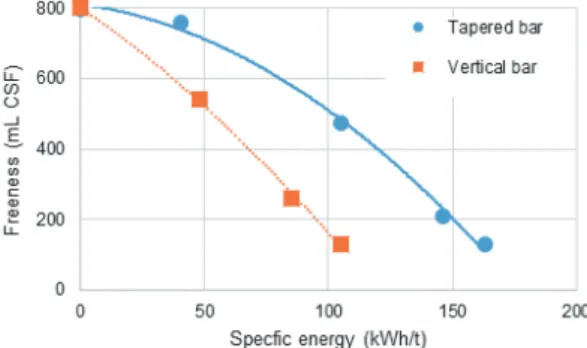
which a dilute fiber furnish may be drained. The drainage rate is related to the surface conditions and swelling of the pulp fibers. It is used to deter- mine or estimate the target level of refining of the pulp of interest or the ease of drainage of white water through the wet web, especially in or near the initial sections of the former. As shown in Fig. 2, the refining energy required to achieve the same freeness level could be reduced by up to approxi- mately 64% when pulp fibers were refined by the bar fillings without a draft angle. In other words, the vertical bar plate had a much better advantage in reducing the refining energy because the sharp- ness of the bar edges was better.

WRV is a measure of the capacity of pulp fibers to hold water.

9)

It is closely related to internal and external fibrillation and fines fraction. As shown in Fig. 3, regardless of the presence of a draft angle, the WRV of pulp fibers showed no significant dif- ference as the refining progressed. As shown in Fig. 4, the vertical bar plate induced more fiber cutting, resulting in shorter fiber length and more fines than the tapered one. This means that the tapered bar plate contributed to more fibrillation than the vertical bar plate, which affected the in- crease in WRV. Unlike the tapered bar plate, the generation of more fines seems to have affected the increase in WRV.

in the pulp stock was removed to adjust its consis- tency to around 4% to 5% for refining.

Refining was conducted using a laboratory single disk refiner (KOSWON Co., Korea) with two dif- ferent plates, as shown in Table 3. The pulp stock was consecutively refined to achieve a Canadian Standard Freeness of 190 mL.

2.4 Measurement of pulp and paper properties

The mean fiber length and fines content (≤0.2 mm) were determined by FQA-360 (OpTest Equip- ment Inc., Canada). Handsheets for measuring the physical properties of the paper were made, condi- tioned, and tested in accordance with TAPPI Stan- dard Test Method T 205. Their physical properties, including tensile and tear strength, were measured in accordance with TAPPI Standard Test Method T 220. Paper bulk was calculated using the basis weight of each sheet, and thickness was measured via the L&W caliper test (Micrometer, Sweden).

Water retention value (WRV, g/g) was measured in accordance with ISO 23714:2014.

9)

3. Results and Discussion

3.1 Change in pulp properties

The freeness of pulp is a measure of the rate at

Fig. 2. Freeness of pulp fibers refined by bar plates with and without a draft angle.

Fig. 3. WRV of pulp fibers refined by bar plates

with and without a draft angle.

(5)

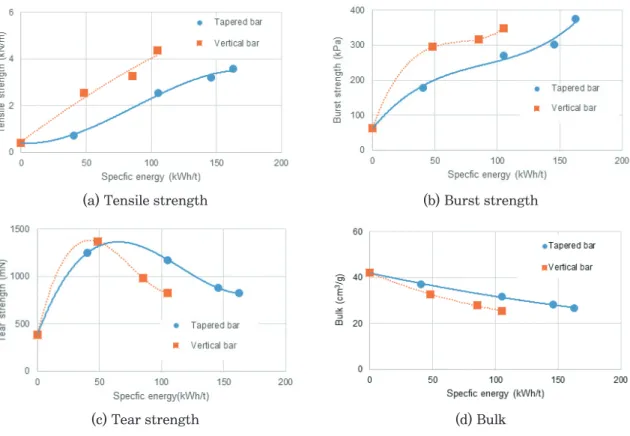
length by the vertical bar led to a faster reduction in tear strength as refining proceeded. Tear resistance is related to fiber length, inter-fiber bonding, and fiber strength; fiber length and fiber bonding are the most important of these factors. Shorter fibers by the vertical bar plate concentrated the stress in

3.2 Change in paper properties

The change in physical properties of the paper based on refining is shown in Fig. 5. In the case of tensile and burst strength, the vertical bar plate showed better strength development for the same rate of refining energy. However, more loss of fiber

(a) Mean fiber length (b) Fines content

Fig. 4. Mean fiber length and fines content of pulp fibers refined by bar plates with and without a draft angle.

Fig. 5. Change in physical properties of papers refined by bar plates with and without a draft angle.

(c) Tear strength (d) Bulk

(b) Burst strength

(a) Tensile strength

(6)

a smaller region and caused a rapid drop in tear resistance.

Paper bulk was negatively affected by the vertical bar plate, which contributed to a greater increase in inter-fiber bonding. At the same rate of refining energy, the tapered bar plate showed a greater bulk of paper than the vertical bar plate. However, the strength development rate was larger than the bulk reduction rate. Therefore, it is more advanta- geous to refine pulp fibers with the vertical bar in terms of energy saving and strength improvement.

3.3 Stock output during refining

When the same amount of pulp stock was sup- plied to the refiner with different bar shapes, the amount passing through the refiner was compared, as shown in Fig. 6. As the refining proceeded, the amount of pulp stock passing through the vertical bar plate without a draft angle was treated by 6%

to 7% more than the tapered bar plate. The vertical bar plate can treat more pulp stocks at the same rate of refining energy because its groove is wider than that of the tapered bar plate. This means that refining with the vertical bar plate can be very helpful in terms of cost reduction for papermaking companies because it can increase the throughput of pulp stock with reduced rates of refining energy.

Even though the vertical bar has a larger cutting edge load than the tapered bar, the inlet area, A1=25.6 mm

2

, of the vertical groove through which

pulp stock passes is larger than A2=22.1 mm

2

of the tapered groove (Fig. 7). This means that the vertical bar plate can handle more pulp stocks than the tapered bar plate within a certain period.

4. Conclusions

Currently, manufacturing a refiner plate via sand casting method gives a draft angle to prevent damage to the mold. This manufacturing method has a negative effect during refining because it reduces the flow rate of the pulp stock and the sharpness of the bar edge. The vertical bar with excellent sharpness at the bar edges could reach the target freeness with less refining energy than the tapered bar. Instead, more fiber cutting pro- cesses occurred at the same rate of refining energy, resulting in shorter fiber length and more fines. In the case of paper properties, the vertical bar showed better tensile and burst strength than the tapered bar due to excellent inter-fiber bonding.

The improvement of inter-fiber bonding was accompanied by a greater decrease in paper bulk at the same rate of refining energy. However, tear strength tended to decrease faster due to shorter fiber length and more fines. In conclusion, it was confirmed that the vertical bar had better refining efficiency than the tapered bar in terms of more throughput and greater saving of refining energy.

In addition, it was expected that this technology Fig. 6. Comparison of stock output during refining.

(a) Vertical bar (b) Tapered bar

Fig. 7. Comparison of the grooves areas.

(7)

can be applied in the manufacture of plates with finer bar fillings.

Acknowledgment

This research was supported by the Basic Science Research Program through the National Research Foundation of Korea (NRF) and funded by the Ministry of Education (grant number: 2017R1D1A3B 04027967). The authors also thank the KOS1 offi- cials for their assistance in the manufacture of the refiner plate.

Literature Cited

1. AFT Aikawa Group, Introduction to stock preparation refining (2016).

2. Valmet, Technical paper series–Pulping de- velopments (2013).

3. Roy, P., A study on TIG welding process and its basic features as well as parametric opti- mization, International Journal for Innovative

Research in Sci. & Tech. 2(6):71-74 (2015).

4. Rusnaldy, R., Diffusion bonding: An advanced of material process, ROTASI 3(1):23-27 (2001).

5. Akca, E. and Gursel, A., The effect of diffu- sion welding parameters on the mechanical properties of titanium alloy and aluminum couples, Metals 7(22):1-11 (2017).

6. Kay, I. M., Pattern-making tricks for better casting, Engineered Casting Solutions, Winter 2002, pp. 48-49 (2002).

7. Lee, J. Y., Kim, C. H., Kwon, S., Park, H. H., Yim, H. T., Gu, H. G., and Min, B.-G., Study of mixed refining of softwood kraft pulps and hardwood kraft pulps using different bar plate, Journal of Korea TAPPI 50(5):31-38 (2018).

8. Lee, J. Y., Kim, C. H., Kwon, S., Park, H. H., Yim, H. T., Gu, H. G., Min, B.-G., and Yang, J. K., Study of refining behaviors of hardwood bleached kraft pulp using domestic casting plates with different pattern design, Journal of Korea TAPPI 50(3):36-43 (2018).

9. ISO 23714, Pulps - Determination of water

retention value (WRV).

수치

Table 1.  Fiber dimensions of the softwood pulp used for refining Arithmetic mean   fiber length (mm) Length-weighted mean  fiber length (mm) Fiber width (μm) Coarseness (mg/100 m) SwBKP 1.25 2.34 34.4 15.5
Table 2. Composition of the molten metal for manufacturing refiner plates without a draft angle
Fig. 3.  WRV of pulp fibers refined by bar plates  with and without a draft angle.
Fig. 5. Change in physical properties of papers refined by bar plates with and without a draft angle.

참조

관련 문서

Note that the boundary with the smallest misorientation is made up of a row of dislocations, whereas the high-angle boundaries have a disordered structure in

(a) Low-Angle and High-Angle Boundaries (b) Special High-Angle Grain Boundaries (c) Equilibrium in

measured in clockwise from the north to the vertical plane containing the given line - Plunge: An acute angle measured in a vertical. plane between the given line and the

ƒ Casting is a manufacturing process by which a molten material such as metal or plastic is introduced into a mold made of sand or metal, allowed to solidify within the mold,

Melt lamination process, depending on the characteristics Floor laminate Out-of-Plane so the mechanical properties of the products according to the angle

The orifice inserted inside the mold increases the shear rate, extension rate inside the channel, which has been shown to improve the angle in the direction

This study, made up of 6 chapters in all, aims to handle the details and problems of the spouse inheritance system under existing law, as well as to review the draft of

A crystal plane at an angle θ to the close-packed plane will contain broken bonds in excess of the close-packed plane due to the atoms at the steps..