INTRODUCTION
Radiofrequency catheter ablation (RFCA) has become an im- portant rhythm control therapy in the management of anti-ar- rhythmic drug-resistant atrial fibrillation (AF).1,2 However, the
risk of procedure-related thromboembolic events exists at the time of catheter ablation, and the embolic risk is reportedly in the range 0.4–2.0%.3-5 Most strokes occur within 24 hours of the procedure.5 Therefore, an optimal peri-procedural antico- agulation is required, although its specific details have not been determined. Most patients with AF take oral anticoagu- lants. Anticoagulation guidelines that pertain to cardioversion of AF have been proposed for patients who present for AF ab- lation at the time of the procedure.6 Therefore, if the patient has been in AF for 48 hours or longer or for an unknown dura- tion, most experts prescribe 3 weeks of effective oral anticoag- ulation prior to the RFCA. Since there are no studies compar- ing the use of heparin with no heparin use during RFCA, all patients receive intra-procedural heparin regardless of antico- agulation status or anticoagulant use. After a successful proce-
Early Experience of Novel Oral Anticoagulants in Catheter Ablation for Atrial Fibrillation:
Efficacy and Safety Comparison to Warfarin
Dong Geum Shin, Tae-Hoon Kim, Jae-Sun Uhm, Joung-Youn Kim, Boyoung Joung, Moon-Hyoung Lee, and Hui-Nam Pak
Department of Cardiology, Yonsei University Health System, Seoul, Korea.
Purpose: Compared with warfarin, novel oral anticoagulants (NOACs) are convenient to use, although they require a blanking pe- riod immediately before radiofrequency catheter ablation for atrial fibrillation (AF). We compared NOACs and uninterrupted war- farin in the peri-procedural period of AF ablation.
Materials and Methods: We compared 141 patients treated with peri-procedural NOACs (72% men; 58±11 years old; 71% with paroxysmal AF) and 281 age-, sex-, AF type-, and history of stroke-matched patients treated with uninterrupted warfarin. NOACs were stopped 24 hours before the procedure and restarted on the same procedure day after hemostasis was achieved.
Results: We found no difference in the CHA2DS2-VASc (p=0.376) and HAS-BLED scores (p=0.175) between the groups. The pre- procedural anticoagulation duration was significantly shorter in the NOAC group (76.3±110.7 days) than in the warfarin group (274.7±582.7 days, p<0.001). The intra-procedural total heparin requirement was higher (p<0.001), although mean activated clot- ting time was shorter (350.0±25.0 s vs. 367.4±42.9 s, p<0.001), in the NOAC group than in the warfarin group. There was no signifi- cant difference in thromboembolic events (1.4% vs. 0%, p=0.111) or major bleeding (1.4% vs. 3.9%, p=0.235) between the NOAC and warfarin groups. Minor stroke occurred in two cases within 10 hours of the procedure (underlying CHA2DS2-VASc scores 0 and 1) in the NOAC group.
Conclusion: Pre-procedural anticoagulation duration was shorter and intra-procedural heparin requirement was higher with NOAC than with uninterrupted warfarin during AF ablation. Although the peri-procedural thromboembolism and bleeding inci- dences did not differ, minor stroke occurred in two cases in the NOAC group.
Key Words: Atrial fibrillation, catheter ablation, novel oral anticoagulant, warfarin Yonsei Med J 2016 Mar;57(2):342-349
http://dx.doi.org/10.3349/ymj.2016.57.2.342 pISSN: 0513-5796 · eISSN: 1976-2437
Received: April 10, 2015 Revised: June 8, 2015 Accepted: June 17, 2015
Corresponding author: Dr. Hui-Nam Pak, Department of Cardiology, Yonsei Uni- versity Health System, 50-1 Yonsei-ro, Seodaemun-gu, Seoul 03722, Korea.
Tel: 82-2-2228-8459, Fax: 82-2-393-2041, E-mail: [email protected]
•The authors have no financial conflicts of interest.
© Copyright: Yonsei University College of Medicine 2016
This is an Open Access article distributed under the terms of the Creative Com- mons Attribution Non-Commercial License (http://creativecommons.org/licenses/
by-nc/3.0) which permits unrestricted non-commercial use, distribution, and repro- duction in any medium, provided the original work is properly cited.
dure, oral anticoagulants are usually restarted after hemosta- sis is achieved and then continued for at least 2–3 months, even in patients with a low CHA2DS2-VASc score.7 Several stud- ies have recently examined the peri-procedural management of novel oral anticoagulants (NOACs) for patients who are scheduled to undergo RFCA.8-12 The advantages of NOACs as peri-procedural anticoagulants include a rapid onset of action with shorter time required to achieve therapeutic anticoagula- tion and no concern for a sub- or supra-therapeutic interna- tional normalized ratio (INR) on the day of the procedure. In contrast, although there is a consensus that pre-procedural uninterrupted warfarin is safe and effective for preventing pro- cedure-related thromboembolism,13 termination of NOACs for 24–48 hours before the procedure has been recommended by the European Heart Rhythm Association (EHRA) practical guide.14 Therefore, we hypothesized that NOACs are non-infe- rior to continuous warfarin in the peri-procedural period of AF catheter ablation, despite the transient blanking period. The purpose of our study was to compare the use of NOACs and uninterrupted warfarin in the peri-procedural period for AF catheter ablation in terms of safety, efficacy, and intra-proce- dural heparin requirement.
MATERIALS AND METHODS
Study design
The study protocol adhered to the principles of the Declara- tion of Helsinki and was approved by the Institutional Review Board of Yonsei University Health System. All patients provid- ed written informed consent. Among 632 consecutive patients in the Yonsei AF ablation cohort between September 2012 and October 2014, 141 patients taking peri-procedural NOACs (72% men; 58±11 years old; 71% with paroxysmal AF) were initially compared to 491 patients taking uninterrupted warfa- rin before AF ablation. We then conducted propensity score matching between the continuous warfarin group and the NOAC group. A total of 141 patients in the NOAC group and 281 age-, sex-, AF type-, and history of stroke-matched patients in the warfarin group were compared. All patients had anti-ar- rhythmic drug-refractory AF and underwent RFCA. All patients received warfarin or NOAC as oral anticoagulants prior to the procedure for 3 or more weeks. All patients, including those with effective pre-procedural oral anticoagulation, underwent transesophageal echocardiography (TEE) prior to RFCA. The choice of oral anticoagulant was decided based on the prefer- ence of the cardiologists or primary care physicians who treat- ed the patients before the procedure. Among the 141 patients in the NOAC group, 11 were switched from warfarin after the referral because of an unstable INR.
We assessed each patient’s heparin requirement and acti- vated clotting time (ACT) during the procedure, and thrombo- embolic and bleeding complications during 30 days post-AF
ablation. Thromboembolic complication was defined as stroke, transient ischemic attack (TIA), or systemic embolism.
Bleeding complications were classified as major or minor bleeding. Major bleeding was defined as pericardial tampon- ade or bleeding including a hematoma requiring a blood trans- fusion or a decreased level of hemoglobin ≥4.0 g/dL without an overt source.15 Minor bleeding was defined as bleeding with a decreased hemoglobin level at 3.0–4.0 g/dL without an overt source, groin hematoma, or pericardial effusion without tam- ponade. Hematoma was defined as any significant palpable mass associated with purpura at skin level.16 We also evaluated vascular complications (any identified pseudoaneurysm or arteriovenous fistula) that required re-hospitalization or lon- ger hospitalization. We compared the NOAC and warfarin groups for 1) duration of pre-procedural anticoagulation, 2) in- tra-procedural heparin requirement, and 3) intra-procedural ACT, and 4) complication of thromboembolism, and 5) bleed- ing during the 30-day post-RFCA period.
Anticoagulation
We continued anticoagulation therapy for patients presenting for RFCA who were taking warfarin. The target therapeutic INR was 2.0–3.0. The INR was checked on a monthly basis before the procedure and on the same day as the procedure. Warfarin was continued at a maintenance dose (INR 2.0–3.0) after the procedure. For patients taking a NOAC (dabigatran, rivaroxa- ban, or apixaban) who presented for RFCA, we discontinued two doses of dabigatran and apixaban and single doses of riva- roxaban before procedure, and restarted NOAC on the day of the procedure after confirming hemostasis following sheath removal. All patients received intra-procedural anticoagula- tion with intravenous heparin. Initial bolus doses of unfrac- tionated heparin (100 IU/kg) were administered before trans- septal puncture. The ACT was monitored every 10–30 min throughout the procedures and adjusted as needed with peri- odic heparin boluses. The intensity of heparinization main- tained was at an ACT of 350–400 s during the procedure. Oral anticoagulation was then continued for at least 3 months after the procedure in all patients.
Radiofrequency catheter ablation
Details regarding electrophysiological mapping and RFCA technique and strategy were described in previous studies.17,18 In brief, an open irrigation 3.5-mm-tip deflectable catheter (Celsius, Johnson & Johnson Inc.; Diamond Bar, CA, USA;
Coolflex, St. Jude Medical Inc., Minnetonka, MN, USA; 30–35 W; 47°C) was used for RFCA (Stockert generator, Biosense Webster Inc., Diamond Bar, CA, USA). Circumferential pul- monary vein isolation and bi-directional block of the cavotri- cuspid isthmus ablation were performed in all patients. For patients with persistent AF, we added a roof line, posterior in- ferior line, and anterior line as a standard lesion set. Addition- al ablation of the superior vena cava or non-pulmonary vein
foci or after complex fractionated electrography was deter- mined by the operator.
Follow-up after ablation
All patients were followed up after the procedure with anti-ar- rhythmic drugs discontinued. All patients were monitored with continuous electrocardiography overnight and dis- charged the day after the procedure. All patients were sched- uled for outpatient clinic follow-ups and rhythm follow-ups according to the 2012 Heart Rhythm Society/EHRA/European Cardiac Arrhythmia Society Expert Consensus Statement guide- lines.6 In this study, we compared the efficacy and safety of NOACs and warfarin within 1 month of the AF ablation.
Statistical analysis
The baseline characteristics between the NOAC and warfarin groups were compared. Continuous variables are reported as mean±standard deviation (SD) and analyzed using the Stu- dent t-test. Categorical variables were reported as counts and proportions and analyzed using Pearson chi-square test or Fisher exact test as appropriate. Propensity score matching was used to reduce the selection bias associated with the oral anticoagulant treatment and potential confounding bias in an observational study and to adjust for the differences in the pa- tients’ characteristics.19 At the initial comparison, AF type and history of stroke/TIA were statistically different between NOAC group and warfarin group. Therefore, we chose those 2 variables, age, and sex as references for propensity score match-
ing. The following variables were considered each time a pa- tient from the NOAC group was matched to a maximum of two patients from the warfarin group. A matching caliper of 0.05 SD of the logit of the estimated propensity score was enforced using R package, including Matchit, RI tools, and CEM.19 The SPSS statistical package version 20.0 (SPSS Inc., Chicago, IL, USA) was used to perform all of the statistical evaluations. p values ≤0.05 were considered statistically significant.
RESULTS
Baseline characteristics
The patient population comprised 141 patients in the NOAC group and 491 patients in the uninterrupted warfarin group.
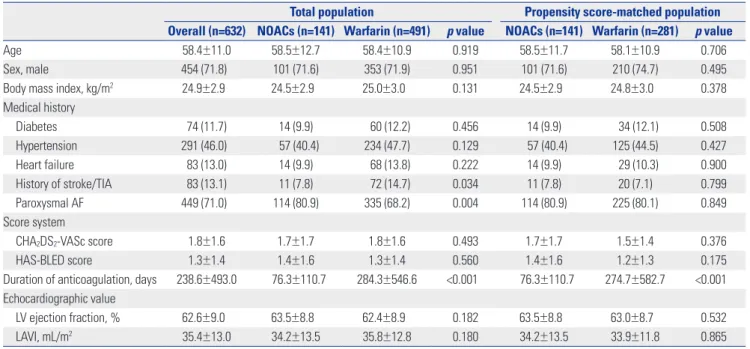
We selected 281 patients in the warfarin group after age-, sex-, AF type-, and history of stroke-matching and compared them with the 141 patients in the NOAC group. Patients in the NOAC group were prescribed dabigatran (n=99; 70.2%), rivaroxaban (n=18; 12.8%), or apixaban (n=24; 17.0%). Table 1 compares the baseline characteristics of the study population according to oral anticoagulant. Before propensity score matching, NO- ACs were more likely to be prescribed for patients with parox- ysmal AF (p=0.004) and those without a history of stroke/TIA (p=0.034). After age-, sex-, AF type-, and history of stroke- matching, the duration of pre-procedural anticoagulation was significantly shorter in the NOAC group than in the warfarin group (76.3±110.7 days vs. 274.7±582.7 days, p<0.001). None
Table 1. Baseline Characteristics of the Study Population
Total population Propensity score-matched population Overall (n=632) NOACs (n=141) Warfarin (n=491) p value NOACs (n=141) Warfarin (n=281) p value
Age 58.4±11.0 58.5±12.7 58.4±10.9 0.919 58.5±11.7 58.1±10.9 0.706
Sex, male 454 (71.8) 101 (71.6) 353 (71.9) 0.951 101 (71.6) 210 (74.7) 0.495
Body mass index, kg/m2 24.9±2.9 24.5±2.9 25.0±3.0 0.131 24.5±2.9 24.8±3.0 0.378
Medical history
Diabetes 74 (11.7) 14 (9.9) 60 (12.2) 0.456 14 (9.9) 34 (12.1) 0.508
Hypertension 291 (46.0) 57 (40.4) 234 (47.7) 0.129 57 (40.4) 125 (44.5) 0.427
Heart failure 83 (13.0) 14 (9.9) 68 (13.8) 0.222 14 (9.9) 29 (10.3) 0.900
History of stroke/TIA 83 (13.1) 11 (7.8) 72 (14.7) 0.034 11 (7.8) 20 (7.1) 0.799
Paroxysmal AF 449 (71.0) 114 (80.9) 335 (68.2) 0.004 114 (80.9) 225 (80.1) 0.849
Score system
CHA2DS2-VASc score 1.8±1.6 1.7±1.7 1.8±1.6 0.493 1.7±1.7 1.5±1.4 0.376
HAS-BLED score 1.3±1.4 1.4±1.6 1.3±1.4 0.560 1.4±1.6 1.2±1.3 0.175
Duration of anticoagulation, days 238.6±493.0 76.3±110.7 284.3±546.6 <0.001 76.3±110.7 274.7±582.7 <0.001 Echocardiographic value
LV ejection fraction, % 62.6±9.0 63.5±8.8 62.4±8.9 0.182 63.5±8.8 63.0±8.7 0.532
LAVI, mL/m2 35.4±13.0 34.2±13.5 35.8±12.8 0.180 34.2±13.5 33.9±11.8 0.865
AF, atrial fibrillation; CHA2DS2-VASc, Congestive heart failure, Hypertension, Age ≥75 (doubled), Diabetes mellitus, and prior ischemic Stroke, transient ischemic attack or thromboembolism (doubled), Vascular disease, Age 65–74, Sex category (female); HAS-BLED, Hypertension, Abnormal renal/liver function, Stroke, Bleeding tendency or predisposition, Labile INR, Elderly (e.g., >65), Drugs (e.g., aspirin, clopidogrel or non-steroidal antiinflammatory drug), Alcohol abuse; LAVI, left atrial volume index; LV, left ventricle; NOACs, novel oral anticoagulants; TIA, transient ischemic attack.
Numbers in parenthesis are in percentages.
of the other variables significantly differed between the two groups.
Intra-procedural characteristics
There was no significant difference in total procedure (181.8±
47.9 min vs. 177.2±52.0 min, p=0.387) and total ablation times (4364.5±1560.1 s vs. 4353.4±1563.6 s, p=0.945) between the NOAC and warfarin groups. During the procedure, the mean ACT differed significantly between the NOAC and warfarin groups (350.0±25.0 s vs. 367.4±42.9 s, p<0.001) (Fig. 1A). The total dose of unfractionated heparin to maintain a therapeutic ACT during RFCA was significantly higher in the NOAC group than in the warfarin group (18068.3±6844.4 IU vs. 11890.3±
5808.1 IU, p<0.001) (Fig. 1B).
Complications
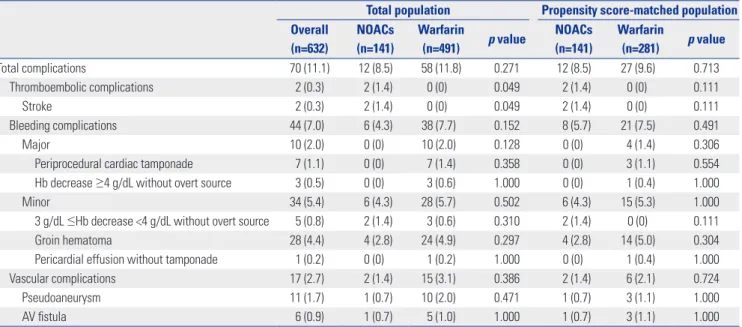
The overall rate of peri-procedural complications, including minor bleeding, was 11.1% (70/632) (Table 2). Two thrombo- embolic (0.3%), 44 bleeding (7.0%), and 17 vascular complica- tions (2.7%) occurred during the 30-day follow-up period. Al- though stroke-related events tended to occur more often in the NOAC group (1.4% vs. 0%, p=0.049), bleeding (4.3% vs. 7.7%, p=0.152) and vascular complications (1.4% vs. 3.1%, p=0.386) did not differ between the groups. The overall complication rate was not significantly different after age-, sex-, AF type-, and history of stroke-matching. There were two cases of post- procedural stroke in the NOAC group (Table 3). One patient complained of vomiting and headache immediately after the procedure, while another manifested diplopia 10 hours after RFCA. Both patients showed small acute infarctions docu- mented by brain magnetic resonance imaging (Fig. 2). These
Fig. 1. Comparison of mean ACT (A) and total heparin dosage (B) between patients in the NOAC and warfarin groups during the procedure. ACT, activated clotting time; NOAC, novel oral anticoagulant.
30000
20000
10000
0
UFH, IU
Total heparin dosage p<0.001
B
NOAC Warfarin 500
400 300 200
100 0
ACT, sec
Mean ACTs p<0.001
A
NOAC Warfarin
Table 2. Procedural Complications of the Study Population
Total population Propensity score-matched population Overall
(n=632)
NOACs (n=141)
Warfarin
(n=491) p value NOACs (n=141)
Warfarin
(n=281) p value
Total complications 70 (11.1) 12 (8.5) 58 (11.8) 0.271 12 (8.5) 27 (9.6) 0.713
Thromboembolic complications 2 (0.3) 2 (1.4) 0 (0) 0.049 2 (1.4) 0 (0) 0.111
Stroke 2 (0.3) 2 (1.4) 0 (0) 0.049 2 (1.4) 0 (0) 0.111
Bleeding complications 44 (7.0) 6 (4.3) 38 (7.7) 0.152 8 (5.7) 21 (7.5) 0.491
Major 10 (2.0) 0 (0) 10 (2.0) 0.128 0 (0) 4 (1.4) 0.306
Periprocedural cardiac tamponade 7 (1.1) 0 (0) 7 (1.4) 0.358 0 (0) 3 (1.1) 0.554
Hb decrease ≥4 g/dL without overt source 3 (0.5) 0 (0) 3 (0.6) 1.000 0 (0) 1 (0.4) 1.000
Minor 34 (5.4) 6 (4.3) 28 (5.7) 0.502 6 (4.3) 15 (5.3) 1.000
3 g/dL ≤Hb decrease <4 g/dL without overt source 5 (0.8) 2 (1.4) 3 (0.6) 0.310 2 (1.4) 0 (0) 0.111
Groin hematoma 28 (4.4) 4 (2.8) 24 (4.9) 0.297 4 (2.8) 14 (5.0) 0.304
Pericardial effusion without tamponade 1 (0.2) 0 (0) 1 (0.2) 1.000 0 (0) 1 (0.4) 1.000
Vascular complications 17 (2.7) 2 (1.4) 15 (3.1) 0.386 2 (1.4) 6 (2.1) 0.724
Pseudoaneurysm 11 (1.7) 1 (0.7) 10 (2.0) 0.471 1 (0.7) 3 (1.1) 1.000
AV fistula 6 (0.9) 1 (0.7) 5 (1.0) 1.000 1 (0.7) 3 (1.1) 1.000
AV, arteriovenous; Hb, hemoglobin; NOACs, novel oral anticoagulants.
patients had a CHA2DS2-VASc score ≤1 and paroxysmal AF.
Both patients recovered without neurological sequelae after medical therapy.
DISCUSSION
In the present study, we explored the difference between the use of NOACs and uninterrupted warfarin in the peri-proce- dural period in patients with AF who underwent catheter ab- lation. In this retrospective observational study, pre-procedur- al anticoagulation duration was shorter and intra-procedural heparin requirement was higher with NOAC than with unin- terrupted warfarin in AF ablation. Although the incidences of peri-procedural thromboembolism and bleeding did not dif- fer, there were two cases of minor stroke in the NOAC group with pre-procedural blanking of the anticoagulation.
Comparisons of NOAC and warfarin in patients with non-valvular AF
Options for anticoagulation have expanded steadily over the past few decades, providing a greater number of agents for preventing and managing thromboembolic disease. In partic- ular, anticoagulation with NOACs have led to similar or lower rates of both ischemic stroke and major bleeding, compared to warfarin, in patients with non-valvular AF in large random- ized trials.20 These results support the broad concept that NO- ACs are preferable to warfarin in many cases. For example, the use of peri-ablation anticoagulation with NOACs has been rapidly expanding worldwide. The majority of similar studies has reported non-inferiority or even superiority of NOACs in terms of thromboembolism and bleeding complications.21-25 As with most studies, our study showed no difference in the peri-procedural incidences of thromboembolism and bleed- ing during AF ablation in the NOAC and warfarin groups.
Fig. 2. Diffusion-weighted magnetic resonance imaging of two patients after atrial fibrillation catheter ablation displaying smaller foci of restricted diffu- sion in (A) the right frontal lobe (arrow) and (B) the left dorsal pons (arrow).
A B
Table 3. Characteristics of Patients with Thromboembolic Events 30 Days after Arterial Fibrillation Ablation No. Sex/
age
Event characteristics
Hours after ablation
AF classification
CHADS2/ CHA2DS2-VASc
Anticoagulation type and duration
Ablation time (sec)
Hospital duration (days)
ManagementNeurological sequelae
1 M/40 Stroke,
right frontal lobe 0 Paroxysmal AF 0/0 NOAC, 26 days
(apixaban 5 mg BID) 3879 3 Medical None
2 M/56 Stroke, left
dorsal pons 10 Paroxysmal AF 1/1 NOAC, 40 days
(dabigatran 150 mg BID) 4244 6 Medical None
M, male; AF, atrial fibrillation; CHADS2, Congestive heart failure, Hypertension, Age ≥75, Diabetes mellitus, and prior Stroke or transient ischemic attack (dou- bled); CHA2DS2-VASc, Congestive heart failure, Hypertension, Age ≥75 (doubled), Diabetes mellitus, and prior ischemic Stroke, transient ischemic attack or thromboembolism (doubled), Vascular disease, Age 65–74, Sex category (female); HAS-BLED, Hypertension, Abnormal renal/liver function, Stroke, Bleeding ten- dency or predisposition, Labile INR, Elderly (e.g., >65), Drugs (e.g., aspirin, clopidogrel or non-steroidal antiinflammatory drug), Alcohol abuse; NOACs, novel oral anticoagulants.
Advantages and disadvantages in NOAC use in the peri-procedural period
Anticoagulant use must be balanced to minimize thromboem- bolic and bleeding risks, as well as complications and side ef- fects, in patients undergoing AF catheter ablation.26 Compared to uninterrupted warfarin, NOAC has several advantages for use in the peri-procedural period of RFCA for AF in terms of convenience (no requirement for routine testing of INR, no need for frequent dose adjustment, and rapid onset of action) and less susceptibility to dietary and drug interactions. Since saturation of warfarin and maintaining an optimal INR is dif- ficult, especially in outpatient clinics,27,28 the shorter duration of pre-procedural anticoagulation in the NOAC group versus the warfarin group reflects the convenience of NOAC use. In contrast, NOACs have the following disadvantages: 1) lack of an approved antidote/reversing agent; 2) limited data for effi- cacy and safety (in patients with chronic kidney disease and long-term adverse effects); 3) lack of easily available monitor- ing of blood levels and compliance; 4) higher cost; and 5) the required pre-procedural blanking period immediate before AF ablation.
The EHRA Practical Guide suggests that discontinuation and restarting of anticoagulation should be individualized to consider both patient characteristics (kidney function, age, his- tory of bleeding complications, concomitant medication) and procedural factors according to the types of NOACs used.6 However, in many studies on the use of NOACs in ablation, the time for stopping anticoagulation has differed. Some stud- ies stopped anticoagulation on the night before the proce- dure,21,29 while others have uninterrupted anticoagulation.11,12,24 Although there was no statistical difference in thromboembol- ic or hemorrhagic complications between the NOAC and warfarin groups in this study, there were two cases of minor stroke in the NOAC group. In non-valvular AF, high CHA2DS2- VASc scores reportedly reflect a high risk of stroke;30 however, both patients in this study had low CHA2DS2-VASc scores.
Also, we previously reported that routine pre-procedural TEE is not mandatory for stroke prevention evaluation in patients with AF on warfarin;31 however, it is not clear whether the same strategy is acceptable for patients who are taking NOACs.
Cappato, et al.32 recently reported that uninterrupted oral riva- roxaban is feasible and event rates were similar to those for uninterrupted warfarin. Therefore, further prospective ran- domized studies are needed to identify for optimal anticoagu- lation schedules with other NOACs at the periprocedural pe- riod, instead of old EHRA practice guidelines14 with limited evidence.
Effects of NOACs on ACT
Heparin plays some role in the intrinsic coagulation pathways and manifests anticoagulation effects. In contrast, warfarin af- fects not only the intrinsic coagulation pathways, but also co- agulation factor IX in the intrinsic pathways and coagulation
factors X and II in the common pathways.33 NOACs clearly af- fect the common pathways, although each drug targets differ- ent coagulation factors. The target coagulation factors are fac- tor II for dabigatran and factor Xa for rivaroxaban and apixaban.
We previously reported on the reduced intra-procedural hep- arin requirement with continuous warfarin strategy, compared to switching to heparin group.13 Saturated warfarin or NOACs increased the ACT and reduced the heparin requirement dur- ing the procedure, and a significantly higher heparin require- ment in the NOAC group than in the uninterrupted warfarin group was related to skipping anticoagulation in both this study and other studies.21,22,24
Limitations
Since this was a single-center cohort study that included a se- lective group of patients referred for AF catheter ablation, its results cannot be generalized. Given that most of the previous investigations exploring AF were performed in Caucasian populations, the findings from this study in an Asian popula- tion are valuable. This study was non-randomized, and the an- ticoagulant used in each patient was based on the clinician’s preference. This selection bias is visible in the patients’ baseline characteristics. To minimize the selection bias, we conducted age-, sex-, AF type-, and history of stroke-matching based on propensity score. We did not analyze the results according to the different NOACs. Although we tried to follow EHRA prac- tice guidelines,14 it was not easy to enforce 24 hours of absti- nence before the procedure. Therefore, we skipped two doses of dibigatran or apixaban and a single dose of rivaroxaban.
Further double-blind studies are needed for in-depth com- parisons of NOACs according to each subset of medication, as are studies with a larger number of patients.
Conclusion
The pre-procedural anticoagulation duration was shorter in the NOAC group than in the warfarin group in patients who underwent AF catheter ablation. Although the intra-proce- dural heparin requirement was higher and ACT was lower in the NOAC group, there were no differences in peri-procedural thromboembolism and bleeding complications. However, we must pay special attention to the anticoagulation blanking pe- riod and the potential poor compliance of patients treated with NOACs immediate before AF catheter ablation.
ACKNOWLEDGEMENTS
This work was supported by a Korea Health 21 R&D Project grant (A085136) from the Ministry of Health and Welfare, and a grant from National Research Foundation of Korea Ministry of Science (7-2013-0362), Ministry of Science, ICT & Future Planning (MSIP).
REFERENCES
1. Haïssaguerre M, Jaïs P, Shah DC, Takahashi A, Hocini M, Quiniou G, et al. Spontaneous initiation of atrial fibrillation by ectopic beats originating in the pulmonary veins. N Engl J Med 1998;339:
659-66.
2. January CT, Wann LS, Alpert JS, Calkins H, Cigarroa JE, Cleveland JC Jr, et al. 2014 AHA/ACC/HRS guideline for the management of patients with atrial fibrillation: a report of the American College of Cardiology/American Heart Association Task Force on Practice Guidelines and the Heart Rhythm Society. J Am Coll Cardiol 2014;
64:e1-76.
3. Spragg DD, Dalal D, Cheema A, Scherr D, Chilukuri K, Cheng A, et al. Complications of catheter ablation for atrial fibrillation: inci- dence and predictors. J Cardiovasc Electrophysiol 2008;19:627-31.
4. Cappato R, Calkins H, Chen SA, Davies W, Iesaka Y, Kalman J, et al. Prevalence and causes of fatal outcome in catheter ablation of atrial fibrillation. J Am Coll Cardiol 2009;53:1798-803.
5. Page SP, Herring N, Hunter RJ, Withycombe E, Lovell M, Wali G, et al. Periprocedural stroke risk in patients undergoing catheter ab- lation for atrial fibrillation on uninterrupted warfarin. J Cardio- vasc Electrophysiol 2014;25:585-90.
6. Calkins H, Kuck KH, Cappato R, Brugada J, Camm AJ, Chen SA, et al. 2012 HRS/EHRA/ECAS Expert Consensus Statement on Cath- eter and Surgical Ablation of Atrial Fibrillation: recommendations for patient selection, procedural techniques, patient manage- ment and follow-up, definitions, endpoints, and research trial de- sign. Europace 2012;14:528-606.
7. Eitel C, Koch J, Sommer P, John S, Kircher S, Bollmann A, et al.
Novel oral anticoagulants in a real-world cohort of patients un- dergoing catheter ablation of atrial fibrillation. Europace 2013;15:
1587-93.
8. Hohnloser SH, Camm AJ. Safety and efficacy of dabigatran etexi- late during catheter ablation of atrial fibrillation: a meta-analysis of the literature. Europace 2013;15:1407-11.
9. Providência R, Albenque JP, Combes S, Bouzeman A, Casteigt B, Combes N, et al. Safety and efficacy of dabigatran versus warfarin in patients undergoing catheter ablation of atrial fibrillation: a systematic review and meta-analysis. Heart 2014;100:324-35.
10. Bin Abdulhak AA, Khan AR, Tleyjeh IM, Spertus JA, Sanders SU, Steigerwalt KE, et al. Safety and efficacy of interrupted dabigatran for peri-procedural anticoagulation in catheter ablation of atrial fi- brillation: a systematic review and meta-analysis. Europace 2013;
15:1412-20.
11. Lakkireddy D, Reddy YM, Di Biase L, Vallakati A, Mansour MC, Santangeli P, et al. Feasibility and safety of uninterrupted rivarox- aban for periprocedural anticoagulation in patients undergoing radiofrequency ablation for atrial fibrillation: results from a mul- ticenter prospective registry. J Am Coll Cardiol 2014;63:982-8.
12. Dillier R, Ammar S, Hessling G, Kaess B, Pavaci H, Buiatti A, et al.
Safety of continuous periprocedural rivaroxaban for patients un- dergoing left atrial catheter ablation procedures. Circ Arrhythm Electrophysiol 2014;7:576-82.
13. Kwak JJ, Pak HN, Jang JK, Kim SK, Park JH, Choi JI, et al. Safety and convenience of continuous warfarin strategy during the peri- procedural period in patients who underwent catheter ablation of atrial fibrillation. J Cardiovasc Electrophysiol 2010;21:620-5.
14. Heidbuchel H, Verhamme P, Alings M, Antz M, Hacke W, Oldgren J, et al. European Heart Rhythm Association Practical Guide on the use of new oral anticoagulants in patients with non-valvular atrial fibrillation. Europace 2013;15:625-51.
15. Kastrati A, Neumann FJ, Mehilli J, Byrne RA, Iijima R, Büttner HJ,
et al. Bivalirudin versus unfractionated heparin during percuta- neous coronary intervention. N Engl J Med 2008;359:688-96.
16. Kussmaul WG 3rd, Buchbinder M, Whitlow PL, Aker UT, Heuser RR, King SB, et al. Rapid arterial hemostasis and decreased access site complications after cardiac catheterization and angioplasty:
results of a randomized trial of a novel hemostatic device. J Am Coll Cardiol 1995;25:1685-92.
17. Park JH, Pak HN, Choi EJ, Jang JK, Kim SK, Choi DH, et al. The re- lationship between endocardial voltage and regional volume in electroanatomical remodeled left atria in patients with atrial fibril- lation: comparison of three-dimensional computed tomographic images and voltage mapping. J Cardiovasc Electrophysiol 2009;
20:1349-56.
18. Shim J, Joung B, Park JH, Uhm JS, Lee MH, Pak HN. Long dura- tion of radiofrequency energy delivery is an independent predic- tor of clinical recurrence after catheter ablation of atrial fibrilla- tion: over 500 cases experience. Int J Cardiol 2013;167:2667-72.
19. D’Agostino RB Jr. Propensity scores in cardiovascular research.
Circulation 2007;115:2340-3.
20. Ruff CT, Giugliano RP, Braunwald E, Hoffman EB, Deenadayalu N, Ezekowitz MD, et al. Comparison of the efficacy and safety of new oral anticoagulants with warfarin in patients with atrial fibril- lation: a meta-analysis of randomised trials. Lancet 2014;383:955- 62.
21. Kim JS, She F, Jongnarangsin K, Chugh A, Latchamsetty R, Ghan- bari H, et al. Dabigatran vs warfarin for radiofrequency catheter ablation of atrial fibrillation. Heart Rhythm 2013;10:483-9.
22. Bassiouny M, Saliba W, Rickard J, Shao M, Sey A, Diab M, et al.
Use of dabigatran for periprocedural anticoagulation in patients undergoing catheter ablation for atrial fibrillation. Circ Arrhythm Electrophysiol 2013;6:460-6.
23. Kaseno K, Naito S, Nakamura K, Sakamoto T, Sasaki T, Tsukada N, et al. Efficacy and safety of periprocedural dabigatran in patients undergoing catheter ablation of atrial fibrillation. Circ J 2012;76:
2337-42.
24. Maddox W, Kay GN, Yamada T, Osorio J, Doppalapudi H, Plumb VJ, et al. Dabigatran versus warfarin therapy for uninterrupted oral anticoagulation during atrial fibrillation ablation. J Cardio- vasc Electrophysiol 2013;24:861-5.
25. Yamaji H, Murakami T, Hina K, Higashiya S, Kawamura H, Mu- rakami M, et al. Usefulness of dabigatran etexilate as periproce- dural anticoagulation therapy for atrial fibrillation ablation. Clin Drug Investig 2013;33:409-18.
26. Singer DE, Chang Y, Fang MC, Borowsky LH, Pomernacki NK, Udaltsova N, et al. The net clinical benefit of warfarin anticoagu- lation in atrial fibrillation. Ann Intern Med 2009;151:297-305.
27. Uhm JS, Won H, Joung B, Nam GB, Choi KJ, Lee MH, et al. Safety and efficacy of switching anticoagulation to aspirin three months after successful radiofrequency catheter ablation of atrial fibrilla- tion. Yonsei Med J 2014;55:1238-45.
28. Hirsh J, Bauer KA, Donati MB, Gould M, Samama MM, Weitz JI;
American College of Chest Physicians. Parenteral anticoagulants:
American College of Chest Physicians Evidence-Based Clinical Practice Guidelines (8th Edition). Chest 2008;133(6 Suppl):141S- 59S.
29. Nin T, Sairaku A, Yoshida Y, Kamiya H, Tatematsu Y, Nanasato M, et al. A randomized controlled trial of dabigatran versus warfarin for periablation anticoagulation in patients undergoing ablation of atrial fibrillation. Pacing Clin Electrophysiol 2013;36:172-9.
30. Kim YD, Lee KY, Nam HS, Han SW, Lee JY, Cho HJ, et al. Factors associated with ischemic stroke on therapeutic anticoagulation in patients with nonvalvular atrial fibrillation. Yonsei Med J 2015;56:
410-7.
31. Han JH, Shin DH, Lee HJ, Kim YJ, Lee SH, Shim J, et al. Routine preprocedural transesophageal echocardiography might not be necessary for stroke prevention evaluation in AF patients on anti- coagulation therapy. Int J Cardiol 2013;168:1992-6.
32. Cappato R, Marchlinski FE, Hohnloser SH, Naccarelli GV, Xiang J,
Wilber DJ, et al. Uninterrupted rivaroxaban vs. uninterrupted vi- tamin K antagonists for catheter ablation in non-valvular atrial fi- brillation. Eur Heart J 2015;36:1805-11.
33. Chang RJ, Doherty TM, Goldberg SL. How does warfarin affect the activated coagulation time? Am Heart J 1998;136:477-9.