Lab Anim Res 2017: 33(2), 84-91 https://doi.org/10.5625/lar.2017.33.2.84
ISSN 2233-7660 (Online)
Antimicrobial property of lemongrass (Cymbopogon citratus) oil against pathogenic bacteria isolated from pet turtles
B. C. J. De Silva, Won-Gi Jung, Sabrina Hossain, S.H.M.P. Wimalasena, H.N.K.S. Pathirana, Gang-Joon Heo*
Veterinary Medical Center and College of Veterinary Medicine, Chungbuk National University, Cheongju 28644, Korea
The usage of essential oils as antimicrobial agents is gaining attention. Besides, pet turtles were known to harbor a range of pathogenic bacteria while the turtle keeping is a growing trend worldwide.The current study examined the antimicrobial activity of lemon grass oil (LGO) against seven species of Gram negative bacteria namely; Aeromonas hydrophila, A. caviae, Citrobacter freundii, Salmonella enterica, Edwardsiella tarda, Pseudomonas aeruginosa, and Proteus mirabilis isolated from three popular species of pet turtles. Along with the results of disc diffusion, minimum inhibitory and minimum bactericidal concentration (MIC and MBC) tests, LGO was detected as effective against 6 species of bacteria excluding P. aeruginosa. MIC of LGO for the strains except P. aeruginosa ranged from 0.016 to 0.5% (V/V). The lowest MIC recorded in the E. tarda strain followed by A. hydrophilla, C. freundii, P. mirabilis , and S.
enterica. Interestingly, all the bacterial species except E. tarda were showing high multiple antimicrobial resistance (MAR) index values ranging from 0.36 to 0.91 upon the 11 antibiotics tested although they were sensitive to LGO.
Keywords: Lemongrass oil, antimicrobial property, pet turtles, pathogenic bacteria
Received 12 December 2016; Revised version received 7 February 2017; Accepted 16 March 2017
Down the ages, numerous essential oils (EOs) extracted from plant materials have been used for their aroma, flavor, bactericidal, preservative and medicinal properties [1]. Particularly, essential oils have been tested for their potential implications as alternative remedies to treat many infectious diseases [2]. Since EOs are a rich source of biologically active compounds, investigating the antimicrobial properties of EOs extracted from aromatic plants is a growing interest [3].
Lemongrass (Cymbopogon citratus), a tall perennial grass comprising of about 55 species, grows in tropical and subtropical habitats [4]. The key active constituents of lemongrass oil (LGO) giving its distinct aroma are citral (65-86%), neral and geraniol [5]. It was identified that lemongrass oil bears antidepressant, antioxidant, antiseptic, sedative, nervine, bactericidal, and fungicidal properties [6]. As a bactericidal agent, the LGO was
found to be effective against many bacterial species including Acinetobacter baumanii, Aeromonas veronii, Enterococcus faecalis, Escherichia coli, Klebsiella pneumonia, Salmonella enterica, Serratia marcesens, Proteus vulgaris, Enterobacter aerogenes, Corynebacterium equii, Staphylococcus aureus and so on [3,7-9].
Turtles are now gaining attention worldwide owing to their commercial value, particularly as exotic pets.
Specifically, South Korea was among the top highest buyers of pet turtles from USA [10]. However, the popularity of pet turtles has not been accompanied by dissemination of the public health concerns that arise when raising them. In the meantime, pet turtle have been known to harbor a variety of microbes either opportunistic or readily pathogenic [11-13]. Besides, bacterial strains showing virulence and antimicrobial resistance with the aid of genetic determinants advocates their medical
*Corresponding author: Gang-Joon Heo, Laboratory of Aquatic Animal Medicine, Veterinary Medical Center and College of Veterinary Medicine, Chungbuk National University, Chungdaero 1, Seowon-gu, Cheongju, Chungbuk 28644, Korea
Tel: +82-43-261-2617; Fax: +82-43-267-3150; E-mail: [email protected]
This is an Open Access article distributed under the terms of the Creative Commons Attribution Non-Commercial License (http://creativecommons.org/licenses/
by-nc/3.0) which permits unrestricted non-commercial use, distribution, and reproduction in any medium, provided the original work is properly cited.
Antimicrobial property of lemongrass oil against pet turtle-borne bacteria 85
Lab Anim Res | June, 2017 | Vol. 33, No. 2
importance [14-18]. Common expressions of affection towards pets involve physical contact, yet turtle owners may not be aware of the risk of contracting a pathogen when handling their pet without adequate countermeasures.
Usage of antibiotics in controlling bacterial growth or treating the infections is a common medical practice, but the emergence of drug resistant bacteria is one of the most serious threats constraining successful treatment of microbial diseases [19]. Therefore, the applicability of natural products instead of synthetic drugs against bacteria has become attentive. Since, some of the key constituents of EOs act in a parallel way to the synthesized antibiotics [20], their utility towards the therapeutic application in controlling pathogenic bacteria owns significance.
Particularly, the application of EOs to prevent turtle- borne zoonoses is noteworthy.
Therefore, our study sought to investigate the antimicrobial properties of LGO against seven species of pathogenic bacteria isolated from three popular pet turtle species by detecting the susceptibility by disc diffusion, minimum inhibitory concentration (MIC), and minimum bactericidal concentration (MBC) tests.
Materials and Methods
Turtles and bacteria
All the studied strains of bacteria were isolated from three popular turtle species namely; yellow-bellied slider (Trachemys scripta scripta), Chinese stripe-necked turtle (Ocadia sinensis) and river cooter (Pseudemys concinna concinna) which were reared under the laboratory conditions. A total of 40 bacterial strains belonging into seven species comprising, Aeromonas hydrophila, A.
caviae, Citrobacter freundii, Salmonella enterica, Edwardsiella tarda, Pseudomonas aeruginosa, Proteus mirabilis were selected for the study. All the strains of bacteria had been previously identified up to their species level by 16s rRNA sequencing and BLAST compatibility with GenBank database.
EO and the source
Professional grade LGO (EO extracted from Cymbopogon citratus) manufactured by EuroAroma
®, Germany was purchased from a Korean local merchant. According to the manufacturer, the LGO has been isolated by distillation from the leaves of lemongrass grown in China and the product has been tested for 100% purity by chiral method.
Disc diffusion test
Target bacterial strains were cultured in tryptic soy agar (TSA) (MBcell, Seoul, Korea) one night at 37ºC then diluted to a concentration of 0.5 MacFarland units (1.5×10
6CFU/mL) in sterile saline which were used as the inocula. The Mueller Hinton agar (MHA) (MBcell, Seoul, Korea) plates were prepared in 90 mm diameter Petri plates where the thickness of the agar was 4 mm.
One hundred microliters (100 µL) of each bacterial solution was inoculated onto the plates and uniformly distributed by sterile cotton swabs. Inoculated plates were allowed to stand for 15 minutes. At the same time, 6 mm diameter sterile disks (ADVANTEC
®, Japan) were soaked with 20 µL of the LGO with different dilutions;
1:1 (pure LGO) and 1:2, 1:5, 1:10; 1 part of the LGO inrespective parts of the methanolic solution. Then the disks soaked with LGO were symmetrically placed onto the inoculated medium immediately by means of sterile tweezers and the plates were further sealed by thin plastic wrap in order to prevent evaporation. One of the disks was soaked with sterile distilled water as a control.
Test was conducted in triplicates and the plates were incubated for 24±2 h at 37ºC under aerobic conditions.
The effect of LGO was evaluated by measuring the diameter of the areas with no bacterial growth.
The susceptibility of 11 selected antibiotics namely;
ampicillin (10 g), amoxicillin (30 g), cefoxitin (30 g), cephalothin (30 g), ceftriaxone (30 g), imipenem (10 g), gentamycin (10 g), amikacin (30 g), streptomycin (10 g), nalidixic acid (30 g), and ciprofloxacin (5 g) was examined on MHA (MBcell, Seoul, Korea) following the recom- mendations of Performance Standards for Antimicrobial Susceptibility Testing; Clinical and Laboratory Standards Institute [21].
Calculating the Multiple Antibiotic Resistance (MAR) index
Following the disc diffusion test results of antibiotics, one strain from each species showing the strongest resistance with in the species was selected for calculating the MAR index. MAR index was calculated as the ratio of number of antibiotics to which bacteria was resistant to total number of antibiotics to which the bacteria was exposed.
MIC and MBC
The MIC of LGO was determined by broth micro-
dilution method according to the National Committee for
Clinical Laboratory Standards (NCCLS). All strains were cultured on TSA and incubated at 37ºC for 24 h prior to MIC determination. The inoculum density of each test organism was adjusted equivalent to 0.5 McFarland units prepared in sterile saline. One hundred microliters (100 µL) of double strength Mueller Hinton broth containing 5% dimethyl sulfoxide (DMSO) was dispensed into wells of 96-well micro titer plates. In the first column of wells, LGO was added with a final concentration of 2% (V/V) and then serially diluted by two-fold across the plate until a final concentration of 0.004% (V/V). One hundred microliters (100 µL) of each bacterial suspension was added to each well and the plates were incubated at 37ºC for 16 h. The assay for each of the pathogens was conducted in triplicates.
In order to determine the MBC, the culture medium from wells which have LGO concentration higher than MIC were smeared on separate TSA plates and incubated at 37ºC for 24 h. MBC was determined as the lowest concentration of LGO which gave no growth of bacteria on the TSA plate.
Results
Disc diffusion test
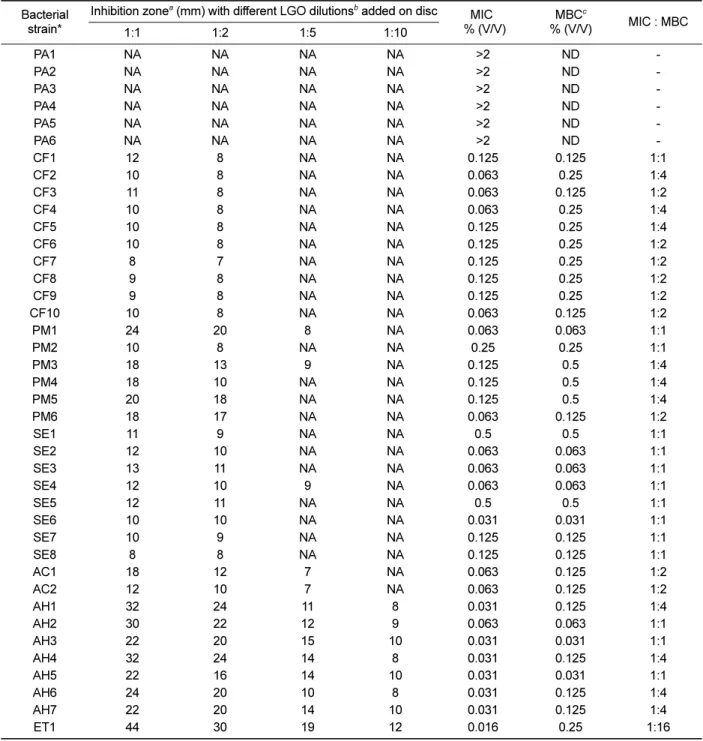
The susceptibility pattern of LGO against turtle-borne bacteria is given in Table 1. The results revealed that the LGO showed antibacterial activity against the majority of tested Gram negative bacteria (85%) except P.
aeruginosa with varying magnitudes. The sensitivity was found gradually increasing with the increase in concentration of oil. The highest resistance was observed in P. aeruginosa in which all the tested strains showing no any growth inhibition to any of the dilutions of LGO.
In contrast, E. tarda was observed as the most susceptible species where the highest inhibition zone (44 mm) was observed. A. hydrophila was comparatively more sensitive to LGO showing inhibition even in the 1:10 dilution where A. caviae was showing a reduced sensitivity than A. hydrophila . The highest inhibition recorded for A.
hydrophila was 32 mm for 1:1 dilution while the least was 10 mm for 1:10. In the case of A. caviae the highest inhibition observed was 18 mm in 1:1 and 7 mm was the least for 1:5. The susceptibility of C. freundii, P.
mirabilis, and S. enterica was observed to be more or less similar where the inhibition was not pronounced after 1:2 dilution.
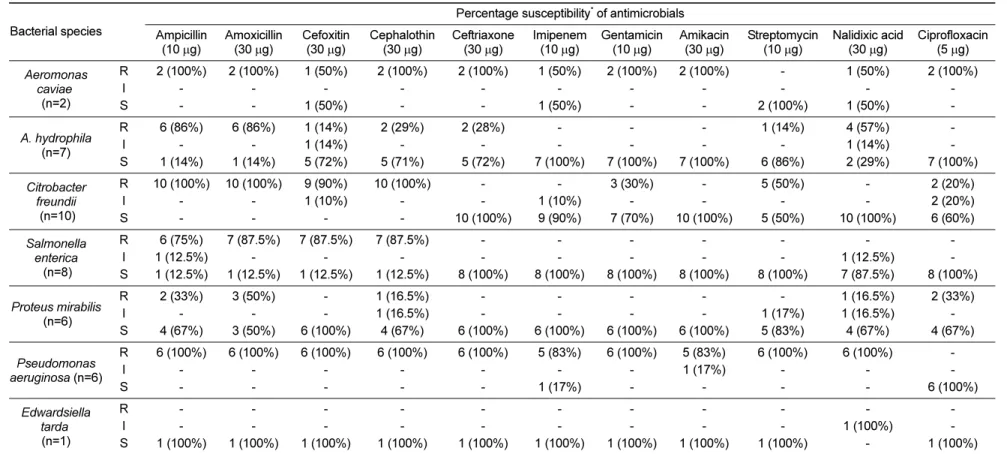
The antibiotic resistance profile of tested bacterial
species is summarized in Table 2. A. caviae was resistant to all tested antibiotics except streptomycin but, the E.
tarda strain was sensitive to all tested antibiotics. In addition, P. aeruginosa strongly resisted 10 antibiotics being sensitive only to ciprofloxacin. Both A. hydrophila and C. freundii also showed resistance to 7 antibiotics while S. enterica could resist only amoxicillin, ampicillin, cefoxitin and cephalothin.
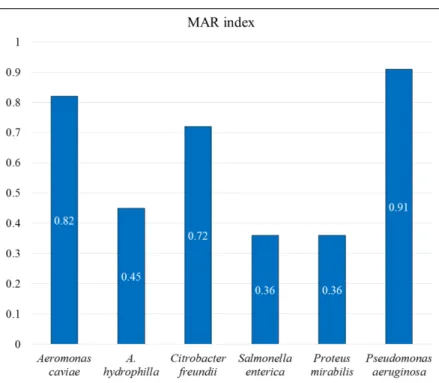
According to the MAR index calculated for each species, the highest value (0.91) was obtained for P . aeruginosa (Figure 1). P. mirabilis, and S. enterica were calculated to have the lowest MAR index (0.36). MAR index values of other bacterial species are 0.82, 0.72, and 0.45 for A. caviae, C. freundii, and A. hydrophila respectively. More importantly, all the species were detected to have MAR index higher than 0.2 which is the breakpoint to detect the high risk of infection.
MIC and MBC
MIC and MBC values of each strain were given in Table 1. MIC of LGO tested for turtle-borne bacteria ranged from 0.016 to 0.5% (V/V) among the species other than P. aeruginosa and the majority of the strains were having MIC 0.125%. P. aeruginosa was detected to be the most resistant where the MIC was >2%. In MIC test, 0.5% was observed in two strains of S. enterica while the following (0.125%) was detected in 2 S.
enterica, 3 P. mirabilis and 6 C. freundii isolates.
Interestingly, E. tarda was found to be the species bearing the least MIC (0.016%).
With respect to MBC, the values ranged from being identical or greater than MIC as shown in Table 1. In the case of E. tarda the MIC: MBC ratio was detected the highest as 1:16 and the rest did not exceed 1:4. In addition, 3 P. mirabilis, 4 A. hydrophila and 6 C. freundii showed the 1:4 ratio where 1:2 was more pronounced in A. caviae, and C. freundii . Noticeably, MIC and MBC of all S. enterica isolates remained alike.
Discussion
It has been proven that plant EOs are agents
advocating the killing or inhibiting the growth of
pathogenic bacteria with the aid of many antibacterial
properties. Besides, LGO has been reported to have good
antibacterial properties [3,7-9]. Evidently, the infection
of Gram negative bacteria is hard to treat than Gram
positives owing to their intrinsic and acquired resistance
Antimicrobial property of lemongrass oil against pet turtle-borne bacteria 87
Lab Anim Res | June, 2017 | Vol. 33, No. 2
mechanisms [22]. Since, pet turtle keeping is a growing trend but, reported to harbor many Gram negative bacteria [11-18], efficacy of EOs as antibacterial agents for turtle-borne bacteria worth examining. Moreover, to our knowledge, this is the first to study the antibacterial properties of LGO against pet-turtle borne Gram negative
bacteria.
Along with the susceptibility results, LGO successfully inhibited the growth of six species of bacteria except P . aeruginosa. As the disc diffusion and MIC outcomes revealed, P. aeruginosa was observed to have a MIC higher than 2% LGO. Similar observation was reported
Table 1. Susceptibility pattern of LGO against pet turtle-borne bacteria Bacterial
strain*
Inhibition zone
a(mm) with different LGO dilutions
badded on disc MIC % (V/V)
MBC
c% (V/V) MIC : MBC
1:1 1:2 1:5 1:10
PA1 NA NA NA NA >2 ND -
PA2 NA NA NA NA >2 ND -
PA3 NA NA NA NA >2 ND -
PA4 NA NA NA NA >2 ND -
PA5 NA NA NA NA >2 ND -
PA6 NA NA NA NA >2 ND -
CF1 12 8 NA NA 0.125 0.125 1:1
CF2 10 8 NA NA 0.063 0.25 1:4
CF3 11 8 NA NA 0.063 0.125 1:2
CF4 10 8 NA NA 0.063 0.25 1:4
CF5 10 8 NA NA 0.125 0.25 1:4
CF6 10 8 NA NA 0.125 0.25 1:2
CF7 8 7 NA NA 0.125 0.25 1:2
CF8 9 8 NA NA 0.125 0.25 1:2
CF9 9 8 NA NA 0.125 0.25 1:2
CF10 10 8 NA NA 0.063 0.125 1:2
PM1 24 20 8 NA 0.063 0.063 1:1
PM2 10 8 NA NA 0.25 0.25 1:1
PM3 18 13 9 NA 0.125 0.5 1:4
PM4 18 10 NA NA 0.125 0.5 1:4
PM5 20 18 NA NA 0.125 0.5 1:4
PM6 18 17 NA NA 0.063 0.125 1:2
SE1 11 9 NA NA 0.5 0.5 1:1
SE2 12 10 NA NA 0.063 0.063 1:1
SE3 13 11 NA NA 0.063 0.063 1:1
SE4 12 10 9 NA 0.063 0.063 1:1
SE5 12 11 NA NA 0.5 0.5 1:1
SE6 10 10 NA NA 0.031 0.031 1:1
SE7 10 9 NA NA 0.125 0.125 1:1
SE8 8 8 NA NA 0.125 0.125 1:1
AC1 18 12 7 NA 0.063 0.125 1:2
AC2 12 10 7 NA 0.063 0.125 1:2
AH1 32 24 11 8 0.031 0.125 1:4
AH2 30 22 12 9 0.063 0.063 1:1
AH3 22 20 15 10 0.031 0.031 1:1
AH4 32 24 14 8 0.031 0.125 1:4
AH5 22 16 14 10 0.031 0.031 1:1
AH6 24 20 10 8 0.031 0.125 1:4
AH7 22 20 14 10 0.031 0.125 1:4
ET1 44 30 19 12 0.016 0.25 1:16
*Strain number was given according to the species; PA=Pseudomonas aeruginosa, CF=Citrobacter freundii, PM=Proteus mirabilis, SE=Salmonella enterica, AC=Aeromonas caviae, AH=A. hydrophila, ET=Edwardsiella tarda
a
Inhibition zone; NA=No growth inhibition.
b
Concentration added on disc; 1:1=pure oil, 1:2, 1:5, 1:10 = 1 part of LGO in respective parts of the dilution.
c